




Abstract
Investigations of human papillomavirus (HPV) in the glans penis are scarce, especially with regard to its natural history. To elucidate HPV prevalence among Japanese men attending urological clinics, 798 adult participants were recruited consecutively and stratified into groups by age based on 10-year intervals. The overall HPV prevalence among the participants was 24.8%, with 15.5% positive for high-risk HPV and 9.3% infected with other HPVs. The HPV positivity rate was sustained in those over 80 years of age at nearly the same level as those in the younger age groups. We also determined the age at last sexual intercourse of 15 HPV-positive participants in the 80+ years age group. In addition, six participants positive for HPV were re-examined for HPV and all showed nearly the same HPV types as those identified in their first examinations. The difference between the age at the first test and the age of last intercourse was 8.3 ± 6.2 years. Except for the elderly group who reported sexual intercourse within the previous year, the duration was 10.0 ± 5.1 years. Our data suggest an HPV persistence of at least eight years. Further investigation is necessary to elucidate the long-term persistence of HPV infection in the glans penis.
Introduction
Human papillomavirus (HPV) is a known cause of cervical cancer in women. 1 More than 200 HPV types have been reported to date. 2 Of these, high-risk HPV types are thought to cause cervical cancer, vulvar cancer, anal cancer, etc. 1 Several reports have been published regarding cervical cancer in women. However, reports concerning HPV in the glans penis are scarce,3,4 especially with regard to the natural history of HPV infection in the glans penis. 5 In general, the half-life of HPV in the glans penis is thought to be about two years.6,7 However, HPV persistence may be longer. Capra et al. suggested that a study period of two to three years may not be long enough to accurately measure the persistence of HPV in men. 6
The present study investigated the prevalence of HPV among Japanese attendees of urological clinics who were stratified at 10-year age intervals from 20 to >80 years of age. We also investigated the 80+ years group with a focus on the persistence of HPV in the glans penis.
Patients and methods
The participants included adult men who visited our urological clinics. They were consecutively recruited in the out-patient clinic of Asoka Hospital and Nagareyama Central Hospital from September 2011 to August 2015. We recruited more than 100 participants in each age group from the 20s to 80+ years in 10-year age intervals. Prior to starting the study, written informed consent was obtained from all participants. The participants then completed the questionnaires, which included questions regarding their age, number of lifetime sex partners, age at the initiation of sexual activity, and sexual intercourse within the previous year. To focus on the persistence of HPV infection among the elderly aged 80+ years, we followed this age group and tested them twice.
This study was approved by the Ethics Committees of Asoka Hospital (approval no. 00008) and Nagareyama Central Hospital (approval no. 00001), which are located in the Tokyo Metropolitan district. We explained the study design and purpose to the candidates during their first visit to our clinics. Patients who did not accept our study protocol were excluded from this study.
The urologists at the two clinics collected rubbing samples of the glans penis. Briefly, cells were collected with a saline-wet cotton swab which was used to rub the entire surface of the glans with 10 to 12 back-and-forth movements. Cells were suspended in 2.5 mL of preservative solution. Samples were then shipped to the LSI Medience Corporation (Tokyo, Japan). The method used to detect HPV types has been described previously. 8 Briefly, 1 –mL aliquots of a preservative solution containing cell samples were centrifuged at 5000 r/min for 5 min and the supernatant was discarded. The cell pellet was washed twice with 300 μL of 10 mmol/L Tris–HCl (pH 8.0). Deoxyribonucleic acid (DNA) was extracted from the cells using a DNA extraction kit (SMI test, G & G Science Co., Fukushima, Japan) according to the manufacturer’s instructions. HPV-DNA testing and genotyping were evaluated using the GENOSEARCH-HPV 31 kit (Medical and Biological Laboratory, Nagoya, Japan). 9 This kit contains a probe for detecting β-globin in the DNA extracted from all samples, and samples without β-globin amplification were removed from the analysis. This assay can be used to identify 31 HPV genotypes, consisting of high-risk (types 16, 18, 26, 31, 33, 35, 39, 45, 51, 52, 53, 56, 58, 59, 68, 70, 73, and 82) and other types (types 6b, 11, 42, 44, 54, 55, 61, 62, 66, 71, 84, 90, and CP6108) by a combination of multiplex polymerase chain reaction and Luminex technology. 10 In this study, the high-risk HPV types were defined according to the current International Agency for Research on Cancer classification.11–13 We counted the numbers of participants positive for at least one high-risk HPV type, only other HPV types, single HPV type, and multiple HPV types.
Results
A total of 798 male participants were recruited. Their characteristics were as follows: median age (range): 57 (20–95) years; median number of lifetime sex partners (range): 5 (0 to 1500); and mean age at sex initiation (range): 20 (10–70). Some of the observed urological diseases included lower urinary tract symptoms (n = 237), urinary tract infection (n = 141), urolithiasis (n = 101), high serum prostate-specific antigen level (n = 67), balanoposthitis (n = 43), prostate cancer (n = 39), bladder cancer (n = 26), microscopic hematuria (n = 25), erectile dysfunction (n = 13), phimosis (n = 10), and condyloma acuminatum (n = 7).
The prevalence of HPV was 24.8% (198/798 cases). Of these 198 cases, the results in 124 and 74 were positive for at least one high-risk HPV type (15.5%, 124/798 cases) or had only other HPV types (9.3%, 74/798 cases), respectively (Table 1). Single HPV types were detected in 126 cases (15.8%, 126/798 cases), while multiple HPV types were detected in 72 cases (9.0%, 72/798 cases). As shown in Table 1, every age group demonstrated a 14 to 34% prevalence of any HPV. High-risk HPV was detected in about 12–20% of the participants in every age group except for those in their 70s (8.7%). Likewise, other HPV types were detected in about 8–10% of participants in every age group except for those in their 50s (15.3%). In the 80+ years group, the results in 22 of 105 cases were positive for any HPV type.
Prevalence of human papillomavirus infection according to age groups.
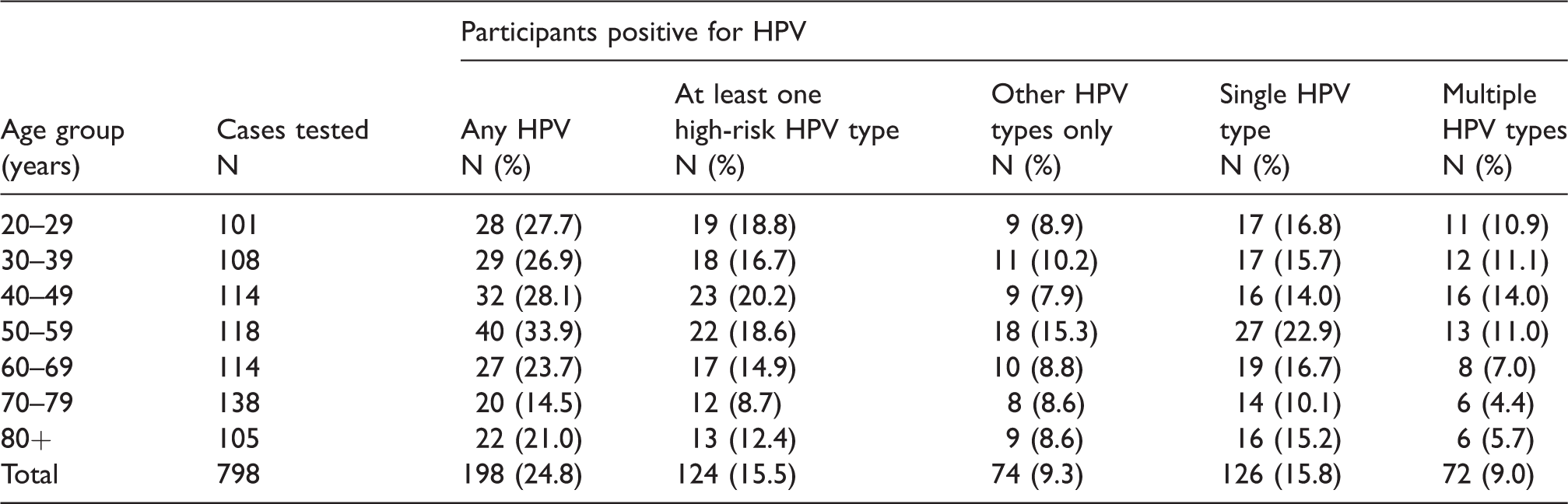
HPV: human papillomavirus.
Table 2 shows the rates of those who reported having sexual intercourse within the previous year according to age group. The rate was above 70% among those in their 20s to 50s. However, it gradually decreased with age from the 60s. Among those who were 80+ years of age, the rate decreased to 9.5%.
Sexual intercourse within the previous year.

Table 3 shows the HPV-positive cases in the 80+ years age group. Information was obtained from 15 of 22 HPV-positive cases; however, seven cases were lost to follow-up. We could not contact them again by any means, including telephone or e-mail. The mean age at first visit to our out-patient clinics was 82.6 ± 2.8 years. The mean age of final sexual intercourse was 74.4 ± 7.4 years. The difference between the tested age and the age of last sexual intercourse was 8.2 ± 6.0 years. High-risk HPV types (16, 52, and 56) were identified in five cases. Among the 15 HPV-positive cases, the clinical diagnoses included benign prostatic hyperplasia (n = 12), bladder cancer treated only with transurethral resection (n = 2), and prostate cancer (n = 1) treated with radical prostatectomy 19 years previously with no sexual ability. HPV type 52 was detected in both participants with bladder cancer. Only one participant (age 88 years) reported sexual intercourse within the previous year. Among 14 cases without current sexual intercourse, the time interval between the tested age and the age of last intercourse was 8.8 ± 5.8 years.
Pertinent data concerning human papillomavirus-positive cases in the age group of 80+ years (n = 15).
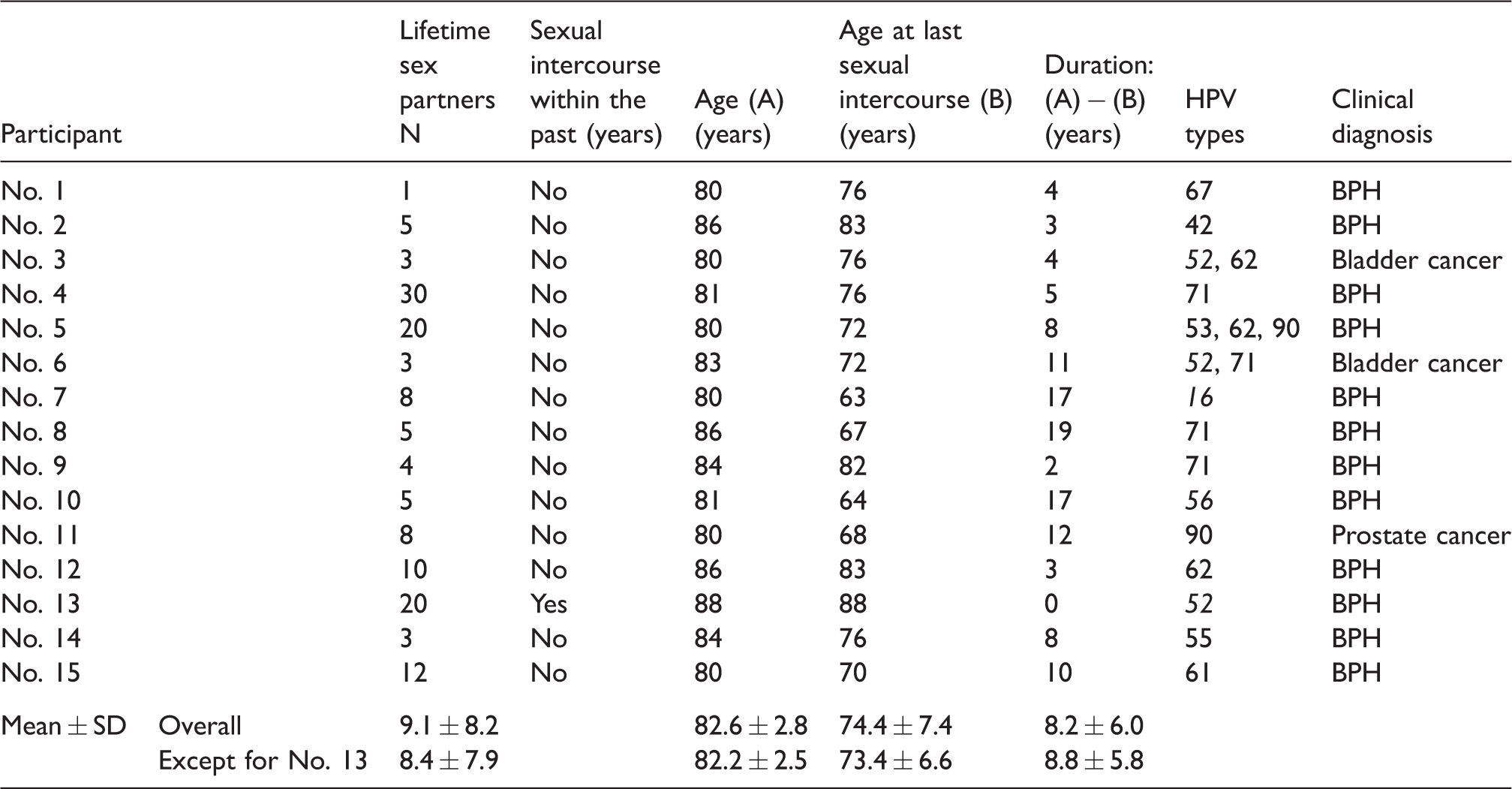
Note: Italicized human papillomavirus types are considered high risk.
HPV: human papillomavirus; BPH: benign prostatic hyperplasia.
Table 4 shows the results of re-examination of six HPV-positive cases in the 80+ years age group. All cases had nearly the same HPV types. HPV 52 was newly detected in one man (No. 15). The duration between tested age and age of last intercourse was 8.3 ± 6.2 years, while the duration between the first and second examinations was 18.5 ± 12.2 months. When participant No. 13 was excluded for being currently sexually active, the duration between tested age and age of last intercourse was 10.0 ± 5.1 years, while the duration between the first and second examinations was 20.4 ± 12.6 months.
Results of re-examination of human papillomavirus-positive cases in the 80+ years age group (n = 6).
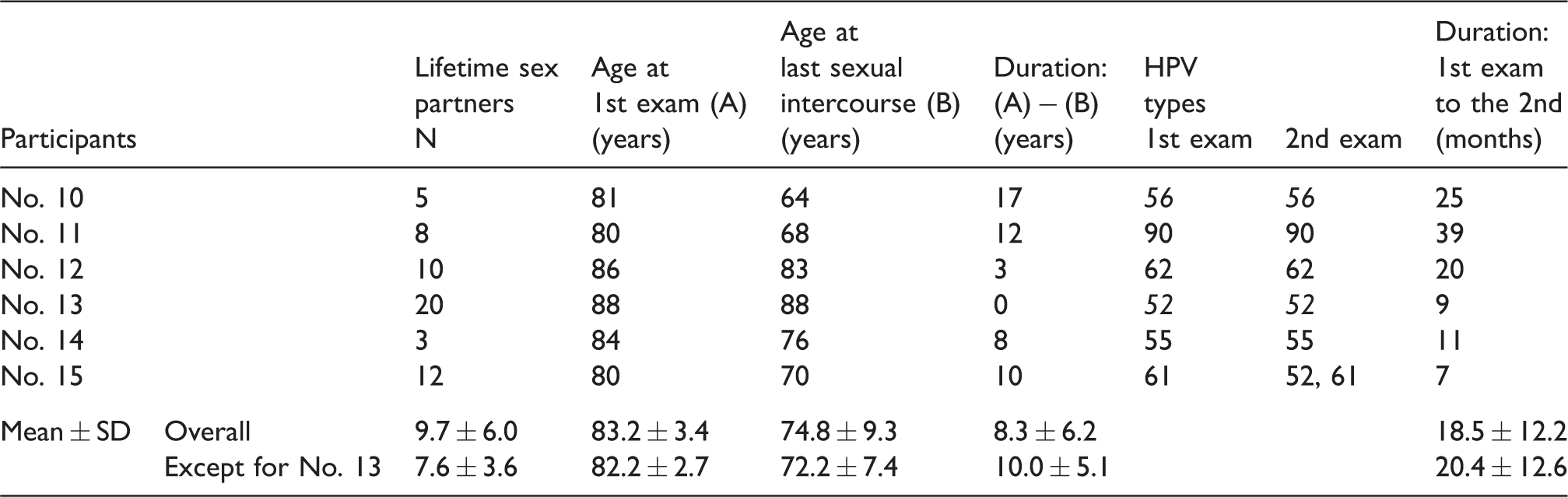
Note: Italicized human papillomavirus types are considered high risk.
exam: examination; HPV: human papillomavirus.
Discussion
HPV information among individuals aged 80+ years could not be found in the literature or is very scarce. Many reports concerning HPV in the glans penis describe men between 20 and 70 years who are sexually active.14–16 The reported prevalence of HPV in the glans penis is around 40–70%14–16 and the duration of HPV persistence is around 24 months.6,7 Giuliano et al. reported that HPV was cleared in about 75% of HPV-positive men (18 to 44 years), with a mean clearance time of 5.9 months. 14 However, there is no reference regarding HPV in individuals above 80 years of age. In the present study, the HPV prevalence (24.8%) among Japanese men was less than that among American and Mexican men.14,15 However, the positivity rates of any HPV type were similar between younger generations of Japanese and those in the 80+ years age group (21.0%). This tendency was also seen in the report by Giuliano et al. 5 although the HPV prevalence was as high as 50% among those aged 45 to 70 years compared to the 18 to 30 and 31 to 44-year groups. These data may suggest that the HPV positivity rate in every age group is sustained at about same levels throughout life. Despite the decreasing sexual intercourse rate with increasing age, a similar HPV prevalence was maintained in the 80+ years age group, similar to the other age groups. This may indirectly indicate that the long-term persistence of HPV in the glans penis is not due to the new HPV infection. Nearly no elderly in the 80+ age reported having sexual intercourse for more than eight years. This tendency is shown in Table 2, in which the gradual decrease in sexual intercourse rates falls to 9.5% in the 80+ years age group.
As shown in Table 3, the difference between the tested age and the age of last intercourse was 8.8 ± 5.8 years in 14 patients in their 80s. Moreover, in five patients who remained positive for HPV in the re-examination, the duration between the last coitus and the HPV re-examination was 10.0 ± 5.1 years. Considering the reported 9–10-year abstinence, these participants were not likely to have acquired new HPV infections because they did not have sexual intercourse during this time. We believe that they were infected with HPV during their younger years, perhaps in their 20s to 50s, although we could not demonstrate the long-term persistence of HPV in the current study, which only lasted 20.4 months. We detected HPV 52 in both participants with bladder cancer. Shigehara et al. reviewed eight case–control studies on HPV prevalence in bladder cancer and reported HPV 18 to be the most frequently detected type. 17 Because our sample size was very small in the age group of 80+ years, we cannot argue that HPV 52 is associated with bladder cancer carcinogenesis or long-term persistence. Based on the above data, we observed an HPV persistence of at least eight years. However, there may be other explanations for HPV positivity in sexually inactive elderly men. For example, unknown routes of HPV infection without penetrative sexual intercourse, some type of immunodeficiency among the elderly, or specimen contamination may be involved. We also cannot confirm the participants’ reports regarding their sexual lives.
Large-scale studies with longer follow-up periods of HPV-positive patients are necessary to elucidate the true duration of HPV persistence.
Footnotes
Acknowledgements
We would like to thank the participants and hospital staff. Additionally, we thank Dr. Kei Kawana (Professor and Chairman, Department of Obstetrics & Gynecology, Nihon University School of Medicine, Tokyo, Japan) and Dr. Masaaki Kawase (Lecturer, Department of Dermatology, Jichi Medical University Saitama Medical Center, Saitama, Japan) for their crucial suggestions for drafting the manuscript.
Declaration of conflicting interests
The authors declared no potential conflicts of interest with respect to the research, authorship, and/or publication of this article.
Funding
The authors disclosed receipt of the following financial support for the research, authorship, and/or publication of this article: This work was completely funded by the Japanese Foundation for Sexual Health Medicine in 2013 (no number was obtained for this grant).