



Abstract
Previous research has given considerable attention to venues where men who have sex with men (MSM) meet their sex partners. However, no previous study examined a vast range of sexual risk behaviors. The objective of this study was to examine the association between the types of venues for meeting sexual partners, condomless anal intercourse, engagement in group sex, and HIV and sexually transmitted infection (STI) risk among a sample of MSM. Users of a popular geosocial-networking app in Paris were provided an advertisement with text encouraging them to complete an anonymous web-based survey (n = 580), which included questions about sex-seeking venues, condomless anal intercourse, HIV status and STI history, and sociodemographic characteristics. A log-binomial model was used to assess association between venues (i.e. public venues [gay clubs, bars, and discos], cruising venues [such as gay saunas, beaches, and parks], and internet-based venues [internet chat sites and geosocial-networking apps]), condomless anal intercourse, engagement in group sex, and HIV infection as well as infection with other STIs, after adjustment for sociodemographics. In multivariable models, attending cruising venues was associated with condomless receptive anal intercourse (adjusted relative risk [aRR] = 1.47; 95% confidence interval [CI] = 1.20–1.81), any kind of condomless anal intercourse (aRR = 1.34; 95% CI = 1.14–1.58), an STI (aRR = 1.50; 95% CI = 1.09–2.05), engagement in group sex (aRR = 1.42; 95% CI = 1.27–1.59), and multiple partners for both condomless insertive (aRR = 2.00; 95% CI = 1.38–2.88), and receptive (aRR = 1.70; 95% CI = 1.23–2.36) anal intercourse, STI infection (aRR = 1.50, 95% CI = 1.09–2.05) and HIV infection (aRR = 1.76; 95% CI = 1.05–2.96). No associations were found with other venue types and sexual risk behaviors, STIs, and HIV infection, except for group sex, which was associated with all venue types. Use of cruising where the primary aim is to have sex was found to be associated with risky sexual behavior. Risky behavior reduction strategies such as preexposure prophylaxis campaigns should be targeted to MSM who frequent cruising venues.
Keywords
Introduction
In the past decade, international efforts to combat HIV have resulted in stabilization in the annual incidence of HIV infection. 1 However, certain subgroups, such as sexual minority men, remain disproportionately affected by HIV. 2 Gay, bisexual, and other men who have sex with men (MSM) continue to bear a disproportionate burden of HIV, among other STIs, in the US and Western Europe.3,4 MSM account for approximately two-thirds of total HIV diagnoses in the US, and for more than half of HIV diagnoses in Western Europe, 5 and, while the incidence of HIV is decreasing in other populations, HIV incidence among MSM continues to rise. According to a 2016 UNAIDS report, 18% of MSM are infected with HIV in France. 6 Consequently, this makes the average French MSM individual 200 times more likely to be infected with HIV when compared to the average French individual without same-sex partners.7,8 This health disparity clearly exacts a devastating toll upon MSM and speaks to the need to escalate HIV prevention efforts for this population, 9 including advancing research efforts to better understand factors mediating sexual behavior among MSM, including the environments in which sex occurs.
Emerging research has dedicated considerable attention to the environmental contexts that may predispose MSM to increased HIV risk (e.g. venues where MSM meet their sexual partners) in an attempt to explore reasons underlying increased rates of HIV among MSM.10–12 Venues exist both online (e.g. internet chat sites and geosocial applications) and offline (e.g. social and cruising venues). Specifically, cruising venues are venues where physical interaction between individuals is prohibited. Previously, research has focused on categorizing venues in aggregated such as commercial (e.g. bathhouses, sex clubs) or public (parks, beaches)13,14 and comparing the association of each with sexual risk behaviors. For example, Parsons and Halkitis 13 reported that commercial sex environments are more associated with risky sexual behaviors when compared with public sex environments. While an important contribution to the literature, this approach is limited by the fact that it considered multiple venues as a single construct, disregarding the reality that each specific venue might carry its own specific risk profile.
In addition, as technology advances and the use of online venues to meet sex partners continues to proliferate, 15 especially among MSM, 16 it is crucial to understand how online and offline venues differ, and how these different venues influence sexual health outcomes. This understanding is essential to better inform behavioral interventions to attenuate HIV transmission among MSM. This is because individuals who meet sex partners in different venues are likely to expose themselves to different risks, as each type of venue has specific norms in common that contribute to the risk profile that affect the health outcomes of its users.
To the best of our knowledge, the current study is the first in France and one of only a few in Europe that aims to advance the literature on online and offline venues by exploring the association between the types of venue used for meeting their sexual partners and sexual risk behaviors. Additionally, previous studies have not examined a range of HIV risk behaviors and outcomes. Given the high prevalence rates of HIV among MSM in France, it is critical to be aware of the environments in which MSM interact. Using an approach that offers analysis between different types of venues will provide better insights to how to be able to address the needs of MSM, specifically in France, who are most at risk of HIV and STIs. This could be done by targeting the venues that are found to be consistent in their environmental influence and risk profile on this understudied population in public health.10,14
Given the above, the objective of the current study was to examine the association between the types of venue for meeting sexual partners and condomless anal intercourse, engagement in group sex, and HIV and STI infection, among a sample of gay, bisexual, and other MSM in the Paris (France) metropolitan area. We hypothesized that cruising venues where physical contact is possible on site would be associated with higher risk of HIV infection and engagement in sexual risk behaviors given the norms these spaces may foster regarding lack of communication about HIV/STI status and condom use.17,18
Methods
Data
We employed broadcast advertisements on a popular geosocial networking application for MSM, targeting MSM individuals in the Paris (France) metropolitan area in October 2016. Users were shown an advertisement with text encouraging them to complete an anonymous web-based survey, consistent with previous research.16,19 In English the ad read: ‘Looking to improve your health, and the health of those in your community? Share your thoughts with us on gay and bisexual men’s health and have a chance to win €65! Click more to get started!’. The advertisement was placed during three consecutive 24-hour weekday periods and was presented to users upon entering for the first time during the broadcast period. Upon clicking, users were directed to a webpage to complete the survey, which included 52 items in total. As an incentive for participation, the advertisement described that users who completed the survey would be entered in a raffle to win €65, (approximately $70 US dollars at the time of survey administration).
Users were given the option to take the survey either in English or French. The vast majority (94.3%) took the survey in French. The survey took an average of 11.4 min for users to complete. At the end of the recruitment period, 5206 users had clicked on the advertisement and reached the landing page of the survey, 935 users provided informed consent and began the survey, and 580 users provided informed consent and completed the survey (62.0% completion rate and 11.1% overall completion rate). All protocols were approved by the New York University School of Medicine Institutional Review Board prior to data collection.
Venues for meeting sexual partners
Venues used by participants for meeting sexual partners were assessed with an item that read: ‘In the past three months, what types of places have you visited to meet sexual partners?’. As done in prior research, 20 four options were provided for participants to choose from: (1) gay clubs, bars, or discos; (2) gay saunas, beaches, or parks; (3) internet chat sites; and (4) smartphone apps. Participants were allowed to choose more than one option. These groups were not mutually exclusive, since multiple responses were allowed. In this study, we decided not to focus on those who chose only one venue due to the smaller sample size (n = 163) and given that we do not know the percentage of times spent in each venue (e.g. we are unable to give statistical weight to each venue according to time spent there by an individual), which may cause misclassification.
Moreover, we conceptualized gay clubs, bars, and discos as public venues; gay saunas, beaches, and parks as cruising venues; internet chat sites and geosocial-networking apps as internet-based venues.
Condomless anal intercourse
Participants indicated the total number of partners with whom they had had condomless insertive anal intercourse and condomless receptive anal intercourse in the preceding three months. These count variables were transformed into categorical variables with two categories (0 partners and 1 or more partners). The study separately assessed condomless insertive anal intercourse, condomless receptive anal intercourse, and any condomless anal intercourse including condomless insertive anal intercourse or condomless receptive anal intercourse.
Engagement in group sex
We assessed engagement in group sex events with the question: ‘Have you ever had group sex (sex with three or more people during a single sexual encounter)?’. Response options were: ‘Yes, in the last three months’; ‘Yes, but not in the last three months’; and ‘No.’. For analyses, we retained the original three-level variable as well as dichotomized it to be ‘Yes’ (indicating any group sex) and ‘No’ (indicating no group sex).
HIV and other sexually transmitted infections (STIs)
Participants were asked to self-report their HIV status with one item reading ‘What is your HIV status?’ with three response options (negative, positive, and unknown). HIV status was recoded into a dichotomous variable (negative and positive). ‘Unknown’ responses (12.4%) were recoded as ‘Missing’. Additionally, participants were asked: ‘In the past year, have you been diagnosed with any of the following?’. Participants were asked to select from a list of six common STIs, i.e. gonorrhea, Chlamydia, syphilis, herpes simplex virus, human papillomavirus, and hepatitis C virus. A composite variable was created to indicate any recent STI diagnosis (yes, no).
Sociodemographic variables
Participants were asked to report their age in years (categorized into five groups: 18–24, 25–29, 30–39, 40–49, 50 years and older), sexual orientation (gay, bisexual, straight, other), whether or not they had been born in France (yes, no), employment status (employed, unemployed, student, retired), and current relationship status (single, relationship with a man, relationship with a woman).
Statistical analysis
The study participants’ characteristics, sexual risk behaviors (including condomless anal intercourse, and engagement in group sex), and HIV/STI status according to type of place visited to meet sexual partners were analyzed descriptively (frequencies and percentages). In the multivariable analyses, we used a log-binomial regression model to assess the association between venue types and condomless anal intercourse, engagement in group sex, and HIV/STI status, adjusting for sociodemographic variables. When convergence issues were encountered, a modified Poisson regression model was applied, as proposed by Zou. 21 The results are presented as adjusted relative risks (aRRs) with 95% confidence intervals (CIs). All statistical analyses were carried out using Stata version 14.0 (Stata Corp., College Station, TX, USA). All tests were two sided, with a level of significance set at 0.05.
Results
The mean age of the 580 study participants was 35.2 years (standard deviation = 9.9 years), 84.0% of them reported being gay, and 19.5% reported that they were not born in France. Of the participants, 49.8% reported that they had engaged in either condomless receptive or insertive anal intercourse in the past three months and 65.2% reported that they had engaged in group sex. Moreover, 10.0% of participants identified themselves as HIV positive and 22.2% had had an STI in the previous year (Table 1).
Sociodemographic characteristics, venues, and HIV/STI risk.
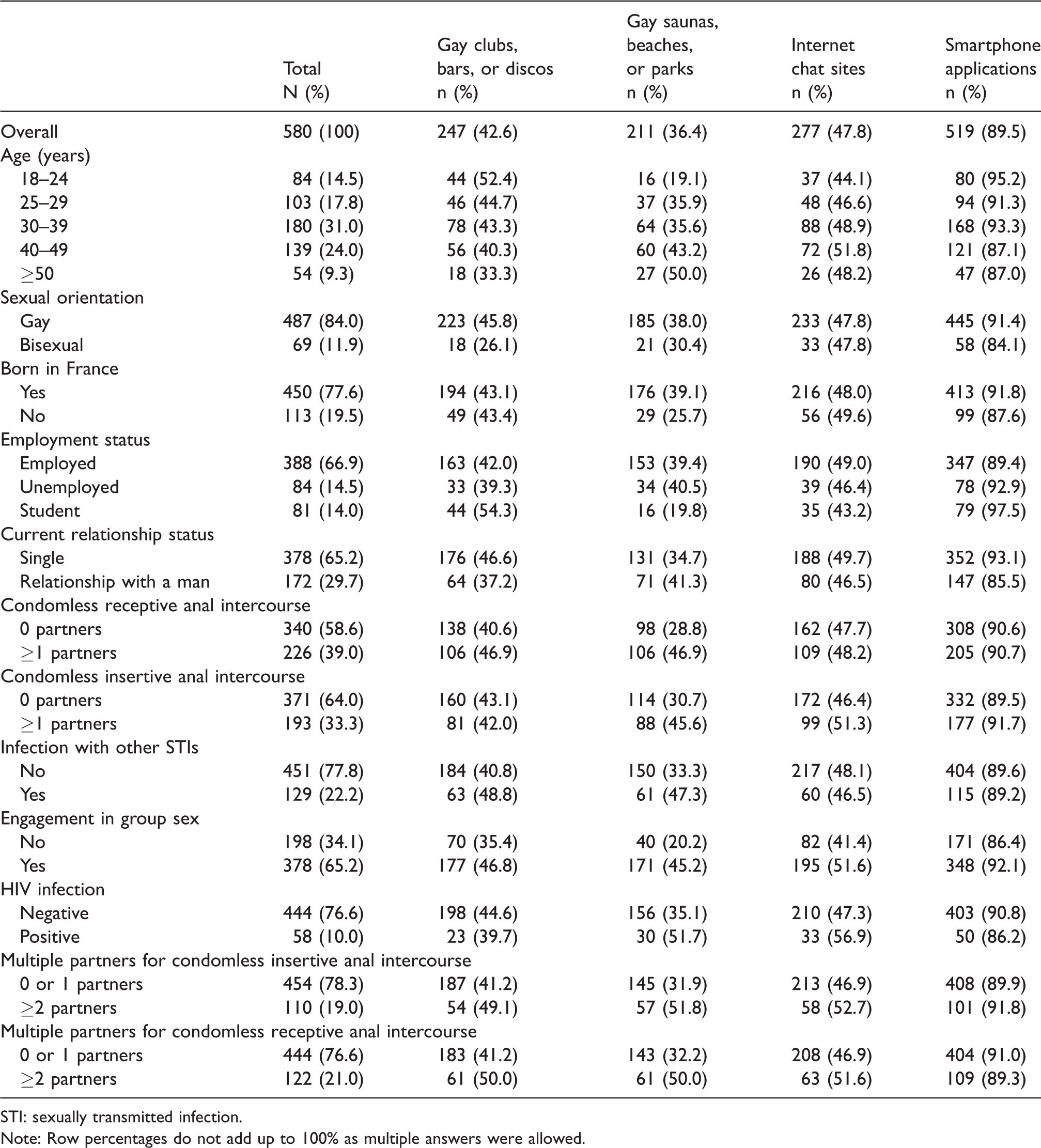
STI: sexually transmitted infection.
Note: Row percentages do not add up to 100% as multiple answers were allowed.
In the last three months, 247 (42.6%) of 580 MSM reported that they had met sexual partners at gay clubs, bars, or discos. Almost half of them (47.8%) had visited internet chat sites, and the majority (89.5%) reported that they had used smartphone applications to meet sexual partners. Among those who reported having ever had an STI(s) in the past year, 47.3% reported that they met sexual partners at gay saunas, beaches, or parks and 48.8% identified gay clubs, bars, or disco. Among HIV-positive men, 86.2 and 56.9% reported that they met sexual partners using smartphone applications and internet chat sites, respectively.
The results of multivariable analyses are presented in Table 2, which shows that those individuals who visited gay saunas, beaches, or parks to meet sexual partners were more likely to have condomless receptive anal intercourse (aRR = 1.47; 95% CI = 1.20–1.81), any kind of condomless anal intercourse (aRR = 1.34; 95% CI = 1.14–1.58), a recent STI (aRR = 1.50; 95% CI = 1.09–2.05), to have engaged in group sex (aRR = 1.42; 95% CI = 1.27–1.59), to have multiple partners for condomless insertive anal intercourse (aRR = 2.00; 95% CI = 1.38–2.88), and to have multiple partners for condomless receptive anal intercourse (aRR = 1.70; 95% CI = 1.23–2.36), to have an STI(s) in last year (aRR = 1.50; 95% CI = 1.09–2.05), and to be HIV seropositive (aRR = 1.76; 95% CI = 1.05–2.96), compared to men who did not visit gay saunas, beached, or parks. By contrast, gay clubs, bars, or discos were significantly associated with only engagement in group sex (aRR = 1.17; 95% CI = 1.04–1.32) and multiple partners for condomless insertive anal intercourse (aRR = 1.46; 95% CI = 1.02–2.09). Additionally, both internet chat sites and smartphone applications were significantly associated with engagement in group sex only (aRR = 1.16; 95% CI = 1.03–1.31) and (aRR = 1.47; 95% CI = 1.10–1.96), respectively.
Multivariate association (aRRs) between specific online and offline venues for meeting sex partners, condomless anal intercourse, and STIs.

aRR: adjusted risk ratio; CI: confidence interval; CIAI: condomless insertive anal intercourse; STI: sexually transmitted infection.
aModified Poisson regression model.
*p < 0.05; **p < 0.01.
Discussion
The objective of the current study was to examine the association between different venues for meeting sexual partners and risky sexual activity, HIV risk, and STIs among a sample of MSM. This study categorized venues according to the type of major interaction occurring in each venue. Venues included public venues (gay clubs, bars, discos), cruising venues (gay saunas, beaches, and parks), and internet-based venues (internet-based platforms such as online chatting sites and smartphone applications). Among our sample, approximately 36.4% reported to have met a sex partner in cruising venues (e.g. gay saunas, beaches, and parks) in the past three months. In concert with findings of prior research conducted in Europe and elsewhere, 20 MSM who visited cruising venues were significantly more likely to engage in sexual risk behaviors, be infected with STIs and be HIV positive. Cruising venues comprise an environment that fosters sexual risk behaviors. It is also important to note that noncruising venues were also associated with some sexual health outcomes. For instance, all venues (public venues, cruising venues, and internet-based venues) were associated with engagement in group sex. Additionally, public venues were associated with multiple partners for condomless insertive anal intercourse.
Cruising venues are environments in which there is a decreased expectation for verbal or direct communication about HIV/STI status or condom use given the casual and anonymous nature of the sexual encounters that often occur in these spaces. This, in turn, leads to a decreased perception of responsibility for protecting sexual partners from infection and engaging in safer sex. 18 In a study conducted among MSM in Asia, Wei et al. 17 demonstrated that MSM who attended cruising venues were less likely to disclose their HIV status in comparison with those who do not attend such venues, and that nondisclosure was associated with having multiple partners, further contributing to increases in risk for HIV infection among cruising venue attendees. The environment of cruising venues can facilitate different norms in communication compared to other spaces, where minimal communication is accepted in cruising venues, with the expectation of little to no private information being disclosed by partners. Such an environment is also likely to encourage individuals who prefer to engage in casual or anonymous condomless sex to frequent these venues and expect no responsibility of discussing testing behaviors or serostatus, contributing to their risk of acquiring HIV and other STIs (if uninfected) or transmitted HIV or other STIs (if infected). 10 This thereby establishes cruising venues as an attractive venue for high-risk sexual behavior in that individuals are more likely to engage in high-risk sexual behaviors if other people at the venue are also engaging in high-risk sexual behaviors. 22 On the contrary, partners who arrange an encounter over a more communication-friendly space (e.g. internet chat sites) are more likely to disclose their HIV status,23,24 suggesting that these spaces may foster conversation regarding HIV status.
The findings of this study can inform interventions for mitigating HIV risk behavior among MSM. For example, HIV risk reduction strategies, such as preexposure prophylaxis (PrEP) campaigns and safer sex awareness campaigns, can be focused in offline venues, mainly in different cruising venues. Having such campaigns in these venues could help promote a more informed environment in which communication is encouraged between sex partners, changing the culture present in cruising venues. Additionally, effective measures should be taken to ensure the availability of safer sex promoting resources (e.g. condoms and lubrication) in these venues. In addition, the promotion of PrEP to individuals who frequent these spaces may make existing sex practices safer by providing risk reduction tools other than condoms. Indeed, cruising venues should be considered an optimal setting to reach high-risk MSM for HIV research and targeted prevention interventions. 20 Future research should continue to study venues from a behavioral perspective, where venues are categorized according to behaviors allowed by the environment. Additionally, future research should focus on estimating prevalence of HIV and STIs across different venues. One particular marker that could be utilized in such research is viral load across venues. Overall, these data will provide more insights about the pathway(s) in which specific venues affect an individual’s behaviors and promote higher risk sexual activities.
Limitations
The current study has noteworthy limitations. First, the sample was recruited via a geosocial-networking smartphone application. Despite this being a novel and effective method of recruiting, selection bias can be a concern with this method. Specifically, volunteer bias is likely as participating in the survey depended solely on participants responsiveness to an advertisement presented to them; individuals who accepted to volunteer in participating may have differed systematically to the general population. For instance, participants may have perceived themselves at elevated risk for HIV infection and therefore been more interested in completing the survey advertised. In addition, given the nature of our sample recruitment, our study may not be generalizable to populations of MSM who do not use this smartphone application. Furthermore, all data were self-reported, which could have introduced social desirability bias, reporting bias, or recall bias. 25 Same-source bias is an additional issue with the data collection procedure, given that both the exposure and the outcome were self-reported. Moreover, the cross-sectional nature of the study does not give any insights on the directionality of the association; thus, reverse causation could be present, e.g. those at higher risk of HIV may be more likely to attend cruising venues regardless of effects of the sexual environment on HIV risk behavior.
Conclusions
In this study, we found that cruising venues (i.e. gay saunas, beaches, and parks) were associated with engagement in condomless receptive anal intercourse, any condomless anal intercourse, engagement in group sex, and engagement in condomless anal intercourse with multiple partners as well as infection with STIs and HIV-positive serostatus. Results from this study suggest that HIV risk reduction strategies such as PrEP campaigns should be targeted to MSM who frequent gay saunas, beaches, and parks.
Footnotes
Acknowledgments
We thank the translators and participants of this study who contributed to the project. We thank Noah Kreski and Jace Morganstein for assisting in the development, translation, and management of the survey used in the current study.
Declaration of conflicting interests
The authors declared no potential conflicts of interest with respect to the research, authorship, and/or publication of this article.
Funding
The authors disclosed receipt of the following financial support for the research, authorship, and/or publication of this article: This work was supported by Dr Dustin Duncan’s New York University School of Medicine Start-Up Research Fund.