



Abstract
We report the case of a 29-year-old man with human immunodeficiency virus infection and irregular adherence to antiretroviral therapy who initially presented with pulmonary symptoms and subsequently developed spinal cord compromise symptoms. After many different diagnostic tests, invasive aspergillosis with pleuroparenchymal involvement and vertebral osteomyelitis by Aspergillus spp. was diagnosed. The patient was treated with amphotericin B deoxycholate without improvement and a fatal outcome ensued. Differential diagnoses of vertebral osteomyelitis in immunosuppressed patients should be taken into account for early detection and prompt treatment.
Introduction
Aspergillus spp. are saprophytic fungi whose main habitat is soil and plants.1,2 This type of fungus, when inhaled, can produce different forms of disease in some patients who have underlying lung damage; however, immunocompromised patients are severely affected. 2 Aspergillosis is an opportunistic infection that primarily affects the respiratory tract and can spread hematogenously. 3 Certain conditions such as severe neutropenia, glucocorticoid treatment, transplants and human immunodeficiency virus (HIV) infection can predispose to invasive infection. 4 The prevalence of aspergillosis and invasive aspergillosis in patients living with HIV is 0.43% and from 0.02% to 0.13%, respectively.5,6 Among invasive forms, Aspergillus osteomyelitis has been described as a diagnostic challenge due to its rarity and high mortality. 7
We report a case of an HIV-infected patient with low adherence to antiretroviral therapy (ART) who presented with Aspergillus spp. vertebral osteomyelitis.
Case presentation
A 29-year-old man with a history of HIV infection and irregular ART (started treatment for four years and then abandoned for three years) was evaluated in a local clinic due to right hemithorax pain, cough and weight loss. The patient was diagnosed with pulmonary tuberculosis with negative bacilioscopy and treatment was started because of the high suspicion based on the patient symptoms, epidemiology and immunodeficiency state. Four months later, a CD4 lymphocyte count and an HIV viral load revealed 120 cells/mm3 and 40 copies/ml, respectively. The patient was admitted to the hospital due to increased pain, cough and weight loss.
A thorax computed tomography scan was performed and revealed a right-sided cavitated apical-posterior consolidation with air-fluid level. Based on the suspicion of a pulmonary abscess, treatment with ceftriaxone 1 g every 12 h and clindamycin 600 mg every 8 h was started. During hospitalization, fiberoptic bronchoscopy with histology of the biopsy and bronchial aspirate was performed to confirm the diagnosis. The results showed pulmonary aspergillosis and fibrino-leukocytic material. For that reason, treatment with oral itraconazole 200 mg was started every 12 h and the antibiotic regimen was modified to ciprofloxacin 400 mg IV every 12 h plus oral trimethoprim/sulfamethoxazole 160/800 mg every 12 h.
On the 85th day of his hospitalization, the patient presented paresthesias with decreased muscle strength in the lower limbs, fever, and urinary and fecal incontinence. Because of spinal cord compromise symptoms, spine magnetic resonance imaging was performed. The images revealed T4, T5 and T6 vertebral lesions with stenosis of the vertebral canal. Medullary and right foraminal compression was found with involvement of the adjacent ribs (Figure 1). Finally, perivertebral soft tissue biopsy confirmed the presence of necrotic tissue with Aspergillus spp. and Ziehl–Neelsen-negative macrophages were found with micro-abscesses (Figure 2). Based on the results, the diagnosis of invasive aspergillosis with pleuroparenchymal involvement and vertebral osteomyelitis by Aspergillus spp. was established. Subsequently, the patient began treatment with amphotericin B deoxycholate but died after two days.
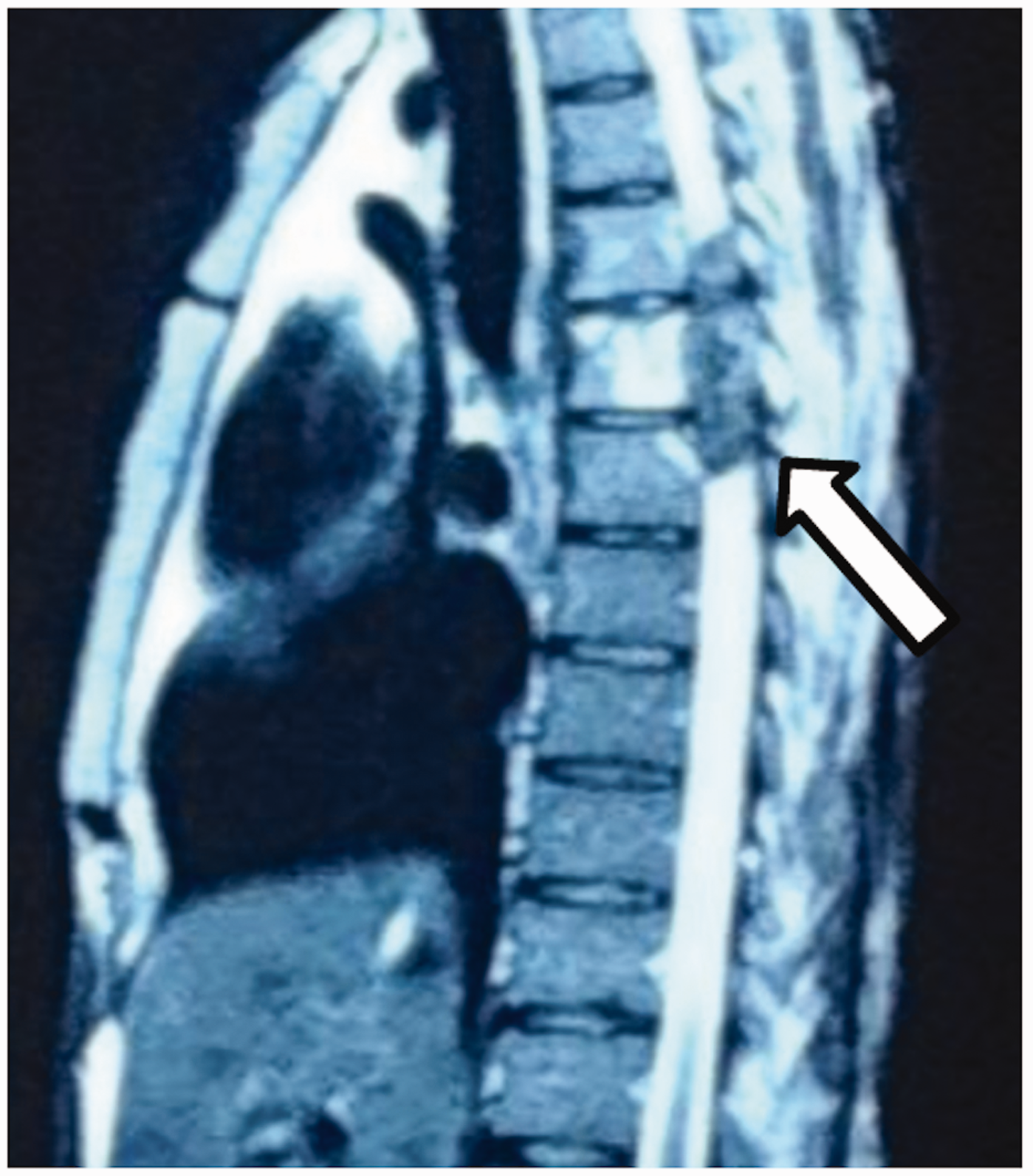
MRI of dorsal column: T4, T5 and T6 vertebral lesions associated with stenosis of the vertebral canal, medullary and right foraminal compression.

Necrotic tissue with the presence of Aspergillus spp. H&E stain.
Discussion
Invasive aspergillosis occurs in patients with immunocompromised conditions by hematogenous spread and direct implantation to the central nervous and cardiovascular system.8,9 Bone involvement is rare, with vertebral bodies being the most frequent site. 10 In this case, the patient presented severe immunosuppression which allowed Aspergillus invasion and dissemination. Pain and tenderness, neurological deficits such as paresthesias and decreased muscle strength are the most frequent manifestations. In cases of spinal cord compression, urinary and fecal incontinence occurs. 8
The differential diagnosis includes tuberculosis, Staphylococcal osteomyelitis and brucellosis. 11 Signs and symptoms not related to each other associated with nonspecific laboratory findings led this case to have a fatal outcome due to the late diagnosis and management. The treatment of Aspergillus osteomyelitis consists of the debridement of necrotic bone and antifungals such as voriconazole, posaconazole, itraconazole or amphotericin B.9,12,13 Surgical intervention is indicated in those patients with complications due to vertebral involvement. 7 In this case, initial treatment with oral itraconazole was indicated. Despite this treatment, invasive pulmonary aspergillosis was not controlled. Later, the diagnosis of vertebral aspergillosis was made and treatment with amphotericin B deoxycholate was started without improvement.
Conclusions
In conclusion, differential diagnoses of vertebral osteomyelitis in immunosuppressed patients should be taken into account to enable early treatment. In this case, we demonstrate the challenges of making a final diagnosis and appropriate management due to the variety of symptoms, rarity of the disease and absence of non-invasive diagnostic methods. For this reason, it is important to have adequate protocols for the management of invasive opportunistic infections.
Footnotes
Authors’ contribution
All authors identified the case and arranged it in chronological order. They wrote, revised the case report, read and approved the final version.
Consent
Unfortunately, the patient in this case died after receiving treatment and had no family around him. We tried to contact his family to ask for a written informed consent for patient information and images to be published but could not find any family or relatives.
Declaration of conflicting interests
The authors declared no potential conflicts of interest with respect to the research, authorship, and/or publication of this article.
Funding
The authors received no financial support for the research, authorship, and/or publication of this article.