




Abstract
We report the frequency of sexually transmitted infections (STIs) diagnosed in UK adult film industry performers. A total of 100 adult film performers regularly screened for STIs on an average of every three weeks. High rates of condomless sex were reported and there were STIs recorded during the 19-year period covered by this study (1996–2015). STIs recorded included gonorrhoea, chlamydia, non-gonococcal urethritis, genital warts, syphilis and Trichomonas vaginalis.
Keywords
Background
Some UK Adult Film Industry (AFI) employers recommend performers to have regular sexually transmitted infection (STI) screening, prior to filming, and require a ‘negative’ test/certificate. 1 Adult film performers (AFPs) who have screening may regard testing as a harm reduction strategy; screening does not necessarily prevent STIs but may serve as an early warning system in relation to specific infections, e.g. human immunodeficiency virus (HIV), syphilis, gonorrhoea and chlamydia. Research in USA and UK on AFPs report that sexual intercourse is condomless 80%–90% of the time,2–7 and the prevalence of STI is between 8% and 35%.
Aim
The aim of this study was to ascertain the frequency of AFPs’ STI testing in the UK, in relation to infection diagnoses and sequalae.
Methods
Two audits were undertaken, by a sole master’s degree researcher, of 100 self-identified AFPs’ case notes at an inner London, England, specialist sexual health service for sex workers. The audits covered the periods 2014–2015 (Audit 1) and 1996–2015 (Audit 2).
In Audit 1, information was gathered on sexual orientation, sexual practices, frequency of attendance at clinic and prevalence of condomless sex in a single year. This selected time period in Audit 1 gave an up-to-date and detailed representation of consultations with genitourinary (GU) physicians and nurses, in response to AFI recommendations.
Audit 2 was the first in the UK to assess the prevalence of STIs among AFPs attending this clinic over a substantial period of time, 1996 to 2015.
Results
Selected results from Audit 1 show that between 2014 and 2015, 38% (n = 38) of AFPs attended testing every three weeks, whereas two AFPs choose weekly testing. There was a high occurrence of condomless sex acts by AFPs: 85% (n = 530) compared to 15% (n= 94) intercourse with condom (Table 1). The percentage of condomless sex in the female AFPs’ professional work decreased slightly when compared to their personal lives (81% compared with 85%), whereas in male AFPs, the percentage decreased from 84% in personal life to 91% in professional practice. Females were diverse in sex activities for work, including 16% (n = 8) performing oro-anal sex (‘rimming’), 24% (n = 12) mutual masturbation or ‘fingering’ and 38% (n = 19) having receiving anal intercourse (Table 1). Twenty-one female AFPs worked in other areas of sex work: 17 as escorts, 2 in escorting/webcamming and 2 worked at sex parties/swingers’ clubs. Two males worked as escorts.
Demographics and sexual practices among the 100 AFPs 2014 to 2015.

AFP: adult film performer.
In Audit 2, 171 new diagnoses of STIs were recorded from 1996 to 2015 (genital warts (n = 31), gonorrhoea (n = 40), non-gonococcal urethritis (n = 41) chlamydia (n = 35), Trichomonas vaginalis (n = 1) and syphilis (n = 1)) (Table 2). There were no cases of HIV, hepatitis B or hepatitis C. Males were more likely to have an STI than females: 98 compared to 73. Hepatitis vaccination uptake showed 34 of the patients commenced hepatitis A and 77 commenced hepatitis B vaccination.
Sexual infections in 100 AFPs audit by gender and sexuality (1996 to 2015).
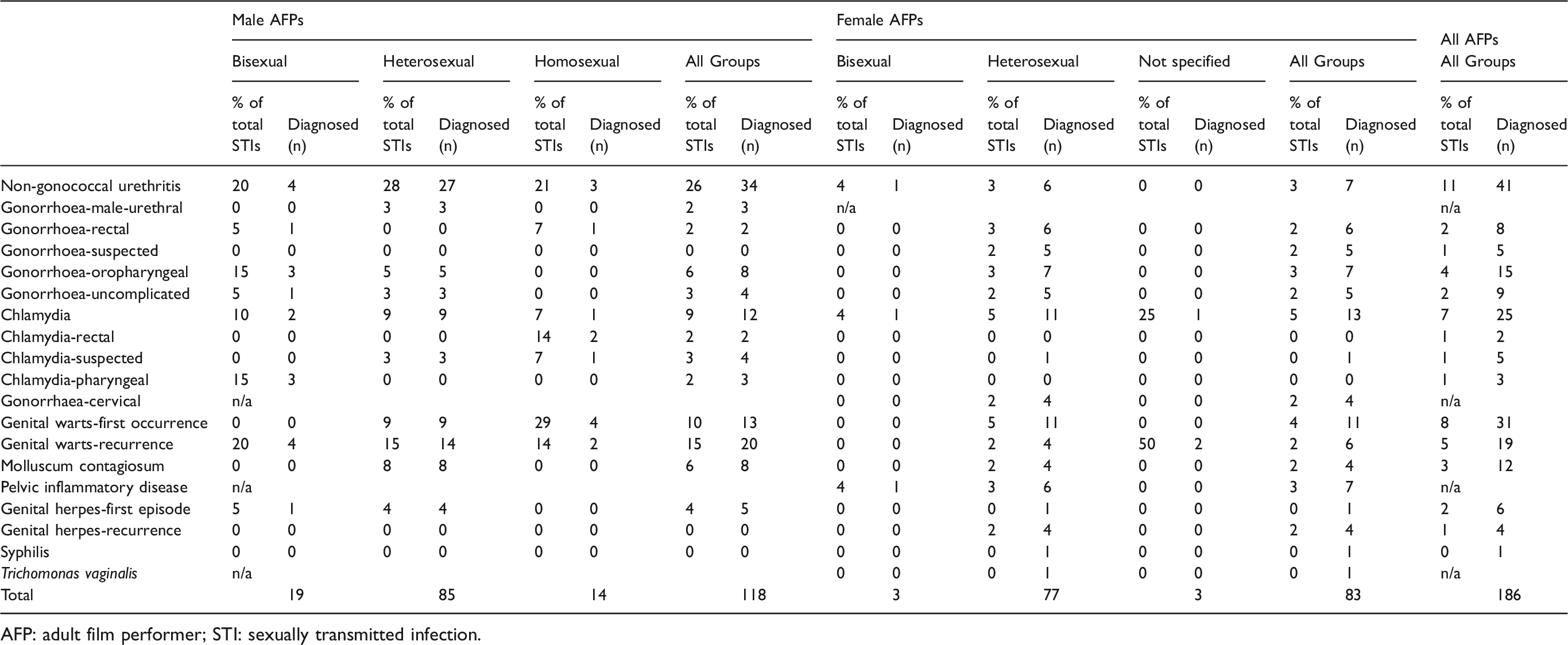
AFP: adult film performer; STI: sexually transmitted infection.
Discussion
UK AFPs demonstrate a preference for testing every 28 days (a self-determined AFI UK standard); 8 however, US researchers recommended testing every 7–14 days in order to minimise STIs. 7 , 9 The US Free Speech Coalition responded to this shorter timeframe and introduced the Performer Availability Screening Services ‘Moratorium’ which recommends terminating filming if HIV is detected. 10 No similar system exists in the UK and it is questionable how effective this policy is at preventing STIs/HIV, as no robust evidence exists. Our study highlighted females do not exclusively work in one genre of sex work, and further research utilising tools aimed at HIV prevention (condom use, TasP, PEP, PrEP and U = U [Undetectable=Untransmittable]) may be fruitful in the future.
The study was conducted retrospectively and was limited due to reliance on presumed accurate documentation. An under-estimation of the prevalence of STIs in this cohort is possible, as online testing and treatment of STIs are now readily available, and/or the cohort could attend other National Health Service/private clinics.
An unexpected finding identified gonorrhoea in five self-identified heterosexual men’s pharynges. This may support recommendations for three-site anatomical testing for gonorrhoea and chlamydia to reduce a possible reservoir of missed infections. 4
To conclude, a challenging interplay exists between performers, healthcare providers and film producers in attaining and improving sexual health among these sex workers. To address any deficits in optimum service provision, there is a need to develop specific UK national guidance for clinicians, including improved collaboration with established AFI organisations such as United Kingdom Adult Producers (UKAP) and ‘PORN4PREP’. It will also be important to undertake a proper review of the industry’s occupational safety mechanisms for performers and to question AFPs’ personal risk reduction strategies.
Footnotes
Declaration of conflicting interests
The authors declared no potential conflicts of interest with respect to the research, authorship, and/or publication of this article.
Funding
The authors disclosed receipt of the following financial support for the research, authorship, and/or publication of this article: This research was supported by Imperial College Healthcare NHS Trust towards Masters of Art Degree in Professional Studies and Social Care (Sexual Health).