



Abstract
We report a case of Mycoplasma genitalium-positive non-gonococcal urethritis who failed to respond to multiple different courses of antibiotics including azithromycin, minocycline, moxifloxacin and spectinomycin. Extracted M. genitalium DNA from urethral swabs obtained from the patient harbored mutations of 23S rRNA, parC and gyrA. Microbiological cure was eventually achieved by a 14-day course of doxycycline.
Introduction
Mycoplasma genitalium is a common cause of non-gonococcal urethritis (NGU) in men. Treatment of NGU with macrolides or quinolones is usually prescribed to cover M. genitalium, but treatment failure has increased in recent years. 1 Mutations of the 23S rRNA gene have been identified in assocaition with macrolide resistance. 2 Similarly, mutations in the quinolone resistance determining region (QRDR) of the topoisomerase IV gene parC, and possibly DNA gyrase gene gyrA, are associated with quinolone resistance. 1 , 3
Here we report a case of treatment-resistant, M. genitalium-positive NGU.
Case report
A 48-year-old man was referred to our clinic with a two-month history of persistent urethral irritation and urethral discharge. He reported condomless vaginal sex with a casual female partner one month prior to the onset of symptoms. He tested positive for Chlamydia trachomatis during previous visits to a different local dermato-venereology clinic and was given a seven-day course of azithromycin and a seven-day course of minocycline. He reported mild improvement of urethral irritation after the treatment, but the symptoms never fully resolved, and the urethral discharge remained even though the C. trachomatis test became negative after treatment.
Examination of the genital area revealed redness of the penile meatus, and his underwear was contaminated with a small amount of discharge. First void urine sample was negative for C. trachomatis and Neisseria gonorrhoeae using the cobas 4800 chlamydia/NG Amplification/Detection Assay (Roche Molecular Systems Inc, New Jersey, USA). Blood samples were negative for Treponema pallidum particle agglutination (TPPA, Fuji Rebio Inc, Japan) and HIV antibody (Wantai Biological Pharmacy, Beijing, China). However, a urethral swab was positive for M. genitalium using an in-house PCR targeting the mgpB gene.
During the following ten months, the patient was treated with multiple antibiotics (Table 1). In summary: antofloxacin (a fluoroquinolone antibiotic produced in China) 200 mg once a day for seven days, followed by azithromycin 500 mg once a day for seven days; moxifloxacin 400 mg once a day for seven days, followed by minocycline 100 mg twice a day for 14 days; antofloxacin 200 mg once a day plus rifampin 450 mg once a day for 21 days; azithromycin 500 mg once a day for 21 days. He reported improvement in symptoms after azithromycin treatment, but the symptoms and urethral discharge never completely resolved, and he repeatedly tested positive for M. genitalium three weeks after each course of treatment.
Clinical course of a man with NGU infected with M. genitalium that failed to response to multiple antibiotics in Guangzhou, China.
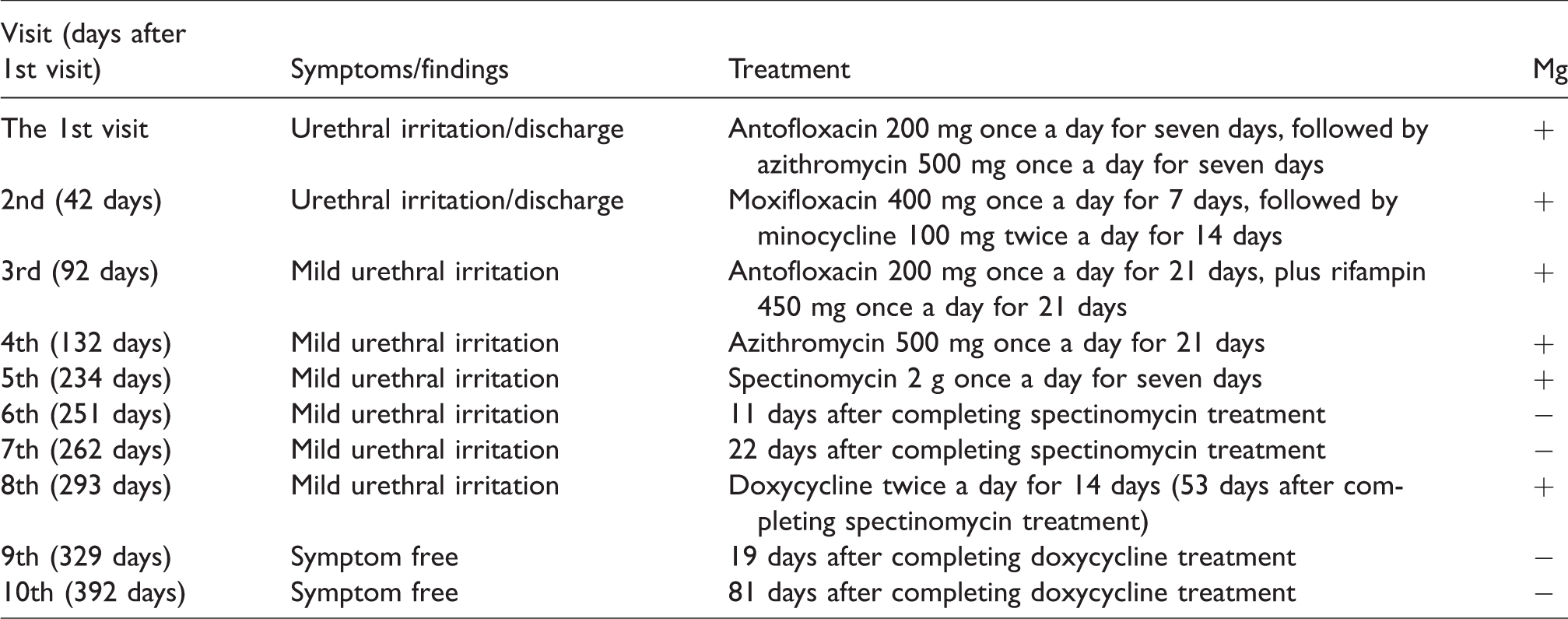
The patient was then given intramuscular spectinomycin 2 g once a day for seven days. His symptoms improved significantly, with only occasional urethral irritation, and his PCR tests for M. genitalium became negative on days 11 and 22 but he tested positive again on day 52 after the treatment. The patient was then given doxycycline 100 mg twice a day for 14 days. His symptoms almost resolved except for occasional urethral irritation. His PCR tests for M. genitalium were negative on days 19, 81 and 116 after doxycycline treatment. During the more than ten months of treatment, he occasionally had protected vaginal sex with his wife. Cervical swabs from his wife were negative for C. trachomatis, N. gonorrhoeae and M. genitalium.
Detection of mutations in the 23S rRNA, parC, gyrA and gyrB
A urethral swab sample prior to his spectinomycin treatment was taken, and DNA extracted from the urethral swab was examined for drug resistance-associated mutations. Primers used for detecting the mutations were described in other studies,2–5 e.g. Macrolide resistance of M. genitalium strains was tested by partial amplification of the 23S rRNA gene region with primers Mg23S-1992F: 5′-CCATCTCTTGACTGTCTCGGCT AT-3′, and Mg23S-2138R: 5′-CCTACCTATTCTCTA CATGGTGGTGTT-3′. For detection of mutations associated with fluoroquinolone resistance, partial amplification of gyrA, gyrB and parC with primers MG-GYRA F: 5′-CCTGATGCTAGAGATGGACTT AAA-3′, MG-GYRA R: 5′-AAGTTCTGCTGCAAGT TTAGATAAT-3′, MG-GYRB F:5′-TTGTACAACCA GAGATCCTTCG-3′, MG-GYRB R: 5′-GTGGGGG TTGAGCAATAAAA-3′. MG-PARC F:TGGGCTT AAAACCCACCACT, MG-PARC R:CGGGTTTCT GTGTAACGCAT genes was carried out. All sequencing results were compared with the sequence of reference strain G37 from the gene bank. In this case, the M. genitalium had the A2072G mutation in 23S rRNA (A2059G in E. Coli numbering system), Ser83IIe mutation in parC, and Gly93Cys mutation in gyrA. No mutations were found in the gyrB.
Ethical statement
Ethical approval for this report was obtained from the Science Research Ethical Committee of the Dermatology Hospital of Southern Medical University (GDDHLS-20171203). The patient gave written informed consent for all tests and the publication of this report.
Discussion
Macrolide failure in treating M. genitalium infection had been reported in China, 6 but failure to respond to both macrolides and quinolones has not been reported previously. To our knowledge, this is the first reported case from China of M. genitalium harboring mutations in 23S rRNA, parC and gyrA in a patient who failed to respond to multiple courses of antibiotics. Macrolides and fluoroquinolones treatment failures to M. genitalium have been reported in Europe, 2 Australia 7 and Japan; 8 this case will fill a blank part of the M. genitalium drug resistance map of the world.
Azithromycin is the first-line antibiotic for the treatment of M. genitalium infection, as recommended in Europe. 9 In this case, even though the microbiological cure was not achieved with azithromycin, the patient’s symptoms did improve. It is not clear whether improved symptoms are associated with reduced bacterial load. Furthermore, since the pre-treatment specimens were not be able to sequenced, it is not known whether the subsequent 23S rRNA mutations were induced by azithromycin treatment. 2 Moxifloxacin is the second-line treatment for M. genitalium infection and is generally very effective in curing M. genitalium, but mutations which caused the acquisition of an amino acid changes in parC have been found to increase levels of fluoroquinolone resistance. 5 In this case, Ser83IIe mutation in parC, and Gly93Cys mutation in gyrA were detected. Ser83–>Ile in ParC reduces quinolone binding to topoisomerase IV, but gyrA mutations have not yet been correlated with moxifloxacin resistance. 1 , 10 Antofloxacin is reported to have similar efficacy to levofloxacin, which has a poor cure rate for M. genitalium. In this case, the use of antofloxacin before moxifloxacin could conceivably be responsible for the development of quinolone resistance, and subsequent failure of moxifloxacin treatment; thus whether the mutations in parC and gyrA were antofloxacin induced could not be completely ruled out.
Spectinomycin, an aminocyclitol aminoglycoside, only used as an alternative treatment for N. gonorrhoeae, was previously reported as a successful cure for a patient with M. genitalium infection. 11 In this case, microbiological cure with spectinomycin treatment was achieved on day 11 and maintained for three weeks, but M. genitalium became positive again two months later after completing spectinomycin treatment. The negative results on days 11 and 22 might have resulted from sampling too early, 12 and the reappearance of a positive result after two months suggested treatment failure, even though we could not completely exclude the possibility of re-infection. The patient reported that he only occasionally had protected vaginal sex with his wife who had tested negative for M. genitalium. Doxycycline has a low cure rate for M. genitalium infection and is listed as the third-line therapy for persistent M. genitalium infection after azithromycin and moxifloxacin. 9 We did not prescribe doxycycline after his failure to azithromycin and moxifloxacin because, at the second visit, he failed to response to minocycline, another tetracycline-class antibiotic. We speculated the eventual success of doxycycline, and failure of minocycline at the beginning might relate to change in the M. genitalium load, 13 as improved symptoms were observed after multiple antibiotics treatment indicating a lower M. genitalium load in the urethra before commencing the doxycycline therapy.
M. genitalium is the second most common cause of NGU after C. trachomatis. In China, however, M. genitalium is not routinely tested for due to a lack of awareness and limited availability of commercial testing kits. Thus, the percentage of cases of NGU attributable to M. genitalium in China is unknown. This report may only reveal the tip of the iceberg; more research is needed to understand the extent of the epidemic and drug resistance patterns of M. genitalium in China.
Footnotes
Declaration of conflicting interests
The authors declared no potential conflicts of interest with respect to the research, authorship, and/or publication of this article.
Funding
The authors disclosed receipt of the following financial support for the research, authorship and/or publication of this article: This work was supported by the Bureau of Science and Information Technology of Guangzhou Municipality (no. 201704020219).
