



Abstract
All pregnant women in the United Kingdom are offered and encouraged to take up screening for human immunodeficiency virus (HIV), hepatitis B and syphilis, with excellent uptake rates and engagement in care resulting in very few infants being infected with HIV in the United Kingdom. However, in that small number of women who decline testing, there remains an opportunity to offer further support to test and engage them and their baby in care, even if this happens in labour or immediately after birth. In addition, these women may be at increased risk of HIV. Our hospital is in an extremely high prevalence area for HIV, and most untested individuals are of childbearing age. We embarked on a quality improvement project to engage all women delivering at our unit in HIV testing or to test their babies via cord blood at birth. We sought to do this in a constructive and inclusive way, led by the HIV specialist midwife with the support of the HIV antenatal and the hospital senior management teams. Following an initial evaluation, the approach was modified and an innovative approach together with a trusted advocate was used to engage a particularly hard-to-reach group. We have achieved 100% uptake of HIV testing and made two HIV diagnoses that would not otherwise have been made; both in women who reported themselves not to be at risk and both engaged in care and delivered HIV-negative infants.
Setting the context for this quality improvement project
The UK Infectious Diseases in Pregnancy Screening Programme (IDPS) recommends ‘systematic population screening in pregnancy for HIV , hepatitis B and syphilis’. 1 The screening programme reaches a 99.6% uptake across the United Kingdom. 2 However the 0.4% of those not screened are believed to be at higher risk of HIV. 3 By detecting maternal HIV, antenatal and perinatal interventions can reduce vertical transmission to 0.28% 4 from 15–30%. 5
The 2006–2013 national audit of perinatal HIV identified the main reasons for transmission were psycho-social issues, declined HIV testing and seroconversion during pregnancy. Of those children with undiagnosed mothers, this was due to declining testing in 42%. Eight children born to undiagnosed mothers died and of these, six were less than 6 months old. 6 There is an opportunity immediately after birth to test babies whose mothers declined HIV testing to allow reduction in the risk of HIV transmission with post-exposure prophylaxis (PEP) and exclusive formula feeding. This will also allow close follow-up and early diagnosis of babies who acquire HIV infection. 5
Manchester is deemed an extremely high prevalence area with rates of over 6 per 1000. 7 The number of new diagnoses is highest in both men and women during childbearing age. In 2017, it was noted that 38% of the annual new diagnoses were diagnosed late and 9% of the population remains undiagnosed. 7
St Mary’s Hospital (Oxford Road site) in Manchester (SMH) is a busy tertiary referral centre with an established HIV service for HIV-positive pregnant women and their babies. Uptake of HIV testing is very high, and outcomes for those who accept testing are excellent. However, we were concerned for the health of women who decline screening and the potential missed opportunity to prevent transmission to their babies. The HIV antenatal multidisciplinary team (MDT), with the support of the senior leadership team at SMH, commenced a quality improvement project to attempt to address this risk and we adopted the Plan, Do, Study, Act (PDSA) approach, completing two PDSA cycles to achieve our objective.
Developing the quality improvement plan
The objective of this work was to ensure that babies born at SMH receive all possible interventions to prevent mother-to-child transmission of HIV.
We were mindful of taking an effective, fair and non-discriminatory approach that is supportive for all. As an extremely high prevalence area for HIV, we sought to determine the HIV status of all pregnant mothers, and we developed a new policy for the babies of women who decline HIV testing in pregnancy. This policy recommends HIV testing of babies born to mothers declining HIV testing in pregnancy as soon as possible after birth, ideally by point of care testing (POCT) of cord blood and seeking to do this with maternal consent. We decided on a uniform not a risk-assessed approach which has been described previously 8 as this may miss women and their infants in our patient population.
The policy was approved for use within SMH and implemented from 1.7.2018. To evaluate the impact of this new approach, we collected detailed information prospectively on women declining the initial HIV screening offer, their reasons for doing so and how this was managed.
Initial implementation of this new approach
Mothers who had declined HIV screening from 1.7.2018 to 1.4.2019 were included in the initial evaluation. They were excluded if they had left the country, had a spontaneous termination of pregnancy or their care was transferred to another trust.
HIV screening coverage at SMH during this time period was 99.7%, well above the rates deemed acceptable and achievable.
9
The total number of mothers declining HIV testing at first offer, those excluded, the reasons for declining and subsequent testing status are illustrated in Figures 1 and 2. Reasons for declining HIV testing during the early implementation of the policy. Test results for those who initially decline HIV testing during the early implementation of the policy.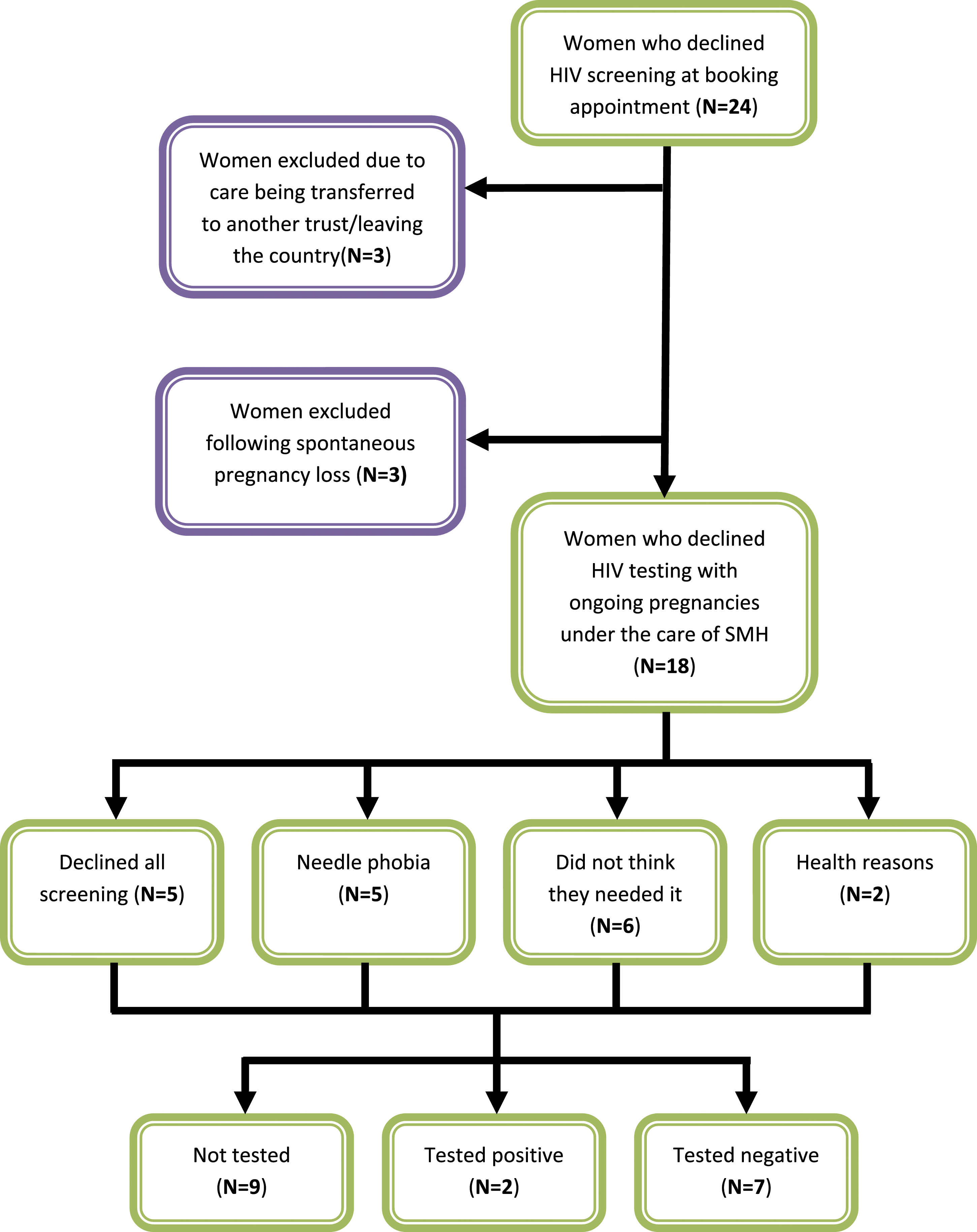

All women were called by the HIV specialist midwife to discuss HIV testing and were all offered a consultation with a member of the HIV antenatal team. The most frequently cited reason for declining, in 6 of the 18 mothers, was a perception they did not need HIV testing – yet two of these (11%) subsequently tested HIV positive. Both accepted HIV treatment for themselves, notification of their families and partners, all interventions to prevent mother-to-child transmission and both have had children that are HIV negative. Both women were of black African ethnicity, one was previously diagnosed with HIV in another country.
Of the five who declined all antenatal screening, four were from the orthodox Jewish communities in Manchester. None of these accepted a subsequent offer of testing either for themselves antenatally or of their baby at birth.
Learning from the initial implementation of the new policy and making improvements
The UK Infectious Diseases in Pregnancy Screening Programme (IDPS) recommends that women who initially decline HIV testing in pregnancy receive a second offer from the screening programme prior to any further action being considered locally. In the initial policy, women declining screening were offered an appointment with a member of the HIV antenatal team. Following this consultation, half of those agreed to HIV testing and two tested positive (11%). However, half continued to decline testing and we noted that this included all the women who declined all antenatal screening tests and are from the local orthodox Jewish community.
We modified our approach to women who continue to decline HIV testing after two offers from the screening programme. We introduced an approach of writing to explain our policy and offer support to take an HIV test themselves during pregnancy or for us to arrange cord blood testing of their baby when they are born. If women do not respond to this one further approach is made followed by a plan for a re-offer in labour or cord blood testing at birth. The specialist midwife within the team leads this process and if additional concerns such as safeguarding are raised, they are addressed appropriately and a patient-centred approach is always taken. In addition to this, a consultant obstetrician in the HIV MDT together with a doula from the Jewish community produced a letter from them both for women to encourage engagement with antenatal screening. This describes the benefits of HIV testing for the women and their babies and offers further support, which was then sent to all women from that community as their second offer of screening.
Evaluating improvements to the policy and our approach
These adjustments to policy implementation were put in place from 1.4.2019 to present. We noted that in the next 12 months, of the 22 women who initially declined HIV testing antenatally, all subsequently accepted this. Women frequently chose to test with their community midwives so additional trips to hospital to see the HIV antenatal team were not needed. The bespoke approach building on a constructive professional relationship with a trusted member of the local Jewish community has been successful in engaging this harder-to-reach group in HIV testing. As far as we are aware, this is a novel approach to constructively engage all pregnant women in HIV testing, even those who decline on more than one occasion.
Summary
Our aim with this quality improvement project was to ensure that babies born at SMH receive all possible interventions to prevent mother-to-child transmission of HIV. We used the well-established PDSA approach to do this, achieving our objective within two PDSA cycles. We took a pragmatic approach that is supportive and inclusive as we have an extremely high HIV prevalence in our local population, and we modified our approach and policy based on early evaluation of the changes we have made. We have developed an innovative approach for a specific hard-to-reach population for blood-borne virus screening together with a trusted advocate, which could be extrapolated in other regions to other groups proving hard to engage. Women at highest risk are actually those who report they are not at risk and do not require testing; it is in this group that we made the HIV diagnoses that would otherwise have been missed, engaging our patients successfully in HIV care to the benefit of their health and preventing transmission to their babies as well as allowing testing of their wider families.
Footnotes
Declaration of conflicting interests
The author(s) declared no potential conflicts of interest with respect to the research, authorship, and/or publication of this article.
Funding
The author(s) received no financial support for the research, authorship, and/or publication of this article.
