




Abstract

Most publicly funded sexual health clinics in high income settings operate both pre-booked and walk-in options for face:face appointments.1–4 Post COVID pandemic, we have little intelligence on whether patients accessing sexual health clinics prefer pre-booked or walk-in appointments. 1 Brighton has a large population of young people, MSM (men who have sex with men) and gender diverse people and is served by a single sexual health clinic with approximately 35,000 attendances per year (417 pre-booked appointments and 265 walk-in appointments per week). We aimed to explore patient appointment preferences to optimise future services.
As part of a service evaluation project, an electronic survey was sent to patients via text following a face: face attendance in July-August 2022. Data were collected on demographics and whether they preferred pre-booked or walk-in face:face appointments. Fisher’s exact test was used to explore any associations in demographics and appointment preference. This project was approved by our local clinical governance committee.
Sexual health appointment preference (N = 278).
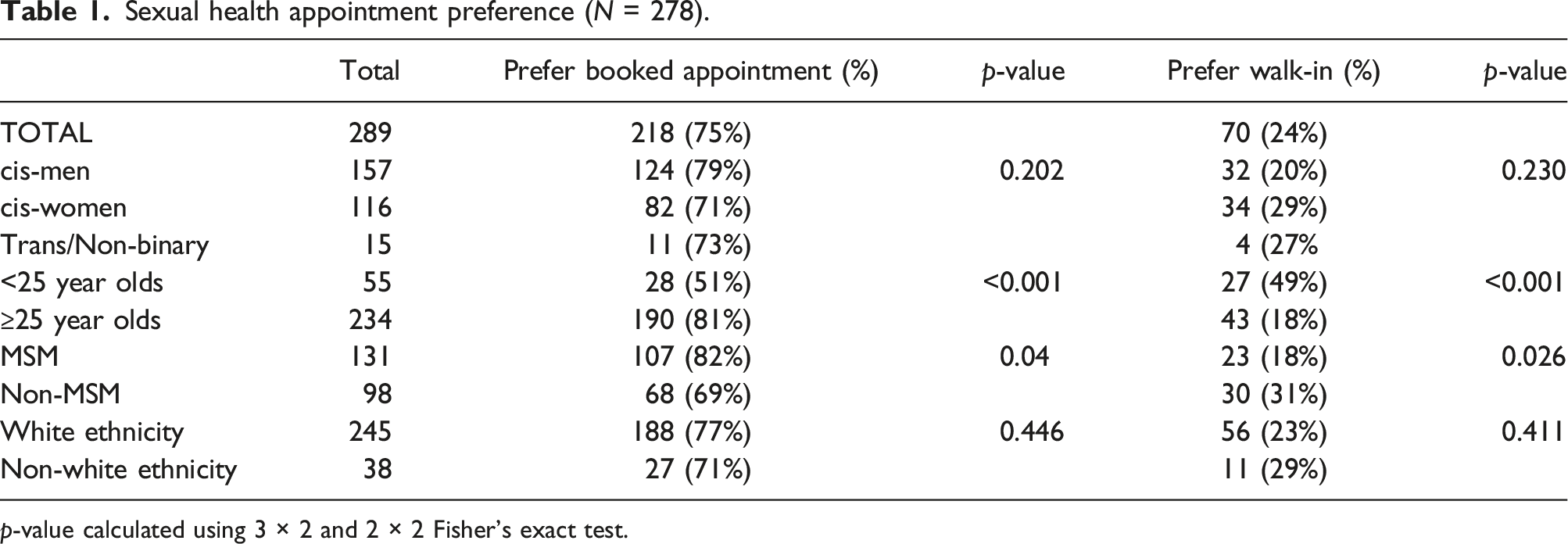
p-value calculated using 3 × 2 and 2 × 2 Fisher’s exact test.
We have shown that most respondents prefer pre-booked appointments; however there exist significant differences by age and sexuality, with a higher proportion of ≥25-year-olds; and MSM preferring pre-booked appointments. Importantly, young people (<25 years) have mixed preferences appointment type. Previous research suggest that the majority of sexual health attendees prefer pre-booked appointments; however the preference for walk-in clinics increases as the wait for an appointment increases. 2 There are nuances around sexual heath appointment preferences; patients’ value the specialist knowledge of the staff in sexual health clinics and the availability of comprehensive testing over appointment types. 3 Furthermore, under 25s use pre-booked clinics less frequently than older people; and people of African and Caribbean origin are less likely to use pre-booked appointments. 5
There are several limitations to our study including; being a single centre study that only captured people who recently attended a face:face appointment with a relatively low response rate (15%). We were unable to explore if there were any differences in demographics between those who responded and those who didn’t and we were unable to ascertain what type of appointment they had attended.
No one type of sexual health appointment suits everyone, and given the importance of attracting key populations to services, (e.g. MSM (men who have sex with men) and young people), it is vital that services offer a variety of appointment types to increase access. Locally we have increased the proportion of pre-booked appointments for MSM (with online booking), and increased the proportion of walk-in appointments for <25-year-olds.
Footnotes
Acknowledgements
We would like to acknowledge the sexual health team at University Hospitals Sussex NHS foundation trust (Brighton) sexual health and contraception service.
Author contributions
DR, RC, CF designed this study. RC performed the data collection. AST and DR performed the data analysis. AST, RC, CF, DW DR all contributed to the final manuscript.
Declaration of conflicting interests
The author(s) declared no potential conflicts of interest with respect to the research, authorship, and/or publication of this article.
Funding
The author(s) received no financial support for the research, authorship, and/or publication of this article.
Ethical approval
This service evaluation was approved by our local clinical governance committee on 26th May 2022.
Data availability
All the data from this work is in the manuscript.
