



Abstract
Background
Motor neuron disease (MND) is a well-known group of neurodegenerative diseases, with amyotrophic lateral sclerosis (ALS) being the most common form. Since 1985, a possible association between MND/ALS and HIV infection has been described.
Methods
We performed a systematic review of case reports and case series involving people living with HIV with MND/ALS through PubMed, Bireme, Embase, and Lilacs databases. The risk of bias was assessed using the Joanna Briggs Institute (JBI) Critical Appraisal Tool for Case Reports.
Results
We analyzed 36 articles presenting 88 cases. The mean age was 41.6 years. Antiretroviral therapy (ART) was used by 89.8% and riluzole by 16.9%. First signs and symptoms were similarly present on cervical/upper (25%) and lumbosacral/lower limbs (23.9%), mostly with fasciculations (69.8%) and hyperreflexia (58.8%). MND had a progressive course in 32.9% patients and a clinical improve in 54.6% following ART. The mean survival of the 32 patients who died was 12.3 months and the mean survival of the living patients was 62 months. Respiratory failure was the main cause of death (35.7%).
Conclusions
MND/ALS may present differently in the people living with HIV as a rapidly progressive disease in younger people but with the potential to improve weakness and survival through antiretroviral therapy.
Take-home points
• Motor neuron disease in HIV-seropositive patients presents differently than in HIV-seronegative ones. • Patients with motor neuron diseases should be tested for HIV infection. • Adequate neurological assessment should be performed for people living with HIV regarding motor neuron diseases such as amyotrophic lateral sclerosis (ALS) and ALS-like syndromes. • Antiretroviral therapy should be considered an important tool to improve neuromuscular symptoms in people living with HIV with motor neuron disease.
Introduction
Motor neuron disease (MND) is a group of neurodegenerative diseases characterized by progressive and irreversible damage to upper, lower, or both upper and lower motor neurons. Amyotrophic lateral sclerosis (ALS) is the most common form of MND. The average age of onset is between 51 and 66 years, and the disease affects men and women in a ratio of 2:1. 1 The average time between the onset of symptoms and death or invasive mechanical ventilation is 24 to 50 months. 1
The clinical course of ALS involves both upper motor neuron signs, such as spasticity and hyperreflexia, and lower motor neuron signs, such as fasciculations, weakness, and muscle wasting. 2 One-third of patients present with bulbar onset of the disease, with progressive dysarthria, dysphagia, and often with emotional lability. 2 Patients can also present with cognitive and behavioral impairment. Respiratory insufficiency is the cause of death in 77% of patients. 3 There are some criteria for diagnosing ALS, like El Escorial and Airlie House. 2
As there is no cure for ALS, symptomatic and supportive treatment is essential for disease management. Thus, healthcare centers usually have a multidisciplinary team that includes neurologists, psychologists, nurses, physical educators, and other professionals, depending on each patient’s needs. 4
The causes of ALS have not yet been completely elucidated. However, many genetic mutations have been described in ALS. Furthermore, environmental factors such as smoking, toxins, viruses, and epigenetic factors may have a role in ALS development. 5
Since the 1960s, a possible causal relationship between MND and viral infection has been speculated. The polio virus, HTLV, and HIV have been proposed to cause ALS. 5 From 1985, case reports of HIV-positive ALS patients began to appear in the literature. 6 Additionally, HIV infection has been noted in other forms of motor neuron disease.
In the general population, the incidence of ALS is 0.6–3.8 per 100,000 persons-year, and the prevalence is 4.1–8.4 per 100,000 people. 1 A study of 1700 patients living with HIV followed through 13 years found six patients presenting neurological symptoms compatible with an ALS-like disorder, suggesting a higher incidence. 7 This indicates that the prevalence of ALS is higher in people living with HIV. Although it was calculated through a small population, the prevalence of ALS-like disorder seems to be higher in people living with HIV.
In coexistence with HIV infection, ALS tends to occur in younger patients, progresses rapidly, and may have some degree of improvement after starting antiretroviral therapy (ART). 5 Despite the prevalence of HIV worldwide, with around 39 million people living with the virus, the literature has been adding little knowledge over the decades about the severity and treatment of associated MND when compared to the general population. 8
Due to differences in the epidemiology and clinical course of different MNDs in people who are HIV-positive and people who are HIV-negative, there is a need to enhance current knowledge regarding the relationship between HIV and MND/ALS-like disorders. Thus, we performed a systematic review of case reports and case series of people living with HIV with MND in the literature. This article aims to elucidate these patients’ characteristics, clinical manifestations, and management. Furthermore, we also sought to evaluate the influence of ART on neurological deficits.
Materials and methods
Search strategy and inclusion criteria
This systematic review, registered in the International Prospective Register of Systematic Reviews (PROSPERO) under protocol CRD42023475980, adhered to rigorous search methodology. Employing guidelines outlined by the Preferred Reporting Items for Systematic Reviews and Meta-Analyses (PRISMA), comprehensive literature searches were conducted to identify relevant articles. 9
On November 01, 2022, international online databases including PubMed, Bireme, EMBASE, and Lilacs were systematically queried using the following search strategy, in full: (“HIV”) AND (“Motor Neuron Disease” OR “MND” OR “Amyotrophic Lateral Sclerosis” OR “ALS”). Additionally, it should be acknowledged that the search strategy remained consistent across all databases utilized in this study, and both conference-published material and papers published in peer-reviewed journals were considered for inclusion. Thus, inclusion criteria encompassed reports published in English, Portuguese, or Spanish and meeting the following conditions: (a) being a case report or case series describing cases of MND patients with HIV infection; (b) availability in English, Portuguese, or Spanish languages; (c) high quality of evidence, related to the arrangement of information between articles.
As exclusion criteria, case reports, and case series were exclusively chosen over case-control or cohort studies to focus on detailed accounts of individual or small groups of Motor Neuron Disease (MND) patients with HIV infection. While case-control or cohort studies could offer higher evidence levels, they were omitted to emphasize nuanced clinical observations and rare manifestations specific to this population. This approach aims to provide a comprehensive understanding of the disease presentation in people living with HIV, guiding potential diagnostic and therapeutic strategies within this context.
Outcomes of interest
Given that our primary aim is to assess the progression of MND in people living with HIV, we will analyze characteristics such as age at diagnosis, clinical course of the disease, and response to MND after the introduction of ART.
Screening and data extraction
Using Rayyan software, authors deduplicated extracted articles. 10 Then, two researchers evaluated the titles and abstracts independently based on the previously mentioned eligibility criteria. In cases of doubt or disagreement, a third researcher assessed the work to make the final decision. After defining the included articles, the whole text evaluation stage began to decide whether it was eligible. Articles that were not case reports or case series, those written in other languages than English, Spanish, and Portuguese, and articles in which the full text was not available were excluded.
The same two authors also did data extraction. The data extracted were (a) author and year of study, (b) patient’s age, (c) patient’s sex, (d) interval between HIV and ALS diagnosis’, (e) first symptom, (f) location of the first symptom, (g) presence or absence of opportunistic infections, (h) presence or absence of fasciculations, (i) presence or absence of hyperreflexia, (j) presence or absence of respiratory signs, (k) use or not of ART, (l) CD4, (m) HIV viral load, (n) use or not of riluzol, (o) survival and cause of death.
Risk of bias assessment
The quality of the included studies was assessed using the Joanna Briggs Institute (JBI) Critical Appraisal Tool for case reports. 11 Two researchers independently evaluated the quality of each study, and any divergences were resolved through discussion with a third researcher. The JBI tool includes specific criteria for assessing the methodological quality of case reports and case series.
Results
The search identified 1763 articles after removing duplicates between databases. After applying our inclusion criteria, we identified 36 articles presenting 88 cases included in the review. Figure 1 presents our selection process for studies included in this review. Table 1 presents detailed information about all the cases. PRISMA 2020 flow diagram for new systematic reviews which included searches of databases and registers only. Motor neuron disease in patients with HIV infection: summary of case reports and series of cases. ART: antiretroviral therapy; NR: not reported; LMN: lower motor neuron; UMN: upper motor neuron; CMV: cytomegalovirus.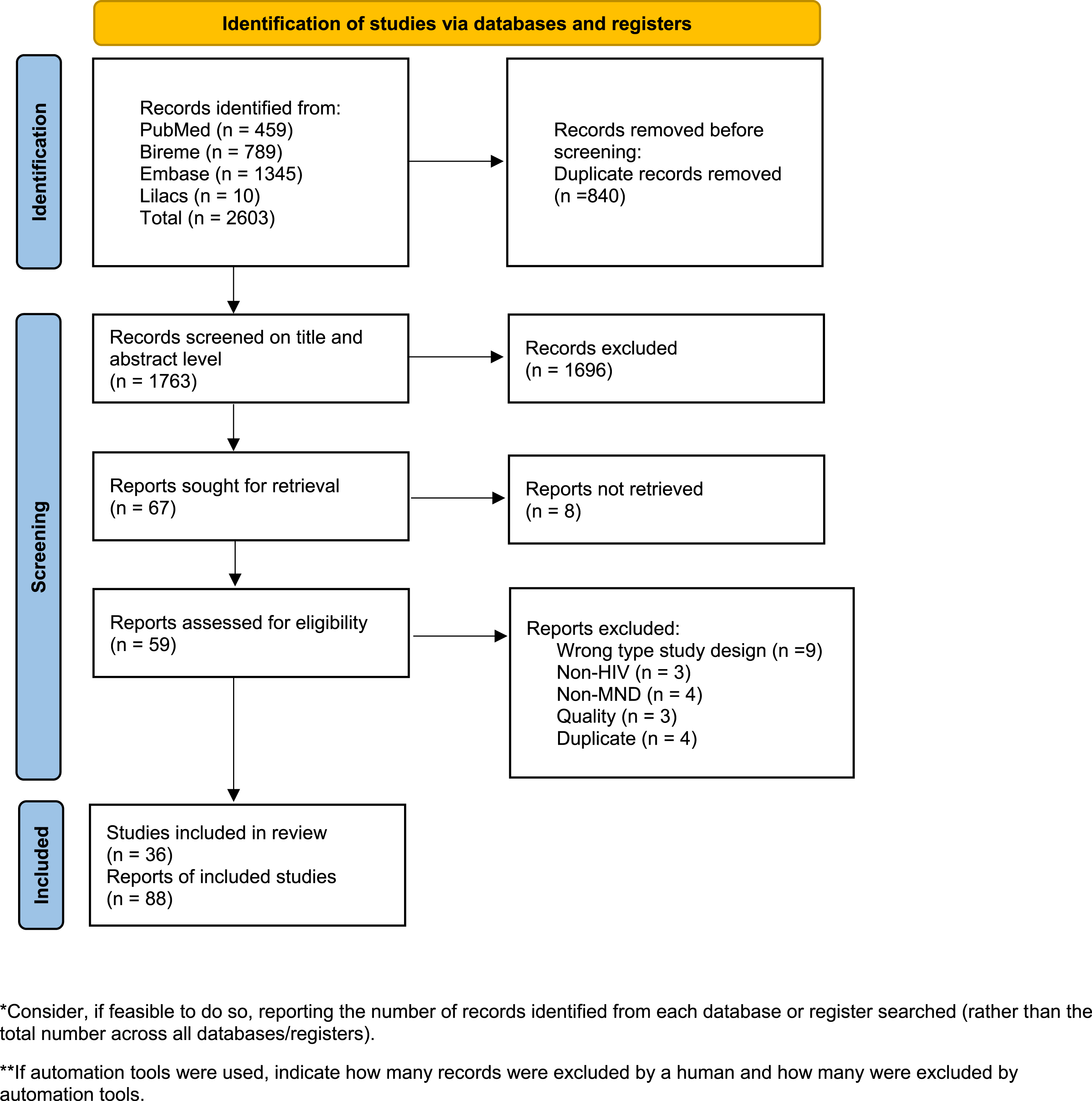

Among 88 patients recruited in this review (mean age 41.6 years), male predominance was identified in 86.8% (64/88). MND/ALS-like syndrome was the first clinical manifestation related to HIV infection in 19.3% (17/88). In contrast, 75% (66/88) of HIV tests had already been positive before MND. CD4 count and viral load were used as parameters for evaluation and monitoring of immunological status and varied widely: CD4 ranged from 2 to 893 (302 ± 216.3 cells/μl) and viral load between undetectable to 101,767 copies/ml (20,828 ± 26,948 copies/ml).
Clinical manifestations, treatment and survival of MND patients with HIV infection.

aInformation not detailed in the 35 patients of Moodley et al.
Regarding the first signs and symptoms, the most reported topography was cervical/upper limbs (25%; 22/88) and lumbosacral/lower limbs (23.9%; 21/88), according to Table 2. Fasciculations were observed in 69.8% (37/53) of patients, hyperreflexia in 58.8% (31/53), bulbar symptoms in 32.1% (17/53), respiratory symptoms in 15.1% (8/53) and cognitive impairment in 7.5% (4/53). Purely LMN syndrome was observed in 30.2% (16/53) of the cases and purely UMN syndrome in 9.4% (5/53), while LMN and UMN syndrome was present in most of the patients (60.3%; 32/53). The clinical features of the 35 patients described by Moodley et al. 40 were not fully described.
The course of MND was progressive in 32.9% of the patients (29/88), while improvement was reported in 54.6% (48/88). The mean period of survival after diagnosis was 12.3 months in patients who died and 42.8 months considering all patients and respiratory failure was the most common cause of death in 35.7% (5/14) patients, followed by opportunist infection (28.5%; 4/14) and AIDS complex dementia (14.2%; 2/14). The cause of death was related to MND in 15 of the 18 patients who died in Moodley et al., 40 but no more details of the causes were given. Table 2 shows the primary clinical manifestations, treatment, and survival data.
Discussion
In this systematic review, we analyzed 88 cases of motor neuron disease associated with HIV infection. These patients showed particular differences when compared with the general cases. This reinforces the need for an earlier and regular neurological assessment in people living with HIV.
We observed that MND occurs in younger patients when associated with HIV than in the general population. The mean age of MND/ALS-like diagnosis in seropositive patients was 41.6 years old, while in seronegative patients, this age ranges from 51 to 66 years old, with a higher incidence after 65 years. 2 Besides these age differences, our results show a male-to-female ratio of 2.6:1, a proportion similar to that found in MND epidemiological studies, which report a male-to-female ratio of 2:1 in seronegative patients. 1 Spinal-onset of MND was observed in most of these patients as in the general population rather than the bulbar-onset.2,45,46
Further, even if the clinical signs and symptoms of MND in people living with HIV are similar to the general population, the epidemiological characteristics seem to be different,6,39 as well as the progression of the disease and the response to antiretroviral therapy.7,18,39
These differences must be related to the mechanism by which HIV affects the central nervous system and presents an MND/ALS-like disorder. Pathophysiology is unknown, but it probably involves more than a single mechanism. 7 Some evidence suggests that the infection infiltrates macrophages and triggers inflammation of microglia and astrocytes, indirectly affecting damage to cortical and spinal anterior horn motor neurons. 37 Previous studies show activation of a human endogenous retrovirus K (HERV-K) in brain tissue and anterior horn cells at autopsy of patients with amyotrophic lateral sclerosis47,48 and is regulated by TAR DNA-binding protein 43 (TDP-43), which is a highly conserved nuclear RNA/DNA binding protein involved in the regulation of RNA processing. TDP-43 is a multifunctional protein and is overexpressed in ALS and other neurodegenerative diseases (Alzheimer’s disease, frontotemporal dementia, and limbic predominant age-related TDP-43 encephalopathy - LATE) and is believed to have an important role in regulating HERV-K expression and contributes to DNA damage and morphological and functional changes consistent with axonal and dendritic injury subsequent neurodegeneration. 49 Besides, the activity of reverse transcriptase, an enzyme necessary for viral replication, can be found in the brain and blood of ALS seronegative patients.37,48
This possible influence of HIV on the pathophysiology of MND has been speculated for many decades. Therefore, it was expected that the use of ART would affect the course of the disease. In 2001, the first case of MND was reported in which there was a significant clinical improvement in the neurological condition following the use of ART. 18 . In the same year, a case series presented 6 HIV-positive patients with MND who had stabilization or improvement of the clinical symptoms after using ART. 7 The results of our systematic review are in line with this association. This study found that 54.6% of patients improved their neurological condition, with some recovering significantly. Among these patients, 97.9% used ART. Furthermore, in 12.5% of cases, the clinical condition stabilized. Of these, 81.81% used ART (in the remaining cases, the articles did not specify whether ART was used).
In this review, 32 patients died. The average survival among these patients was 12.3 months. In epidemiological studies, the survival of ALS patients is variable. Some indicate 24–50 months, 1 and others 36–48 months. 50 Therefore, the survival of dead HIV-positive patients in this review is below the average survival of non-HIV patients. Thus, as has been speculated in previous studies, MND has a faster course in the presence of HIV infection. This reinforces the need for an earlier and regular neurological assessment in people living with HIV. This is yet another factor that supports the hypothesis that HIV influences the pathogenesis of MND.
The primary limitation of our systematic review stemmed from the language inclusion criteria. As other idioms were excluded, a study that met other criteria could be neglected. However, this may not be a solid impairment to this document’s quality since most articles are written in English. This review highlighted the significant variability in clinical characteristics, symptoms, and outcomes among cases of motor neuron disease in people living with HIV, emphasizing the importance of considering heterogeneity in interpreting the results. Recognizing these methodological aspects is crucial for enhancing the validity and reliability of the evidence presented and guiding future research and clinical practices in this complex field.
Conclusion
Although the causal relationship and the influence of the overlap between HIV infection and MND/ALS needs to be further investigated, patients diagnosed or suspected of having MND/ALS-like disorders must be tested for HIV, and those who are HIV-positive would benefit from ART and also multidisciplinary support care for MND/ALS.
Footnotes
Acknowledgements
The authors thanks the Institutional Program of Scientific Research Volunteers of the Federal University of Uberlândia.
Author contributions
D. dos Santos contributed to the manuscript design of the study. J. Fernandes and L. Garcia contributed to the manuscript writing from the systematic literature review. F. Gouhie contributed to the methodological analysis and the written process of the manuscript. R. Campos contributed to the manuscript’s written process. All the authors have reviewed and approved the final version of this manuscript.
Declaration of conflicting interests
The author(s) declared no potential conflicts of interest with respect to the research, authorship, and/or publication of this article.
Funding
The author(s) received no financial support for the research, authorship, and/or publication of this article.
