



Abstract
Background
Dermatophytosis is an infection of the skin or adnexa, which is extremely widespread in the environment. Sexually transmitted infections (STIs) are an increasing global public health threat, especially among men who have sex with men (MSM). This study aims to describe an outbreak of sexually transmitted dermatophytosis among MSM in our cohort between April 2022 and October 2023.
Methods
This is a retrospective monocentric study including outpatients who were diagnosed with at least one episode of dermatophytosis between March 2010 and October 2023 at the Infectious Diseases Unit of San Raffaele Scientific Institute, Milan, Italy. Mycosis diagnosis was mainly clinical following the medical visit and physical examination.
Results
Overall, 107 people were diagnosed with dermatophytosis between March 2010 and October 2023. All 56 cases observed since April 2022 included 55 MSM and 1 female; compared to before 2022 there was a total diagnosis of 51 cases.
Conclusions
These results highlight the evident increase in the incidence of mycotic infections among MSM, followed in our center. We are dealing with a new entity of sexually transmissible infections, in addition to the existing diseases that are being studied.
Background
Dermatophytoses are fungal infections caused by molds, mainly classified as Trichophyton, Microsporum, and Epidermophyton. The incubation period of such infections varies from 4 to 14 days resulting in a superficial infection, growing with typical filamentous forms in the stratum corneum of the epidermis, hair, and nails.1,2
More than thirty dermatophytes can cause infection of the skin or the adnexa. These are extremely widespread in the environment, especially in hot-humid climates.
Diagnosis of dermatophytosis is essentially clinical, following documentation of erythematous lesions, cutaneous xerosis, sometimes oedema, vesicles, and pustules. Microbiological investigations (e.g. culture of scrapings, PCR) allow species identification. 3
Sexually transmitted infections (STIs) are one of the most common infections, which continue a global public health threat. These are growing steadily, particularly among members of key populations, such as men who have sex with men (MSM). Worldwide, since 2021 there has been an increase in STI diagnoses among young people, and especially between 2020 and 2021, there was an increase in syphilis diagnoses of 32%, followed by an increase in gonorrhea (4%). 4 Recently, Jabet A. et al described a case-series of sexually transmitted Trichophyton mentagrophytes genotype VII infection among MSM in France. The aim of this report is to describe an outbreak of sexually transmitted dermatophytosis among MSM in our cohort between April 2022 and October 2023. 5
Methods
This is a retrospective monocentric study including outpatients who were diagnosed with at least one episode of skin dermatophytosis between March 2010 and October 2023 at the Infectious Diseases Unit of San Raffaele Scientific Institute, Milan, Italy. The study focused on dermatophytosis of the skin, excluding onychomycosis. Mycosis diagnosis was clinical following a medical visit and physical examination. Exclusion of other STIs causative of cutaneous lesions was performed. Individuals’ characteristics of interest (including risk factors, clinical history, laboratory data and medications) were recorded during routine clinical care visits into the database of the Infectious Diseases Unit of San Raffaele Hospital [Centro San Luigi (CSLHIV) Cohort]. The CSLHIV Cohort was approved by the Ethics Committee of San Raffaele Hospital (4th December 2017, protocol n.34); on their first visit to our center, individuals provided written informed consent on the use of their anonymized data in scientific analyses. The planning conduct and reporting of this study was in line with the Declaration of Helsinki. Recorded data were anonymized and managed according to the Good Clinical Practice. Descriptive analyses of the individuals’ characteristics were performed using median (interquartile, IQR) and frequency (%). The baseline was defined at the time of mycosis diagnosis. Statistical analyses were carried out using the SAS software (Statistical Analyses System Inc, Cary, NC, release 9.4).
Results
Cohort description
Overall, 107 people were diagnosed with skin dermatophytosis between March 2010 and October 2023. Since April 2022, 56 cases were observed, among which 9 cases had been diagnosed before January 2023. All 56 cases observed since April 2022 included 55 MSM and 1 female; compared to before 2022 when there was a total diagnosis of 51 cases. Before 2022 47/51 (92%) were male. The rising rate of observed mycosis is presented in Figure 1: an outbreak of cases among MSM was noted between April 2022 and October 2023. During the outbreak after April 2022, the median age at the time of diagnosis was 39 years (IQR = 41.5–32, range 23–74); 20/55 (36%) were people living with HIV (PLWH) and 29/55 (53%) were Pre-exposure Prophylaxis (PrEP) users. Concurrent STIs were detected among 8/55 (15%) MSM, and 2/55 (4%) had more than one STI. In detail, 8/55 (15%) MSM had chlamydia, 3/55 (5%) had syphilis, 1/55 (2%) gonorrhea and 1/55 (2%) genital herpes simplex. Previous STIs were detected among 47/55 (85%) MSM, in particular, 30/55 (55%) had syphilis, 28/55 (51%) gonorrhea, and 21/55 (38%) chlamydia. Referring to PLWH, all had undetectable HIV RNA <50 copies/mL, and the median CD4+ lymphocyte count at baseline was 858 cell/microL (IQR = 750-966). Median time from HIV diagnosis was 10 years (IQR = 9-19). All included MSM reported attendance to sex venues, including saunas, and engagement in cruising activities in the 3 months prior to diagnosis of mycosis. Gym attendance was disclosed by all people in the month before baseline. (a) Epidemic curve of dermatophytosis in our cohort of outpatients from March 2010 (n = 103). Outbreak of dermatophytosis from April 2022 to October 2023 (n = 49). (b) Incidence of dermatophytosis diagnoses by quarters.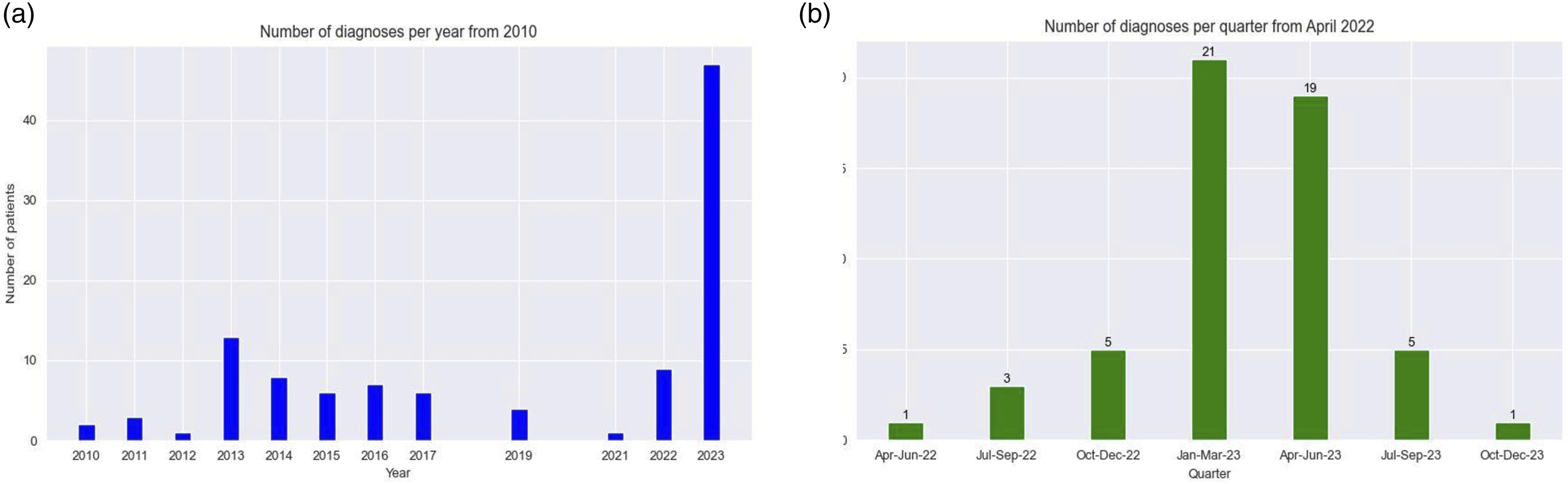
Description of outbreak
At the clinical examination, the lesions were similar between all cases, presenting with erythematous lesions, oedema, vesicles and pustule formation (Figure 2). All individuals complained of pruritus. In 24/55 (44%) cases the localization of the mycosis was inguinal or genital (tinea genitalis) and in 11/55 (20%) gluteal. Among other cases, the lesion localization was heterogeneous, including face, body, extremities, inguinal and genital region. The first-line therapy prescribed was terbinafine in 50/55 (91%) individuals: 29/55 (53%) received oral terbinafine, 9/55 (16%) received only topical terbinafine, and 11/55 (20%) received a combination of oral and topical; only 1/55 (2%) received oral fluconazole in addition to topical terbinafine. Topical clotrimazole was administered in 1/55 (2%), topical miconazole in 1/55 (2%), oral itraconazole in 1/55 (2%) and oral fluconazole in 1/55 (2%) cases. The median duration of therapy was 14 days (IQR = 14-14, range 7–56). Recurrence of lesions was documented in 12/55 (22%) MSM following treatment discontinuation (6 treated with combination therapy of oral terbinafine and topical formulations as first line therapy, 5 treated with oral terbinafine, 1 with topical miconazole). The second-line therapy consisted of repetition of oral formulation with terbinafine in 8/12 (67%) cases, among which 1/8 (12%) topical clotrimazole and 4/8 (50%) topical terbinafine were added; 1/12 (8%) were treated with topical terbinafine and 3/12 (25%) with oral fluconazole. The median time of treatment for the second-line therapy was 14 days (IQR = 14-21). In 1/55 (2%) a third recurrence occurred, in this case oral terbinafine was re-introduced for 28 days (overall treatment of 70 days). Erythematous lesions with oedema and pustules. (a,f) Tinea genitalis cercinate erythematous lesions around groin hair. (b) Tinea barbae a single cercinate erythematous lesion. (c,d,e) Tinea corporis several and extended erythematous lesions with oedema, pustules and xerosis on gluteal region. 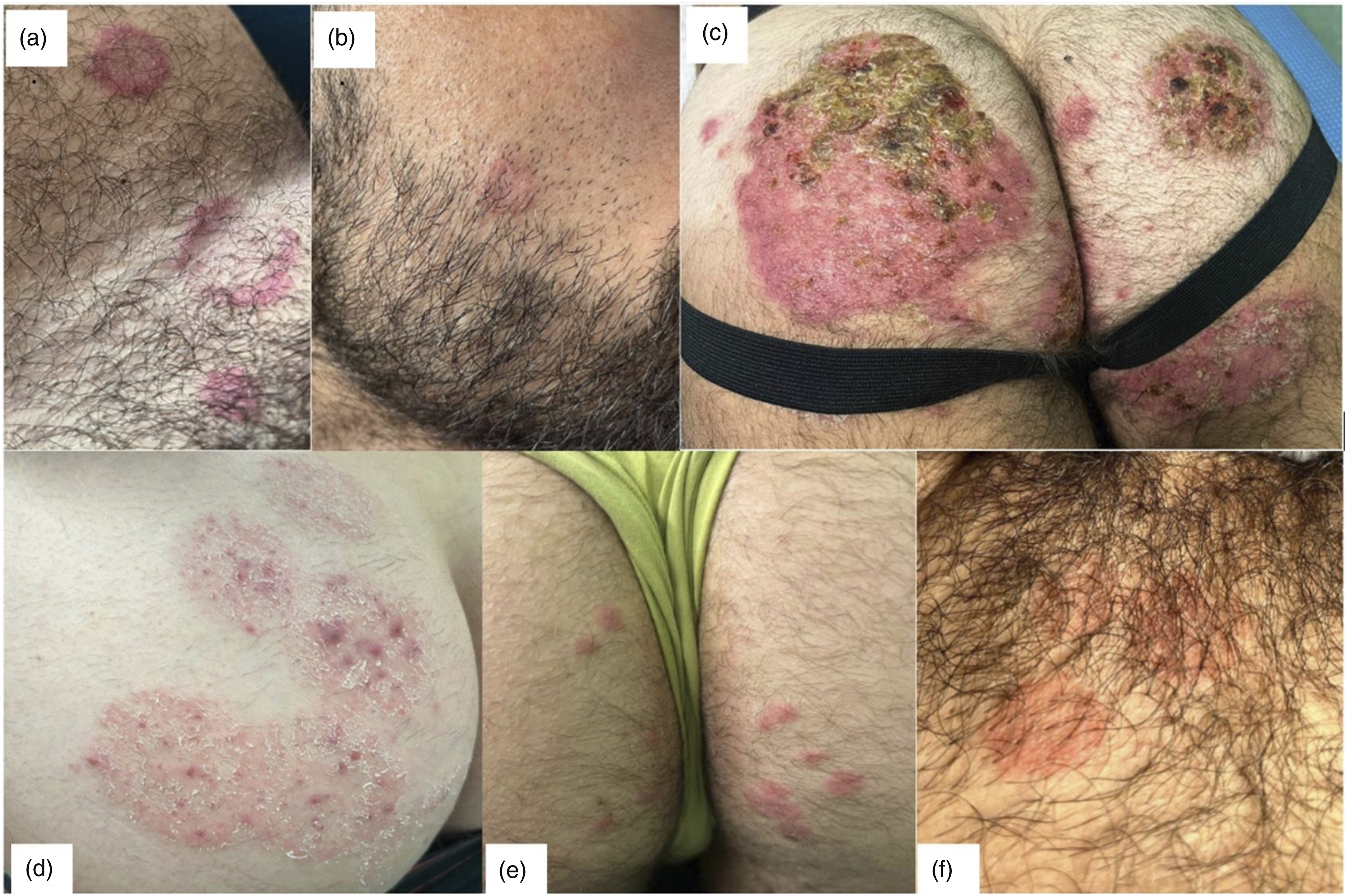
Discussion
Since April 2022, in our cohort of outpatients followed for STIs, we observed an increase in dermatophytosis cases among MSM. The increase in cases has been major during 2023. The affected population were mostly young male adults, with almost all included people being MSM as opposite than before 2022. The most frequent localization was gluteal and the inguinal-genital region; less frequently affected areas included facial, trunk and upper extremities. In this cohort the diagnosis was mainly clinical. First line treatment had mostly been oral terbinafine; while in few cases with more extensive and widespread lesions, the choice was to combine oral terbinafine and topical formulation. The manifestations were severe and relapses occurred in almost a quarter of our cohort, with most cases treated with oral terbinafine. In only one case a third relapse had occurred; this one was treated with oral terbinafine for 1 month. Terbinafine was re-prescribed for most individuals following relapse, suggesting that the previous therapy may have been too short to eradicate the disease and therefore requiring prolonged treatment.
Dermatophytosis is transmitted by person-to-person and animal-to-person contact or by soil-to-person spread. Transmission can occur through both direct and indirect contact with contaminated fomites. For instance, gyms and saunas represent environments that favor mold persistence and contamination. Since the most frequent localization were the gluteal and inguinal-genital regions, it is likely that dermatophytes were transmitted during sexual intercourse. The description in this report shows that we are dealing with a disease entity in its own right and with an infection transmissible through sexual intercourse. Recently several cases of dermatophytosis were reported and these highlight TMVII is newly circulating in Europe. Jabet et al reported a recent case series of dermatophytosis caused by of T. mentagrophytes genotype VII in external genitalia, buttocks, facial region among MSM with a high-risk STI profile, which also supports the hypothesis of sexual transmission. The study population cited above was also all male and mostly MSM. 5 A new case was reported in the US and treated with lengthy antifungal therapy. 6 Another observational study reports growing evidence of “tinea genitalis” as a distinct dermatophytosis transmitted during sexual intercourse. 7
T. mentagrophytes is often associated with this form of dermatophyte infection. At the Charité University Hospital in Berlin, 43 patients with fungal infections of the pubogenital region caused by T mentagrophytes VII were observed between January 2016 and July 2017. 8 Another recent case report described a case of 35-year-old patient, an immigrant woman, with tinea genitalis profunda, potentially sexually transmitted, treated systemically with terbinafine, during almost 3 weeks of hospitalization. 9 Luchsinger et al also described a case series of 7 patients of tinea genitalis and supposed a new entity of sexually transmitted infection. 10 Previously there was also a Danish couple in whom a severe inflammation related to T. mentagrophytes was reported. In all these cases, dermatophytosis lesions were associated with severe inflammation; because of this reason, they are often misdiagnosed as bacterial infections. 11 The description of cases of dermatophytosis related to sexual intercourse is also reported in a case series by Otero et al reporting cases of tinea cruris among sex workers in Spain. 12
The risk factors related to dermatophytosis are several. Diabetes mellitus, immunosuppression, or atopic dermatitis are conditions that can predispose individuals to acquire genital dermatophytosis.13–15 In addition, regular grooming of pubic hair increases the risk of acquiring sexually transmitted infections (STIs) due to microinjuries from razor use, which facilitates epithelial penetration of bacteria, viruses, and fungi. As supported in a case series study of Bakare et al shaving pubic hair in addition to friction during sexual contact can facilitate direct transmission of STIs.16,17
In our cohort, no predisponding diseases were found, apart from all individuals belonging to a key-population of MSM, PrEP users or PLWH. Whereas most individuals (86%) previously contracted an STI, with the most cases being syphilis (51%) and gonorrhea (47%). All MSM reported having frequented sex venues, including saunas, and engaging in cruising activities in the 3 months prior to the diagnosis of mycosis. Furthermore, all subjects revealed that they had visited gyms in the month prior to the baseline. These might be contributing factors which likely facilitate fungal transmission.
The STIs remain the most transmitted infection, which constitutes a worldwide threat. During April 2022 monkeypox was spreading around the world and due to the speed of its diffusion and the severity of its presentation, it caught our attention. 18 We are probably dealing with a new entity of STIs. The onset of new STIs should invite us to reflect on the need to change our approach these infections and to consider the possibility that several infectious diseases are potentially transmissible through sexual relations. Therefore, cutaneous lesions, compatible with mycosis, among people belonging to key-populations, should urge consideration of these pathogens.
Limitations of study
In our cohort, several cases of dermatophytosis have been recorded through clinical evaluation, and no further microbiological investigations were required as the cases responded well to first-line therapy. Moreover, cases might be underdiagnosed given the heterogenous disease severity, which often was very mild and not associated with sexual transmission by the patients. This is a single-center study, and we would like to encourage other centers to report their own cases of dermatophytosis, to support the hypothesis of sexual transmission and to consider mycoses as part of sexually transmissible infections (STIs).
Conclusions
In this study we report a dermatophytosis outbreak among our outpatient clinic cohort. Since April 2022, cases of dermatophytosis were recorded mainly in the gluteal, and inguinal-genital regions, which might be potentially sexually transmissible. This suggests a new entity of sexually transmissible infection, added to previous similar evidence. For this reason, we suggest paying attention to lesions compatible with dermatophytosis and differentiating them from other STI-related lesions. Physicians should remain vigilant on dermatophytosis among people belonging to key populations. First-line therapy with oral or topic terbinafine treated most of dermatophytosis lesions, but sometimes longer periods of treatment are required to avoid relapses. Accordingly, to this outbreak, we call to report additional international cases to raise physician awareness of this newly observed infection among MSM.
Footnotes
Authors’ contributions
Conceptualization SN. CM and ARR contributed to the writing of the article and collected clinical data. SN, AC, ARR, contributed to the review of the article. RL collected clinical data and LG analysed clinical data and contributed to the review of the article. EM, DC, CG, GT, MB, CC contributed to review literature and to the review of the article. AC coordinated clinical activities. All authors have read and agreed to the final version of the manuscript.
Acknowledgements
The authors would like to thank all the healthcare professionals from San Raffaele Scientific Institute in Milan, who collaborated in the diagnosis and the management of patients.
Declaration of conflicting interests
The author(s) declared no potential conflicts of interest with respect to the research, authorship, and/or publication of this article.
Funding
The author(s) received no financial support for the research, authorship, and/or publication of this article.
Disclaimer
This work was presented at the 16th Italian Conference on AIDS and Antiviral Research (ICAR 2024), Rome, Italy, 19th-21th June 2024.
