



Abstract
Erythematous-petechial lesions of the palate caused by fellatio are probably frequent. However, they have rarely been reported in the literature because they are not easily visible by the patient, are almost always asymptomatic and heal spontaneously within a few days. We report 10 patients (9 females and 1 male, with an age ranging from 29 to 59 years) with this condition. Two patients complained of mild burning sensation in the oral cavity. In all patients it was possible to exclude sexually transmitted infections. No treatment was prescribed. Complete remission was observed within 2 weeks.
Introduction
Erythematous-petechial lesions of the palate caused by fellatio are probably frequent. However, they have rarely been reported in the literature because they are not easily visible by the patient, are almost always asymptomatic and heal spontaneously within a few days.1–16
Case report
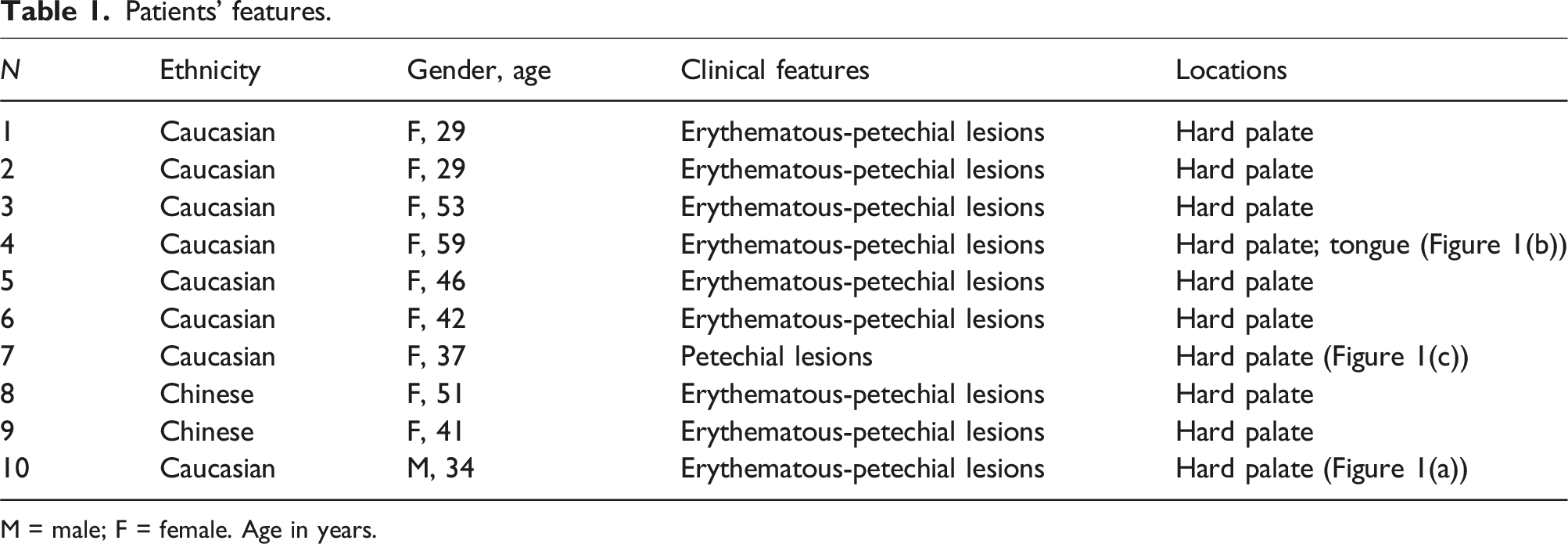
In the period 1987–2024 we made a diagnosis of erythematous-petechial lesions of the palate caused by fellatio in 10 patients. Six of them had been sent to us by their dentists. Four patients were admitted because they feared a sexually transmitted disease. The caselist consists of 9 females and 1 male, with an age ranging from 29 to 59 years (mean age: 42.1 years). Nine patients had multiple erythematous-petechial lesions located exclusively on the hard palate (Figure 1(a) and (c)). One female patient had only petechial lesions (Figure 1(c)). One female patient showed also erythematous-petechial lesions on the dorsal surface of the tongue (Figure 1(b)). Two patients complained of mild burning sensation at the oral cavity. Complete patients characteristics are reported in Table 1. All patients were subjected to laboratory tests for syphilis, HIV and hepatitis C (with negative results), and swabs for Herpes Simplex Virus types 1 and 2 (negative results). In six women, urethral swabs for real-time PCR for C. trachomatis, M. genitalium and N. gonorrhoeae were negative. Microscopical examinations and cultures for N. gonorrhoeae were also negative. In all patients it was possible to exclude, by means of laboratory examinations, sexually transmitted infections. No treatment was prescribed. Complete remission was observed in all patients within 10 days. In all patients follow up was negative up to 1 month after the first examination. (a) Multiple erythematous-petechial lesions located exclusively on the hard palate in a male patient (patient number 10 in Table 1). (b) One female patient also showed erythematous-petechial lesions on the dorsal surface of the tongue (patient number 4 in Table 1). (c) One female patient had only petechial lesions (patient number 7 in Table 1). Patients’ features. M = male; F = female. Age in years.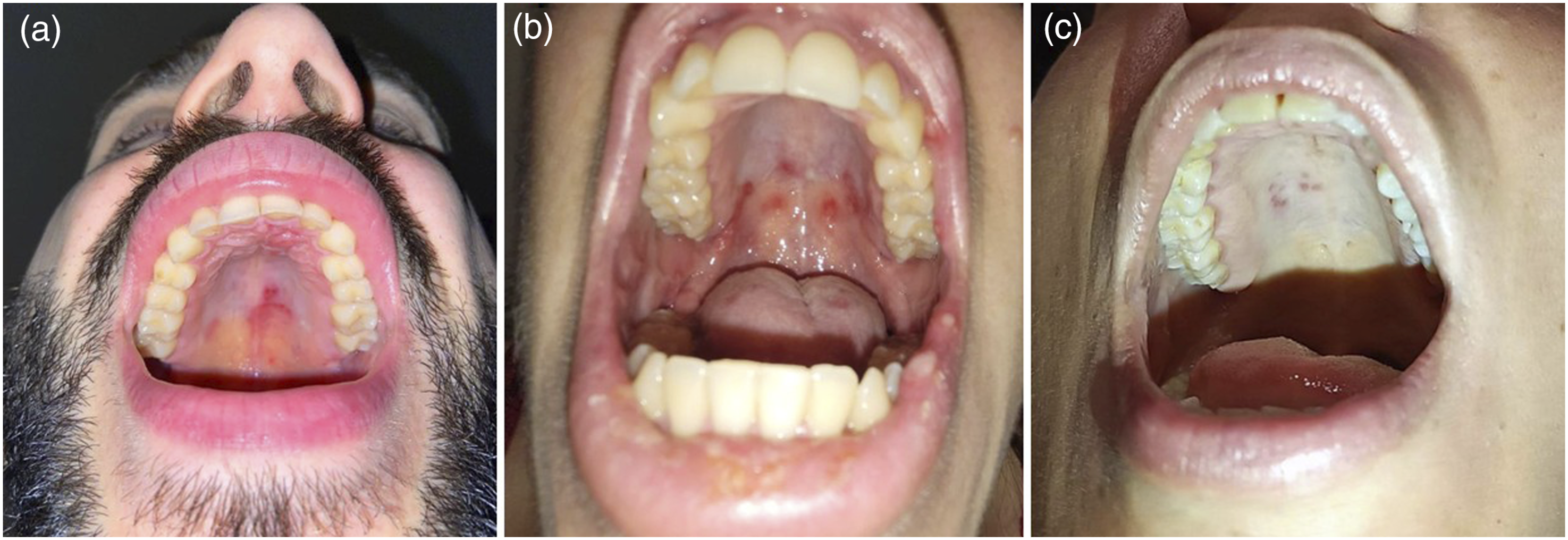
Discussion
Lesions on the palate following fellatio were first described in 1928 by Barthélemy.1,13,15 These lesions have been called variously, such as petechial hemorrhages of the soft palate, 2 palatal erythema,3,7 petechiae of the palate, 10 purpuric palatal lesions, 10 palatal ecchymosis, 12 palatal purpura, 13 erythema of the soft palate 14 and palatal petechiae. 16 We think that the best term probably is erythematous-petechial lesions of the palate, because these lesions are not only erythematous or petechial and do not occur only on the soft palate: in fact, in all our patients, the hard palate was involved. According to literature data, these lesions are much more common in females1–3,5,10–13,16: our experience confirms it. Erythematous,3,5,7,14,16 ecchymotic,3,9,12 haemorrhagic,5,7,10,11,16 petechial2,5,10,11 and purpuric5,7,10,13,15 lesions are the most frequently observed clinical features. Also vesicles may be observed. 5 Both hard3,7,12 and soft2–5,7,10,11,14,16 palate are involved. The tongue, as in one of our patients, is rarely involved. 8 These manifestations are usually asymptomatic.10,16 Complete and spontaneous remission occurs in 1–3 weeks.2,11 As previously mentioned, these lesions are rarely reported in the literature for some reasons: (a) they are not easily visible by the patient; (b) they are almost always asymptomatic and (c) they heal spontaneously within a few days. The diagnosis of erythematous-petechial lesions of the palate caused by fellatio may be difficult, because it is based on a careful and tricky medical history and the exclusion of other possible causes. Laboratory tests are important in order to exclude sexually transmitted infections. Therapy is usually unnecessary.
Footnotes
Declaration of conflicting interests
The author(s) declared no potential conflicts of interest with respect to the research, authorship, and/or publication of this article.
Funding
The author(s) received no financial support for the research, authorship, and/or publication of this article.
Ethical statement
AI declaration
AI has not been used for this paper.

Data Availability Statement
Anonymized data (medical reports of each case) will be shared upon reasonable request from any qualified investigator for purposes of replicating procedures and results.