



Abstract
Objectives
Genito-urinary medicine (GUM) in the UK is experiencing a recruitment crisis, with persistently low higher specialty training (HST) fill rates. As completion of Internal Medicine Training (IMT) stage 1 is required before GUM HST, we aimed to explore prospective applicants’ understanding of applications and identify how the Student and Trainee Association for Sexual Health and HIV (STASHH) could provide support.
Methods
An online evaluation was distributed via STASHH’s social media and ambassador networks to medical students and pre-specialty doctors interested in GUM. Respondents provided information on training stage, familiarity with IMT applications, self-assessed scores, and perceived barriers.
Results
Of 59 respondents, 56 were eligible for analysis. Most (86%) were considering IMT, but 73% reported the IMT requirements deterred them from GUM. 34% self-scored above the 2024 interview threshold. Gaps included postgraduate qualifications (83%), teaching (70%), and publications (58%). Barriers included research access, time and financial pressures, lack of mentorship, and perceived lack of understanding of the research process. These barriers disproportionately affect those from widening participation backgrounds.
Conclusions
Difficulties in IMT stage 1 recruitment are likely to present a significant barrier to adequate GUM HST fill rates. STASHH can address this through improved access to mentorship, teaching, research opportunities, and clearer portfolio guidance.
Keywords
Introduction
Genito-urinary medicine (GUM) is facing a recruitment crisis. GUM higher specialty training (HST) in the UK has been consistently undersubscribed since 2015 1 with a fill rate in England of 20% in 2024. 2 While competition ratios recently increased to 1.02 applicants per job in 2025, this remains lower than equivalent specialties. GUM continued to participate in a second round of recruitment, suggesting that fill rates were not 100% despite these higher competition ratios. 3 Exploring and addressing the multifactorial reasons for this is critical for the long-term sustainability of GUM services; The Student and Trainee Association for Sexual Health and HIV (STASHH) was set up in 2020 as an arm of the British Association for Sexual Health and HIV (BASHH). 4 It is a UK-wide network of medical students and pre-specialty doctors, which provides peer support and educational opportunities to those interested in a career in GUM. As well as STASHH, the LoveGUM campaign is working nationally to promote the specialty and address recruitment challenges. 5
Completion of Internal Medicine Training (IMT) stage 1 is a prerequisite to applying for GUM HST, as it is for most other medical specialties. IMT posts have become increasingly hard to access, with competition ratios rising from 1.5 in 2018 to 5.3 in 2025. 3 Applicants are shortlisted following self-scoring of their achievements in six domains: Publications, teaching experience, training in teaching, postgraduate degrees/qualifications and quality improvement projects. 6 As competition increases, so does the minimum score required for interview. 7 Limited access to IMT stage 1, and issues with successful application, are a theoretical barrier for doctors interested in pursuing a career in GUM. These challenges are likely to be felt most acutely in GUM, where national fill rates remain among the lowest of any specialty.
Aims
This project aimed to explore prospective GUM HST applicants’ understanding and opinions on IMT applications, as well as their self-assessment score for interview. IMT stage 1 has anecdotally been identified as a barrier to GUM recruitment, and this has been examined further through our evaluation questions. This work also aimed to identify opportunities for STASHH and GUM clinicians to support prospective GUM applicants to enter IMT, thus addressing recruitment issues.
Methods
We conducted an online evaluation distributed to pre-specialty doctors and students interested in GUM (see Appendix A). The evaluation was promoted on STASHH social media and via our local ambassador networks.
Evaluation responses were accepted between 13/02/25 and 24/04/25. We asked respondents multiple choice questions about their stage of training, previous involvement with STASHH, plans for and knowledge about IMT and GUM applications, and opinions about IMT as a deterring factor for GUM HST. Respondents were then asked to self-score their portfolios using the IMT stage 1 application matrix. The final section explored applicants’ feelings about IMT applications. We asked them to score their concerns from 1 to 10 and, in free-text questions, to state the areas in which they most require support. Free-text responses were analysed thematically using a narrative approach to identify key themes, following the methodology outlined by Braun and Clarke. 8 All questions required an answer to complete the survey.
This project is a service evaluation of the opportunities offered by STASHH, examining how well we support students and trainees interested in a career in GUM and identifying ways we can provide further support. Therefore, it did not require formal ethical approval, and all participants consented to the use of their anonymised data.
Results
Of 59 respondents, 61% were pre-specialty doctors, 39% medical students, and 64% were involved in STASHH, whether on the committee, as a local ambassador or engaging with virtual content. Three respondents were excluded as they were not interested in applying for GUM. All responses should be taken in the context of students and trainees who are primarily interested in GUM as a future career.
Impact of IMT training on GUM applications
86% of respondents reported that they were considering applying for IMT stage 1. 73 % of respondents stated that the requirement to complete IMT stage 1 was a deterring factor in their decision-making process around choosing a career in GUM; 5% felt IMT was an attracting factor, while 15% were neither attracted or deterred and 7% were unsure. 88% were aware that IMT stage 1 is a compulsory pathway to applying to GUM HST. Yet, when asked how concerned they were about entering IMT (with 10 being ‘extremely concerned’), the average score was 8.4/10.
“Less likely to apply due to the off putting IMT training and competitive nature of it”. Clinical years medical student “I am really interested in gum [sic] but IMT does feel like a barrier”. Clinical years medical student “IMT is my deterrent unfortunately.” F3 + doctor
IMT interview threshold
34% of respondents self-scored the minimum number of points required for interview in the 2024 recruitment cycle. Among respondents who had completed foundation training, thus eligible to apply to IMT, 47% met the interview threshold.
The most common domains where prospective applicants scored zero points were: postgraduate qualifications (83%), training in teaching (70%), publications (58%), and presentations/posters (31%). It is not possible to meet the interview threshold without scoring some points for publications, training in teaching, or post-graduate qualifications (see Appendix B or
6
for full scoring criteria). This was the case for 39% of total respondents, including 14% who were F1-F2 doctors.
“I have applied this year for the third time with a score of 15 this year... it’s ridiculous I was borderline for getting one purely based on publications or not having a PG cert... I know I want to do GUM but struggling to get into IMT. The system needs to change”. F3 + doctor “Getting published and post-graduate qualifications is a really difficult task for foundation doctors to have achieved by this stage. I went through 5 years of medical school and then straight into F1 and didn’t know enough about the IMT scoring system... I’m disheartened that I want to do GUM... but won’t even get an interview... despite a good CV tailored towards GUM since medical school but just not quite the right things done for points” F1-F2 doctor
Free text responses describe feelings of “hopelessness” and being “disheartened” due to the increasing competitiveness of IMT applications. Anxiety about meeting the interview threshold deterred some applicants from applying to GUM.
“The thought of applying for IMT, the difficulty in the application, the risk of not getting in, and having to do three years of general IMT puts me off applying for GUM”. F3 + doctor “I want to do GUM, but feels like falling at the first hurdle if I can't get into IMT. If there was another way to do GUM I'm sure a lot of people would consider it. If I repeatedly can't get into IMT I will have to aim towards a different career path other than GUM”. F3 + doctor
Barriers and support

Many respondents described this process as opaque and reliant on informal networks, with several citing an element of “luck” or “right place, right time” as determinants of a successful IMT application. There was significant frustration about changes to the scoring criteria between recruitment years. For example, points for leadership and prizes were removed from the matrix for 2024 entry. Respondents stated disappointment that non-academic qualities like leadership and clinical experience are not adequately valued.
[Applying is] “much more competitive than it has ever been before (total points available decreased from 40 to 30 but the interview threshold increased in 2024/2025), they keep moving the goal posts (changing what scores points), difficulty in getting publications which make up a lot of points, feels like it is favouring those who are more interested in academia and doesn't value other things which make people good doctors”. F1-F2 doctor “The minimum points to get in keep going up / changing” and “domains they use can change last minute”. F3 + doctor
When asked where participants required support, most responses included: research involvement, obtaining publications, and gaining teaching experience. More notably, specific challenges included delivering poster presentations, preparing for interviews, and accessing postgraduate certifications. Several participants expressed confusion or lack of knowledge about what a strong IMT application involves.
Discussion
To our knowledge, this is the first evaluation exploring barriers to IMT stage 1 entry for prospective GUM applicants. NHS England is due to publish a broader review of medical training, garnering responses from over 7000 participants across 23 national focus groups. However, this does not focus specifically on IMT or recruitment into GUM. 9
It is encouraging that the Joint Royal Colleges of Physicians Training Board (JRCPTB) has recognised these recruitment challenges in a recently issued position statement on IMT recruitment plans for 2026. 10 Their recommendations include surveying 2025 IMT applicants and current Foundation Doctors for their feedback on IMT recruitment, awarding points to those who only apply for IMT, and reviewing the current interview format. The outcome of these recommendations remains to be seen.
Our findings suggest that most respondents are motivated to apply for IMT and that they understand its relevance to subsequent GUM applications. However, these findings highlight that prospective GUM applicants have difficulty fulfilling the portfolio requirements for IMT entry, particularly garnering opportunities that would lead to presentations or publication. As such, entry to IMT stage 1 has become a barrier to GUM application. Applicants’ support needs focus on access to opportunities, mentors, and transparent, achievable guidance on how to build a successful application portfolio.
Impact of barriers
Those unable to meet the shortlisting threshold commonly seek non-training roles such as clinical fellow posts to ensure financial security. Subsequently, these roles are expected to become increasingly competitive and can often have little time allocated for portfolio development. 11 Applicants from widening participation backgrounds or with dependents are likely to be disproportionately affected by the barriers described. They are less able to risk job insecurity or complete portfolio requirements unpaid and outside of working hours.12,13 As such, these groups need targeted support.
Overcoming barriers
STASHH is well positioned to implement targeted interventions to address the needs of applicants, which will be vital for GUM recruitment. This includes the development of guides on different aspects of the application process. The STASHH guide on IMT applications has recently been published. 14 Further developing and formalizing STASHH teaching roles can also support individuals to have their work recognized when applying to IMT.
STASHH can encourage GUM clinicians to proactively support trainees by promoting awareness of the IMT scoring matrix, advocating for Clinical Teaching Fellow roles, and facilitating access to research and quality improvement. STASHH aims to improve engagement with our existing mentorship scheme to facilitate these changes.
Continued collaboration with BASHH would further strengthen these efforts, perhaps in facilitating opportunities for presentations and publications. As a network of students and pre-specialty doctors, STASHH has firsthand insight into the barriers faced. Working together with the support of senior colleagues can highlight these issues and drive greater change.
The recommendations presented in Figure 1 would directly address the portfolio difficulties identified and support a more equitable route into IMT and, subsequently, GUM HST. By reducing barriers and fostering early engagement, we can help ensure that pre-specialty trainees with talent and potential are able to enter the specialty and fill gaps in recruitment. overview of recommendations.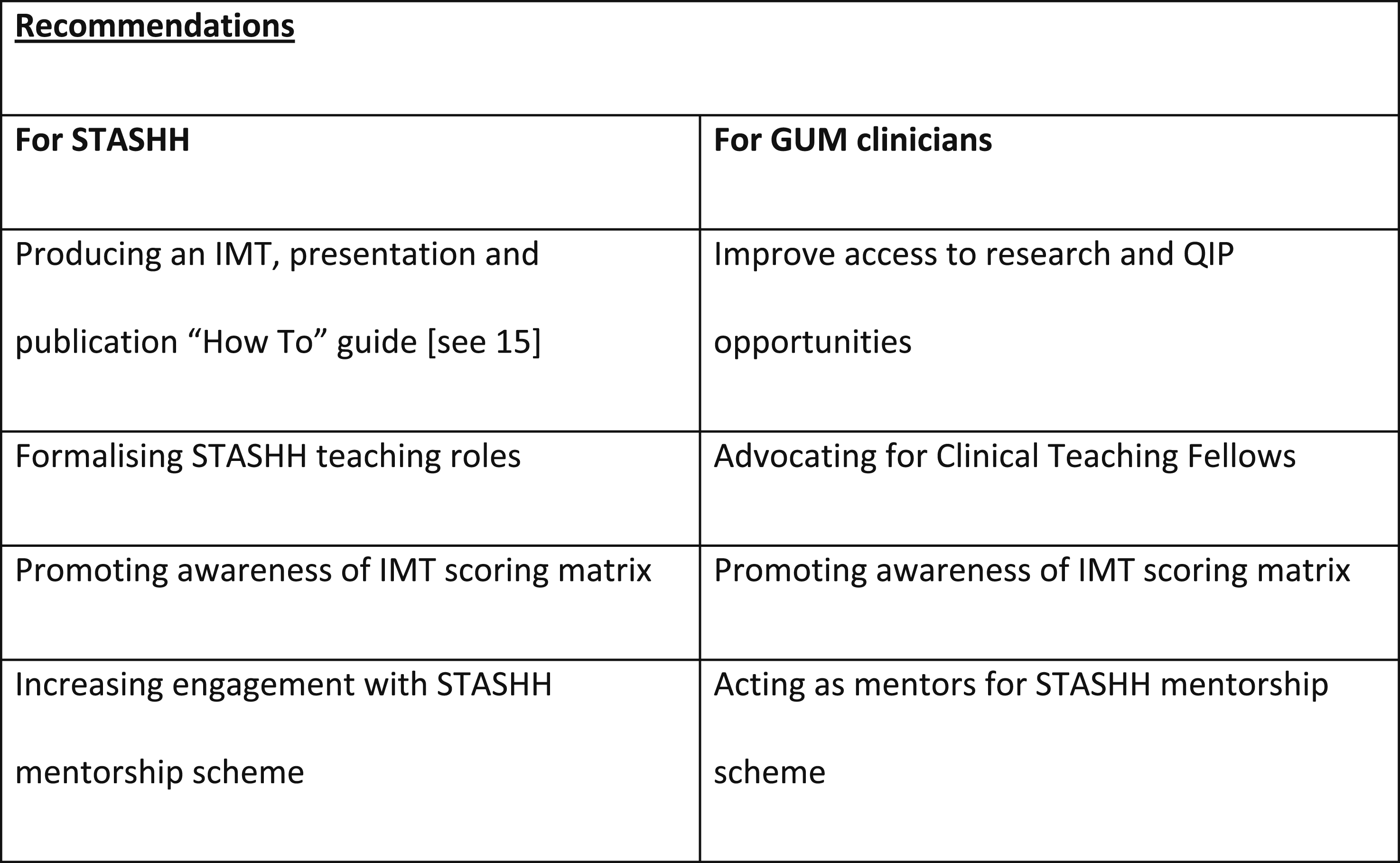
Limitations
The opportunistic sampling approach risks selection bias, since the evaluation may have preferentially reached those already engaged with career planning via STASHH. Although respondents may have scored themselves incorrectly, there is the same risk in IMT self-scoring. Unlike the application process, we have not randomly selected respondents to review evidence of their self-assessed scores.
This survey presents a snapshot of respondents’ current professional intentions across different stages of their medical career, from pre-clinical medical students to doctors with several years of postgraduate work. We did not follow up respondents to see what application decisions they ultimately made, and it is possible that this data does not reflect their final choices.
Supplemental Material
Supplemental Material - Investigating prospective Genito-urinary medicine trainees’ perspectives on applying to and entering Internal Medicine Training: Barriers and opportunities for support
Supplemental Material Investigating prospective Genito-urinary medicine trainees’ perspectives on applying to and entering Internal Medicine Training: Barriers and opportunities for support by Richardson Millicent, Mulchrone Maeve, Thomas Catrin, Cochrane Eleanor, Goldwater Breheny Cate, Sunilkumar Adhishree, Lyons Amy, Currie Grace, Todd Liberty, Heath Ella, Edwards Lily, Cartner Emma, Masters Toni in International Journal of STD & AIDS
Footnotes
Author note
The authors of this article are all current/former STASHH committee members

Consent to participate
This was a service evaluation project and no formal consent for completion of the evaluation was sought. Participants were advised in writing that, by completing the questions, they were agreeing to the use of their anonymised data and could withdraw at any time.
Funding
The authors received no financial support for the research, authorship, and/or publication of this article.
Declaration of conflicting interests
The author(s) declared the following potential conflicts of interest with respect to the research, authorship, and/or publication of this article: Declaration of conflicting interest- Authors are all current or former members of the STASHH committee, within which this service evaluation was conducted. This affiliation is stated for transparency. The authors declare no other competing interests.
Supplemental Material
Supplemental material for this article is available online.