



Abstract
Background
Restless Leg Syndrome (RLS) is a common neurological disorder with a prevalence of 5-10% in Western countries. Emerging evidence suggests a higher prevalence among people living with HIV (PWHIV), though comprehensive studies are lacking. RLS may be exacerbated in PWHIV due to chronic neuro-inflammation and nutritional deficiencies. This study aimed to determine the prevalence of RLS in a Greek PWHIV population and identify associated demographic, clinical and laboratory risk factors.
Methods
This was a cross-sectional study of 194 PWHIV and 200 non-HIV controls. Data were collected via clinical interviews, validated questionnaires and medical records. We assessed RLS prevalence, clinical characteristics, sleep quality and psychological distress. Statistical analysis included Mann-Whitney U tests, Chi-square tests, and a stepwise logistic regression model to identify independent predictors of RLS.
Results
RLS prevalence was significantly higher in the PWHIV group (31%; 95% CI: 25.3–38.3%) compared to controls (15%; 95% CI: 10.2–20.2%, p < 0.001). In PWHIV, RLS was associated with shorter duration of HIV/HAART, lower CD4 cell counts at diagnosis and currently, and detectable viral load. Detectable viral load was the strongest independent predictor of RLS (OR 15.49, p < 0.001). RLS was also independently associated with poor sleep quality (OR 15.48), anxiety (OR 5.18), and depression (OR 9.22).
Conclusions
RLS is a prevalent comorbidity in Greek PWHIV, strongly associated with active viral replication and a state of advanced immunosuppression. The findings highlight the need for systematic RLS screening in this population to improve clinical outcomes and psychosocial well-being.
Introduction
Restless Leg Syndrome (RLS) is a chronic neurological disorder characterized by an irresistible urge to move the legs, often accompanied by uncomfortable and unpleasant sensations such as creeping, crawling, tingling or aching. 1 These symptoms typically emerge or intensify during periods of rest or inactivity, particularly in the evening and at night, leading to significant sleep disturbances, chronic fatigue and a diminished quality of life. 2 RLS is a common condition in the general population with prevalence estimates ranging from 5% to 10% in Western countries. 3 However, a growing body of clinical observations and research has suggested a disproportionately higher prevalence of RLS among people living with HIV (PWHIV).4–6 This observation has significant clinical and public health implications, as RLS can exacerbate the existing burden of comorbidities in this population and negatively impact treatment adherence and overall well-being. 7
The link between RLS and HIV is not yet fully elucidated but several plausible and interconnected pathophysiological mechanisms have been proposed. 8 One of the central hypotheses resolves around the disruption of the central nervous system’s dopaminergic pathways. 9 RLS is fundamentally a disorder of dopamine dysregulation. 9 Dopamine is a crucial neurotransmitter involved in motor control, and deficiencies in its signaling are thought to be the primary cause of RLS symptoms. 10 HIV, through its ability to cross the blood-brain barrier and induce chronic neuro-inflammation, may directly or indirectly impair dopamine synthesis and function. 11 This state of chronic inflammation, a hallmark of untreated or long-term HIV infection, involves the persistent activation of immune cells and the release of pro-inflammatory cytokines. 12 These molecules, such as TNA-a and IL-6, are known to interfere with dopamine metabolism and neuronal health, creating a neurochemical environment conducive to RLS development. 13 Furthermore, nutritional deficiencies, particularly of iron, are well-established as a risk factor for RLS. 13 Iron is an essential cofactor for tyrosine hydroxylase, the rate-limiting enzyme in dopamine synthesis. 14 PWHIV are at an increased risk for iron deficiency due to various factors including chronic inflammation which can disrupt iron homeostasis, poor dietary intake and gastrointestinal malabsorption. 15 A deficiency in iron can directly contribute to dopaminergic dysfunction and RLS symptomatology. 16 Beyond iron, other micronutrient deficiencies such as those of vitamin B12 and folate, which are also common on PWHIV may play a contributory role. 17
The clinical landscape of HIV care has been transformed by the implementation of Highly Active Antiretroviral treatment (HAART) which has turned HIV from a fatal disease at the beginning of the pandemic into a manageable chronic condition. 17 A consequence of this success is the increasing prevalence of age-related and non-AIDS comorbidities including neurological disorders. 18 While modern HAART regimens are generally well-tolerated, some older agents were associated with peripheral neuropathy, a condition that can cause sensory disturbances in the legs that may be mistaken for or coexist with RLS. 19 The intricate interplay between the virus itself, the inflammatory response it provokes, potential drug side effects and coexisting conditions, makes the diagnosis and management of RLS in this population challenging. 20
Given the significant impact of RLS on sleep quality, daytime function and overall quality of life, understanding its true prevalence and associated risk factors in the context of HIV is of paramount importance. While several smaller studies have explores this association, comprehensive, large-scale investigations are warranted to provide a more accurate epidemiological picture. This study aimed to determine the prevalence of RLS in a Greek population of people living with HIV (PWHIV) compared to a non-HIV control group. Additionally, we investigated the association between RLS and clinical HIV metrics, anthropometric characteristics, and psychosocial factors, including sleep quality, anxiety, and depression. By shedding light on this often under-diagnosed comorbidity, we hope to improve clinical screening, facilitate eerlier diagnosis and inform the development of targeted management strategies to enhance the well-being and long-term health outcomes of PWHIV.
Materials and methods
Study design and population
This cross-sectional, descriptive and comparative study was conducted at the Department of Infectious Diseases of University General Hospital of Alexandroupolis (Greece). The primary research question of this study was to determine whether active HIV replication and immunosuppression are independent predictors of RLS. Secondarily, we sought to quantify the associated burden of sleep and psychological disturbances in those affected by RLS within this population. This study aimed to determine the prevalence of RLS in a population of PWHIV and to identify specific risk factors and comorbidities associated with the syndrome. The study also aimed to compare these findings with a control non-HIV group to elucidate the differential prevalence and characteristics of RLS in the context of HIV infection. The study population comprised two distinct groups. The first, the HIV group, consisted of adults PWHIV receiving regular follow-up care at the aforementioned Unit. A total of 194 individuals were enrolled in this group. Participants in the HIV group were recruited via consecutive sampling during their regularly scheduled follow-up appointments at the Infectious Diseases Unit. To minimize selection bias, every adult patient meeting the inclusion criteria was invited to participate by the attending physician. Of those invited, 43 declined to participate, primarily citing time constraints, resulting in the final sample of 194 individuals. This approach ensured a representative snapshot of the clinic’s active patient population. The second, the control group, consisted of 200 non-HIV individuals recruited from the outpatient clinics of the 2nd University Department of Internal Medicine during the same period. These individuals were attending for routine check-ups or minor acute conditions not associated with chronic neurological or sleep disorders. We ensured comparability by verifying that the burden of chronic comorbidities and lifestyle habits did not significantly differ from the HIV group.
Inclusion and exclusion criteria
Inclusion and exclusion criteria were applied to both groups to ensure a homogeneous study population ant the validity of the results. Adult individuals with a confirmed HIV diagnosis on ART were included to the HIV group, while adults with confirmed HIV-seronegative status to the control group. To ensure the validity of the control group, HIV-negative status was confirmed via documented negative results of a 4th generation ELISA screening test performed within the previous 6 months or at the time of recruitment as part of their clinical workup. Participants without a documented negative HIV test or those who refused testing were excluded from the control group. The exclusion criteria for both groups were meticulously defined to prevent cofounding factors from influencing the results. Individuals were excluded if they had medical condition that could interfere with their ability to complete the study questionnaires. Anyone with a pre-existing, known diagnosis of a primary sleep disorder such as sleep apnea or narcolepsy was excluded from the study. Pregnant women, people with known neural damage, people receiving treatment with antidepressants, antipsychotics, anti-nausea or sedating antihistamines and people with known iron deficiency were excluded from the study.
All participants provided written informed consent prior to their enrollment. The consent form detailed their voluntary participation, the use of their anonymized medical data for research purposes and the eventual publication of the study’s findings. A rigorous data anonymization protocol was followed to ensure the complete confidentiality and privacy of all participants. The study adhered to all institutional ethical guidelines and was approved by the Hospital’s Scientific Council confirming its compliance with ethical research standards. The research was conducted over a 1-year period and was approved by the Ethics Committee of the Democritus University of Thrace.
Data collection and assessments
A comprehensive and standardized data collection protocol was conducted for all participants in both the HIV and control groups. Data were gathered through a detailed clinical interview and a battery of validated self-assessment questionnaires.
Demographic, anthropometric and lifestyle data
Detailed demographic information including age, gender, marital status and educational level was systematically recorded. Marital status was assessed as a surrogate marker for social support and household stability, factors previously shown to influence psychological well-being and sleep hygiene in chronic disease populations. Given that RLS symptoms are subjectively reported and often exacerbated by psychological distress, understanding the patient’s immediate social context was considered relevant to the holistic assessment of the syndrome. Anthropometric measurements including weight, Body Mass Index (BMI), and neck, waist and hip circumferences were obtained. BMI was calculated according to World Health Organization (WHO) standards into four groups: very low (≤16.5 kg/m2), low (≤18.5 kg/m2), normal (≥18.5 and ≤24.9 kg/m2), overweight (>25 and ≤29 kg/m2) and obese (≥30 kg/m2). Abdominal obesity was defined as waist circumference of ≥88 cm for women and ≥102 cm for men. Information on lifestyle habits such as smoking status, alcohol consumption and recreational substance use was also documented.
Clinical and laboratory data
Clinical data for the HIV group were extracted from their electronic medical records. This included key HIV-related metrics such as the duration of HIV diagnosis, the duration on HAART, the HAART regimen, at diagnosis and current value of CD4 cell count, HIV viral load, transmission mode and CDC stage of HIV infection. For both groups, a complete record of existing comorbidities was compiled. Venous blood samples were collected to measure specific laboratory parameters, including hemoglobin (Hb), hematocrit (Hct), serum iron and ferritin levels.
Sleep and psychosocial assessment tools
A series of validated questionnaires were administered to all participants. These instruments were selected to provide a holistic assessment of RLS, sleep quality and psychological well-being. No polysomnography or actigraphy was conducted in the present study.
The presence of RLS was determined using a validated questionnaire based on the core diagnostic criteria of the International Restless Leg Syndrome Study Group (IRLSSG). A diagnosis of RLS is supported by the presence of at least three positive criteria. The severity of the syndrome was quantified using a dedicated RLS severity scale. The Athens Insomnia Scale is an eight-item self-reported scale designed to screen for and assess the severity of insomnia. A score of ≥6 was used as the diagnostic threshold for insomnia. The Greek version of the Pittsburgh Sleep Quality Index (PSQI) is a 19-item self-rated questionnaire that evaluated sleep quality and disturbance over a 1-month period. A total score of ≥5 indicated poor sleep quality. MOS Sleep Scale was also used in order to assess various sleep parameters by a 12-item self-report scale. The likelihood of falling asleep was measured by the Epworth Sleeping Scale which is a four-point self-assessment questionnaire in eight different situations. A score of ≥10 is indicative of excessive daytime sleepiness. The Fatigue Severity Scale is a nine-item self-assessment tool used to quantify the severity of fatigue and its impact on a person’s life. A score of ≥4 on this indicates that the individuals appear severe fatigue. The Hospital Anxiety and Depression Scale (KADS) is a 14-item self-report rating scale composed of two subscales, one for anxiety and one for depression. A score of ≥8 on either subscale indicated the presence of clinically significant symptoms. Participants’ physical activity levels were quantified and classified based on the results of the International Physical Activity Questionnaire (IPAQ). Physical activity was categorized into three levels: low (total PAscore <600 MET. min.wk−1, moderate and high (total PAscore ≥3000 MET. min.wk−1) or rigorous (PAscore ≥1500 MET. min.wk−1).
Statistical analysis
All statistical analyses were conducted using the IBM Statistical Package for the Social Sciences (SPSS), version 19.0. The normality of quantitative variables was assessed using the Kolmogorov-Smirnov test. Quantitative variables, including age, were presented as median and interquartile range (IQR). Comparisons between the two groups were performed using the Mann-Whitney U test to ensure a robust non-parametric assessment, regardless of sample size. The qualitative variables were expressed as absolute frequencies and relative percentages (%). The evaluation of the associations between various patient characteristics and sleep disorders was conducted by using the Chi-square test, the Fisher’s exact test, Student’s t-test and Mann-Whitney test. The strength of these associations was measured by calculated Odds Ratios (OR) with their corresponding 95% Confidence Intervals (CI). Stepwise logistic regression models were constructed to determine the independent effect of patient sociodemographic characteristics, lifestyle habits and health-related factors on the presence of RLS. All statistical tests were two-tailed and a p-value <0.05 was considered to indicate statistical significance.
Results
Demographic and clinical characteristics of the study groups
Demographic, epidemiological and clinical characteristics of PWHIV group (n = 194) and non-HIV control group (n = 200).

Prevalence of RLS and inter-group analysis
Association of RLS with epidemiological and clinical characteristics of PWHIV of control group.

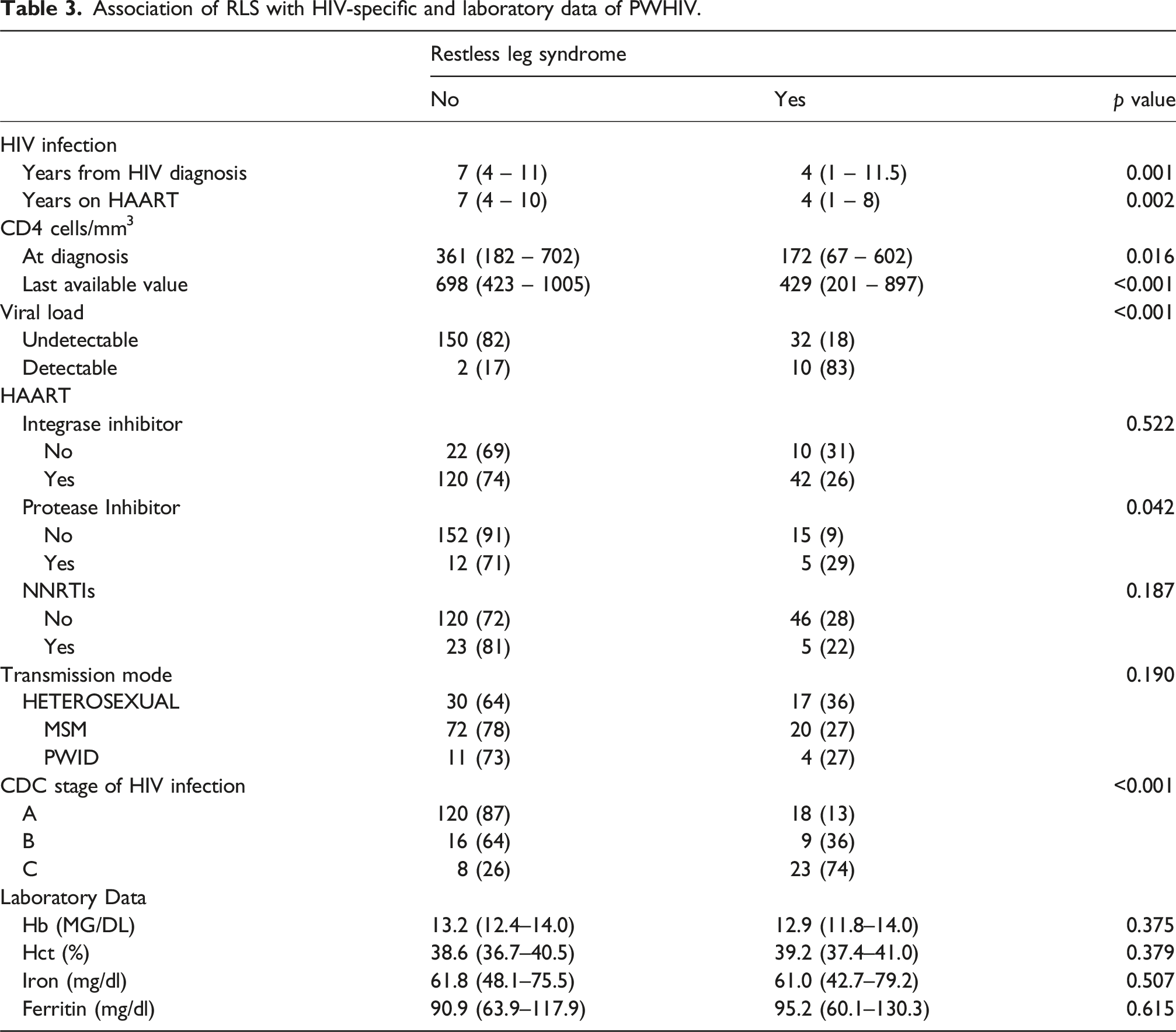
Characteristics of PWHIV with and without RLS
Association of RLS with HIV-specific and laboratory data of PWHIV.
In contrast to the HIV group, the non-HIV control group showed minimal differences between the RLS and non-RLS subgroups. There were no statistically significant differences in age, gender, education level, or marital status. Anthropometric measurements and lifestyle habits were also comparable between the two subgroups.
Comparison of RLS-positive individuals between PWHIV and non-HIV controls
While there were no significant differences in age, gender, or BMI, median physical activity level in PWHIV with RLS was significantly lower, as evidenced by a lower IPAQ score (1132 vs 1398 MET. min/week, p = 0.028). Furthermore, the high frequency of RLS in the HIV group was associated with HIV specific data such as an advanced CDC HIV stage, detectable viral load, and lower CD4 cell count, characteristics not present in the control group.
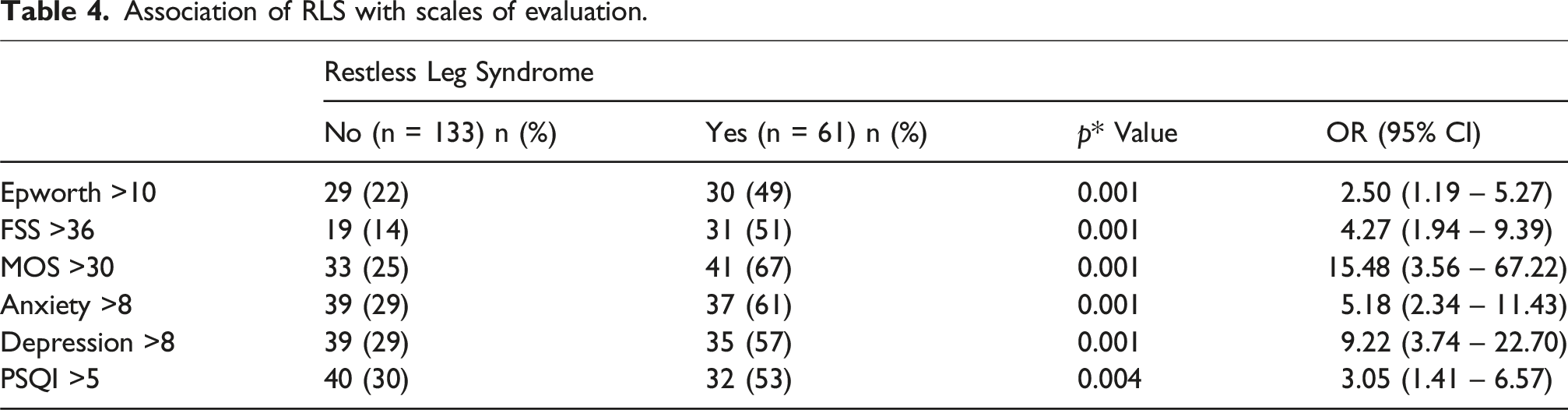
Association of RLS with sleep quality, fatigue, and depression
Association of RLS with scales of evaluation.
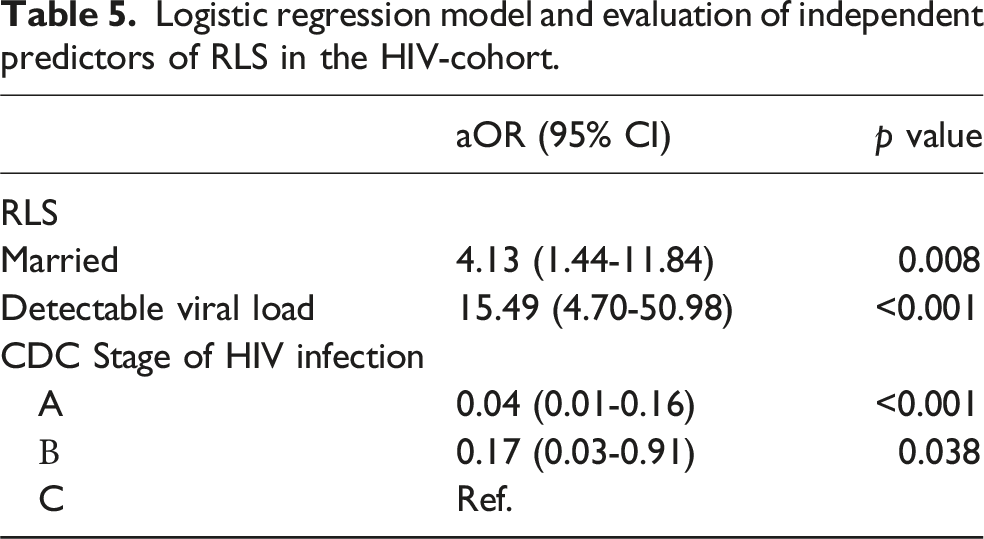
Multivariate analysis
Logistic regression model and evaluation of independent predictors of RLS in the HIV-cohort.
Discussion
Our study identified a significantly higher prevalence of Restless Leg Syndrome (RLS) among people with HIV (31%) compared to non-HIV controls (15%; p < 0.001). While our study population of 194 PWHIV represents a single-center experience, it provides a statistically significant sample to estimate the frequency of RLS within the regional Greek PWHIV population. The study was sufficiently powered to detect a significant difference (p < 0.001) between the HIV group (31%) and the control group (15%). This finding resonates with a German cohort study that reported an RLS prevalence of 33.3% in PWHIV. 21 This consistency between these studies suggests a potential regional or demographic predispotion. Conversely other studies have reported different findings. For instance, a study on an ethnically diverse cohort of HIV-positive adults in the United States found an RLS prevalence of 11% which is similar to general population estimates 5-11%. 22 The discrepancies in prevalence rates can be attributed to several factors. Methodological differences in RLS diagnosis are a key contributor. 23 The German study and presumably, our study, used a formal, expert-driven clinical assessment, whereas the US study relied on a self –report questionnaire.21,24 Relying solely on self-report surveys can be problematic, as they have been shown to have low specificity and can lead to a significant number of false positives if not followed by a careful differential diagnosis. 22 The German cohort’s high prevalence may also be linked to its racial homogeneity (100% Caucasian), as RLS prevalence is generally higher in individuals of European descent than in Asian or African populations. 21 The US study by contrast included a racially diverse sample which might have lowered the overall prevalence rate. 24
Our study’s detailed sub-analysis of the HIV group offers crucial insights into the underlying pathophysiology of RLS in PWHIV. We observed a strong association between RLS and indicators of advanced HIV disease and active viral replication. Specifically, RLS-positive individuals had significantly lower median CD4 cell counts at diagnosis and at the time of the study compared to the RLS-negative group. The most striking finding was the powerful link between RLS and a detectable viral load. A logistic regression model revealed that having a detectable viral load was the most potent independent predictor of RLS, increasing the odds by over 15 times. This finding suggests a direct relationship between ongoing viral replication and the development of RLS symptoms. The proposed pathophysiological link between HIV and RLS centers on the role of chronic inflammation. 25 HIV infection, even when managed with modern therapy, can induce a state of persistent inflammation and immune activation. 26 This inflammatory response involves the release of pro-inflammatory cytokines, such as TNF-a and IL-6, which are known to interfere with dopamine metabolism and neuronal health. 27 A study on a diverse sample of PWHIV found a genetic association between RLS and specific polymorphism in the IL1B and IL17 A genes, which encode for cytokines that mediate inflammatory processes. 27 This suggests that the overactive inflammatory response characteristic of HIV may lower the threshold for developing RLS by dysregulating dopamine receptors. 27 Furthermore, inflammation can disrupt iron homeostasis, a well-established risk factor for RLS. 27 Iron is a vital cofactor for the synthesis of dopamine, and chronic inflammation can lead to a central nervous system (CNS) iron deficiency by upregulating hepcidin 28 .
The presence of RLS in our PWHIV group was associated with a significant burden on their daily lives. RLS-positive individuals were more likely to report excessive daytime sleepiness (2.5-fold increased odds) and poor sleep quality was observed with a remarkable 15.48-fold increased odds. They also reported higher rates of fatigue, anxiety and depression. These findings are consistent with the general RLS population, where the condition has a profound negative impact on sleep, quality of life and mental health, often comparable to other severe chronic conditions like type 2 diabetes mellitus and clinical depression. 29 The widespread lack of awareness of RLS, both among patients and clinicians, contributes to this burden. 29 A large-scale survey showed that while 81% of RLS suffers had discussed their symptoms with a doctor, only 6.2% were given a diagnosis of RLS. 30 This under-diagnosis prevents patients from receiving effective treatments such as dopamine agonists that could significantly improve their quality of life. An unexpected finding in our multivariate analysis was the association between marital status and RLS (OR 4.13). This may be attributed to the role of bed partners in recognizing nocturnal symptoms that a single individual might otherwise ignore or misattribute to simple insomnia. Given that we controlled for age, comorbidities, and psychological distress, this finding highlights the importance of the patient’s social environment in the diagnostic process of neurological sleep disorders.
The implications of our study extend to clinical practice and public health. The strong association between RLS and a detectable viral load highlights the importance of achieving and maintaining viral suppression through effective HAART. This may not only improve overall health outcomes but also alleviate RLS symptoms. Additionally, clinicians should be aware of the RLS diagnostic criteria, which were updated in 2012 by the International Restless Leg Syndrome Study Group (IRLSSG) to include a fifth essential criterion: differential diagnosis. 31 This is particularly important for PWHIV, who may also present with other conditions that mimic RLS such as peripheral neuropathy. 31 The revised criteria also include specifiers for clinical significance and course allowing for a more nuanced diagnosis and a better understanding of the disease’s impact on an individual’s life. 31
The interpretation of these findings must be considered alongside several limitations. The cross-sectional design of the study precludes the establishment of temporal or causal relationships between HIV-specific immunological markers, such as viral load or CD4 cell counts, and the clinical manifestation of RLS. Because this investigation was conducted at a single regional academic centre, the observed prevalence rates and risk factors may not be fully generalizable to the broader population of PWHIV in Greece. We acknowledge that our sample size of 194 PWHIV, while robust for a single-center investigation, may limit the generalizability of the prevalence rates to the entire Greek PWHIV population. However, the high degree of statistical significance in our comparative and multivariate analyses suggests that the identified associations are valid for this clinical context. Despite the application of rigorous inclusion and exclusion criteria, potential diagnostic confounders remain. The diagnosis of RLS was derived from standardized clinical interviews and validated self-assessment instruments rather than objective physiological metrics, such as polysomnography or actigraphy. Additionally, although systemic iron and ferritin levels were documented, the study did not measure specific neuro-inflammatory biomarkers or hepcidin levels.
Conclusions
RLS is a highly prevalent comorbidity among Greek PWHIV, occurring at more than double the rate of the general population. Our findings demonstrate that active viral replication and advanced immunosuppression are the primary clinical predictors of this syndrome. Furthermore, the presence of RLS is strongly associated with severe sleep disruption and psychological distress. Clinicians should implement systematic screening for RLS, particularly in patients with detectable viral loads, to address these often-overlooked drivers of patient morbidity. Longitudinal studies are needed to understand the natural history of the condition in this population and to evaluate the long-term effects of viral suppression and targeted RLS treatments. In essence, the high prevalence and significant impact of RLS in PWHIV underscore the need for a comprehensive approach to HIV care that included screening for and managing this often-overlooked neurological disorder.
Footnotes

Consent to participate
Informed consent was obtained from all subjects involved in the study.
Author Contributions
Conceptualization, V.P.. and P.P.; methodology, V.P.; software, V.P.; validation, V.P., P.P. and P.S.; formal analysis, V.P. and M.P.; investigation, V.P.; resources, N.B.; data curation, V.P. and G.T.; writing—original draft preparation, V.P.; writing—review and editing, V.P.; visualization, V.P.; supervision, D. P, R.R. and P.S..; project administration, P.P.. All authors have read and agreed to the published version of the manuscript.
Funding
The authors received no financial support for the research, authorship, and/or publication of this article.
Declaration of conflicting interests
The authors declared no potential conflicts of interest with respect to the research, authorship, and/or publication of this article.
Institutional Review Board Statement
The study was conducted in accordance with the Declaration of Helsinki, and approved by the Institutional Review Board and Ethics Committe of University General Hospital of Alexandroupolis (protocol code 6578 and 27/09/2023).