



Abstract
Background
The diagnosis of neurosyphilis is challenging due to the limited sensitivity of cerebrospinal fluid Venereal Disease Research Laboratory (VDRL) test. Late latent syphilis is defined as positive treponemal serology without clinical manifestations and untreated infection for more than 1 year. Symptomatic or asymptomatic neurosyphilis is diagnosed based on cerebrospinal fluid findings and clinical symptoms. This cross-sectional study investigated serum Toluidine Red Unheated Serum Test (TRUST) titer and cerebrospinal fluid inflammatory markers as predictors of neurosyphilis in HIV-negative patients with late latent syphilis.
Methods
A total of 196 HIV-negative patients with late latent syphilis who underwent lumbar puncture at the Shanghai Skin Disease Hospital between September 2009 and December 2022 were included. Neurosyphilis was defined as a reactive cerebrospinal fluid (CSF) Venereal Disease Research Laboratory (VDRL). Demographic, clinical, and laboratory variables were analyzed using logistic regression and receiver operating characteristic curves.
Results
Of the 196 patients, 123 (63%) were diagnosed with neurosyphilis. In multivariable analysis, higher serum TRUST titer, elevated CSF white blood cell count, and increased CSF protein levels were independently associated with neurosyphilis. Optimal cutoffs were serum TRUST ≥1:16, CSF protein ≥0.7 g/L, and CSF white blood cell ≥10 cells/μL. The CSF white blood cell count showed the highest diagnostic accuracy (AUC = 0.90). The combination of these three variables improved the sensitivity and specificity by 89% and 90%, respectively.
Conclusion
Among HIV-negative patients with late latent syphilis, elevated serum TRUST titer, CSF white blood cell count, and a CSF protein level ≥0.7 g/L are independently associated with neurosyphilis. The composite panel serves as reliable tool for post-lumbar puncture risk stratification and interpretation of CSF findings in routine practice.
Keywords
Introduction
Neurosyphilis (NS) is a severe neurological complication of syphilis that results from Treponema pallidum subsp. pallidum invasion of the central nervous system. 1 Accurate diagnosis remains challenging owing to non-specific clinical manifestations, insidious onset, and limitations of current diagnostic methods. 2 These factors frequently contribute to underdiagnosis, delayed intervention, and irreversible neurological outcomes, including dementia, motor dysfunction, and sensory deficits. 3
The cerebrospinal fluid(CSF) Venereal Disease Research Laboratory (VDRL) test has traditionally served as the diagnostic standard for NS. 4 Despite its widespread use, CSF VDRL exhibits notable limitations, particularly suboptimal sensitivity, which can result in missed diagnoses. 5 As a non-treponemal assay, CSF VDRL detects reaginic antibodies rather than those specific to Treponema pallidum, leading to reduced reactivity in some patients with NS, especially those with atypical presentations or early stage disease. 6 This limitation is even more pronounced in individuals with late latent syphilis, where neurological involvement may be asymptomatic or subtle, further decreasing CSF VDRL positivity rates and increasing the risk of missed diagnosis. 7
Recent research has improved understanding of HIV-negative NS by identifying risk factors, developing risk stratification tools, and investigating biomarkers. Key advancements include stage-specific risk profiles, 8 predictors for asymptomatic NS, 9 risk factors for treatment failure, 10 a risk score model, 11 and evaluation of CSF CXCL13 as a biomarker. 12 However, research on NS in HIV-negative patients with clinical neurological symptoms (not just latent syphilis) is still limited. These research gaps highlight the need for better diagnostic markers, clearer understanding of progression mechanisms, stronger evidence, prospective validation of risk models, and integration of these tools into clinical practice.
Toluidine Red Unheated Serum Test (TRUST) is a non-treponemal serologic assay used to quantify syphilis activity and monitor treatment response, which has been widely used in clinical syphilis screening and severity evaluation. To address these needs, this cross-sectional study was conducted at the Shanghai Skin Disease Hospital. Standardized diagnostic criteria, comprehensive variable assessment, and rigorous statistical methods were employed to identify independent predictors of NS in patients with late latent syphilis. The aim of this cross-sectional study was to investigate the prevalence and predictive factors of NS among HIV-negative patients with late latent syphilis and to develop a practical composite biomaker panel for risk stratification and CSF result interpretation after lumbar puncture (LP).
Materials and methods
Study design and ethics statement
The study was conducted at Shanghai Skin Disease Hospital, Shanghai, China. Data were collected on patients with late latent syphilis who underwent LP between September 2009 and December 2022. Patient records were reviewed to collect data such as age, sex, place of origin, HIV status, serum TRUST titer, CSF VDRL, CSF protein, CSF WBC count, neurological symptoms, and comorbidities (hypertension, ischemic heart disease, stroke, and diabetes mellitus). All patients provided informed consent prior to LP. The study was approved by the Medical Ethics Committee of Shanghai Skin Disease Hospital (approval number: 2020-16) and was conducted in accordance with the Declaration of Helsinki.
Diagnostic criteria
Serum Toluidine Red Unheated Serum Test (TRUST) is a non-treponemal assay used to quantify syphilis activity, reported as a reciprocal titer. Late latent syphilis is defined as positive treponemal serology without clinical signs or symptoms, with untreated infection for more than 1 year. 13 They were admitted for CSF examination to screen for central nervous system involvement. During history taking and physical examination on admission, some patients presented with neuropsychiatric symptoms, while others had no such symptoms. The diagnosis of NS followed the Centers for Disease Control and Prevention guidelines used in Europe and America,3,13 based on a positive CSF VDRL test (gold standard). According to CSF VDRL test results and clinical symptoms, patients were further diagnosed as symptomatic NS or asymptomatic NS.
Statistical analysis
Different analytical methods were applied, depending on the type of data. Continuous variables were first tested for normality using the Kolmogorov-Smirnov test. Normally distributed data are reported as mean ± standard deviation (x̅ ± s) and compared using the t-test. Non-normally distributed data were reported as median and interquartile range and compared using the Mann-Whitney U test. Categorical variables were reported as frequencies (percentages) and compared using Fisher’s exact test. Logistic regression estimated odds ratios (ORs) for NS-related laboratory indicators and clinical symptoms. Variables with p < 0.1 in univariate analysis were selected as candidates. Multivariable models were built using clinically driven confounder selection (gender, disease duration, syphilis serological titer, HIV infection, diabetes mellitus), with ORs adjusted for these confounders and age. ROC curve analysis was conducted to evaluate the diagnostic accuracy of significant indicators, with DeLong 95% confidence intervals calculated for each area under the curve (AUC), and optimal cut-off values determined using the Youden index. This cross-sectional study utilized available samples. An events per variable (EPV) assessment confirmed that there were sufficient NS cases (≥10 per predictor, approximately 80−120 cases, 6−8 predictors) to ensure the reliability of the multivariable model. Although no priori sample size calculation was performed, the EPV assessment justified the statistical power to detect associations between predictors and NS. The composite index (serum TRUST titer, CSF WBC, and CSF protein) was directly compared with CSF-VDRL (gold standard) in diagnostic performance analysis. Analyses were performed with SPSS software (version 26.0; Chicago, IL, USA) and graphs with GraphPad Prism (version 9.5.0; GraphPad Software, USA); two-tailed tests were used, with significance set at p < 0.05.
Results
Participants baseline characteristics
From September 2009 to December 2022, 200 patients with late latent syphilis at the Shanghai Skin Disease Hospital underwent LP. Three patients with HIV and one patient who refused LP were excluded, resulting in 196 eligible patients. Among these, 123 were diagnosed with NS and 73 with non-NS (Figure 1). The incidence of NS was 63% (95% CI: 56%−69%). Flow chart showing patients recruited and grouping. The flow chart depicts the recruitment process for patients with late latent syphilis included in the analysis. 200 inpatients were initially diagnosed with late latent syphilis at presentation between September 2009 and December 2022 were enrolled. Four patients were subsequently excluded: three had HIV co-infection, and one refused to undergo a lumbar puncture. Some were subsequently diagnosed with neurosyphilis based on CSF findings. The final analysis included 196 patients, comprising 123 neurosyphilis cases and 73 non-neurosyphilis cases.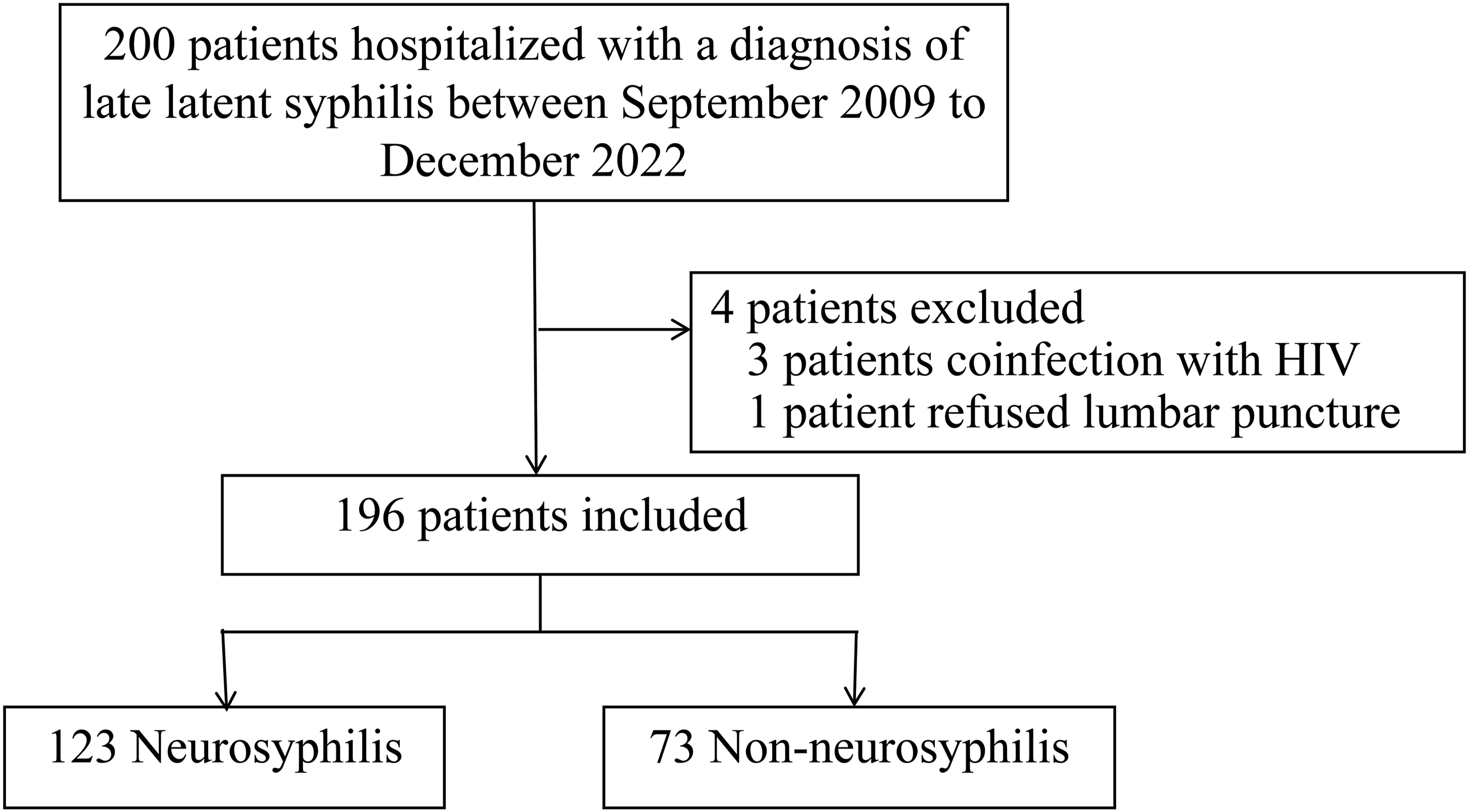
Demographic and clinical characteristics of the study population.
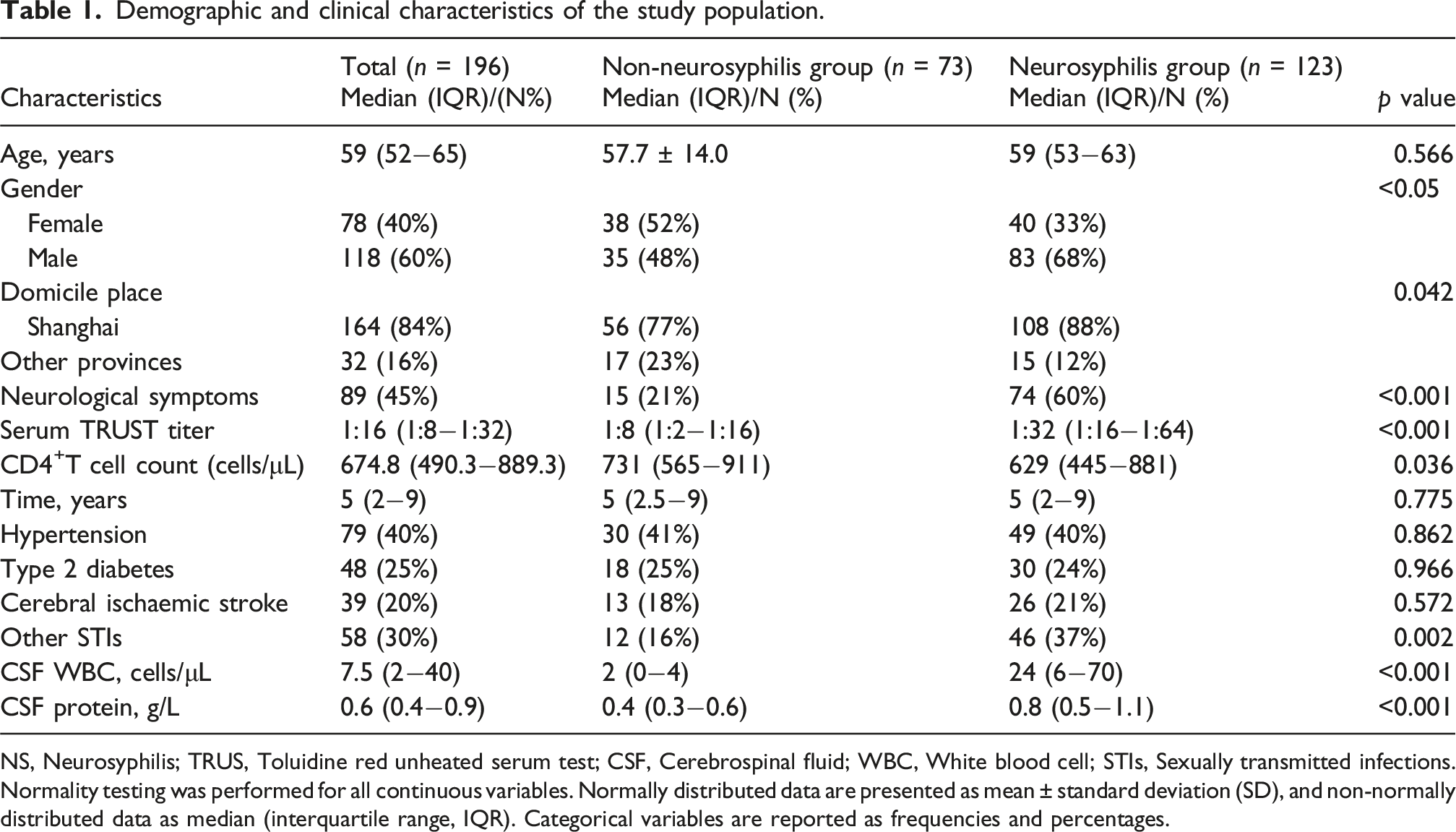
NS, Neurosyphilis; TRUS, Toluidine red unheated serum test; CSF, Cerebrospinal fluid; WBC, White blood cell; STIs, Sexually transmitted infections.
Normality testing was performed for all continuous variables. Normally distributed data are presented as mean ± standard deviation (SD), and non-normally distributed data as median (interquartile range, IQR). Categorical variables are reported as frequencies and percentages.
Predictors of neurosyphilis
Predictors of neurosyphilis according to univariable and multivariable logistic regression.

OR, Odds ratio; CI, Confidence interval; TRUST, Serum toluidine red unheated serum test; STI, sexually transmitted infection; CSF, Cerebrospinal fluid; WBC, White blood cell.
aOdds ratios were adjusted for age, gender, disease duration, syphilis serological titer, HIV infection, diabetes mellitus.
bCSF protein cutoff of 0.45 g/L is the screening cutoff used in univariate analysis.
Sensitivity and specificity analyses of serum TRUST titer, CSF protein, and CSF WBC
The evaluation of diagnostic tests of syphilitic indicators for neurosyphilis.
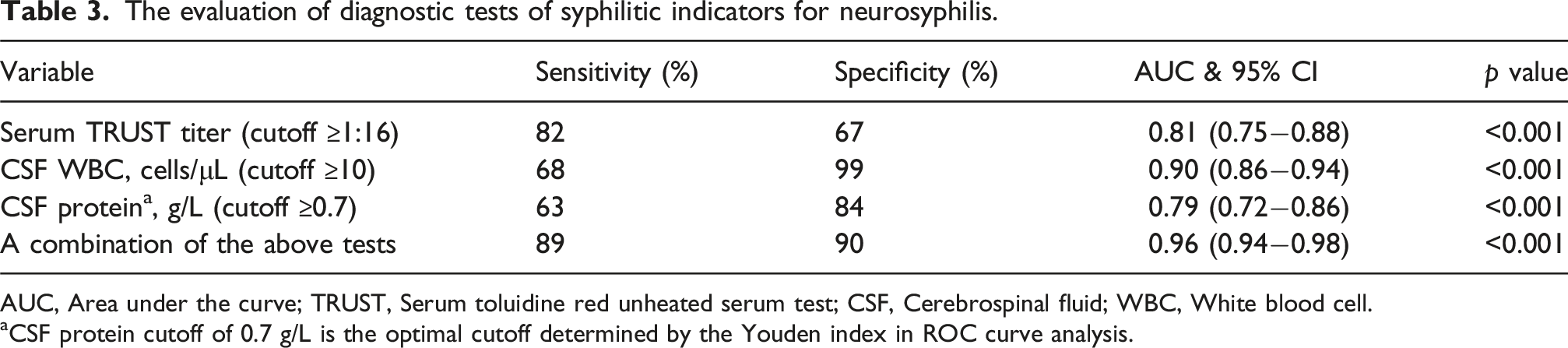
AUC, Area under the curve; TRUST, Serum toluidine red unheated serum test; CSF, Cerebrospinal fluid; WBC, White blood cell.
aCSF protein cutoff of 0.7 g/L is the optimal cutoff determined by the Youden index in ROC curve analysis.

Receiver operating characteristic curve for neurosyphilis indicators. The ROC curve analysis demonstrated that the combination of CSF WBC, CSF protein, and serum TRUST titer yielded the highest diagnostic accuracy for neurosyphilis (AUC = 0.96). Among the individual biomarkers, CSF WBC count demonstrated the strongest performance (AUC = 0.90), followed by serum TRUST titer (AUC = 0.81) and CSF protein (AUC = 0.79).
Discussion
Latent syphilis presents without symptoms and is detected through serological testing. 14 Inadequate or absent treatment can lead to central nervous system involvement15,16 and non-specific neuropsychiatric symptoms,17,18 which often delay diagnosis and increase both morbidity and transmission risk. 19 Limited laboratory testing and dependence on invasive CSF analysis create significant diagnostic challenges, 20 highlighting the need for increased clinical awareness and improved diagnostic methods.
This cross-sectional study assessed 196 patients with late latent syphilis who underwent LP to determine the independent clinical and laboratory predictors of NS, with all analyses benchmarked against the gold-standard CSF-VDRL. NS was diagnosed in 63% of these patients, a rate significantly higher than that previously reported, which challenges the prevailing assumption that late latent syphilis poses a low risk of neurological involvement. 21 This finding is clinically important because it indicates that a considerable proportion of patients may have undetected NS. Unrecognized cases can lead to delayed treatment and irreversible neurological complications, highlighting the need for improved risk stratification and targeted diagnostic strategies. In the absence of targeted screening, many cases of NS may remain undiagnosed, further supporting the importance of this study.
Elevated serum TRUST titers in late latent syphilis are associated with NS, particularly when accompanied by CSF protein levels and CSF WBC counts. These CSF abnormalities serve as direct indicators of neuroinflammatory activity associated with NS. 22 Previous research in HIV-infected patients has identified a serum RPR titer of 1:32 or higher as a predictor of NS. 23 In the present study, serum TRUST titers of 1:16 or higher were proposed as independent indicators of NS in HIV-negative patients with late latent syphilis. Elevated CSF protein levels (>0.45 g/L) and/or WBC >5.0 cells/μL serve as important biomarkers for screening presumptive NS 24 as they reflect underlying neuroinflammatory activity. Consistent with these findings, mean CSF protein levels were higher in symptomatic-NS patients (0.91 g/L [0.61, 1.22]), compared to asymptomatic-NS patients(0.72 g/L [0.46, 0.88]; p = 0.001). However, mean CSF WBC levels did not differ significantly between symptomatic NS (25 cells/μL [7.75, 67]) and asymptomatic NS (24 cells/μL [4.5, 70]) patients (p = 0.764) (Supplemental Materials: Table 1).
This study identified a set of accessible serum and CSF parameters that could enhance the diagnosis of NS in patients with late latent syphilis. Previous studies have inconsistently linked individual markers, such as elevated serum TRUST titers or CSF abnormalities, with NS risk, and no validated combination of these parameters has been widely implemented in clinical practice. 25 Our findings demonstrate that elevated serum TRUST titer (≥1:16), CSF protein (≥0.7 g/L), and CSF WBC count (≥10 cells/μL) serve as independent predictors of NS. The combination of these three markers yields a sensitivity of 89%, specificity of 90.4%, and an AUC of 0.96 (95% CI, 0.94−0.98), which is valuable for identifying patients at high risk. While a high serum TRUST titer alone exhibits limited sensitivity and specificity, its combination with CSF indicators enhances diagnostic reliability. This strategy is particularly advantageous in resource-limited settings where advanced diagnostic tools are unavailable.
These findings have important clinical implications for patient management. The high incidence of NS (63%) among late latent syphilis patients who underwent LP underscores a considerable neurological burden. Since CSF WBC and CSF protein are obtainabe only after LP, the present model serves as a practical tool for risk stratification and interpretation of CSF results after LP, rather than for per-LP decision making.26,27 Using serum TRUST titers and CSF indicators provides a practical, data-driven method for diagnosing NS when VDRL reagents are unavailable or testing is not possible. Applying established cutoff values enables clinicians to stratify patients with greater confidence. For example, a CSF WBC count ≥10 cells/μL (specificity 99%) can help confirm NS after LP. This supports timely diagnosis and penicillin treatment, which are critical for preventing severe complications, such as stroke or dementia, 28 and aids reliable interpretation of results rather than reducing the number of LPs.
Limitations
This study had several limitations. First, the retrospective, single-center design may restrict the generalizability of the results to other regions or healthcare settings with different patient populations and syphilis management protocols. Second, NS was diagnosed based on CSF-VDRL reactivity, which remains the gold standard. However, its limited sensitivity may lead to undetected cases and introduce bias in the evaluation of the predictive performance of biomarkers. Third, Selection bias may be present because only patients who underwent LP were included, potentially overrepresenting those with a higher clinical suspicion of NS and overestimating the association between the identified predictors and NS. Fourth, the combined diagnostic model showed excellent apparent discriminatory performance in the present study. However, since the model was developed and evaluated using the same retrospective dataset without internal or external validation, the reported AUC may be somewhat optimistic. Further internal validation or external validation in independent cohorts is required before broader clinical application. Fifth, although age was adjusted for in the analysis, other potential confounding factors such as infection duration and host genetic factors were not fully accounted for. Future prospective, multicenter studies with larger sample sizes are warranted to reduce selection bias and validate these predictors. Use of alternative diagnostic standards will also improve the reliability of these findings.
Conclusion
In summary, a composite panel of elevated serum TRUST titer (≥1:16), CSF WBC count (≥10 cells/μL), and CSF protein (≥0.7 g/L) level strongly predicts NS in HIV-negative patients with late latent syphilis. Since CSF paremeters are available only after LP, the combined use of these indicators - directly compared with the gold-standard CSF-VDRL - provides high diagnostic accuracy (AUC = 0.96) and is best applied as a post-LP tool for risk stratification and interpretation of CSF findings. These results highlight the value of readily available laboratory markers in improving diagnostic precision and guiding management. Future prospective, multi-center studies with novel biomarkers and clinical endpoints are needed to validate these predictors and further improve prognostic assessment in NS.
Supplemental material
Supplemental Material - Serum Toluidine Red Unheated Serum Test (TRUST) titer and cerebrospinal fluid parameters as predictors of neurosyphilis in HIV-negative people with late latent syphilis
Supplemental Material for Serum Toluidine Red Unheated Serum Test (TRUST) titer and cerebrospinal fluid parameters as predictors of neurosyphilis in HIV-negative people with late latent syphilis by Lin Zhu, Xin Gu, Liyan Ni, Wei Zhao, Zhifang Guan, Haikong Lu and Pingyu Zhou in International Journal of STD & AIDS
Footnotes
Acknowledgements
We greatly appreciate all patients for their cooperation.

Ethical considerations
This study involves human participants and was approved by the Shanghai Skin Disease Hospital Ethics Committee (reference number: 2020-16). Written informed consent was obtained from all the patients. This study was performed according to the STROBE guidelines.
Consent to participate
All participants provided informed consent before participating in the study.
Funding
The authors disclosed receipt of the following financial support for the research, authorship, and/or publication of this article: This work was supported by grants from the National Natural Science Foundation of China (82072322, 82103739, 82472329), Shanghai Science and Technology Commission (17DZ2293300, YDZX20193100002868).
Declaration of conflicting interests
The authors declared no potential conflicts of interest with respect to the research, authorship, and/or publication of this article.
Data Availability Statement
All data relevant to the study are included in the article or uploaded as supplementary information.
Provenance and peer review
Not commissioned; externally peer reviewed.
Supplemental material
Supplemental material for this article is available online.
References
Supplementary Material
Please find the following supplemental material available below.
For Open Access articles published under a Creative Commons License, all supplemental material carries the same license as the article it is associated with.
For non-Open Access articles published, all supplemental material carries a non-exclusive license, and permission requests for re-use of supplemental material or any part of supplemental material shall be sent directly to the copyright owner as specified in the copyright notice associated with the article.
