



Abstract
Background
Reports on bladder cancer among people living with HIV (PLWH) are very limited. In this case series, we investigated the clinical characteristics, pathology, treatments, adjuvant therapy, and survival of bladder cancer in PLWH.
Methods
This case series identified all PLWH treated for bladder cancer at our institution between 2013 and 2023 through review of medical records. Clinical data were presented as descriptive statistics. We estimated median and 1-, 3-, and 5-years cancer-specific survival using the Kaplan–Meier method and conducted univariate Cox analyses to evaluate variables associated with cancer-specific survival.
Results
Twenty PLWH underwent treatment for bladder cancer during the study period. All patients were male with a median age of 56 years. Radical cystectomy was performed in four patients (20%) and transurethral resection of bladder tumor in sixteen (80%). Adjuvant immunotherapy (tislelizumab) combined with chemotherapy (gemcitabine and cisplatin) was used in six patients after radical cystectomy. In the Kaplan–Meier analysis, the 1-, 3-, and 5-years cancer-specific survival rates of the cohort were 85%, 65%, and 60%, respectively. In univariate analysis, higher tumor stage (stage >T1 vs T1) was significantly associated with cancer-specific survival.
Conclusions
Given the relatively young age and aggressive pathological features observed in this case series, further research is warranted to determine whether targeted screening in PLWH could be beneficial. Limited data preliminarily suggest that intravesical chemotherapy with pirarubicin and adjuvant immunotherapy combined with chemotherapy may be safe and effective options for PLWH with bladder cancer; however, these observations require validation in larger studies. PLWH with muscle-invasive bladder cancer appear to have poorer cancer-specific survival.
Introduction
With the widespread adoption of antiretroviral therapy (ART), life expectancy among people living with HIV (PLWH) has increased markedly. 1 Notably, the incidence of non-AIDS-defining cancers (NADCs) has risen steadily, now accounting for one quarter to one third of all deaths in this population.2–4 Bladder cancer, a NADC, ranked 12th in global incidence among 36 cancers in 2020, with 570,000 new cases worldwide. 5
Data on bladder cancer in PLWH remain limited. To our knowledge, the first report originated from Uganda, where a decline in bladder cancer incidence coincided with the emergence of HIV. 6 Similarly, the US HIV Cancer Match Study reported a lower bladder cancer incidence in PLWH than in the general population (standardized incidence ratio [SIR] = 0.7). 7 However, a French series of 15 PLWH with baldder cancer suggested that HIV was associated with poorer outcomes. 8 A subsequent US study of 11 such patients found they presented at a younger age with only mild immunosuppression, yet their disease course resembled that of the general population. 9
In 2010, Chinese researchers identified two bladder cancer cases in a cohort of 3554 PLWH—the first study in China to estimate cancer incidence in this population—reporting an SIR of 4.9 and poorer outcomes. 10 Nevertheless, reports on bladder cancer in PLWH remain scarce and inconclusive regarding incidence, risk factors, pathology, and outcomes. In this preliminary study—the largest to date—we investigated the clinical characteristics, treatments, pathology, long-term survival, and HIV-related parameters in PLWH with bladder cancer.
Methods
We reviewed the medical records of patients treated at the Department of Urology, Beijing Youan Hospital, Capital Medical University, between 2013 and 2023, identifying those with both HIV and bladder cancer. Demographic, clinical, and HIV-related data were collected. For HIV-related parameters, CD4 count was measured within 2 weeks before bladder cancer diagnosis, and HIV viral load was measured within 3 months before diagnosis. Viral suppression was defined as HIV RNA <40 copies/mL.Nadir CD4 count means the lowest historical CD4 count. Duration of ART prior to cancer diagnosis was also recorded. Treatment protocols, pathology results, and long-term survival were documented.
After radical cystectomy (RC), patients received adjuvant gemcitabine-cisplatin plus tislelizumab (TGC). Treatment-related adverse events and response (objective, partial, and complete) were assessed at baseline and every 12 weeks until progression, unacceptable toxicity, or death.
Descriptive statistics characterized the cohort. Cancer-specific survival (CSS) was estimated using Kaplan–Meier analysis, and predictors were evaluated with univariate Cox proportional hazards models (SAS 9.3; significance at p < 0.05). Variables included in the univariable Cox regression analyses were selected based on clinical relevance and previously reported prognostic factors in bladder cancer. In the univariate Cox regression analyses, each variable was assessed individually without adjustment for other covariates, as the small sample size precluded multivariate modelling. The proportional hazards assumption was tested for each categorical variable by inspecting log-minus-log survival plots; all variables satisfied the assumption, as indicated by approximately parallel curves.
This study was reviewed and approved by the Ethics Committee of Beijing Youan Hospital, Capital Medical University (Approval No. [2020]035). The study was conducted in accordance with the Declaration of Helsinki. Written informed consent was obtained from all individual participants included in the study.
Results
Clinical characteristics
Clinical characteristics and HIV-relevant parameters.
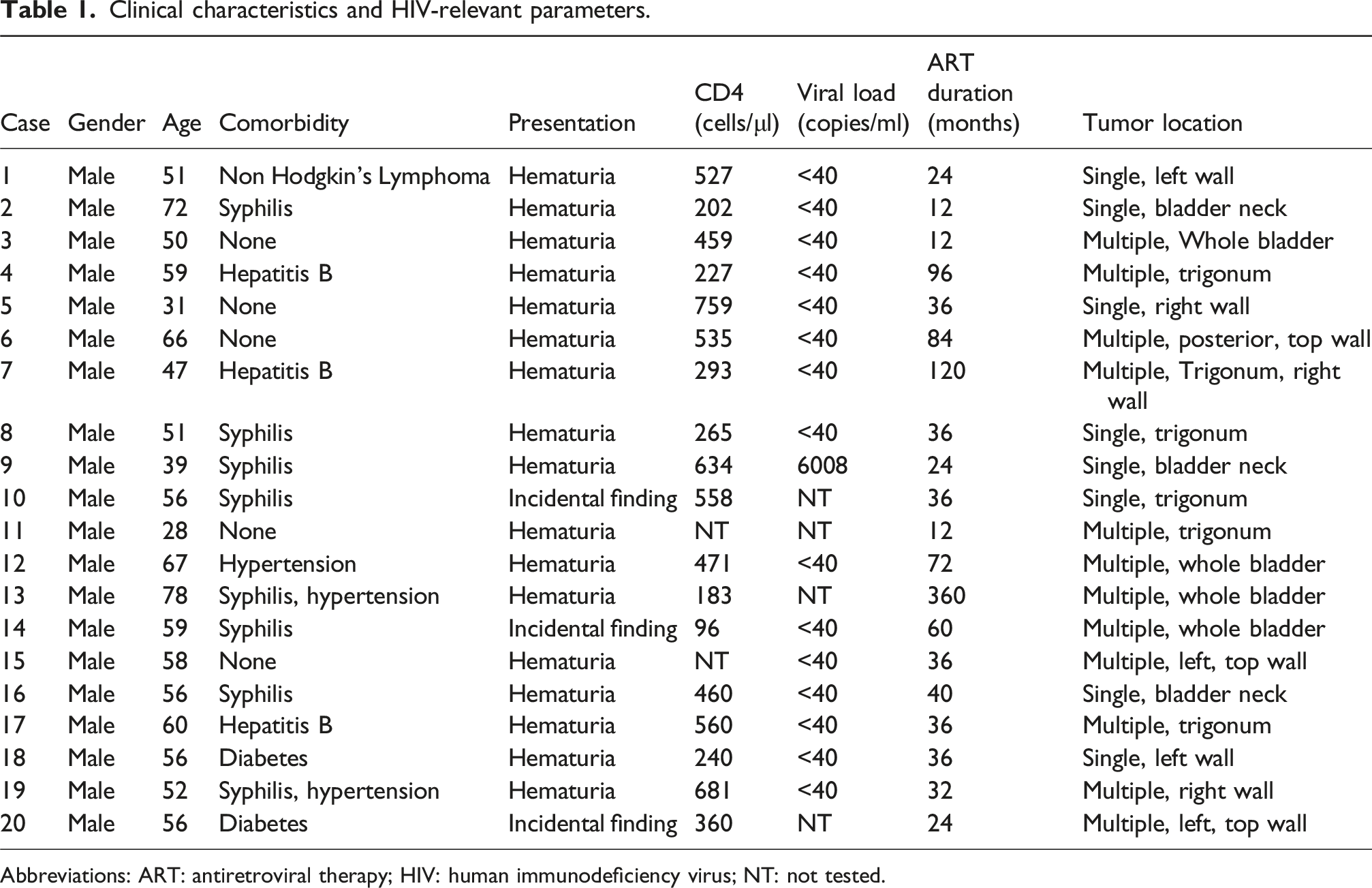
Abbreviations: ART: antiretroviral therapy; HIV: human immunodeficiency virus; NT: not tested.
HIV-relevant parameters
All patients had accepted regular ART for a median of 36 months (range 12–360) prior to bladder cancer diagnosis. Viral load was measured in 16 patients within 3 months before diagnosis: fifteen had <40 copies/mL, and one had 6008 copies/mL. The median CD4 count within 2 weeks before diagnosis was 459/µL (range 96–759) (Table 1).
Pathology
Pathological analysis confirmed transitional cell carcinoma (TCC) in all cases. Eight patients (40%) had low-grade TCC at diagnosis; twelve had high-grade or invasive TCC. Among those with high-grade TCC, four experienced one (n = 3) or two (n = 1) recurrences. One patient with initial low-grade TCC developed high-grade focal recurrence. Thirteen patients (65%) had non-muscle-invasive bladder cancer (NMIBC); seven had muscle-invasive bladder cancer (MIBC) (≥pT2N0M0), including two with progression to MIBC after recurrence. Among MIBC cases, invasion of the prostatic urethra (n = 1) or perivesical tissues (n = 1) was observed.
Treatment
All patients underwent surgery at initial diagnosis: radical cystectomy (RC) in four (20%) and transurethral resection of bladder tumor (TURBT) in 16 (80%). Among those undergoing TURBT, four experienced a single relapse (including one who underwent cystectomy post-recurrence), and one underwent two TURBT procedures for recurrence followed by radical cystectomy and urethrectomy for urethral invasion. All patients with NMIBC received at least 6 months of conventional intravesical chemotherapy (pirarubicin 30 mg), with mild bladder irritation as the only adverse reaction (n = 1). During a median follow-up of 63 months (range 25–112), eight patients (six with MIBC) progressed to metastatic disease.
Adjuvant therapy
Among the six patients who received adjuvant tislelizumab plus gemcitabine–cisplatin (TGC) after RC, one (16.7%) achieved complete response, three (50%) partial response, one (16.7%) stable disease, and one (16.7%) progressive disease after ≥4 cycles. All six experienced treatment-related adverse events, most commonly nausea/vomiting (66.7%), leukopenia (66.7%), and anemia (50%). Grade ≥3 treatment-related adverse events occurred in three patients, including leukopenia (50%), anemia (33.3%), and nausea/vomiting (33.3%).
Long-term survival
Cancer-specific survival stratified by clinical and HIV-related variables.

Abbreviations: CSS: cancer-specific survival; NR: not reached; NMIBC: non-muscle-invasive bladder cancer; MIBC: muscle-invasive bladder cancer.
Events: number of cancer-specific deaths.
Univariable Cox regression analysis for cancer-specific mortality.
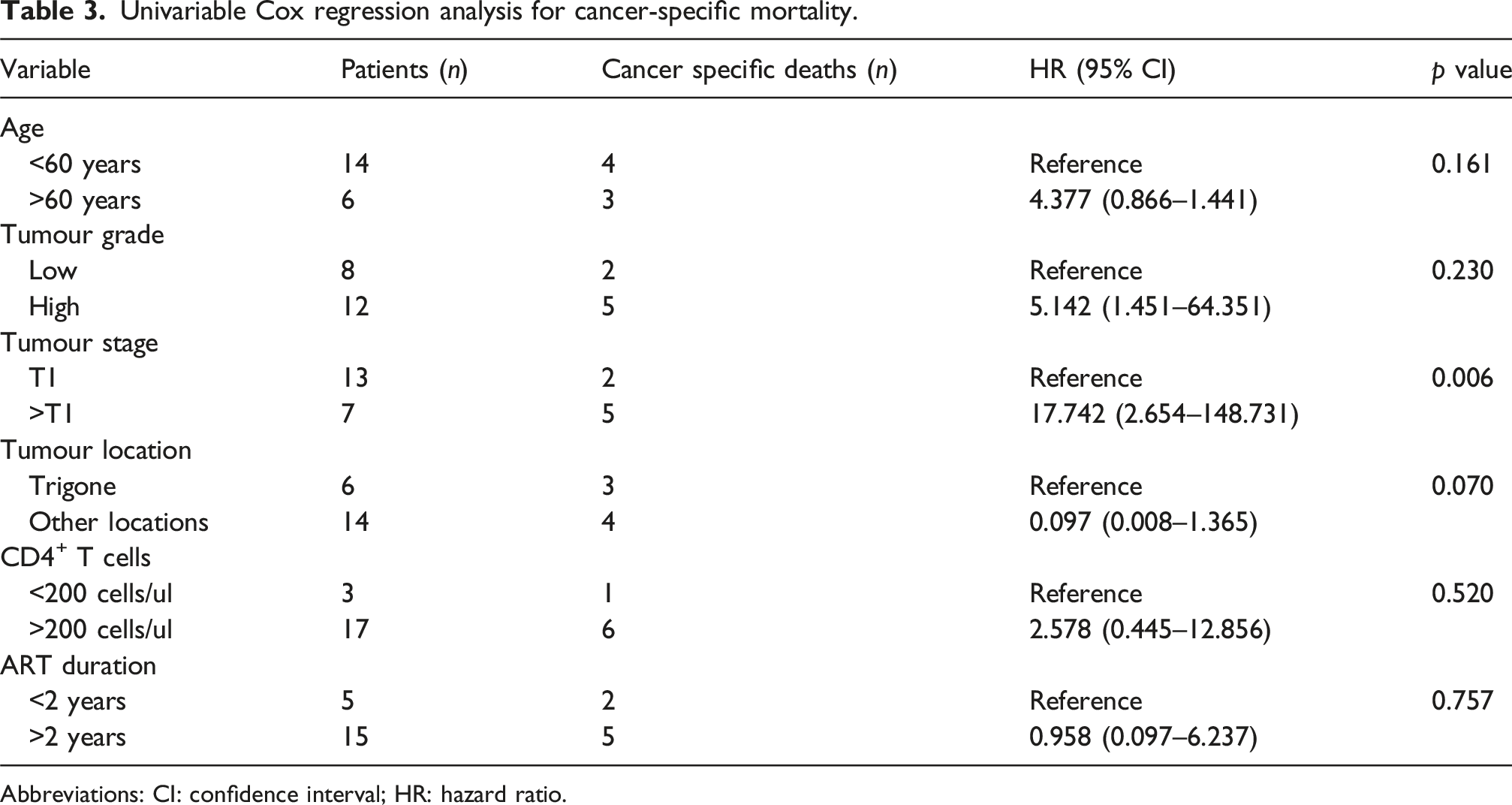
Abbreviations: CI: confidence interval; HR: hazard ratio.
Discussion
The median age at bladder cancer diagnosis in this cohort was 56 years, consistent with prior reports in this population (55–56 years)8,9 but appeared lower than that in the general population (65–70 years). 11 All patients were male, which aligns with the well-documented male predominance in bladder cancer (3–4 times higher incidence than in females).5,11,12
In our cohort, 35% of patients had MIBC, of whom 60% had high-grade histology—similar to previous findings in PLWH but appeared higher than in the general population.8,13 Among NMIBC patients receiving regular intravesical pirarubicin after TURBT, relapse occurred in five (33.3% of those initially diagnosed with stage T1 disease). This relapse rate compared favorably with the >75% recurrence expected without intravesical therapy and the 39% relative risk reduction reported with intravesical chemotherapy. 14 Only one mild adverse event (bladder irritation) occurred, suggesting pirarubicin is safe in PLWH.
Intravesical bacille Calmette-Guérin (BCG), the preferred treatment for high-risk NMIBC, relies on CD4 + T-cell activation and theoretically risks disseminated infection in PLWH. 15 While routine use of BCG in this population is not generally recommended, limited evidence—including one patient with HIV who tolerated BCG without complications or relapse 9 and three renal transplant recipients who received BCG with prophylactic antituberculosis therapy without systemic infection 16 —suggests that BCG may be feasible in selected cases with appropriate precautions.
Many studies are underway exploring or have initially confirmed the efficacy and safety of immune checkpoint inhibitors in combination with platinum-based chemotherapy in MIBCs.17,18 The use of TGC in locally advanced bladder cancer patients was recently demonstrated to have encouraging antitumor activity and good tolerability. 19 In our study, the confirmed objective responses was 66.7%,which is compared favorably with that reported in recent literature. On the other hand, the incidence of treatment-related adverse events was also similar to that reported previously. 20 Our limited data preliminarily suggest that the TGC regimen is safe and effective, however more definitive conclusions require further validation through larger-sample studies.
Multiple factors influence long-term outcomes in bladder cancer, with tumor stage, grade, gender, and age well-established as prognostic determinants.21,22 In our cohort, univariate analysis identified tumor stage as the only factor significantly associated with long-term survival; age, tumor grade, and HIV-related parameters (CD4 count, ART duration) were not statistically significant. However, given the small sample size and exploratory nature of these analyses, these findings should be interpreted with caution and require confirmation in larger studies.
Prior studies report 5-years CSS of approximately 90% for males with NMIBC versus 27.1–65.5% for MIBC, depending on substage. 23 In our series, CSS among NMIBC patients appeared to approximate that of the general population, whereas MIBC patients had 0% 5-years CSS—a marked divergence consistent with findings in other HIV-associated malignancies (e.g., lung, colorectal cancer), where advanced-stage tumors portend worse outcomes.24,25
This study has several limitations. As a single-center case series, it is subject to inherent biases and lacks a control group of HIV-negative patients, precluding causal inferences about HIV’s impact on bladder cancer outcomes; all comparisons with the general population are descriptive only. The small sample size (n = 20), due to the rarity of this population, limits statistical power and generalizability; our findings are exploratory and require validation in larger, controlled studies. Additionally, smoking data from medical records may be underreported due to incomplete documentation. Despite these limitations, this is the largest single-center series to date on HIV-related bladder cancer, providing valuable descriptive data for future research.
Conclusions
Given the relatively young age and aggressive pathological features observed in this case series, further research is warranted to determine whether targeted screening in PLWH could be beneficial. Limited data preliminarily suggest that intravesical chemotherapy with pirarubicin and adjuvant TGC therapy may be safe and effective options for PLWH with bladder cancer; however, these findings should be considered exploratory and require validation in larger, prospective studies. PLWH with muscle-invasive bladder cancer appear to have poorer CSS, consistent with the prognostic significance of tumor stage observed in the general population.
Footnotes
Acknowledgments
We would like to thank our collaborators in the pathology and radiology departments at Beijing Youan Hospital for their assistance with this study.

Author contributions
Mengmeng Zhang contributed research design, data collection, manuscript writing/editing. Zhiqiang Zhu contributed statistic analysis.Yanyan Zhang performed the imaging analysis.Yu Zhang revised the manuscript. Hui Liu was responsible for pathological analysis. All authors read and approved the final manuscript.
Funding
The authors received no financial support for the research, authorship, and/or publication of this article.
Declaration of conflicting interests
The authors declared no potential conflicts of interest with respect to the research, authorship, and/or publication of this article.