




Abstract
A cartoon historian discusses the key figures in posters, postcards and other printed ephemera published during the First World War
Posters were displayed widely in Britain during the First World War, on hoardings, public buildings, shop windows, buses, trams, railway stations and the Underground – even on the base of Nelson's column in Trafalgar Square. Whether for recruitment, war savings, food campaigns or general propaganda, they – along with numerous comic pictorial postcards and other ephemera – were produced right through the conflict. The most famous was the image, by Alfred Leete (1882–1933), of Kitchener with his pointing finger inviting men to volunteer for service in the British Army.
Leete's poster was published by the all-party Parliamentary Recruiting Committee (PRC) that by August 1915 had distributed 54 million posters throughout the UK. In total, 130 different designs had been produced (often in editions of 10,000 copies or more) before conscription was introduced in May 1916, and the campaign was a great success. The original British Expeditionary Force of 100,000 men had suffered major casualties on the Western Front and the appeal by Lord Kitchener (who was then War Secretary) for a further 100,000 men was far surpassed, with 500,000 signing up in the first month alone.
The first PRC poster was purely typographical and incorporated Lord Nelson's famous exhortation. It read: “England Expects Every Man To Do His Duty and Join the Army To-Day”. By coincidence it was published in October 1914, the same month as Nelson's great victory at the Battle of Trafalgar in 1805.
Leete's drawing was based on his earlier cover design for London Opinion (issue September 5, 1914), but with an additional strapline, as Kitchener insisted that all advertising for the British Army should end with the words “God Save the King”. The poster later inspired US, Italian, German and Hungarian wartime variants and pastiches continue to this day.
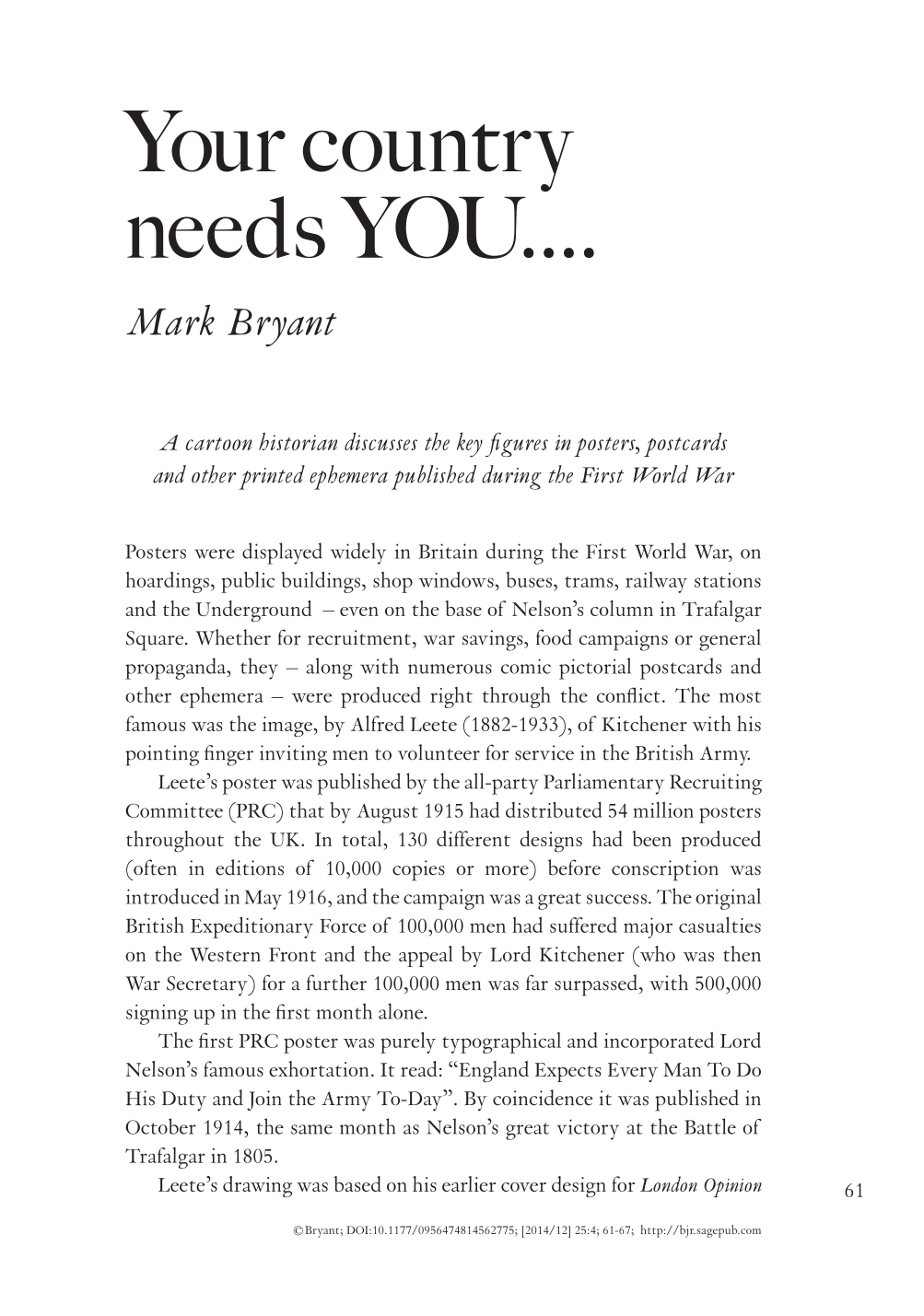
Another well-known recruiting poster was “Daddy, what did YOU do in the Great War?” (1915).  Drawn by Savile Lumley (1876–1960) it features a little girl sitting on her father's lap and asking this question as her brother plays with soldiers at his feet. Amongst the many pastiches of this guilt-inducing drawing was the 1930s anti-appeasement cartoon “What are YOU Going to Do in the Great Peace, Daddy?” (Punch, October 12, 1938) drawn by EH Shepard, who is perhaps best known today for his illustrations to Winnie the Pooh.
A much-plagiarised recruiting poster (notably in France and the USA) was “Take up the Sword of Justice” (PRC poster No.105, 1915) by Punch magazine's main wartime cartoonist, Bernard (later Sir Bernard) Partridge (1861–1945). It features the figure of Justice, holding a sword in her right hand and floating above a seascape littered with bodies. On the horizon can be seen the transatlantic liner Lusitania, which is sinking fast after being torpedoed by a German submarine. (A number of Partridge's Punch cartoons were also used as wartime posters.)
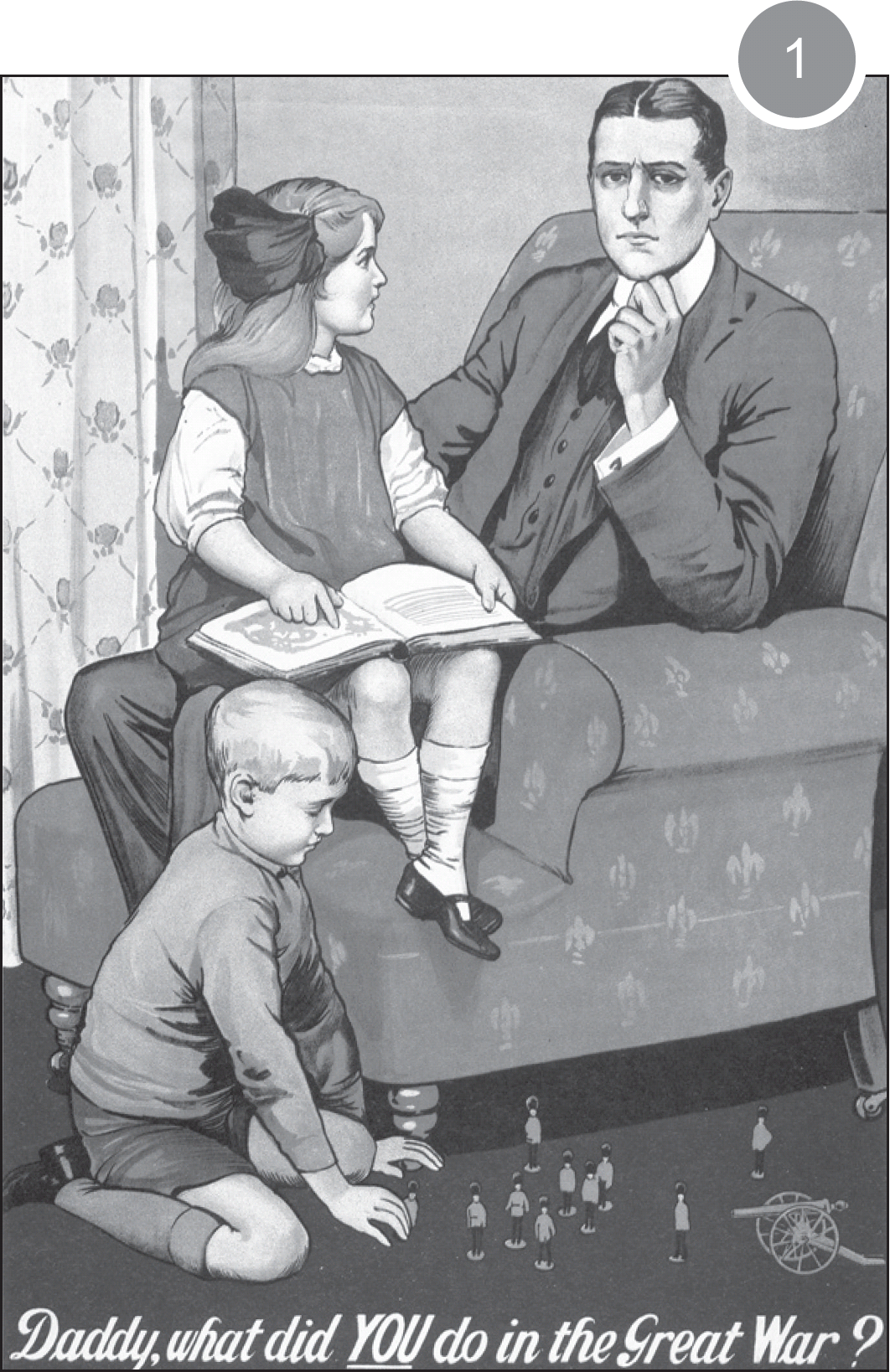
The PRC also published a colour poster drawn by Lt-General Sir Robert Baden-Powell (1857–1941), hero of the defence of Mafeking in the Boer War and founder of the Boy Scouts. In “Are YOU in This?” (No.112, 1915),  a bow-tied civilian with his hands in his pockets is shown looking at a soldier, a sailor, a nurse, munition workers and a Boy Scout (who hands ammunition to the soldier). Baden-Powell's horse Black Prince features in another poster, “Forward! Forward to Victory – Enlist Now” (No. 133, 1915), by the famous horse-painter (and illustrator of Black Beauty), Lucy Kemp-Welch (1869–1958).
Another artist working for the PRC was Clarence Lawson Wood (1878–1957), who served as an officer in the Kite Balloon Wing of the Royal Flying Corps and later became famous for his humorous animal subjects, especially Gran'pop the artful ginger ape. Lawson Wood designed a group of posters framed with the general wording “Your King and Country Need You to Maintain the Honour and Glory of the British Empire”. One of these, “A Chip off the Old Block” (No.18, 1914) depicts a medal-wearing veteran shaking hands with a soldier.
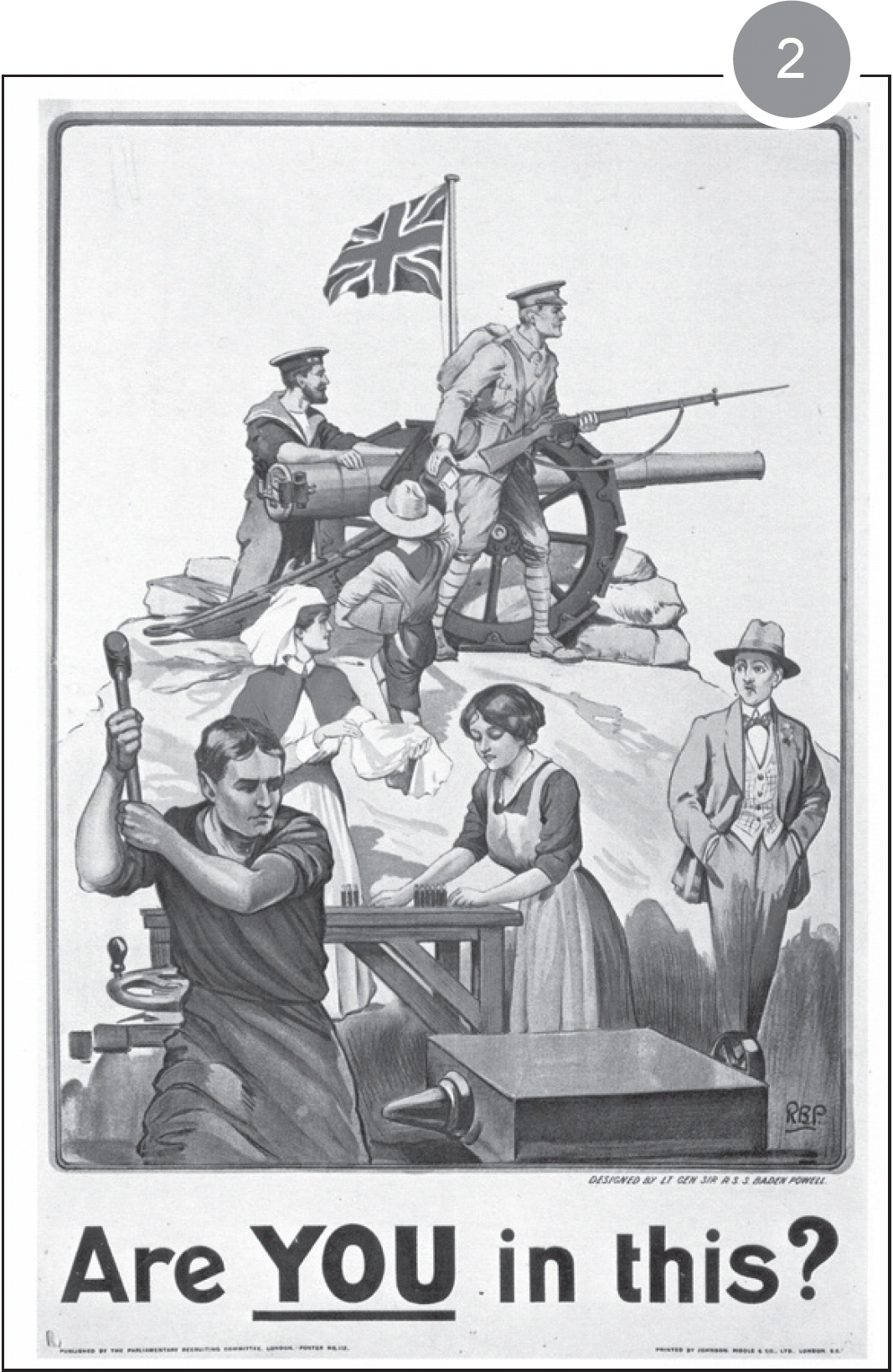
An earlier poster in the PRC series (No. 11, 1914) was EV Kealey's soldier image “Follow Me! Your Country Needs You”. Kealey also drew “Women of Britain say – GO!” (No.75, 1915)  featuring a mother, daughter and small boy looking out of a window at new recruits marching off to war. The original artwork was evidently flipped for publication, as on the poster the mother's wedding ring is on her right hand and the four soldiers all have their rifles on their right shoulders.
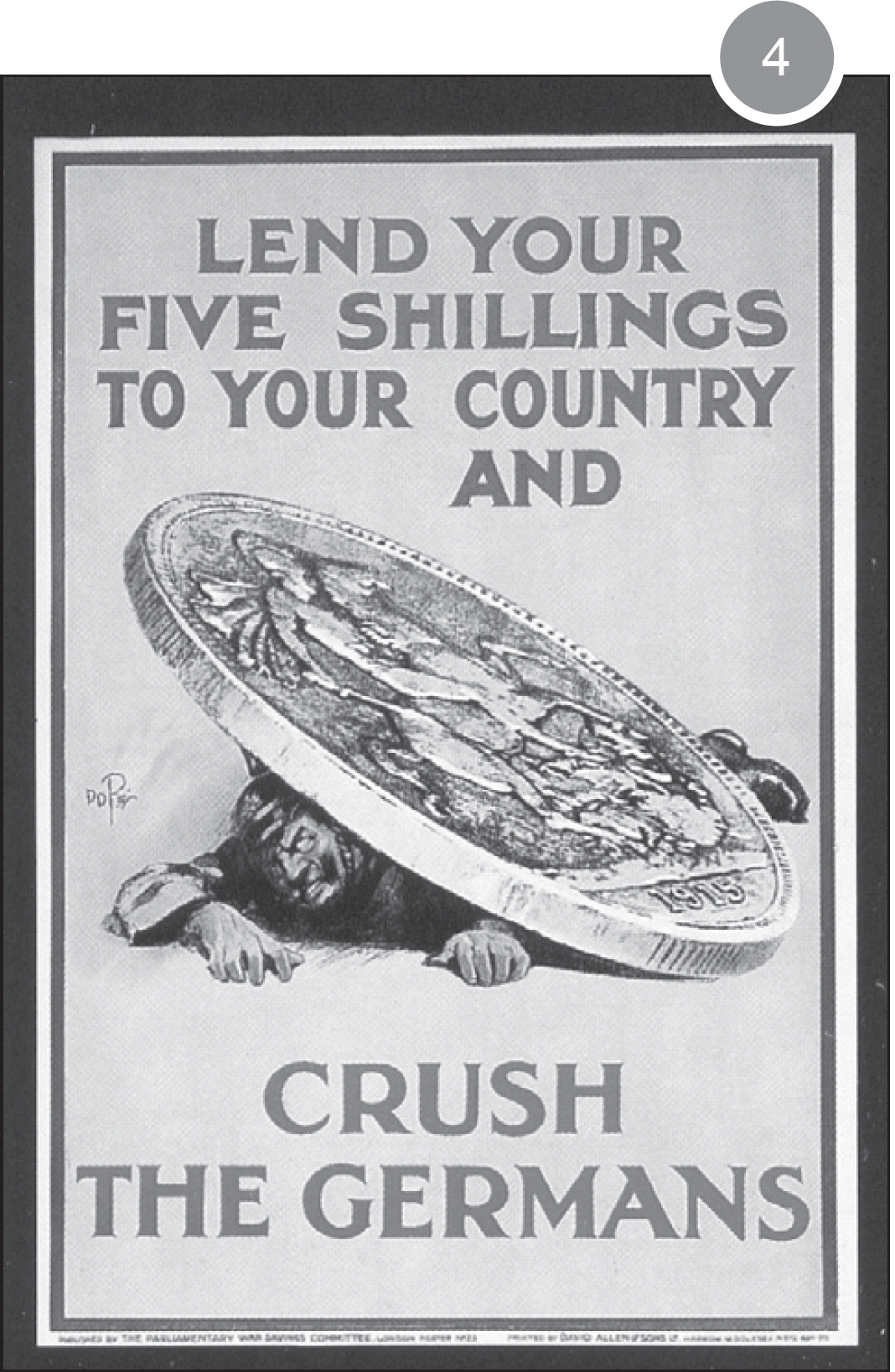
EV Kealey also drew for the Parliamentary War Savings Committee (“Back them up: Invest in the War Loan”) and a well-known cartoon poster by an unidentified artist for the same organisation was “Lend Your Five Shillings to Your Country and Crush the Germans” (No.23, 1915),  with the Kaiser being flattened by a huge coin (Abel Faivre produced a similar design for France's own War Loan campaign).
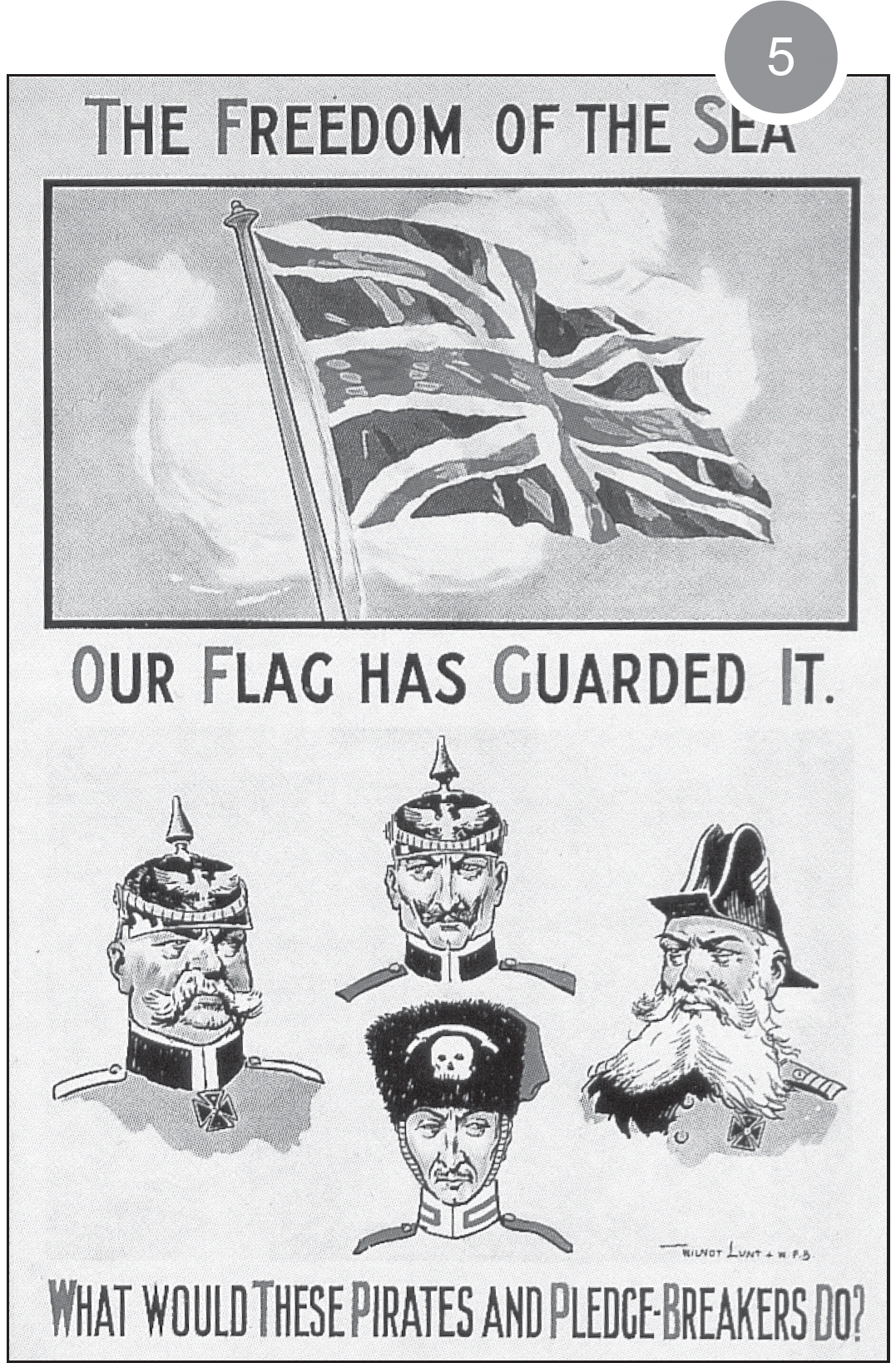
General propaganda posters using cartoons included Wilmot Lunt's “The Freedom of the Sea” (c1915).  Below the words “Our Flag Has Guarded It”, can be seen caricatures of Hindenburg, the Kaiser, Crown Prince Wilhelm and Grand Admiral Von Tirpitz and the words “What Would These Pirates and Pledge-Breakers Do?”.
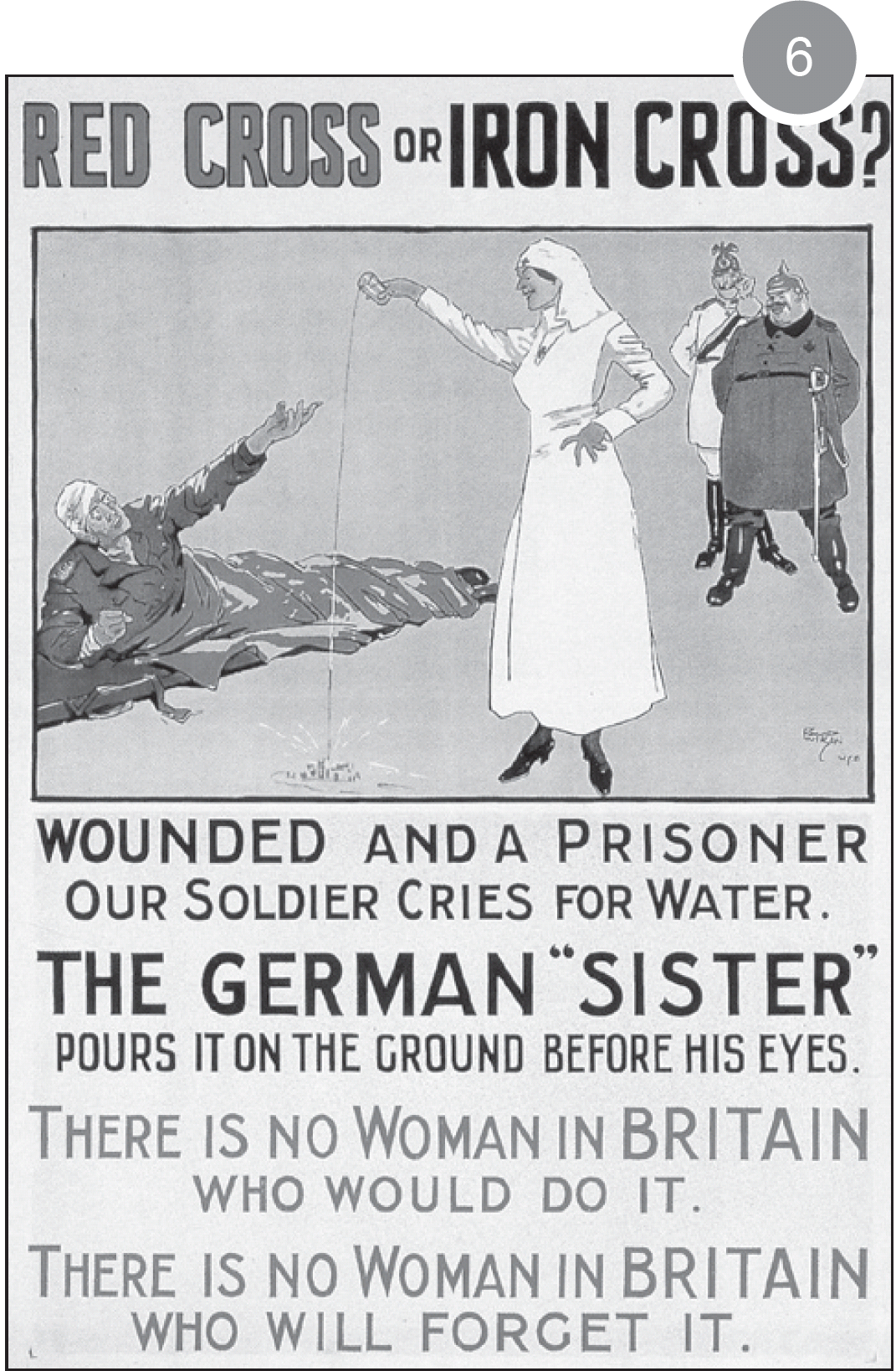
Rather darker, more hate-filled propaganda posters were those designed by David Wilson (1873–1935), such as “Red Cross or Iron Cross?” (1915),  showing a German nurse denying water to a wounded British prisoner. Others included “How the Hun Hates!” (c1915), in which captured British fishermen accused of being mine-layers are humiliated by being paraded in front of German citizens with half their hair and beards shaved off, and “The Hun and the Home” (c1918) comparing buildings in England with the devastation in Belgium.
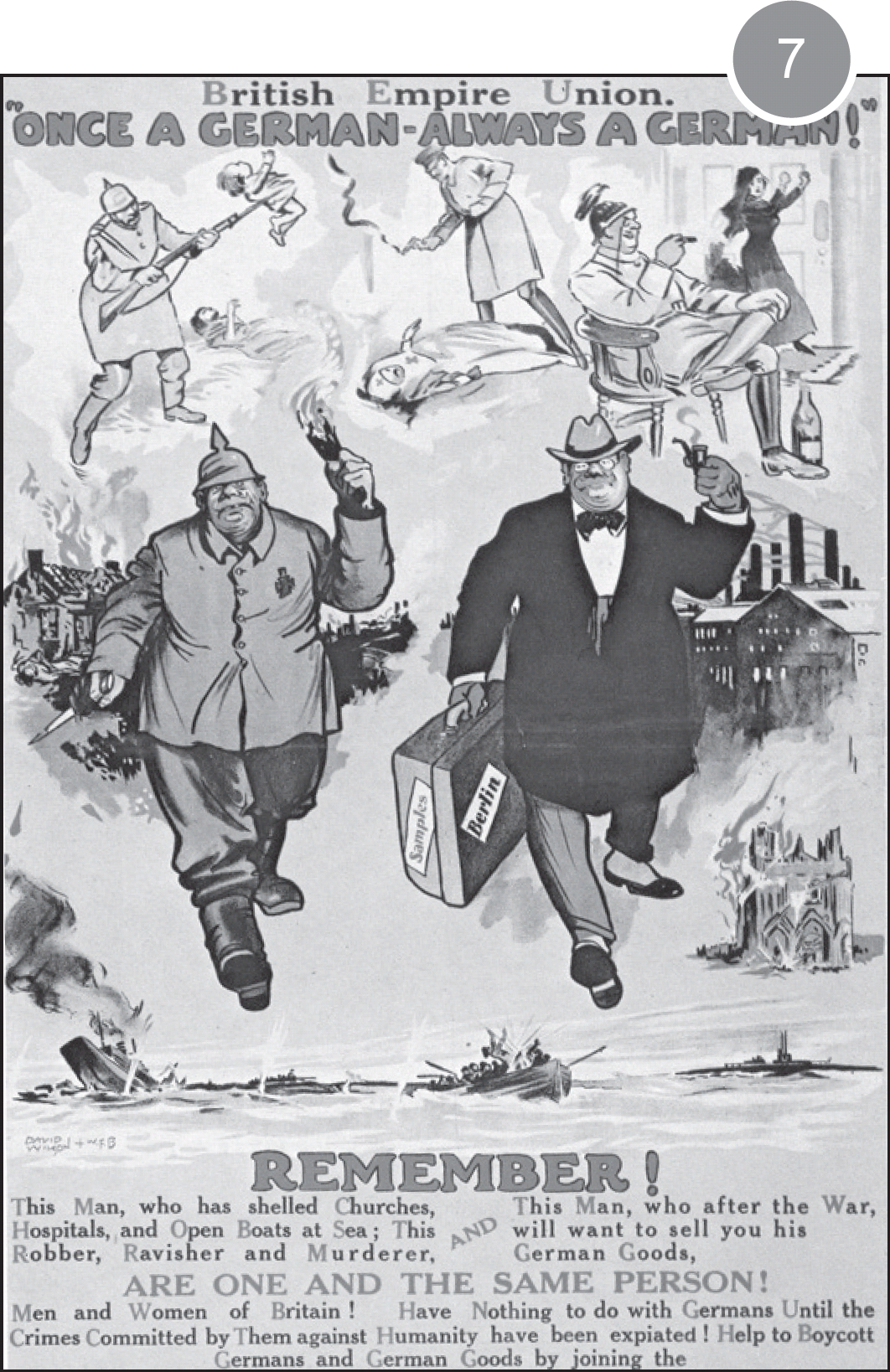
Another of Wilson's posters, “Once a German – Always a German!” (1918),  was intended to discourage postwar trade with Germany by detailing images of alleged atrocities committed by German troops during the war years. This latter poster was originally published in the December 1917 issue of the Monthly Record of the British Empire Union and was later translated into Portuguese. It was also used as a cinema film, being drawn “live” on screen.
The wartime posters of Leonard Raven Hill (1867–1942) included a number of enlarged black-and-white reproductions of his Punch cartoons, such as “To Arms” (1914). However, he also drew a more gruesome colour image, “Not Much!”, featuring a bloody-handed Kaiser saying to John Bull: “Won't You Shake Hands?” and receiving the answer: “Not Till You've Cleaned Yourself!”
A popular cartoon poster (by Wippell) of a hen dressed in a Union Flag bonnet and shawl and carrying two baskets of eggs, was produced for The National Egg Collection for the Wounded.  Started in August 1915, the campaign had Queen Alexandra (Edward VII's widow) as its patron and aimed to collect 200,000 eggs per week for Britain's wounded soldiers and sailors. By 1918 more than 40 million eggs had been sent to UK hospitals as well as to military hospitals in France and elsewhere.
The largest poster produced in Britain during the First World War was an oil painting created by Bert Thomas (1883–1966) for the War Bonds campaign in 1918. Covering the front of the National Gallery in Trafalgar Square, it was 75 feet long and depicted Sir Francis Drake facing the Spanish Armada. Thomas's famous “ ‘Arf a Mo’, Kaiser!” cartoon from the Weekly Dispatch' Tobacco for the Troops fund was also reproduced as a poster and another of his drawings for the “Smoke Fund” was “Thumbs Up” (1917) featuring a wounded soldier and sailor (with the word “Excellent” on his cap). In addition Thomas produced “If Others Did Not Buy War Bonds What Would Your Money Be Worth? Do Your Duty Too!” (1917), showing a German soldier standing in front of St Paul's Cathedral in flames, and “Joan of Arc Saved France. Women of Britain Save Your Country – Buy War Savings Certificates” (1918).
Picture postcards, both in colour and black and white, were very popular during the war years and reprints of famous cartoons were common. Gale & Polden republished drawings by Bert Thomas (including “Arf a Mo', Kaiser!”) and the Bystander reissued (from 1916) some of Bruce Bairnsfather's “Fragments from France” cartoons in nine series of six postcards. In addition The Syren & Shipping produced sets of postcards of the naval cartoons of EGO Beuttler (1880–1964), whose work was praised by the Daily Sketch: “Beuttler is to the Navy what Bairnsfather is to the Army.”


Jarrold & Sons published a number of series of “Punch War Cartoons” (12 cards to a set), including drawings by Bernard Partridge and Leonard Raven Hill. Partridge also designed postcards for the newly established Blue Cross Quarantine Kennels in south London (for soldiers bringing their pet dogs home from the Front). Raven Hill also produced his own original series, “Out for Victory”, with titles such as “The Allotment Holder” reading “Too old to fight, but doing his bit to beat the U-boats” and “The Munition Girl” captioned “England expects every woman to do her duty”.
Other postcards by Jarrold included two series of postcards based on the book Keep Smiling: More News by Liarless for German Homes (1914)  by Walter Emanuel and John Hassall (1868–1948). Hassall served as a special constable during the war, guarding the gates of Buckingham Palace amongst other duties, and was the founder of the John Hassall School of Art (whose pupils included Bruce Bairnsfather, Bert Thomas and HM Bateman). His other wartime books included Ye Berlyn Tapestrie, Wilhelm's Invasion of Flanders (1915) and The Hassall ABC (1918).
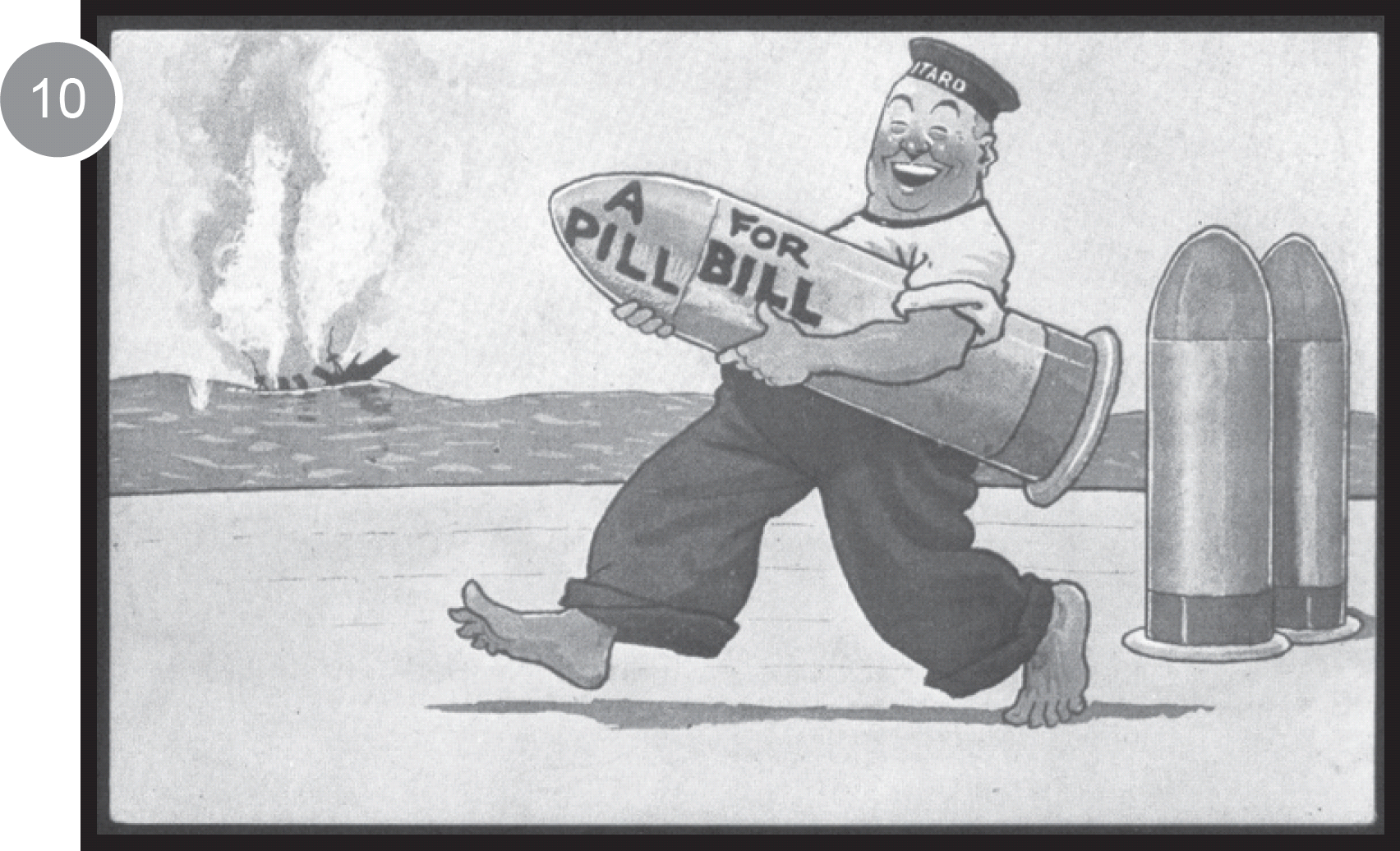
Other wartime postcard publishers included many already established names such as Bamforth, Valentine, Regent, Salmon and Tuck and E.Mack (e.g. ‘A Pill for Bill).  Amongst the many artists working in the field at this time were Doug Tempest, Fred Spurgin, Dudley Buxton, Hayward Young, Reg Carter, Reg Maurice, Fred Gothard (FG) and Archibald English (AE). There was even a London company called The War Cartoon Studios which published cartoon postcards by “Clik”.
Two unusual series were Photochrom's “Camp Silhouettes”, which featured black-and-white silhouette cartoons by GAS (GA Stevens, who also worked for the evening Star), and Lawrence Colborne's colour cartoons for E Mack, which showed German soldiers running away or hiding from the Allies with the names of individual British and Allied regiments or battalions incorporated in the captions (the pictures remained the same).

One of the best-known cartoonists working for Inter-Art during the war was Donald McGill (1875–1962), known as the king of the saucy postcard. McGill, who had lost his left foot in a childhood accident and was 39 when war broke out, began designing postcards for Inter-Art in 1914, after his former employer, Joseph Asher, owner of The Pictorial Postcard Co, was interned as an enemy alien. His contributions to the Recruits, Comique and Two-Eight-One series often had captions both in English and French. Examples included his version of “Daddy, what did YOU do in the Great War?”, showing a sweating soldier struggling to carry two huge soup tureens for a field kitchen, as well as “Another Big Draught Going to the Front!” with a fat soldier drinking a massive tankard of beer.
Two unlikely postcard publishers during this period were FW Woolworth and Boots the Chemist. Woolworth produced a series featuring the British Lion by the Punch artist FG Lewin (1861–1933) which included one showing a huge lion standing over a tiny, terrified, Kaiser in a ruined European village with the Kaiser saying “D-d-did you s-s-say ‘Berlin’?!!”  Boots the Chemist, meanwhile, published “The Glory of a Lion and His Mane” (from their series “A Tribute to Our Colonies”). Drawn by William Armitage (1856–1941) it showed the British Lion with its mane formed of the words Canada, India, Australia, New Zealand and African Colonies.
In addition there were even some English translations of foreign postcards. A number of booklets (each of 10 cards) reprinting cartoons from De Telegraaf by Louis Raemaekers were sold in aid of the Red Cross, and “Our Sailors” – a 20-card series drawn by Henri Gervèse (1880–1959) of Le Rire and published by Raffaeli in Toulon – was distributed in Britain through the Fleet Newspaper Committee.
Finally, as a footnote to cartoons appearing in wartime printed ephemera, mention should also be made of the smallest variety of all – drawings that appeared on cigarette cards. Amongst these were Bairnsfather's “Fragments from France” series published by R&J Hills, a number of Punch cartoons reprinted by WD & HO Wills, and no less than 140 cards with images by Louis Raemaekers for Black Cat cigarettes produced by Carreras.