



Abstract
A classic problem in moral psychology concerns whether and when moral judgments are driven by intuition versus deliberate reasoning. In this investigation, we explored the role of reappraisal, an emotion-regulation strategy that involves construing an emotion-eliciting situation in a way that diminishes the intensity of the emotional experience. We hypothesized that although emotional reactions evoke initial moral intuitions, reappraisal weakens the influence of these intuitions, leading to more deliberative moral judgments. Three studies of moral judgments in emotionally evocative, disgust-eliciting moral dilemmas supported our hypothesis. A greater tendency to reappraise was related to fewer intuition-based judgments (Study 1). Content analysis of open-ended descriptions of moral-reasoning processes revealed that reappraisal was associated with longer time spent in deliberation and with fewer intuitionist moral judgments (Study 2). Finally, in comparison with participants who simply watched an emotion-inducing film, participants who had been instructed to reappraise their reactions while watching the film subsequently reported less intense emotional reactions to moral dilemmas, and these dampened reactions led, in turn, to fewer intuitionist moral judgments (Study 3).
A dominant view in moral psychology has traditionally been that people make moral judgments through a reasoned process relying on conscious deliberation (Haidt, 2001). In the 20th century, Kohlberg (1969) and Turiel (1983) affirmed this view in their research on reported moral decisions, arguing that such choices are reasoned and deliberate. However, in the past decade, moral psychologists have challenged the extent to which reason plays a role in moral judgments, suggesting instead that emotionally driven, automatic moral intuitions are at the heart of such judgments (Haidt, 2001). In line with Hume’s (1739/2000) argument that reason is a slave to the passions, Haidt (2001) proposed a social-intuitionist model of moral judgment, arguing that quick, heuristic feelings of right or wrong drive moral judgments.
Intuitionists assert that emotions are a critical factor in evoking judgments of what is moral and what is immoral (Haidt, 2001; Horberg, Oveis, Keltner, & Cohen, 2009; Valdesolo & DeSteno, 2006; Wheatley & Haidt, 2005). In their pioneering work, Haidt, Koller, and Dias (1993) presented participants with moral dilemmas specifically designed to evoke disgust, a provocative moral emotion. Even though the dilemmas made clear that the targets’ behaviors caused no harm, most participants nonetheless deemed the behaviors immoral. When asked to explain their judgments, participants commonly reported that the actions simply felt wrong, often referencing a strong emotional reaction (e.g., “That is disgusting!”; Haidt & Hersh, 2001; Haidt et al., 1993). In neuroscience, brain-imaging studies have indicated that moral dilemmas that elicit intuitionist judgments (e.g., the footbridge dilemma; Thomson, 1986) lead to activation of brain regions associated with emotion (Greene, Nystrom, Engell, Darley, & Cohen, 2004; Greene, Sommerville, Nystrom, Darley, & Cohen, 2001). Additionally, researchers found that people who were induced to feel positive affect were subsequently less likely to make intuitionist-based moral judgments (Valdesolo & DeSteno, 2006). These and other results implicating emotion as a key factor in moral judgments have sparked considerable debate on the relative roles of intuitive and deliberative processes, as many researchers have maintained that deliberation plays a primary role in moral judgment (Huebner, Dwyer, & Hauser, 2009; Pizarro & Bloom, 2003).
Dual-Process Models of Moral Judgment
In reaction to debate over the relative merits of intuitionist and deliberative models, other researchers have argued for a dual-process model of moral judgment, in which emotionally driven intuitions take primacy (System 1), but can be overridden by effortful reasoning (System 2; Cushman, Young, & Greene, 2010). Empirical evidence supporting dual-process models of moral judgment has been growing (e.g., Greene, Morelli, Lowenberg, Nystrom, & Cohen, 2008; Greene et al., 2004). The studies that have yielded such evidence have typically utilized moral dilemmas that were designed to pit intuition against deliberative reasoning, by describing behaviors that violate sacred principles or values but do no harm. Condemning these behaviors indicates intuition-based judgment, whereas judging the behaviors to be appropriate suggests that more deliberative, consequentialist reasoning has overridden intuition (Greene et al., 2004). These studies have demonstrated variability among individuals, raising questions about how and why some participants but not others override their emotionally driven, moral intuitions when making moral judgments (Bartels, 2008; Haidt & Kesebir, 2010; Moore, Clark, & Kane, 2008). What determines whether someone overrides intuition when making moral judgments?
Applying an Emotion-Regulation Perspective to Moral Judgment
Recent research has demonstrated that humans are not always slaves to their passions: Instead, sometimes individuals are capable of controlling their emotions by influencing which emotions they feel and how intensely they experience these emotions (e.g., Gross & John, 2003). In this article, we apply current theorizing about emotion regulation in an attempt to provide insight about moral judgment. Although past findings have implicated emotion as critical in evoking intuitionist moral judgments (Haidt, 2001; Valdesolo & DeSteno, 2006; Wheatley & Haidt, 2005), researchers have yet to examine whether differences in emotion-regulation tendencies explain differences in people’s moral judgments. Specifically, we propose that the emotion-regulation strategy of reappraisal is a key factor in determining whether an individual’s moral judgments will be intuition based or whether such intuitions will be overridden by more deliberative reasoning.
Reappraisal is one of multiple emotion-regulation strategies that people can use to influence their emotions (Gross, 2007). Although other strategies exist (e.g., expressive suppression, attentional deployment), here we focus on reappraisal because it has been shown to have a substantial and reliable impact on the intensity of emotional experience (Gross, 1998, 2002). Reappraisal involves construing an emotion-eliciting situation or event in a way that diminishes the intensity of the emotional experience (Gross, 2002; Gross & John, 2003; Lazarus & Alfert, 1964). We predicted that when exposed to a potentially immoral act that elicits emotionally driven moral intuitions, some people will reappraise their emotion by focusing on why they are experiencing it and whether there is good reason to experience it, and that this reappraisal will limit the emotional impact. Further, by decreasing the intensity of such people’s emotional experience, reappraisal will lead them to make more deliberative moral judgments. Although emotional reactions evoke initial moral intuitions, reappraisal of the elicited emotion should decreases its intensity, weakening the influence of these intuitions and leading to more deliberative moral judgments (Fig. 1).
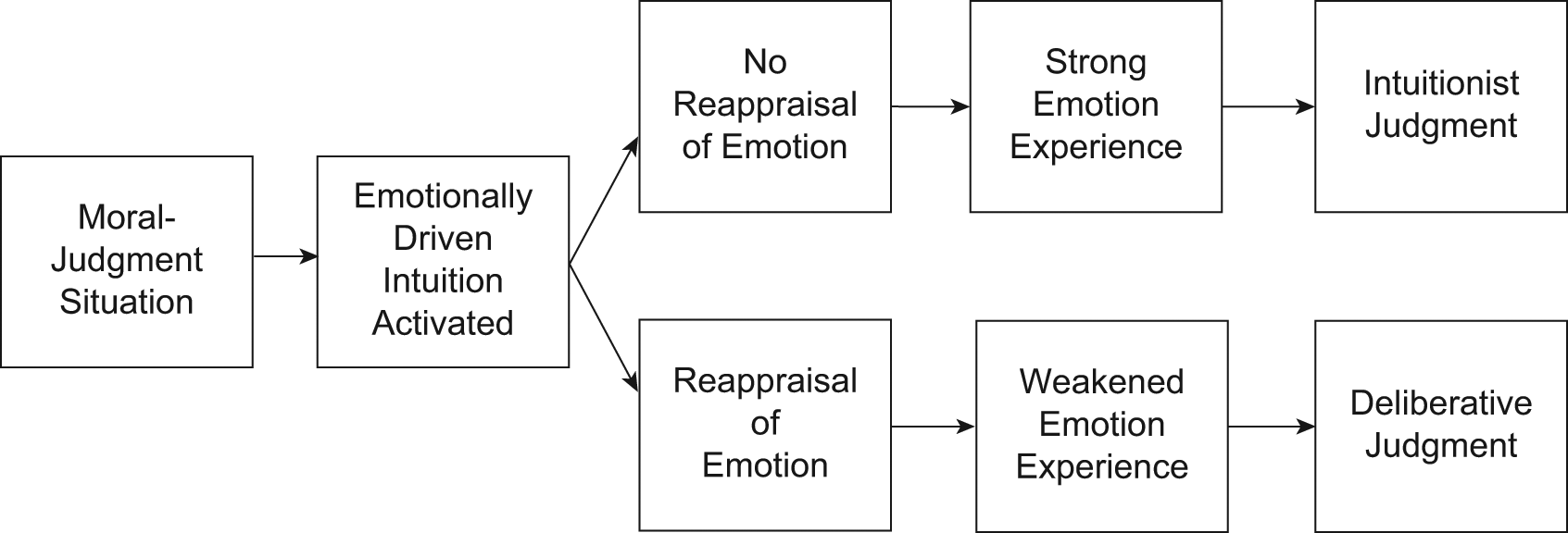
Process model of how emotion reappraisal influences moral judgment. According to this model, when the emotion evoked in a moral-judgment situation is reappraised, this process weakens the experience of emotion and results in a judgment based on deliberation. In contrast, when there is no emotion reappraisal, the individual experiences strong emotion and will make a moral judgment based on moral intuitions.
To test our hypothesis, we conducted three studies examining the effects of reappraisal on moral judgment. We used the moral dilemmas developed by Haidt et al. (1993) because they elicit a particular emotion—disgust—that often leads individuals to intuitionist judgments. To examine the role of reappraisal, we used three methodological approaches. In Study 1, we measured individual differences in habitual reappraisal. In Study 2, we used introspective accounts of the judgment process to measure use of reappraisal processes. In Study 3, we manipulated the use of reappraisal in an experimental design.
Study 1: The Effects of Habitual Reappraisal on Moral Judgments
We first examined reappraisal as a chronic tendency, predicting that individuals who scored higher on this tendency would be significantly less likely to make intuition-based judgments in moral dilemmas.
Method
Participants
Ninety-nine participants (31 males, 68 females; mean age = 34.56 years, SD = 12.39 years) were recruited via the craigslist.org Web sites of 15 American cities. We advertised our study in the “volunteers” section of each city’s Craigslist Web site. People who clicked on our ad were provided with a link to the study on another Web site. In exchange for participation, participants were entered into a drawing for their choice of an iPod or a $50 prize.
Procedure
After responding to a demographic questionnaire, participants completed the Emotion Regulation Questionnaire (ERQ; Gross & John, 2003). The ERQ consists of 10 items gauging the tendency to utilize two emotion-regulation strategies: reappraisal (e.g., “When I want to feel less negative emotion, I change the way I’m thinking about the situation”) and suppression (e.g., “I control my emotions by not expressing them”). Although we were primarily interested in reappraisal, we included the suppression items to establish discriminant validity. Suppression involves inhibiting emotion displays, but tends not to reduce emotional experience (Gross, 1998; Gross & John, 2003; Gross & Levenson, 1993, 1997). Participants responded to each item on a 7-point scale ranging from 1 (strongly disagree) to 7 (strongly agree). Items for each strategy showed good internal consistency (α = .84 for reappraisal and .80 for suppression). Past researchers have found that reappraisal is not related to intelligence and is only minimally associated with Big Five personality traits, including openness to experience (Gross & John, 2003; John & Gross, 2004).
Participants then read through two moral dilemmas (Haidt et al., 1993). The incest dilemma described siblings who decide to engage in consensual sexual intercourse after taking every possible precaution to avoid pregnancy and emotional complications; thus, it was clear that no harm would come from their actions. The chicken dilemma described a man who purchased a dead chicken, had sex with it, and then cooked and ate it in the privacy of his own home. For each scenario, participants answered two questions: “Is this morally wrong?” and “How morally wrong would you rate their [the man’s] behavior?” Participants answered the first question by indicating either “yes” or “no” and responded to the second on a 7-point scale ranging from 1 (not at all) to 7 (extremely).
Results and discussion
Logistic regression analyses with reappraisal and suppression scores as simultaneous predictors demonstrated that participants with a greater tendency toward reappraisal were significantly less likely to report that the people in the dilemmas behaved immorally (chicken scenario: b = −0.48, p < .05; incest scenario: b = −0.43, p < .05), whereas scores for suppression were not significantly related to judgments of morality (ps > .54). 1 Likewise, regression analyses on ratings of how morally wrong the individuals in the scenarios were yielded significant effects for reappraisal scores (chicken scenario: b = 0.21, p < .05; incest scenario: b = 0.27, p < .01), but not suppression scores (ps > .62). As predicted, participants who scored higher on reappraisal found the targets’ behavior to be less morally wrong. These results suggest that the chronic tendency to regulate emotions through reappraisal can influence moral judgments such that the more individuals tend to reappraise their emotions, the more likely they are to override their moral intuitions and to make more deliberative moral judgments. 2
Study 2: Reappraisal in the Moral-Judgment Process
In Study 2, we focused on the role of reappraisal in the process of forming moral judgments. Specifically, if individuals make more-deliberative moral judgments because they engage in reappraisal, overriding their initial, emotionally driven moral intuitions, then an examination of individuals’ moral-judgment processes should demonstrate that those who reappraise more during their judgment process are more likely to make deliberative judgments and less likely to make intuition-based judgments. Further, past research has linked response time to deliberative judgments, with those more rational judgments typically taking longer to formulate and report than intuition-based judgments (Greene et al., 2004; Greene et al., 2001; Suter & Hertwig, 2011). Because response time is associated with deliberative judgments, we hypothesized that the more individuals engaged in reappraisal during the judgment process, the longer they would take to form their judgments.
Method
Participants
One hundred twenty-six undergraduates (29 males, 97 females; mean age = 20.86 years, SD = 2.61 years) participated in Study 2 online in return for extra credit in a sociology course.
Procedure
Participants were presented the same moral dilemmas and questions that we used in Study 1. Additionally, our software recorded the amount of time that participants took to indicate whether the behavior in each scenario was morally wrong. We corrected for the skewed distribution of these response times by transforming them to the corresponding natural logs. Participants were also asked to report what emotion or emotions they felt when they first read each scenario. Then they were asked to write three to five sentences in response to the following open-ended question: “What happened in your head from the first moment you felt the emotion until the moment you decided whether this action was right or wrong?”
A large majority of participants reported that their initial reaction to the dilemmas was one of disgust (e.g., “gross,” “revolted,” “disgusted”; chicken scenario: 88%; incest scenario: 85%). Trained coders who were blind to the study’s hypotheses coded participants’ responses to the open-ended question by using two separate reappraisal indicators that we modeled after the ERQ (Gross & John, 2003): (a) “Participant attempted to reappraise the felt emotion,” and (b) “Participant changed the way he/she thought about the scenario to decrease emotional reaction.” The coding scale for the first indicator ranged from 0 (no reappraisal) to 7 (a great deal of reappraisal). The coding scale for the second indicator ranged from 0 (no evidence) to 7 (a great deal of evidence). Note that these two indicators emphasized the regulation of emotion rather than more general cognitive processing. Coders were instructed to score only clear indications of emotion processing—specifically, whether participants used reappraisal (i.e., the extent to which participants reported reconstruing their perception of the moral dilemmas in a way that diminished the intensity of their emotional reaction or experience). Following is an example of a response coded as clear evidence for reappraisal use in the chicken dilemma:
At first, I was overcome with disgust and horror. But as I read the question and considered it, I started to see it was the man’s choice . . . it’s his chicken, he can do whatever he wants with it . . . the horror and disgust started to fade away.
The next example was coded as reflecting low reappraisal use:
I immediately felt this act was wrong. It was almost a simultaneous reaction to think disgust then wrongfulness. There was not much time between the initial emotion and the decision of wrong doing.
The following example indicates cognitive processing but not reappraisal:
I was disgusted. I actually had to stop reading. What person would do such a thing?
Intercoder reliability for each indicator was high (average α = .86). Likewise, for each dilemma, the two reappraisal indicators were highly correlated. Therefore, we averaged across indicators within each dilemma to create a reappraisal composite for each participant (the two dilemmas’ average α = .93).
Results and discussion
Logistic regression analyses with the reappraisal composite as a predictor and participants’ “yes”/“no” responses as the dependent variable revealed a strong negative association between reappraisal and judgments of immorality for each dilemma (chicken scenario: b = −0.74, p < .001; incest scenario: b = −0.86, p < .001). For every 1-point increase in reappraisal score, the odds of the participant’s judging the target behavior to be morally wrong dropped by 2.09 units for the chicken dilemma and by 2.36 units for the incest dilemma. We found parallel results for the association between the reappraisal composite and how morally wrong participants judged the target behaviors to be (chicken scenario: r = −.62, p < .001; incest scenario: r = −.67, p < .001); the more participants engaged in reappraisal after reading the scenarios, the less morally wrong they found the behavior. These results are consistent with our prediction that engaging in reappraisal during the moral-judgment process leads to fewer intuition-based moral judgments.
Additionally, an examination of the response time data showed that there was a significant positive relationship between the time participants took to make their moral judgments and their reappraisal scores (chicken scenario: r = .23, p < .01; incest scenario: r = .23, p < .01): Participants who exhibited higher levels of reappraisal during their moral-reasoning process tended to take longer to make their judgments. This finding offers further evidence for our argument that reappraisal plays a role in the formulation of deliberative judgments, as past research has shown that such judgments are distinguished by the longer periods of time that people typically take in formulating them (Greene et al., 2004; Greene et al., 2001; Suter & Hertwig, 2011).
Study 3: Manipulated Reappraisal and Its Effects on Moral Judgments
Our first two studies demonstrated an association between reappraisal and deliberative moral reasoning. However, because of the correlational nature of these studies, we cannot take them as evidence of a causal relationship between reappraisal and deliberative moral judgments. Likewise, there is the possibility that a third variable could have driven the observed associations between reappraisal and reasoned moral judgments. Additionally, in Study 2, participants made their moral judgments prior to describing their emotion processing, so it is possible that their descriptions were skewed by their having already made the moral judgments.
To address these concerns, in Study 3, we experimentally manipulated whether participants were instructed to reappraise their emotional reactions to a sad 3 film clip that they viewed prior to formulating judgments in a series of moral dilemmas. We studied possible carryover effects of engaging in reappraisal prior to making moral judgments, reasoning that our manipulation would activate a propensity to reappraise that would subsequently affect participants’ judgment processes in the moral dilemmas (Gross, 1998). If we are right that reappraisal during the moral-reasoning process leads individuals to make more deliberative judgments, then individuals instructed to reappraise their emotional reactions to an emotion-inducing film clip should thereafter make more deliberative moral judgments. Also, we asked participants to report how intensely they experienced the emotions that the moral dilemmas generated, and after they did so, we asked them to make their moral judgments. By doing so, we could directly test whether reappraisal shapes moral judgments by diminishing the strength of individuals’ emotional reactions to moral dilemmas.
Method
Participants
Forty undergraduates (10 males, 30 females; mean age = 20.20 years, SD = 1.56 years) participated in return for course credit.
Procedure
The study was framed as having two unrelated parts: a film-watching component to help in selection of videos for future research and a subsequent general-questionnaire component. At laboratory computer stations, participants watched a short film clip from the movie The Champ (Lovell & Zeffirelli, 1979), which we selected because past research had indicated that it evokes strong feelings of sadness (Gross & Levenson, 1995). Depending on the experimental condition, before the movie, we asked participants either to simply watch the clip (control condition) or to watch it and simultaneously reappraise the emotions that they felt while watching (reappraisal condition; Gross, 1998).
Following the clip, participants read three moral dilemmas. In an effort to broaden our measure of moral judgments, we added a third dilemma to the two used in Studies 1 and 2 and created composite scores of participants’ responses to the three scenarios. The third dilemma described a family cooking and eating their pet dog, who had recently died in an accident (Haidt et al., 1993). After reading each dilemma, participants were asked the following open-ended question: “What emotion(s) did you feel when you read the story?” On average, 88% reported feeling disgust. Participants next indicated how intensely they felt the stated emotion or emotions on a 7-point scale ranging from 1 (not intense at all) to 7 (extremely intense). Then, participants indicated how morally wrong they found the behavior of the people in each dilemma, on a 7-point scale ranging from 1 (not at all) to 7 (extremely). Alpha reliability across the three dilemmas was .76 for emotion intensity and .63 for ratings of morality, so we formed composites for these measures. Finally, participants completed a questionnaire measuring possible suspicion that the film-watching and questionnaire components were actually related. No participants indicated such a suspicion.
Results and discussion
A t test showed that our experimental manipulation significantly affected participants’ perceptions of targets’ immorality, t(38) = 2.05, p < .05. Participants in the reappraisal condition subsequently rated the behavior of the targets in the scenarios as significantly less immoral (M = 4.75, SD = 1.48) than did participants in the control condition (M = 5.62, SD = 1.18).
To test our hypothesis that engaging in reappraisal decreases the intensity of subsequent emotion, we compared how intensely participants in each condition experienced their emotional reactions to the moral dilemmas. This analysis revealed a significant difference between conditions, t(37) = 1.99, p = .05. Participants in the reappraisal condition reported experiencing significantly less intense emotion (M = 4.88, SD = 1.23) than did participants in the control condition (M = 5.62, SD = 1.09).
We conducted a mediation analysis testing whether participants in the reappraisal condition rated the targets as less immoral because they experienced less intense emotional responses to the moral dilemmas. Entering the experimental-condition variable and the emotion-intensity ratings simultaneously as predictors of immorality ratings in a regression analysis revealed that emotion intensity remained a significant predictor, whereas the reappraisal manipulation was no longer significant (Fig. 2). A bootstrap analysis (Preacher & Hayes, 2004) revealed that the 95% confidence interval for the indirect effect did not include 0, [−0.02, −1.21], indicating that emotion intensity significantly mediated the effect of experimental condition on how immoral the participants found the targets’ behavior to be. 4
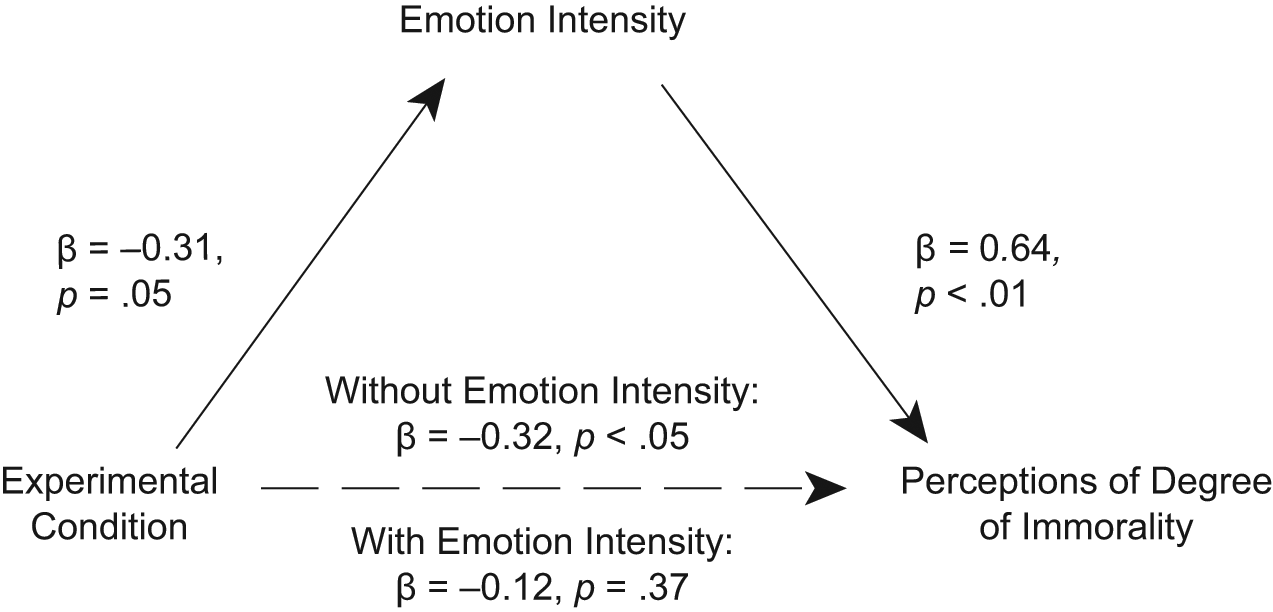
Results from Study 3: emotion intensity as a mediator of the effect of experimental condition on individuals’ perceptions of targets’ degree of immorality. The dashed arrow indicates a path that was statistically insignificant in the full model.
These results demonstrate that our manipulation of reappraisal led participants to make less intuition-based moral judgments. Our mediation analysis indicates that a decrease in the intensity of participants’ emotional reactions to the moral dilemmas explained why our manipulation had this effect. This result suggests that in moral-judgment situations, individuals’ use of reappraisal strategies diminishes the intensity of their emotional reactions, increasing the likelihood that they will override their initial, emotionally driven intuitions and will ultimately exhibit more deliberative reasoning instead. Further, these results mirror those of Study 2 even though in Study 3, participants reported their emotions prior to making their moral judgments. Thus, our results are likely not due to the order of these measures.
General Discussion
Our findings provide consistent support for the hypothesis that the emotion-regulation strategy of reappraisal leads individuals to greater use of deliberative reasoning in making moral judgments. Specifically, our results suggest that, although individuals often have emotionally driven moral intuitions, they can override such intuitions through reappraisal processes that diminish their emotional experience and thereby yield more deliberative moral reasoning. These results provide further evidence that emotions play a role in the moral-judgment process, a point of ongoing debate in the literature (Huebner et al., 2009; Pizarro & Bloom, 2003). More generally, our results support existing dual-process models and extend them by providing an answer to the questions of how and when individuals override their moral intuitions.
These results fit well with recent neuroimaging results from the moral-psychology and emotion-regulation literatures (e.g., Goldin, McRae, Ramel, & Gross, 2008; Greene et al., 2004; Ochsner & Gross, 2008). Neural imaging of participants formulating moral judgments showed that activation of the prefrontal cortex (PFC) is strongly associated with deliberative and consequentialist moral judgments (Greene et al., 2004). Similarly, imaging studies examining emotion regulation have shown an association between activation of the PFC and the use of reappraisal (for a review, see Ochsner & Gross, 2008). Here, we directly tested and found evidence for the link between reappraisal and deliberative judgments suggested by those findings.
Although applying an emotion-regulation perspective to the study of moral judgments helps provide insight into the judgment process, it also raises new questions that future research should address. For instance, is the process of overriding moral intuitions by using reappraisal a conscious process? The emotion-regulation literature suggests that reappraisal may involve both conscious and unconscious aspects and that there may be individual differences in the extent to which it has become habitual (John & Gross, 2004; Williams, Bargh, Nocera, & Gray, 2009). Future research might explore whether individuals’ use of reappraisal during the moral-judgment process is primarily conscious or unconscious. Additionally, the current research utilized moral dilemmas shown to elicit the strong emotional reaction of disgust, because past research has demonstrated that feelings of disgust have a strong influence on moral judgments (Haidt, Rozin, McCauley, & Imada, 1997; Horberg et al., 2009; Inbar, Pizarro, Knobe, & Bloom, 2009; Schnall, Haidt, Clore, & Jordan, 2008; Wheatley & Haidt, 2005). Would researchers find that reappraisal plays the same role in the case of scenarios that elicit other moral emotions (e.g., anger)? Future research might also explore how different characteristics of the moral dilemmas themselves might moderate the likelihood that individuals engage in emotional-reappraisal processes.
Overall, our findings offer important insights into the processes through which moral judgments are formed. For centuries, scholars have debated whether moral judgments emerge from rational, controlled reasoning processes or instead are driven by emotions. However, recent psychological research has suggested that judgment processes are more complex, as experimental results have supported both of those views. Accounting for both intuition and deliberative reasoning, the current research extends dual-process accounts of moral judgment, showing that although emotional reactions elicit moral intuitions, these emotions can also be regulated. In this way, individuals are both slave and master, with the capacity to be controlled by, but also to shape, their emotion-laden judgmental processes.
Footnotes
Declaration of Conflicting Interests
The authors declared that they had no conflicts of interest with respect to their authorship or the publication of this article.
Funding
This research was supported by a Graduate Research Fellowship from the National Science Foundation.