



Abstract
Persuasive messages are more effective when they are custom-tailored to reflect the interests and concerns of the intended audience. Much of the message-framing literature has focused on the advantages of using either gain or loss frames, depending on the motivational orientation of the target group. In the current study, we extended this research to examine whether a persuasive appeal’s effectiveness can be increased by aligning the message framing with the recipient’s personality profile. For a single product, we constructed five advertisements, each designed to target one of the five major trait domains of human personality. In a sample of 324 survey respondents, advertisements were evaluated more positively the more they cohered with participants’ dispositional motives. These results suggest that adapting persuasive messages to the personality traits of the target audience can be an effective way of increasing the messages’ impact, and highlight the potential value of personality-based communication strategies.
In 2012, nearly $530 billion will be spent on advertising around the world (Oser, 2011). This staggering amount is projected to increase by 5% yearly, with some businesses spending up to 30% of their annual revenue on advertising. Whether promoting consumer products, political candidates, or sound health and investment behavior, persuasive communications constitute a major domain of activity, and a substantial component of the global economy. Psychological science plays a prominent role in this field by identifying strategies to improve the effectiveness of persuasive campaigns (Cialdini, 2007; Petty & Cacioppo, 1996).
One such strategy, message tailoring, involves adapting persuasive messages to recipients’ characteristics. For example, regulatory fit occurs when a message is framed to match the recipient’s motivational orientation by focusing either on promoting gains (e.g., “Product X builds healthy teeth!”) or preventing losses (e.g., “Product X prevents cavities!”; Higgins, 2000). Messages that are congruent with an individual’s motivational orientation are processed more fluently and evaluated more positively than incongruent messages are (Cesario, Grant, & Higgins, 2004; Higgins, Idson, Freitas, Spiegel, & Molden, 2003; Lee & Aaker, 2004). These effects have been observed across a diverse set of domains, including dental hygiene, smoking cessation, and consumer purchases (Cesario, Higgins, & Scholer, 2008; Kim, 2006; Labroo & Lee, 2006; Sherman, Mann, & Updegraff, 2006).
Although message-person congruence effects have been examined in relation to a variety of psychological characteristics (Dijkstra, 2008), they have not yet been systematically related to a comprehensive model of personality traits. Such integration, however, would advance the message-framing literature by opening the door to exploring new ways to make persuasive messages more personalized and effective. Examining message-person congruence effects within a comprehensive model of personality would allow for a multidimensional assessment of recipients’ characteristics with a single measurement instrument. In contrast, most of the existing research on message-person congruence effects has involved the use of single psychological constructs, each requiring its own assessment device. Existing research has examined congruence effects primarily by separating message recipients into one of two psychological categories (e.g., promotion- vs. prevention-focused individuals or locomotion- vs. assessment-focused individuals; Avnet & Higgins, 2003; Higgins et al., 2003). Utilizing a model of personality based on dimensional variation rather than categorical typologies could allow for more fine-grained personalization of persuasive messages based on an individual’s relative standing on a given trait dimension.
In the current study, we explored these possibilities by examining whether message-person congruence effects can be obtained by framing persuasive messages in terms of the widely used Big Five personality dimensions (Goldberg, 1990). Each of the five personality dimensions reflects variation in a distinct motivational system: Extraverts are especially sensitive to rewards and social attention (Lucas, Diener, Grob, Suh, & Shao, 2000); agreeable individuals value communal goals and interpersonal harmony (Graziano & Eisenberg, 1997); conscientious individuals value achievement, order, and efficiency (Roberts, Chernyshenko, Stark, & Goldberg, 2005); neurotic individuals are especially sensitive to threats and uncertainty (Carver, Sutton, & Scheier, 2000; Hirsh & Inzlicht, 2008); and open individuals value creativity, innovation, and intellectual stimulation (McCrae & Costa, 1997). We hypothesized that a persuasive message would be more effective when framed to be congruent with the recipient’s personality profile.
Method
A sample of American participants (N = 324) was recruited via Amazon’s Mechanical Turk (203 females, 121 males; mean age = 35.86 years, SD = 12.85; 79.0% Caucasian, 8.3% African American, 4.9% Hispanic, 3.4% East Asian, 4.4% other).
We constructed five advertisements featuring a picture of a cell phone and a few lines of text; the text was manipulated so that each advertisement highlighted the motivational concerns associated with one of the five major personality dimensions (e.g., for extraversion: “With XPhone, you’ll always be where the excitement is”; for neuroticism: “Stay safe and secure with the XPhone”; see the Supplemental Material available online for details). Participants rated the effectiveness of each advertisement (5-point Likert scale ranging from strongly disagree to strongly agree) by responding to the following six items: “I find this advertisement to be persuasive,” “This is an effective advertisement,” “I would purchase this product after seeing this advertisement,” “Overall, I like this advertisement,” “This advertisement has made me more interested in the product,” and “I am interested in learning more about this product after seeing this advertisement.” Responses to these items were averaged together to form an overall rating of each advertisement (α = .94).
Participants’ personality was then assessed with the Big Five Aspect Scales (DeYoung, Quilty, & Peterson, 2007), a valid and reliable measure (mean α = .83).
Results
Ratings of the five advertisements were highly intercorrelated (average r = .56), which indicated shared variance across the ratings due to differences in overall scale usage. To control for this variance, we regressed the ratings for each advertisement on the ratings for the four other advertisements, saving the residuals. These residuals captured the variance in effectiveness ratings uniquely associated with each advertisement and were used in subsequent analyses.
To examine congruence effects, we regressed the residualized ratings for each of the different advertisements on participants’ scores for each of the five personality traits (see Table 1). In each case, an advertisement’s rated effectiveness increased with participants’ scores on the targeted personality dimension. Moreover, scores on the nontargeted dimensions did not predict effectiveness ratings (i.e., the relationship between personality and effectiveness was unique to the targeted personality dimensions).
Results of the Regression Analysis: Scores on the Big Five Traits as Predictors of Respondents’ Ratings of the Advertisements’ Effectiveness
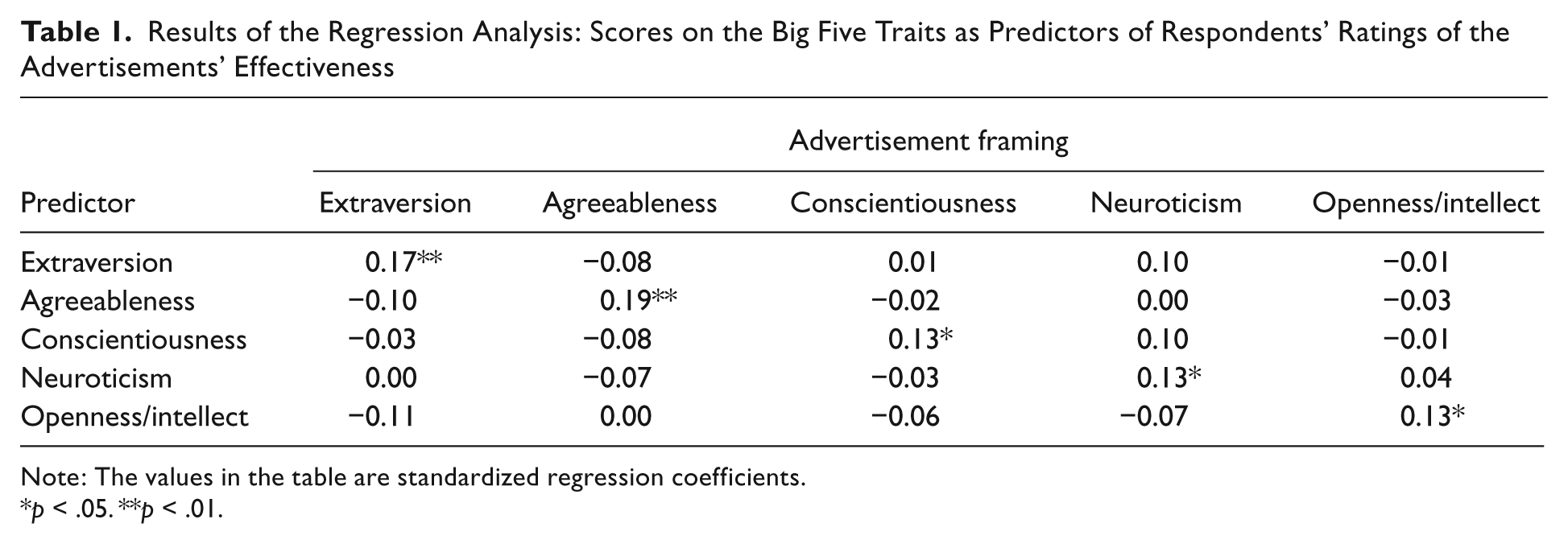
Note: The values in the table are standardized regression coefficients.
p < .05. **p < .01.
A secondary analysis tested whether the effectiveness ratings were more highly correlated with scores on the matched personality traits than with scores on the nonmatched traits. Within each advertisement, the correlations with nonmatched traits were averaged together and compared with the correlation with the matched trait. The correlations with matched traits were significantly larger than the correlations with nonmatched ones for the advertisements targeting four of the five traits—extraversion: rdifference = .23, t(321) = 2.96, p < .01; agreeableness: rdifference = .25, t(321) = 3.20, p < .01; conscientiousness: rdifference = .16, t(321) = 1.98, p < .05; and openness/intellect: rdifference = .14, t(321) = 1.77, p < .05. Although the difference was nonsignificant for the advertisement targeting neuroticism, it was in the predicted direction, rdifference = .10, t(321) = 1.56, p = .10. These results suggest that advertisements targeting neuroticism may have somewhat less specific effects than advertisements targeting the other Big Five dimensions.
Discussion
These results mark the first demonstration of effective message tailoring using a comprehensive model of recipients’ personality traits. Respondents judged an advertisement emphasizing a particular motivational concern as more effective when that concern was congruent with their own personality characteristics. Message-person congruence effects were thus observed by manipulating the framing of an appeal to target a broad variety of motives, including desires for excitement and social rewards (extraversion), connection with family and community (agreeableness), efficiency and goal pursuit (conscientiousness), safety and security (neuroticism), and creativity and intellectual stimulation (openness/intellect). The Big Five personality traits may thus provide a useful framework for simultaneously assessing multiple dimensions of a target audience’s psychological characteristics within a single assessment instrument.
One provocative implication of these results is that they suggest a pathway toward optimal message tailoring. Tailored messages are considerably more effective than one-size-fits-all campaigns (Noar, Benac, & Harris, 2007), and the effectiveness of tailoring increases with greater customization and adaptation to the unique features of the recipient (Dijkstra, 2008). The current results suggest that tailoring a message to an individual’s personality profile may further increase the effectiveness of persuasive campaigns. Such strategies are becoming increasingly practical. Electronic retailers already use a variety of personal information, such as purchase or site-visit history, to tailor their online offers to individual consumers (e.g., Taylor, 2004). These same kinds of informational cues could be used to discern an individual’s personality and frame subsequent messages accordingly. Indeed, it has been established that reliable inferences about personality can be obtained from an individual’s Facebook profile (Back et al., 2010), e-mail address (Back, Schmukle, & Egloff, 2008), and language use (Hirsh & Peterson, 2009; Yarkoni, 2010), and the same may well be true for other lingering signatures of online behavior.
Although message-person congruence led to more positive evaluations of advertisements in our study, we should also point out that there may be some circumstances in which congruence could result in more negative evaluations. In particular, congruently framed messages may produce their effects by increasing the attention that they are given (Kreuter, Bull, Clark, & Oswald, 1999). This increased attention often appears to be associated with a more positive evaluation, but may also result in more negative evaluations when the message itself is of low quality (Updegraff, Sherman, Luyster, & Mann, 2007). Such findings suggest that the quality of a message may have increased importance when the message is personalized.
Overall, these results confirm that tailoring messages to the personality of the audience can be an effective communication strategy. Although the effect sizes for all the traits were modest, they are similar to those reported in previous message-framing research. Additionally, even small differences in effectiveness can have substantial impacts when advertisements are used on a large scale. To the extent that persuasive messages are tailored to multiple trait domains simultaneously, the benefits may be even more pronounced. The current study focused on evaluations of product advertisements, and an important goal for future research will be to examine the generalizability of the reported effects to other persuasive appeals, such as health-promotion, environmental-sustainability, and political campaigns. Tailoring messages to match recipients’ personality characteristics appears to be a promising technique worthy of greater study.
Footnotes

References
Supplementary Material
Please find the following supplemental material available below.
For Open Access articles published under a Creative Commons License, all supplemental material carries the same license as the article it is associated with.
For non-Open Access articles published, all supplemental material carries a non-exclusive license, and permission requests for re-use of supplemental material or any part of supplemental material shall be sent directly to the copyright owner as specified in the copyright notice associated with the article.
