




Abstract
It is frequently suggested that increasing awareness of intergroup bias and limited control over biased responses can improve intergroup interaction behavior. Some uses of the Implicit Association Test (IAT) epitomize this approach to improving intergroup relations. However, if completing the IAT enhances caution and inhibition, reduces self-efficacy, or primes categorical thinking, the test may instead have negative effects. Two experiments demonstrated that when White individuals completed a race-relevant IAT prior to an intergroup interaction (as compared with when they did not), their interaction partner left the exchange feeling less positively regarded. No such effect was evident when White individuals completed a race-irrelevant IAT (Study 1) or an explicit prejudice measure (Study 2) before the exchange, or when their interaction partner was White (Study 1). Mediation analyses (Study 2) suggested that White participants who completed the IAT communicated less positive regard because they adopted a cautious approach to the interaction, limiting their self-disclosure.
The idea that making people aware of their intergroup biases is a good first step toward reducing those biases has been an increasingly prevalent theme in both the academic literature on intergroup relations (e.g., Devine, 1989; Monteith & Mark, 2005) and the popular media (e.g., Gladwell, 2005; Moss, 2009; “Test That Found Widespread Unconscious Racial Bias Validated,” 2009) and is a core component of many antiracism campaigns. Some uses of the Implicit Association Test (IAT; Greenwald, McGhee, & Schwartz, 1998) epitomize this approach to improving intergroup relations. The IAT involves performing a series of word and picture categorization tasks that ultimately indicate whether the test taker associates particular concepts with some groups more strongly than with others (e.g., whether the test taker associates negative concepts with African Americans more strongly than with White Americans).
In line with the belief that heightening awareness of bias is beneficial, researchers have developed an educational Web site (Project Implicit, https://implicit.harvard.edu) at which individuals can take different versions of the test and receive feedback on their level of bias. The site has proved to be extremely popular: Many psychology textbooks and media outlets encourage people to take the test, and more than 5 million people worldwide have done so (Nosek et al., 2007).
The Web site frames the test as a way for individuals to “examine their own hidden biases,” and indeed, the vast majority (an estimated 80% or more) receive feedback that they are biased. As noted on the Web site, even without the feedback, individuals are likely to notice their own intergroup bias as they respond to different components of the test. Individuals who take the test are also likely to become more aware of their limited control over their responses in the intergroup domain: “The site was designed to allow Web visitors to experience what the authors and many laboratory subjects have experienced: inability to control the manifestations of automatic associations that are elicited by the IAT method” (Greenwald, Nosek, & Banaji, 2003, p. 198). This limited control over one’s responses minimizes socially desirable answers and explains, in part, why the test has been used in hundreds of psychology studies (Greenwald et al., 2003).
Surprisingly, although the malleability and construct and predictive validity of scores on the test have been the focus of considerable debate and analysis (e.g., Arkes & Tetlock, 2004; Blanton & Jaccard, 2008; Greenwald, Poehlman, Uhlmann, & Banaji, 2009), how taking the test actually affects intergroup behavior has received little empirical attention. The present study examined the effect of completing a race-based version of the IAT on behavior toward an out-group member during a subsequent face-to-face interaction.
Many discussions of the IAT in particular, and prejudice reduction in general, imply that enhancing people’s awareness of bias and of their limited control over their responses could cause them to better regulate their intergroup behavior, which in turn could have a salutary effect on the signals they communicate to out-group members. This is possible, but it seems more likely that being alerted to potential bias and limited response control—particularly through a direct and concrete personal experience, such as that provided by the IAT—would have negative implications for individuals’ intergroup interaction behavior.
Several characteristics of the IAT could contribute to such negative effects. According to an enhanced-caution account, alerting people to the possibility of bias could encourage a cautious, prevention-oriented approach to intergroup exchanges that involves limited self-disclosure and engagement; fear of saying or doing the wrong thing may lead to inhibited behavior that comes across as unfriendly and aloof (see Devine, Evett, & Vasquez-Suson, 1996; Vorauer & Turpie, 2004). According to a reduced-efficacy account, people’s focus on their limited control over their responses may undermine feelings of efficacy during intergroup interaction—feelings that are important for positive intergroup experiences (e.g., Doerr, Plant, Kunstman, & Buck, 2011; Plant & Butz, 2006). Finally, according to an enhanced-stereotyping account, the mere task of categorizing people into one of two clearly separate groups, especially when one of them is the in-group, may detract from the complex, creative, and inclusive thinking that has been shown to reduce stereotype activation and prompt more positive intergroup behavior (e.g., Bigler & Liben, 1992; Dovidio et al., 1997; Sassenberg & Moskowitz, 2005).
Two studies probed the behavioral effects of completing the IAT. In each case, the key condition was one in which, immediately prior to engaging in a face-to-face interaction with a person of Aboriginal ethnic background (hereafter referred to as Aboriginal), participants of European ethnic background (hereafter referred to as White) completed a race-relevant IAT that involved categorizing pictures of White and Aboriginal individuals. The implications of the IAT manipulation for how White participants’ Aboriginal partners experienced the exchange were of particular interest. Aboriginal partners’ metaperceptions of how they were viewed by the White participants was the key dependent measure. Each study included different control conditions to rule out different alternative explanations for the results, and Study 2 directly tested enhanced-caution, reduced-efficacy, and enhanced-stereotyping accounts for the effects.
The studies took a conservative approach in that upon their arrival at the lab, all participants—even those in the control conditions—were informed of the study’s focus on intergroup interaction. Previous research has suggested that such information in and of itself can interfere with intergroup interaction behavior (Vorauer & Turpie, 2004). Further, for a stringent test, and for ethical reasons, participants who completed the IAT did not receive feedback on their performance. The mere experience of taking the test should be sufficient to alert people to the possibility of bias and limited response control, especially as the vast majority of people do exhibit bias and make mistakes while taking the test. Moreover, most people are able to deduce the purpose of the test even when given an elaborate cover story designed to disguise it (Frantz, Cuddy, Burnett, Ray, & Hart, 2004).
Study 1
In Study 1, White participants completed a race-relevant IAT (RR-IAT) that involved categorizing pictures of White and Aboriginal individuals, a race-irrelevant IAT (RI-IAT) that involved categorizing pictures of insects and flowers, or neither of these tasks immediately prior to a face-to-face interaction with a White or Aboriginal partner. I hypothesized that Aboriginal partners of White individuals who had completed the RR-IAT would feel more negatively evaluated than would Aboriginal partners of White individuals who had not done the RR-IAT. The intragroup and RI-IAT conditions were included to demonstrate that the effects did not reflect general depletion of cognitive resources or feelings of failure.
Method
Participants
Participants were 90 same-sex pairs of previously unacquainted Canadian students in an introductory psychology course (72% female, 28% male); they received partial course credit for their participation. Forty-seven pairs included 2 White students; the remainder included 1 White and 1 Aboriginal student. Students were assigned to pairs on the basis of scheduling convenience. All participants had previously completed a mass testing survey that included demographic questions and the racial in-group identification component of Luhtanen and Crocker’s (1992) Collective Self-Esteem Scale. This measure was administered in light of previous research indicating that in-group identification is generally associated both with perceived negative evaluations from out-group members and with negative evaluations of out-group members (e.g., Branscombe, Schmitt, & Harvey, 1999; Kaiser & Wilkins, 2010; Major, Quinton, & Schmader, 2003). The White member of each White-Aboriginal pair and a randomly selected member of each White-White pair were randomly assigned to the RR-IAT condition, the RI-IAT condition, or the no-task control condition.
Procedure
The members of each pair arrived for a study of “social perception in first meeting situations.” They were assigned to wait for the White female experimenter in different locations and were kept separate at all times, except for the face-to-face interaction and debriefing. As a cover story, the experimenter told participants that some pairs would interact face-to-face and others would only exchange written information. In reality, all pairs had a face-to-face interaction. The experimenter further explained that the researchers were particularly interested in interactions involving members of different ethnic groups; consequently, the experimenter specified whether participants were to be matched with a White or Aboriginal student.
The designated White participant then received the manipulation. If the participant was in one of the IAT conditions, he or she completed the condition-appropriate version of the IAT, which was described as an “information processing task.” If the participant was in the no-task control condition, he or she did neither of the tasks.
The RR-IAT followed the method of Greenwald et al. (2003) and required participants to categorize White faces, Aboriginal faces, pleasant words (e.g., “love”), and unpleasant words (e.g., “filth”) as quickly as possible. The words and pictures were all taken from the Project Implicit Web site; D scores were calculated according to the improved scoring algorithm recommended by Greenwald et al. (2003). As in much IAT research, the average D score was significantly greater than 0, indicating pro-White bias, M = 0.78, t(27) = 7.08, p < .001: Participants responded more quickly when the response keys used to indicate “White” and “Aboriginal” were the same as those used to indicate “pleasant” and “unpleasant,” respectively, compared with when “White” was paired with “unpleasant” and “Aboriginal” with “pleasant.” The RI-IAT was directly parallel but involved categorizing pictures of insects and flowers, in addition to pleasant and unpleasant words (pro-flower bias: M = 1.04, p < .001).
The experimenter then brought the pair members together and gave them the topics that they were to cover in a discussion; for example, some of the topics were academic and social experiences (positive and negative), social issues (capital punishment and euthanasia), and career goals. The pair was told that they could spend as much or as little time on each topic as they liked, but that they should cover the topics in order. The pair was then left alone, but the 15-min discussion was audio-taped with their knowledge.
Immediately after the discussion, participants completed a questionnaire, having been assured of the confidentiality of their responses. Unless otherwise noted, all ratings were made on 7-point scales. The questionnaire included four metaperception measures. First, participants completed an open-ended thought-listing task that involved listing their main thoughts during the discussion. Two independent raters blind to condition counted the number of positive comments (e.g., “I think she liked me,” “he was quite interested in what I had to say”) and the number of neutral comments (e.g., “I am unsure how she feels,” “his feelings toward me are neutral”) and negative comments (e.g., “she didn’t seem very interested [couple of eye rolling],” “this girl was judging [me] a little”) that participants made about how the other participant viewed them. A difference score was created by subtracting the number of negative and neutral comments from the number of positive comments; square-root transformations were conducted to reduce positive skew. 1 Raters’ judgments (α = .69) were averaged together.
Next, a five-item scale assessed participants’ metaperceptions regarding how the other participant felt toward them (i.e., how much the other participant liked, respected, and admired them, was interested in getting to know them, and felt a strong bond with them; α = .86). They then completed a metaevaluation thermometer on which they provided a number between 0 (extremely unfavorable) and 100 (extremely favorable) to indicate the other participant’s overall feelings toward them. Finally, they described in their own words how they thought the other participant felt toward them. These responses were coded in the same fashion as the responses to the open-ended thought-listing task (α = .89). Participants were thanked and debriefed at the end of the study.
Results
The analyses focused on the metaperceptions formed by the partners of the White participants who received the manipulation. Partners’ scores across all four metaperception measures were standardized, combined (α = .74; higher scores indicate more positive metaperceptions), and analyzed using multiple regression. The predictors were two contrast vectors comparing each of the experimental conditions with the no-task control condition (e.g., for the RR-IAT contrast, RR-IAT = 1, no-task control = −1, and RI-IAT = 0), one contrast vector representing the type of exchange (intergroup = 1 and intragroup = −1), and the interactions between type of exchange and the race-relevant and race-irrelevant contrasts. For each pair, in-group identification scores were included as covariates, along with a variable representing whether the pair members shared the same first language (87% did); all covariates were centered. All significant effects involving the manipulations are reported. The predicted values and results of simple-effects analyses are presented in Table 1.
Study 1: Predicted Values for Partners’ Scores on the Metaperception Index as a Function of Exchange Type and the Designated White Participant’s Task Condition
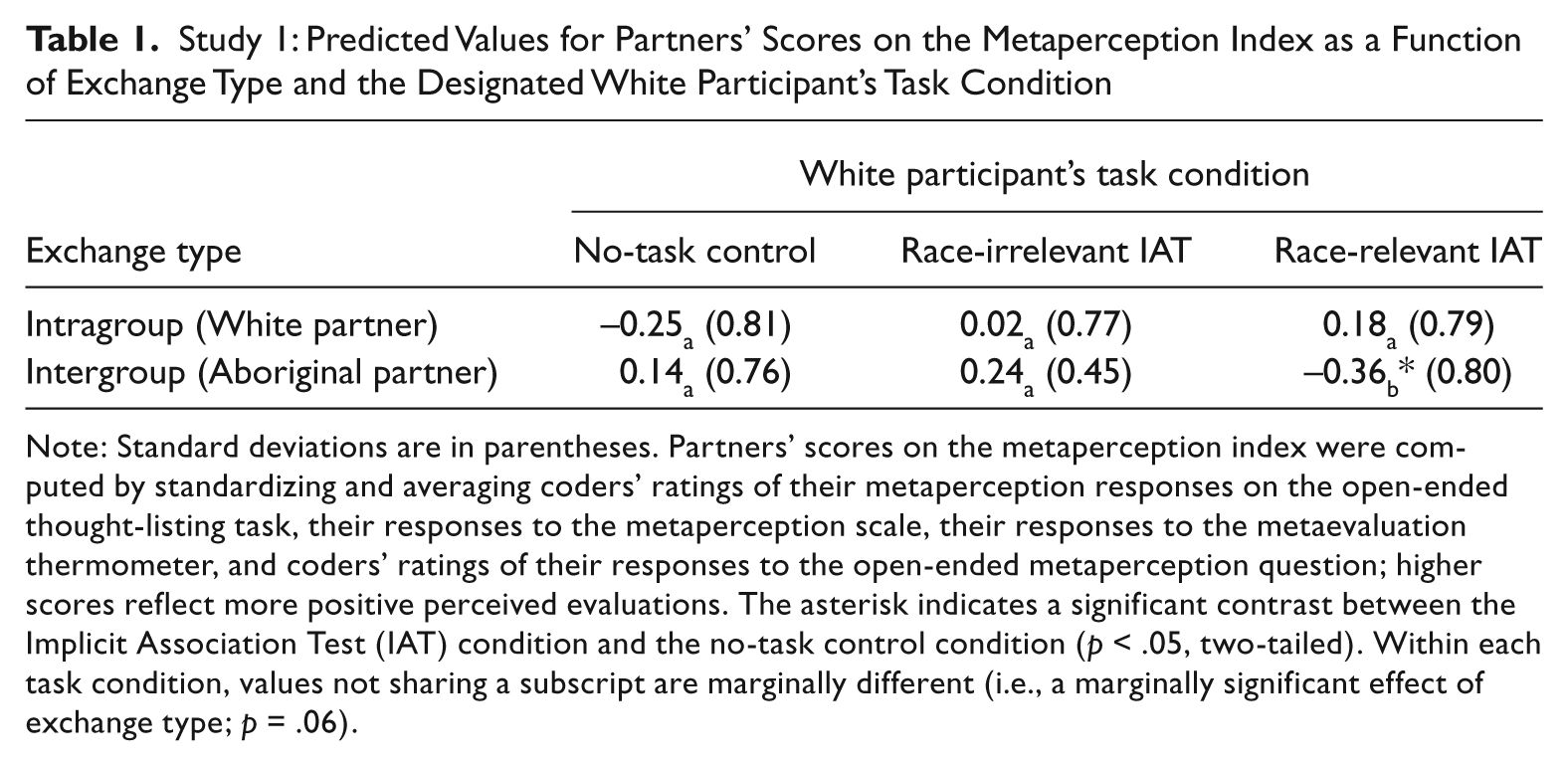
Note: Standard deviations are in parentheses. Partners’ scores on the metaperception index were computed by standardizing and averaging coders’ ratings of their metaperception responses on the open-ended thought-listing task, their responses to the metaperception scale, their responses to the metaevaluation thermometer, and coders’ ratings of their responses to the open-ended metaperception question; higher scores reflect more positive perceived evaluations. The asterisk indicates a significant contrast between the Implicit Association Test (IAT) condition and the no-task control condition (p < .05, two-tailed). Within each task condition, values not sharing a subscript are marginally different (i.e., a marginally significant effect of exchange type; p = .06).
The analysis yielded a significant RR-IAT × Type of Exchange contrast, b = −0.28, β = −0.31, t(81) = 2.38, p < .025. As predicted, Aboriginal partners felt that they were viewed less positively if the White participant with whom they were paired had completed the RR-IAT than if he or she had been in the no-task control condition. This was not true for White partners in White-White pairs (indeed, there was a nonsignificant trend in the opposite direction in intragroup exchanges), or for Aboriginal partners who had been paired with a White participant who had completed the RI-IAT.
Study 2
Study 2 was parallel to Study 1, but it included only intergroup pairs, and it replaced the RI-IAT condition with a condition in which participants completed an explicit self-report measure of attitudes toward Aboriginal persons. This condition was included so that the effects of completing an implicit measure, the RR-IAT, could be distinguished from the effects of completing any measure referencing the ethnicity of an interaction partner in advance of an intergroup exchange.
Several potential mediators of the effect of the RR-IAT on Aboriginal partners’ metaperceptions were considered. To assess whether the manipulation affected the extent to which White participants adopted a cautious and inhibited approach to the interaction, I asked both participants in each pair to rate the other’s degree of self-disclosure. To assess whether the manipulation affected White participants’ self-efficacy, I asked both participants in each pair to judge one another’s relative control over the exchange. Finally, the extent to which both participants in each pair activated stereotypes associated with each ethnic group was assessed.
Method
Participants
Participants were 46 previously unacquainted same-sex pairs of Canadian students in an introductory psychology course (67% female, 33% male). Each pair included 1 White and 1 Aboriginal student. All participants had previously completed a mass testing survey similar to that administered for Study 1; in this study, the perceived-choice component of the Self Determination Scale (see Sheldon, Ryan, & Reis, 1996) was included as an additional covariate to capture individual differences relevant to feelings of control. The White participants were randomly assigned to the RR-IAT condition, explicit-task condition, or no-task control condition.
Procedure
The procedure was identical to that of Study 1, except that the explicit-task condition replaced the RI-IAT condition. Participants in this condition reported their attitudes toward Aboriginal people by completing a modified version of Brigham’s (1993) Attitudes Toward Blacks Scale in which “Aboriginal people” replaced “black people” (16 items; e.g., “It would not bother me if my new roommate was an Aboriginal person”). Scores on this Attitudes Toward Aboriginals (ATA) scale indicated low levels of explicit prejudice (M = 3.44, SD = 1.51, on the 10-point scale; α = .92). Pro-White bias on the RR-IAT was again evident, M = 0.78, t(14) = 6.00, p < .001. 2
This study included only one metaperception measure—the same metaperception scale used in Study 1, with one extra item assessing how much the other participant had formed a positive impression (α = .85). A parallel impression measure assessed reactions to the other participant (α = .89). Participants also answered questions regarding their perceptions of the other participant’s specific behaviors, including his or her perceived self-disclosure (“How much personal information about him/herself did the other participant share with you?”). Whether the impression measure appeared before or after the metaperception and behavior-perception items was counterbalanced. In addition, participants answered three questions regarding who exerted the most influence over the exchange (e.g., “The other participant/I was mostly in control of the discussion”; α = .87); higher numbers reflected the perception that the other participant was more in control.
Next, participants performed a lexical decision-making task (presented as an information processing task) that measured stereotype activation. The procedure and words were identical to those used by Vorauer, Hunter, Main, and Roy (2000). Participants indicated whether each of 72 letter strings formed a word. Of the 36 words, 9 were relevant to White Canadians’ stereotype of Aboriginal Canadians (e.g., “lazy”), 9 were relevant to White Canadians’ metastereotype regarding how they are viewed by Aboriginal Canadians (e.g., “unfair”), 9 were not relevant to either stereotype, and 9 were positive fillers. Response times to stereotype-relevant words were trimmed so as not to exceed 2 standard deviations above the mean for any given word. Indices were computed by averaging the response times for the traits in each category.
Results
Analyses were parallel to those in Study 1, with the predictors being two contrast vectors comparing each of the experimental conditions with the no-task control condition. Covariates were the same as in Study 1 (74% shared the same first language) but also included pair members’ self-determination scores. The predicted values are presented in Table 2.
Study 2: Predicted Values for Aboriginal Partners’ Experience of the Exchange as a Function of the White Participant’s Task Condition
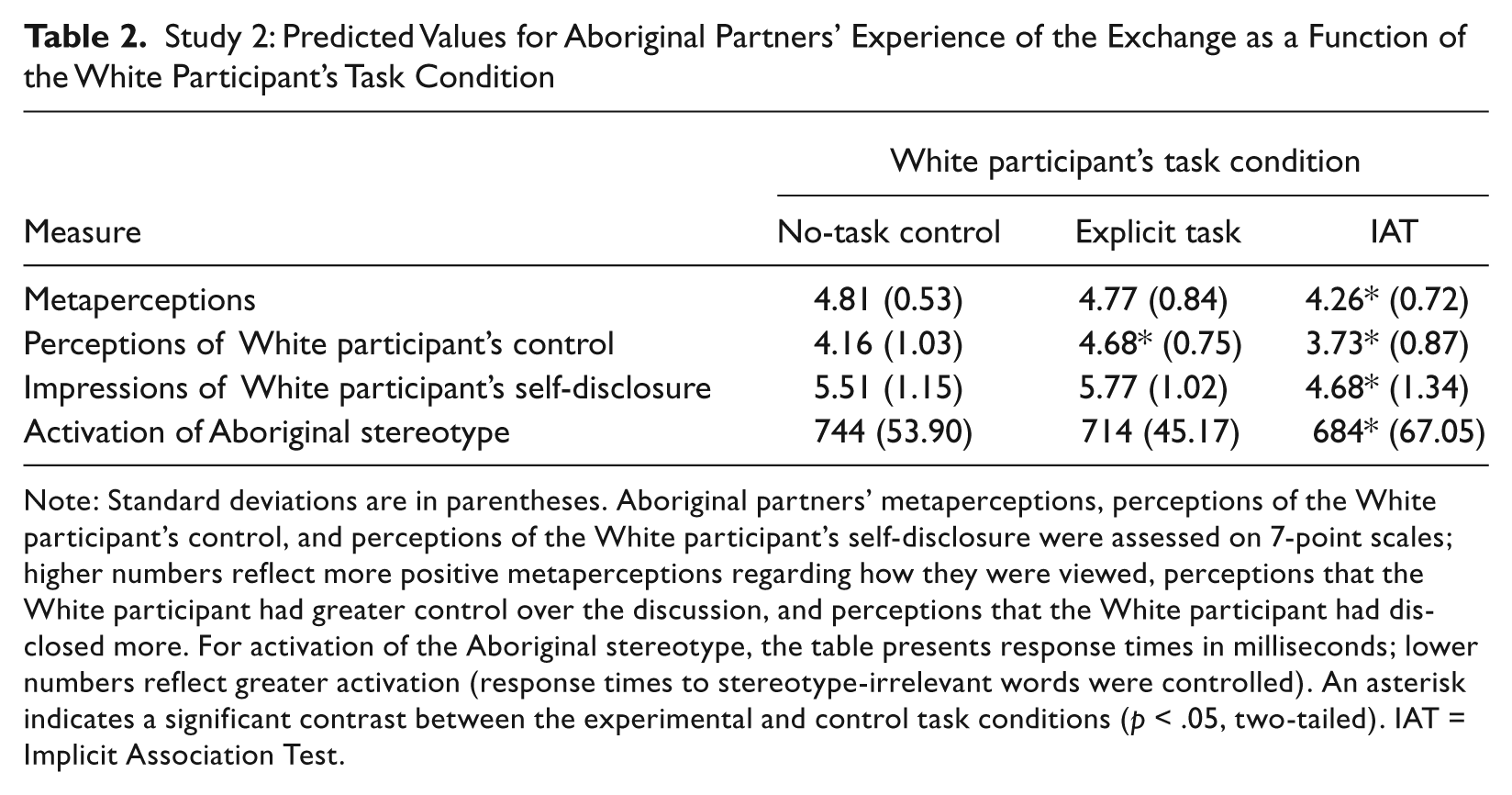
Note: Standard deviations are in parentheses. Aboriginal partners’ metaperceptions, perceptions of the White participant’s control, and perceptions of the White participant’s self-disclosure were assessed on 7-point scales; higher numbers reflect more positive metaperceptions regarding how they were viewed, perceptions that the White participant had greater control over the discussion, and perceptions that the White participant had disclosed more. For activation of the Aboriginal stereotype, the table presents response times in milliseconds; lower numbers reflect greater activation (response times to stereotype-irrelevant words were controlled). An asterisk indicates a significant contrast between the experimental and control task conditions (p < .05, two-tailed). IAT = Implicit Association Test.
Metaperceptions
The analysis of the Aboriginal partners’ metaperceptions regarding how the White participant with whom they were paired viewed them yielded a significant RR-IAT contrast, b = −0.36, β = −0.38, t(38) = 2.13, p < .05; Aboriginal partners felt that they were viewed less positively if the White participant with whom they were paired had completed the RR-IAT than if he or she had been in the no-task control condition. There were no significant effects involving the manipulation on the Aboriginal partners’ impressions of the White participants (M = 5.51, SD = 0.88).
Mediators
Results were consistent with the enhanced-caution interpretation of the RR-IAT effect in that Aboriginal partners perceived that the White participant with whom they were paired self-disclosed less if he or she had completed the RR-IAT than if he or she had been in the no-task control condition, RR-IAT contrast b = −0.64, β = −0.41, t(38) = 2.28, p < .05.
Results were also consistent with the reduced-efficacy account in that Aboriginal partners perceived that the White participant with whom they were paired had less control over the discussion relative to themselves if he or she had completed the RR-IAT than if he or she had been in the no-task control condition, RR-IAT contrast, b = −0.46, β = −0.37, t(38) = 2.17, p < .05. This analysis also yielded a significant explicit contrast in the opposite direction, b = 0.49, β = 0.39, t(38) = 2.45, p < .025.
Analyses of the stereotype-activation data included reaction times to the stereotype-irrelevant words (on which there were no significant or marginal effects) as a further covariate. Aboriginal partners showed greater activation of the Aboriginal stereotype if the White participant with whom they were paired had completed the RR-IAT than if he or she had been in the no-task control condition, RR-IAT contrast b = −29.98, β = −0.24, t(35) = 2.14, p < .05. There were no significant effects on Aboriginal partners’ activation of the White stereotype (M = 718 ms, SD = 121 ms).
There were no significant effects on White participants’ responses to the measures of any of the potential mediators. Conceivably, the manipulation interfered with White participants’ postinteraction responses much as it disrupted their behavior during the interaction itself. For example, if the RR-IAT primed the possibility of bias, it may also have made it more likely that participants’ answers were influenced by social desirability or defensiveness. It is notable that the disconnect between self-reported and outwardly observed control seems to parallel the way individuals’ psychological sense of power can exist outside of conscious awareness (Smith & Galinsky, 2010).
Mediation
Mediation analyses were conducted to test the various accounts for the negative effect of White participants’ RR-IAT experience on their Aboriginal partners’ metaperceptions. Bootstrapping procedures (Shrout & Bolger, 2002) were used to compute a confidence interval (CI) around the indirect effect (i.e., the path through the mediator), with the SPSS macros that Preacher and Hayes (2004) have provided for this procedure. If zero falls outside the CI, mediation can be said to be present.
In the test of the enhanced-caution account, the RR-IAT contrast was the independent variable, Aboriginal partners’ metaperceptions was the dependent variable, and Aboriginal partners’ perceptions of the White participant’s self-disclosure was the mediator. (In this and all other mediation analyses reported, the explicit contrast was controlled, along with covariates associated with significant or marginal effects.) Results revealed a 95% CI ranging from −0.343 to −0.004, indicating significant mediation (p < .05). Parallel analyses testing whether Aboriginal partners’ perceptions of the White participant’s relative control over the interaction (reduced-efficacy account) or Aboriginal partners’ activation of the Aboriginal stereotype (enhanced-stereotyping account) accounted for the RR-IAT effect did not indicate significant mediation (95% CIs: [−0.025, 0.207] and [−0.170, 0.127], respectively). Interestingly, however, the negative effect of the RR-IAT on Aboriginal partners’ perceptions of the White participant’s self-disclosure was mediated by Aboriginal partners’ perceptions of the White participant’s relative control over the interaction (95% CI: [−0.554, −0.028]), a result suggesting a link between reduced efficacy and a cautious approach to intergroup interaction. Reverse mediation was not significant (95% CI: [−0.480, 0.012]).
General Discussion
The results of these studies clearly indicate that being alerted to potential bias and limited response control through taking the IAT has negative implications for White individuals’ intergroup interaction behavior. In both studies, when White individuals completed the RR-IAT before engaging in a face-to-face intergroup interaction, their Aboriginal interaction partners left the exchange feeling less positively regarded. No such effects were evident when White individuals completed an RI-IAT (Study 1) or an explicit prejudice measure (Study 2) before the exchange, or when their interaction partner was White (Study 1).
Mediation analyses conducted in Study 2 suggested that the experience of taking the RR-IAT led White individuals to communicate less positive regard because it prompted them to adopt a cautious approach to the interaction, as reflected by their Aboriginal partner’s perceptions that their personal self-disclosures were limited. The experience of completing the RR-IAT also made White participants appear to their Aboriginal partner as relatively less efficacious and influential in the discussion, an effect that contributed to their being perceived as having shared less information about themselves during the exchange.
Limitations
Although the effects of completing the RR-IAT on White individuals’ subsequent intergroup interaction behavior were clearly negative in these studies, it is possible that with a greater time delay between the test and the interaction, more positive effects would be evident. With a better opportunity to reflect, introspect, and plan, individuals might use the test experience in a positive way to modify their behavior. Further, alternative implicit tasks that frame the judgments differently (e.g., the “personalized” IAT; Olson & Fazio, 2004) might have more positive effects on how test takers behave during subsequent intergroup exchanges. Other important questions center on whether the effects would be different if taking the test was self-initiated outside the lab and on whether the results generalize to different intergroup relationships and to broader awareness interventions (e.g., public information campaigns and educational workshops). To the extent that the specters of bias and limited control are raised in these alternative tasks and circumstances, the effects may be similar. Along these lines, given that most people evidence bias on the test, it seems likely that the effects would, if anything, tend to be stronger if feedback were provided, although this has not been established. Finally, the enhanced-caution account for the results was tested somewhat indirectly in this research, via perceived self-disclosure. Although there are good grounds for expecting lower self-disclosure to be indicative of caution and inhibition (e.g., Post, Wittmaier, & Radin, 1978; Stephan, Stephan, Wenzel, & Cornelius, 1991), other interpretations are possible.
Implications
One direct implication of the present findings is that researchers using the IAT should be mindful of how administering this measure might affect their participants’ subsequent behavior toward an out-group interaction partner. More broadly, the findings suggest that being alerted to potential bias and limited response control through a direct personal experience such as that provided by the IAT—and possibly by other interventions intended to enhance awareness of bias and limited control over behavioral responses—can lead to worse rather than better behavior regulation. Indeed, the present research reveals that, at least in some circumstances, taking the IAT can harm individuals’ behavior in subsequent intergroup interactions. Anyone who takes the test should be wary of this potential unintended side effect.
Footnotes
Acknowledgements
I thank Hilary Johnson, Brianna Bogucki, Tara Galaugher, Matthew Quesnel, and Yunqiao Wang for assistance with data collection, coding, and computer programming.
Declaration of Conflicting Interests
The author declared that she had no conflicts of interest with respect to her authorship or the publication of this article.
Funding
This research was facilitated by a Social Sciences and Humanities Research Council of Canada grant.