



Abstract
Humor is ubiquitous and often beneficial, but the conditions that elicit it have been debated for millennia. We examine two factors that jointly influence perceptions of humor: the degree to which a stimulus is a violation (tragedy vs. mishap) and one’s perceived distance from the stimulus (far vs. close). Five studies show that tragedies (which feature severe violations) are more humorous when temporally, socially, hypothetically, or spatially distant, but that mishaps (which feature mild violations) are more humorous when psychologically close. Although prevailing theories of humor have difficulty explaining the interaction between severity and distance revealed in these studies, our results are consistent with the proposal that humor occurs when a violation simultaneously seems benign. This benign-violation account suggests that distance facilitates humor in the case of tragedies by reducing threat, but that closeness facilitates humor in the case of mishaps by maintaining some sense of threat.
Humor is tragedy plus time.
Tragedy is when I cut my finger. Comedy is when you walk into an open sewer and die.
Humor is the psychological state characterized by the appraisal that something is funny, the positive emotion of amusement, and the tendency to laugh (Gervais & Wilson, 2005; Martin, 2007; Veatch, 1998). Humor is both ubiquitous and important. It benefits well-being, facilitates coping, smoothes social relationships, attracts attention, and influences consumption and relationship choices (Keltner & Bonanno, 1997; Martin, 2007). The conditions that elicit humor, however, are debated. Here, we attempt to inform the debate by examining a factor that comedians, writers, directors, and some humor theorists speculate plays a crucial role in the creation of humor: psychological distance. We propose that, contrary to prevailing theories, the effect of distance on humor depends on the extent to which a stimulus is aversive. In accordance with a recent account that suggests humor is created by the perception of a benign violation, we hypothesize that although distance increases humor in response to tragedies, it decreases humor in response to milder mishaps. We report a series of studies in which we tested competing accounts of humor and obtained evidence that psychological distance reduces threat independently of changes in cognitive construal.
Psychological Distance and Humor
Psychological distance is the subjective set of experiences associated with being close or far away from something (Ross & Wilson, 2002; Van Boven, Kane, McGraw, & Dale, 2010). There are four commonly accepted forms of distance (Liberman & Trope, 2008): (a) spatial (e.g., a mile is more distant than a foot), (b) social (e.g., a stranger is more distant than a friend), (c) temporal (e.g., a year is more distant than a day), and (d) hypothetical (e.g., an imagined event is more distant than a real event). Psychological distance has multiple properties. Construal-level theory proposes that distance causes people to construe events more abstractly (e.g., Liberman & Trope, 2008; Trope & Liberman, 2010). Other evidence suggests another important property of psychological distance: It reduces the extent to which potentially aversive stimuli are threatening (Mobbs et al., 2007; Williams & Bargh, 2008). For example, people who are spatially distant from a tragic event, such as the September 11 attacks on the World Trade Center, perceive less threat and experience less anxiety and posttraumatic stress than people who are spatially close (Blanchard et al., 2004; Huddy, Feldman, Taber, & Lahav, 2005). Further, merely priming distance by asking people to plot points far apart rather than close together can make reading a violent story less distressing (Williams & Bargh, 2008).
Prior research on psychological distance and humor is consistent with the intuitively appealing suggestions attributed to Mark Twain and Mel Brooks with which we opened this article: Distance helps transform tragedy into comedy. For example, immoral acts, like bestiality, are more amusing to readers primed to feel spatially distant (McGraw & Warren, 2010), disparaging sexist jokes are more amusing to people who are not personally affected (Wolff, Smith, & Murray, 1934), and highly disgusting behavior is more amusing to viewers who take a socially distant perspective (Hemenover & Schimmack, 2007). Although research has yet to explore the effects of hypotheticality or temporal distance, anecdotal evidence suggests that they have similar effects. The popularity of cartoons, such as South Park and Looney Tunes, indicates that hypotheticality can make scathing satire and brutal violence humorous. Similarly, the Oscar-winning movie Life Is Beautiful indicates that even a Nazi genocide can be a source of humor if enough time has passed. (Also, people often quip “too soon” when a joke is told shortly after a tragedy.)
Although most prevailing theories of humor do not directly account for the role of psychological distance, some accommodate the view that distance increases humor. Superiority theories, which hold that humor results from an unexpected feeling of triumph, suggest that disparagement is funny when it victimizes someone else or a past self, but not one’s current self (Gruner, 1997; Hobbes, 1651/1968). Reversal theories, which hold that humor occurs when people reinterpret something in a less serious or favorable manner, suggest that psychological distance from real-world concerns is also necessary in order for people to respond to such reinterpretation with humor (Apter, 1982; Wyer & Collins, 1992). Incongruity theories, which hold that humor results from perceiving a mismatch between expectation and reality (Martin, 2007), typically do not explain how distance influences humor. One version of such theories, however, explicitly proposes that humor requires psychological distance in addition to incongruity (Morreall, 2009). Other versions, which propose that humor occurs when one makes sense of (i.e., “resolves”) an unexpected occurrence (e.g., Suls, 1972) or when one sees something from multiple perspectives (e.g., Koestler, 1964), can accommodate distance effects in a roundabout way using a construal-level account of psychological distance. In this view, distance may increase humor because it increases abstract, high-level construals (Liberman & Trope, 2008; Trope & Liberman, 2010), which make it easier to hold multiple interpretations (Hong & Lee, 2010).
Humor in Benign Violations
We drew from a recent account of humor to make the prediction that the effect of distance depends on the degree to which a stimulus is aversive. Building on work by Veatch (1998), McGraw and Warren (2010) proposed that humor occurs when a violation (i.e., a stimulus that is physically or psychologically threatening) simultaneously seems benign (i.e., okay). Evolutionarily, the original violations likely were physical threats from attackers or unpredictable ecological disasters (Buss, 2009; Gervais & Wilson, 2005; Ramachandran, 1998). As humans began to develop a sense of self, a complex worldview, interdependent societies, and communication skills, violations likely expanded to include identity threats and behaviors that break logical, cultural, social, conversational, and linguistic norms (McGraw & Warren, 2010; Veatch, 1998). McGraw and Warren’s account posits that the potentially negative experience inherent in a violation generates humor when the apparent threat is perceived to be okay or acceptable.
The account suggests that seemingly disparate humor-inducing stimuli are alike in that they are perceived to be benign violations: Play fighting and tickling are mock attacks, puns violate one linguistic or logic norm while adhering to another, and satire presents something that is wrong as if it is not (Veatch, 1998). This account also suggests that because humor requires a benign violation, either too much or too little threat impedes humor. Too much threat makes it difficult to perceive a violation as benign; conversely, too little threat makes it difficult to perceive that there is a violation. For example, the laughter typically elicited by play fighting and tickling ceases either when the attack becomes too aggressive or prolonged (no longer benign) or when it stops (no longer a violation).
Because of the threat-reducing properties of psychological distance, we suggest that distance should increase the humor perceived in highly aversive stimuli (i.e., tragedies) by making these severe violations seem benign (Fig. 1). Indeed, the evidence suggesting that distance increases humor comes from studies featuring highly aversive stimuli (e.g., bestiality, disparaging jokes). In contrast, we propose that distance should have the opposite effect for less aversive, mild violations because in such cases, distance eliminates an already low level of threat. Mild violations pose only a small amount of threat, which, even from a close distance, should be easy to perceive as benign. However, increasing distance may make it difficult to perceive any threat in the stimulus, so that it is transformed from a more humorous benign violation into a less humorous, purely benign stimulus (Fig. 1). In sum, we hypothesize that distance should increase the humor perceived in tragedies, such as getting hit by a car, but decrease the humor in mishaps, such as stubbing a toe.

Predictions of the benign-violation account of the perception of humor. According to this account, psychological distance (distant vs. close) and severity of the violation (tragedy vs. mishap) interact in determining whether a violation is humorous. Humor increases with distance in the case of tragedies, but decreases with distance in the case of mishaps.
Overview of the Present Studies
In five studies, we tested the interactive effects of distance and violation severity on perceived humor. Whereas other humor theories also predict that distance makes tragedies more humorous, only the benign-violation account predicts that closeness makes mishaps more humorous. Therefore, by exploring whether the effect of distance is reversed in the case of mishaps, our studies provided a critical test between competing accounts of what makes things funny. Across the five studies, we examined the interaction between severity and all four commonly accepted forms of distance: temporal (Studies 1 and 2), social (Study 3), hypothetical (Study 4), and spatial (Study 5).
Study 1: Humor Then and Now
Inspired by the opening quote attributed to Mark Twain, we investigated the relationship between distance, violation severity, and humor by asking respondents to recall an event that had become either more or less funny over time. If distance increases the humor in severe violations (i.e., tragedies), but decreases the humor in mild violations (i.e., mishaps), then autobiographical events that get funnier over time should feature more severe violations than those that get less funny over time.
Design and measures
Participants in Study 1 were recruited through Amazon’s Mechanical Turk. Respondents (N = 70; 34% female, 66% male; mean age = 30.2 years; 30% born in the United States) were randomly assigned to one of two conditions and asked to describe an autobiographical event. Those in the increasing-humor condition described “an incident that has become more humorous as time has passed.” Conversely, respondents in the decreasing-humor condition described “an incident that has become less humorous as time has passed.” After describing the incident, participants rated their impression of its severity on four 7-point scales anchored by not threatening/threatening, not aversive/aversive, not upsetting/upsetting, and not disturbing/disturbing (α = .85). Finally, participants rated the extent to which they considered the incident humorous, both at the time it occurred (α = .90) and at the time of the study (α = .92); these ratings were made on three 7-point scales anchored by not funny/funny, not humorous/humorous, and not amusing/amusing.
Results
The humor ratings indicated that the condition manipulation was effective. Respondents in the increasing-humor condition perceived the incident to be more humorous in the present (i.e., when the incident was distant; M = 6.13, SD = .92) than at the time it occurred (i.e., when the incident was close; M = 3.12, SD = 1.70), t(39) = 9.23, p < .001. Conversely, respondents in the decreasing-humor condition perceived the incident to be less humorous in the present (M = 3.46, SD = 1.90) than at the time it occurred (M = 5.25, SD = 1.59), t(33) = −3.50, p < .001.
Respondents also indicated that incidents that became more funny over time were more severe (M = 3.87, SD = 1.59) than incidents that became less funny (M = 2.52, SD = 1.65), F(1, 68) = 12.55, p < .001. Consistent with the idea that severe violations are difficult to see as benign at a close distance, a correlational analysis indicated that ratings of severity were negatively related to how humorous the incident seemed at the time it occurred, r(72) = −0.63, p < .001. However, consistent with the idea that distance makes it easier to see severe violations as benign, a second correlational analysis indicated that ratings of severity were positively related to how humorous the incident seemed at the time of the study, r(72) = .37, p < .01. Figure 2 depicts a spotlight analysis that illustrates how the perceived humor of the autobiographical event depended on both temporal distance and the severity of the violation. For mild violations (1 SD below the mean), perceived humor was greater when the event happened than at the time of the study, but for severe violations (1 SD above the mean), perceived humor was greater at the time of the study than when the event occurred.
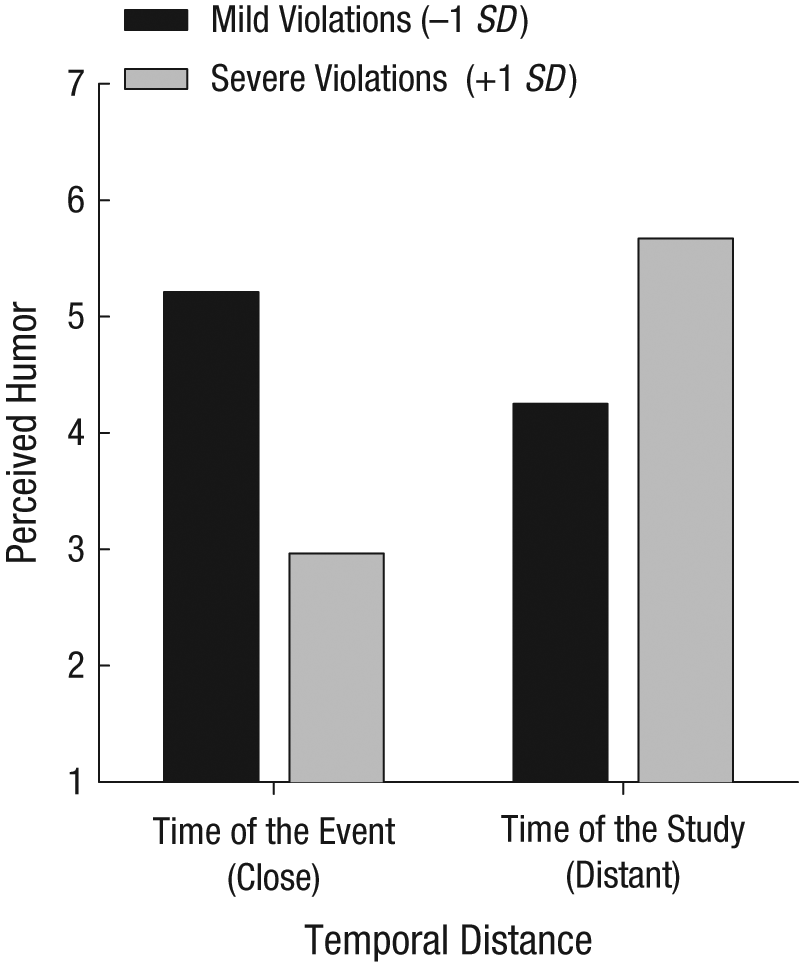
Perceived humorousness of the recalled autobiographical event in Study 1 as a function of temporal distance and severity of the violation (1 SD below the mean vs. 1 SD above the mean). Temporal distance was manipulated by asking participants to judge how humorous the event seemed both at the time it occurred (close to the event) and at the time of the study (distant from the event).
Study 2: Reversal of the Effects of Temporal Distance as a Function of Violation Severity
In our subsequent studies, we moved away from a retrospective approach and assessed humor perceptions in real time. In Study 2, we used an empirical thought experiment to manipulate the time an event occurred and its severity (Fig. 3). We tested whether distance increased humor for tragedies, but reduced humor for mishaps.
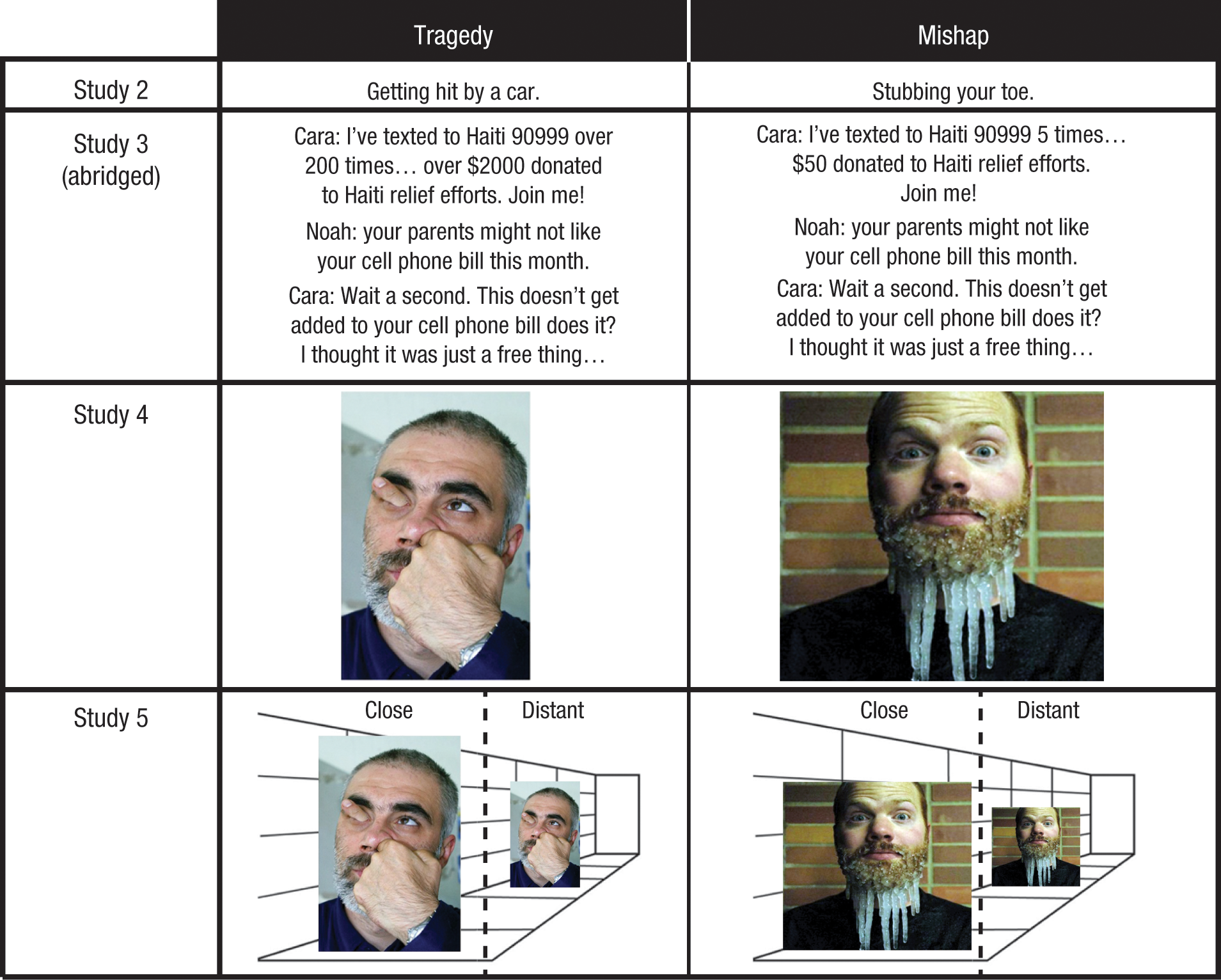
Illustration of the stimuli used in Studies 2 through 5. In Study 2, participants judged which of two events seemed more humorous; in Study 3, they read an online exchange and reported their perceptions of the humor in the event; and in Studies 4 and 5, they judged the humor in two photos.
Design and measures
As part of a voluntary in-class exercise, undergraduate students (N = 87) were presented with two pairs of events (order was counterbalanced):
Being hit by a car five years ago. or Being hit by a car yesterday. Stubbing your toe five years ago. or Stubbing your toe yesterday.
For each pair, they indicated which situation they would “more likely find humorous.”
Results
Results were consistent with previous evidence in that 99% of respondents indicated that a severe violation, getting hit by a car, would be more humorous if it occurred 5 years ago than if it occurred yesterday. However, as we predicted, the reverse effect was obtained for the mild violation; only 18% of respondents indicated that stubbing a toe would be more humorous if it occurred 5 years ago than if it occurred yesterday, χ2(1, N = 87) = 116.1, p < .001 (Fig. 4a).
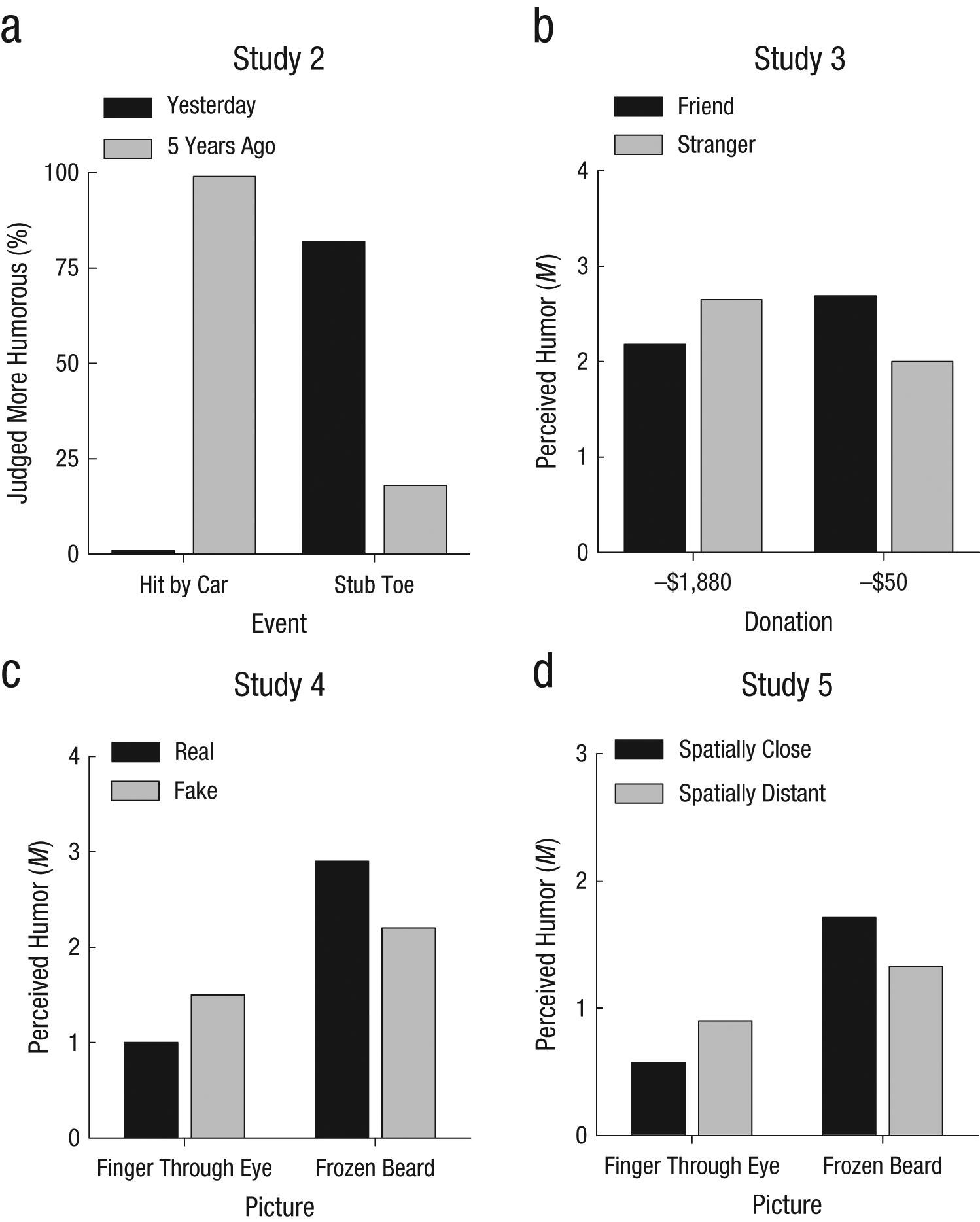
Humor as a function of distance and violation severity in Studies 2 through 5. In Study 2 (a), respondents rated whether each of two events (being hit by a car, stubbing a toe) would be more humorous if it occurred yesterday (temporally close) or if it occurred 5 years ago (temporally distant). In Study 3 (b), respondents rated the humor of an online exchange in which a woman discovered that she had unwittingly donated money (either $1,880 or $50); they made their ratings both while imagining that the woman was a friend (socially close) and while imagining that she was a stranger (socially distant). In Study 4 (c), respondents rated the humor of two pictures, which they believed to be either real (close) or fake (distant). In Study 5 (d), participants rated the humor of one of two pictures, which was presented so as to appear either spatially close or spatially distant. In each panel, the two bars on the left depict results for a severe violation, and the two bars on the right depict results for a mild violation.
Study 3: Reversal of the Effects of Social Distance as a Function of Violation Severity
In our next three studies, we continued to test whether the effect of psychological distance on humor depends on whether something is a tragedy or a mishap. These studies featured the remaining forms of distance and new violations.
Design and measures
Undergraduate students participated in Study 3, which was ostensibly on social networking services, in exchange for course credit. Only students who had not previously seen the stimuli (which originally appeared on a popular Web site, failbook.com) were invited to participate (N = 90). The study used a 2 (distance: close, distant; within subjects) × 2 (violation severity: mild, severe; between subjects) mixed design.
Participants read an online exchange in which a young woman discovers that she has unknowingly donated nearly $2,000 (tragedy) or $50 (mishap) via text messaging (see Fig. 3 and the Supplemental Material available online for details). We manipulated social distance by having participants rate their perceptions of the posting twice, once imagining the woman as “a close friend,” and once imagining her as “someone you don’t know” (order counterbalanced). Participants responded to two questions: “Do you think your friend’s [this stranger’s] posting is funny?” and “Do you think your friend’s [this stranger’s] posting is humorous?” The 6-point response scale ranged from 0, no, to 5, very. We combined responses to these two questions to create a measure of perceived humor (αs > .9).
Results
A repeated measures analysis of variance with social distance as a within-subjects variable and violation severity and order as between-subjects variables showed the predicted interaction between distance and severity, F(1, 86) = 20.1, p < .001 (Fig. 4b). Whereas a stranger accidentally donating $1,880 was judged more humorous (M = 2.65, SD = 1.91) than a friend accidentally donating $1,880 (M = 2.18, SD = 1.74), t(50) = 2.47, p < .05, Cohen’s d = 0.35, the effect of distance reversed when the mistake was less severe: The $50 mistake was judged more humorous when it hurt a friend (M = 2.69, SD = 1.69) rather than a stranger (M = 2.00, SD = 1.81), t(38) = 2.97, p < .01, Cohen’s d = −0.48. The three-way interaction was not significant, F(1, 86) = 0.07, p > .7; that is, the interaction between social distance and violation severity was similar irrespective of whether respondents first imagined that the woman was a friend or first imagined that she was a stranger.
Study 4: Reversal of the Effects of Hypotheticality as a Function of Violation Severity
Although our first three studies revealed a pattern consistent with the benign-violation account, they could be criticized on the grounds that the distance manipulations were too transparent. Therefore, we next employed a between-subjects design that disguised the distance manipulation. We also conceptually replicated the previous studies using different stimuli (photographs from a Web site), a different type of violation (a physical abnormality), and a different form of psychological distance (hypotheticality).
Design and measures
Undergraduate students (N = 67) completed the study in exchange for course credit. The study used a 2 (distance: close, distant; between subjects) × 2 (violation severity: severe, mild; within subjects) mixed design.
Participants received a booklet titled “Judging Website Content.” Those in the close condition read about a Web site, “Realphotos.net,” that “displays real pictures” that “have not been altered using image design software.” Participants in the distant condition received similar information, except that the Web site was named “Fakephotos.net,” and participants were told that the site “displays fake pictures” that “have been altered using image design software.” Next, participants judged the humor of pictures purportedly from the Web site. One picture portrayed a severe abnormality, a man with his finger protruding from his eye socket, and the other portrayed a mild abnormality, a man with a frozen beard (Fig. 3; order counterbalanced). Participants rated the extent to which they perceived the photos to be funny and humorous on 6-point scales ranging from 0, no, to 5, a lot.
Results
A repeated measures analysis of variance with violation severity as a within-subjects variable and distance (hypotheticality) and order as between-subjects variables again showed the predicted interaction between distance and severity, F(1, 62) = 10.25, p < .01 (Fig. 4c). Whereas the highly aversive image was more humorous, though not significantly so, when it was perceived to be fake (M = 1.50, SD = 1.35) than when it was perceived to be real (M = 1.01, SD = 1.31), t(64) = 1.49, p = .14, Cohen’s d = 0.37, the less aversive image was significantly more humorous when it was perceived to be real (M = 2.88, SD = 1.09) than when it was perceived to be fake (M = 2.22, SD = 1.40), t(64) = −2.16, p < .05, Cohen’s d = −0.53. The three-way interaction was not significant, F(1, 62) = 0.21, n.s. Thus, the effect did not depend on the presentation order of the pictures.
Study 5: Reversal of the Effects of Spatial Distance as a Function of Violation Severity
In our final study, we attempted to replicate the reversal shown in our previous studies using a subtle manipulation of spatial distance and a fully between-subjects design.
Design and measures
The study used a 2 (spatial distance: close, distant) × 2 (violation severity: severe, mild) between-subjects design. Respondents (N = 350; 50% female, 50% male; mean age = 48.7 years) were recruited from an online survey panel. Each viewed one of the two images from Study 4. We manipulated perceived spatial distance by varying the size and position of the image relative to the background. In the close condition, the image was approximately 2.5 in. × 3 in. and appeared toward the left side of the page; in the distant condition, the image was approximately 1.5 in. × 1.7 in. and appeared toward the right side of the page (for illustrative purposes, Fig. 3 shows the images in both positions; see the Supplemental Material for stimulus materials). Participants indicated the extent to which they perceived the image to be humorous, using the same scale as in Study 4.
Results
Older respondents generally perceived less humor in the images, b = −0.017, t(345) = −3.65, p < .001. Therefore, we included age as a covariate in our analysis. Results replicated previous studies: An analysis of covariance revealed a significant crossover interaction between spatial distance and violation severity, F(1, 345) = 7.47, p < .01 (Fig. 4d). Whereas the highly aversive image was more humorous when it looked far away (M = 0.90, SD = 1.42) than when it looked close (M = 0.57, SD = 1.02), t(345) = 1.90, p = .06, Cohen’s d = 0.27, the mildly aversive image was more humorous when it looked close (M = 1.71, SD = 1.39) than when it looked far away (M = 1.33, SD = 1.36), t(345) = −1.97, p < .05, Cohen’s d = −0.28.
General Discussion
We have broadened understanding of what makes things funny by showing that perceptions of humor depend on both psychological distance from a potentially funny stimulus and the extent to which the stimulus seems aversive. Our five studies show that psychological distance increases the humor perceived in more aversive, severe violations (i.e., tragedies), but that closeness increases the humor perceived in less aversive, mild violations (i.e., mishaps). We found this reversal across various forms of distance, types of violations, and experimental designs. The observed interaction between psychological distance and violation severity is not easily accounted for by prevailing accounts of humor or psychological distance. 1 The interaction, however, is consistent with both the benign-violation account of humor (McGraw & Warren, 2010; Veatch, 1998) and the threat-reduction account of psychological distance (Mobbs et al., 2007; Williams & Bargh, 2008).
Psychological distance is more than construal level
Our research provides additional evidence that psychological distance is capable of influencing judgments independently of cognitive construals (Van Boven et al., 2010; Williams & Bargh, 2008; Williams, Stein, & Galguera, 2011). Psychological distance often influences the cognitive construal of a situation: Closeness facilitates concrete, low-level construal, and distance facilitates abstract, high-level construal (Liberman & Trope, 2008; Trope & Liberman, 2010). A construal-level theory account for the effects of distance on humor can possibly explain how distance makes severe violations funnier by making it easier to see multiple interpretations (Hong & Lee 2010), but such an account has difficulty parsimoniously explaining how closeness makes mild violations funnier. Changes in cognitive construal are important consequences of psychological distance, but they are not the only consequences. Psychological distance also reduces threat.
Conceptualizing humor as benign violations
We used the benign-violation account to generate novel predictions about the effect of psychological distance on humor. The account builds on insights from a wide range of theories to suggest three jointly necessary and sufficient conditions for humor: an appraisal that there is a violation, an appraisal that everything is benign, and the simultaneous perception of both appraisals (McGraw & Warren, 2010; Veatch, 1998). The idea that humor requires a violation is included in a number of humor theories that propose that humor is associated with negative elements, including forbidden sexual and aggressive drives (e.g., Freud, 1928), disparagement (e.g., Gruner, 1997), diminishment (e.g., Wyer & Collins, 1992), and unmet expectations (e.g., Morreall, 2009). The idea that humor requires a benign appraisal is consistent with other accounts that propose that humor requires resolution (e.g., Suls, 1972), playfulness (e.g., Gervais & Wilson, 2005), or safety (e.g., Ramachandran, 1998). The idea that humor requires simultaneity is consistent with yet other accounts that propose that humor requires bisociation (Koestler, 1964), synergy (e.g., Apter, 1982), or script opposition (e.g., Attardo & Raskin, 1991). Although previous theories have included each of the conditions in isolation, the benign-violation hypothesis is the first to consider them as jointly influencing humor perception.
In addition to explaining the effects of psychological distance on humor, the benign-violation account helps explain when a broad range of stimuli (puns, satire, etc.) are humorous and when they are not. Consider tickling as an example. Because humor theories often have difficulty explaining why tickling produces laughter, many theorists argue that laughter provoked by tickling does not qualify as humor (e.g., Wyer & Collins, 1992). The benign-violation hypothesis, however, suggests that laughter provoked by tickling is like other humor in that it is caused by a benign violation. Tickling elicits laughter when it poses a harmless physical threat from a trusted aggressor (a benign violation), but not when it poses a more serious threat from an untrusted aggressor or when it involves no violation at all because the tickler is oneself.
Another potential advantage of the benign-violation account is that it can help explain the link between many of the antecedents and consequences of humor, which are often examined in isolation. For instance, humor facilitates coping with pain and adversity, smoothes interpersonal conflict, and eases criticisms (Martin, 2007)—consequences that are consistent with the notion that humor is associated with violations that are transformed into less threatening and more pleasing benign violations.
A note about laughter
Not all instances of laughter indicate humor. For example, laughter can serve purely social communicative functions or occur simply because other people are laughing (Provine, 2000). Although the antecedents of laughter are fairly well understood (see Provine, 2000), our studies contribute to the more contested question of what makes things humorous. However, because we limited our investigation to appraisals of humor and not laughter per se, future work should examine whether violation severity and distance also have an interactive effect on laughter. One interesting puzzle is Provine’s (2000) observation that most of the laughter in everyday situations is elicited by seemingly mundane comments that are not apparently funny to an observer (e.g., “Do you have a rubber band?”). The benign-violation account suggests the following explanation (which is consistent with the saying, “you had to be there”): These interactions could be humorous because they feature extremely mild violations at a very close distance. Because any distance from the context, no matter how slight, removes the perception of a violation, people who are not involved, and subsequently, even the same people who were involved, do not find these comments to be humorous.
Conclusion
In his Treatise on Human Nature, Hobbes wrote, “Men laugh at the follies of themselves past” (as quoted in Allibone, 1880/2011, p. 390), suggesting that psychological distance enhances humor. We have demonstrated that Hobbes was only partially correct. Although distance does increase the humor perceived in highly aversive situations, such as getting hit by a car, closeness increases the humor perceived in mildly aversive situations, such as stubbing a toe. Because distance reduces threat, tragedies fail to be funny when one is too close for comfort, but mishaps fail to be funny when one is too far to care.
Footnotes
Acknowledgements
We thank the Humor Research Lab (HuRL) at the University of Colorado Boulder for research assistance, as well as helpful comments and suggestions. We are also grateful to Dan Bartels, Jonah Berger, Reid Hastie, Jeff Larsen, Jonathan Levav, and David Mazursky for helpful suggestions and encouragement.
Declaration of Conflicting Interests
The authors declared that they had no conflicts of interest with respect to their authorship or the publication of this article.

Notes
References
Supplementary Material
Please find the following supplemental material available below.
For Open Access articles published under a Creative Commons License, all supplemental material carries the same license as the article it is associated with.
For non-Open Access articles published, all supplemental material carries a non-exclusive license, and permission requests for re-use of supplemental material or any part of supplemental material shall be sent directly to the copyright owner as specified in the copyright notice associated with the article.
