




Abstract
In the study reported here, we assessed the theory that vocabulary learning in children depends critically on the capacity of a “phonological loop” that is indexed by nonword-repetition ability. A 3-year longitudinal study of 219 children assessed nonword-repetition ability and vocabulary knowledge at yearly intervals between the ages of 4 and 7 years. There was a considerable degree of longitudinal stability in children’s vocabulary and nonword-repetition skills, but there was no evidence of any influence of nonword-repetition ability on later vocabulary knowledge. These results seriously call into question the claim that vocabulary learning in children is constrained by nonword-repetition ability, and they cast doubt on the broader theory that the phonological loop functions as a language-learning device.
Keywords
Vocabulary knowledge is one of the fundamental building blocks of language development. There is a very rapid growth in vocabulary knowledge during early childhood; it is estimated that by the end of Grade 2, the average child knows the meanings of approximately 6,000 root word forms (Biemiller, 2005). Despite the critical role of vocabulary learning in language and cognitive development, the cognitive mechanisms underlying vocabulary learning are not well understood. One influential theoretical account claims that phonological memory underpins and places critical constraints on the learning of new vocabulary. It has been proposed that the phonological loop component illustrated in Baddeley’s (1996) working memory model evolved to function as a language-learning device that allows a child “to store unfamiliar sound patterns while more permanent memory records are being constructed” (Baddeley, Gathercole, & Papagno, 1998, p. 158). From a practical perspective, such a theory clearly implies that memory-training programs might be critical in helping to remediate the vocabulary-learning difficulties seen in children with language impairments (Hulme & Snowling, 2009).
In practice, studies of the Baddeley et al. (1998) theory about memory and vocabulary learning have relied exclusively on measures of nonword-repetition ability, as this task gives “a relatively pure measure of phonological loop capacity” (Baddeley et al., 1998, p. 159). Several studies have shown that nonword-repetition ability is a reliable concurrent correlate of individual differences in children’s vocabulary knowledge (de Jong & van der Leij, 1999; Holopainen, Ahonen, Tolvanen, & Lyytinen, 2000; for a review, see Melby-Lervåg & Lervåg, 2012) and that children with language-learning impairments have severe nonword-repetition deficits (Bishop, North, & Donlan, 1996; Conti-Ramsden, 2003; Graf Estes, Evans, & Else-Quest, 2007). However, studies such as these, which used only concurrent measures, cannot provide any convincing support for the claim that nonword repetition is a causal influence on vocabulary development.
Longitudinal studies potentially provide better evidence about causality, but only one prior study (Gathercole, Willis, Emslie, & Baddeley, 1992) has examined the mutual developmental relationship between nonword repetition and vocabulary at several time points during early childhood. This study examined 80 children on four occasions between the ages of 4 and 8 years. Cross-lagged correlational analyses were interpreted as evidence that phonological memory skills at age 4 years exerted a direct, and probably causal, influence on vocabulary skills at age 5 years. It was suggested that at later ages, vocabulary development became a longitudinal influence on nonword-repetition skills.
There is, however, considerable uncertainty surrounding these conclusions about putative causal relationships, given that they are based on the use of cross-lagged correlations. Rogosa (1980) demonstrated that cross-lagged correlations may give rise to contradictory patterns depending on the variance and reliability (true-score variance) of the different measures compared across different time points; Rogosa’s conclusion was that this form of analysis “is best forgotten” (p. 257). In contrast to the findings of Gathercole et al. (1992), the results of two other studies failed to show evidence that nonword-repetition ability is a longitudinal predictor of the growth in vocabulary in children between the ages of 5 and 6 years (Bowey, 2001; de Jong & Olson, 2004).
The dominant theoretical position in this area sees nonword repetition as a “pure” measure of phonological memory, which in turn is a mechanism responsible for vocabulary learning. In contrast, other researchers have argued that improvements in nonword-repetition scores may be a consequence of increased vocabulary knowledge (Bowey, 2001; Metsala, 1999; Snowling, Chiat, & Hulme, 1991) or a consequence of learning to read (Nation & Hulme, 2011). Similarly, MacDonald and Christiansen (2002) have argued that working memory capacity “is not a primitive that can vary independently” (p. 35) but is rather an emergent property of the language-processing architecture.
Given the theoretical and practical importance of understanding the relationships between nonword repetition and vocabulary skills, we decided to reassess the claim that nonword repetition may exert a causal influence on vocabulary acquisition. We therefore replicated the longitudinal study by Gathercole et al. (1992) on a larger sample using statistical techniques that overcame the problems of cross-lagged correlational analyses used in that study. We also reanalyzed the data from Gathercole et al. (1992) to show that the same pattern of conclusions from our study was found when appropriate analyses were conducted on their data. We focused on the study of Gathercole et al. (1992) because it is the only previous study with multiple times of measurement, which allows analyses that control for measurement error to be conducted.
Method
Participants
Two hundred nineteen children (104 girls, 115 boys; average age = 4.3 years, SD = 2.3 months) were recruited from Norwegian day-care centers (there were small amounts of missing data, although at least 193 children had data at all time points assessed in the current study). Children who learned Norwegian as a second language, children diagnosed with learning disabilities, and children with sensory impairments were excluded from the study.
Design and procedure
The children were tested annually in December and January over a period of 4 years. Testing at Times 1 and 2 was done in day-care centers, and testing at Times 3 and 4 was usually done in school. Tests were administered in a fixed order by trained assistants.
Tests and materials
Nonword repetition
The children were tested with the Children’s Test of Nonword Repetition (Gathercole & Baddeley, 1996), adapted to the phonetic and semantic features of the Norwegian language. The nonwords were presented to the child through earphones using an mp3 player. The children were told to listen carefully to each nonword and repeat it back immediately as accurately as possible. The nonword-repetition test consisted of 28 items with two, three, four, and five syllables, and children were tested with all items. Repetition attempts were scored as either incorrect or correct.
Vocabulary
A Norwegian version of the British Picture Vocabulary Scale (Dunn, Dunn, Whetton, & Burley, 1997) was used to measure vocabulary. In this test, the child responds by pointing to one of four line drawings that corresponds to the word spoken by the test administrator. The test has 144 items. Testing was stopped when the child erred on 8 out of the last 12 items presented.
Results
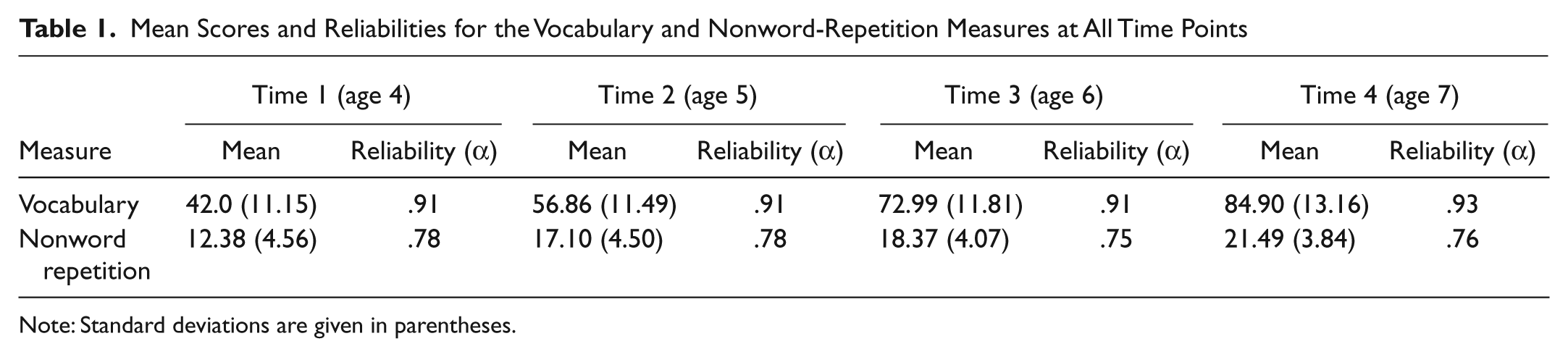
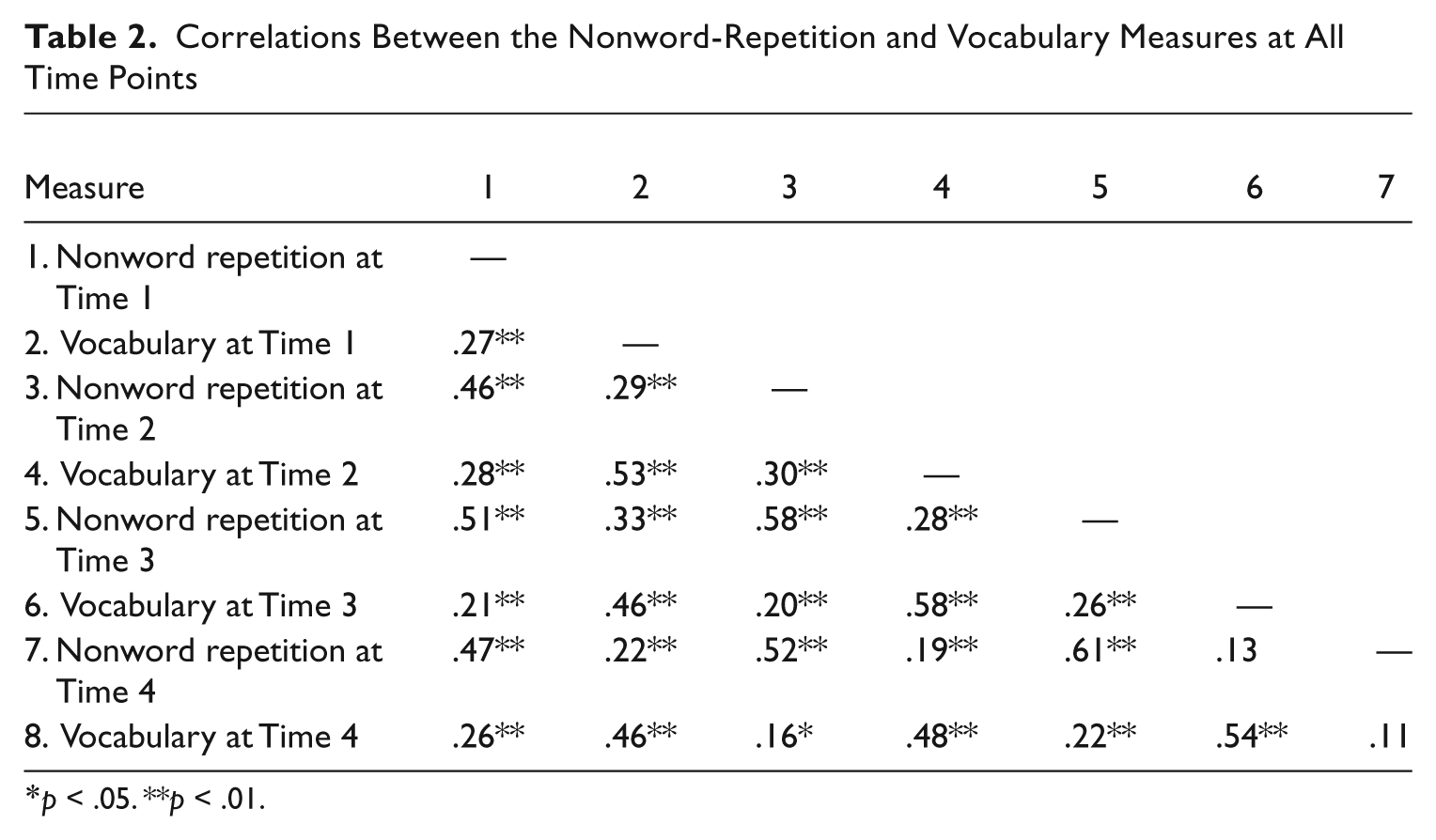
Mean scores and standard deviations for the vocabulary and nonword-repetition measures at all time points are shown in Table 1, and correlations between the two measures are shown in Table 2. The data were first analyzed using simplex models (Kenny & Campbell, 1989; Marsh, 1993; Raykov, 1998). Simplex models are designed for modeling the stability of a construct across repeated times of measurement. They assume that a measure at a given time point is influenced by the same measure at the immediately preceding time point. In a simplex model, measurement error is usually estimated by fixing the unstandardized error variance in a construct to be equal across all times of measurement. This means that only true-score variance is included in the regressions between constructs, whereas with cross-lagged correlations, error variance in the constructs is included.
Mean Scores and Reliabilities for the Vocabulary and Nonword-Repetition Measures at All Time Points
Note: Standard deviations are given in parentheses.
Correlations Between the Nonword-Repetition and Vocabulary Measures at All Time Points
p < .05. **p < .01.
Figure 1a shows a simplex model of the relationship between nonword-repetition and vocabulary ability for our data. This model assesses the stability of each construct over time as well as whether either of the constructs predicts additional variance in the other construct across successive time points (i.e., whether nonword-repetition ability at age 4 predicts additional variance in vocabulary ability at age 5, and vice versa). If such longitudinal cross-loadings exist, they would be consistent with (but not prove) a causal influence from the earlier measured variable to the later measured variable.

Simplex models of the developmental relationship between nonword-repetition and vocabulary ability in children ages 4 through 7 years. Panel (a) shows the model for the data from the study reported here; panel (b) shows the model for the data from Gathercole, Willis, Emslie, and Baddeley (1992). Rectangles represent the observed variables, and ovals indicate the latent true-score variables. The paths from the latent constructs to the observed variables represent the part of the variance in the observed variables that can be attributed to true-score variance. The paths between the same latent construct at different time points represent the stability coefficients—the impact of a variable on itself 1 year later. The numbers on paths directed toward the latent constructs represent the residual of the latent constructs—the part of the variance that is not explained by the model. The double-headed arrows represent the correlation between the two latent constructs. Standardized coefficients are shown.
The simplex model in Figure 1a fitted the data extremely well, χ2(19, N = 219) = 18.64, p = .48; comparative fit index (CFI) = 1.00; root mean square error of approximation (RMSEA) = .00, 90% confidence interval (CI) = [0.00, 0.06]; standardized root mean square residual (SRMSR) = .04. There were no significant cross-loadings between the two variables at successive times of measurement (i.e., nonword-repetition and vocabulary ability had no longitudinal influence on each other between the ages of 4 to 7 years, after controlling for the longitudinal autoregressive influences of each construct). It is notable that the path from vocabulary ability at age 4 to nonword-repetition ability at age 5 was the only cross-loading in the model that approached significance (β = 0.17, p = .079), which is the opposite pattern to that presented in the cross-lagged correlational analyses of Gathercole et al. (1992). In summary, nonword-repetition and vocabulary were moderately correlated abilities that showed both substantial development and substantial longitudinal stability in the period studied here, but there was no convincing evidence of any causal influence from either construct to the other.
We performed the same simplex analysis on the data reported by Gathercole et al. (1992) by generating a covariance matrix from the means, standard deviations, and correlations they reported. The model for their data is shown in Figure 1b. This model again fitted the data very well, χ2(20, N = 80) = 27.67, p < .12; CFI = .98; RMSEA = .07, 90% CI = [0.00, 0.13]; SRMSR = .05. This model showed a very similar pattern to that of our own data, with no significant cross-loadings. Also, as in our study, the path from vocabulary ability at age 4 to nonword-repetition ability at age 5 was the strongest cross-loading, although it was not significant because of the small sample size (β = 0.20, p = .27). We should point out that the very different pattern of results in our simplex model of the data of Gathercole et al. (1992) compared with the pattern shown in their cross-lagged correlations is attributable to the fact that error variance was removed from the structural relations between the constructs in the simplex model.
By estimating the relationships between true scores (scores that exclude error variance), simplex models overcome one of the major criticisms of cross-lagged correlation analyses. However, it has been argued that simplex models may not be optimal for detecting predictors of change (Raykov, 1998; Stoolmiller & Bank, 1995). The models in Figure 1 show very high stability for both vocabulary and nonword-repetition ability, which implies that the ranking of individuals between consecutive times of measurement are largely preserved. In such circumstances, autoregressive models (such as simplex models) have limited power to detect predictors of change. In contrast to simplex models, individual growth-curve models have greater power to detect predictors of change in the face of preserved rank order over time. These models estimate absolute change scores for individuals across time, which means that predictors of change that do not involve change in rank order can be detected (Rogosa & Willett, 1985). Also because latent growth-curve models are more parsimonious than comparable simplex models, they have greater power to detect predictors of change (Raykov, 1998).
To further investigate potential influences over time between vocabulary and nonword-repetition ability, we estimated latent growth-curve models, in which the starting level (intercepts) and variations in the rate of individual growth (slopes) for each construct were assessed. In these models, variations among children in growth in vocabulary ability from age 4 to 7 years were predicted from nonword-repetition ability at the age of 4 when vocabulary ability at the same age was controlled. At the same time, the growth of nonword-repetition ability was predicted from vocabulary skills at the age of 4 when nonword-repetition ability at the same age was controlled.
Figure 2 shows these models for both our own data (Fig. 2a) and Gathercole et al.’s (1992) data (Fig. 2b). As can be seen, the patterns found in the simplex models were confirmed: No cross-loadings were found between vocabulary and nonword-repetition ability in either of the samples. In addition, no correlations were found between the growth of vocabulary and nonword-repetition ability—either in the conditional models shown in Figure 2 or in comparable unconditional models, in which only correlations were estimated among the four growth constructs (initial status and slopes for nonword-repetition and vocabulary ability). One reason for this is that we found no significant variation in the rate of growth of vocabulary in either sample, which in turn implies that there is little variation in growth rates to be predicted by other variables in these models. The low variance in the rates of vocabulary growth revealed here is, in some ways, surprising. The simplex models indicated that there was high stability of relative growth rates in vocabulary in this period. The growth models extend this finding to demonstrate that the absolute rates of growth show very little variation in this period, either in our own data or that of Gathercole et al. (1992).
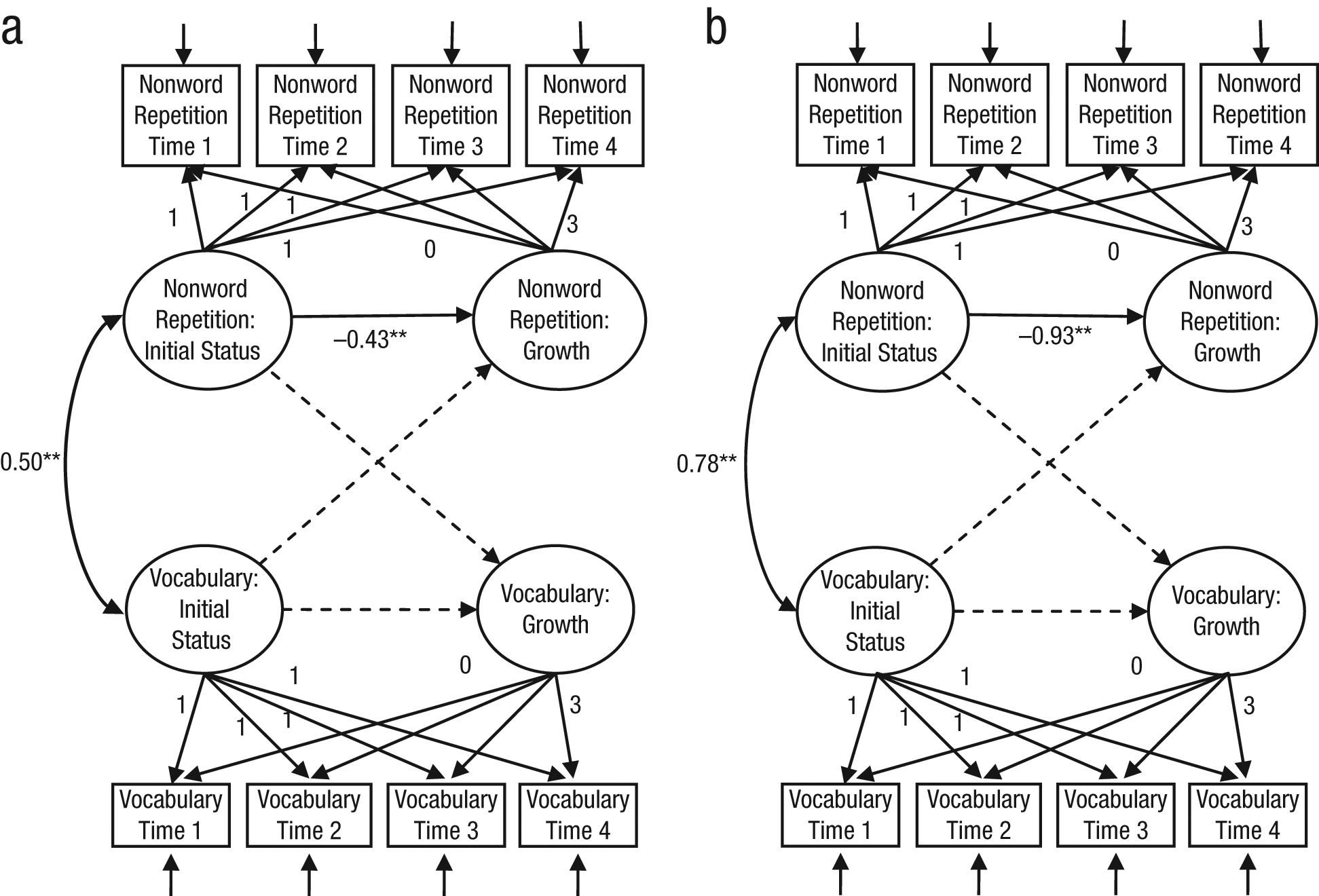
Growth models of the developmental relationship between nonword-repetition and vocabulary ability in children ages 4 through 7 years. Panel (a) shows the model for the data from the study reported here; panel (b) shows the model for the data from Gathercole, Willis, Emslie, and Baddeley (1992). Rectangles represent the observed variables. The ovals labeled “Initial Status” represent the intercepts—the true scores of the constructs at Time 1. The ovals labeled “Growth” represent the actual (true score) growth between Time 1 and Time 4. The path from “Nonword Repetition: Initial Status” to “Nonword Repetition: Growth” represents the impact of initial skills in nonword repetition on the later growth in nonword-repetition skills. Double-headed arrows represent the correlation between the two latent constructs. All dashed paths were nonsignificant and deleted from the models. The paths from the ovals to the observed variables represent the coding that was done to create the growth constructs (initial status and growth); these coefficients are unstandardized (paths without numbers were freely estimated). All relations between the latent constructs were standardized. Asterisks indicate significant paths (**p < .01).
Both of the models in Figure 2 fitted the data very well, χ2(23, N = 219) = 20.84, p < .59; CFI = 1.00; RMSEA = .00, 90% CI = [0.00, 0.05]; SRMSR = .05, for the current data, and χ2 (23, N = 80) = 31.20, p < .12; CFI = .98; RMSEA = .07, 90% CI = [0.00, 0.12]; SRMSR = .06, for the data of Gathercole et al. (1992).
Discussion
The claim that nonword-repetition ability is a critical causal influence on vocabulary acquisition (Gathercole et al., 1992) has been highly influential in studies of typically developing and language-impaired children (Hulme & Snowling, 2009). However, our large-scale longitudinal study, as well as our reanalyses of the data from Gathercole et al. (1992), provides no support for this claim. Although there was some weak evidence from the simplex model suggesting the opposite predictive pattern (vocabulary knowledge at age 4 tended to predict nonword-repetition ability a year later), this effect was not significant. In addition, our individual growth-curve models found no evidence for any influence of nonword repetition on the growth of vocabulary between the ages of 4 and 7 years, or vice versa; instead, these models indicate that the rate of vocabulary growth shows very little variation among children in this age range.
Because the age range (4–7 years) considered here is a period of rapid growth in children’s vocabulary knowledge (Biemiller, 2005), the absence of support for the claims of Gathercole et al. (1992) is critical evidence against the causal theory they proposed. However, we should stress that no longitudinal study can provide convincing evidence for such a causal theory. A training study (in which either nonword repetition or vocabulary is trained) would be needed to evaluate such a causal theory adequately.
From an applied perspective, it is notable that training studies with older children and young adults using remedial programs that include phonological-memory training have failed to find transfer effects to vocabulary knowledge (Dahlin, Nyberg, Bäckman, & Neely, 2008; Schmiedek, Lövdén, & Lindenberger, 2010). Such findings are to be expected given the results reported here. We would suggest, in contrast, that remedial instruction for children with restricted vocabulary knowledge should focus directly on training vocabulary and other aspects of language comprehension because such training has been demonstrated to be effective (for one example, see Clarke, Snowling, Truelove, & Hulme, 2010). Theoretically, it would be important to assess whether such training of vocabulary knowledge can, in turn, produce improvements in nonword-repetition abilities. Improvements in nonword-repetition ability as a result of improvements in vocabulary knowledge would be expected, if as some researchers have argued (Bowey, 2001; Metsala, 1999), nonword-repetition ability is a consequence rather than a cause of developmental improvements in vocabulary knowledge.
Footnotes
Declaration of Conflicting Interests
The authors declared that they had no conflicts of interest with respect to their authorship or the publication of this article.