




Abstract
One of the most heavily debated questions in implicit social cognition is the extent to which implicit measures can be voluntarily controlled. The experiment reported here is the first to employ a novel strategy for intentionally controlling performance in the autobiographical Implicit Association Test (aIAT). Specifically, when explicitly instructed to do so, participants were able to speed up their responses in the incongruent blocks of the aIAT and thus influence the outcome of the test. This effect was larger when the experimental instruction was followed by practice in speeding responses than when the instruction was given alone. A process-dissociation analysis suggested that the effect was due to reductions in the ability of participants’ automatic associations to influence responses when instructions to speed up were provided. This experiment provides new insight into the potential for strategic control in the performance of implicit measures and into the interplay between automatic and controlled processes underlying performance on implicit measures.
Utilizing implicit measures, researchers have found evidence that people’s basic beliefs and attitudes can be assessed on the basis of their split-second responses (Fazio & Olson, 2003; Nosek, Hawkins, & Frazier, 2011). Implicit measures are capable of capturing automatic reactions that people may not want to reveal, may consciously disavow, or may not even be aware of (Gawronski & Bodenhausen, 2011; Greenwald & Banaji, 1995; Nosek et al., 2011). They also have been used to predict behaviors that self-report measures cannot predict (Galdi, Arcuri, & Gawronski, 2008; Nock et al., 2010). Implicit measures have been used to assess stereotype activation and intergroup bias (Amodio & Devine, 2006), self-esteem (Greenwald, Nosek, & Banaji, 2003), decision-making processes (Galdi et al., 2008), and mental health states (Nock et al., 2010). Recently, one implicit measure, the autobiographical Implicit Association Test (aIAT), has been used to detect whether statements are true autobiographical memories; in this capacity, it may be applied in forensic settings to detect whether people are concealing information (Sartori, Agosta, Zogmaister, Ferrara, & Castiello, 2008).
The aIAT has the same structure as the original IAT (Greenwald, McGhee, & Schwartz, 1998), which compares participants’ response times (RTs) to four types of stimuli sorted into two categories. The aIAT is used to compare two double-classification blocks of stimuli. For example, in the criminal context framed by Sartori et al. (2008), participants first responded to a true-crime/false-innocent block, in which they pressed one key for both true sentences and sentences related to a crime they committed, and another key for false sentences and sentences related to a crime of which they were innocent. This was followed by a true-innocent/false-crime block, in which participants pressed one key for both false sentences and sentences related to a crime they committed, and another key for true sentences and sentences related to a crime of which they were innocent. It is hypothesized that for a guilty examinee, the RTs from the true-crime/false-innocent block should be faster than the RTs from the true-innocent/false-crime block. The reverse should be true for an innocent examinee. This is because, for both innocent and guilty participants, the type of statements grouped together in the former category had the same truth value (thus were congruent); likewise, the grouped statements that participants responded to more slowly had different truth values (thus were incongruent). In Sartori et al.’s study, high diagnostic accuracy (> 90%) was obtained across six experiments. Despite the study’s success, one issue requiring greater scrutiny is the extent to which examinees can intentionally control their aIAT performance.
Previous studies have tested the ability of contextual factors to influence implicit measures. In studies examining the malleability of IATs, participants were exposed to stimuli and procedures that ran counter to their presumed automatic biases; such manipulations influenced IAT outcomes without respondents having any specific conscious goal of controlling their performance (e.g., Blair, 2002; Gawronski & Bodenhausen, 2005). In studies investigating the controllability of IATs, researchers have found that when merely asked to control their IAT performances, participants were unable to do so (Banse, Seise, & Zerbes, 2001; Egloff & Schmukle, 2002). However, when provided with a specific instruction to slow down their responses in the congruent blocks, participants could fake the test (Fiedler & Bluemke, 2005; Verschuere, Prati, & De Houwer, 2009).
Although these findings suggest that the performance of implicit measures can be influenced via different routes, it remains unclear whether people can directly control the automatic biases underlying their IAT responses. Thus, a novel strategy for controlling implicit measures would consist of speeding responses in the incongruent blocks, in which the control process and the automatic biases work in an antagonistic way. Currently, it is unknown whether respondents can successfully implement this strategy. This is an important question not only because claims of an undefeatable memory test must be strictly examined, but also because the ability to reduce response latencies in the incongruent blocks, if achievable, could reveal new insights into people’s capacity to control automatic associations more generally. Automatic associations may influence peoples’ perception, judgment, and behavior (e.g., Galdi et al., 2008; Hugenberg & Bodenhausen, 2003), so investigating the capacity to control these associations could have important implications for self-regulation across multiple psychological domains (e.g., Sherman et al., 2008).
In the study reported here, we tested whether participants can speed up responses in the incongruent blocks so as to distort aIAT results. In addition, we investigated whether the automatic and controlled processes that underlie performance on the aIAT can be manipulated via this strategy. We examined four different groups, all of which took the aIAT twice. We explicitly instructed one group of participants to speed up their responses in the incongruent blocks in the second aIAT (the instruction group). A second group of participants was also instructed to speed up their responses in the incongruent blocks of the second aIAT, but this group was given practice time as well (the training group). A practice group without instruction and a mere repetition group were also run as controls to ensure that any observed effect was specific to intentional control instead of practice or repetition.
If a conscious intention is sufficient to produce fast yet accurate responses in the incongruent block, then the first two groups should be able to “beat” the aIAT. However, because IATs involve stimulus-response incompatibility (De Houwer, 2003), it may be that practice is required for respondents to speed up their responses (Shiffrin & Schneider, 1977). In that case, only the training group should show the capacity to beat the test. Meanwhile, we employed the process-dissociation procedure to decompose performance on the aIAT so as to investigate the extent to which the controlled and automatic processes underlying aIAT performance can be influenced (Jacoby, 1991; Payne, 2005).
Method
Participants
Sixty-four participants (28 males, 36 females; age range = 19–24 years) were recruited to participate in the study for monetary compensation. They were randomly assigned to one of four instruction conditions (each with 16 members): repetition, practice, instruction, and training.
Procedure
After signing consent forms, participants were randomly assigned to an exam or an article scenario. In both scenarios, participants were explicitly told to enact a mock crime: to take either a copy of an exam or a research article from a faculty member’s mailbox in their department’s main office, which is off-limits to students. Participants were instructed to call the experimenter if caught during the mock crime.
After the mock crime, participants were seated in front of a monitor for the first of two aIATs. The aIAT was conducted using a procedure similar to that used by Sartori et al. (2008). The first block (20 trials) required participants to classify sentences presented on the monitor based on whether they were true (e.g., “I am in a lab”) or false (e.g., “I am in a shop”). The second block (20 trials) required participants to classify sentences on the basis of whether the sentences belonged to the exam category (e.g., “I took an exam copy”) or the article category (“I took an article”).
For half the participants in each scenario, the third block (60 trials) required them to press one key for both true sentences and sentences from the exam category, and the other key for both false sentences and sentences from the article category. (Thus, the true-exam/false-article block was a congruent block for participants in the exam scenario but an incongruent block for participants in the article scenario.) For the other half of the participants in each scenario, the third block required them to press one key for true sentences and sentences from the article category, and the other key for false sentences and sentences from the exam category. (Thus, the true-article/false-exam block was a congruent block for participants in the article scenario but an incongruent block for participants in the exam scenario.)
The fourth block (40 trials) was identical to the second block, except that the response keys for sentences from the exam and article categories were reversed. The fifth block (60 trials) presented the pairing (true-exam/false-article or true-article/false-exam) that had not been used in the third block. Thus, the order of congruent and incongruent blocks was counterbalanced between participants in each scenario.
Following the first aIAT, each participant completed the task again after receiving one of four instructions. Participants in the repetition group simply completed the aIAT for a second time. This group was run to control for the possible effect of task repetition. In the practice group, participants were instructed to repeat the incongruent blocks three times; the cover story was that the experimenter was interested in the influence of time passing on participants’ performance. Thus, participants in this group were simply repeating the incongruent blocks without being instructed to control their performance. In the instruction group, after learning how the test worked, participants were explicitly instructed in the second aIAT to speed up their responses in the incongruent block. Thus, only instruction but no practice was given to this group. In the training group, the participants were instructed, in the same way as the instruction group was, to speed up their responses in the incongruent block, and then they practiced with the incongruent blocks for the same length of time as the practice group did.
Results
Manipulation check
Participants’ behavioral results are presented in Table 1. It is clear that participants did speed up their responses in the incongruent blocks from the first to second aIATs, which confirmed that the instruction group followed directions. Specifically, the effect size of the speedup in the incongruent blocks was largest in the training group (Cohen’s d = 2.79, p < .001), followed by the instruction group (Cohen’s d = 1.34, p < .001) and the practice group (Cohen’s d = 0.45, p < .05). There was no significant effect in the repetition group (p > .2). No speed-accuracy trade-off was observed.
Mean Response Times (RTs) and Related Statistics for the Four Groups
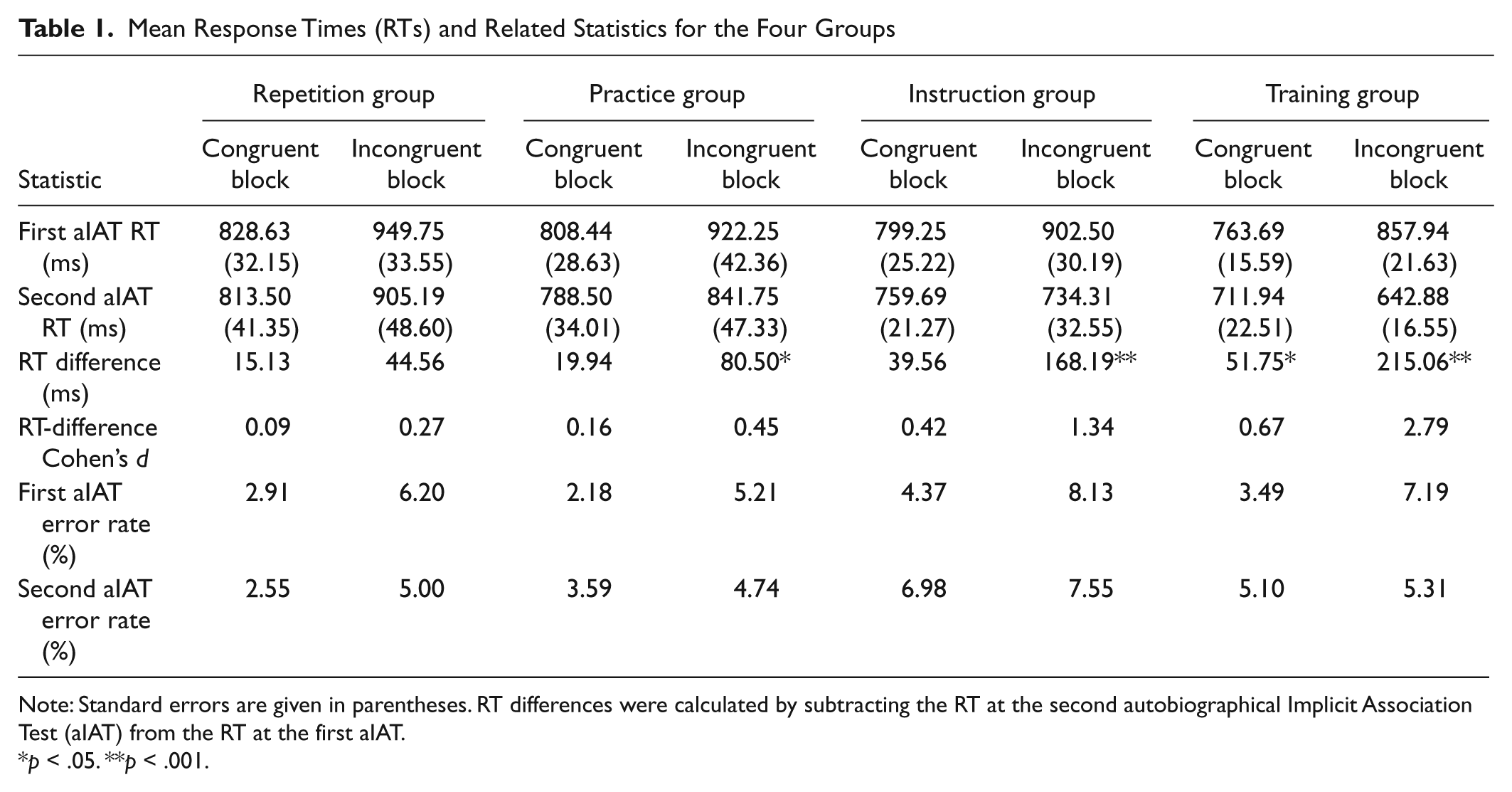
Note: Standard errors are given in parentheses. RT differences were calculated by subtracting the RT at the second autobiographical Implicit Association Test (aIAT) from the RT at the first aIAT.
p < .05. **p < .001.
D-score analysis
We calculated each participant’s D600 score (for a detailed algorithm, see Greenwald et al., 2003, and Sartori et al., 2008) as our main dependent variable. A positive D score means that reactions were faster when actual autobiographical sentences (i.e., sentences related to the scenario to which participants were assigned) and true sentences shared the same response key than when actual autobiographical sentences and false sentences shared the same response key.
There were no significant main effects of scenario (exam vs. article) or block order (congruent first vs. congruent second) on D scores, nor an interaction between these two factors (Fs < 1, ps > .1; see Additional Analyses in the Supplemental Material available online). Therefore, they were not considered in the following analysis. A mixed analysis of variance (ANOVA) using group as a between-subjects variable (repetition vs. practice vs. instruction vs. training) and test session as a within-subjects variable (first aIAT vs. second aIAT) was conducted on D scores (Fig. 1a). This analysis showed that D scores changed dramatically from the first to the second aIAT (M = 0.49 vs. M = 0.04), F(1, 60) = 67.36, p < .001, η2 = .53. Moreover, a significant test-session-by-group interaction was seen, F(1, 60) = 10.95, p < .001, η2 = .35, which suggests that test session exerted different effects over different groups. Post hoc tests showed that D scores were reduced significantly from the first aIAT to the second aIAT only in the instruction group, t(15) = 4.36, p < .001, and the training group, t(15) = 7.38, p < .001.
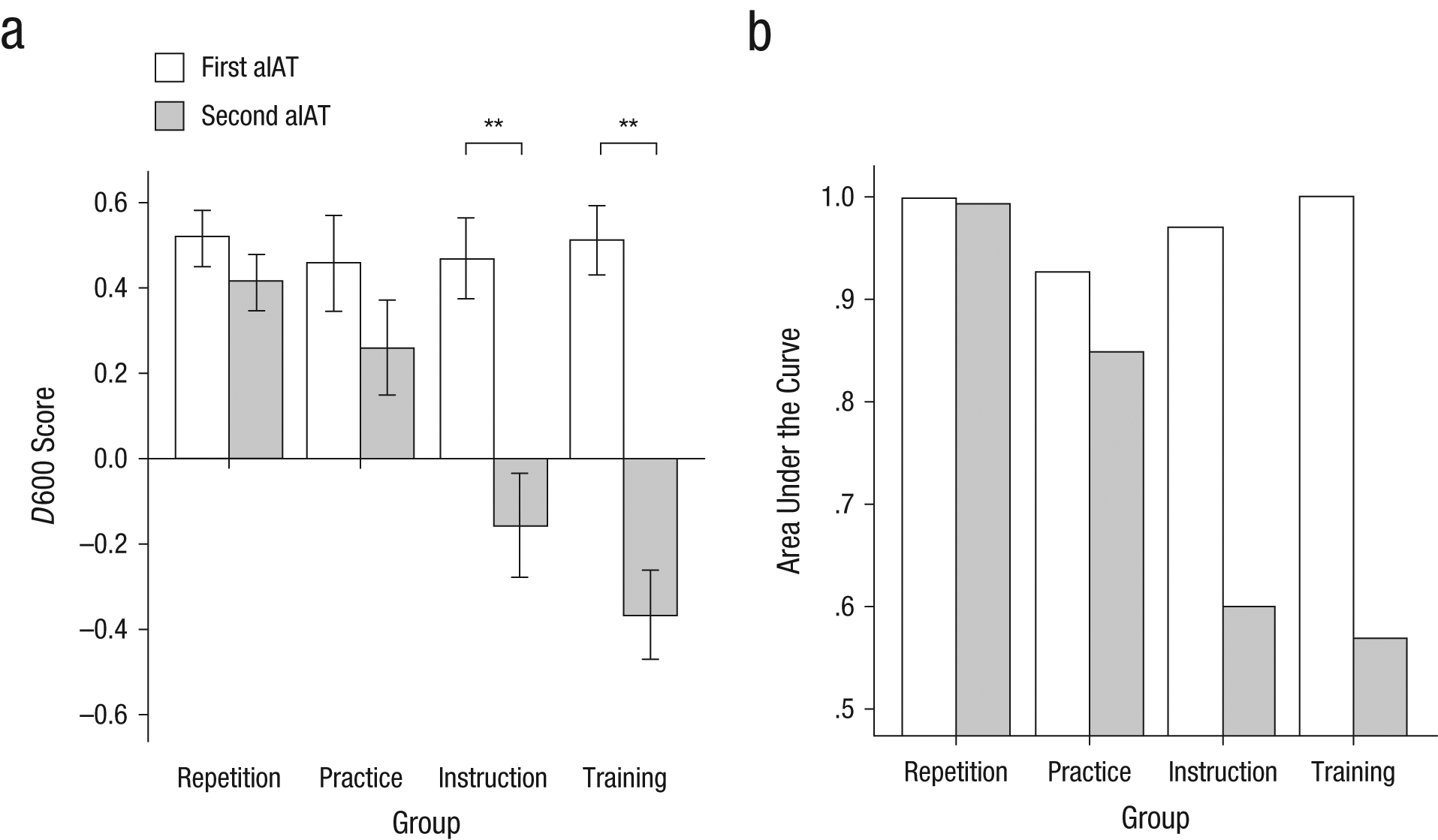
Mean D600 score (a) and area under the curve (b) as a function of group and test session. Positive and negative D600 scores indicate stronger and weaker associations, respectively, between true sentences and sentences related to the scenario to which participants were assigned. Areas under the curve indicate the classification efficiency of the test. They range from 1.0, which means perfect classification, to .5, which means chance-level classification. Asterisks indicate significant differences between the first and second tests (**p < .001). Error bars indicate ±1 SE. aIAT = autobiographical Implicit Association Test.
Classifying autobiographical memory
Participants were classified as being in either the exam or article condition on the basis of their D scores (e.g., faster RTs from the true-exam/false-article block than from the false-exam/true-article block suggested that the participant was in the exam-scenario). Classification efficiency of the test was measured with receiver-operating characteristic curves. The area under the curve (AUC) indexes the accuracy with which a given participant’s actual autobiographical memory can be identified correctly (.5 = chance, 1.0 = perfect). Results showed that the test successfully discriminated participants from the exam and article conditions in the first aIATs (AUCs > .90, ps < .01; Fig. 1b). However, in the second aIAT, the AUC was reduced to chance level in the instruction group (AUC = .60, p > .3) and in the training group (AUC = .57, p > .4) but not in the other groups (AUCs > .85, ps < .01).
Furthermore, we investigated whether “fakers” (i.e., participants who tried to “beat” the test by consciously influencing the results) could be differentiated from nonfakers. Confirming that participants were not beating the test in an obvious manner, results showed that fakers cannot be distinguished from nonfakers (see Detecting Fakers in the Supplemental Material).
Process-dissociation analysis
Given that there were multiple ongoing cognitive processes interacting to influence task performance (Conrey, Sherman, Gawronski, Hugenberg, & Groom, 2005; Jacoby, 1991), we conducted a process-dissociation analysis to estimate the automatic versus controlled processes underlying performance on the aIAT. Controlled processes detect and execute the correct responses even when there is stimulus-response interference. Automatic processes reflect the automatic associations between autobiographical sentences and truth that drive responses when control fails (Sherman et al., 2008).
By analyzing accuracy from congruent and incongruent blocks, we were able to calculate a parameter for controlled processes (C) as p(correct response on congruent trials) – p(incorrect response on incongruent trials) and a parameter for automatic processes as p(incorrect response on incongruent trials)/(1 − C). (For further details, see Payne, 2005, and Stewart, von Hippel, & Radvansky, 2009.) We conducted separate 4 (group: repetition vs. practice vs. instruction vs. training) × 2 (test session: first aIAT vs. second aIAT) mixed ANOVAs on the estimates for controlled and automatic processes (Fig. 2). No effect was observed for the estimates for the controlled processes (Fs < 1, ps > .4), probably because of the ceiling effect across all conditions (0.86–0.93; Fig. 2a). However, across groups, the estimates for the automatic processes (Fig. 2b) were reduced from the first aIAT (M = 0.663) to the second aIAT (M = 0.558), F(1, 60) = 12.261, p < .01, η2 = .17, although the group-by-test-session interaction was not significant (p > .5). Given that the D-score changes were significant only in the instruction and the training groups, we further conducted a regression analysis using the estimates of the controlled and automatic processes to predict participants’ D-score change. Results showed that the change of D score could be predicted with the reduction of the automatic-process estimates (β = 0.536, p < .01) but not with the change of the controlled-process estimates (β = −0.115, p > .3).
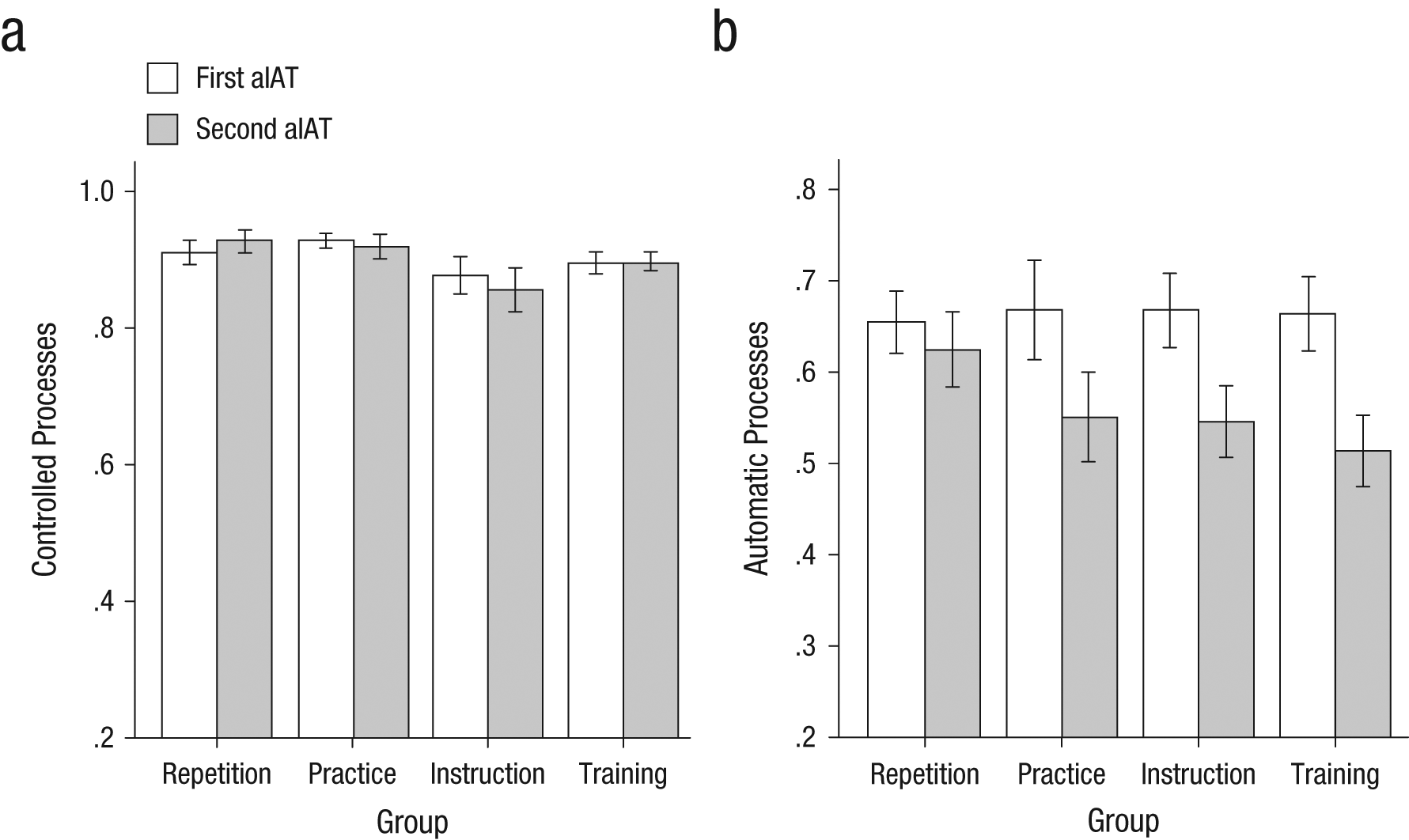
Results of the process-dissociation analysis: estimates of (a) controlled and (b) automatic processes as a function of group and test session. Error bars indicate ±1 SE. aIAT = autobiographical Implicit Association Test.
Discussion
Previous studies have suggested that the aIAT is a promising tool for forensic investigation (e.g., Sartori et al., 2008; Hu & Rosenfeld, 2012). Although our study replicated the finding that the aIAT can accurately detect autobiographical events in participants naive to its purpose, it is also the first to find that participants could successfully change their aIAT outcome given specific instructions or training. This was achieved using a novel procedure that led participants to speed up the RTs in the incongruent blocks without concomitantly slowing RTs in the congruent blocks (cf. Fiedler & Bluemke, 2005). In particular, instruction itself was sufficient to change the aIAT’s outcome, producing reductions in the ability of automatic associations to bias responses.
One possible reason that participants could control their aIAT performance after merely being instructed to do so is that the mental associations measured in this study were recently acquired autobiographical events, which may be relatively easy for participants to influence (De Houwer, Beckers, & Moors, 2007). Future studies should investigate whether participants can similarly control the associations that are established via relatively long-term socialization, such as intergroup biases (Baron & Banaji, 2006).
Another factor that may influence results is the categorization-labeling scheme used in the aIAT. Unlike previous studies that required participants to map stimuli with valence labels such as guilty and innocent, our study used exam and article labels that might have induced participants to frame our task as a mere semantic-classification task. This possibility was probably prevented by requiring participants to classify sentences in terms of distinct personal experience (e.g., “I did . . . ”). However, future studies are required to fully explore the effects of categorization scheme on IAT results.
The training procedure we employed here allowed us to examine whether automatic associations can be controlled via intentional practice. Indeed, participants from the training group exhibited a larger behavioral change than the other groups did. The process-dissociation analysis provided complementary evidence that training participants on incongruent blocks could effectively limit the ability of automatic associations to influence responses. This finding is also consistent with the results of previous studies showing that training could decrease automatically activated racial stereotypes (Kawakami, Dovidio, Moll, Hermsen, & Russin, 2000). We suggest that active training may improve participants’ efficiency in overcoming the response conflict that is involved in the aIAT. Indeed, a previous neuroimaging study found that training in stimulus-response incompatible tasks decreased the activity of cognitive control networks (e.g., dorsolateral prefrontal cortex, anterior cingulate cortex), which was taken to indicate greater efficiency of control processes (Milham, Banich, Claus, & Cohen, 2003). Because these brain areas are also involved during IATs (Beer et al., 2008), it is possible that our training procedure also benefits participants’ cognitive control efficiencies, leading to better controllability of automatic response biases. Another possible mechanism is that our training procedure might initiate “propositional” thinking that affirms new associations (i.e., the crime is false, the alibi is true), which subsequently changes the associative processes underlying aIAT performance (Gawronski & Bodenhausen, 2011).
To conclude, this study documented a novel way to influence implicit measures and possibly the automatic associations that underlie responses to them. If instructional manipulations can indeed influence people’s automatic reactions, this may have important implications for a variety of significant arenas of self-regulation, such as drug craving and intergroup bias.
Footnotes
Acknowledgements
We thank Steve Franconeri, Bertram Gawronski, Niels Birbaumer, and Jeff Sherman for comments.
Declaration of Conflicting Interests
The authors declared that they had no conflicts of interest with respect to their authorship or the publication of this article.
Funding
This research was funded by the Dispute Resolution Research Center, Kellogg School of Management, Northwestern University.

References
Supplementary Material
Please find the following supplemental material available below.
For Open Access articles published under a Creative Commons License, all supplemental material carries the same license as the article it is associated with.
For non-Open Access articles published, all supplemental material carries a non-exclusive license, and permission requests for re-use of supplemental material or any part of supplemental material shall be sent directly to the copyright owner as specified in the copyright notice associated with the article.
