



Abstract
In this research, we evaluated how well overall levels of positive engagement in adolescents’ families of origin, as well as adolescents’ unique expressions of positive engagement in observed family interactions, statistically predicted marital outcomes approximately 20 years later. The sample consisted of 288 focal individuals and their spouses, drawn from the Iowa Youth and Families Project (IYFP). Data for focal individuals’ family-of-origin positive engagement were taken from IYFP assessments from 1989 to 1991. Data for outcomes of interest, including focal individuals’ and spouses’ marital behavior, were drawn from the IYFP between 2007 and 2008. Individuals’ unique expressions of positive engagement in their families of origin were linked to the degree of positive engagement these adolescents later exhibited toward their spouses. A positive family climate during adolescence for one marital partner was also associated with positive marital outcomes for both partners. Overall, our results suggest that the climate in one’s family of origin may have long-term significance for one’s interpersonal relationships.
Keywords
Families are an important context for developing patterns of interaction for future intimate relationships (e.g., Amato & Booth, 1997; Bowlby, 1969/1997; Oriña et al., 2011; Simpson, Collins, Tran, & Haydon, 2007; Sroufe, Egeland, Carlson, & Collins, 2005). Indeed, many relational characteristics and outcomes, such as aggression and divorce, have demonstrated intergenerational continuity (e.g., Amato, 1996; Capaldi & Gorman-Smith, 2003; Riggs & O’Leary, 1996). In contrast to these negative attributes of relationships, however, the long-term correlates of positive interpersonal behaviors in the family of origin have received less attention from researchers (but see work on attachment security for a notable exception; e.g., Sroufe et al., 2005). This is unfortunate, given that research has linked increased levels of self-regulation, empathy, prosocial behavior, and emotional development in children to a positive family climate (Davidov & Grusec, 2006; Eisenberg, Cumberland, & Spinrad, 1998; Eisenberg et al., 2005; Thompson & Meyer, 2007). In short, an individual’s experiences in the family may have important consequences for his or her future close relationships, such as marriage.
Accordingly, the goal of the study reported here was to evaluate the long-term significance of positive-engagement behaviors in individuals’ families of origin. Positive engagement is an interpersonal style characterized by transparent communication, warmth, and support (Ackerman, Kashy, Donnellan, & Conger, 2011). It entails the use of conflict- resolution strategies that emphasize clear communication and cooperative problem solving. In our analyses, we evaluated the extent to which overall levels of positive engagement in adolescents’ families of origin (i.e., the average amount of positive engagement expressed), as well as adolescents’ unique expressions of positive engagement in observed family interactions (i.e., adolescents’ general tendencies to be positively engaged with their family members after controlling for the family’s overall levels of positive engagement), statistically predicted these individuals’ marital outcomes in adulthood, approximately 20 years later.
The work we report here was informed by the Development of Early Adult Romantic Relationships (DEARR) model (Bryant & Conger, 2002). The model posits that the interactional characteristics of families influence younger family members’ later competencies in intimate relationships. Bryant and Conger (2002) presented three mechanisms through which behaviors in individuals’ families of origin may additively combine to affect later outcomes in their relationships: observational learning (Bandura & Walters, 1963), socialization (Maccoby & Martin, 1983), and behavioral continuity (Caspi, 1993).
According to the observational-learning account, individuals imitate the patterns of interpersonal behavior that were most frequently modeled and reinforced in their families of origin. The socialization account proposes that interpersonal patterns are acquired via individuals’ direct interactions with either their parents or their siblings during adolescence. Finally, the behavioral-continuity account states that individuals’ interaction styles in adolescence persist into adulthood because they help to shape the environmental circumstances individuals are exposed to across the life span (Caspi, Bem, & Elder, 1989). Whereas the observational-learning and socialization accounts suggest that exposure to family-level dynamics contributes directly to outcomes in individuals’ later romantic relationships, the behavioral-continuity account implies that the influence of behavior in families of origin is due to the stability of individuals’ interaction styles throughout life.
In an early test of the DEARR model, Conger, Cui, Bryant, and Elder (2000) evaluated whether behavior among members of adolescents’ (13- to 16-year-olds’) families of origin predicted the level of warmth in those adolescents’ dating relationships in early adulthood (i.e., when the focal individuals were 20.7 years old on average). The Conger et al. (2000) study used a subset of data from the Iowa Youth and Families Project (IYFP; Conger & Elder, 1994), a large, ongoing longitudinal study of development from early adolescence to adulthood. Conger et al. found that observed levels of nurturing parenting by the adolescents’ mothers and fathers were positively associated with the adolescents’ expressions of warmth toward their dating partners during emerging adulthood. These effects held in analyses controlling for qualities observed in parental marital interactions (i.e., interactions that did not involve the adolescent).
The findings from Conger et al. (2000) suggested that observed family interactions are related to future competencies in romantic relationships. However, the behavior observed in family interactions may reflect some combination of family-level, relationship-specific, and individual-level processes (Kenny, Kashy, & Cook, 2006). Therefore, an important next step is to clarify which of these processes account for associations between family-of-origin interactions and individuals’ later experiences. The Social Relations Model (SRM; Kenny et al., 2006) provides a methodology for quantifying the relative importance of each of these processes. We recently revisited the IYFP data from 1989 to 1991 and used the SRM to partition the variation in positive-engagement behaviors in family interactions (Ackerman et al., 2011). These analyses revealed that variability in positive-engagement behaviors between family members was primarily a function of the family climate (i.e., in some families, everyone exhibits high levels of engagement, but in other families, everyone does not; this overall level of engagement is referred to as the family mean in the SRM) and individual differences (i.e., some individuals are engaged with all of their family members, but others are not; this characteristic level of engagement with one’s family members is referred to as the actor effect in the SRM). This pattern of systematic variation suggests that family-level and individual-level factors in adolescence are most likely to predict subsequent relationship outcomes in adulthood.
Previous research (e.g., Caspi & Elder, 1988; Conger et al., 2000) has uncovered associations between treatment by one’s parents in childhood and outcomes in adulthood. In SRM terminology, the unique aspects of parent-child interactions (i.e., the portion of a behavior that remains after controlling for the family mean, the parent’s actor effect, and the child’s tendency to elicit positive behavior from all family members, known as a the child’s partner effect) are called parent-to-child relationship effects. However, our research (Ackerman et al., 2011) yielded little evidence of variation in parent-to-child relationship effects for positive engagement. Instead, parents’ positive-engagement behaviors with their children were mostly a function of the family mean and the parents’ actor effects. This pattern suggests that the overall family climate may be at least partly responsible for the association between positive engagement in parent-child relationships and children’s later outcomes in adulthood.
In the research presented here, we used insights from Ackerman et al. (2011) to extend Conger et al.’s (2000) findings much further into adulthood. We used the analytic framework provided by the SRM to derive our primary predictor variables. The majority of the focal individuals whose dating relationships were studied in Conger et al. are now husbands and wives in their early 30s. Thus, we were able to examine whether behavioral patterns in their families of origin carried over to these individuals’ relationships with their marital partners in adulthood. In addition, we could disentangle the effects of the average expression of positive engagement in families of origin (i.e., family means) from adolescents’ dispositional expressions of positive engagement (i.e., adolescents’ actor effects). Doing so allowed us to quantify the relative contributions of family-dynamics and behavioral-continuity processes to the link between positive engagement in an adolescent’s family interactions and his or her subsequent marital outcomes (e.g., marital satisfaction and hostility).
Evidence for these processes would be indicated by the presence of a statistical link between the family mean (for the family-dynamics process) or the individual’s actor effect (for the behavioral-continuity process) and later marital outcomes. Because the DEARR model presumes that these processes should operate in an additive manner, however, evidence supporting one process does not necessarily rule out the operation of the other. Finally, because we had observational and self-report data from focal individuals’ spouses, we were able to evaluate whether the family-of-origin experiences for focal individuals were associated with relationship outcomes for their spouses.
Method
Participants
Data were drawn from a sample of approximately 400 families participating in the IYFP (Conger & Elder, 1994; Elder & Conger, 2000). The project began in 1989, when the 288 focal individuals whose data are included in the present study were in the seventh grade (mean age = 12.61 years, SD = 0.54). All families in this initial sample were Caucasian, resided in Iowa, and included a father, a mother, the focal individual, and a sibling who was no more than 4 years younger or older than the focal individual. Our primary predictors were based on family-of-origin scores for positive interpersonal behavior derived from videotaped conflict-resolution interactions that occurred during each of the first 3 years of data collection (i.e., 1989–1991).
The primary outcomes reported in this article are based on data from a single wave of interviews conducted during 2007 and 2008. Outcomes include marital behavior and reported relationship satisfaction from the 288 focal individuals (along with their spouses) who were married at this wave of data collection. 1 At this wave, focal individuals’ ages ranged from 30 to 33 years (M = 31.15, SD = 0.44), and their spouses’ ages ranged from 23 to 53 years (M = 32.03, SD = 4.05). Of the 288 focal individuals, 162 were women and 126 were men, and 241 reported being parents.
Procedure and measures
Family-of-origin sample
In each of the first three waves of data collection (1989–1991), the focal individuals were observed while they engaged in a 15-min conflict-resolution task with three other family members (their mother, father, and sibling). Family members discussed issues that caused conflict within the family, with the goal of finding possible resolutions. Interactions were videotaped, and independent coders evaluated them using the Iowa Family Interaction Rating Scales (Melby & Conger, 2001). Interactions were coded for five indicators of positive engagement: listener responsiveness, assertiveness, prosocial behavior, effective communication, and warmth-support. Ratings for each of these dimensions were made using scales from 1 (not at all characteristic) to 5 (mainly characteristic).
For each dimension, coders provided a score for every dyadic combination within the family. For example, coders rated the focal individual’s effective communication toward his or her father (individual-father dyad; IF score), mother (individual-mother dyad; IM score), and sibling (individual-sibling dyad; IS score). Likewise, ratings were provided for the other dyadic combinations—father-mother (FM), father-individual (FI), father-sibling (FS), mother-father (MF), mother-individual (MI), mother-sibling (MS), sibling-father (SF), sibling-mother (SM), and sibling-individual (SI)—for a total of 12 scores for each dimension. For each of the 12 dyadic combinations, a composite positive-engagement score was computed by averaging ratings across the five dimensions.
Following the logic of the SRM and drawing from the results of our previous work (Ackerman et al., 2011), we created two key predictor variables using these dyadic scores. To provide a conservative test of the family-dynamics path, we computed the family mean by omitting scores for any dyadic combination including the focal individual. Thus, the family mean was the average of the FM, FS, MF, MS, SM, and SF positive-engagement scores. 2 The focal individual’s actor effect, which represented the focal individual’s tendency to be engaged with all of his or her family members over and above the family mean (i.e., the behavioral-continuity path), was computed by averaging the IF, IM, and IS positive-engagement scores (i.e., the positive engagement expressed by the focal individual toward his or her family members), adjusting this value to control for the fact that the focal individual never had himself or herself as a partner (i.e., the missing-partner bias), and then subtracting the family mean to provide an estimate of the focal individual’s unique expression of positive engagement that was not confounded with the normative level of positive engagement in his or her family (for an exact formula, see Cook & Dreyer, 1984; see also Kenny et al., 2006, p. 255). These predictor variables for the 288 focal individuals were computed for each of the three waves and then averaged across waves. 3
Married sample
Between 2007 and 2008, married focal individuals and their spouses completed questionnaires measuring conflict and relationship satisfaction, and they engaged in a videotaped 25-min interaction task in which they discussed qualities of their romantic relationship (i.e., its history and status), problems in their relationship, and future plans. Our self-report measure of marital conflict was the Negative Behavioral Interactions questionnaire (Donnellan, Assad, Robins, & Conger, 2007), which includes eight items assessing the frequency of respondents’ negative interpersonal behaviors during the past month. Sample items are “Get angry at him/her” and “Criticize him/her or his/her ideas.” Ratings were made on scales from 1 (always) to 7 (never) and were scored such that higher scores reflected more negative interactions. Average scores were computed for focal individuals (α = .89) and their spouses (α = .89).
We used the Quality of Marriage Index (Norton, 1983) to assess participants’ satisfaction with their marriage. Example items are “We have a good relationship” and “Our relationship is strong.” The response scale was from 1 (strongly agree) to 5 (strongly disagree). All responses were reverse-coded, and composites were computed by averaging across the five items. Higher average scores indicated greater marital satisfaction (focal individuals: α = .96; spouses: α = .97).
Videotaped interactions between focal individuals and their spouses were rated on the same five positive-engagement dimensions used to code family-of-origin interactions. Ratings were made using scales from 1 (not at all characteristic) to 9 (mainly characteristic). Composite positive-engagement scores for the focal individual and his or her spouse were generated, respectively, by taking the average of a person’s scores for the five positive-engagement dimensions (focal individuals: α = .91; spouses: α = .91). Coders also rated the degree to which focal individuals and their spouses expressed hostility, angry coercion, and antisocial behaviors toward each other. We averaged these three scores to create behavioral-hostility indexes for the focal individual (α = .87) and his or her spouse (α = .82).
Results
Table 1 presents descriptive statistics for the study variables. Altogether, four marital outcomes were assessed for focal individuals and their spouses: (a) observed positive-engagement behaviors; (b) observed behavioral hostility; (c) self-reported frequency of engagement in negative interactions; and (d) self-reported relationship satisfaction. Multilevel-modeling analyses were used to evaluate how well positive interpersonal behavior expressed by adolescents and their family members between 1989 and 1991 predicted the adolescents’ interpersonal outcomes approximately 20 years later. 4 We used multilevel modeling because outcomes for the focal individuals and their spouses were substantially correlated (for the four variables, rs = .55–.70). Two predictor variables were included in the primary analyses: the focal individuals’ unique interpersonal styles during adolescence (i.e., the individuals’ actor effects for positive engagement) and the focal individuals’ overall family climates (i.e., the family means for positive engagement). Note that unlike many dyadic analyses in which both members of each dyad supply data for the predictors as well as the outcomes (e.g., the actor-partner interdependence model; Kenny et al., 2006), our analyses used predictors from the focal individuals only.
Means, Standard Deviations, and Zero-Order Correlations Between Variables
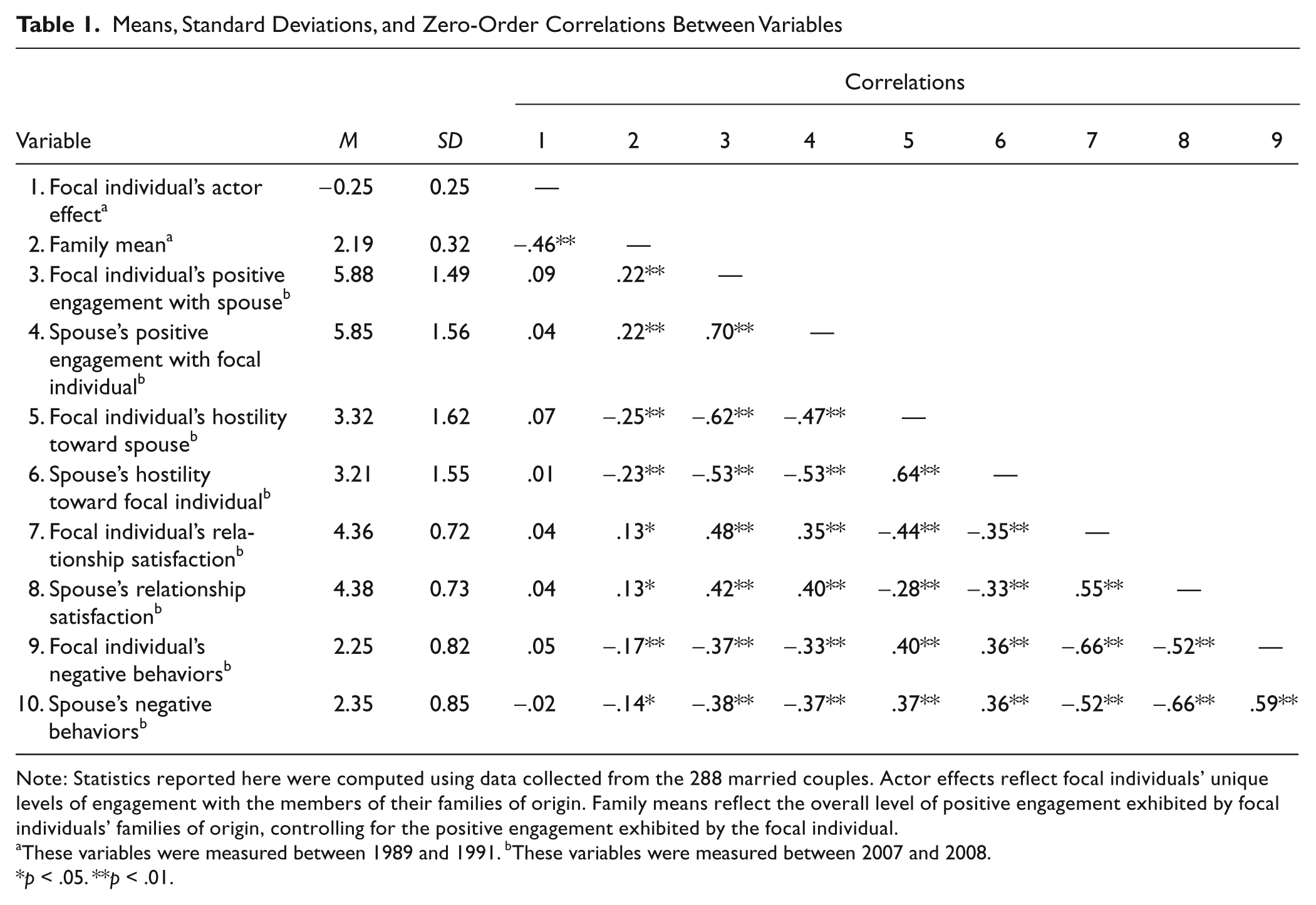
Note: Statistics reported here were computed using data collected from the 288 married couples. Actor effects reflect focal individuals’ unique levels of engagement with the members of their families of origin. Family means reflect the overall level of positive engagement exhibited by focal individuals’ families of origin, controlling for the positive engagement exhibited by the focal individual.
These variables were measured between 1989 and 1991. bThese variables were measured between 2007 and 2008.
p < .05. **p < .01.
Table 2 shows the results of the multilevel-modeling analyses. The family mean and the individual’s actor effect were both significant predictors of individuals’ expressions of positive engagement in their marital relationships. Moreover, these effects were significant predictors of spouses’ positive engagement (which the actor-partner interdependence model would define as a partner effect). Thus, there was evidence that both family-dynamics and behavioral-continuity processes contributed to the association between positive engagement in the family of origin and later positive engagement in romantic relationships.
Results From Multilevel-Model Analyses Examining Links Between Family-of-Origin Positive Engagement and Subsequent Marital Behaviors and Relationship Satisfaction
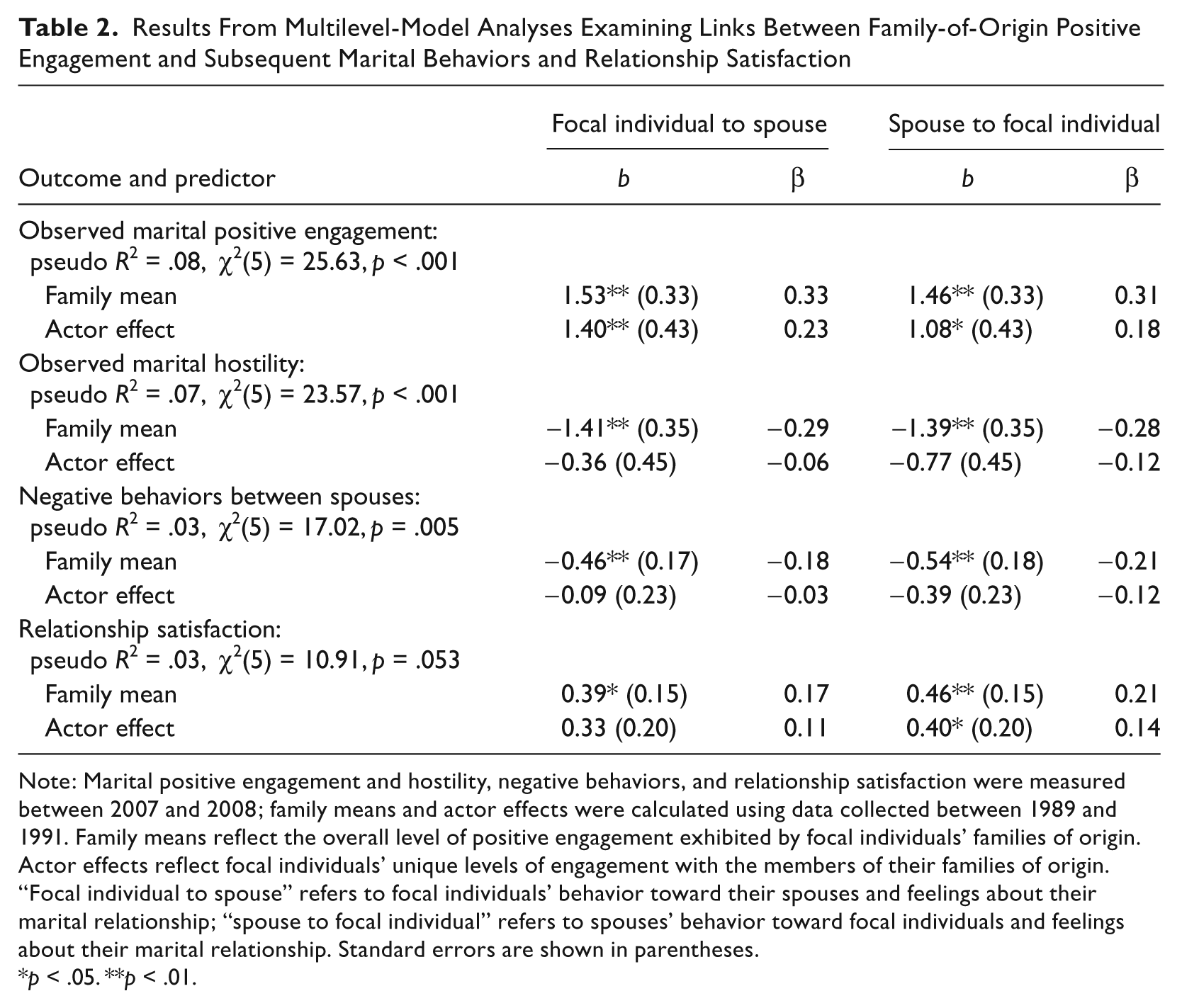
Note: Marital positive engagement and hostility, negative behaviors, and relationship satisfaction were measured between 2007 and 2008; family means and actor effects were calculated using data collected between 1989 and 1991. Family means reflect the overall level of positive engagement exhibited by focal individuals’ families of origin. Actor effects reflect focal individuals’ unique levels of engagement with the members of their families of origin. “Focal individual to spouse” refers to focal individuals’ behavior toward their spouses and feelings about their marital relationship; “spouse to focal individual” refers to spouses’ behavior toward focal individuals and feelings about their marital relationship. Standard errors are shown in parentheses.
p < .05. **p < .01.
Table 2 also shows that focal individuals who came from families characterized by higher positive engagement expressed less hostility toward their spouses, and their spouses displayed less hostile behavior toward them. This same pattern was revealed in self-reports of negative behaviors in marital interactions. The family mean for focal individuals also statistically predicted relationship satisfaction for both partners. Finally, the actor effect for focal individuals predicted their spouses’ relationship satisfaction as well. In sum, these results show that interpersonal behavior in the family of origin is associated with functioning in committed romantic unions across substantial time intervals. 5
Discussion
In this study, we assessed the degree to which observed expressions of positive engagement in focal individuals’ families of origin statistically predicted characteristics of these individuals’ marital relationships in adulthood. At a basic level, our findings highlight the association between a positive family climate during adolescence and the quality of one’s marriage later in life. Our results are therefore consistent with the DEARR model with respect to the developmental significance of experiences in one’s family of origin.
Although the DEARR model specifies that both observational learning and socialization underlie the connection between the dynamics in the family of origin and later relationship outcomes, our analyses could not definitively distinguish between them. Indeed, we believe that these two mechanisms are unlikely to be independent, given that observational learning is almost certainly a part of family socialization. 6 Despite this inability to distinguish the effects of observational learning from those of socialization, we were able to investigate the relative contributions of processes involving the dynamics in the family of origin and processes involving behavioral continuity to predicting marital outcomes. In so doing, we found that family-level factors still contributed to the prediction of adult marital-relationship outcomes after we accounted for the continuity of individual differences.
It is especially noteworthy that the family mean showed robust links with all of the marital outcomes we examined. This is not to say, of course, that behavioral-continuity processes were not in operation. Indeed, our results also provide evidence for the continuity of individual differences, given that the actor effect for focal individuals predicted some (although not all) of the relationship outcomes we investigated. In particular, there was an association between the focal individuals’ unique expressions of positive engagement in their families of origin and the degree of positive engagement that focal individuals exhibited toward their spouses 20 years later. This finding converges with results from other research demonstrating continuity in interactional styles such as shyness and explosive temperaments (Caspi et al., 1989). Our work has extended this literature by using observational data to measure the continuity of positive-engagement behaviors.
Perhaps one of the most striking results from this work was that the quality of one marital partner’s family climate during adolescence was associated with marital outcomes for the other partner. Recall that the family-climate variable did not include any data from the focal individuals. Therefore, it is somewhat remarkable that it was correlated with the behavior and satisfaction of the individuals’ spouses approximately 20 years later. Individuals who grew up in warmer, more supportive, and more engaged families expressed more positivity and less negativity toward their spouses, and their spouses expressed more positivity and less negativity toward them. It is possible that family dynamics foster a supportive interpersonal style that later elicits similar behavior from a spouse (an evocative process). Alternatively, individuals who grew up in families with a positive and warm climate may have sought out partners who provided a similar relationship environment. We suspect that both selection and evocative processes may account for the connection between an individual’s experiences in her or his family of origin and her or his spouse’s thoughts, feelings, and behaviors. These possibilities constitute an important direction for future research.
Despite our use of a multimethod prospective longitudinal design, this study was not without limitations. One limitation was the use of a primarily rural, Caucasian sample. It remains to be seen whether our results would generalize to samples of other ethnicities in other geographical locations. Another limitation entails the participant-inclusion criterion stipulating that families of origin had to include a mother, a father, and at least two children. We based the derivation of our predictor variables on results that were observed for families with this structure (Ackerman et al., 2011), and it is possible that single-parent and other family structures have different interpersonal dynamics. Finally, we must emphasize that this study was correlational, so we cannot claim that experiences in one’s family of origin truly cause later marital outcomes. Experimental evidence (perhaps in the form of intervention studies) would be needed to make such claims. Nevertheless, the temporal ordering of the data collection diminishes the plausibility of common alternative explanations (e.g., focal individuals’ relationship satisfaction in 2007 and 2008 could not have caused their families’ dynamics between 1989 and 1991). Likewise, the multimethod design and the length of time between assessments rule out the possibility that shared-method variance is the only explanation for the findings.
In sum, past research has consistently shown that growing up in a family characterized by an aversive emotional climate is associated with a host of negative interpersonal outcomes later in life (e.g., Amato, 1996; Bernard & Bernard, 1983; Riggs & O’Leary, 1996). The current research provides evidence that growing up in a warm, supportive, and interpersonally engaged family is associated with positive marital outcomes for both individuals and their marital partners approximately 20 years later. Thus, our findings provide compelling evidence for the interpersonal legacy of a positive family climate.
Footnotes
Declaration of Conflicting Interests
The authors declared that they had no conflicts of interest with respect to their authorship or the publication of this article.
Funding
The analyses reported here were supported by Eunice Kennedy Shriver National Institute of Child Health and Human Development Grant HD064687. Previous support for the Iowa Youth and Families Project came from multiple sources, including the National Institute of Mental Health (Grants MH00567, MH19734, MH43270, MH59355, MH62989, MH48165, and MH051361), the National Institute on Drug Abuse (Grant DA05347), the National Institute of Child Health and Human Development (Grants HD027724, HD051746, and HD047573), the Maternal and Child Health Bureau (Grant MCJ-109572), and the MacArthur Foundation Research Network on Successful Adolescent Development Among Youth in High-Risk Settings. The content of this article is solely the responsibility of the authors and does not necessarily represent the official views of the funding agencies.