




Abstract
Today’s most pressing social challenges require people to recognize their shared fate and work together—to think and act interdependently. In the three studies reported here, we found that appeals for increased interdependence may undermine the very motivation they seek to inspire. We examined the hypothesis that invoking interdependent action undermines motivation for chronically independent European Americans but not for bicultural Asian Americans who are both chronically independent and chronically interdependent. Studies 1 and 2 demonstrated that priming interdependent rather than independent action undermined European Americans’ motivation to perform challenging mental and physical tasks. Study 3 showed that framing an appeal for environmental sustainability in terms of interdependent rather than independent action led to decreased motivation and resource allocation among European Americans. Motivation was not undermined for Asian Americans, which reveals how behavior is divergently shaped, in the land of the free, by foundational sociocultural schemas of independence and interdependence. This research has the novel implication that it may be necessary to invoke independent behaviors in order to successfully motivate interdependence.
Keywords
Each time I look at that flag, I’m reminded that our destiny is stitched together like those 50 stars and those 13 stripes . . . And if we hold fast to that truth, in this moment of trial, there is no challenge too great.
In today’s increasingly interconnected world, the most pressing sociopolitical challenges spotlight the significance of interdependent awareness and action. From the universal impact of environmental degradation to the economic recession experienced around the globe, people are repeatedly exposed to messages urging them—as President Obama did—to recognize their shared fate, work together, and think interdependently. These messages can appeal to both collective action (e.g., boycotting a company for unsustainable practices) and acting individually with interdependent awareness (e.g., bringing your own reusable bags to the grocery store). Will these appeals to act and think interdependently motivate people in the land of the free, where independence has been Americans’ persistent cultural and psychological signature?
Acting independently is the most pervasive, promoted, valued, and psychologically beneficial style of behavior in mainstream, European American sociocultural contexts, in which independence is the normative schema for thought and action (Brim, Ryff, & Kessler, 2004; Hodgins et al., 2010; Iyengar & Lepper, 1999; Ji, Peng, & Nisbett, 2000; Kitayama, Duffy, & Uchida, 2007; Markus & Kitayama, 2010; Mesquita, 2001; Oishi & Diener, 2001). According to this independent schema, “good” behavior is characterized by acting autonomously, feeling in control, and determining one’s own outcomes free from others’ influence (Heine, 2001; Markus & Kitayama, 2003; Triandis, 1989). Outside mainstream America, however, interdependence is often the socioculturally normative schema for thought and action (Henrich, Heine, & Norenzayan, 2010; Markus & Conner, 2013). In these contexts, “good” behavior is instead characterized by maintaining relationships, explicitly acknowledging shared fate, and coordinating one’s own behavior to accommodate the needs and perspectives of in-group others (Markus & Kitayama, 2003). Although being connected and relating to other people is certainly important for Americans, relationships are often enacted in ways that preserve individual autonomy and needs (Adams, Anderson, & Adonu, 2004; Kitayama et al., 2007).
Will appeals to interdependent, rather than independent, action motivate Americans? On the one hand, priming studies suggest that people can be situationally cued to act independently or interdependently, regardless of which behavior style is normative in a given context (cf. Oyserman & Lee, 2007). On the other hand, given that value, engagement, and motivation are enhanced when an object or activity matches one’s identity or motivational orientation, interdependent appeals may be inherently less effective for Americans (e.g., Fulmer et al., 2010; Higgins, 2000; Oyserman, 2009). Further, research on social loafing has shown that working in groups toward a shared outcome can decrease effort among Americans (Karau & Williams, 1993). Extending this research, we pose the following novel questions. First, can American independence be a cultural and psychological barrier to motivating Americans to think and act interdependently? And, second, if so, how can Americans be motivated to take action on pressing social issues that require interdependence?
We theorize that if independence functions as a foundational schema for thought and behavior in mainstream American cultural contexts (Markus & Kitayama, 2010), then appeals to act interdependently may be inconsistent with Americans’ chronic motivational orientation. To examine this theory, we compared European Americans, who have been exposed primarily to mainstream cultural contexts that promote and value independence, with East Asian Americans, who have been exposed both to these contexts and also to cultural contexts that promote and value interdependence. Asian Americans are considered bicultural because they are exposed not only to mainstream American contexts that foster independent behavior (e.g., in schools and workplaces), but also to East Asian contexts that foster interdependent behavior (e.g., in families and communities; cf. Devos, 2006; Hong, Morris, Chiu, & Benet-Martìnez, 2000; Tsai, Ying, & Lee, 2000). Because both independent action and interdependent action have been found to characterize “good” behavior for Asian Americans, both appeals to act independently or appeals to act interdependently may be consistent with their chronic motivational orientation.
This European American/Asian American cultural contrast allowed us to examine whether independence necessarily functions as a barrier to interdependent awareness and action. Comparing two American groups who are similar in their exposure to independence but different in their exposure to interdependence enabled us to test the theory that interdependence may undermine motivation because of a lack of exposure to cultural contexts that promote and value it as a normatively “good” style of behavior. 1 Specifically, we tested the hypothesis that invoking interdependent behavior, compared with invoking independent behavior, would undermine motivation for European Americans but not for bicultural Asian Americans.
Study 1
In Study 1, we investigated whether interdependent action undermines motivation for European Americans but not for Asian Americans. To simulate the experience of widespread appeals to interdependent awareness and action for individual Americans, we compared the effects of priming interdependent and independent behavior, and we measured how these primes affected persistence. We used persistence at a difficult task (solving challenging anagram puzzles) as a measure of motivation. We operationalized interdependent action as adapting one’s own behavior to accommodate the needs and perspectives of others, and we operationalized independent action as acting autonomously and determining one’s own outcomes free from the influence of others (Kitayama et al., 2007). We predicted that, compared with Asian Americans, European Americans would persist less when primed with interdependent behavior.
Method
Participants
One hundred thirty-two students (all U.S. citizens; 66 European American and 66 Asian American; 89 female, 43 male; mean age = 19.49 years) from Stanford University participated in Study 1.
Materials and procedure
Each participant was run individually in the lab in one of three conditions. Participants in all conditions first completed the manipulation, in which two groups were primed implicitly with independent or interdependent behavior, respectively, and the third group received no behavioral priming. All participants completed a scrambled-sentence task (Srull & Wyer, 1979) in which they created four-word sentences out of five words. Depending on the condition, the five words included an independent-behavior word (e.g., autonomous, separate, influence, control, free), an interdependent-behavior word (e.g., coordinate, accommodate, adjust, connect, flexible), or neutral words (the control condition). The words selected for the priming task derived from behaviors associated with independent and interdependent styles of action (cf. Markus & Kitayama, 2010).
Next, participants were asked to solve 10 extremely challenging anagrams. They were told that they had no time limit (Muraven, Tice, & Baumeister, 1998) but were allowed to persist for a maximum of 15 min (25% reached the limit). Pretesting confirmed that the task was very difficult—participants (N = 23) solved fewer than 2 anagrams correctly—so we did not expect variation in actual performance in the present study. 2
Results and discussion
A 3 (condition: independent prime vs. interdependent prime vs. no prime) × 2 (ethnicity: European American vs. Asian American) analysis of covariance (ANCOVA) controlling for actual performance found a significant main effect of condition, F(2, 125) = 4.71, p < .05, η p 2 = .07, and an interaction between condition and ethnicity, F(2, 125) = 3.22, p < .05, η p 2 = .05, on participants’ persistence time 3 (see Fig. 1). As predicted, European Americans persisted significantly less in the interdependent-prime condition than in both the independent-prime condition, t(41) = 3.64, p < .001, d = 1.14, and the control condition, t(42) = 2.57, p < .05, d = 0.79. Also as predicted, Asian Americans’ persistence did not differ by condition (ts < 1.50). Moreover, because results in the independent-prime and the control conditions did not differ for European Americans (t < 1.50, n.s.), it appears that the interdependent-behavior prime substantially depressed persistence. European Americans persisted for 4 min less at a difficult verbal task when primed with interdependent behavior than with independent behavior and 3 min less when primed with interdependent behavior than with no behavioral prime.

Mean persistence time on the anagram task as a function of ethnicity and condition (Study 1). Error bars show standard errors of the mean.
Study 2
The goal of Study 2 was to replicate Study 1’s findings using a different priming manipulation and measure of motivation. In Study 2, we employed an explicit method of priming interdependent and independent behavior and assessed persistence at a difficult physical, rather than mental, task. A difficult physical-persistence task commonly used in research on motivation is squeezing a handgrip as hard as possible for as long as possible (Muraven et al., 1998). As in Study 1, we predicted that, compared with Asian Americans, European Americans would persist less when primed with interdependent behavior relative to when primed with independent behavior.
Method
Participants
Eighty-five female students 4 (all U.S. citizens, 46 European American and 39 Asian American; mean age = 19.61 years) from Stanford University participated in Study 2.
Materials and procedure
The handgrip is an exercise device designed to increase hand strength. It consists of two handles held together by a spring; both handles are gripped in one hand. Participants were asked to hold a sponge between the handles by squeezing the handgrip for as long as possible (Muraven et al., 1998). Participants’ baseline persistence time was obtained before the priming manipulation to control for individual differences in strength.
To prime independent and interdependent behavior, we asked participants to role-play a job applicant. They were instructed to think of themselves as a person who is “in control, self-reliant, and skilled at working on her own” (independent-behavior prime) or as a person who is “flexible, receptive to other people, and skilled at working with others” (interdependent-behavior prime). They then answered a series of questions about themselves. Following the priming task, participants were asked to squeeze the handgrip again for as long as possible. The handgrip task was presented as a separate study. Participants were run individually in the lab. (See the Supplemental Material available online for more details.)
Results and discussion
Participants completed a manipulation check asking them to describe the applicant they role-played; 100% correctly recalled either independent or interdependent behavior in their descriptions. A 2 (condition: independent prime vs. interdependent prime) × 2 (ethnicity: European American vs. Asian American) ANCOVA controlling for baseline persistence found a significant main effect of condition, F(1, 80) = 6.69, p < .05, η p 2 = .08, and an interaction between condition and ethnicity, F(1, 80) = 5.77, p < .05, η p 2 = .07, on participants’ persistence time (see Fig. 2). As hypothesized, European Americans persisted significantly less when primed with interdependent behavior than with independent behavior, t(44) = 4.43, p < .0001, d = 1.34. Also as predicted, Asian Americans’ persistence did not differ by condition (t < 1.00, n.s.). Moreover, given that European Americans’ persistence in the interdependent-behavior condition was lowest of all—compared with Asian Americans in the independent-prime condition, t(42) = 2.86, p < .01, d = 0.88, and Asian Americans in the interdependent-prime condition, t(41) = 2.67, p < .01, d = 0.83—it again appears that the interdependent-behavior prime substantially depressed persistence. 5 These results replicated the findings of Study 1 with a different priming manipulation and persistence task. On average, European Americans squeezed the handgrip for 40 s less when primed with interdependent than with independent behavior. (See the Supplemental Material for additional results.)

Mean persistence time on the handgrip task as a function of ethnicity and condition (Study 2). Error bars show standard errors of the mean.
Studies 3a and 3b
Studies 1 and 2 revealed that priming European Americans with interdependent behavior leads to decreased motivation in the lab and that Asian Americans do not show this decrease in motivation. In Studies 3a and 3b, we further examined the role of interdependence in undermining motivation, this time focusing not on general motivation, but on motivating action for a significant social issue that is often linked to appeals for greater interdependence. Specifically, we investigated the consequences of framing a new university class about environmental sustainability in terms of either independent or interdependent behavior.
We predicted that when course participation was framed in terms of interdependent rather than independent behavior, European American—but not Asian American—students would allocate fewer resources to support the course. Further, we expected that this effect would be explained by the reduced motivation experienced by European Americans when the course participation was framed in terms of interdependent behavior.
Study 3a method
Participants
Ninety-one students (all U.S. citizens, 47 European American and 44 Asian American; 63 female, 28 male; mean age = 19.15 years) from Stanford University participated in Study 3a.
Materials and procedure
In this online study, participants were told that the university planned to create new courses about current, pressing global issues, and it wanted student feedback. Each participant viewed one of two attractive, multipage Web sites that advertised a course about promoting environmental sustainability. Although the rationale, importance, and requirements were the same in both course ads, student learning and participation were framed differently. In the independent course frame, students were told that they would take charge of sustainable solutions, learn to work autonomously, develop personal skills (e.g., “know your own perspective,” “be unique”), and cultivate expertise in individual action. In the interdependent course frame, students were instead told that they would work together for sustainable solutions, learn to collaborate with others, develop skills for social coordination (e.g., “take others’ perspectives,” “be flexible”), and cultivate expertise in social action.
Participants next predicted how much effort they would put into studying for the class and how hard they would work in the class on separate scales from 1 (none) to 7 (a lot), and then predicted how motivated they would be in the class on a scale from 1 (not at all) to 7 (extremely). These items were reliable (α = .92) and were averaged to create a course-motivation scale.
Participants then allocated funds to sponsor course-related activities versus other attractive campus activities (Farwell & Weiner, 2000). They allocated funds along a 7-point continuum from $500 (the minimum amount) to $3,000 (the maximum amount), and then they indicated on a scale from 1 (not at all) to 7 (extremely) the extent to which they agreed with making the course a university requirement. 6 Participants also completed four manipulation checks to assess whether the course-frame manipulation shaped how they perceived the course and whether they found the two course frames to be comparably appealing.
Study 3a results and discussion
Manipulation checks and framing effects
Participants completed an open-ended manipulation check in which they were asked to recall information about the course; 100% correctly described the course in terms of the condition to which they were assigned (i.e., recalling either independent or interdependent behavior). To ensure that the course frames were comparably appealing, we also assessed students’ perceptions of course rigor. A 2 (condition: independent frame vs. interdependent frame) × 2 (ethnicity: European American vs. Asian American) analysis of variance (ANOVA) showed no significant differences in the three additional measures used as manipulation checks, namely, how seriously participants would take the course (M = 4.87, SD = 1.35), how difficult they thought the course would be (M = 4.01, SD = 1.30), and how intellectually challenging they found the course (M = 4.42, SD = 1.41; all 7-point scales; Fs < 2.50, n.s.).
ANOVAs revealed significant interactive effects of condition and ethnicity on motivation, F(1, 87) = 4.92, p < .05, η p 2 = .05, and resource allocation, F(1, 87) = 5.15, p < .05, η p 2 = .06. As predicted, European Americans demonstrated less motivation, t(45) = 2.99, p < .01, d = 0.89, and allocated fewer resources, t(45) = 2.52, p < .05, d = 0.75, when the course was framed with interdependent behavior than with independent behavior. They were also less likely to agree that the course should be a university requirement when the course was framed with interdependent behavior than with independent behavior, t(45) = 2.14, p < .05, d = 0.64. As hypothesized, Asian Americans did not differ in their responses according to condition (t < 1.00, n.s.; see Table 1 for mean ratings).
Mean Ratings for Key Variables in Study 3a
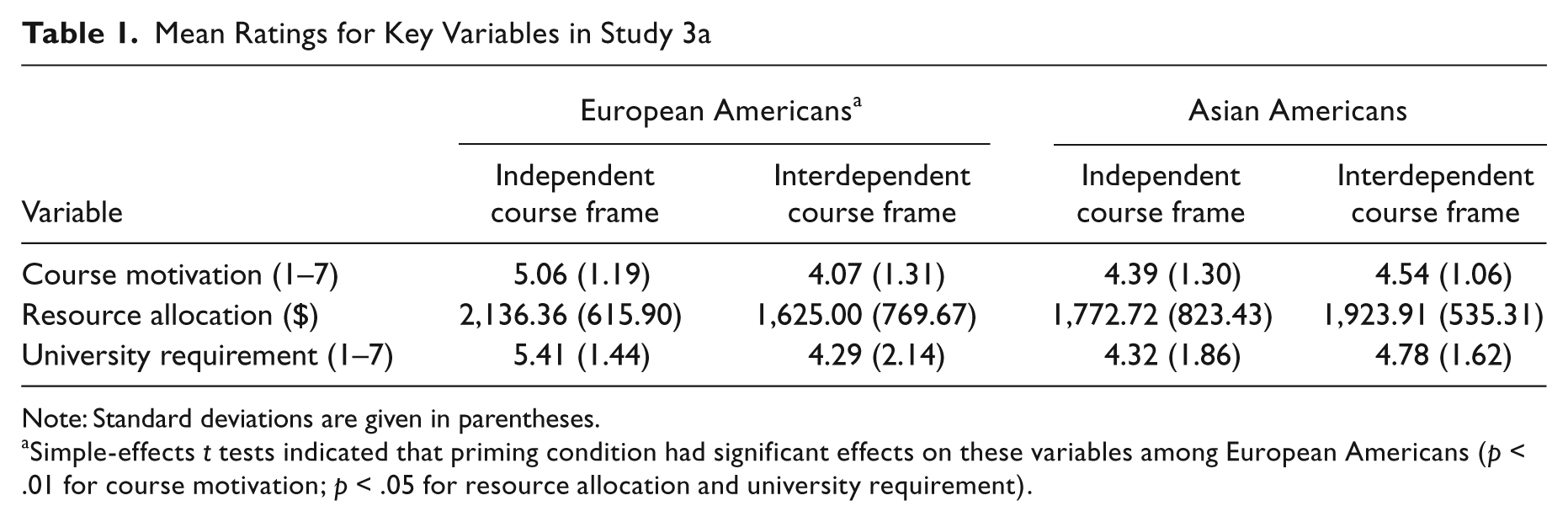
Note: Standard deviations are given in parentheses.
Simple-effects t tests indicated that priming condition had significant effects on these variables among European Americans (p < .01 for course motivation; p < .05 for resource allocation and university requirement).
Mediated moderation
We hypothesized that the condition-by-ethnicity interaction on resource allocation would be mediated by course motivation. Following the guidelines set by Muller, Judd, and Yzerbyt (2005) and by Preacher and Hayes (2008), we conducted a mediated moderation analysis with 5,000 bootstrap resamples using the SPSS macro developed by Preacher and Hayes (2008). Using this procedure, we computed a point estimate and a 95% confidence interval (CI) for the mediation effect. Course motivation significantly mediated the condition-by-ethnicity interaction, predicting resource allocation (point estimate = 0.43, 95% CI = [0.08, 0.94]) and agreement that the course should be a university requirement (point estimate = 0.55, 95% CI = [0.11, 1.09]; see Table 2 for coefficients for the mediation models). The lower motivation experienced by European Americans compared with Asian Americans explained why European Americans allocated fewer resources to the course when it was framed in terms of interdependent than independent behavior. This finding reveals that framing social issues in terms of interdependent action may actually work against the intended goal of inspiring Americans to take action and lead to decreased motivation.
Results of Mediated Moderation Analyses of the Effect of the Course Frame × Ethnicity Interaction, as Mediated by Motivation (Study 3a)
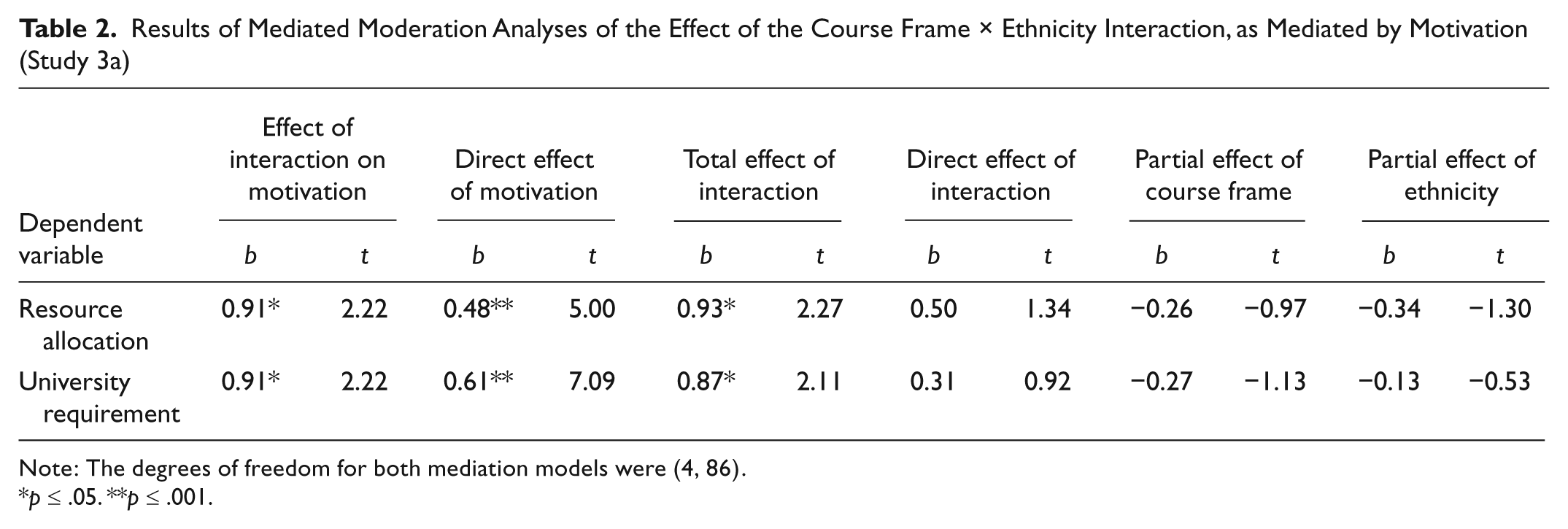
Note: The degrees of freedom for both mediation models were (4, 86).
p ≤ .05. **p ≤ .001.
One possible explanation for the motivational effects seen here is that interdependent and independent action differ in power or approach orientation. Some of the terms and concepts used to distinguish interdependent action from independent action overlap with those used in research on the effects of power and approach (e.g., autonomy; Bargh, Raymond, Pryor, & Strack, 1995; Galinsky, Gruenfeld, & Magee, 2003; Lammers, Stoker, & Stapel, 2009). Another potential explanation for these findings is that the interdependent course frame was not as appealing to students as the independent frame, beyond the ratings of course rigor assessed in Study 3a. Consequently, we carried out a follow-up study to examine these possibilities.
Study 3b method
Participants
Eighty-four students (all U.S. citizens, 41 European American and 43 Asian American; 60 female, 24 male; mean age = 20.17 years) from Stanford University participated in Study 3b.
Materials and procedure
Participants followed the same procedures as in Study 3a but completed different dependent measures and filler items. First, participants rated how interesting, engaging, energizing, inspiring, and boring they found the course description on separate scales from 1 (not at all) to 7 (extremely). They also evaluated the course description on good-bad, strong-weak, active-passive, powerful-powerless semantic differential scales (7-point continuum).
Participants then rated how they would feel participating in the course using two power scales: a 2-item scale assessing personal power (i.e., “To what degree do you have power over yourself”) and social power (i.e., “To what degree do you think you can influence and affect other people”) and a 10-item scale assessing general power (2 items; α = .63), personal power (4 items; α = .73), and social power (4 items; α = .72; Lammers et al., 2009). They rated items on the 2-item scale from 1 (not at all) to 5 (very much) and items on the 10-item scale from 1 (not at all) to 7 (extremely). Participants also completed the promotion-strategy index (Sassenberg, Jonas, Shah, & Brazy, 2007) by rating preference for five pairs of approach-avoidance behaviors along a 7-point continuum (α = .33).
Study 3b results and discussion
A 2 (condition: independent frame vs. interdependent frame) × 2 (ethnicity: European American vs. Asian American) ANOVA showed no significant differences in how interesting (M = 4.31, SD = 1.46), engaging (M = 4.26, SD = 1.41), energizing (M = 4.14, SD = 1.46), inspiring (M = 4.07, SD = 1.54), or boring (M = 3.81, SD = 1.73) participants found the course ads (Fs < 1.90, n.s.). They also rated the course ads as comparably good (M = 2.83, SD = 1.30), strong (M = 3.26, SD = 1.44), active (M = 2.16, SD = 1.45), and powerful (M = 3.24, SD = 1.31; Fs < 1.00, n.s.). Participants also did not differ significantly on the 2-item power scale (personal power: M = 3.95, SD = 0.81; social power: M = 3.49, SD = 0.86; Fs < 2.40, n.s.) or on the 10-item scale (general power: M = 4.33, SD = 1.05; personal power: M = 3.39, SD = 1.04; social power: M = 4.80, SD = 0.94; Fs < 1.50, n.s.). Nor did they differ in behavioral approach (M = 3.90, SD = 0.69; F < 1.50, n.s.). Although reliability was relatively low for this scale, no differences were present on single items.
These results suggest that we created two comparable course frames that were equally appealing and did not divergently affect students’ feelings of power or approach orientation. The motivational differences observed here were not simply a consequence of manipulating appeal, power, or behavioral approach. Future work should further examine the particular ways in which interdependent action can decrease motivation for European Americans.
General Discussion
In the land of the free, can appeals to increased interdependent awareness and action undermine motivation for independent Americans? The present studies reveal that they can. Specifically, we found that priming interdependent rather than independent action undermines general motivation for both mental and physical tasks and that framing participation in a university class about environmental sustainability in terms of interdependent action (working together) rather than independent action (taking charge) leads to decreased motivation and resource allocation. These effects were robust and suggest that the frequent and pressing calls for Americans to recognize their shared fate and think collectively may result in the unintended consequences of undermining the very motivation they seek to inspire. It is important to note that interdependent action is not inherently demotivating for all Americans. Rather, it is demotivating for European Americans for whom, unlike for bicultural Asian Americans, interdependent action has not yet been systematically and pervasively associated with valued, normative, “good” behavior in their sociocultural context.
Although studies have demonstrated that people across sociocultural contexts can be primed to act independently and interdependently (cf. Oyserman & Lee, 2007), the present results underscore that these schemas are not created equal. These findings support the theory that independence functions as a foundational schema for thought and behavior in mainstream European American cultural contexts (Markus & Kitayama, 2010). Interdependent action is not as motivating for independent European Americans because it is inconsistent with this schema. These results have significant and novel implications: practically, for inspiring social awareness and action among Americans, and theoretically, for demonstrating the powerful ways in which cultural schemas can both facilitate and serve as barriers to behavior.
An important strength of this research is that interdependent and independent action were primed in multiple ways, and the effects of these primes were examined across a variety of evaluative and behavioral dependent measures. These studies also have limitations. Given our interest in current appeals to interdependent behavior, we focused on the consequences of invoking or priming interdependent action. Future work should pinpoint which particular aspects of interdependence (e.g., shared fate, adjusting to other people) undermine motivation among European Americans. Subsequent studies should also be conducted to test whether interdependent behavior undermines motivation for tasks that require collective or group action rather than individual action. Lastly, a variety of interrelated self-processes may be implicated in these effects and should be explored (e.g., ego depletion for European Americans; Baumeister & Vohs, 2007).
In the land of the free, motivating Americans to take action for today’s pressing societal challenges will be accomplished most effectively when people are encouraged to “take charge” rather than to “work together.” For interdependent action to become chronically motivating, it needs to be valued and promoted in American worlds and by American selves to the same extent as independence is (Hamedani, Markus, & Fu, 2011). Until interdependence is more consistently and effectively represented in the ideas, practices, products, and institutions—that is, the culture—of the American mainstream, successfully encouraging the perspective that our destiny is “stitched together” may require invoking independent behavior to achieve interdependent ends.
Footnotes
Acknowledgements
We thank Jennifer Eberhardt, Dale Miller, Lee Ross, Jeanne Tsai, Taylor Phillips, Krishna Savani, Nicole Stephens, Sarah Townsend, the Stanford Culture Collaboratory, and the reviewers for their helpful feedback. We also thank our research assistants for their contributions.
Declaration of Conflicting Interests
The authors declared that they had no conflicts of interest with respect to their authorship or the publication of this article.
Funding
This research was supported by National Science Foundation Research Grant No. 0092018, awarded to Hazel Rose Markus.

Notes
References
Supplementary Material
Please find the following supplemental material available below.
For Open Access articles published under a Creative Commons License, all supplemental material carries the same license as the article it is associated with.
For non-Open Access articles published, all supplemental material carries a non-exclusive license, and permission requests for re-use of supplemental material or any part of supplemental material shall be sent directly to the copyright owner as specified in the copyright notice associated with the article.
