



Abstract
We propose that positive affect promotes dishonest behavior by providing the cognitive flexibility necessary to reframe and to rationalize dishonest acts. This hypothesis was tested in two studies. The results of Study 1 showed that individuals experiencing positive affect morally disengage to a greater extent than do individuals experiencing neutral affect. Study 2 built on this finding by demonstrating that the ability to morally disengage can lead individuals who experience positive affect to behave dishonestly. Specifically, the results of Study 2 showed that people experiencing positive affect are more likely to steal than individuals experiencing neutral affect, particularly when self-awareness is low. Furthermore, moral disengagement fully mediated this effect. Taken together, the results suggest that positive affect paves the way for the commission of dishonest acts by altering how individuals evaluate the moral implications of their own behavior.
A typical organization loses approximately 5% of its revenue each year to fraud, which results in a global loss of 2.9 trillion dollars annually (Association of Certified Fraud Examiners, 2010). To address this issue, psychological research on theft has focused on the role of negative emotions in studies suggesting that dishonest individuals are angry, frustrated, hostile, prone to anxiety, and likely to engage in dishonest behaviors as a reaction to injustice (Penney & Spector, 2007). In other words, to expose dishonesty, society should search the ranks of the disgruntled. However, in the present studies, we traced the roots of dishonest behavior to a previously unconsidered source. We argue that positive affect promotes the ability to morally disengage, which, in turn, leads to dishonest behavior. Consequently, the mild feelings of happiness associated with a wide range of prosocial behavior (Fredrickson & Joiner, 2002; Fritz & Sonnentag, 2009) can also contribute to dishonesty if left unchecked.
It is well known that positive affect increases cognitive flexibility, the ability to redefine and evaluate events and information in different, unusual ways (Isen, 2000). Positive affect broadens categories, which facilitates connections between concepts that might ordinarily be viewed as unrelated (e.g., categorizing wastebaskets as furniture or tractors as vehicles; Isen & Daubman, 1984). Without denying the obvious benefits of cognitive flexibility for problem solving, we considered this process in a very different context by theorizing that the cognitively flexible may also be morally flexible. Dishonest behavior can threaten an individual’s positive moral self-image unless it can be rationalized or reframed (Mazar & Ariely, 2006) through moral disengagement (Bandura, 1999). For instance, an individual can recategorize theft as “just borrowing” something, thus paving the way for the commission of a dishonest act (Bandura, 1999; Detert, Trevino, & Sweitzer, 2008; Mazar & Aggarwal, 2011). Drawing on and extending the research on positive affect and categorization, we argued that if people experiencing positive affect create more inclusive categories, they may be more adept at stretching the definition of honesty to include behaviors that might ordinarily be viewed as dishonest. Therefore, we predicted that people experiencing positive affect will be more likely to morally disengage than people experiencing neutral affect.
Study 1
Method
Participants and design
Eighty participants from a large U.S. university (40% male, 60% female; mean age = 20.26 years) participated in Study 1 for course credit. Each participant was randomly assigned to either a positive-affect or a neutral-affect condition.
Procedure
Participants first completed an autobiographical memory task designed to induce positive or neutral affect (Ashton-James, Maddux, Galinsky, & Chartrand, 2009; Urada & Miller, 2000). In the positive-affect condition, participants recalled a life experience that made them feel positive, uplifted, or happy. Participants in the neutral-affect condition were asked to recall their actions of the current day. Following this task, participants completed a validated and widely used survey of moral disengagement (Detert et al., 2008): Using a 7-point scale, participants rated their agreement with 32 statements, such as, “It is ok to tell small lies because they don’t really do any harm” (α = .90). To check the positive-affect manipulation, we asked participants to rate their affect on 7-point scales ranging from happy to sad, pleasant to unpleasant, and good to bad (Ashton-James et al., 2009).
Results
Manipulation check
Participants in the positive-affect condition reported greater positive affect (M = 5.16, SD = 1.19) than did participants in the neutral-affect condition (M = 4.38, SD = 1.20), F(1, 78) = 8.47, p = .005, η2 = .10. 1 Because of the nature of the prime, participants could have recalled a moral or prosocial behavior, which could have, in turn, licensed dishonest behavior as a result of a moral self-licensing effect. However, coding of the content of the recalled events indicated that only 3 participants recalled a moral or prosocial event, thus reducing this concern (see the Supplemental Material available online).
Moral disengagement
Participants in the positive-affect condition scored higher on moral disengagement (M = 2.92, SD = 0.66) than did participants in the neutral-affect condition (M = 2.52, SD = 0.62), F(1, 78) = 8.00, p = .006, η2 = .09.
Discussion
The results of Study 1 supported our hypothesis that positive affect promotes moral disengagement. Moral disengagement, in turn, may cause individuals experiencing positive affect to be more likely than individuals experiencing neutral affect to engage in dishonest behaviors, a possibility that we tested in Study 2. This is not to say, however, that the morally diluting consequences of positive affect are inevitable. Although positive affect may facilitate the ability to blur the lines between moral and immoral behaviors, self-awareness can counter this effect by making behavioral standards salient (Fenigstein, Scheier, & Buss, 1975). Therefore, in Study 2, we manipulated affect and self-awareness to investigate their interactive effects on dishonest behavior. We also measured the hypothesized mediator, moral disengagement (Detert et al., 2008), to replicate the results of Study 1 and to trace the psychological process that links positive affect to dishonesty. We specifically tested our hypothesis that, among participants who are low in self-awareness, moral disengagement will mediate the relationship between positive affect and dishonesty.
Study 2
Method
Participants
Ninety students from a large U.S. university (64% male, 36% female; mean age = 21 years) participated in Study 2 for $5 and an opportunity to earn up to an additional $10.
Procedure
Participants entered the laboratory and were randomly assigned to four conditions based on a 2 (affect: positive vs. neutral) × 2 (self-awareness: high vs. low) factorial design. First, following the procedures used by Dijksterhuis and Van Knippenberg (2000), we manipulated self-awareness by asking participants to sit at a cubicle with a mirror or a cubicle without a mirror. Participants randomly assigned to sit at the cubicles with the mirrors were in the high-self-awareness condition, whereas the participants seated at the cubicles without the mirrors were in the low-self-awareness condition. Participants then watched a short movie clip designed to induce positive or neutral affect (e.g., Fredrickson, 2001; Tice, Baumeister, Shmueli, & Muraven, 2007). Participants in the positive-affect condition watched a clip of a cartoon duck showering. Participants in the neutral-affect condition watched a clip of a screensaver-like animation of colored sticks (both clips are available from the corresponding author).
Next, participants performed a number-search task (Mazar, Amir, & Ariely, 2008). Participants received a worksheet with 20 number-search matrices, each with a set of 12 three-digit numbers, and a red pencil to use while completing the task. Participants had 5 min to find two numbers in each matrix that added up to 10 (e.g., 4.78 and 5.22); the time allotted was not sufficient for anyone to solve all 20 matrices. For each correct answer, participants earned $0.50, for a maximum of $10. After 5 min had passed, the researcher collected the red pencil and distributed a report form, a pen, an answer key, and an envelope containing $10. Switching the red pencil and the pen disallowed participants from altering the number of problems solved after the time was up. The participants corrected their own answers, reported the number of problems that they correctly solved on the report form, compensated themselves, and then placed all of their materials in a large box.
No identifying information was apparent on any of the task materials. Therefore, as the participants’ actions appeared untraceable, participants could be dishonest by taking more money than they had earned. However, a system of identifying numbers written in invisible ink allowed the researcher to calculate the difference between how much money each individual earned and how much money he or she took, thus allowing for an accurate behavioral measure of dishonesty. Positive differences indicated that participants behaved dishonestly by stealing money that they did not legitimately earn.
Following the number-search task, participants completed a series of surveys that measured their perspectives on behaviors and themselves. They completed a measure of moral disengagement (Detert et al., 2008; α = .88) and measures to check the affect manipulation (Ashton-James et al., 2009) and the self-awareness manipulation (Fenigstein et al., 1975; α = .87). The self-awareness scale asked participants to rate their agreement or disagreement with statements such as “I generally pay attention to my behavior” on a 7-point scale.
Results
Self-awareness manipulation check
As expected, there was a significant main effect of self-awareness condition, such that individuals in the high-self-awareness condition experienced greater levels of self-awareness (M = 5.50, SD = 0.94) than did individuals in the low-self-awareness condition (M = 5.11, SD = 0.82), F(1, 88) = 4.39, p = .04, η2 = .05. There was no main effect of affect condition, F(1, 88) = 0.169, p = .68, η2 = .002, nor a significant interaction between the affect and self-awareness conditions, F(1, 88) = 2.29, p = .08, η2 = .07.
Affect manipulation check
As expected, individuals in the positive-affect condition reported greater positive affect (M = 5.15, SD = 0.86) than did individuals in the neutral-affect condition (M = 3.50, SD = 0.51), F(1, 88) = 120.32, p < .001, η2 = .58. There was no main effect of self-awareness condition, F(1, 88) = 0.03, p = .85, η2 = .00, nor a significant interaction between the affect and self-awareness conditions, F(1, 88) = 1.74, p = .19, η2 = .06.
Moral disengagement
A 2 (affect: positive vs. neutral) × 2 (self-awareness: high vs. low) analysis of variance (ANOVA) on moral disengagement showed a significant main effect of self-awareness, such that individuals in the high-self-awareness condition scored lower on the moral-disengagement scale (M = 2.41, SD = 0.64) than did individuals in the low-self-awareness condition (M = 2.75, SD = 0.45), F(1, 88) = 8.64, p = .004, η2 = .09. The results also showed a significant main effect of affect condition, such that individuals in the positive-affect condition scored higher on the moral-disengagement measure (M = 2.73, SD = 0.63) than did individuals in the neutral-affect condition (M = 2.42, SD = 0.63), F(1, 88) = 6.56, p = .01, η2 = .07, thus replicating the results of Study 1.
As predicted, there was also a significant interaction between the self-awareness and affect conditions, F(1, 88) = 4.25, p = .043, η2 = .05. In the low-self-awareness condition, participants who experienced positive affect reported greater moral disengagement (M = 3.02, SD = 0.45) compared with participants who experienced neutral affect (M = 2.48, SD = 0.57), t(45) = 3.57, p < .001. Conversely, in the high-self-awareness condition, participants who experienced positive affect did not report greater moral disengagement (M = 2.37, SD = 0.68) than did participants who experienced neutral affect (M = 2.43, SD = 0.49), t(41) = 0.33, p = .74.
Dishonesty
Consistent with prior research (Beaman, Klentz, Diener, & Svanum, 1979; Diener & Wallbom, 1976), results from a 2 (affect: positive vs. neutral) × 2 (self-awareness: high vs. low) ANOVA on dishonesty showed a significant main effect of self-awareness, such that individuals in the high-self-awareness condition stole less money (M = $0.16, SD = $0.44) than did individuals in the low-self-awareness condition (M = $0.98, SD = $1.11), F(1, 88) = 20.61, p < .001, η2 = .19. There was also a significant main effect of affect condition, such that individuals in the positive-affect condition stole more money (M = $0.78, SD = $1.09) than did individuals in the neutral-affect condition, (M = $0.36, SD = $0.70), F(1, 88) = 4.47, p = .04, η2 = .05.
Consistent with our prediction, results also showed a significant interaction between the self-awareness and affect conditions, F(1, 88) = 10.23, p < .001, η2 = .26 (see Fig. 1). In the low-self-awareness condition, participants who experienced positive affect stole significantly more money (M = $1.27, SD = $1.17) than did participants who experienced neutral affect (M = $0.12, SD = $0.44), t(45) = 2.27, p = .03. Conversely, in the high-self-awareness condition, participants who experienced positive affect did not steal significantly more money (M = $0.12, SD = $0.45) than did participants who experienced neutral affect (M = $0.19, SD = $0.45), t(41) = 0.54, p = .59. Additional analyses showed that, even when self-awareness was low, participants who experienced neutral affect did not steal significantly more money (M = $0.55, SD = $0.88) than did participants whose self-awareness was high (M = $0.19, SD = $0.45), t(39) = 1.79, p = .08. Finally, a 3-to-1 contrast analysis indicated that individuals in the positive-affect and low-self-awareness condition stole significantly more money than did participants in the other three conditions, t(88) = 5.22, p < .001.

Results from Study 2: average amount of money stolen as a function of self-awareness condition and affect condition. Error bars indicate ±1 SEM.
The mediating role of moral disengagement
Taken together, the results demonstrate that dishonest behavior was highest among individuals who were experiencing both positive affect and low self-awareness. To test our prediction that moral disengagement mediated this effect, we used bootstrapping procedures, which establish a confidence interval for the indirect effect; mediation is established when the confidence interval does not include zero (MacKinnon, Fairchild, & Fritz, 2007; Shrout & Bolger, 2002). The condition combining positive affect and low self-awareness was coded as 1 and the remaining three conditions were coded as 0 for this analysis. The direct effect of positive affect and low self-awareness (β = 0.65, p = .003) was reduced to nonsignificance when participants’ moral disengagement was included in the analyses (β = 0.42, p = .08), and moral disengagement was a significant predictor of dishonesty (β = 0.31, p = .0083). A bootstrap analysis showed that the 95% bias-corrected confidence interval for the size of the indirect effect excluded zero [0.0716, 0.6436], which suggests that there was a significant indirect effect of positive affect on dishonesty (MacKinnon et al., 2007; Shrout & Bolger, 2002). Figure 2 outlines the mediational process.
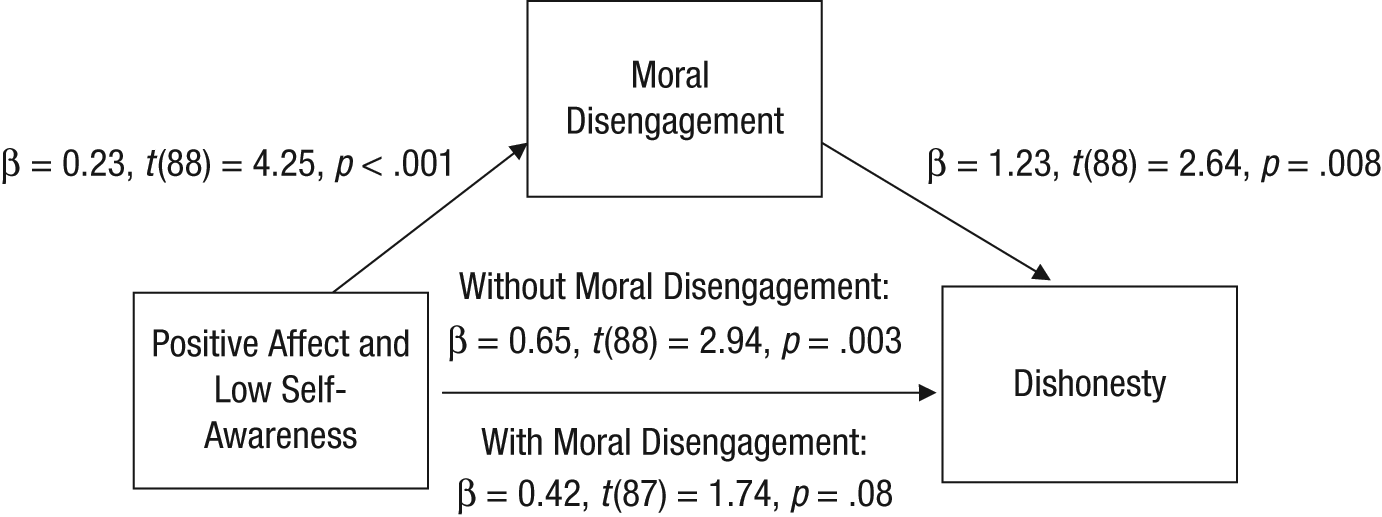
Results from Study 2: mediation model showing the influence of positive affect and low self-awareness on dishonesty, as mediated by moral disengagement.
General Discussion
Most individuals operate in a moral gray zone within which the boundaries between honest and dishonest behavior are not always clear (Anteby, 2008). The work reported here is the first to demonstrate that, within this gray zone, the experience of positive affect may facilitate moral disengagement, which allows the inclusion of a broader range of behaviors as moral. This flexibility of categories thereby promotes the commission of dishonest acts (Gino & Ariely, 2012). However, by increasing participants’ self-awareness, we removed the facilitative effect of positive affect on dishonesty. This finding dovetails with previous research showing that increasing self-awareness through creating the sensation of being watched (Bateson, Nettle, & Roberts, 2006) or by priming thoughts about a mindful god (Gervais & Norenzayan, 2012) can increase reputational concerns and cooperative behaviors.
The results make at least three important contributions to existing research. First, most research on dishonesty, particularly theft, has focused on the role of negative emotions (Penney & Spector, 2007). However, we showed that positive affect can also cause dishonest behavior through a different psychological process; namely, by promoting moral disengagement. Future research might build on these findings by investigating how positive affect shapes judgments, not just of oneself, but also of the behavior of a target other. It is possible that positive affect might broaden what an evaluator considers to be immoral behavior, thus leading to the somewhat counterintuitive prediction that positive affect might make judges more morally conservative and perhaps even more punitive (Minson & Monin, 2012). In other words, cognitive flexibility might give rise to moral hypocrisy by making evaluators simultaneously harsher on other people and more lenient on themselves. Similarly, our findings may also have implications for the literature on moral regulation. If considering past prosocial deeds increases positive affect, then positive affect might, in turn, lead to dishonesty, which would explain the licensing effect (Jordan, Mullen, & Murnighan, 2011).
Second, the consequences of positive affect on dishonesty may be insidious, as the ability to morally disengage from the negative implications of their behavior may allow individuals to steal with impunity. Indeed, our results suggest that although positive affect promoted theft, there were no discernible effects on participants’ self-reported moral identity (see the Supplemental Material), which suggests that individuals can steal while at the same time retaining their positive moral self-image.
Finally, although conventional wisdom would suggest that happy people are less likely than unhappy people to be dishonest, our work suggests that anyone who buys into this simplistic cliché might be blindsided by the stealth behind the smile.
Footnotes

References
Supplementary Material
Please find the following supplemental material available below.
For Open Access articles published under a Creative Commons License, all supplemental material carries the same license as the article it is associated with.
For non-Open Access articles published, all supplemental material carries a non-exclusive license, and permission requests for re-use of supplemental material or any part of supplemental material shall be sent directly to the copyright owner as specified in the copyright notice associated with the article.
