



Abstract
Multitasking poses a major challenge in modern work environments by putting the worker under cognitive load. Performance decrements often occur when people are under high cognitive load because they switch to less demanding—and often less accurate—cognitive strategies. Although cognitive load disturbs performance over a wide range of tasks, it may also carry benefits. In the experiments reported here, we showed that judgment performance can increase under cognitive load. Participants solved a multiple-cue judgment task in which high performance could be achieved by using a similarity-based judgment strategy but not by using a more demanding rule-based judgment strategy. Accordingly, cognitive load induced a shift to a similarity-based judgment strategy, which consequently led to more accurate judgments. By contrast, shifting to a similarity-based strategy harmed judgments in a task best solved by using a rule-based strategy. These results show how important it is to consider the cognitive strategies people rely on to understand how people perform in demanding work environments.
Suppose you hurt your leg in an accident and go to the hospital for emergency treatment. While treating you, the physician is repeatedly interrupted by a medical assistant. Is the physician still able to treat you properly? Emergency physicians are—on average—interrupted 10 times per hour (Chisholm, Collison, Nelson, & Cordell, 2000). These interruptions can increase the risk of failure, such as medication errors (Westbrook, Woods, Rob, Dunsmuir, & Day, 2010). One reason why distractions are so damaging is that they increase cognitive load on the physician and reduce working memory capacity for the focal task (Baddeley, 1992; Baddeley & Hitch, 1974).
Research has shown that high cognitive load severely impairs performance in various tasks, ranging from memory (Baddeley & Hitch, 1974) to motor abilities (Yogev-Seligmann, Hausdorff, & Giladi, 2008) to problem solving (Logie, Gilhooly, & Wynn, 1994). Similarly, making accurate judgments, such as diagnosing a patient, can require high working memory capacity, and thus accuracy should suffer under cognitive load (Juslin, Karlsson, & Olsson, 2008; Payne, Bettman, & Johnson, 1993; Weaver & Stewart, 2012). Sometimes, however, cognitive load can improve performance: For instance, experienced golf players who are distracted putt better than experienced golf players focusing on performance aspects (Beilock, Carr, MacMahon, & Starkes, 2002). Likewise, cognitive load induced by the presence of other people often facilitates performance (e.g., Baron, 1986; Markman, Maddox, & Worthy, 2006). Given that negative consequences of cognitive load are often, but not always, found, under what circumstances does performance increase under cognitive load?
To predict performance, we argue that one must consider the cognitive strategies people use for solving problems and how well these strategies perform. Research shows that strategies demanding high working memory capacity are impaired under cognitive load, which induces people to switch to less demanding strategies (Beach & Mitchell, 1978; Beilock & DeCaro, 2007; Payne et al., 1993; Rieskamp & Hoffrage, 2008). If less demanding strategies cannot help solve the task, performance decreases. However, if less demanding strategies can help solve the task, performance can increase (Beilock & DeCaro, 2007). Social pressure, for instance, expedites learning in nonverbalizable categorization problems (Markman et al., 2006) that are solvable by using similarity-based strategies (Juslin, Olsson, & Olsson, 2003) but harms learning in verbalizable categorization problems solvable by using rule-based strategies.
In the present work, we investigated how cognitive load changes strategy use in a multiple-cue judgment task and how strategy use interacts with the task environment. Specifically, we first tested whether cognitive load fosters switching from a rule-based judgment strategy to a similarity-based judgment strategy. Second, we tested whether cognitive load improves performance in tasks for which the similarity-based strategy is better suited.
Multiple-Cue Judgments
In multiple-cue judgment tasks, a number of cues, such as a patient’s symptoms, are used to predict a quantitative criterion, say, an appropriate drug dosage for that patient. Recent research suggests that people commonly use two types of cognitive strategies for judgments: rule-based strategies and similarity-based strategies (Erickson & Kruschke, 1998; Juslin et al., 2008; Nosofsky, Palmeri, & McKinley, 1994; von Helversen & Rieskamp, 2008, 2009). Rule-based strategies assume that people try to find or abstract a rule specifying the relation between each cue and the criterion. The abstracted cue weights are then integrated in a linear additive fashion. For instance, a physician may apply a rule that specifies the appropriate dosage as a linear function of the patient’s symptoms. Linear regression models can capture these rules and have successfully described human judgment in various domains (Brehmer & Brehmer, 1988).
Alternatively, physicians could recall patients they have previously treated and estimate the dosage according to the treatment of similar patients. In this case, the physician relies on a similarity-based strategy. Models assuming a similarity-based strategy, such as exemplar models, successfully predict human behavior in a wide selection of cognitive tasks, such as categorization (Juslin et al., 2003; Nosofsky & Johansen, 2000) and judgment (Juslin et al., 2008). Exemplar models assume that previously encountered exemplars are stored in memory. When judging a new object, the similarity of this “probe” to all stored objects determines the judgment (see Section A in the Supplemental Material available online for the models’ mathematical descriptions).
Converging evidence suggests that people switch between rule- and similarity-based strategies depending on task characteristics (Juslin et al., 2003; Juslin et al., 2008; von Helversen, Mata, & Olsson, 2010). For instance, Juslin and colleagues (2008) found that people used a rule-based cue-abstraction strategy in a linear judgment problem in which the criterion was an additive function of the cues. However, people switched to an exemplar strategy in a nonlinear task in which the criterion was a multiplicative function of the cues. Likewise, cognitive load may induce selecting another judgment strategy. In fact, evidence suggests that rule-based strategies demand more working memory capacity than similarity-based strategies (Juslin et al., 2008). For instance, increased cognitive load impaired performance in rule-based categorizations but marginally affected performance in similarity-based categorizations (Zeithamova & Maddox, 2006, 2007; but see Miles & Minda, 2011). Furthermore, Filoteo, Lauritzen, and Maddox (2010) found that cognitive load improved performance in similarity-based, but not in rule-based, categorizations; they explained that this improvement occurred because more people shifted to implicit procedural strategies when making similarity-based categorizations. Sloman (1996) argued that similarity-based processes are executed automatically and require little working memory capacity. However, to what extent similarity-based strategies draw on working memory is still debated (Ashby & O’Brien, 2005; Juslin et al., 2008; Karlsson, Juslin, & Olsson, 2008; Lewandowsky, 2011; Nosofsky & Zaki, 1998).
Following this debate, we investigated how cognitive load affects judgment strategies and performance. If working memory limitations affect rule-based strategies more than similarity-based strategies, increased cognitive load should promote a shift from rule-based to similarity-based judgments. Furthermore, when similarity-based strategies are better suited for solving the judgment problem—as in nonlinear judgment tasks—cognitive load may even enhance performance.
Study 1: Cognitive Load in a Nonlinear Judgment Task
To test our hypothesis, we trained participants in the present study to predict the criterion value for a number of objects using five cues. The criterion was a nonlinear, multiplicative function of the cues and could be better predicted by a similarity-based strategy than by a rule-based strategy (von Helversen & Rieskamp, 2008). We manipulated cognitive load with a concurrent memory task in three conditions that differed according to whether participants were given no, low, or high cognitive load.
Method
Participants
Ninety participants (42 women, 48 men; mean age = 24 years, SD = 5 years) were recruited from the University of Basel. Participants received 17 Swiss francs (CHF) per hour (roughly $18) and a performance-contingent bonus (M = 8.3 CHF) for participation. One participant who always made identical judgments was excluded from the analysis.
Design and materials
The cover story in the judgment task was adopted from von Helversen et al. (2010) and asked participants to predict how many fictitious creatures (“Golbis”) a comic figure (a “Sonic”) could catch. The Sonics’ appearance differed in five binary features (the cues): hair (spiky vs. dreadlocks), nose (red round vs. yellow beaky), tail (spiny vs. curly), ears (pointy vs. floppy), and body (green wings vs. blue spikes). 1 These cues could be used to predict how many Golbis a Sonic would catch (the criterion). Table 1 illustrates the task structure: The cues were given a binary value of zero or one, and they varied in their cue weights, that is, in their importance for predicting the criterion. The cue weights were randomly assigned to the five pictorial cues, as were the cue values (zero or one) to the features (e.g., spiny vs. curly). We divided the items into a training set and a validation set; both sets could be better solved by a similarity-based strategy than a rule-based strategy. Additionally, the two strategies predicted different responses on the validation items (for item selection, see Section A in the Supplemental Material).
Cue and Criterion Values of Items in the Nonlinear Judgment Task of Study 1
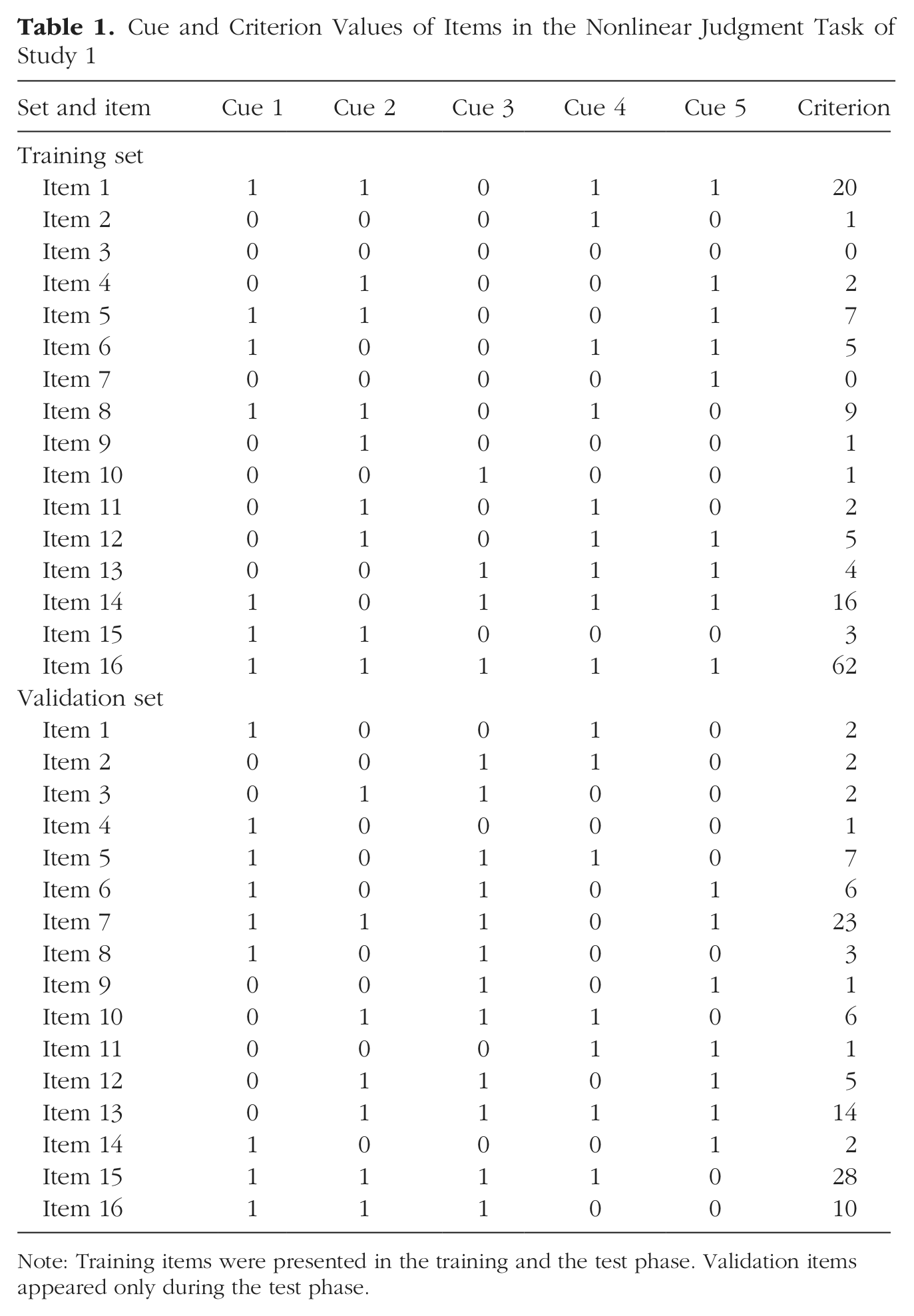
Note: Training items were presented in the training and the test phase. Validation items appeared only during the test phase.
Procedure
To control for possible differences in working memory capacity, we first asked participants to complete an operation-span task (Unsworth, Heitz, Schrock, & Engle, 2005). During this task, participants recalled letters while solving mathematical equations. The subsequent judgment task was divided into a training and a test phase. In the training phase, participants learned to make judgments for 16 training items. To induce a shift to a similarity-based strategy, we manipulated cognitive load during this phase across three conditions, which differed according to whether participants were given no, low, or high cognitive load. Thirty participants were assigned to each condition.
On each trial in the training phase, participants saw 1 of the 16 Sonics from the training set and estimated its criterion value. After each trial, participants received feedback about the correct criterion value and the points earned. In the low- or high-cognitive-load condition, participants saw two or four consonants, respectively, before the Sonic appeared. Consonants were presented consecutively, each for 2 s. After the participants received feedback about their criterion judgment, they were asked to recall the letters in their presentation order. The training phase ended when a learning criterion was reached. Participants met this learning criterion when judgment accuracy, as measured in root-mean-square deviation (RMSD) between participants’ judgments and the criterion values, fell below 6 RMSD. Each participant completed at least 8 training blocks, each consisting of 16 trials; training terminated after 14 blocks even if the learning criterion had not been reached. In the test phase, participants estimated criterion values for all 32 Sonics from the training and the validation sets twice without feedback and without cognitive load.
To motivate participants, we provided a performance-contingent payment. In each trial, participants earned 10 points (corresponding to 0.05 CHF) for a correct answer. The more their judgment deviated from the correct answer, the fewer points they received: They received 9 points if their judgment deviated by one from the correct answer, 8 points if it deviated by two, 6 points if it deviated by three, and 3 points if it deviated by four. Participants under low and high cognitive load received an additional point for correct letter recall. To prevent participants from trading off recall performance and judgment performance, we did not award any points for the memory or for the judgment task when they could not recall the letters. Additionally, participants received a bonus of 3 CHF if they reached the learning criterion for the judgment task within 14 training blocks.
Results
Adherence to cognitive load
To check whether we manipulated cognitive load successfully, we calculated the percentage of correctly recalled letter sequences over all blocks. Letter recall was generally high; however, participants under low cognitive load recalled letters better than did participants under high cognitive load, t(46.13) = 3.35, p = .002 (see Table 2). In both conditions, higher criterion-judgment accuracy was related to better letter recall (all rs < −.35, all ps < .05), which indicates that participants did not trade off letter recall and judgment accuracy. Excluding participants who recalled fewer than 90% of the letter sequences correctly led to comparable results. Taken together, these results suggest that the cognitive-load manipulation was successful.
Mean Results for the Three Conditions in Study 1
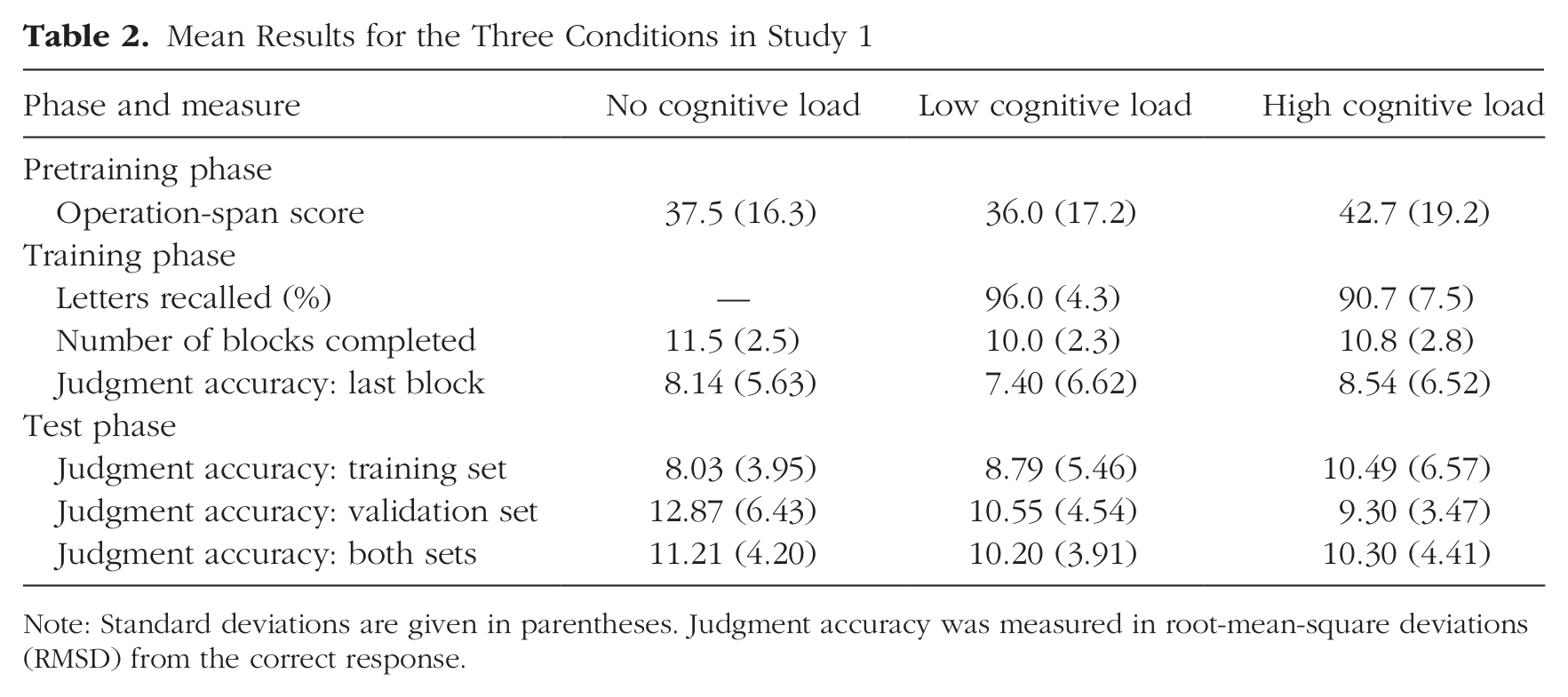
Note: Standard deviations are given in parentheses. Judgment accuracy was measured in root-mean-square deviations (RMSD) from the correct response.
Differences in working memory capacity
Working memory capacity may be an important mediator of judgment performance (DeCaro, Carlson, Thomas, & Beilock, 2009; Lewandowsky, 2011). Hence, we measured individual differences in working memory capacity with an operation-span task (Unsworth et al., 2005). Working memory capacity did not vary significantly between the cognitive-load conditions, F(2, 86) = 1.20, p = .305 (see Table 2). Including working memory capacity as a covariate did not affect the results in any subsequent analysis.
Criterion-judgment performance
Can people learn accurate judgments even under high cognitive load? The majority of participants (68%) reached the learning criterion within 14 blocks, which suggests that, overall, participants mastered the task. The number of participants who did not reach the learning criterion did not differ significantly among conditions (high load: 11, low load: 6, control: 12), χ2(2, N = 89) = 2.85, p = .241. 2 Additionally, we assessed learning performance with the number of training blocks completed and judgment accuracy in the last training block (see Table 2). An analysis of variance revealed that participants in the two cognitive-load conditions did not require more training than participants without cognitive load, F(2, 86) = 2.30, η2 = .05, p = .107. Neither high nor low cognitive load resulted in poorer judgment accuracy in the last training block than did no cognitive load, F(2, 86) < 1, p = .778. These results show that cognitive load did not harm learning.
But were participants able to generalize the good performance to validation items when they learned under cognitive load? We measured judgment accuracy in the test phase as the RMSD between the criterion value and participants’ judgments, averaged over the two test blocks separately for training and validation items. As expected based on the learning results, performance for training items did not differ significantly among the three conditions, F(2, 86) = 1.61, η2 = .04, p = .206 (see Table 2). However, for validation items, participants made more accurate judgments in the two cognitive-load conditions than in the no-load condition, F(2, 86) = 4.00, η2 = .09, p = .022. Furthermore, a linear contrast for cognitive load showed that for validation items, increasing cognitive load led to higher judgment accuracy, F(2, 86) = 7.78, p = .007. In sum, consistent with our hypothesis, the results showed that cognitive load increased people’s judgment performance.
Cognitive modeling of judgment strategies
According to our hypothesis, cognitive load might induce people to switch to a similarity-based strategy. Because the task could be better solved with a similarity-based strategy than with a rule-based strategy, such a shift could explain performance improvements under cognitive load. We followed a cognitive-modeling approach to investigate the judgment strategies participants used. We first fitted three computational models, an exemplar model (similarity-based strategy), a linear model (rule-based strategy), and a baseline model (estimating participants’ mean judgment), to participants’ judgments during the training phase (for details, see Section A in the Supplemental Material). We then determined how accurately the models predicted participants’ judgments during the test phase and excluded participants best described by the baseline model. To capture how much participants relied on a linear versus an exemplar model, we fitted a strategy weight ranging from zero to one to participants’ judgments in the test phase. This strategy weight weighs the predictions of the linear and the exemplar model for the test phase. A strategy weight over .5 indicates a higher probability for the exemplar model; a strategy weight lower than .5 indicates a higher probability for the linear model. Classifying participants based on a threshold strategy weight of .5 was identical to a classification based on model fit in the test phase.
Cognitive load, indeed, affected the strategy weight, F(2, 67) = 6.98, η2 = .17, p = .005. Participants under high cognitive load had a higher strategy weight (M = .86, SE = .04) than did participants under low cognitive load (M = .70, SE = .07) or without cognitive load (M = .52, SE = .07). Figure 1 (upper panel) illustrates the effect of cognitive load on strategy use, with participants classified based on the strategy weight. In the control condition, the linear and the exemplar model predicted an equal percentage of participants best. However, under cognitive load, the exemplar model predicted the majority of participants best. In addition to cognitive load, working memory capacity may alter strategy choice. To analyze this relationship, we regressed strategy weight on working memory capacity using cognitive load as a covariate. In this analysis, working memory capacity did not predict strategy weight beyond cognitive load, b = 0.001, SE = 0.002, t(67) = 0.54, p = .592. Taken together, these results suggest that cognitive load induced participants to rely more on a similarity-based than a rule-based judgment strategy.
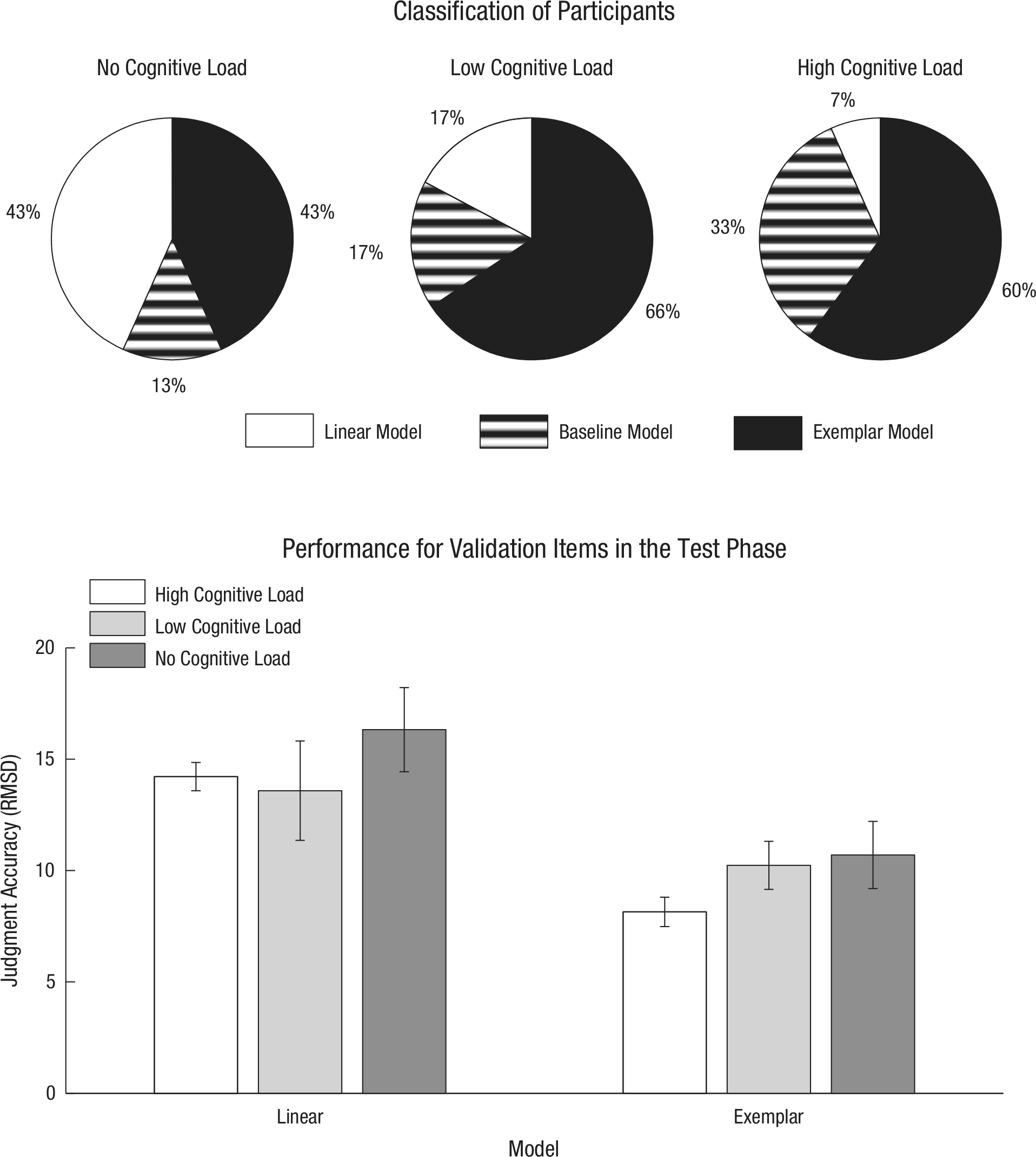
Judgment strategies in the nonlinear judgment task in Study 1. The pie charts show the percentage of participants in each of the three cognitive-load conditions who were best described by the baseline, the linear, or the exemplar model. The graph shows judgment accuracy, measured in root-mean-square deviations (RMSDs) from the correct response, for validation items in the test phase as a function of model type and cognitive-load condition. Error bars represent ±1 SE.
Judgment accuracy and cognitive models
Can a change of strategy explain differences in judgment accuracy under cognitive load? Figure 1 (lower panel) shows judgment accuracy for validation items in the test phase, separately for participants assigned to the exemplar and the linear model. The figure illustrates that participants assigned to the exemplar model judged validation items more accurately than did participants assigned to the linear model.
If cognitive load increases judgment performance by changing the cognitive strategy, the strategy weight should mediate the effect of cognitive load on judgment performance. We tested this hypothesis with a mediation analysis in which cognitive load was the independent variable, strategy weight was the mediator, and judgment accuracy for validation items was the dependent variable (Preacher & Hayes, 2008). First, we regressed judgment accuracy on cognitive load. This regression showed that increasing cognitive load led to a higher judgment accuracy, b = −2.39, SE = 0.78, t(68) = 3.08, p = .003, R2 = .12. However, with strategy weight included in the hierarchical regression, cognitive load no longer predicted judgment accuracy, b = −0.95, SE = 0.75, t(67) = 1.27, p = .209. Instead, the strategy weight predicted judgment accuracy, b = −8.35, SE = 1.79, t(67) = 4.65, p < .001, R2 = .34. A test of the indirect effect indicated that the strategy weight mediated the effect of cognitive load on judgment, b = −1.44, SE = 0.49, Sobel’s Z = 2.96, p = .003, and thus explains why participants performed better under cognitive load (see Section A in the Supplemental Material for additional results).
Study 2: Extension to a Linear Judgment Task
How does cognitive load influence performance in a linear task? In a linear judgment task, similarity-based strategies lead to worse performance than rule-based strategies. Thus, if cognitive load causes participants to rely more on a less demanding similarity-based strategy than a more demanding rule-based strategy, this should decrease performance in a linear task. However, strategy selection is affected not only by the effort it takes to process a strategy, but also by feedback about strategy performance (Payne et al., 1993). Feedback reinforces successful strategies and makes their selection more likely (Rieskamp & Otto, 2006). In the nonlinear task, feedback and cognitive load promoted reliance on similarity-based strategies. Yet, in a linear judgment task, feedback should favor a rule-based strategy. Accordingly, participants may be more motivated to use a rule-based strategy, which would reduce the influence of cognitive load on strategy selection. To investigate this question, we compared how people under high cognitive load (four letters) and people without cognitive load solved a linear judgment task (see Mata, von Helversen, Karlsson, & Cüpper, 2012).
Method
Sixty participants (35 women, 25 men; mean age = 25 years, SD = 7 years) solved a linear judgment task. Each participant was randomly assigned to one of two conditions: high cognitive load (in which participants saw four letters before each trial, as in Study 1) or no cognitive load (in which participants saw no letters before each trial). Participants received 17 CHF per hour and a performance-contingent bonus (M = 5.4 CHF). The design and materials were the same as in Study 1, except that the Sonics’ appearance varied among only four binary cues: hair, nose, ears, and body. The criterion was a linear function of these four cues. The task consisted of a training and a test phase. During the training phase, participants repeatedly judged 10 training items until a learning criterion had been reached (with at least 8 and at most 16 blocks). In the test phase, participants judged 10 training items and 6 validation items four times without feedback (see Section B in the Supplemental Material for details on the methods used in Study 2).
Results
To test whether people switched to a similarity-based strategy in the present study, we followed the same approach as in the first study. We modeled participants’ judgments and excluded participants assigned to the baseline model. Then we estimated the strategy weight to capture how much participants relied on an exemplar rather than a linear model. As illustrated in Figure 2 (upper panel), the percentage of participants assigned to the exemplar model increased slightly under cognitive load, reflected in a marginally significant higher strategy weight in the high-load condition (M = .53, SE = .07) than in the control condition, (M = .33, SE = .07), t(49) = 1.91, d = 0.54, p = .061.
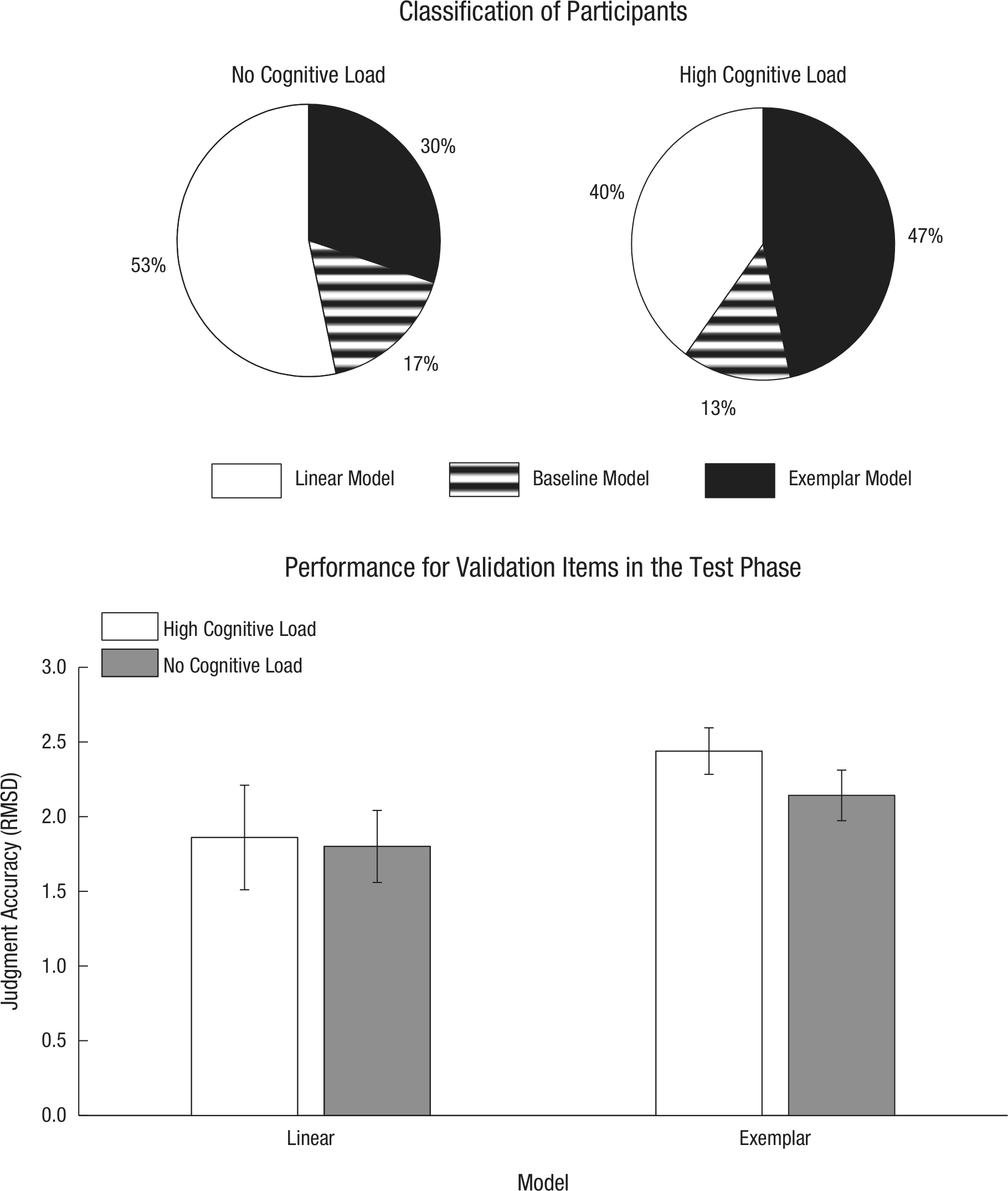
Judgment strategies in the linear judgment task in Study 2. The pie charts show the percentage of participants in the two cognitive-load conditions who were best described by the baseline, the linear, or the exemplar model. The graph shows judgment accuracy, measured in root-mean-square deviations (RMSDs) from the correct response, for validation items in the test phase as a function of model type and cognitive-load condition. Error bars represent ±1 SE.
Cognitive load did not affect performance (high-load condition: M = 2.32 RMSD, SD = 0.97; control condition: M = 2.15 RMSD, SD = 0.93), t(58) = 0.68, p = .50. A regression analysis, however, showed that a higher strategy weight representing similarity-based strategies predicted lower judgment performance on validation items, b = −0.873, SE = 0.319, t(49) = 2.735, p = .009, R2 = .13. Thus, a similarity-based strategy harmed judgment performance in the linear task (see Fig. 2, lower panel).
In sum, cognitive load induced a shift to similarity-based strategies even in a linear judgment task. Furthermore, following a similarity-based strategy harmed judgment performance. However, the shift was not pronounced enough to effectively decrease performance under high cognitive load (see Section B in the Supplemental Material for a more detailed analysis of results of Study 2).
Discussion
In daily life, gaining time by doing several things at once is tempting. Although most people can walk and talk at the same time, using a mobile phone while driving can be dangerous. In fact, distraction impairs performance over a wide range of tasks (Baddeley, 1992). Distractions, however, may not always hurt performance. In contrast, we found that people made more accurate judgments after learning a nonlinear judgment task under concurrent memory load, a finding that matches research showing that cognitive load can enhance performance (Beilock & DeCaro, 2007; Filoteo et al., 2010; Markman et al., 2006).
In our research, we extended these findings to judgments by modeling the cognitive strategies people use and linking these strategies to judgment performance. In the nonlinear judgment task, cognitive load increased performance for validation items. This performance increase was explained by a shift from a rule-based strategy to a less demanding but more accurate similarity-based strategy. Switching to a less demanding strategy, however, does not always benefit judgment performance. If the strategy people use under cognitive load is not adapted to the judgment problem, judgment performance can decrease. Accordingly, in a linear judgment task, we found that following the less accurate similarity-based strategy impaired judgment performance. This suggests that considering the cognitive strategies people use under cognitive load is crucial for predicting performance.
Our results resonate with research suggesting that cognitive load induces people to switch to a less demanding cognitive strategy (Beach & Mitchell, 1978; Beilock & DeCaro, 2007; Payne et al., 1993; Rieskamp & Hoffrage, 2008). In the two experiments reported here, we found that participants under cognitive load were more likely to use a similarity-based strategy than participants who were not under cognitive load. One reason for this strategy change could be that rule-based strategies are more susceptible to working memory limitations than similarity-based strategies are (Juslin et al., 2008). This is supported by research suggesting that rule-based strategies place strong demands on working memory (Ashby & O’Brien, 2005; Zeithamova & Maddox, 2006, 2007), whereas similarity-based categorization may be learned via implicit, automatic processes (Ashby, Alfonso-Reese, Turken, & Waldron, 1998; Ashby & O’Brien, 2005; Filoteo et al., 2010; Markman et al., 2006, but see Karlsson et al., 2008; Lewandowsky, 2011).
The tasks, however, differed in how much participants shifted their strategies under cognitive load. In the linear judgment task, participants relied less strongly on a similarity-based strategy than participants did in the nonlinear task. Possibly, performance feedback reinforced rule-based strategies enough to motivate participants to rely on a rule-based strategy that allowed accurate judgments to outweigh effort reductions from switching to a similarity-based strategy (Payne et al., 1993).
The effect of cognitive load may also depend on type of load: In our studies, we focused on verbal cognitive load. Visual load, however, interferes more strongly with visual processing and reduces learning in similarity-based categorizations (Miles & Minda, 2011). Thus, high visual cognitive load may impair similarity-based judgment strategies. Additionally, the effect of cognitive load may depend on reward structure (Maddox & Markman, 2010; Worthy, Markman, & Maddox, 2009). Under high pressure, aiming to minimize losses impairs performance in similarity-based categorizations (Worthy et al., 2009). In our studies, participants tried to maximize gains by collecting as many points as possible. Yet it is possible that avoiding losses would hurt similarity-based judgments under cognitive load.
In sum, we found that people under cognitive load relied more often on a similarity-based judgment strategy than on a rule-based judgment strategy. Although this strategy change proved useful in a nonlinear judgment task, following a similarity-based strategy harmed performance in a linear judgment task. Evidently, recognizing the cognitive strategies that people rely on is a key to understanding how they solve problems and can help researchers predict how good people are at solving them. Uncovering people’s cognitive strategies may lead to a better understanding of when and how people can maintain high performance even in distracting environments, such as emergency departments.
Footnotes
Acknowledgements
We thank Mélanie Moos for her help with conducting the experiment and Anita Todd for editing a draft of this article.
Declaration of Conflicting Interests
The authors declared that they had no conflicts of interest with respect to their authorship or the publication of this article.
Funding
This research was supported by a grant from the Swiss National Science Foundation (100014_130192/1).

Notes
References
Supplementary Material
Please find the following supplemental material available below.
For Open Access articles published under a Creative Commons License, all supplemental material carries the same license as the article it is associated with.
For non-Open Access articles published, all supplemental material carries a non-exclusive license, and permission requests for re-use of supplemental material or any part of supplemental material shall be sent directly to the copyright owner as specified in the copyright notice associated with the article.
