




Abstract
Despite considerable research into whether face perception is impaired in autistic individuals, clear answers have proved elusive. In the present study, we sought to determine whether co-occurring alexithymia (characterized by difficulties interpreting emotional states) may be responsible for face-perception deficits previously attributed to autism. Two experiments were conducted using psychophysical procedures to determine the relative contributions of alexithymia and autism to identity and expression recognition. Experiment 1 showed that alexithymia correlates strongly with the precision of expression attributions, whereas autism severity was unrelated to expression-recognition ability. Experiment 2 confirmed that alexithymia is not associated with impaired ability to detect expression variation; instead, results suggested that alexithymia is associated with difficulties interpreting intact sensory descriptions. Neither alexithymia nor autism was associated with biased or imprecise identity attributions. These findings accord with the hypothesis that the emotional symptoms of autism are in fact due to co-occurring alexithymia and that existing diagnostic criteria may need to be revised.
Keywords
Autism spectrum conditions (ASCs) are characterized by abnormalities of social interaction, impaired verbal and nonverbal communication, and a restricted repertoire of interests and activities (American Psychiatric Association, 1994). Because individuals with autism have characteristic problems with social interaction, much research has sought to determine whether they are impaired in their ability to perceive the most fundamental of all social stimuli: faces. Clear answers have, however, proved surprisingly elusive. Despite the substantial research funding invested in these studies, inconsistency has been the only consistent feature of the literature on face perception in autism (Harms, Martin, & Wallace, 2010; Simmons et al., 2009; Weigelt, Koldewyn, & Kanwisher, 2012). Whereas several studies suggest that individuals with autism are impaired at recognizing identity from faces (e.g., Boucher & Lewis, 1992; Riby, Doherty-Sneddon, & Bruce, 2009), many other studies have found no such deficit (e.g., Deruelle, Rondan, Gepner, & Tardif, 2004; Ozonoff, Pennington, & Rogers, 1990). An equally incoherent picture has emerged from the study of facial-emotion recognition, with different studies finding evidence for (e.g., Ashwin, Chapman, Colle, & Baron-Cohen, 2006; Humphreys, Minshew, Leonard, & Behrmann, 2007) and against (e.g., Adolphs, Sears, & Piven, 2001; Castelli, 2005) an emotion-recognition deficit in autism. Indeed, one review recently concluded that “behavioral studies are only slightly more likely to find facial emotion recognition deficits in autism than not” (Harms et al., 2010, p. 317).
Three key factors have been suggested as potential causes of these inconsistent empirical results. First, the methodology used differs widely across studies (Weigelt et al., 2012). There has been a growing call for the use of more rigorous psychophysical paradigms, including the use of morph stimuli (Harms et al., 2010) and the modeling of full psychometric functions (Dakin & Frith, 2005). Second, differences in demographic variables such as IQ and age may account for inconsistent results across studies. Some effects may be evident only at a particular range of functioning or at certain developmental stages (Harms et al., 2010). Third, clusters observed within behavioral data sets have prompted some authors to raise the possibility of subgroups within the ASC population (Weigelt et al., 2012). It is this suggestion that forms the focus of the present study. Specifically, we sought to address the possibility that co-occurring alexithymia may be responsible for face-perception deficits often attributed to individuals with ASC.
Trait alexithymia (hereafter “alexithymia”) is a subclinical phenomenon characterized by difficulties in recognizing, describing, and distinguishing feelings from the bodily sensations of emotional arousal (Nemiah, Freyberger, & Sifneos, 1976). Crucially, although the incidence of alexithymia in the general population is thought to be only 10% (Linden, Wen, & Paulus, 1995; Salminen, Saarijärvi, Äärelä, Toikka, & Kauhanen, 1999), studies suggest severe degrees of alexithymia in at least 50% of individuals with autism (Berthoz & Hill, 2005; Hill, Berthoz, & Frith, 2004; Lombardo, Barnes, Wheelwright, & Baron-Cohen, 2007). Despite their association, alexithymia and autism are fundamentally independent constructs. Alexithymia is neither necessary nor sufficient for an autism diagnosis, nor is it universal among autistic individuals. Conversely, many individuals show severe degrees of alexithymia without demonstrating autistic symptoms.
There is good reason to speculate that co-occurring alexithymia may play an important role in understanding face perception deficits in individuals with ASC. First, previous research suggests that alexithymia (independent of autism) is associated with impaired recognition of emotional expressions. Although existing studies have employed a variety of methods, a consistent picture has emerged: Greater alexithymia seems to be associated with atypical sorting or classification of emotional facial expressions, particularly those with negative valence (Jessimer & Markham, 1997; Lane et al., 1996; McDonald & Prkachin, 1990; Swart, Kortekaas, & Aleman, 2009). Second, recent findings suggest that several other emotional deficits attributed to autism may instead be due to co-occurring alexithymia, including socioemotional deficits in empathy (Bird et al., 2010) and attention to facial emotion (Bird, Press, & Richardson, 2011). In these studies, the degree of alexithymia, but not autism severity, predicted both anterior insula activity when individuals with autism empathize with the pain of other people and fixations to the eye and mouth area.
The foregoing results suggest that researchers aiming to understand how autism affects face perception need also to consider the contribution of alexithymia. In the study reported here, we used rigorous psychophysical methods to evaluate the relative contributions of autism and alexithymia to the attribution of facial identity and emotion. In two experiments, we compared the performance of an ASC group with a group of alexithymia-matched control subjects. According to the alexithymia hypothesis, previous reports of impaired face perception in ASC, in particular deficits of expression recognition, reflect co-occurring alexithymia. Consequently, the alexithymia hypothesis predicts no group difference when control groups are matched for alexithymia. Crucially, we therefore ensured that both the ASC and control groups contained individuals both with and without alexithymia, which allowed us to distinguish the influence of autism and alexithymia. In our first experiment, we found that alexithymia and not autism predicted the precision of participants’ attributions of emotional expressions. In our second experiment, we confirmed that this effect was due to alexithymic individuals’ inability to interpret the emotional content of their percept rather than difficulties detecting subtle expression variation.
Experiment 1
In Experiment 1, we sought to determine the relative contribution of autism and alexithymia to participants’ ability to attribute facial identity and emotion. Stimuli were drawn from morph continua to systematically vary stimulus intensity and presented according to a method-of-constant-stimuli procedure to estimate participants’ psychometric functions for identity and expression attribution.
Method
Participants
Thirty-two participants completed the experiment, 16 with a clinical diagnosis of ASC (15 males, 1 female; mean age = 39.2 years) and 16 without (12 males, 4 females; mean age = 33.4 years). The ASC and control groups did not differ significantly in age, t(30) = 1.41, p > .16, or gender, χ2(1, N = 32) = 2.13, p > .14. All ASC participants received diagnoses of an autism spectrum disorder from an independent clinician. Participants’ degree of autism was determined using the Autism Diagnostic Observation Schedule (Lord et al., 2000). Of the 16 ASC participants, 10 met the criteria for autism, and 5 met the criteria for autistic-spectrum disorders. One participant in the ASC group did not reach the necessary criteria for either of these diagnoses, but reached the criteria for ASC on the Autism Spectrum Quotient (AQ; Baron-Cohen, Wheelwright, Skinner, Martin, & Clubley, 2001). This participant was not an outlier in any analysis, and the exclusion of this participant did not alter correlations with ASC severity. Autistic features were assessed in all participants using the AQ. Full details of the ASC group are provided in Table S1 in the Supplemental Material available online. AQ scores were significantly higher in the ASC group (M = 33.13, SD = 10.09) than in the control group (M = 17.88, SD = 8.21), t(30) = 4.69, p < .001.
Participants were assessed for alexithymia using the 20-item Toronto Alexithymia Scale (TAS-20; Bagby, Taylor, & Parker, 1994) and the Bermond-Vorst Alexithymia Questionnaire (Vorst & Bermond, 2001). As expected, scores on these measures were highly correlated (r = .720, p < .001). Because the incidence of alexithymia differs between the ASC and typical populations (Hill et al., 2004), participants were prescreened using the TAS-20 to ensure equivalent distributions of alexithymia in each group. Of the 32 participants, 5 in each group met the criteria for alexithymia (TAS-20 score ≥ 61). TAS-20 scores were used for group matching and in the analyses because of their previous predictive validity (Bird et al., 2011; Bird et al., 2010). Alexithymia levels did not differ between the ASC group (M = 55.6, SD = 12.0) and the control group (M = 46.9, SD = 19.5), t(30) = 1.51, p > .14. The IQ of the ASC group (M = 121.1, SD = 11.4) and the control group (M = 115.8, SD = 10.3) did not differ significantly, t(30) = 1.38, p > .17, as measured by the Wechsler Adult Intelligence Scale (Wechsler, 1997) and the Wechsler Abbreviated Scale of Intelligence (Wechsler, 1999), respectively.
Stimuli and procedure
Four morph continua were produced, which together constituted two sets of cross-morph stimuli (Fig 1a). The stimuli in each continuum morphed simultaneously between two expressions (either surprise and fear or disgust and anger) and two identities (“Tracie” and “Maria” or “Harold” and “Felix”). The two cross-morph sets (disgust-anger and surprise-fear) each comprised two complementary morph continua. For example, the continuum derived from morphing Harold expressing anger with Felix expressing disgust and the complementary continuum derived from morphing Harold expressing disgust with Felix expressing anger together comprised the disgust-anger cross-morph set. Original gray-scale images were taken from Ekman and Friesen (1976; identities M4, M6, F4, and F5) and were morphed using Morpheus Photo Morpher Version 3.11 (Morpheus Software, Indianapolis, IN). All cross-morph stimuli are shown in Figure S1 in the Supplemental Material. Surprise was morphed with fear, and disgust was morphed with anger, to produce cross-morph sets that emphasized eye- and mouth-region variation, respectively.
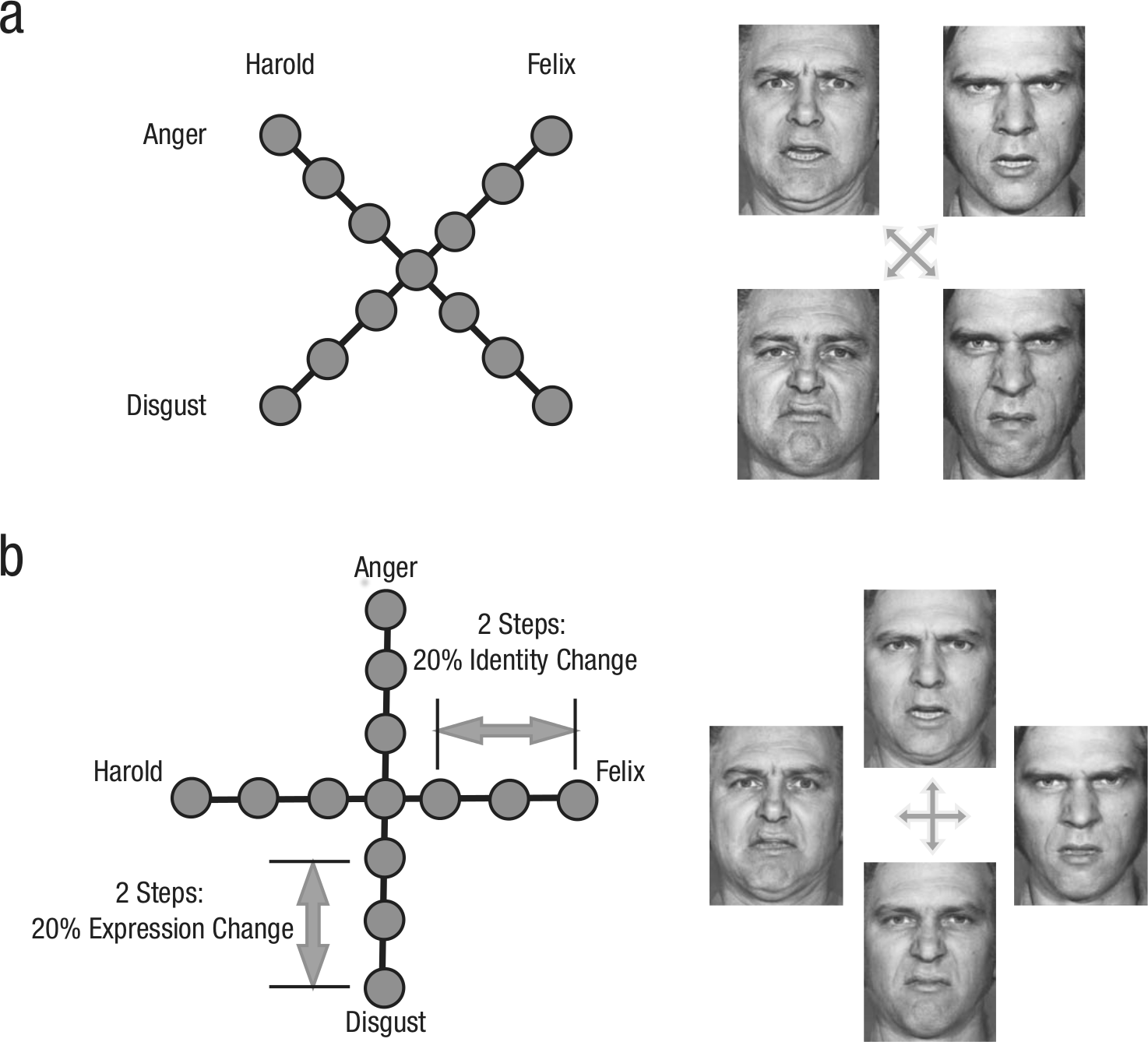
Schematic illustrations of the cross-morph continua (left) and example end points of each continuum (right) used in (a) Experiment 1 and (b) Experiment 2. In Experiment 1, the stimuli in each cross-morph continuum morphed simultaneously between two facial expressions (e.g., anger and disgust) and two facial identities (e.g., “Harold” and “Felix”). In Experiment 2, the stimuli in each cross-morph continuum morphed between either two facial expressions or two facial identities while the other dimension was held constant. In both experiments, the seven stimuli in each continuum varied in intensity between 20% and 80% of each attribute in 10% increments.
The experimental program was written in MATLAB (The MathWorks, Natick, MA) with the Psychophysics Toolbox (Brainard, 1997; Pelli, 1997). Trials began with a fixation cross (1,500 ms) and then presented a stimulus drawn from one of the cross-morph sets (800 ms). Stimuli were presented for 800 ms until replaced by a prompt to attribute either its expression (e.g., “Disgust or Anger?”) or its identity (e.g., “Harold or Felix?”). The use of cross-morph stimuli meant that the same stimulus images could be used to model the psychometric functions for identity and expression attribution. Because the same stimuli were used for both attributions and because attribution type was interleaved within each block, participants were unaware whether they would be required to attribute emotion or identity during stimulus presentation. Participants therefore needed to attend to sources of identity and expression variance at all times, as is typical when faces are encountered outside the laboratory.
Testing for Experiment 1 consisted of two sessions, one for each cross-morph set. Session order was fully counterbalanced. Sessions comprised 10 blocks of 28 experimental trials each. The 14 cross-morph stimuli were presented twice within each block, which elicited each attribution once. Sessions began with an introductory screen showing the two emotions of the two individuals at 80% intensity. These four images were clearly labeled for expression and identity. Thereafter, participants completed 8 practice trials without feedback. During short breaks between blocks, the introductory screen showing the labeled expressions and identities was presented again. Each cross-morph session lasted approximately 25 min.
Results and discussion
The attribution data from Experiment 1 were modeled by fitting cumulative Gaussian functions to estimate psychometric functions. Function fitting was completed in MATLAB using the Palamedes toolbox (Prins & Kingdom, 2009). Separate functions for each expression and identity dimension were modeled for each participant. Two parameters were estimated: The point of subjective equivalence (PSE) and attribution threshold (Fig. 2a). The PSE is a measure of bias and describes the point on the identity or expression dimension at which participants are equally likely to make either attribution. The attribution threshold is an index of attribution precision and was inferred from the standard deviation of the Gaussian distribution that best fit the data; lower thresholds indicate better performance.
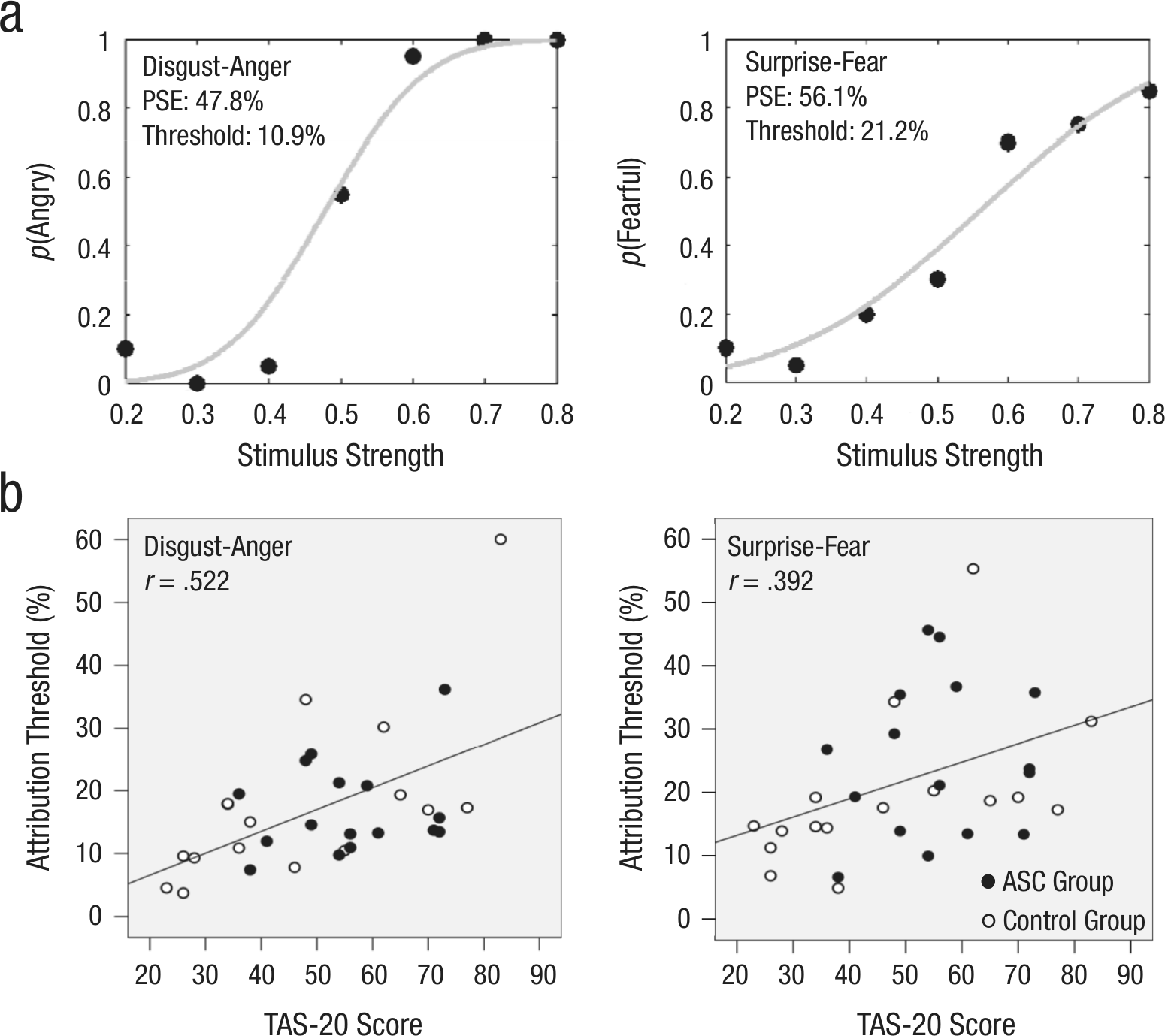
Results for the disgust-anger continua (left) and surprise-fear continua (right) from Experiment 1. The graphs (a) show the probability that participants would judge the stimulus as angry (left) or fearful (right) as a function of stimulus strength. The attribution threshold indicates the standard deviation of the Gaussian distribution that best modeled participants’ responses. The wider the Gaussian distribution, the less precise participants’ attributions; lower thresholds therefore indicate better performance. The scatter plots (b; with best-fitting regression lines) show attribution thresholds for participants in the autism-spectrum-condition (ASC) and control groups as a function of their score on the Toronto Alexithymia Scale (TAS-20; Bagby, Taylor, & Parker, 1994). A greater score on the TAS-20 indicates more severe alexithymia. PSE = point of subjective equivalence.
Consistent with the alexithymia hypothesis, group analyses revealed no differences between the ASC group and the alexithymia-matched control group on any measure of identity or expression attribution (Table 1). To confirm whether the absence of group effects was due to the equivalent levels of alexithymia in the two groups, we undertook more detailed analyses of the individual differences. AQ score was used as a measure of autism severity, as data were available for all participants. Its use was validated by the high correlation between the presence of a clinical diagnosis and AQ score (r = .650, p < .001). Simple correlations (Fig. 2b) revealed that alexithymia was significantly correlated with the precision of participants’ attributions of disgust-anger (r = .522, p < .01) and surprise-fear (r = .392, p < .05). Autism, however, was not significantly correlated with attribution precision for disgust-anger (r = .296, p > .10) or surprise-fear (r = .097, p > .50). Neither alexithymia nor autism was correlated with any measure of bias or identity-attribution precision (see Table S2 in the Supplemental Material).
Mean Scores and Tests of Group Differences in Experiments 1 and 2
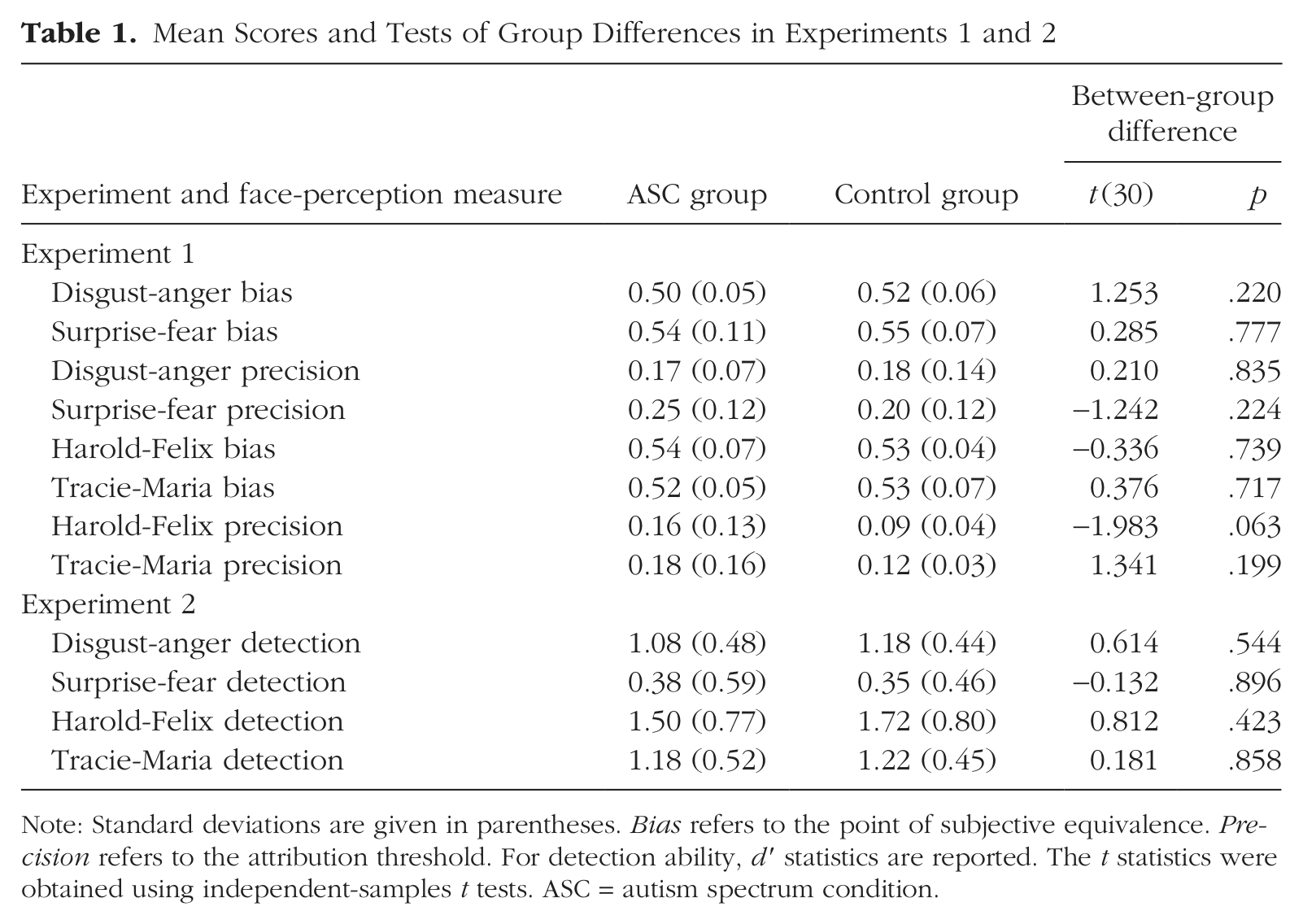
Note: Standard deviations are given in parentheses. Bias refers to the point of subjective equivalence. Precision refers to the attribution threshold. For detection ability, d′ statistics are reported. The t statistics were obtained using independent-samples t tests. ASC = autism spectrum condition.
Despite the significant simple correlation between alexithymia and expression attribution, it is possible that this relationship is not robust once the effects of IQ, gender, and age are considered (Harms et al., 2010). Moreover, it is possible that autism accounts for a significant proportion of unique variance once these demographic factors and alexithymia are taken into account. To consider these possibilities, we performed additional hierarchical regression analyses.
The regressions of principal interest model the variance in disgust-anger and surprise-fear attribution precision (Table 2). Demographic variables (gender, age and IQ) were entered in the first step of each model, and alexithymia and autism were entered in the second and third steps, respectively. When added to the demographic variables (Step 2), alexithymia was a significant predictor of both disgust-anger precision, β = 0.548, t(31) = 3.27, p < .01, and surprise-fear precision, β = 0.363, t(31) = 2.07, p < .05. The addition of alexithymia scores significantly improved the fit of both models, increasing the variance accounted for by 26.7% in the disgust-anger model, F(1, 27) = 10.68, p < .01, and 11.7% in the surprise-fear model, F(1, 27) = 4.28, p < .05. In contrast, adding autism (Step 3) led to nonsignificant changes in the amount of variance accounted for: 0.8% and 5.1% in the disgust-anger and surprise-fear models, respectively.
Results of the Hierarchical Regressions Used in Experiment 1 to Model Disgust-Anger and Surprise-Fear Attribution Precision

Note: Standardized coefficients are shown. For the model predicting disgust-anger precision, in Step 1, R2 = 5.7%; in Step 2, R2 = 32.4% and ΔR2 = 26.7% (p < .01); and in Step 3, R2 = 33.2% and ΔR2 = 0.8%. For the model predicting surprise-fear precision, in Step 1, R2 = 14.1%; in Step 2, R2 = 25.9% and ΔR2 = 11.7% (p < .05); and in Step 3, R2 = 30.9% and ΔR2 = 5.1%.
p < .05. **p < .001.
These analyses suggest that autism accounts for very little variance in expression-attribution precision once alexithymia has been accounted for. However, our autism measure (AQ) and our alexithymia measure (TAS-20) were correlated (r = .640, p < .001). Consequently, when entered into a multiple regression simultaneously, autism may not be a significant predictor because of multicollinearity. We therefore ran two further hierarchical regressions, again modeling disgust-anger and surprise-fear attribution precision, but now entering autism in Step 2 and alexithymia in Step 3. When added to the demographic predictors (Step 2), autism failed to significantly improve either model, accounting for only an additional 7.0% and 0.2% of the variance in disgust-anger and surprise-fear precision, respectively. Despite the correlation with autism, alexithymia was again a significant predictor of both disgust-anger precision, β = 0.624, t(31) = 2.82, p < .01, and surprise-fear precision, β = 0.562, t(31) = 2.50, p < .025, when added in Step 3. Adding alexithymia led to significant increases in the variance accounted for: 20.5% in the disgust-anger model, F(1, 26) = 7.96, p < .01, and in the surprise-fear model, 16.6%, F(1, 26) = 6.24, p < .025.
Together, the results of these analyses strongly argue that alexithymia, and not autism, is associated with impaired expression recognition. Autism did not correlate with attribution precision and failed to account for significant variance in the regression analyses. In contrast, alexithymia correlated with expression-attribution precision and remained a highly significant predictor after the influence of demographic variables and autism had been accounted for. Tellingly, this pattern was replicated across both the disgust-anger and surprise-fear tasks, despite the differing emphasis on eye and mouth variation. However, although it is clear that individuals with high levels of alexithymia have difficulties attributing facial emotion, neither Experiment 1 nor previous studies of expression recognition in alexithymia have revealed whether this reflects a problem interpreting an intact sensory description or whether individuals are less able to detect subtle differences between facial expressions. We addressed this possibility in our second experiment.
Experiment 2
In Experiment 2, we sought to determine whether autism or alexithymia were correlated with participants’ ability to detect physical differences present in morphed facial stimuli. Participants completed a sequential matching task so we could estimate their ability to detect the presence of a 20% difference in either identity or expression intensity. Unlike the attribution task employed in Experiment 1, matching tasks do not require participants to label a percept but simply to decide whether two stimuli are identical. If alexithymia is correlated with detection of expression variation, it would argue against an account positing higher-level percept interpretation.
Method
Participants
The 32 participants who completed Experiment 1 also completed Experiment 2. The order in which participants completed the experiments was fully counterbalanced.
Stimuli and procedure
The stimuli used in Experiment 1 morphed simultaneously between different identities and different expressions; therefore, participants could distinguish adjacent stimuli based on variation in either the expression or identity dimensions. To derive separate estimates of ability to detect identity and expression differences, it was necessary to morph expression and identity independently (Fig. 1b). Four novel continua were derived from the same face images as those morphed in Experiment 1. Each continuum comprised seven stimuli morphing between 20% and 80% intensities in equidistant intervals of 10% (Fig. S2 in the Supplemental Material). In the disgust-anger and surprise-fear continua, the face identity was held constant; in the Harold-Felix and Tracie-Maria continua, the facial expression was held constant.
Experimental trials began with a 1,000-ms fixation cross. Two stimuli drawn from one of the identity or expression continua were then presented sequentially for 800 ms each. During an 800-ms interstimulus interval, a mask was displayed; this mask was constructed by phase-scrambling one of the morph stimuli. Experiment 2 comprised 200 trials divided equally into 5 blocks. On 50% of trials, the first and second stimuli were identical. On the remaining 50%, the stimuli were two steps apart on the morph continua, representing an interstimulus-intensity difference of 20%. Participants judged whether or not the two stimuli were the same or different and made key-press responses accordingly. Participants took short breaks between blocks to prevent fatigue. Before commencing the experiment, participants completed 8 practice trials.
Results and discussion
The data were analyzed by calculating separate d′ statistics (Macmillan & Creelman, 1991) to estimate detection ability on each of the four continua: disgust-anger (M = 1.13, SD = 0.45), surprise-fear (M = 0.36, SD = 0.52), Harold-Felix (M = 1.61, SD = 0.78), and Tracie-Maria (M = 1.20, SD = 0.48). One-sample t tests confirmed that both groups could detect a morph difference of 20% on all dimensions (all ps < .025). However, consistent with the alexithymia hypothesis, results showed no significant differences in detection ability between the ASC and alexithymia-matched control groups (Table 1).
As in Experiment 1, correlational and regression analyses were undertaken to complement the group analyses. Simple correlations revealed no relationships between either autism or alexithymia and the two expression-detection measures. Ability to detect disgust-anger variation was significantly correlated with IQ (r = .383, p < .05). Alexithymia was also significantly correlated with detection of the variation in the Harold-Felix identity (r =
The same hierarchical regression analyses used to model expression-attribution precision in Experiment 1 were used to model the four detection measures calculated in Experiment 2 (see Table S3 in the Supplemental Material). IQ continued to significantly predict detection of disgust-anger variation when entered with gender and age in Step 1, β = 0.389, t(31) = 2.29, p < .05, but this fell below significance when alexithymia was added to the regression model. Neither alexithymia nor autism was a significant predictor of any of the four measures when the variance accounted for by the demographic variables was taken into account, irrespective of the order in which they were entered into the regression.
Neither alexithymia nor ASC significantly predicted participants’ ability to detect physical differences between the morphed facial expressions or identities. These findings suggest that the association between alexithymia and imprecise attribution of expressions observed in Experiment 1 is unlikely to reflect inability to detect physical differences between stimuli. Rather, it appears that severe alexithymia may impair participants’ ability to interpret the emotional content of an intact sensory description.
General Discussion
In the present study, we evaluated the relative contributions of autism and alexithymia to the recognition of facial identity and emotional expressions. Experiment 1 showed that an ASC and an alexithymia-matched control group showed equivalent ability to recognize emotional expressions and identity. Regression analyses revealed that alexithymia, and not autism, predicted expression-attribution precision. In Experiment 2, we sought to determine whether the influence of alexithymia on expression recognition reflects the ability to detect differences between morphed facial stimuli. Neither alexithymia nor autism, however, predicted ability to detect identity or expression variation after accounting for effects of IQ, gender, and age. This second finding suggests that individuals with high levels of alexithymia are able to form an intact sensory description but thereafter have difficulties interpreting its emotional content. This impairment does not reflect systematic attribution biases for particular emotions; such a tendency would have resulted in correlations between alexithymia severity and PSE estimates. Rather, alexithymia predicts imprecise but unbiased attributions of emotion.
These results represent a significant step toward disambiguating the inconsistent literature on expression recognition in autism. When expression-recognition deficits have been reported previously (e.g., Ashwin et al., 2006; Humphreys et al., 2007), group differences may reflect greater proportions of severely alexithymic individuals in ASC samples than in non-ASC samples. Because of the higher incidence of alexithymia in the ASC population, ASC samples are likely to contain higher levels of alexithymia than control samples unless steps are taken to ensure matching. It is of particular interest that, when reported, expression-recognition deficits in individuals with ASC are often restricted to negative emotions (Harms et al., 2010), a similar pattern to that seen in individuals with alexithymia. Those studies that found no evidence of impaired expression recognition (e.g., Adolphs et al., 2001; Castelli, 2005) may have used control samples matched, either explicitly or inadvertently, for alexithymia. This conclusion parallels findings with empathic brain activity (Bird et al., 2010) and gaze fixations to emotional social stimuli (Bird et al., 2011). In both cases, alexithymia was found to be a better predictor than the presence or severity of autism. These findings, together with the present results, suggest that the characterization of autism as a disorder with emotional symptoms (e.g., American Psychiatric Association, 1994) may be inappropriate, which would necessitate the development of novel diagnostic criteria for ASCs that do not include emotional impairment.
That alexithymic individuals show atypical patterns of fixations when viewing faces (Bird et al., 2011) may be cited as a potential cause of imprecise expression attribution. However, under this interpretation, it is hard to explain why alexithymia does not also predict impaired identity recognition. Instead, we propose the reverse pattern of causality: Underlying problems interpreting the emotional expressions of other people may give rise to atypical patterns of social-gaze fixations. It is widely thought that those systems responsible for the experience of particular emotions contribute to the recognition of the corresponding emotions in other people (Adolphs, Tranel, Damasio, & Damasio, 1994; Calder, Lawrence, & Young, 2001; Calder & Young, 2005). A population with atypical development of (or connectivity with) limbic structures (e.g. amygdala, insula) might therefore be expected to have difficulties interpreting both their own emotions and those of other people.
It is interesting to note that we found no relationship between the ability to discriminate or attribute identity and the presence of autism. Moreover, neither identity attribution (Experiment 1) nor identity detection (Experiment 2) was predicted by alexithymia once the effects of IQ, gender, and age were accounted for. These findings are consistent with a recent review, which concluded that identity deficits are most likely to be seen in ASC groups when face stimuli remain unfamiliar and experimental paradigms place a demand on short-term perceptual memory for faces (Weigelt et al., 2012). Both of our paradigms repeatedly presented stimuli derived from the same four individuals and therefore gave participants opportunity to learn these identities. Moreover, the use of a single-stimulus procedure in Experiment 1 minimized the perceptual memory load. It remains to be seen whether the alexithymia hypothesis proves useful in understanding apparent face-memory deficits in autism (e.g., Boucher & Lewis, 1992).
Having employed rigorous psychophysical methods, we found that participants’ degree of alexithymia, and not autism, was predictive of expression-attribution precision. These results go a long way toward disambiguating the equivocal literature on expression recognition in autism. Specifically, expression-recognition deficits in ASC samples may be seen only when ASC and control groups are not matched for alexithymia. Our results suggest that matching ASC and control groups for alexithymia should be adopted as routine practice by researchers studying emotional processing in autism. The present findings also reaffirm the clinical and theoretical significance of alexithymia. These results add to the growing literature suggesting that a higher incidence of alexithymia within the population of individuals with autism, rather than autism per se, may be responsible for the emotional impairments currently considered a feature of autism. Developing a more sophisticated understanding of this intriguing condition should be a priority for cognitive scientists.
Footnotes
Acknowledgements
R. C. and R. B. contributed equally to the work reported in this article.
Declaration of Conflicting Interests
The authors declared that they had no conflicts of interest with respect to their authorship or the publication of this article.

References
Supplementary Material
Please find the following supplemental material available below.
For Open Access articles published under a Creative Commons License, all supplemental material carries the same license as the article it is associated with.
For non-Open Access articles published, all supplemental material carries a non-exclusive license, and permission requests for re-use of supplemental material or any part of supplemental material shall be sent directly to the copyright owner as specified in the copyright notice associated with the article.
