



Abstract
The experience of meaning is often conceptualized as involving reliable pattern or coherence. However, research has not addressed whether exposure to pattern or coherence influences the phenomenological experience of meaning in life. Four studies tested the prediction that exposure to objective coherence (vs. incoherence) would lead to higher reports of meaning in life. In Studies 1 and 2 (combined N = 214), adults rated photographs of trees presented in patterns (organized around their seasonal content) or randomly. Participants in the pattern conditions reported higher meaning in life than those in the random conditions. Studies 3 and 4 (combined N = 229) yielded similar results when participants read coherent, as opposed to incoherent, linguistic triads. The manipulations did not influence explicit or implicit affect. Implications for understanding the human experience of meaning, the processes that support that experience, and its potential role in adaptation are discussed.
Keywords
People who rate their lives as highly meaningful are better off in many ways, compared with those who rate their lives as less meaningful. Greater self-reported meaning in life (MIL) is associated with higher quality of life (Krause, 2007), better self-reported health (Steger, Mann, Michels, & Cooper, 2009), better occupational adjustment (Littman-Ovadia & Steger, 2010), better adaptive coping (Thompson, Coker, Krause, & Henry, 2003), lower incidence of psychological disorders (Mascaro & Rosen, 2005; Owens, Steger, Whitesell, & Herrera, 2009; Steger & Kashdan, 2009) and suicidal ideation (Heisel & Flett, 2004), slower age-related cognitive decline (Boyle, Buchman, Barnes, & Bennett, 2010), and decreased mortality (Boyle, Barnes, Buchman, & Bennett, 2009; Krause, 2009). Given the breadth of the associations between self-reports of MIL and positive outcomes, illuminating the processes that inform these reports and understanding why MIL is potentially adaptive are important scientific goals.
Questionnaires measuring MIL generally contain items that include variations on the word meaning, such as “My existence is very purposeful and meaningful” (from the Purpose in Life Test, Crumbaugh & Maholick, 1964). Such self-reports are clearly important, but conceptually defining what exactly people mean when they rate their lives as “meaningful” has proven difficult. Definitions of MIL typically include three themes: purpose, personal significance, and connections or coherence (e.g., Antonovsky, 1993; King, Hicks, Krull, & Del Gaiso, 2006; Leontiev, 2005). The first two themes might be viewed as primarily motivational, whereas the third is often considered more cognitive. From this cognitive perspective, a life is meaningful to the extent that it “makes sense” to the person living it (Baumeister & Vohs, 2002).
The present studies focus on this cognitive aspect of MIL—the notion that life may be experienced as meaningful when it contains connections, reliable associations, or coherence. This feature of MIL might explain its potential role in adaptation, as detecting reliable connections in the environment is a survival-relevant goal for all species (Geary, 2004). If the subjective feeling of meaningfulness tracks reliable patterns in the environment, that feeling would connect the person to the environment in an important way.
The idea that the experience of meaning might result from features of the environment differs from typical characterizations of the construct. More commonly, meaning is defined as a constructive process, and human beings are described as natural meaning makers (e.g., Heine, Proulx, & Vohs, 2006). Coherence and reliable pattern can be constructed (Park, 2010), but these are also characteristics of the world (King, 2012). The very existence of associative learning suggests that all creatures share the capacity to detect reliable associations in the environment. In humans, meaningfulness may emerge as an experience reflecting such detection in the absence of constructive processes. We propose that the feeling of meaning (Hicks, Cicero, Trent, Burton, & King, 2010) is likely to emerge when reliable patterns exist in environmental stimuli and that at least part of the adaptive nature of MIL may be found in its capacity to track the existence of such patterns.
Do self-reports of MIL reflect experiences with reliable pattern or coherence? Research has never addressed this question. The present studies fill this gap by demonstrating the effects of stimulus coherence on self-reports of MIL. The experience of meaning has been explored in two different ways. The first tradition is represented in the studies cited in the opening paragraph, which examined MIL as a predictor of various outcomes and suggest that MIL is an adaptive experience. Also within this tradition is experimental research examining the influence of situational factors on reports of MIL. For instance, social exclusion leads to lower ratings of the meaningfulness of one’s existence (Williams & Nida, 2011), and induced positive affect leads to increased MIL (e.g., King et al., 2006). This work has demonstrated that MIL can be influenced by experimental manipulations.
A second approach, grounded in the meaning-maintenance model (MMM; Heine et al., 2006), focuses not on subjective ratings but on how violations of expectancies influence meaning-relevant behaviors. MMM studies show that expectancy violations lead to compensatory attempts to reinstate meaning (e.g., by setting higher bail for a hypothetical prostitute or by detecting patterns in an artificial grammar; Proulx & Heine, 2008; Randles, Proulx, & Heine, 2011). These findings are interpreted as indicating that exposure to nonsensical stimuli is threatening and motivates the reinstatement of meaning. MMM studies have not included measures of MIL. Further, the outcomes used in MMM studies, though putatively related to meaning, have not accrued the nomological network of associations that characterize self-report ratings of MIL. Thus, whether experimental manipulations of coherence influence self-reports of MIL remains unknown.
We present four studies that tested the effects of encountering patterned (vs. random) stimuli (Studies 1 and 2) or stimuli possessing an underlying coherence (vs. no coherence; Studies 3 and 4) on self-reports of MIL. We did not expect the manipulations to influence mood. Nevertheless, to establish that the effect of condition was independent of mood, we included explicit measures of positive affect in all the studies. To address the possibility that exposure to random or incoherent stimuli might engender threat, we included negative-affect items specifically targeting anxiety and threat in Studies 1, 2, and 4. Implicit affect was measured in Studies 1 and 2. We predicted that MIL would be higher following an encounter with coherent, rather than incoherent, stimuli.
Study 1
To begin this investigation, we chose a natural pattern, the four seasons. We searched online for photographs depicting at least one tree, indications of the season (e.g., blossoms, greenery, fall color, snow), and no people, roads, paths, fences, or buildings. The 16 photos we selected included 4 for each season. They were shown sequentially to 77 Amazon Mechanical Turk (MTurk) participants, who were paid $1 (35 men, 42 women; mean age = 36.47 years). To ensure that participants looked at the pictures, we asked them to rate the contrast in each photo from 1 (low) to 7 (high) and to select the predominant color in each photo from an array. Time spent on each photo was recorded (M = 14.59 s, SD = 7.21). All participants rated the same photographs, but the order of presentation varied: In the seasonal-pattern condition, photographs were presented in one of eight orders conforming to four cycles of the progression of the seasons—spring, summer, autumn, winter. In the random condition, photographs were presented in one of eight noncyclical random orders.
Participants then completed measures of MIL and affect in counterbalanced order. MIL research has employed many different questionnaires with various idiosyncrasies, though all include items using the words meaning and purpose (Heintzelman & King, 2012). To focus on this shared feature, we selected five items from established MIL measures: “My life has a clear sense of purpose” (from the Presence of Meaning subscale of the Meaning in Life Questionnaire, or MLQ; Steger, Frazier, Oishi, & Kaler, 2006); “I have found a really significant meaning in my life” and “I have a sense of direction and purpose in life” (from Krause, 2004); and “My existence is very purposeful and meaningful” and “As I view the world in relation to my life, the world fits meaningfully with my life” (from Crumbaugh & Maholick, 1964). Items were rated on a scale from 1 (not at all) to 7 (extremely much). 1 Participants also rated their current mood, using the same scale to indicate the extent to which three positive descriptors (happy, cheerful, pleased; explicit positive affect, or EPA) and two negative descriptors (anxious, worried; explicit negative affect, or ENA) characterized how they were feeling at that time.
For our measure of implicit affect, participants used a scale from 1 to 7 to rate artificial words (e.g., “TALEP”; after Quirin, Kazén, & Kuhl, 2009) on how much each expressed three positive (happy, cheerful, pleased) and three negative (sad, worried, upset) moods. Though participants rated five words, composite scores were unreliable (αs
Table 1 presents reliabilities, descriptive statistics, and results for between-conditions comparisons. MIL was significantly higher in the seasonal-pattern condition than in the random condition. As expected, the manipulation did not affect mood. This null prediction was tested using Bayes factors. The Jeffrey-Zellner-Siow prior (JZS) Bayes factor for the largest nonsignificant difference (ENA) indicated the null to be 5.33 times as likely as the alternative (Rouder, Speckman, Sun, Morey, & Iverson, 2009). In a regression equation controlling for time spent on each photo (β = −0.00, n.s.), EPA (β = 0.31, p = .007), ENA (β = −0.15, n.s.), IPA (β = −0.07, n.s.), and INA (β = −0.25, p = .023), condition (coded 0 = random, 1 = seasonal) predicted MIL, β = 0.21, p = .049.
Results of Study 1
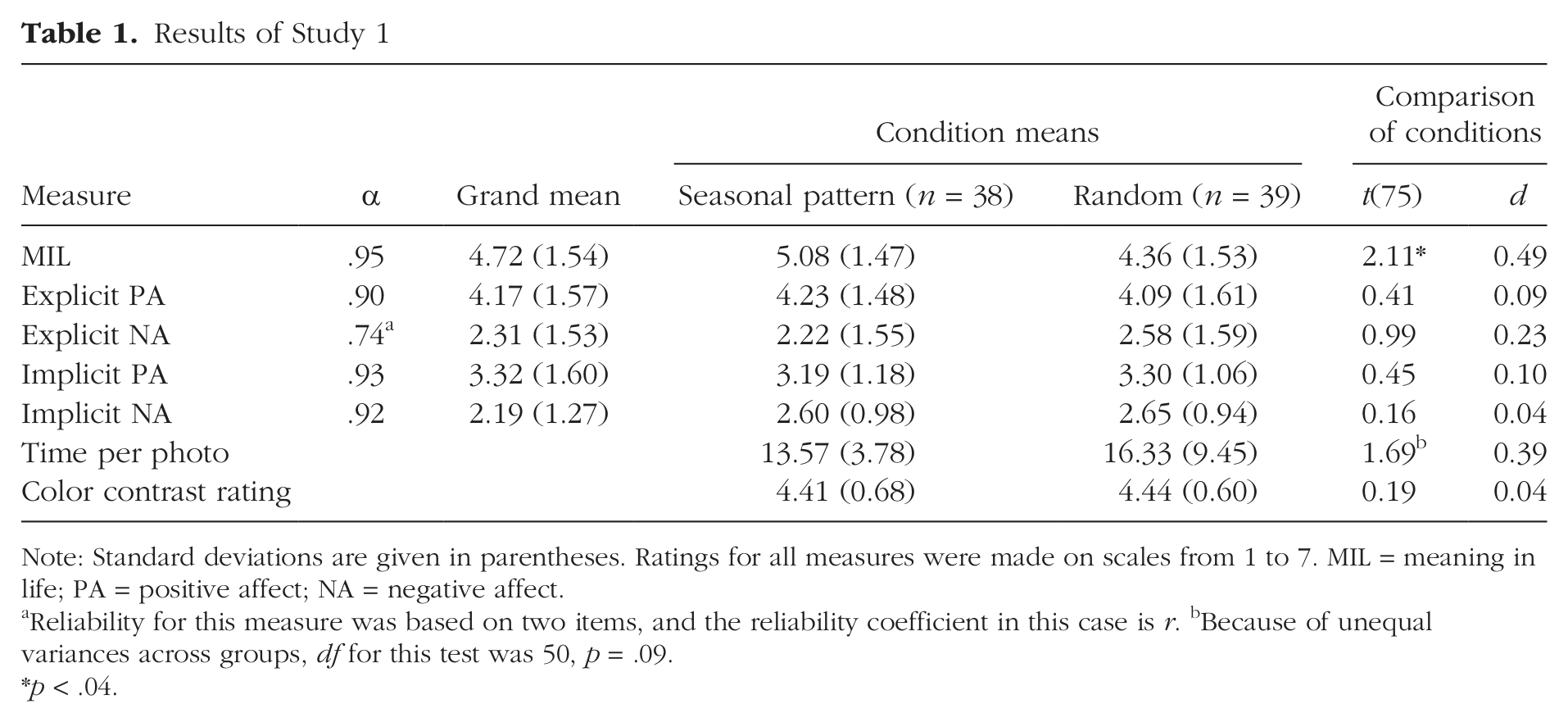
Note: Standard deviations are given in parentheses. Ratings for all measures were made on scales from 1 to 7. MIL = meaning in life; PA = positive affect; NA = negative affect.
Reliability for this measure was based on two items, and the reliability coefficient in this case is r. bBecause of unequal variances across groups, df for this test was 50, p = .09.
p < .04.
An ambiguity in Study 1 is whether the difference in MIL was due to the existence of pattern in the stimuli or to the familiarity of the pattern. To address this issue, in Study 2 we added a condition in which participants evaluated the stimuli presented in a novel pattern. We predicted that MIL would be higher in the two patterned conditions relative to the random condition.
Study 2
One hundred thirty-seven MTurk participants, who were paid $1 (61 men, 76 women; mean age = 30.83 years), were randomly assigned to evaluate the Study 1 photos in one of three conditions: seasonal pattern, random, or arbitrary pattern. In the arbitrary-pattern condition, the photos were presented in four cycles of one of eight arbitrary patterns, none of which conformed to seasonal change (e.g., autumn, summer, spring, winter). Mean time spent on each photograph was recorded (M = 14.11 s, SD = 6.30). Participants then completed the measures from Study 1. As Table 2 shows, MIL was higher in the two pattern conditions relative to the random condition. As expected, no other variables differed by condition. The JZS Bayes factor for the largest nonsignificant difference (IPA) indicated that the null was 6.31 times as likely as the alternative.
Results of Study 2
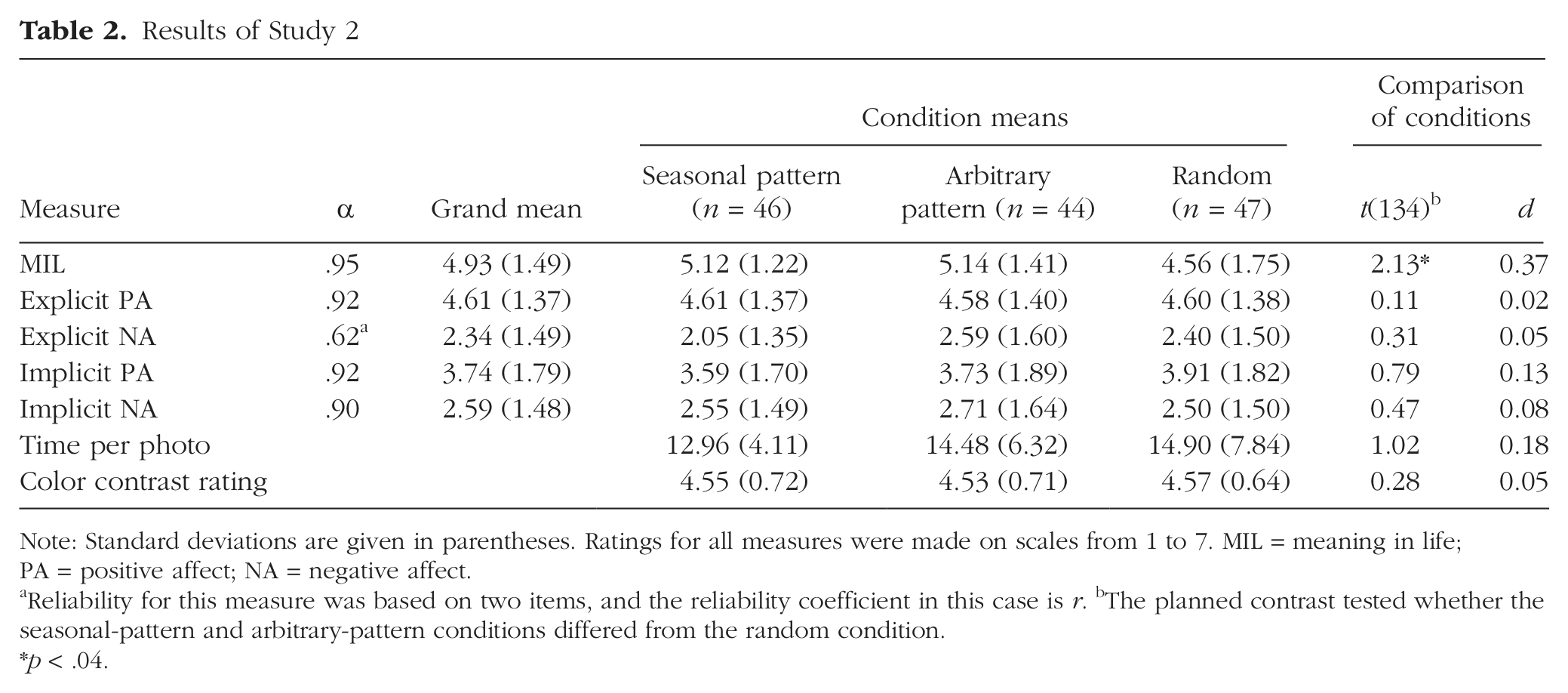
Note: Standard deviations are given in parentheses. Ratings for all measures were made on scales from 1 to 7. MIL = meaning in life; PA = positive affect; NA = negative affect.
Reliability for this measure was based on two items, and the reliability coefficient in this case is r. bThe planned contrast tested whether the seasonal-pattern and arbitrary-pattern conditions differed from the random condition.
p < .04.
To summarize results, we created two dummy codes representing the seasonal-pattern condition (coded 1; others = 0) and the arbitrary-pattern condition (coded 1; others = 0), leaving the random condition as the baseline. In a regression equation controlling for time spent on each photo (β = −0.04, n.s.), EPA (β = 0.54, p = .000), ENA (β = −0.07, n.s.), IPA (β = 0.01, n.s.), and INA (β = 0.03, n.s.), both pattern conditions (seasonal pattern: β = 0.17, p = .04; arbitrary pattern: β = 0.19, p = .02) independently predicted MIL.
Discussion of Studies 1 and 2
The results of Studies 1 and 2 support the prediction that MIL tracks the patterned nature of environmental stimuli. Systematic patterns, even when encountered incidentally, led to higher MIL than randomness. Two issues warrant consideration. First, both the seasonal and the arbitrary patterns were structured around characteristics of the natural world. Encounters with nature can be existentially complex, promoting psychological well-being but also uncertainty (Koole & Van den Berg, 2005). Responses to nature likely depend on which aspect of nature (beauty vs. chaos) is most salient (Koole & Van den Berg, 2005). Participants who viewed ordered images of nature may have experienced more beauty and well-being, relative to participants in the random conditions. For this reason, it was important to conceptually replicate the effects using stimuli that do not depict nature.
Second, the patterns were potentially obvious as participants completed the task. Were the patterns noticed? At the end of Study 2, participants were asked if they had noticed anything about the photos that they would like to mention. Of the 36 participants who commented on the photos, none mentioned the pattern in the order of presentation. 2 Still, participants may have noticed the pattern but not commented on it.
Would MIL be influenced by coherence that is unrelated to the natural world and that is not obvious? To answer this question, in Studies 3 and 4 we used stimuli that possess an underlying coherence that is not easily discernible: semantic triads (i.e., Remote Associates Test items; Mednick & Mednick, 1967). These triads, which represent overlearned semantic associations (Kahneman & Klein, 2009), consist of three words that are all associated with the same fourth word. Somewhat surprisingly, when guessing rapidly, people are able to discriminate coherent triads (those that share a common associate) from incoherent triads (those that have no common associate; Topolinski & Strack, 2009), even without being able to identify the common associate. Thus, the coherence that characterizes these stimuli is recognizable, though potentially subconsciously so (Bolte, Goschke, & Kuhl, 2003).
In Studies 3 and 4, participants simply read either coherent or incoherent word triads and rated MIL and affect. We predicted that MIL would be higher in the coherent than in the incoherent conditions.
Study 3
Sixty undergraduates (44 men, 16 women) came to our lab and were told that we wanted to find out how long it takes people to read word lists. Participants read words presented on a computer screen, quietly to themselves, pressing the space bar after each triad. They were randomly assigned to read 10 coherent triads (e.g., “falling, actor, dust”; common associate: star) or 10 incoherent triads (e.g., “belt, deal, nose”; n = 30 in each condition). Triads were pulled randomly from a previous study using these stimuli (Hicks et al., 2010). Participants then completed the MLQ Presence of Meaning subscale (α = .89; M = 5.10, SD = 1.17) and rated their current positive affect, as in Study 1 (α = .86; M = 4.54, SD = 1.09).
As predicted, participants in the coherent condition rated their lives as significantly more meaningful (M = 5.40, SD = 0.89) than those in the incoherent condition (M = 4.81, SD = 1.32), t(58) = 2.02, p = .049, d = 0.54. Neither reading time, t(58) = 0.66, p = .52, nor EPA, t(58) = 0.31, p = .76, differed between conditions. The JZS Bayes factor for EPA was 4.92. Regressing MIL on reading time (β = 0.33, p = .006), EPA (β = 0.29, p = .033), and condition (coded 0 = incoherent, 1 = coherent) showed that condition independently predicted MIL, β = 0.27, p = .02.
Study 3 supports our prediction, but aspects of the study render the results ambiguous. Most notably, the words in the triads differed between the conditions. Furthermore, because reading times were left to the participants’ discretion, it is not clear whether longer reading times (associated with higher MIL) might have reflected actively trying to make sense of the triads. Though participants were not told that the words had any underlying structure, they may have spontaneously tried to make sense of the words. Finally, Study 3 measured positive affect but not negative affect. Study 4 addressed these issues.
The most important difference between Studies 3 and 4 is that in Study 4, participants in the two conditions read the same words. Words were arranged as coherent triads (e.g., “magic, plush, floor”; common associate: carpet) in the coherent condition, and the same words were rearranged to create incoherent triads (e.g., “magic, actor, spoon”) in the incoherent condition. Thus, the stimuli were identical except in their pattern of presentation, as in Studies 1 and 2. Additionally, we held reading times constant and included a measure of negative affect. We predicted that reading coherent triads would lead to higher MIL than reading the same words presented in incoherent triads.
Study 4
One hundred sixty-nine MTurk participants, who were paid $1 (79 men, 83 women, 7 unknown; mean age = 30.39 years), read 10 triads. The 30 words were arranged as coherent triads in the coherent condition and were scrambled to create incoherent triads in the incoherent condition. Each triad remained on the screen for 4 s before the screen automatically advanced. 3 Participants then completed measures of explicit affect and MIL, as in Studies 1 and 2. Table 3 presents the results. As in Study 3, participants in the coherent condition reported higher MIL than those in the incoherent condition. EPA and ENA did not differ significantly between the two conditions. The JZS Bayes factor for EPA was 2.70. In a regression equation controlling for EPA (β = 0.62, p = .001) and ENA (β = 0.01, n.s.), condition (coded 0 = incoherent, 1 = coherent) predicted MIL, β = 0.14, p = .019.
Results of Study 4
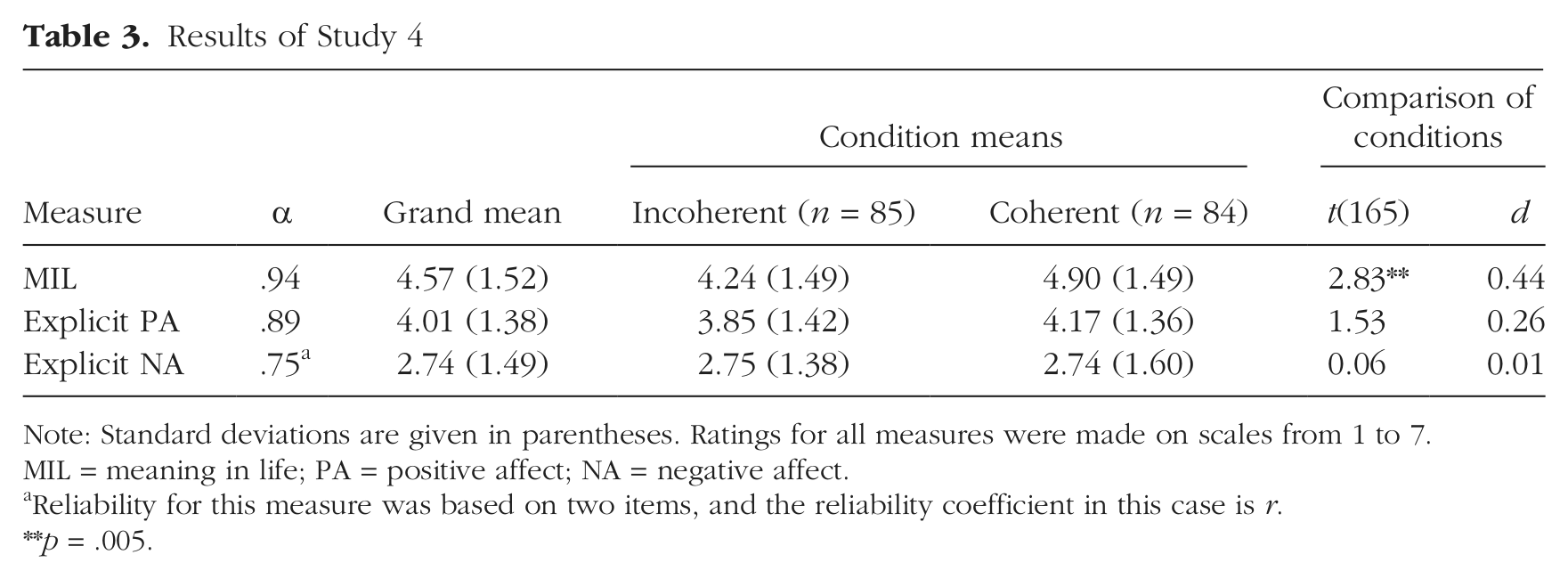
Note: Standard deviations are given in parentheses. Ratings for all measures were made on scales from 1 to 7. MIL = meaning in life; PA = positive affect; NA = negative affect.
Reliability for this measure was based on two items, and the reliability coefficient in this case is r.
p = .005.
Discussion of Studies 3 and 4
Studies 3 and 4 support the prediction that MIL tracks the objective coherence of environmental stimuli: Simply reading coherent word triads led to higher MIL than reading the very same words lacking that coherence. Taken together with Studies 1 and 2, Studies 3 and 4 provide strong support for the role of the objective coherence of stimuli in subjective judgments of life’s meaning.
Notably, Study 4 is similar to MMM studies involving subliminal presentation of incongruous word pairs (e.g., “turn-frogs”) as a “meaning threat” (Randles et al., 2011). In those studies, individuals primed with incongruous, rather than congruous, word pairs showed enhanced performance on an artificial-grammar task and set higher bails for a prostitute, presumably as compensation for that threat. In Study 4, MIL was lower in the incoherent than in the coherent condition, and these results jibe with the MMM, which would similarly predict that meaning would be threatened, or reduced, by experiences of incoherence. It is potentially interesting, however, that individuals in the incoherent condition did not engage in fluid compensation (i.e., by claiming higher levels of MIL).
General Discussion
Although the human experience of MIL is often described as reflecting the existence of reliable relationships, this aspect of MIL has not been addressed empirically. These studies support the prediction that the feeling that life is meaningful is sensitive to the coherence of stimuli, whether those stimuli are nature pictures or linguistic stimuli, whether they represent familiar or unfamiliar patterns, and whether the patterns are quite transparent or quite a bit less so. The observed effects are notable given that they emerged independently of affect and in light of the relative stability of general judgments of MIL (Steger et al., 2006). Exposure to pattern or coherence led to higher MIL than exposure to randomness or incoherence.
Certainly, the studies reported here do not call into question the relevance of motivational variables to existential meaning. Many such variables (e.g., religious faith, social connections, the self) can serve as enduring sources of MIL. We do not claim that the cognitive aspect of MIL captured in these studies fully encompasses this rich experience. It is easy to imagine that certain individuals (e.g., prisoners) experience very high levels of regularity but struggle to attain a sense of MIL. Motivational aspects of MIL likely relate to the cognitive aspect but are not redundant with it.
In keeping with typical MIL assessments, many of the items we used to measure MIL concerned the experience of purpose. It is perhaps curious that manipulations of pattern and coherence (which seem most relevant to the cognitive aspect of MIL) influence ratings of purpose (a motivational aspect). We speculate that meaningfulness “feels” the same whether it emerges from environmental stimuli or goal-directed behavior. That both of these types of experiences feel meaningful may explain why psychologists have included items tapping into these different (but related) experiences in measures of MIL.
At least in reference to the cognitive aspect of MIL, these results suggest that research on associative learning and perception has potential relevance to the science of meaning. Like associative learning, perception of covariation (Turk-Browne, Scholl, Chun, & Johnson, 2008) and perception of stimulus coherence (Volz & von Cramon, 2006) occur without awareness. If MIL draws from such detection, it may involve processes that are not available to awareness, which could explain the ineffable quality of MIL. This possibility raises the issue of the role of awareness in the present studies. Although the coherence of the stimuli in Studies 3 and 4 was arguably less obvious than the patterns in Studies 1 and 2, whether participants in these studies were aware of the patterns and coherence they encountered remains unclear. Future research might directly address whether awareness of pattern and coherence is necessary for these to increase the level of reported MIL.
Two ambiguities in the present work warrant discussion. First, was MIL enhanced by coherence or reduced by randomness? Drawing on classical conditioning studies (Rescorla, 2000), we had initially conceived of the random and incoherent conditions as appropriate controls. There was no reason for any participants to expect the stimuli to possess pattern or coherence. For this reason, we might conclude that pattern or coherence enhanced MIL. An alternative control condition might involve no exposure to any stimuli at all (e.g., see note 1 for the scale mean in the absence of stimuli), but such a condition would differ in central ways from conditions involving exposure to stimuli. A potentially superior strategy would employ a within-participants design to resolve this ambiguity. Clearly, the present data cannot rule out the possibility that encountering random or incoherent stimuli reduces MIL. In either case, the present studies support the conclusion that the experience of MIL is supported by the existence of pattern and coherence.
A second issue is the potential role of processing fluency in Studies 3 and 4 (see note 3). Coherent triads are processed more easily than incoherent triads (Topolinski & Strack, 2009). Though no current theories suggest a role for processing ease in MIL, such ease has diverse effects (Alter & Oppenheimer, 2009). We have argued that it is coherence that drives the effects observed in Studies 3 and 4, but direct tests of ease of processing are required to address its potential mediating role.
As we have noted, research supports the stability of MIL over time. It might be that more enduring sources of meaning underpin this stable experience and that state feelings of meaning are more susceptible to environmental changes. The sensitivity of these feelings to the existence of coherence may help to illuminate their role in adaptation. Any characteristic that plays a role in adaptation (or self-regulation) must be responsive to changing circumstances. Thus, as is the case for other results demonstrating that experimental manipulations can influence MIL judgments, the present results might be recognized not as trivializing the experience of MIL but, quite the contrary, as highlighting its potential role in adaptive functioning. MIL ratings, at least in part, reflect the coherence that characterizes one’s world at any given moment. The potentially unique effects of the manipulations on self-reported MIL may speak to the unique function of the subjective feeling of meaning: It tells the individual when the world is making sense.
Footnotes
Acknowledgements
We thank Tamara Coker for assisting with data collection in Study 3.
Declaration of Conflicting Interests
The authors declared that they had no conflicts of interest with respect to their authorship or the publication of this article.
Funding
Preparation of this manuscript was supported by National Science Foundation Grant 1036447.