




Abstract
Over human evolutionary history, upper-body strength has been a major component of fighting ability. Evolutionary models of animal conflict predict that actors with greater fighting ability will more actively attempt to acquire or defend resources than less formidable contestants will. Here, we applied these models to political decision making about redistribution of income and wealth among modern humans. In studies conducted in Argentina, Denmark, and the United States, men with greater upper-body strength more strongly endorsed the self-beneficial position: Among men of lower socioeconomic status (SES), strength predicted increased support for redistribution; among men of higher SES, strength predicted increased opposition to redistribution. Because personal upper-body strength is irrelevant to payoffs from economic policies in modern mass democracies, the continuing role of strength suggests that modern political decision making is shaped by an evolved psychology designed for small-scale groups.
Given the ubiquitous presence of aggression among animal species, it is highly probable that human ancestors engaged in aggression for tens of millions of generations, possibly from the origin of the vertebrates. In contrast, the human transition from small-scale conflict to state politics involving millions of players took place with extraordinary abruptness, from 3 to 250 generations ago, depending on the region and its population (Hibbs & Olsson, 2004). This means that despite the technological and demographic changes associated with agriculture and the industrial revolution, any evolved decision-making system that navigates political conflicts in modern contexts must have been designed by natural selection to operate in small-scale social ecologies such as those faced by human ancestors (Petersen, 2012).
What effect would these intense, long-enduring selection pressures have had on the subset of decision-making machinery that evolved to regulate conflict? The asymmetric war of attrition (AWA) is one of the best validated models in behavioral ecology (Hammerstein & Parker, 1982; Maynard Smith & Parker, 1976), and it is supported by scores of empirical studies across all major vertebrate classes (Kelly, 2008). Its central premise is that greater fighting ability leads animals to bargain for a disproportionate share of contested resources (Huntingford & Turner, 1987; Kelly, 2008; Smuts, Cheney, Seyfarth, Wrangham, & Struhsaker, 1987). Lesser fighting ability leads animals to more readily cede resources they cannot cost-effectively defend. It is a fitness error for weaker contestants to attempt to seize resources when they cannot prevail and for stronger ones to cede what they can cost-effectively defend. Although human social evolution incorporated an unusually strong cooperative dimension (Cosmides & Tooby, 1992; Trivers, 1971), converging evidence from archaeology (Gat, 1999), human evolutionary ecology (Chagnon, 1988; Hess, Helfrecht, Hagen, Sell, & Hewlett, 2010; von Rueden, Gurven, & Kaplan, 2008), and psychology (Archer & Thanzami, 2007; Sell, Hone, & Pound, 2012; Sell, Tooby, & Cosmides, 2009; Price, Kang, Dunn, & Hopkins, 2010; Thomsen, Frankenhuis, Ingold-Smith, & Carey, 2011) indicates that asymmetries in fighting ability were nevertheless a socially relevant variable in ancestral human populations. These asymmetries helped determine the outcomes of conflicts and hence predicted the payoffs of making alternative decisions. In short, this regime would have selected for neural machinery that assessed relative fighting ability and used these assessments as inputs to regulate people’s decisions about whether to attempt to take resources from others and, reciprocally, about whether to cede one’s own resources to others.
In small-scale societies, a man’s upper-body strength was one of several key components of his fighting ability with or without weapons (Sell, Tooby, & Cosmides, 2009; von Rueden et al., 2008). Even in developed and well-policed societies in which individual violence is rarely used to settle important resource conflicts (Pinker, 2011), people nevertheless accurately assess men’s upper-body strength from visual and auditory cues, spontaneously base their assessment of others’ fighting ability on upper-body strength, and accurately assess their own strength (Archer & Thanzami, 2007; Sell et al., 2010; Sell, Cosmides, et al., 2009; Sell, Tooby, & Cosmides, 2009). Consistent with the argument that these abilities have an evolved basis, previous research has shown that 10- to 13-month-old preverbal infants make predictions of social outcomes between agents on the basis of relative physical size (Thomsen et al., 2011).
As predicted on the basis of the AWA model, men with greater upper-body strength feel more entitled to advantageous outcomes and have lower thresholds for aggression in conflicts of interest (Archer & Thanzami, 2007; Hess et al., 2010; Sell, Tooby, & Cosmides, 2009; von Rueden et al., 2008). In contrast, direct physical aggression was a less rewarding strategy for women over human evolutionary history, both because women had less to gain and more to lose from aggression (Campbell, 1999) and because they were at an enduring disadvantage in aggression as a result of the evolved upper-body strength differential between men and women (Lassek & Gaulin, 2009). Hence, a person’s upper-body strength is predicted to (and has been found to) play a role in male but not in female decisions involving conflict (Sell, Tooby, & Cosmides, 2009). In short, previous research supports the claim that among modern humans, a man’s own upper-body strength is taken as an input variable to the decision system that regulates how strongly to assert self-interest in conflicts of interest (Sell, Tooby, & Cosmides, 2009).
Economic Redistribution as Conflict Over Resources
Whether they focus on rational choice or heuristic processes, standard models of judgment and decision making assume that somatic variables such as upper-body strength are irrelevant to the choices people make (Gilovich, Griffin, & Kahneman, 2002). Correspondingly, in the study of political decision making, most accounts assume that orientations about modern political conflicts are generated by cultural, historical, or social processes without input from somatic variables in the self. Yet if, as hypothesized, individual dispositions about modern political conflicts are partly generated by evolved mechanisms designed for evolutionarily recurrent conditions, then the AWA model predicts that men with greater upper-body strength should be more likely to adopt political positions that increase their share of resources, whereas men with lesser upper-body strength should be more likely to adopt positions that relinquish resources demanded by other individuals. In contrast to its predictions for men, the model predicts that this relationship should be weaker or absent among women (Sell, Tooby, & Cosmides, 2009). To test the association between upper-body strength and political positions, we focused on a key resource conflict in modern politics: the redistribution of income and wealth.
Analyzed without the complications of macroeconomics, income and wealth redistribution is a simple conflict of interest between individuals whose share of resources would increase following redistribution (i.e., those who are poorer) and individuals whose existing share would be reduced (i.e., those who are richer). If economic redistribution is interpreted by the evolved mechanisms of the mind as a form of resource conflict, then the issue of redistribution should activate the components of human psychology that evolved to handle such conflicts. If human decision-making adaptations evolved to regulate the assertion of self-interest on the basis of fighting ability, then the fighting ability of men should predict their positions on economic redistribution. Specifically, men with greater upper-body strength should more strongly favor redistribution if they are poor but oppose it if they are wealthy. This theory predicts the existence of a two-way interaction between males’ socioeconomic status (SES) and their upper-body strength on support for redistribution. First, for males of low SES, physical strength should positively correlate with support for redistribution; second, for males of high SES, physical strength should negatively correlate with support for redistribution. Women’s upper-body strength, in contrast, should have little or no effect on their support for redistribution.
Rational-choice theory is the dominant theory of pursuit of self-interest in the social sciences. In modern society, male upper-body strength continues to be correlated with success in interpersonal conflicts (Sell, Tooby, & Cosmides, 2009; Sell et al., 2012), which is consistent both with the existence of an evolved AWA-based psychology and with rational decision making that recognizes that in some individual-level conflicts, personal fighting ability may be instrumentally useful. However, when it comes to redistributive policies in modern states, any rational connection between personal upper-body strength and payoffs from assertion of self-interest is severed. Here, payoffs are determined by large-scale economic policies enacted by democratically elected representatives and enforced by the state. To the extent that upper-body strength shapes assertion of self-interest on policies of economic redistribution, this would provide clear support for an evolutionarily based theory of political orientation rather than a rational-choice perspective.
Method
To test the predictions entailed by the AWA model about support for economic redistribution, we collected data on upper-body strength, SES, and support for economic redistribution in three countries: Argentina (113 males, 110 females; mean age = 21 years, SD = 3.03), the United States (211 males, 275 females; mean age = 19 years, SD = 3.35), and Denmark (421 males, 372 females; mean age = 48 years, SD = 13.91; the Danish sample was nationally representative). Fighting ability was operationalized as the circumference of the flexed bicep of the dominant arm—the single best morphological predictor of upper-body strength (Sell, Cosmides, et al., 2009). SES was measured with questionnaires about social and economic background. To measure support for economic redistribution, we asked subjects to state their degree of agreement or disagreement with a number of statements about redistribution. All measures were z-scored prior to analysis. (See the Supplemental Material available online for more details on the methods, including descriptions of the measures of SES, upper-body strength, and support for economic redistribution, as well as additional validation analyses.)
Results
Does upper-body strength influence support for economic redistribution in men? Yes. As predicted, for men of high SES, the correlation between strength and support for redistribution was negative, whereas for men of low SES, the correlation was positive (see Fig. 1). In other words, strong men of high SES opposed redistribution, whereas strong men of low SES favored redistribution. Using ordinary-least-squares regression, we regressed subjects’ support for redistribution on their SES, upper-body strength, and the interaction of these two factors for males and females separately. For males, there was a highly significant interaction effect in all three countries—Argentina: F(1, 98) = 7.83, p = .003, r2 = .082; United States: F(1, 201) = 6.22, p = .007, r2 = .032; Denmark: F(1, 414) = 9.70, p = .001, r2 = .124 (one-tailed ps). Figure 1 displays the marginal effects of male upper-body strength (with associated confidence intervals) on support for redistribution and how that effect changes with different levels of SES. These effects were robust to the inclusion of control variables such as age, body mass index, political ideology, and physical exercise (see the Supplemental Material). It is telling that the effect of strength on support for redistribution remained after controlling for political ideology, which suggests that political ideology can be broken down into different evolved domains that are each regulated by distinct evolutionarily relevant variables (Hatemi & McDermott, 2011; Petersen, Sznycer, Cosmides, & Tooby, 2012).
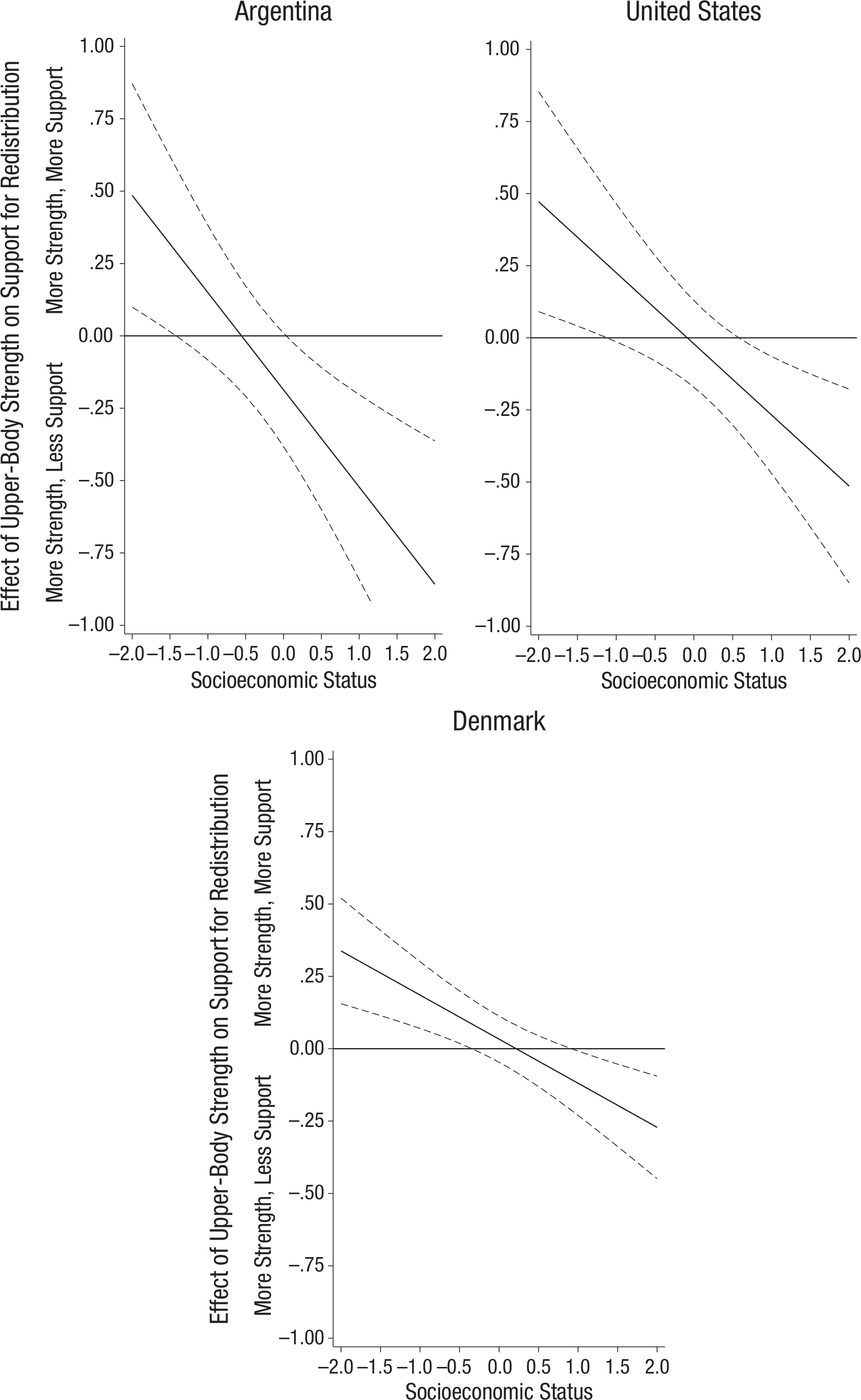
Effect of upper-body strength in men on support for economic redistribution as a function of socioeconomic status. Results are shown separately for Argentina (N = 102), the United States (N = 205), and Denmark (N = 418). Solid lines show predicted effect sizes, and dashed curves indicate 90% confidence intervals of the given effect sizes (equivalent to one-tailed ps). Effect sizes are unstandardized regression coefficients based on z-scored variables.
Does upper-body strength influence support for economic redistribution in women? No. Regarding female subjects, nowhere was the interaction of upper-body strength and SES on support for economic redistribution statistically significant—Argentina: F(1, 87) = 1.38, p = .24; United States: F(1, 268) = 0.39, p = .54; Denmark: F(1, 366) = 0.12, p = .73 (two-tailed ps). Furthermore, the interaction of upper-body strength and SES on support for redistribution was stronger for men than for women in all tested countries, and the difference reached significance in both the United States and Denmark. This was indicated by a three-way interaction between sex, upper-body strength, and SES on support for redistribution—United States: F(1, 469) = 5.69, p = .009; Denmark: F(1, 780) = 3.40, p = .033 (one-tailed ps). In Argentina, the three-way interaction was not significant—Argentina: F(1, 185) = 0.12, p = .364, one-tailed. The effect size of this interaction was comparable in the Argentine and Danish samples (β = 0.09 and β = 0.13, respectively); however, the data from the Argentine sample, less than a third of the size of the Danish sample, lacked the statistical power to reach conventional significance levels.
As predicted, physical strength was positively correlated with support for economic redistribution among low-SES males. However, as SES increased above average, the effect of upper-body strength on support for redistribution became negative; in other words, among higher-SES men, physical strength was correlated with opposition to redistribution. Because redistribution policies have the effect of shifting resources from higher- to lower-SES individuals, the results indicate that physically stronger males (rich and poor) are more prone to bargain in their own self-interest, supporting proposals for redistribution if they are poor and resisting those proposals if they are rich. In contrast, weaker males (rich and poor) are less likely to contest proposals that run against their own self-interest, showing less support for redistribution if they are poor and less resistance to redistribution if they are rich. As predicted, in all three countries, the same statistical pattern was found only among men.
Discussion
The AWA model of animal conflict predicts that animals use advantages in fighting ability to bargain for increased access to resources. Equally, it predicts that attempts to self-interestedly increase resource shares should not be initiated when at a competitive disadvantage. The findings reported here show that this model generalizes to humans and successfully predicts the distribution of support for, and opposition to, economic redistribution in three different nations.
We tested a key prediction derived from animal-conflict theory: Individuals with greater fighting ability (here, upper-body strength) should seek larger shares of contested resources. We showed that upper-body strength in modern adult men influences their willingness to bargain in their own self-interest over income and wealth redistribution. These effects were replicated across cultures and, as expected, found only among males. The effects in the Danish sample were especially informative because it was a large and representative national sample.
These findings also offer a solution to one of social science’s key puzzles: Despite the fact that rational-choice theory is a dominant theory in social science, many empirical studies have found that self-interest has only small effects on political attitudes (Kumlin, 2007). On this basis, critics have argued that political attitudes are divorced from self-interest and are instead derived from abstract political principles (Sears & Funk, 1991; Sears, Lau, Tyler, & Allen, 1980). The present findings show, however, that the assertion of interest in mass politics is reliably calibrated by physical strength, a factor relevant to ancestral bargaining in men. It is not that self-interest is irrelevant—rather, decision-making systems for bargaining are simply designed to reflect self-interest in a cost-effective way, assuming evolutionarily recurrent small-scale social conditions.
Although individual differences in upper-body strength were consequential in ancestral conflicts of interest and continue to be relevant in many interpersonal disputes today, physical strength is objectively irrelevant to the personal payoffs of particular distributional schemes at the national level: National policies on issues such as economic redistribution are determined by anonymous voting, electoral representation, and the numerical power of the factions in the legislature. Furthermore, they are enforced by the state rather that by the individual. Yet our results demonstrate that physically weak males are more reluctant than physically strong males to assert their self-interest—just as if disputes over national policies were a matter of direct physical confrontation among small numbers of individuals, rather than abstract electoral dynamics among millions.
It should be noted that it remains possible that individuals partially recognize the irrelevance of individual fighting ability in the domain of mass social dynamics. It may be that the weighing of physical strength in decision making negatively covaries with the number of individuals involved in a conflict, such that strength influences processing about abstract large-scale political conflict less than processing about small-scale interpersonal disputes. Future research that directly compares the influence of fighting ability on parallel decisions in small- and large-scale settings would be able to determine whether increasing the number of individuals involved down-regulates the strength effect.
Furthermore, the findings of this study are silent with regard to the precise proximate variables that mediate between upper-body strength and psychological traits. One candidate is testosterone, which previous research has linked to both strength (Isidori et al., 2005) and aggression (Archer, 2004). If valid, endogenous endocrine release of testosterone would be regulated by mechanisms designed to monitor upper-body muscle mass in the self and others. At the same time, it should be noted that the association in men between upper-body strength and aggression is unlikely to be just the product of testosterone, as the effects of strength on aggression are substantially greater than the established effect of testosterone on aggression (Archer, 2004; Sell, Tooby, & Cosmides, 2009).
Humans are undeniably complex and unusual animals, and other more traditionally accepted factors certainly play a role in determining how individuals approach mass politics. Nevertheless, modern mass political conflict appears to be another important domain of human behavior in which decision making bears the stamp of our species’ hunter-gatherer past.
Footnotes
Acknowledgements
M. B. P. and D. S. share first authorship. We would like to thank Julian Adan, Marina Cefali, Juan Ison, Catalina Piras, German Silva, Laura Staropoli, Kate Briggs, Michelle Broun, Erika Canola, Ryan Gage, Jason Kunkel, Vanessa Lin, Maren Masterson, and Perla Rodriguez for their help with data collection. We thank John Hibbing, Rose McDermott, Steve Gangestad, and two anonymous reviewers for helpful comments.
Declaration of Conflicting Interests
The authors declared that they had no conflicts of interest with respect to their authorship or the publication of this article.
Funding
Funding was generously provided by a grant from the Danish Research Council to M. B. P., by a National Institutes of Health Director’s Pioneer Award to L. C., and by a grant from the John Templeton Foundation to J. T. The opinions expressed in this publication are those of the authors and do not necessarily reflect the views of any of these organizations.

References
Supplementary Material
Please find the following supplemental material available below.
For Open Access articles published under a Creative Commons License, all supplemental material carries the same license as the article it is associated with.
For non-Open Access articles published, all supplemental material carries a non-exclusive license, and permission requests for re-use of supplemental material or any part of supplemental material shall be sent directly to the copyright owner as specified in the copyright notice associated with the article.
