



Abstract
Object-directed emotion expressions provide two types of information: They can convey the expressers’ person-specific subjective disposition toward objects, or they can be used communicatively as referential symbolic devices to convey culturally shared valence-related knowledge about referents that can be generalized to other individuals. By presenting object-directed emotion expressions in communicative versus noncommunicative contexts, we demonstrated that 18-month-olds can flexibly assign either a person-centered interpretation or an object-centered interpretation to referential emotion displays. When addressed by ostensive signals of communication, infants generalized their object-centered interpretation of the emotion display to other individuals as well, whereas in the noncommunicative emotion-expression context, they attributed to the emoting agent a person-specific subjective dispositional attitude without generalizing this attribution as relevant to other individuals. The findings indicate that, as proposed by natural pedagogy theory, infants are prepared to learn shared cultural knowledge from nonverbal communicative demonstrations addressed to them at a remarkably early age.
Adults’ object-directed emotion expressions provide an important source of social information that even preverbal infants can benefit from when learning about objects and persons in their environment. This benefit is evidenced by the emergence of social referencing by the end of the 1st year when infants in triadic object-referential communicative interactions encounter unfamiliar objects they cannot appraise. After establishing joint attention, infants rely on the valence information expressed by the adult’s object-directed emotion display to modulate their approach/avoidance behavior toward the referent (Moses, Baldwin, Rosicky, & Tidball, 2001; Mumme & Fernald, 2003; Walden & Ogan, 1988).
Object-directed emotion expressions are inherently ambiguous, however, and it remains to be clarified how infants interpret them. Humans use emotion expressions in two fundamentally different ways. In humans, as in nonhuman primates, the automatic activation of evolved patterns of facial-vocal emotion expressions makes manifest the agent’s current emotional reaction toward the referent. Therefore, such emotion displays license a person-centered interpretation that attributes to the agent a person-specific subjective emotional attitude toward the object (e.g., “Mom is frightened of the snake”).
In contrast, humans are unique among primates in their ability to voluntarily display their emotion expressions, using them as symbolic referential devices to communicate to other individuals valence-related information about a referent. During social referencing, adults often present their emotion displays without actually being in the emotion state expressed (think of the calm snake charmer who, when noticing a toddler approach his venomous snake, displays a fearful expression toward it to warn the child about the danger). In such cases, an object-centered interpretation would be more appropriate to capture what the adult intends to communicate to the infant (e.g., “The snake is dangerous to approach”).
In fact, when adults address infants by ostensive signals of communication (e.g., establishing eye contact and using infant-directed speech; see Csibra & Gergely, 2009; Gergely & Csibra, 2005; cf. Sperber & Wilson, 1995) that introduce or accompany their referential emotion display, they often intend to convey relevant knowledge about the referent that (a) is generalizable beyond the situation and (b) represents shared knowledge available to other people, forming part of the cultural common ground shared by one’s social community (e.g., the knowledge that snakes are dangerous). If infants were sensitive to these implications of adults’ ostensive communicative acts, they could assign an object-centered interpretation to individuals’ object-directed emotion displays during social referencing that would allow them (a) to act in an emotion-congruent manner not only toward the particular referent in the here and now but also when encountering other referents of the same kind in future situations and (b) to expect that other people also share the same emotional disposition and will behave accordingly toward the same (kind of) referents.
These alternative interpretations of referential emotion displays—person centered versus object centered—license different kinds of inferences (cf. Gergely & Jacob, 2012). The person-centered interpretation supports predictions about the emoting individual’s likely actions toward the referent in the current episodic situation. However, because in this case the attributed emotional attitude is person specific, it does not sanction the generalization of the inferred action to predictions about other people. In contrast, the object-centered interpretation would license the generalization of the manifested information as knowledge that is shared by and applicable to members of the community other than the expresser.
But can young infants differentiate between person-centered and object-centered interpretations of object-directed emotion expressions, and are they sensitive to the different kinds of inferences these two interpretations support? Infants’ precocious ability to rely on social referencing to modulate their approach/avoidance behaviors is not sufficient in and of itself to answer these questions, because either a person-centered or an object-centered interpretation could provide sufficient information for the infants to modify their actions toward the object in an emotion-congruent manner. It may seem somewhat surprising, therefore, that most previous accounts of early emotion understanding have assumed that infants assign a person-centered interpretation to other people’s emotion displays during social-referencing situations (Moses et al., 2001; Mumme & Fernald, 2003; Repacholi & Gopnik, 1997; Tomasello, 1999; Walden & Ogan, 1988), whereas the alternative assumption, that infants may rely on an object-centered interpretation, has largely been ignored (but see our previous study, Gergely, Egyed, & Király, 2007).
We proposed that human infants’ special sensitivity to ostensive signals of communication, as characterized by natural pedagogy theory (Csibra, 2010; Csibra & Gergely, 2006, 2009; Gergely, 2010), may also play a crucial interpretation-modulating role in helping infants disambiguate person-centered interpretations of others’ referential emotion displays from object-centered interpretations. We hypothesized that in a second-person, child-directed ostensive signaling context, infants would recognize the expresser’s communicative intention (Sperber & Wilson, 1995) and symbolic use of the emotion display and would assign an object-centered interpretation to it. In particular, we hypothesized that during social referencing, adults’ ostensive communicative signals would trigger the shared-knowledge assumption of natural pedagogy (Csibra & Gergely, 2009; Gergely, 2010), leading infants to expect that their object-directed interpretation of the demonstrated emotion display would be applicable to other individuals as well. In contrast, when the referential emotion expression is observed from a third-person perspective in a noncommunicative context, infants should assign a person-centered interpretation and should not generalize their agent-specific attributions as applying to other individuals.
Although this alternative account has not been directly tested in previous experiments on infants’ social referencing, we previously provided evidence in line with the predictions of the natural pedagogy theory that when cued by ostensive communicative signals, 14-month-olds indeed assign an object-centered interpretation to others’ referential emotion displays, leading to an across-person generalization effect (Gergely et al., 2007). Although suggestive, these results remain inconclusive, insofar as we tested for object-centered versus person-centered interpretation of emotion displays only in the context of a communicative demonstration. Therefore, our previous study provided no direct evidence that infants would be equally capable of switching to a person-centered interpretation of the same emotion expressions and attributing an agent-specific subjective mental attitude to the emoting agent when he or she was observed in a noncommunicative context from a third-person perspective (i.e., without the biasing effect of ostensive cues).
The design of the present study allowed us to test (a) whether 18-month-olds are equally capable of making person-centered, compared with object-centered, interpretations of others’ referential emotion expressions; (b) whether object-centered interpretations for such displays are constructed only under the interpretation-biasing effect of ostensive communicative signals; and (c) whether removing such ostensive cues in a noncommunicative context would lead infants to assign the same emotion displays to an agent-specific person-centered interpretation. Furthermore, unlike the paradigms of previous social-referencing studies, the present paradigm allowed us to directly test the shared-knowledge assumption of natural pedagogy theory (Csibra & Gergely, 2009), which posits that in an ostensive communicative context, infants will generalize their object-centered interpretation of the expresser’s emotion display as applicable to other persons (who have not expressed an emotional attitude toward the referent) as well. No such generalization effect was predicted, however, for when infants observed emotion displays in a noncommunicative context.
Method
Participants
Forty-eight 18-month-olds (mean age = 18 months 5 days, SD = 8.89 days, range = 17 months 15 days–18 months 18 days; 23 females and 25 males) participated in the study. They were randomly assigned to three different conditions. A further 17 infants were excluded because of maternal interference (n = 2), distress (n = 1), failure to complete the task by walking away during the familiarization phase (n = 3), or failure to touch either of the stimulus objects during the test (n = 11).
Stimuli
Two unfamiliar objects of different shapes and colors were used. Both their position in relation to each other on the table and the valence (positive or negative) of the emotion the experimenter displayed toward them were counterbalanced across subjects in each condition.
Design and procedure
The procedure began with an initial familiarization phase in which object-directed emotion displays were presented in either a communicative or a noncommunicative context. Then an object-request test phase was administered in which we varied the identity of the person who made the request (the requester being either the same person who displayed the referential emotion expressions or a different person). We created three experimental conditions: (a) a communicative-context/different-person condition, (b) a noncommunicative-context/different-person condition, and (c) a noncommunicative-context/same-person condition (see Fig. 1).
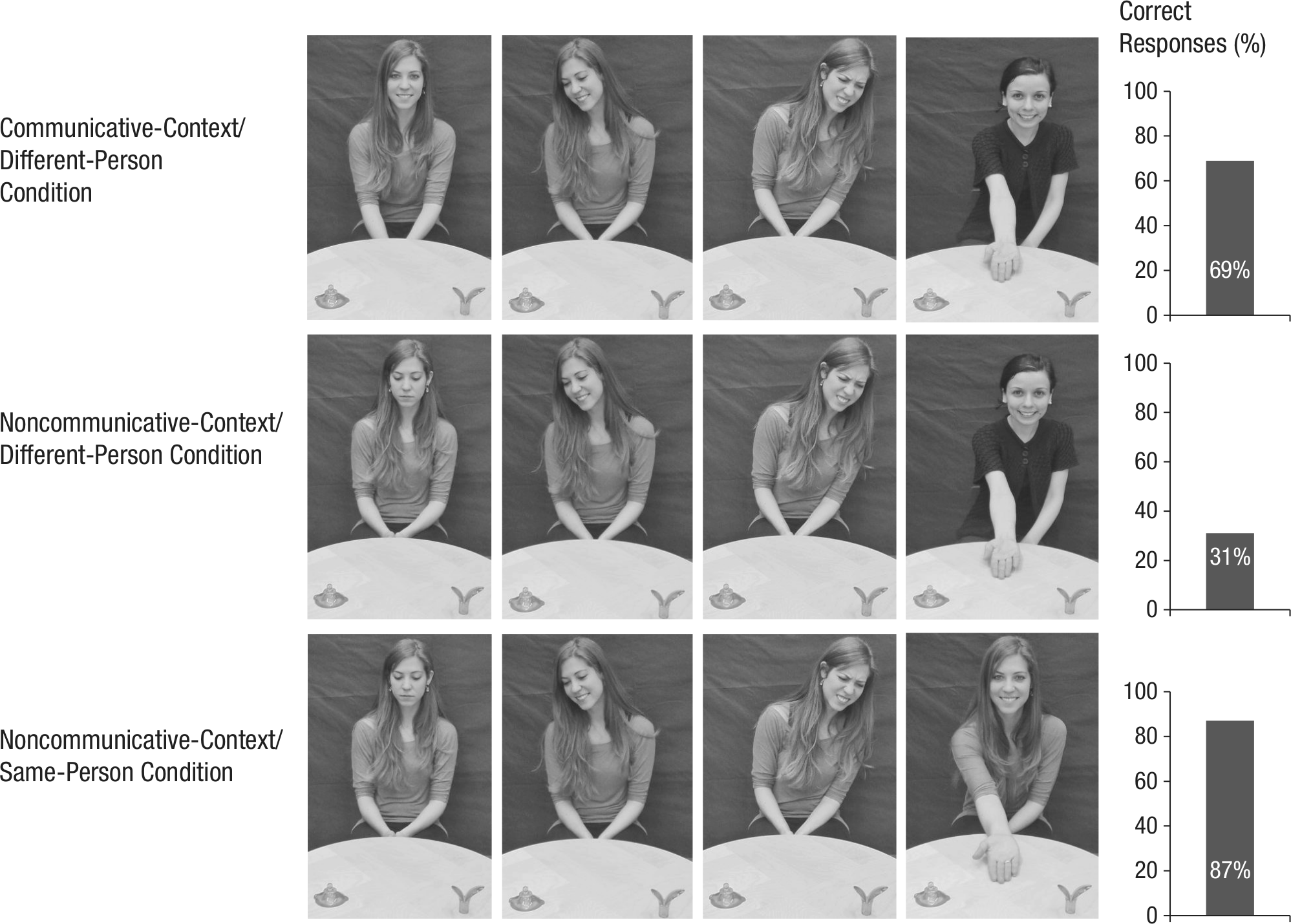
Test-session sequence and results for the three conditions. The conditions were defined by whether the experimenter who presented displays of emotion addressed or did not address the infant and whether the same experimenter or a different experimenter requested an object. In all conditions, an experimenter made object-directed emotion displays, expressing a positive attitude toward one object and a negative attitude toward the other. The requester then asked the infant to give her one of the objects. The graphs show the percentage of responses in which infants chose (by giving to the requester or just touching) the object toward which they had seen a positive attitude displayed, separately for each condition.
Familiarization phase: display of object-directed emotion expressions
Infants in all three experimental groups first participated in an emotion-display familiarization phase. During familiarization, infants were seated in their mother’s lap in front of a table on which the two unfamiliar objects were placed on the left and the right sides, just out of the infants’ reach. Mothers were asked not to communicate or point and were instructed to look down in order not to see the familiarization and test.
Communicative condition
One group of infants observed the demonstrator’s object-directed emotion in a communicative context. The demonstrator first ostensively addressed the infant by looking and smiling at the infant while greeting him or her by name in infant-directed speech, saying, “Hi, [baby’s name], hi! Look!” The demonstrator next turned to look at one of the objects, displaying a positive facial-vocal emotion expression (joy/interest), and then turned toward the other object, presenting a negative emotion display (dislike/disgust). During these emotion displays, the demonstrator provided further ostensive and referential cues of communication by looking back and forth between the object and the baby. This sequence was repeated a second time. Then the demonstrator stood up and left the room.
Noncommunicative condition
Two further groups of infants observed the same demonstrator’s object-directed emotion displays in a noncommunicative context. The familiarization procedure was identical to that of the communicative condition except that the demonstrator acted as if she were alone: She never looked at or talked to the infant either before or during her object-directed emotion expressions.
Test phase: object request in different- and same-person conditions
In the test phase, a female experimenter (the requester) came to the table and sat down at its opposite side, facing the baby. She communicatively addressed the infant using ostensive signals (looking and smiling at the baby while greeting him or her by name using infant-directed speech, saying, “Hi, [baby’s name], hi!”), displayed a manual requesting gesture (placing her hand between the two objects with her open palm turned upward), and said, “Give me one of them!” Then the mother rolled her chair a bit forward so that the infant could reach the objects. Throughout the test phase, the requester looked only at the infant and never at the objects. All events were recorded with two video cameras.
Two separate subject groups were tested in the different-person condition, in which the requester in the test phase was not the same person as the demonstrator in the familiarization phase. One group was presented with the demonstrator’s object-directed emotion displays in the communicative context during familiarization, whereas another group observed the same emotion expressions in the noncommunicative context.
Only one group participated in the same-person condition, in which the requester in the test phase was the same individual as the demonstrator in the familiarization phase. During familiarization, this group observed the demonstrator’s emotion displays in a noncommunicative context. (At the end of familiarization phase, the demonstrator went to the door, stopped, and reapproached the table, playing the requester’s role herself.)
Scoring
The video recordings were coded by two independent coders to identify which of the two objects the infant gave to the experimenter (or just touched) as their first response to the experimenter’s request (coders were blind to the purpose of the study). Infants who gave no response were not included in the final sample. Interrater reliability between the two coders was perfect (100% agreement).
Results
We analyzed infants’ preferential object choices during the object-request test phase in the different conditions. In the communicative-context/different-person condition, 11 infants chose the positively valenced object, and 5 infants chose the negatively valenced object. In the noncommunicative-context/different-person condition, 5 infants chose the positively valenced object, and 11 infants chose the negatively valenced object. In the noncommunicative-context/same-person condition, 14 infants chose the positively valenced object, and 2 infants chose the negatively valenced object (see Fig. 1). This analysis revealed a significant difference in the distribution of object choices among the three conditions, χ2(2, N = 48) = 11.2, p = .004. Planned pairwise comparisons showed that the pattern of choices in the communicative-context/different-person condition did not differ significantly from that in the noncommunicative-context/same-person condition, χ2(1, N = 32) = 1.646, p = .197 (exact one-tailed). In contrast, the pattern of object choices in the communicative-context/different-person condition differed significantly from that in the noncommunicative-context/different-person condition, χ2(1, N = 32) = 4.5, p = .038 (exact one-tailed), odds ratio = 4.84. Finally, the pattern of object choices in the noncommunicative-context/same-person condition differed significantly from that in the noncommunicative-context/different-person condition, χ2(1, N = 32) = 10.494, p = .002 (exact one-tailed), odds ratio = 15.42.
We had tested the same hypotheses in an earlier pilot experiment in which we applied basically the same procedure we used in the study reported here; the main difference was that, to control for intrinsic object preferences, we ran a separate baseline object-choice condition (for details of this experiment, see Pilot-Experiment Method and Results, Table S1, and Fig. S1 in the Supplemental Material available online). The pattern of results in the three experimental conditions of our experiment replicated exactly the corresponding findings from our pilot study despite differences in the type of design, the stimulus objects used, and the experimenters. The results from our pilot study thus provide additional evidence supporting the reliability and generalizability of our findings.
Discussion
Previous approaches to infants’ understanding of emotions during social referencing have assumed that when observing someone’s object-directed emotion expression, infants attribute to that person the corresponding emotion as a person-specific emotional attitude state or a subjective disposition toward the object (Moses et al., 2001; Mumme & Fernald, 2003; Repacholi & Gopnik, 1997; Tomasello, 1999). The present results also demonstrate this capacity: After having observed a person’s positive or negative emotion expressions toward two novel objects in a noncommunicative context, in response to the same person’s subsequent object request, infants prosocially offered the object that the requester had earlier expressed a liking for. In other words, 18-month-olds can adjust their prosocial object-choice responses by consulting their memory representation of the requester’s dispositional attitudes that was formed on the basis of the person’s earlier object-directed emotion expressions. The fact that infants did not generalize this object choice when responding to another person’s object request indicates that they indeed attributed person-specific dispositional attitudes to the demonstrator in the noncommunicative observation condition.
However, our findings go significantly beyond this by providing evidence, for the first time, that by 18 months of age (and probably even earlier; see our previous study, Gergely et al., 2007), infants can flexibly assign a qualitatively different interpretation to other people’s referential emotion displays when these are presented to them in an ostensive communicative context. When communicatively addressed via ostensive signals, infants readily generalized their interpretation of the communicative agent’s referential emotion manifestations as applicable to other individuals as well. This finding indicates that the infants interpreted these ostensive referential emotion displays as manifesting valence-related shared knowledge about the referent that they could rely on when making a prosocial object choice to satisfy the request addressed to them by a different individual (whose person-specific object preferences were unknown to them). This demonstration provides support for the shared-knowledge assumption of natural pedagogy theory (Csibra & Gergely, 2009, 2011), according to which, when communicatively addressed via ostensive signals, infants activate a default expectation that the manifested information about the referent will convey to them culturally shared knowledge that is available and applicable to other members of the community as well. This finding indicates that infants are prepared to learn about shared cultural knowledge through ostensive referential communicative acts at a remarkably early age.
Footnotes
Acknowledgements
The authors thank Gergely Csibra and John S. Watson for their valuable comments.
Declaration of Conflicting Interests
The authors declared that they had no conflicts of interest with respect to their authorship or the publication of this article.
Funding
This research was supported by the European Union’s Sixth Framework Programme (Neural Origins of Language and Communication Grant 12738), the Economic and Social Research Council (Grant RES-062-23-0746), and the Hungarian Scientific Research Fund (Grants K63808 and PD78186).

References
Supplementary Material
Please find the following supplemental material available below.
For Open Access articles published under a Creative Commons License, all supplemental material carries the same license as the article it is associated with.
For non-Open Access articles published, all supplemental material carries a non-exclusive license, and permission requests for re-use of supplemental material or any part of supplemental material shall be sent directly to the copyright owner as specified in the copyright notice associated with the article.

