



Abstract
Companies often provide incentives for employees to maintain healthy lifestyles. These incentives can take the form of either discounted premiums for healthy-weight employees (“carrot” policies) or increased premiums for overweight employees (“stick” policies). In the three studies reported here, we demonstrated that even when stick and carrot policies are formally equivalent, they do not necessarily convey the same information to employees. Stick but not carrot policies were viewed as reflecting negative company attitudes toward overweight employees (Study 1a) and were evaluated especially negatively by overweight participants (Study 1b). This was true even when overweight employees paid less money under the stick than under the carrot policy. When acting as policymakers (Study 2), participants with high levels of implicit overweight bias were especially likely to choose stick policies—often on the grounds that such policies were cost-effective—even when doing so was more costly to the company. Policymakers should realize that the framing of incentive programs can convey tacit, and sometimes stigmatizing, messages.
Employers have witnessed rising health-care costs resulting from the growing number of overweight and obese persons in the workforce. In the United States, where many companies are responsible for providing health care to their employees, these costs are associated with increased health-related expenses, sick leave, disability claims, and absenteeism (Ostbye, Dement, & Krause, 2007). To help recover these costs, many companies have begun to implement “worksite wellness” programs that encourage healthy behavior in employees (O’Donnell, 2006; Parks & Steelman, 2008). Although these wellness programs are varied and multifaceted, one common strategy has been to reward employees for engaging in healthy behaviors—such as maintaining a healthy body mass index (BMI)—by reducing costs to their annual health-care premiums (“carrot” policies).
In contrast to carrot policies, some companies have attempted to recover health-care costs through financial disincentives for unhealthy behaviors (“stick” policies). For example, since 2001, the financial services group Western & Southern Financial has issued health-care premium surcharges to employees with high BMIs (McGregor, 2007). More recently, the Midwestern hospital chain Clarian Health started penalizing employees for unhealthy behavior (including being overweight) through deductions to their paychecks. A recent survey estimated that approximately 18% of employer-based wellness programs use some form of penalty, and this figure is expected to grow to 47% by 2015 (Hewitt Associates, 2010).
Underlying both carrot and stick programs is a belief in the motivating power of financial incentives. Although monetary incentives can induce healthy behavior (e.g., Volpp et al., 2008), they are not the only means of social influence, nor necessarily the most important. We argue that carrot and stick policies also serve a signaling function, conveying information about a company’s attitudes and intentions. These signals in turn influence how people interpret and react to incentives and disincentives, which creates an additional channel of influence on behavior. In the present study, we found that stick policies are especially expressive and that what they express are negative company attitudes toward overweight employees.
Policy Frames and Implicit Messages
Existing data suggest that people dislike policies that penalize the overweight. In a recent nationwide poll that measured reactions to 16 obesity-related policies, the most unpopular policy was one that charged higher premiums for policyholders who were overweight or failed to exercise (Barry, Brescoll, Brownell, & Schlesinger, 2009). We anticipated that such dislike would be particular to stick policies and could be thought of as a kind of framing effect: People will find stick policies more objectionable than carrot policies even when the two imply financially equivalent outcomes for employees. This occurs, we argue, because even when stick and carrot policies are formally equivalent, they are not necessarily information equivalent. Following McKenzie and colleagues (McKenzie, Liersch, & Finkelstein, 2006; Sher & McKenzie, 2006), we reason that a speaker’s (e.g., policymaker’s) choice between equivalent frames (e.g., policies) is usually made in light of relevant background considerations and, therefore, frames can “leak” additional information that is “absorbed” by audience members. For example, a doctor may choose to frame a treatment in terms of its survival rate, rather than its mortality rate, when he or she believes the treatment to be a relatively efficacious option (McKenzie & Nelson, 2003). It seems especially likely that policy frames involving incentives or sanctions would leak information about a policymaker’s preferences and attitudes, as incentives clearly signal that certain behaviors are desired and that others are not.
Furthermore, stick and carrot policies may not only communicate different kinds of information, but also do so to varying degrees. For example, Mulder (2008) had participants play an economic game that either rewarded cooperation or punished defection. In both cases, cooperative behavior was viewed positively, but it was only seen as morally obligatory when participants were punished for defection. That is, punishing undesirable behavior sent a normative message (that a moral rule had been violated) in a way that rewarding desirable behavior did not. Although Mulder did not directly test for information absorption, we expected stick policies to be viewed as particularly informative because they narrowly define appropriate conduct—how one is obligated to act, rather than how one is permitted to act—thereby providing finer resolution of policymakers’ attitudes.
In this article, we report three studies that focused on the role of monetary outcomes and the tacit messages sent by stick and carrot policies. In Studies 1a and 1b, we tested for information absorption: Do people infer company attitudes toward employees from the company’s choice of policy? In Study 2, we tested for information leakage: Do participants, when placed in the role of policymakers, reveal their attitudes toward overweight people through their choice of policy?
Study 1a
We expected that stick and carrot policies would convey different information and to different degrees. Both stick and carrot policies should communicate positive company attitudes toward healthy-weight employees. Stick policies, however, should be viewed as uniquely informative about negative company attitudes toward the overweight. We also examined whether these interpretations are driven by the reward/punishment dichotomy or by the monetary outcomes associated with each policy.
Method
A sample of 142 adults was recruited from Amazon.com’s Mechanical Turk. Sixteen participants were dropped because they failed a comprehension check, 1 which left a final sample of 126 participants (83 females, 41 males, and 2 who did not report gender; mean age = 35 years, range = 18–70 years).
Participants read that a large electronics retailer, Big City Electronics, was deciding on a new employee health-care policy. The scenario stated that the policy change was an effort by company officials to curb rising health-care costs, partly due to an increasing percentage of overweight employees at the company. Experimental conditions varied according to (a) the two options confronting the company and (b) the company’s choice of policy (Table 1 provides an overview).
Overview of Policies in Studies 1a, 1b, and 2
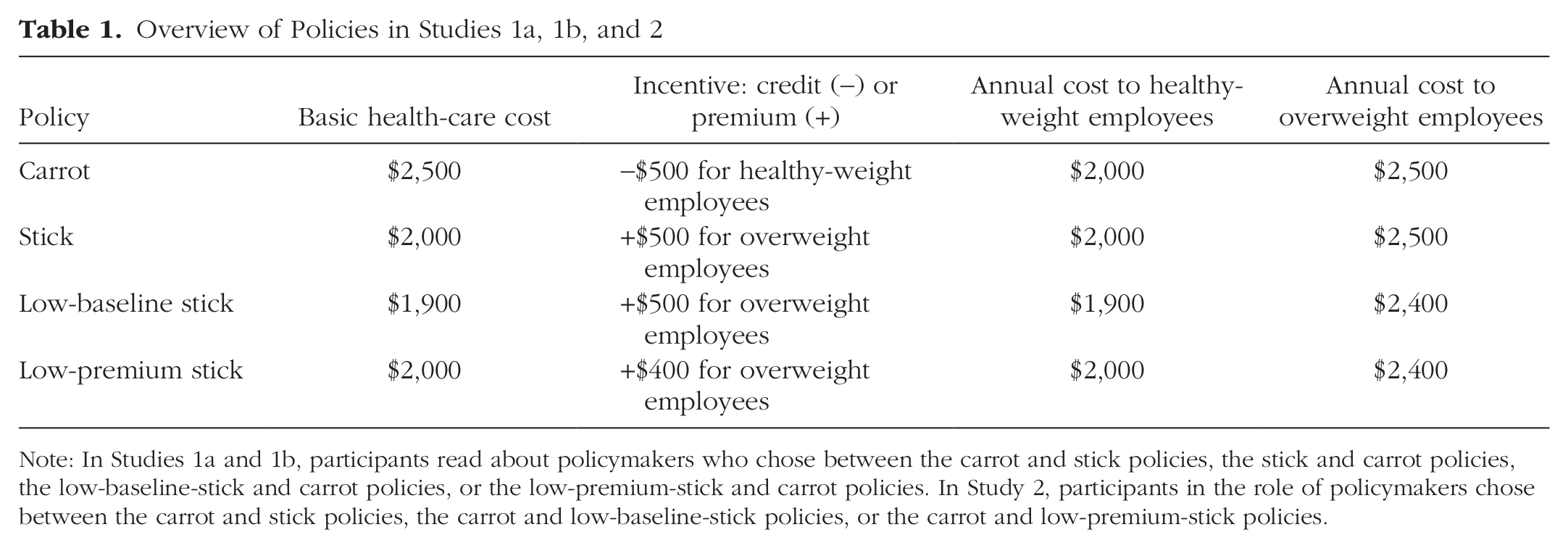
Note: In Studies 1a and 1b, participants read about policymakers who chose between the carrot and stick policies, the stick and carrot policies, the low-baseline-stick and carrot policies, or the low-premium-stick and carrot policies. In Study 2, participants in the role of policymakers chose between the carrot and stick policies, the carrot and low-baseline-stick policies, or the carrot and low-premium-stick policies.
Each participant was randomly assigned to one of four conditions. In the first two conditions, participants read that the company executives were deciding between two formally equivalent options. Option A set basic health-care costs to $2,000 and imposed an additional $500 premium on overweight employees (BMI of 25 or higher), whereas Option B set basic costs to $2,500 and provided healthy-weight employees (BMI of less than 25) with a $500 reduction. Participants in the carrot condition (n = 34) read that executives chose Option B; participants in the stick condition (n = 29) read that executives chose Option A.
The last two conditions were variants of the stick condition. Participants read the same initial scenario as in the other two conditions. However, in the low-baseline-stick condition (n = 25), basic annual health-care costs were set to $1,900, and the overweight premium remained at $500. In the low-premium-stick condition (n = 38), basic annual health-care costs remained at $2,000, and the overweight premium was set to $400. In both cases, the monetary outcomes associated with the carrot option remained the same. These two additional conditions provided test cases in which implementing the stick policy rather than the carrot policy meant that overweight employees paid less money overall.
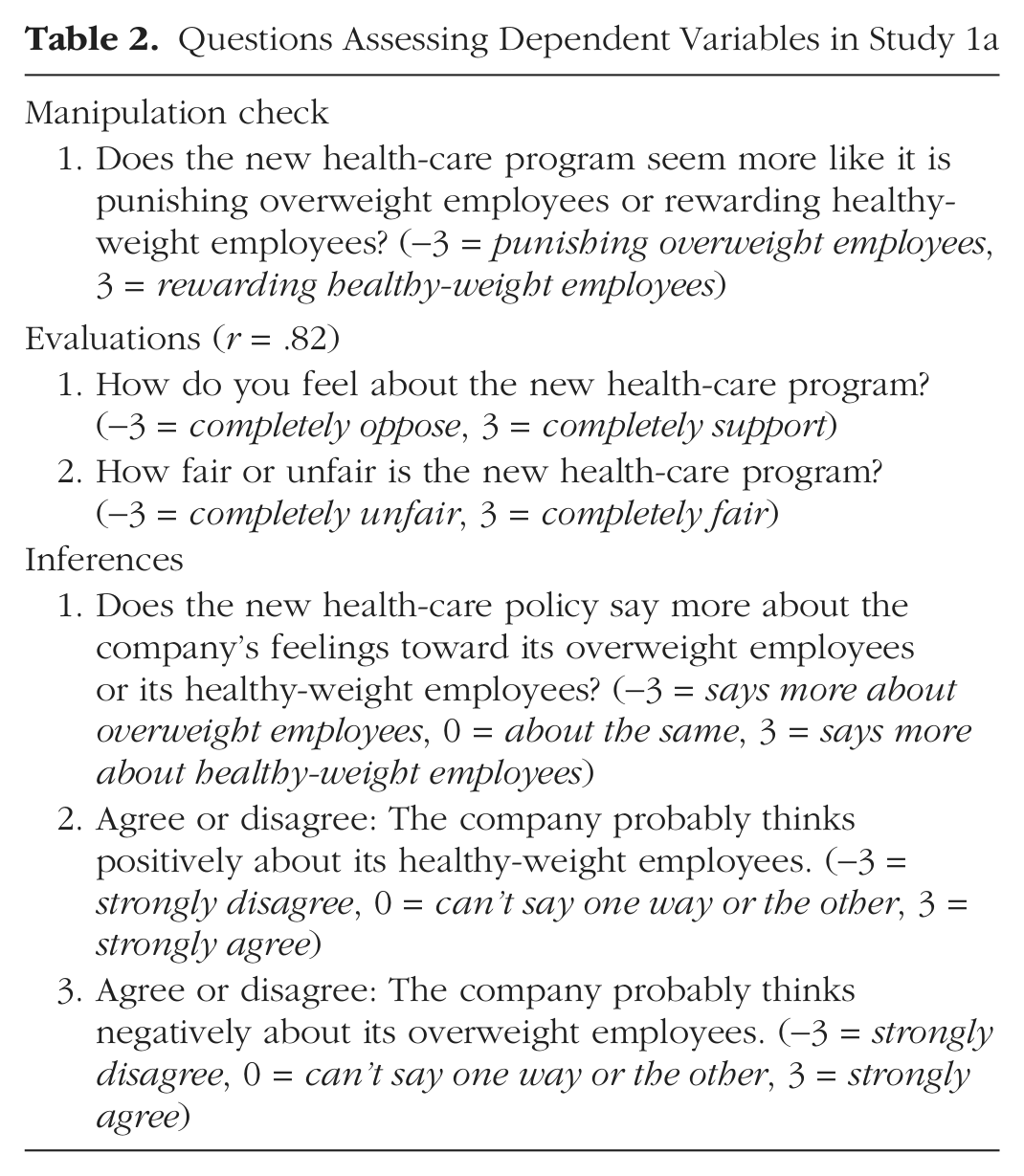
After reading about policymakers’ choices, participants responded in random order to the dependent measures displayed in Table 2. Participants then completed the comprehension-check items and basic demographic questions before being directed to a debriefing page.
Questions Assessing Dependent Variables in Study 1a
Results and discussion
Manipulation check
As intended, participants in the three stick conditions were more likely to view the new policy as a form of punishment (combined M = −1.64) than were participants in the carrot condition (M = 1.00), t(124) = 6.88, p < .001. Means for all three stick conditions were reliably different from the mean for the carrot condition in the expected direction, ps < .001, and means for the three stick conditions were not reliably different from one another, ts < 1.
Policy evaluations
As expected, participants in the three stick conditions evaluated the chosen policy more harshly (combined M = −0.42) than did participants in the carrot condition (M = 0.63), t(124) = 2.78, p = .006. Means in all three stick conditions were lower than the mean in the carrot condition, although not significantly so for the low-baseline-stick condition. All pairwise comparisons are presented in Table 3. Furthermore, no reliable differences were found between the three stick conditions, ts < 1, which suggests that participants were insensitive to material costs. To examine this finding more thoroughly, we conducted a series of planned orthogonal contrasts that gauged participants’ sensitivity to the financial burdens placed on overweight employees, healthy-weight employees, and the company. 2 All of these alternative contrasts (displayed in Table 3) fit the data relatively poorly and fared considerably worse than the stick versus carrot contrast. In short, participants were sensitive to the qualitative distinction between reward and punishment but not to the monetary outcomes associated with each policy.
Planned Contrast Tests in Study 1a
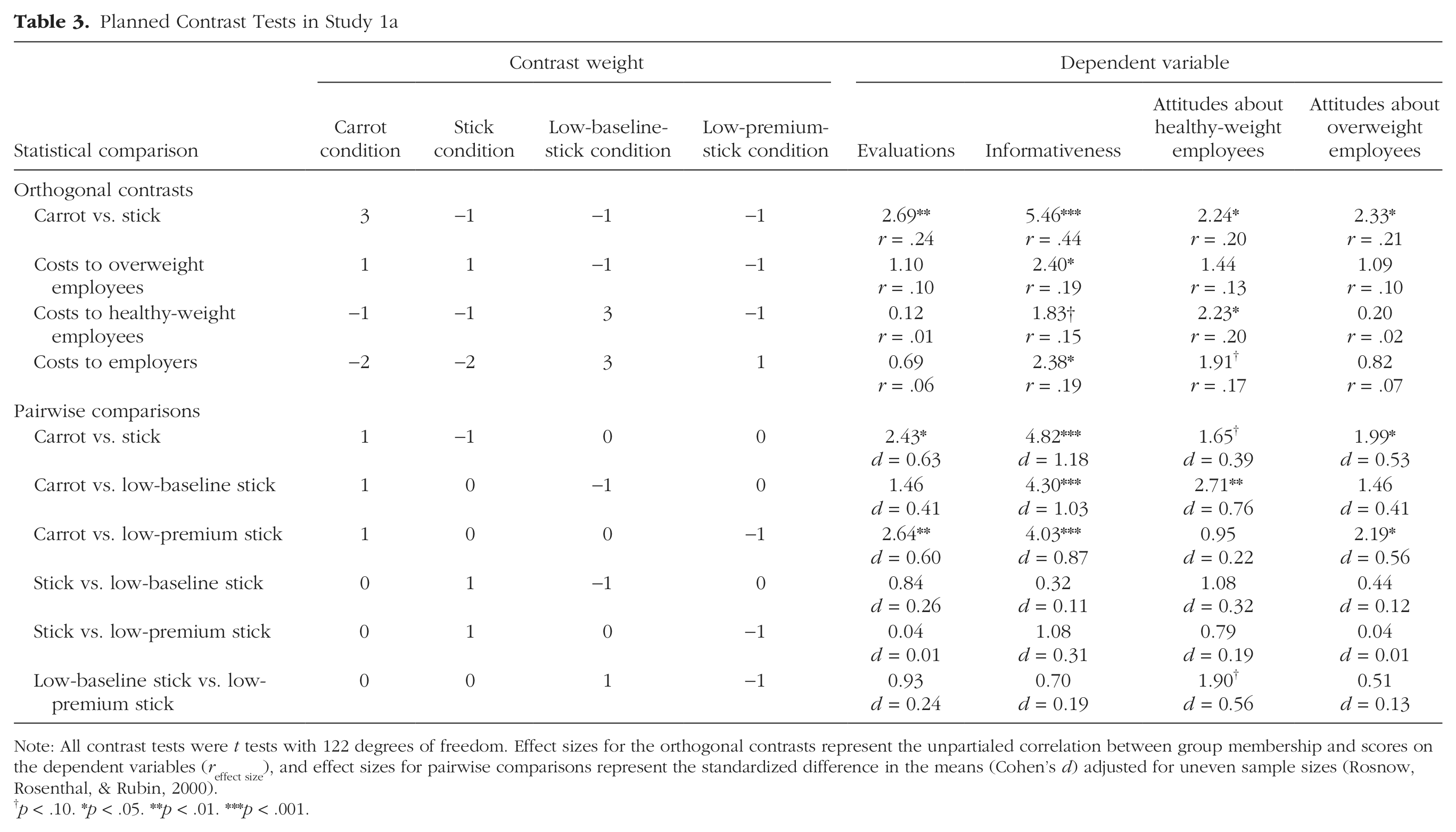
Note: All contrast tests were t tests with 122 degrees of freedom. Effect sizes for the orthogonal contrasts represent the unpartialed correlation between group membership and scores on the dependent variables (r effect size), and effect sizes for pairwise comparisons represent the standardized difference in the means (Cohen’s d) adjusted for uneven sample sizes (Rosnow, Rosenthal, & Rubin, 2000).
p < .10. *p < .05. **p < .01. ***p < .001.
Information absorption
Figure 1 displays the means and 95% confidence intervals (CIs) for the three inference items. Overall, participants in the stick conditions viewed the chosen policy as especially informative about the company’s negative attitude toward overweight employees. For general informativeness, all three stick policies were rated reliably below the scale midpoint, whereas responses in the carrot condition were not. In other words, stick policies were seen as speaking more to overweight employees than to healthy-weight employees, whereas the carrot policy was seen as speaking “about the same” to both sets of employees.

Results from Studies 1a and 1b: mean judgments of policy informativeness (top row), company attitudes about healthy-weight employees (middle row), and company attitudes about overweight employees (bottom row) as a function of policy type. Error bars represent 95% confidence intervals.
Looking at specific inferences, we found that participants inferred positive attitudes about healthy-weight employees in both stick and carrot conditions but inferred negative attitudes about overweight employees only in stick conditions. As Figure 1 shows, all policies were thought to reflect positive attitudes about healthy-weight employees. Participants in the carrot condition were more likely to infer positive company feelings from the chosen policy (M = 1.62) than were participants in the three stick conditions (combined M = 0.90), t(123) = 2.40, p = .02, but responses in all conditions were reliably above the midpoint of the scale (“can’t say one way or the other”). By contrast, participants in the stick conditions thought that the chosen policy signaled negative company feelings about overweight employees (combined M = 1.00), whereas participants in the carrot condition generally did not (M = 0.26), t(124) = 2.07, p = .04. Responses in all three stick conditions were reliably above the midpoint of the scale, whereas the mean response in the carrot condition was not.
Finally, if participants disliked stick policies because of the messages they communicated, then policy informativeness should have mediated policy evaluations. Using a bootstrapping procedure (Shrout & Bolger, 2002) with 5,000 replications, we found a sizable indirect effect of policy type on evaluations through policy informativeness, b = −1.15, 95% CI = [−1.79, −0.65]. In addition, the nonsignificant direct path from policy type to evaluations suggested full mediation, b = 0.09, 95% CI = [−0.71, 0.78]. Follow-up analyses (reported in the Supplemental Material available online) indicated that this indirect effect was driven primarily by inferences of negative company attitudes toward overweight employees rather than by positive attitudes toward healthy-weight employees.
Study 1b
Study 1a showed that only stick policies were thought to communicate stigmatizing information about overweight employees; in Study 1b, we examined whether overweight participants do in fact find stick policies particularly threatening.
Method
A sample of 217 participants recruited from Mechanical Turk 3 was randomly assigned to the same four conditions described in Study 1a (see Table 1) and responded to the same inferential items. Participants also reported on 7-point scales (1 = not at all, 7 = very much so) how stigmatized, humiliated, and uncomfortable they would feel if their current employer implemented a similar policy (α = .90); using the same scale, they also responded to eight items gauging the policy’s expected impact on job dissatisfaction (e.g., “I would be motivated to start looking for a new job”; α = .93). At the end of the study, participants provided their height and weight so we could calculate their BMI. (See the Supplemental Material for the full list of dissatisfaction items and details on the BMI calculation.)
Results and discussion
Study 1b replicated the findings from Study 1a. As Figure 1 shows, all policies sent positive messages about healthy-weight employees; however, only stick policies sent negative messages about overweight employees, and across conditions, participants were insensitive to financial outcomes (additional details are provided in the Supplemental Material).
Looking at the downstream consequences of such inferences, we found that only participants with high BMI viewed stick policies as personally threatening. Regressing policy type, 4 participant BMI, and the interaction term between them onto feelings of stigma returned a marginally significant interaction, b = 0.09, SE = 0.05, p = .08, and regressing the predictors onto expected job satisfaction returned a reliable interaction, b = 0.09, SE = 0.04, p = .02. As Figure 2 shows, feelings of stigma and dissatisfaction were relatively low in the carrot condition and did not reliably increase as a function of participant BMI. In all three stick conditions, in contrast, feelings of stigma and dissatisfaction increased as participants’ BMI increased (ps < .05). Furthermore, we failed to find a similar interaction effect for policy inferences (ps > .30 for the interaction terms). Thus, all participants interpreted stick and carrot policies in roughly the same way, but only participants with high BMIs felt threatened and stigmatized by stick policies. 5

Results from Study 1b: best-fitting regression lines showing (a) feelings of stigma and (b) expected job dissatisfaction as a function of participant body mass index (BMI) in each of the four policy conditions (carrot, stick, low-baseline stick, and low-premium stick). Higher scores on the y-axes represent greater feelings of stigma and expected job dissatisfaction, respectively.
Taken together, Studies 1a and 1b showed clear evidence that participants disliked policies that punished overweight employees, and they thought (correctly) that such policies communicate stigmatizing information to the overweight. Both types of policy signaled positive attitudes toward healthy-weight employees, but only stick policies signaled negative attitudes toward overweight employees. It was this additional negative signal that participants in Study 1a found most distasteful and that overweight participants in Study 1b found most threatening. Although participants were sensitive to the qualitative distinction between punishment and reward, they were relatively insensitive to the material costs associated with each policy: Participants reacted negatively to stick policies even when they represented a cost-saving measure for overweight employees.
Study 2
In Study 2, we examined whether the inferences made in Study 1 were an accurate reflection of policymakers’ genuine attitudes. To do so, we probed for antioverweight attitudes and whether they predicted preferences for stick policies. Because bias against the overweight is something that many people may not readily admit to (consciously or unconsciously), we measured overweight bias using both explicit and implicit attitude measures.
We also manipulated the material outcomes associated with each policy in a manner similar to that in Studies 1a and 1b. Doing so served two purposes. First, by mirroring outcomes we were able to assess the accuracy of the inferences participants made in Studies 1a and 1b. Second, we were able to assess the degree to which our “policymakers” in Study 2 were genuinely motivated by material outcomes (e.g., reducing costs for the company).
Method
Eighty-five university students (77 females, 8 males; mean age = 21 years, range = 18–30 years) participated in return for course credit. Each participant was randomly assigned to one of three between-subjects conditions: carrot versus stick, carrot versus low-baseline stick, and carrot versus low-premium stick.
Participants were seated at a computer workstation and told that they would make several policy decisions. They then responded in random order to four scenarios—a target scenario concerning worksite wellness programs and three filler scenarios (e.g., deciding whether to lay off employees or reduce wages). Participants then completed an implicit and an explicit measure in random order, answered several questionnaires and demographic questions, and were debriefed.
Target scenario
Participants were asked to imagine they were executives whose company was planning to change its employee health-care program because of rising costs. They were then presented with two policies identical to those in Study 1 and, depending on condition, 6 chose between either the carrot and stick policies (n = 36), the carrot and low-premium-stick policies (n = 16), or the carrot and low-baseline-stick policies (n = 33; see Table 1). After making their decision, participants were asked to indicate their level of agreement (−4 = completely disagree, 4 = completely agree) with two statements regarding whether their decision was based on (a) “what seemed the most effective way to reduce costs for the company” and (b) their “personal beliefs about how healthy employees should be.” As a manipulation check, participants indicated on a 9-point scale the extent to which each option was a punishment for overweight employees (−4) versus a reward for healthy-weight employees (+4).
Implicit measure
Participants completed the fat-thin Implicit Association Test (Schwartz, Vartanian, Nosek, & Brownell, 2006), a performance-based categorization task that uses response latencies to assess the strength of the participant’s association between the conceptual dimensions of thin-fat with good-bad. For the thin-fat stimuli, participants viewed 20 different faces (10 “thin” faces and 10 “fat” faces) that had been digitally morphed from an original set of five male and five female faces. For good-bad stimuli, participants viewed either positively valenced words (“joy,” “warmth”) or negatively valenced words (“gloom,” “pain”). Participants were considered to have high levels of implicit overweight bias if they were quick to associate thin faces with positively valenced words and fat faces with negatively valenced words (for details on the scoring procedure, see Greenwald, Nosek, & Banaji, 2003).
Explicit measure
Participants completed a 14-item fat phobia scale (Bacon, Scheltema, & Robinson, 2001), which assessed negative attitudes toward the overweight on a series of 9-point semantic differential scales (e.g., −4 = lazy, 4 = industrious). Items were combined so that higher scores indicated more negative attitudes toward overweight people (α = .88).
Results and discussion
Manipulation check
As intended, participants were more likely to view the stick policy (M = −1.76), compared with the carrot policy (M = 1.58), as a form of punishment toward overweight employees, t(84) = 8.17, p < .001. This was true for all three conditions when examined separately, ps < .01.
Policy decisions
The majority of participants chose carrot policies (72% overall), which implies that choosing a stick policy was a statistically rare event (i.e., < 50%). This is noteworthy because from an information-theoretic perspective, rare events are more informative than common ones (e.g., McKenzie & Mikkelsen, 2007). Recall that in Studies 1a and 1b, participants in the stick conditions viewed the chosen policies as more informative than did those in the carrot condition—the data reported here suggest that such an inference is a reasonable one. In all conditions, the percentage of participants choosing stick policies was low, ranging from 19% to 36%.
Next, we examined whether choosing stick policies leaked attitude information. Using logistic regression, we found that individuals with high levels of implicit bias were more likely to choose stick over carrot policies, β = 0.80, SE = 0.34, p = .02. Examination of the marginal effects indicated that subjects 1 standard deviation above the mean on implicit bias would be expected to choose stick policies 2.35 times more often than subjects 1 standard deviation below the mean (39.7% vs. 16.9%, respectively). Individuals with high levels of explicit bias showed a similar but weaker effect, β = 0.45, SE = 0.26, p = .08. When both implicit and explicit biases were regressed onto policy choices, only implicit bias was reliably associated with choosing stick policies—implicit bias: β = 0.75, SE = 0.33, p = .025; explicit bias: β = 0.41, SE = 0.25, p = .10.
Policy rationales
Participants who chose stick policies were more likely to report that their decision was based on cost-effectiveness considerations (M = 1.75) than those who chose carrot policies (M = 0.26), t(83) = 3.10, p = .003. Participants with high levels of implicit bias were also especially likely to report that their decision was based on cost-effectiveness considerations (r = .23, p = .03) but not on personal beliefs about how healthy employees ought to be (r = .14, p = .21). Participants with high levels of explicit bias, in contrast, showed the opposite pattern: They were especially likely to report that their decision was based on their personal beliefs about weight (r = .30, p = .005) but not on cost-effectiveness considerations (r = .12, p = .26). In other words, participants who explicitly disliked overweight people were forthcoming about their decision, admitting that they chose a stick policy on the basis of personal attitudes. Participants who implicitly disliked overweight people, in contrast, justified their decisions as based on the most economical course of action. But were such participants actually sensitive to considerations of costs?
Sensitivity to costs
If participants with high levels of implicit bias were genuinely motivated by cost-effectiveness considerations—as they claimed to be—then they should be sensitive to money-saving options. Therefore, we would expect to see a reduced rate of stick choices in the low-baseline-stick and low-premium-stick conditions compared with the basic carrot-versus-stick condition. However, we found that all participants (including those with high levels of implicit bias) were insensitive to policy costs. There was no reliable difference in the proportion of participants choosing stick policies across conditions, and the effect of implicit bias was not qualified by condition (ps > .65 for the interaction terms). As Figure 3 shows, participants high in implicit bias consistently favored stick policies, and follow-up tests showed no reliable differences between the three slopes (ps > .50).
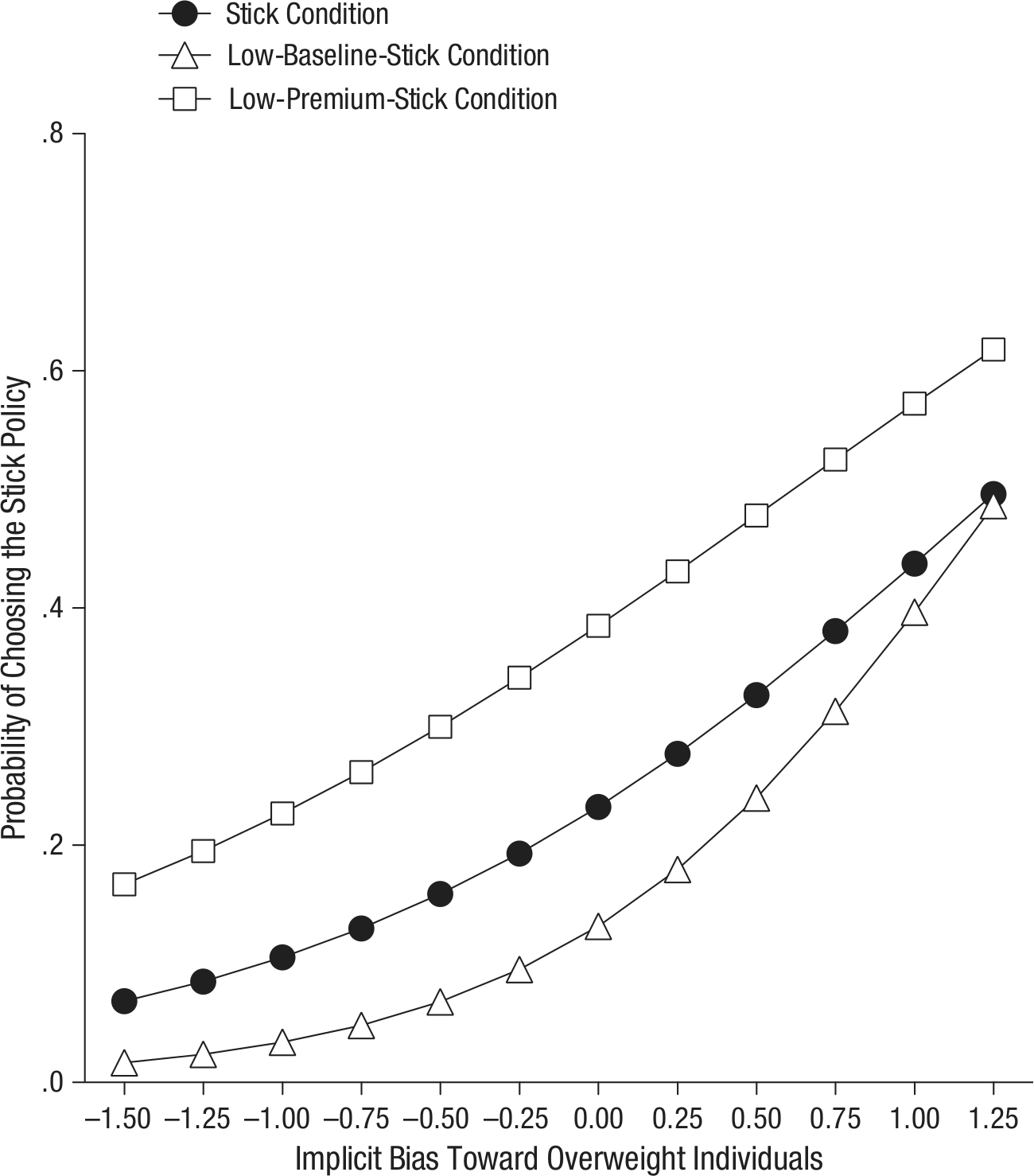
Results from Study 2: predicted probability of choosing the stick policy as a function of implicit bias toward overweight individuals and experimental condition. Predicted probabilities were calculated using average marginal effects. Higher implicit-bias scores represent stronger implicit antioverweight attitudes.
General Discussion
Worksite wellness programs are, among other things, signals that communicate a company’s attitudes and feelings toward its employees. Study 1a showed that participants made predictable inferences about company attitudes on the basis of the employer’s choice of policy. Participants were especially likely to infer that a company viewed overweight employees as problematic if it offered a policy that punished overweight employees rather than rewarded healthy-weight ones. Study 1b demonstrated the downstream consequences of these inferences, as participants who themselves were overweight viewed stick (but not carrot) policies as potentially threatening. Study 2 showed that the inferences drawn in Studies 1a and 1b were reasonable: When placed in the role of an employer, participants leaked attitude information through their choice of policy. Participants with high levels of overweight bias (particularly when measured implicitly) were especially likely to choose stick policies.
Another noteworthy finding was that the absolute monetary outcomes associated with policies had little or no impact on judgments. Participants disliked stick policies regardless of whether they meant that overweight employees would end up paying the same or less than they would under the carrot policy. In Study 2, participants with high levels of overweight bias were most likely to choose stick policies, even when the costs borne by the company were higher than under the carrot policy. What is particularly poignant about this last result is that participants with high levels of implicit bias—the strongest indicator of choosing a stick policy—were also most likely to report that they were motivated by cost-effectiveness considerations. These participants claimed that their decisions were sensitive to costs, 7 but the data suggest otherwise.
Some potential limitations of the current studies are worth discussing. In Studies 1a and 1b, participants made inferences in response to questions posed by the experimenter, but it is unclear whether participants would spontaneously generate such inferences in more naturalistic contexts. Although this is a reasonable concern, previous studies using more subtle procedures have found that participants absorb information spontaneously from a speaker’s choice of frame (Sher & McKenzie, 2006). Another potential concern is the sample and role-playing nature of Study 2: Our “policymakers” were college undergraduates, not managers genuinely accountable for their decisions. It is plausible that real managerial decisions would be driven more by cost-effectiveness considerations than by antioverweight attitudes, and future studies on this topic would be a welcome addition to the literature.
The current studies contribute to a growing body of research showing how policies influence behavior in unexpected ways through the social messages they communicate (Gneezy & Rustichini, 2000; McAdams & Nadler, 2005; McKenzie et al., 2006). Because stick policies send stigmatizing information about overweight employees, policymakers should be aware that implementing such policies could create additional problems. Under existing law, stick policies may create legal liabilities for companies by fostering a potentially hostile work environment (Roehling, 1999). Given that such policies are also unpopular with the public (Barry et al., 2009; McGregor, 2007), implementing stick policies may also lead to reputational costs.
However, even if stick policies did not create additional externalities for companies, employers and policymakers may still have reasons to avoid implementing them. Feelings of stigmatization have consistently been linked to an increase in unhealthy eating behaviors and reduced levels of physical activity, which exacerbates the likelihood of weight gain (see Puhl & Heuer, 2010; Puhl & Latner, 2007). To the extent that stick policies increase feelings of stigmatization in overweight employees, they are likely to prove self-defeating.
Footnotes

References
Supplementary Material
Please find the following supplemental material available below.
For Open Access articles published under a Creative Commons License, all supplemental material carries the same license as the article it is associated with.
For non-Open Access articles published, all supplemental material carries a non-exclusive license, and permission requests for re-use of supplemental material or any part of supplemental material shall be sent directly to the copyright owner as specified in the copyright notice associated with the article.
