



Abstract
Perspective taking is often the glue that binds people together. However, we propose that in competitive contexts, perspective taking is akin to adding gasoline to a fire: It inflames already-aroused competitive impulses and leads people to protect themselves from the potentially insidious actions of their competitors. Overall, we suggest that perspective taking functions as a relational amplifier. In cooperative contexts, it creates the foundation for prosocial impulses, but in competitive contexts, it triggers hypercompetition, leading people to prophylactically engage in unethical behavior to prevent themselves from being exploited. The experiments reported here establish that perspective taking interacts with the relational context—cooperative or competitive—to predict unethical behavior, from using insidious negotiation tactics to materially deceiving one’s partner to cheating on an anagram task. In the context of competition, perspective taking can pervert the age-old axiom “do unto others as you would have them do unto you” into “do unto others as you think they will try to do unto you.”
Perspective taking is often the cornerstone of a happy, functional marriage, the glue that binds spouses together. In divorce, however, taking a departing partner’s perspective may instead inspire deceit and chicanery. Indeed, some divorce attorneys recommend “fighting fire with fire” by imagining the duplicitous and underhanded activities the estranged spouse may be plotting—removing assets from shared bank accounts, racking up credit-card bills, issuing restraining orders, and so forth—and preemptively using these tricks oneself (Johnson, 2013). Previously honorable individuals may take such unethical steps if they fear that their spouses plan to do the same against them. In the competitive context of divorce, perspective taking may act as gasoline being poured onto the growing fire of suspicion.
The research reported here investigated whether, and under what conditions, perspective taking—the process of imagining the mind and thoughts of another individual—triggers unethical behavior. Counter to the notion that perspective taking creates and maintains social bonds (Galinsky, Ku, & Wang, 2005), we suggest that it works as a relational amplifier that intensifies existing cooperative or competitive impulses. Stated differently, perspective taking can change the Golden Rule from “do unto others as you would have them do unto you” to “do unto others as you think they will try to do unto you” (Batson & Moran, 1999). In neutral or cooperative contexts, perspective taking functions as the glue that binds people together by inducing sympathy and altruistic behavior. However, when individuals imagine the potential actions that their competitors will take against them, perspective taking is akin to pouring gasoline on a fire: It inflames already-aroused competitive impulses and incites individuals to engage in unethical behaviors in the service of protecting themselves.
Perspective Taking as Social Glue
The human capacity for perspective taking can often be the glue that holds and binds individuals and social groups together. Experimental research consistently demonstrates that the ability to see the world from another person’s point of view leads individuals to cooperate and offer aid across a myriad of social arenas. Specifically, perspective taking has been linked to greater empathy and altruism (Batson, 1994; Batson & Moran, 1999; Coke, Batson, & McDavis, 1978; Eisenberg & Miller, 1987), increased willingness to volunteer time and money to help individuals facing hardship (Batson et al., 1991; Coke et al., 1978; Dovidio, Allen, & Schroeder, 1990), diminished accessibility and expression of stereotypes (Galinsky & Moskowitz, 2000), reduced egocentrism (Savitsky, Van Boven, Epley, & Wight, 2005), and more objective judgments of fairness (Epley, Caruso, & Bazerman, 2006).
Perspective Taking as Social Gasoline
Although perspective taking often serves as the glue that binds people together, growing evidence suggests that it can fuel antisocial behavior under certain circumstances. Perspective taking can promote more selfish behavior with competitors in resource dilemmas (Epley et al., 2006), more retaliation against transgressors (Okimoto & Wenzel, 2011), and more negative construals of out-group members (Tarrant, Calitri, & Weston, 2012). These findings are consistent with work demonstrating that competition invites competition, even among individuals who initially hold cooperative orientations (Kelley & Stahelski, 1970a, 1970b). Building on this research, as well as related work within economics (i.e., Nash, 1950), we offer a theory for understanding when and why perspective taking leads to antisocial behavior: Perspective taking serves to amplify the existing relational context (i.e., cooperative or competitive). In line with this reasoning, we proposed and tested the hypothesis that perspective taking would lead people to behave more unethically in competitive contexts.
The Unethical Perspective Taker
Research on ethics has traditionally focused on individual (e.g., demographics, personality traits) and situational (e.g., codes of conduct, organizational culture) characteristics (Kish-Gephart, Harrison, & Treviño, 2010; Tenbrunsel & Smith-Crowe, 2008). Emerging evidence, however, suggests that relationships also influence ethical decisions. In particular, in-group identification and shared group membership can lead people to imitate decisions to cheat (Gino, Ayal, & Ariely, 2009) and engage in unethical helping (Gino & Pierce, 2010).
We extended this work by investigating the combined influence of relational context and perspective taking on unethical behavior. The common theoretical lens we offer to explain how perspective taking produces both prosocial and unethical behavior is that perspective taking works as a relational amplifier. In cooperative contexts, perspective taking draws one’s attention to the potential for shared interests and to the counterpart’s expected cooperative behavior. In contrast, in competitive contexts, perspective taking draws attention to conflicting interests and to how a competitor’s actions may threaten one’s own self-interest. Similar to the game-theoretical lens of backward induction—determining one’s optimal choices on the basis of opponents’ anticipated actions (Von Neumann & Morgenstern, 2004)—taking the perspective of a competitor may focus one’s attention on the competitor’s potential use of unethical tactics to gain a competitive advantage. Indeed, individuals misrepresent or withhold information from people they perceive as competitors out of fear of exploitation (Steinel & De Dreu, 2004). Overall, we propose that perspective taking in competitive contexts leads people to do whatever it takes—including engaging in unethical behavior—to protect themselves from the imagined evil of their counterparts.
Overview of the Present Research
We conducted four experiments to test whether relational context moderates the effects of perspective taking on unethical behavior. Experiment 1 examined whether attending to the potential unethical behaviors of a competitor increases participants’ own willingness to employ unethical negotiation tactics. Experiment 2 explored the moderating effect of relational context—cooperative versus competitive—on the effects of perspective taking on unethical intentions. Experiment 3 investigated how the combination of perspective taking and a competitive counterpart affects actual use of deception in a game involving real financial stakes. Finally, Experiment 4 divorced the opportunity to act unethically from the focal relationship to test whether taking the perspective of a competitor automatically activates a mind-set geared toward self-protection at any cost.
Our research makes several important contributions. On the empirical front, we are the first to demonstrate that perspective taking can lead to increased unethical behavior. On the theoretical front, we offer a parsimonious model—perspective taking as a relational amplifier—to explain when and why perspective taking leads to antisocial rather than prosocial behavior. In cooperative contexts, perspective taking is the glue that binds people together and creates the foundation for prosocial behavior. However, in competitive contexts, it is analogous to pouring gasoline on a burning fire, promoting prophylactic use of unethical behavior to prevent potential exploitation.
Experiment 1: The Ethical Cost of Thinking About Competitors
Experiment 1 used the context of negotiations for an initial test of our hypothesis that taking a competitor’s perspective could lead to increased unethical behavior.
Method
One hundred twenty-one working M.B.A. students 1 were randomly assigned to either a self-first or a competitor-first condition. All participants completed a survey that asked them to write about one of their company’s competitors: “Please take a minute to describe one of your company’s competitors. You can pick any company with which your company competes.”
Next, participants imagined that they were involved in a negotiation with the company they had just described and rated the extent to which they and the competing company would be willing to use certain unethical negotiation tactics. These behavioral intentions were assessed with a seven-item survey adapted from the Self-Reported Inappropriate Negotiation Strategies (SINS) scale (e.g., “Intentionally misrepresent factual information in order to support your negotiating arguments or position”; scale from 1, definitely would not use, to 7, definitely would be willing to use; Robinson, Lewicki, & Donahue, 2000). Participants in the self-first condition rated their own intended negotiation behavior first and then rated their competitor’s. Participants in the competitor-first condition rated the competitor first and then themselves. These measures of participants’ own willingness to engage in unethical bargaining (α = .70) and their competitor’s willingness to engage in unethical bargaining (α = .79) were both reliable.
Results and discussion
A mixed-model analysis of variance (ANOVA) revealed a significant interaction between experimental condition (between subjects; self-first vs. competitor-first) and the target of the rating (within subjects; self vs. competitor), F(1, 119) = 6.55, p = .012. As Figure 1 shows, participants who considered their competitor’s negotiation behavior prior to their own reported having greater unethical intentions (M = 3.22, SD = 1.10) than did those who considered their own intentions first (M = 2.83, SD = 0.76), t(119) = −2.25, p = .026. Ratings of the competitor’s unethical intentions, however, did not differ between conditions (3.91 vs. 3.90), t(119) = 0.02, p = .985.
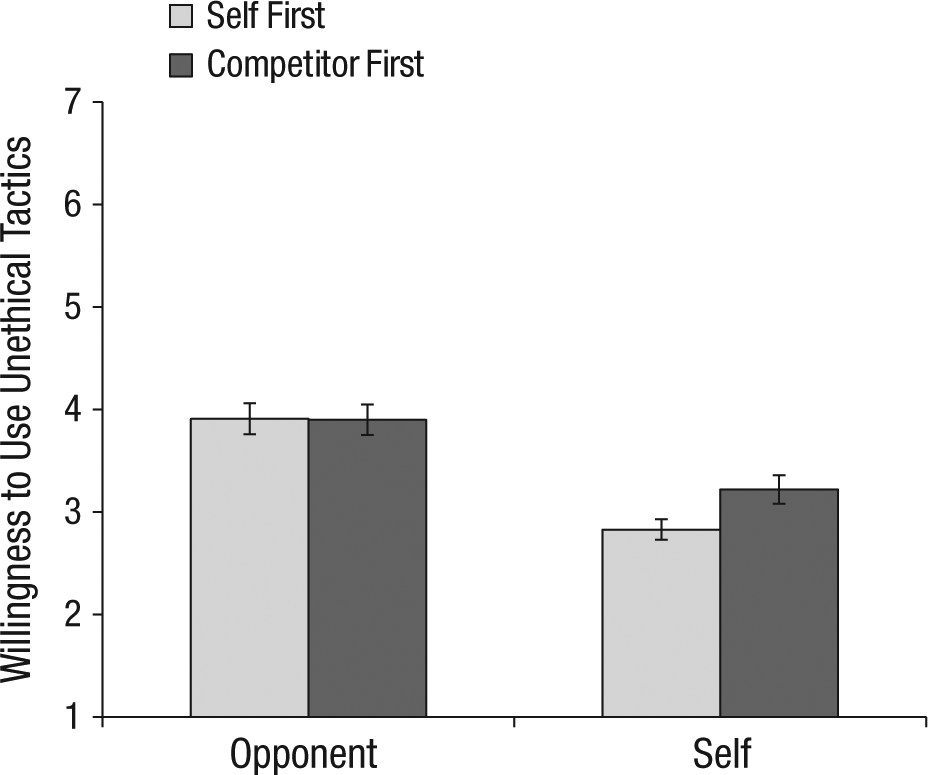
Rated unethical intentions in Experiment 1: participants’ mean ratings of their own and their competitor’s willingness to engage in unethical negotiation behavior in the two experimental conditions (self rated first vs. competitor rated first). Error bars represent ±1 SEM.
Self-ratings of unethical intentions correlated with ratings of the competitor’s unethical intentions (r = .69, p < .001). However, this relationship was stronger when participants considered the competitor’s willingness to use unethical tactics first (r = .78, p < .001) than when they considered their own unethical intentions first (r = .59, p < .001; Fisher’s Z = 1.97, p = .049). A regression analysis predicting self-rated intentions confirmed this finding by revealing an interaction between experimental condition and competitor’s unethical intentions (β = 0.30, p = .001). Participants anchored their own unethical intentions on what they thought their competitor would do and did so more when they considered their competitor’s intentions first rather than second.
Experiment 2: Unethical Intentions in a Negotiation
Experiment 1 provided initial evidence that considering a competitor’s possible behavior leads to greater unethical intentions. However, explicitly asking participants about a competitor’s likelihood of engaging in unethical behaviors prior to asking them about their own willingness to engage in these behaviors may have produced demand effects. To squarely address this limitation, we used a more subtle manipulation of perspective taking and manipulated the relational context (competitive vs. cooperative) in Experiment 2.
Method
Seventy M.B.A. students were randomly assigned to the conditions of a 2 (relational context: competition vs. cooperation) × 2 (perspective-taking condition: perspective taking vs. baseline) design.
First, we asked participants in the competition condition to recall and describe a time when they had competed with someone and how they had felt during the competition. We asked participants in the cooperation condition to recall and describe a time when they had cooperated or collaborated with another person and how they had felt during this cooperation.
Next, we asked all participants to imagine that they were entering a negotiation with the person they had just described. In the baseline condition, we told participants to “take a minute and think about how you would approach the negotiation. Specifically, think about what kinds of tactics you would use.” In the perspective-taking condition, we asked participants to take a minute and take the perspective of this other person. That is, try to imagine what they would be thinking as they approach the negotiation, and try to put yourself in their head, predicting what type of tactics they would use.
Participants then indicated their willingness to use ethically questionable negotiation tactics, rating the same SINS items as in Experiment 1 (α = .64).
Results and discussion
We submitted SINS scores to a 2 (relational context: competition vs. cooperation) × 2 (perspective-taking condition: perspective taking vs. baseline) ANOVA. There was a significant main effect for perspective taking, F(1, 66) = 4.32, p = .042, and a marginal main effect for relational context, F(1, 66) = 3.10, p = .083. As expected, these effects were qualified by a significant interaction, F(1, 66) = 5.88, p = .018 (see Fig. 2). Within the competition condition, participants in the perspective-taking condition (M = 3.76, SD = 0.84) were more willing to use unethical tactics than were those in the baseline condition (M = 3.02, SD = 0.74), F(1, 66) = 20.15, p < .001. In contrast, within the cooperation condition, participants in the perspective-taking condition (M = 3.04, SD = 0.83) did not differ from those in the baseline condition (M = 3.11, SD = 0.71), F(1, 66) = 0.04, p = .842. Overall, participants in the perspective-taking/competition condition had higher unethical intentions than did participants in the other three conditions combined (M = 3.02, SD = 0.75), t(66) = 4.42, p < .001.
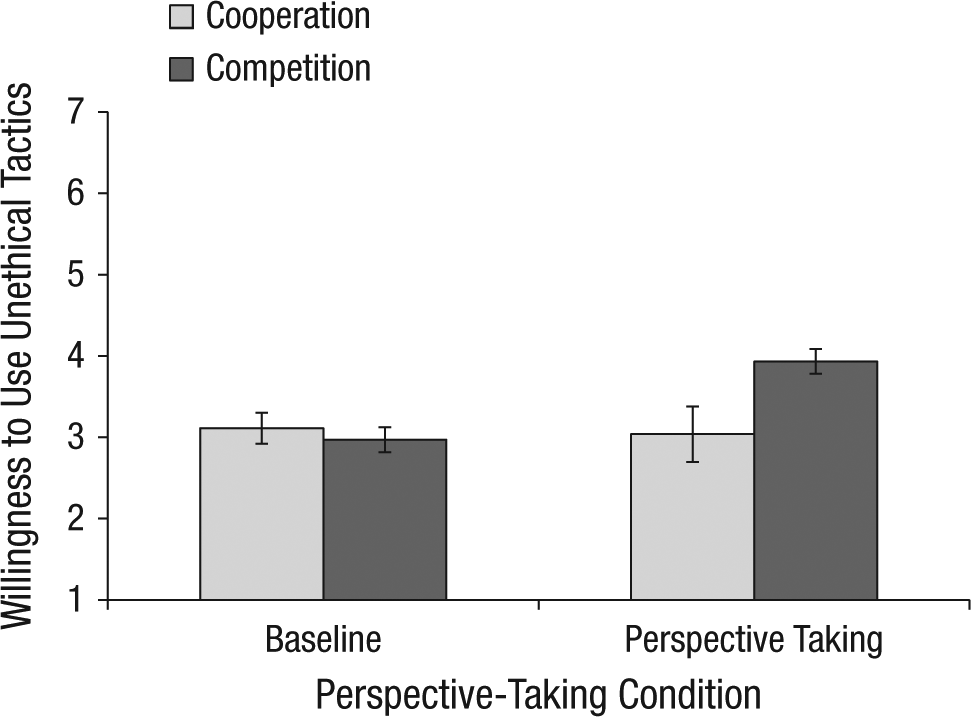
Self-rated unethical intentions in Experiment 2: mean willingness to engage in unethical negotiation behavior as a function of perspective-taking condition (perspective taking vs. baseline) and relational context (competition vs. cooperation). Error bars represent ±1 SEM.
Experiment 2 provides further evidence that taking the perspective of a competitor can foster greater unethical behavior. Furthermore, these effects of perspective taking on unethical intentions crucially depended on the relational context (i.e., competition vs. cooperation).
Experiment 3: Deception in a Public-Goods Game
In Experiment 3, we moved beyond self-report measures and examined the interactive effects of relational context and perspective taking on actual unethical behavior by placing participants in a bargaining context that allowed for the strategic use of deception.
Method
Four hundred twenty adults (57% female, 42% male, 1% with unreported gender; mean age = 35; 96% from the United States or Canada) were recruited from Amazon’s Mechanical Turk and randomly assigned to one of four conditions based on a 2 (relational context: competitive vs. cooperative counterpart) × 2 (perspective-taking condition: perspective taking vs. baseline) experimental design. Participants first wrote a brief essay describing the type of work they enjoyed. Next, we introduced a public-goods game that they would ostensibly play with another participant (in actuality, responses were simulated). Following instructions and comprehension checks, we manipulated relational context and perspective taking. Participants then exchanged messages with their ostensible counterparts and had the opportunity to lie; whether or not they chose to lie served as our dependent measure. Finally, they made their final allocation decisions.
Public-goods game
We created a mixed-motive social dilemma in which each participant received an allocation of points (1 point = $0.05) that could be invested in a joint pool. Any points contributed to the pool grew by 50% and were then divided evenly between both individuals. Points not contributed were kept by the individual to whom they were initially allocated. Thus, the maximum joint benefit was achieved if both individuals contributed all of their points to the pool, and the maximum individual benefit was achieved if a participant contributed nothing to the pool and his or her counterpart contributed everything. We informed participants that they would complete an unknown number of rounds (actually one) and that on each round, each individual would receive a randomly assigned allocation between 8 and 15 points (actually 12), known only to that individual. Finally, we told participants, that before making their final allocation decisions, they would exchange messages with their counterparts, each indicating the size of his or her allocation and the amount he or she intended to invest. We informed participants that these messages were nonbinding, implying that they had an opportunity to lie about their intentions to their counterparts.
Relational-context manipulation
We manipulated participants’ impressions of their counterparts as either cooperative or competitive by revealing their counterparts’ ostensible responses to the question regarding the type of work they enjoyed. In these responses, the word than was deliberately misspelled to increase believability. Participants in the competitive condition read the following:
I like work that challenges me and that is competitive. I think trying to do better then the people around me makes me work harder then my friends or any other person.
Participants in the cooperative condition read the following:
I like working in teams or groups. I think trying to work together towards the same goal we can get more done then just people competing against each other.
Perspective-taking manipulation
We then asked participants to think and write about the upcoming exchange of messages. To facilitate this exercise, we displayed the actual messages they would complete. Specifically, participants saw the following two messages:
I have received an allocation of _________ points.
I will contribute _________ points.
We directed participants in the baseline condition to describe their thoughts and to indicate how they planned to complete their messages. In contrast, we directed participants in the perspective-taking condition to describe their counterpart’s thoughts. Specifically, we asked participants to complete these example messages as they expected their counterpart would if given the same allocation they had received (12 points) and why they thought their counterpart would complete his or her messages that way.
Unethical behavior
Immediately following the perspective-taking manipulation, participants completed and sent the messages reporting the size of their allocation and how much they would contribute to their counterpart. We measured unethical behavior as a dichotomous variable indicating whether or not participants lied about their point allocation. If participants reported an allocation of 12 points, we coded them as honest (unethical behavior = 0). If they indicated they had less than 12 points, we coded them as dishonest (unethical behavior = 1). No one reported receiving more than 12 points.
Mediators
We recorded two potential mediators to test the causal aspect of our theory. We derived the first mediator from the perspective-taking manipulation. We coded expected behavior as honest (0) if participants expected their counterpart to accurately report his or her allocation (i.e., under the presumption that the counterpart had received 12 points) and as dishonest (1) if they expected their counterpart to report fewer points. All participants then made their final allocation decisions after receiving their counterparts’ messages claiming an allocation of 10 points and promising to contribute 8. For our second potential mediator, we asked all participants to report how much they trusted that their counterpart would be honest with them (1 = not at all, 7 = a great deal).
Manipulation and suspicion checks
To verify our manipulations, we asked participants to report how they perceived their counterpart (1 = very competitive, 7 = very cooperative) and how much they considered their counterpart’s perspective (1 = not at all, 7 = a great deal). To assess suspicion, we asked, “Was there anything that took place during the course of the study that you found strange, suspicious, or out of place? If so, exactly when did you feel this way?”
Results and discussion
Sixty-two participants expressed some level of suspicion about the existence of their counterpart. We report analyses for the remaining 358 participants, though results were unchanged when suspicious participants were included in the analyses.
Manipulation check
Participants in the competitive condition perceived their counterparts as less cooperative and more competitive (M = 2.58, SD = 1.80) than did participants in the cooperative condition (M = 5.40, SD = 1.44), F(1, 354) = 267.09, p < .001. Similarly, participants in the perspective-taking condition reported considering the perspective of their counterparts (M = 5.26, SD = 1.54) more than did participants in the baseline condition (M = 4.66, SD = 1.74), F(1, 354) = 12.06, p < .001.
Deception
Ninety-one (25.42%) participants lied to their counterparts about their allocation. Consistent with our hypothesis, a logistic regression analysis of unethical behavior revealed a significant interaction between relational context and perspective-taking condition (Wald statistic = 4.62, p = .032). Main effects for relational context (Wald statistic = 0.20, p = .654) and perspective-taking condition (Wald statistic = 1.90, p = .168) were not significant. As shown in Figure 3, perspective-taking participants were more likely to lie when they perceived their counterparts as competitors (34.78%) than when they perceived their counterparts as cooperators (17.71%), χ2(1, N = 188) = 6.90, p = .009. In contrast, when participants focused on their own perspective, the frequency of lying did not differ between the competitive (23.17%) and cooperative (26.14%) conditions, χ2(1, N = 170) = 0.20, p = .654. From the alternative vantage point, perspective taking led to an increase in deception among participants paired with a competitive counterpart, χ2(1, N = 174) = 2.79, p = .095, and a decrease in deception among participants paired with a cooperative counterpart, χ2(1, N = 184) = 1.90, p = .168. Overall, participants in the perspective-taking/competitive condition used deception significantly more than participants in the other three conditions combined (22.18%), χ2(1, N = 358) = 5.63, p = .018.
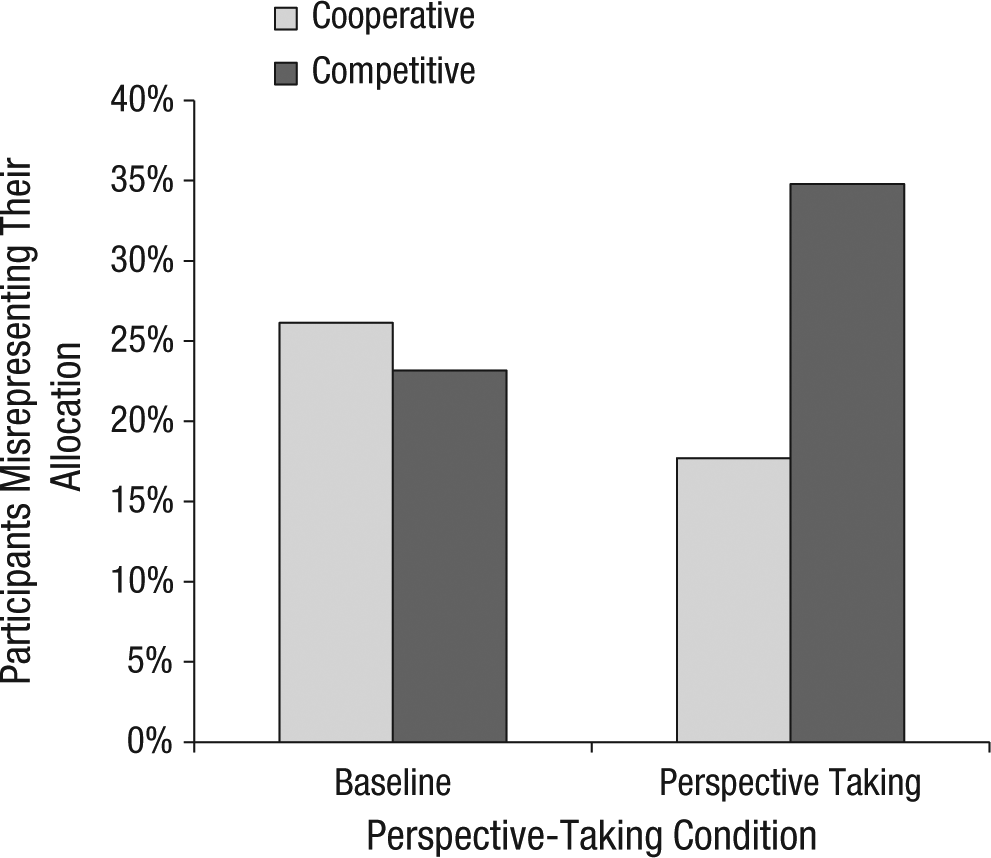
Unethical behavior in Experiment 3: percentage of participants who misrepresented the allocations they received as a function of perspective-taking condition (perspective taking vs. baseline) and relational context (competitive vs. cooperative counterpart).
Mediation
As expected, we found that participants taking the perspective of a competitor were more likely to expect unethical behavior from their counterpart (M = 57.61%) than were participants taking the perspective of a cooperator (M = 32.29%; Wald statistic = 7.14, p = .008). When we regressed participants’ unethical behavior on both the counterpart’s expected behavior and relational context, we found that the coefficient for expected behavior remained significant (Wald statistic = 5.33, p = .009), but the coefficient for relational context did not (Wald statistic = 1.70, p = .191). A bootstrap analysis with 5,000 samples produced a confidence interval (CI) that did not contain zero, indicating a significant indirect effect, 95% CI = [0.003, 0.036].
We also found that trust had a negative relationship with participants’ deceptive behavior (Wald statistic = 30.05, p < .001). Moreover, we found that perspective taking amplified the relationship between relational context and trust, F(1, 355) = 6.40, p < .012. Among participants paired with a competitor, those who took their partner’s perspective reported less trust (M = 3.21, SD = 1.69) than did those who focused on their own (M = 3.73, SD = 1.73), F(1, 355) = 4.47, p = .035. Among participants paired with a cooperator, those who took their partner’s perspective tended to report more trust (M = 5.20, SD = 1.40) than did those took their own perspective (M = 4.85, SD = 1.52), F(1, 355) = 2.11, p = .147. When we regressed participants’ deceptive behavior on trust and our experimental conditions (i.e., relational context, perspective-taking condition, and their interaction), the effect of trust on deception remained significant (Wald statistic = 27.00, p < .001), whereas the interaction between relational context and perspective-taking condition did not (Wald statistic = 1.65, p = .20). A bootstrap analysis with 5,000 samples produced a 95% CI, [0.054, 0.137], that did not contain zero, indicating a significant indirect effect. Taken together, these analyses indicated that expected behavior and trust both mediated the interactive effect of relational context and perspective taking on unethical behavior.
Discussion
In summary, results were consistent with our hypothesis: Taking the perspective of a competitive counterpart led participants to engage in greater deception in a public-goods game by drawing their attention to their counterpart’s potential use of the same tactics. Competition perverted the effects of perspective taking, leading people down the path of unethical behavior.
Experiment 4: Cheating in an Unrelated Context
Experiment 4 extended the previous three experiments by examining whether perspective taking in a competitive context can provoke subsequent unethical behavior in a completely unrelated domain. We examined participants’ dishonesty in reporting their performance on a cognitive task that was entirely unrelated to a competitive/cooperative relationship they had just recalled. This allowed us to test whether perspective taking in a competitive context can activate a self-protection-at-any-cost mind-set.
Method
Two hundred thirty-three M.B.A. students (39% female and 61% male among those who reported their gender; gender data were not collected for one third of the sample) were randomly assigned to the conditions of a 2 (relational context: competition vs. cooperation) × 2 (perspective-taking condition: perspective taking vs. baseline) design.
As in Experiment 2, we manipulated relational context by asking participants to recall either competing or cooperating with another person. To manipulate perspective taking, we asked participants in the baseline condition to also “state what thoughts you were having when you were competing/cooperating.” We asked participants in the perspective-taking condition to take the perspective of their partners and “state what the other person might have been thinking when you were competing/cooperating.”
Following the recall task, participants were presented with an anagram task designed to study cheating behavior (DePalma, Madey, & Bornschein, 1995; Eisenberger & Shank, 1985). Specifically, participants were given 3 min to try to solve a series of four anagrams (“CRKO,” “LABEVE,” “DSLIE,” and “FTOEER”) on a piece of paper. The first and third anagrams had multiple solutions and were quite easily solved (“ROCK,” “CORK”; “IDLES,” “SLIDE”); however, the second and fourth anagrams had no solutions. After this task, participants were asked to report how many anagrams they had solved. Given that two of the anagrams were unsolvable, we coded participants as misrepresenting their performance (unethical behavior = 1) if they reported solving more than two and as accurately represented (unethical behavior = 0) otherwise.
Results and discussion
Twenty-two (9.44%) participants exaggerated their performance on the anagram task. Using logistic regression, we found a significant interaction between relational context and perspective-taking condition in predicting the false reporting of performance (Wald statistic = 5.59, p = .018). We also found a main effect of perspective-taking condition (Wald statistic = 3.82, p = .051), but no effect of relational context (Wald statistic = 0.10, p = .752). As shown in Figure 4, participants who took the perspective of a competitor from their past misrepresented their performance more (21.05%) than did participants who took the perspective of a cooperator (6.78%), χ2(1, N = 116) = 4.52, p = .034. In the baseline condition, participants who recalled a competitor (1.56%) did not differ from participants who recalled a cooperator (8.62%), χ2(1, N = 117) = 2.34, p = .126. From the alternative vantage point, perspective taking led to an increase in unethical behavior among participants who recalled a competitive counterpart, χ2(1, N = 116) = 6.68, p = .010, but not among participants who recalled a cooperative counterpart, χ2(1, N = 117) = 0.14, p = .709. Overall, participants in the perspective-taking/competition condition misrepresented their performance significantly more than did participants in the other three conditions combined (21.05% vs. 5.68%), χ2(1, N = 233) = 10.46, p = .001.
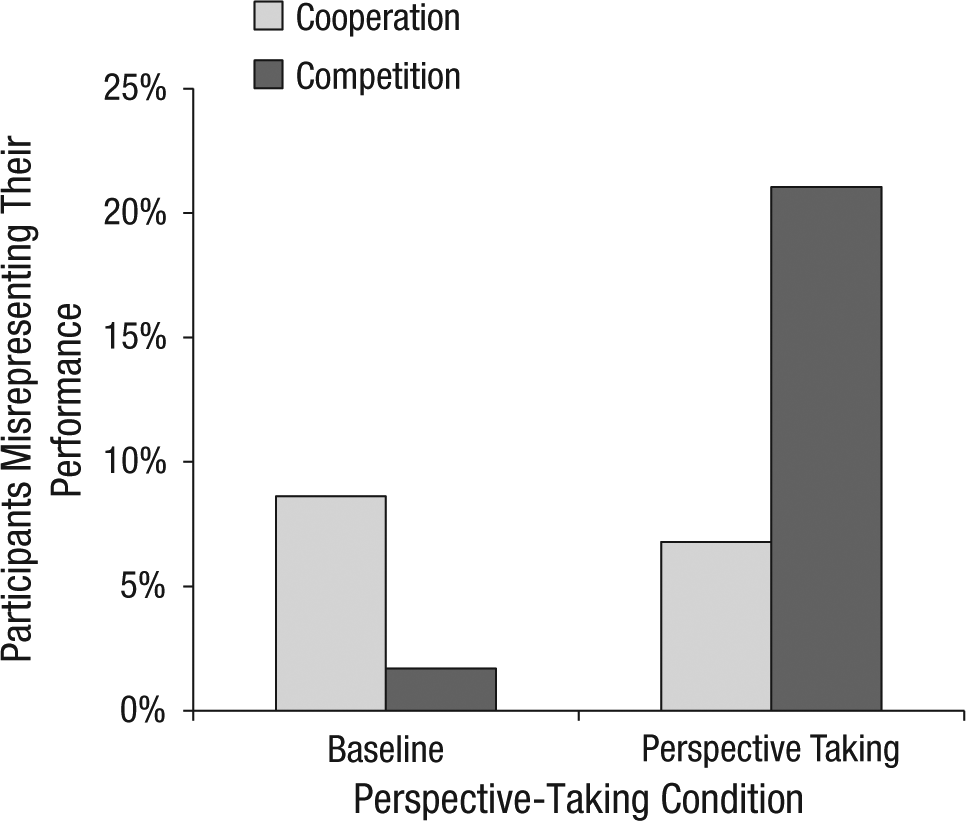
Misrepresentation of performance in Experiment 4: percentage of participants who overreported their performance as a function of perspective-taking condition (perspective taking vs. baseline) and relational context (competition vs. cooperation).
Participants who had previously taken the perspective of a competitor acted more unethically than other participants on a subsequent, wholly unrelated, task. This experiment provides evidence that perspective taking in a competitive context activates a self-protection-at-any-cost mind-set that can spill over into unrelated contexts.
Discussion
Across a series of experiments, we reliably observed an interaction between relational context and perspective taking whereby competition combined with perspective taking proved to be a unique facilitator of unethical behavior. This pattern of results emerged across various instantiations of unethical behavior and using multiple manipulations of competitiveness and perspective taking. In Experiment 1, participants who imagined negotiating with a competitor were more willing to employ ethically questionable tactics if they considered their competitor’s likely behavior before their own. Experiment 2 established that perspective taking interacts with the relational context—competitive or cooperative—to predict unethical negotiation intentions. Experiment 3 demonstrated that these relationships extend to actual unethical behavior directed at other people. Finally, Experiment 4 found that taking the perspective of a competitor creates a self-protection-at-any-cost mind-set that carries over into subsequent tasks unrelated to the competitor.
Taken together, these results suggest that the effects of perspective taking can change dramatically depending on the relational context (i.e., cooperation vs. competition). Although perspective taking has long been thought of as the glue that binds people together, our experiments demonstrate that it can also act as gasoline that fuels competitive and self-protective impulses, leading to deceptive and exploitative behavior, possibly as a prophylactic against exploitation by others. Overall, this research extends current understanding of both the consequences of perspective taking and the relational antecedents of unethical behavior.
It is interesting that we did not find that perspective taking decreased unethical behavior in cooperative contexts. It may be that perspective taking creates the foundation for cooperation, but does not increase moral behavior. In addition, participants in the baseline conditions engaged in relatively little unethical behavior, which suggests potential floor effects. Future research should also explore how relational context and perspective taking might interact with individual differences (e.g., social value orientation; Steinel & De Dreu, 2004). These topics remain open for exploration.
The current findings dovetail with other recent research on the effects of communication media on negotiation outcomes (Swaab, Galinsky, Medvec, & Diermeier, 2012) and on the effects of similarity and familiarity on the intensity of rivalry (Kilduff, Elfenbein, & Staw, 2010). Specifically, a recent meta-analysis found that richer communication media (e.g., face-to-face communication vs. e-mail) enhance the negotiation outcomes of individuals with neutral orientations toward one another by creating opportunities for rapport (Swaab et al., 2012). However, having more communication channels (e.g., sight plus sound) actually hurts the outcomes of negotiators with a competitive orientation, reducing their ability to reach a deal or expand the “pie.” Further, a recent study on the origins of rivalry found that greater similarity and repeated interaction between competitors breeds more intense feelings of rivalry (Kilduff et al., 2010), rather than fostering greater attraction and cooperation, as they normally do (McPherson, Smith-Lovin, & Cook, 2001; Newcomb, 1963; Zajonc, 1968).
These disparate findings suggest a broader phenomenon: Factors that increase psychological closeness between individuals—perspective taking, face-to-face communication, similarity, familiarity—may all serve as relational amplifiers. In cooperative contexts, they smooth the cogs of social interaction, but in competitive contexts, they may intensify competitiveness and lead people to behave more aggressively and even unethically. Contrary to common intuition and the contact hypothesis (Allport, 1954), our work suggests that it is wise to maintain psychological distance between competitors to prevent social glues from transforming into volatile accelerants.
Footnotes
Declaration of Conflicting Interests
The authors declared that they had no conflicts of interest with respect to their authorship or the publication of this article.