



Abstract

Individuals typically believe that children increase parental happiness (see Hansen, 2012), but decades of research have found little support for this contention (e.g., Dolan, Peasgood, & White, 2008). In a recent article, Nelson, Kushlev, English, Dunn, and Lyubomirsky (2013) addressed this issue with analyses of data from the World Values Survey (WVS; 2006) and an experience-sampling data set (Carstensen et al., 2011). Though Nelson et al. carefully avoided making causal claims, they nevertheless concluded that the results provide “strong evidence challenging the widely held [academic] perception that children are a source of reduced well-being” (p. 8).
In this Commentary, we report a reanalysis of the data, which suggests that it is premature to abandon the idea that children reduce happiness. A reassessment of Studies 1 and 2 in Nelson et al., prompted by econometric and conceptual concerns, failed to support the conclusions of the authors. 1 Parents did report higher levels of well-being than nonparents did, but the difference appears to have been entirely driven by omitted factors—such as marital status and parental age—that were highly correlated with both the presence of children and well-being. We found that controlling for such factors, which are available in the data, erases the positive relationship between well-being and parenthood. A reanalysis seems especially critical in light of the importance that Nelson et al. attribute to these findings for “those planning a family” and for “emerging evolutionary perspectives” of parenting (p. 9).
Do Children Improve Parental Well-Being?
Using the WVS sample of U.S. respondents (N = 6,906), we reexamined the relationship between parenthood and three measures of well-being (happiness, life satisfaction, and thoughts about meaning in life) analyzed by Nelson et al. (Table 1). 2 We estimated the following additive linear model:

Parents and Well-Being: Replication and Reanalysis of Nelson, Kushlev, English, Dunn, and Lyubomirsky (2013)
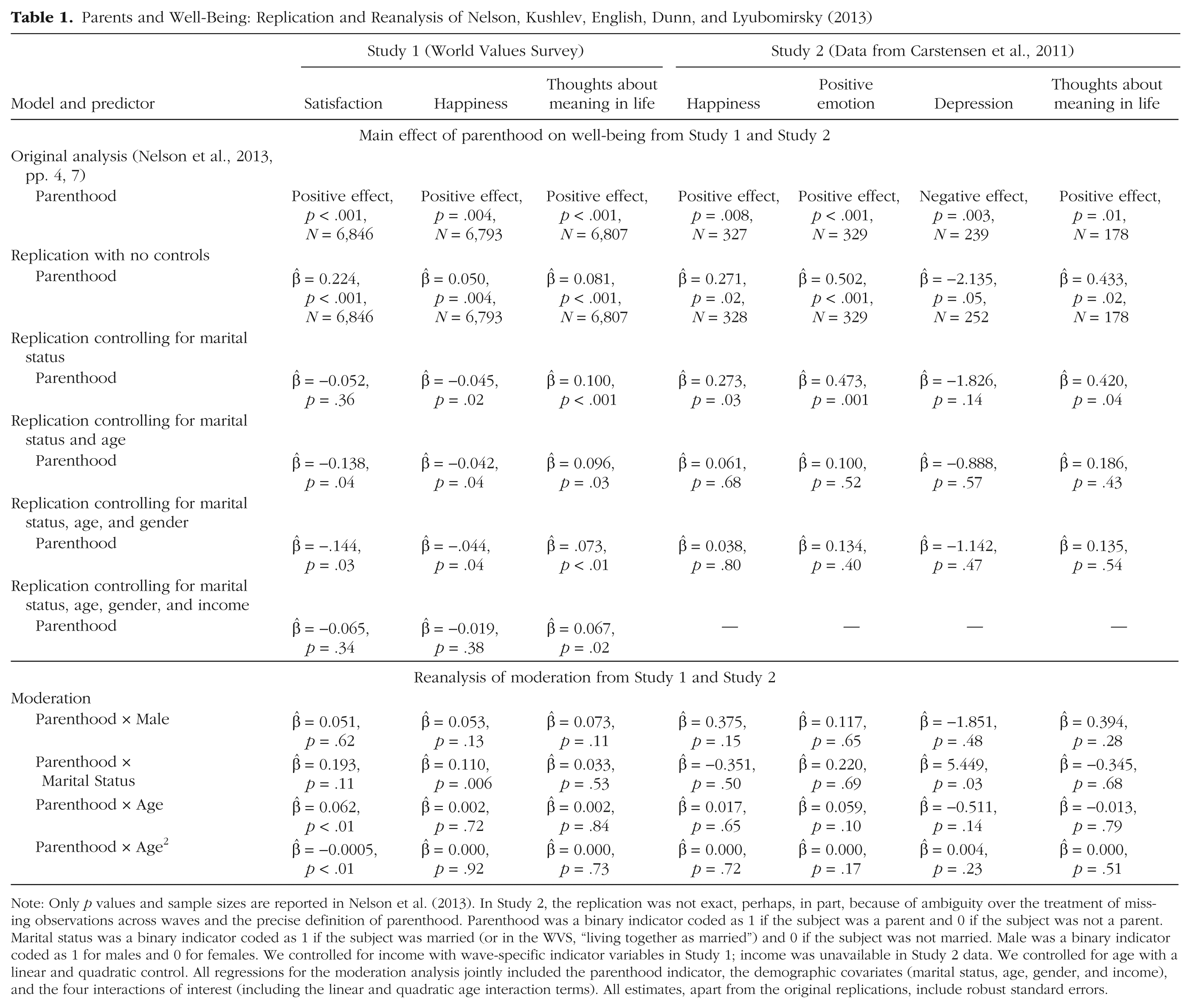
Note: Only p values and sample sizes are reported in Nelson et al. (2013). In Study 2, the replication was not exact, perhaps, in part, because of ambiguity over the treatment of missing observations across waves and the precise definition of parenthood. Parenthood was a binary indicator coded as 1 if the subject was a parent and 0 if the subject was not a parent. Marital status was a binary indicator coded as 1 if the subject was married (or in the WVS, “living together as married”) and 0 if the subject was not married. Male was a binary indicator coded as 1 for males and 0 for females. We controlled for income with wave-specific indicator variables in Study 1; income was unavailable in Study 2 data. We controlled for age with a linear and quadratic control. All regressions for the moderation analysis jointly included the parenthood indicator, the demographic covariates (marital status, age, gender, and income), and the four interactions of interest (including the linear and quadratic age interaction terms). All estimates, apart from the original replications, include robust standard errors.
where
An assumption for causal interpretation of these estimates is the absence of confounding factors that covary with both well-being and parenthood (Wooldridge, 2010). This assumption was not met. Controlling for marital status in the model yielded negative coefficient estimates for the effect of parenthood on both happiness (
In other words, though parents report greater happiness than nonparents do, parents are also much more likely to be married, and married adults report higher well-being than their unmarried counterparts. As can be seen in Table 1, statistically controlling for marriage eliminates the positive association between parenthood and both happiness and satisfaction. The inclusion of additional controls for age, gender, and income produces near-zero and statistically insignificant estimates of the effect of parenthood.
3
We note, however, that the positive association between thoughts about meaning in life and parenthood survives (
What Factors Moderate the Parenthood and Well-Being Link?
In addition to examining the main effect of parenthood on well-being, Nelson et al. found significant moderation by parental gender, marital status, and parental age. Motivated by analogous concerns regarding the potential for bias due to omitted factors, we estimated a single model that jointly included each of the interactions of interest and the aforementioned covariates (Table 1). The results of this exercise using data from Study 1 provided no evidence for moderation by gender and mixed evidence for moderation by age (only for satisfaction) and marital status (only for happiness). With respect to marriage and happiness, the hedonic return of parenthood was near zero for married couples (happiness:
What Can We Conclude?
We share the sentiments of Nelson et al. with regard to the theoretical and practical value of illuminating the hedonic returns to parenthood as well as frustration over an inconclusive literature. However, readers of Nelson et al. will invariably draw conclusions not supported by the authors’ data. Parents in these samples did report higher well-being than nonparents did, but the association was driven by a set of known confounds for which anyone interested in isolating the effect of parenthood must account. Although one might exclude covariates because of potential endogeneity, it is far from clear that such a rationale applies here. These data fail to indicate a statistically meaningful link between parenthood on assessments of satisfaction and happiness, nor significant moderation by parental gender. The article offers, at best, inconsistent evidence for claims regarding parenthood and assessments of meaning, as well as inconsistent evidence for moderation of effects by marital status and age.
One cannot reasonably conclude from the data in Study 1 or 2 that parenthood improves well-being. Study 3 of Nelson et al., in which the authors investigated the relative well-being of parents in the presence of their children, is not diagnostic of the overall hedonic impact of parenthood. Although one must exercise caution in making causal inferences from cross-sectional comparisons of these sorts, even after carefully controlling for observable factors, these data characterize parenthood in a manner that is more consistent with the existing literature (e.g., Dolan et al., 2008) than the one offered by Nelson et al.
Footnotes
Acknowledgements
We thank David Card, Stefano DellaVigna, Dan Gilbert, Prasad Krishnamurthy, Andrew Oswald, Jesse Shapiro, Oleg Urminsky, and Aman Vora for helpful comments. All remaining errors are our own.
Declaration of Conflicting Interests
The authors declared that they had no conflicts of interest with respect to their authorship or the publication of this article.