



Abstract
Money, a resource that absorbs much daily attention, seems to be involved in much unethical behavior, which suggests that money itself may corrupt. This research examined a way to offset such potentially deleterious effects—by focusing on time, a resource that tends to receive less attention than money but is equally ubiquitous in daily life. Across four experiments, we examined whether shifting focus onto time can salvage individuals’ ethicality. We found that implicitly activating the construct of time, rather than money, leads individuals to behave more ethically by cheating less. We further found that priming time reduces cheating by making people reflect on who they are. Implications for the use of time primes in discouraging dishonesty are discussed.
It seems that a day does not go by without some unethical behavior by a politician, movie star, professional athlete, or high-ranking executive making the headlines. Although less sensational, revelations of cheating have also crept into the sciences, and continue to show up in classrooms, businesses, and marriages. Sadly, such actions have ruinous consequences, hurting individuals, families, corporations, and entire academic fields. Given that decades of psychology research have shown that people strive to maintain a positive self-concept (Adler, 1930; Rogers, 1959) and that morality is central to people’s self-image (Aquino & Reed, 2002; Chaiken, Giner-Sorolla, & Chen, 1996), the prevalence of unethical behavior and the fact that even good people are prone to lose track of their moral compass is surprising (Ayal & Gino, 2011; Mazar, Amir, & Ariely, 2008; Shalvi, Eldar, & Bereby-Meyer, 2012). Are there simple ways to encourage self-reflection and thereby decrease individuals’ tendencies to behave immorally, so they do not tarnish their self-image?
Here, we focus on two triggers that may influence self-reflection and are ubiquitous enough in the environment to have a chance at instigating a widespread effect on unethical behavior: money and time. Both are principle resources that individuals encounter on a daily basis, as they constantly manage how to spend and save their dollars and hours. And even though Benjamin Franklin encouraged equating the two in his directive “time is money,” research comparing these resources shows that people react to them differently (Aaker, Rudd, & Mogilner, 2011; DeVoe & Pfeffer, 2007, 2010, 2011; Mogilner, 2010; Zauberman & Lynch, 2005).
When people are focused on money, they behave in self-interested (but not self-reflective) ways. For instance, merely thinking about money leads people to be less helpful and fair in their dealings with others, to be less sensitive to social rejection, and to work harder toward personal goals (Vohs, Mead, & Goode, 2006, 2008; Yang et al., 2013; Zhou, Vohs, & Baumeister, 2009). Indeed, university students were more likely to cheat after seeing 7,000 dollar bills than after seeing 24 (Gino & Pierce, 2009). Given the prominence of money in Western culture’s psyche (Fromm, 1976) and its centrality in Western political philosophy (Caruso, Vohs, Baxter, & Waytz, in press), the prevalence of unethical behavior becomes less surprising.
Time is equally ubiquitous in people’s lives, but it tends to absorb less attention. For instance, in a pilot study we conducted, 125 Americans (55 male, 70 female; ages 18–69 years) reported (on 7-point scales) that they think less about time than about money over the course of their day (Mtime = 5.10, SD = 1.43; Mmoney = 5.55, SD = 1.27), t(124) = 2.70, p = .008, and are less focused on time than on money in general (Mtime = 5.04, SD = 1.44; Mmoney = 5.42, SD = 1.38), t(124) = 2.29, p = .02. Google Trends (www.google.com/trends) also shows that across the world over the past 5 years, “dollar” received 30% more Web searches than “hour,” and “save money” received 73% more searches than “save time.”
If people were to shift their attention away from money and toward time, would they behave in ways that are consistent with self-reflection and a more admirable self-image? Prior research has found that when people are reminded of time (rather than money), they are more generous in their charitable giving (Liu & Aaker, 2008) and are more motivated to connect with loved ones (Mogilner, 2010)—a behavior that is particularly treasured when reflecting on one’s life (Fredrickson & Carstensen, 1990; Loewenstein, 1999). Additionally, whereas people use money in transactions with everyone from close friends to perfect strangers, they reserve time for the people and things that really matter to who they are (Foa & Foa, 1980). Therefore, time may be more than just a resource that people manage in their daily schedules; how they spend their time may serve as the measure of people’s lives and who they are as individuals. If time is indeed more reflective of the self than is money (Mogilner & Aaker, 2009; Reed, Aquino, & Levy, 2007), it may be that leading people to think about time, rather than money, will encourage them to reflect on who they are as individuals, and thus be less prone to unethical behavior.
We specifically predicted that priming people to think about time, rather than money, would lead them to behave more ethically by encouraging them to reflect on who they are and making them more conscious of how they conduct themselves so as to maintain a positive self-image. We tested this hypothesis across four experiments in which we primed participants to think about time or money and observed their tendencies to cheat for monetary or personal gain.
Experiment 1: Priming Money Versus Time
We first examined whether priming people to think about time, rather than money, would lead them to behave more ethically by cheating less. Participants were primed with money, time, or neither and then completed a task in which they had the opportunity to cheat by overstating their performance, thereby taking unearned money.
Method
Participants and design
Ninety-eight students and staff members at a university in the southeastern United States (43 males, 55 females; mean age = 23.15 years, SD = 8.13) participated in the study for pay. They received a $2 fee for showing up and had the opportunity to earn an additional $20 according to their performance in the study. Participants were randomly assigned to one of three conditions: money prime, time prime, or no prime (control condition).
Prime
Participants were told that they would complete a series of unrelated tasks and were first presented with a scrambled-sentences task in which they were surreptitiously exposed to time-related words, money-related words, or only neutral words (Mogilner, 2010). Each item consisted of a set of four words, and the task was to use three to create a sentence. For example, participants in the time condition were asked to construct a sentence out of the word set “sheets the change clock,” those in the money condition were presented with the set “sheets the change price,” and those in the control condition were presented with the neutral set “sheets the change socks.” Participants had 3 min to create as many sentences as possible.
Cheating opportunity
The next task was presented as the “numbers game.” Participants received an envelope that contained $20, along with two sheets of paper. The first was a collection slip that included instructions and an example number matrix, a space for participants to report their performance on the task, and demographic questions. The second was a work sheet with 20 matrices, each consisting of a set of 12 three-digit numbers (e.g., 4.78; Mazar et al., 2008). Participants had 5 min to find two numbers per matrix that added up to 10, but 5 min is not enough time to solve all 20 matrices (Gino, Ayal, & Ariely, 2009). For each pair of numbers identified correctly, participants were instructed to keep $1 from their supply of money; they were to return the remaining amount in the envelope along with the collection slip at the end of the task. Before returning the money and submitting their collection slips, participants threw their actual matrix work sheets into a recycle bin.
There was no apparent identifying information anywhere on the two sheets, so participants’ actual results seemed anonymous. Thus, participants had both an incentive and opportunity to overreport their performance in order to earn more money. In actuality, one of the three-digit numbers in the example matrix on the collection slip was different for each participant and was equal to one of the three-digit numbers in a matrix on the work sheet. This allowed us to later match the work sheet with the collection slip of each participant and to compute the difference between self-reported and actual performance (i.e., the extent of cheating). We calculated this difference such that a positive value indicated cheating.
Results and discussion
The percentage of participants who cheated varied across conditions, χ2(2, N = 98) = 14.61, p = .001 (see Fig. 1); participants were more likely to cheat in the money condition (87.5%, 28/32) than in either the control condition (66.7%, 22/33), χ2(1, N = 65) = 3.97, p < .05, or the time condition (42.4%, 14/33) χ2(1, N = 65) = 14.44, p < .001. Also, participants were less likely to cheat in the time condition than in the control condition, χ2(1, N = 66) = 3.91, p < .05.
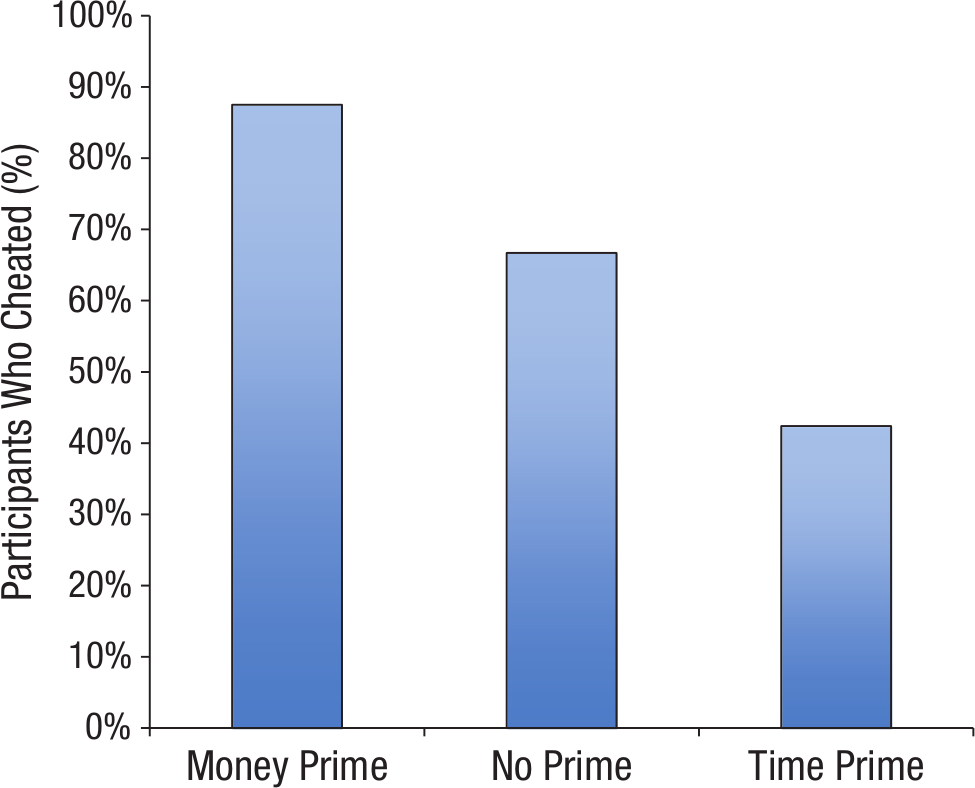
Percentage of participants who cheated in each condition of Experiment 1.
The extent of cheating also varied across conditions, F(2, 95) = 5.09, p = .008, η p 2 = .10. Simple contrasts revealed that participants cheated more in the money condition (M = 4.41, SD = 4.25) than in both the control condition (M = 2.76, SD = 3.96; p = .07) and the time condition (M = 1.55, SD = 2.41; p = .002). The difference between the time and control conditions did not reach statistical significance (p = .18).
Altogether, these results show that that compared with participants in the control condition, participants in the money condition were more likely to cheat by overreporting their performance, whereas participants in the time condition were less likely to cheat.
Experiment 2: Manipulating Self-Reflection
Our first study demonstrated that money primes encourage unethical behavior, whereas time primes discourage it. To test the robustness of these effects, in Experiment 2 we used a novel priming method. Additionally, we adapted the numbers game to rule out a potential confound in the cheating measure: In Experiment 1, participants’ task performance was rewarded with money; therefore, it may have been that priming participants with money simply increased their motivation to earn more money, rather than influencing their ethicality per se. To rule out this potential confound, we did not use money to reward participants for their performance in this experiment.
More important, we designed this study to gain insight into why thinking about time leads to less cheating than thinking about money. We did this by manipulating participants’ motivation to perform well on the numbers game. For half of the participants, the game was described as an intelligence test; for the other participants, the game was described as a personality test that reflected what kind of person they are. We expected that if priming time decreases cheating by making people reflect on who they are, cheating behavior in the latter condition would not differ between participants primed with money and those primed with time. However, participants who were told that the game was a test of intelligence would show the same effect observed in Experiment 1.
Method
Participants and design
One hundred forty-two students at an East Coast university (61 males, 81 females; mean age = 21.84 years, SD = 3.75) participated in this study as part of an hour-long session of studies for which they received $10. Participants were randomly assigned to one of four conditions in a 2 (prime: time vs. money) × 2 (assessment: intelligence vs. personality) between-subjects design.
Prime
Ostensibly before beginning the study, participants were told that in a later experimental session we were going to conduct a study in which students would be exposed to different songs and that we would measure the songs’ effects on behavior. To prepare for that study, we were asking these participants to help us search for songs that have lyrics pertaining to various topics. Participants were asked to spend no more than 5 min finding lyrics for a song that exemplifies how people feel or think about a particular topic: either “money” or “time.” Participants were encouraged to use the Internet site www.songlyrics.com to find an appropriate song. After entering the lyrics of their selected song, they rated how hard it was to think of or find this song (1 = not at all, 7 = very). Finding a time-related song (M = 3.09, SD = 1.95) was no more difficult than finding a money-related song (M = 2.92, SD = 2.11), F < 1.
Cheating opportunity
Next, participants received two sheets of paper for the same numbers game as in Experiment 1, except that there was no money involved. The first sheet included instructions for the task and the collection slip, and the second was the work sheet with 20 matrices. Participants had 5 min to complete as many matrices as possible.
The game was framed as either an intelligence test or a personality test. In the intelligence-test condition, participants were instructed, “This game is an intelligence test that is designed to assess your likelihood to be successful in the future.” In the personality-test condition, they were instructed, “This game is a personality test that is designed to assess what type of person you are.” Before reporting their performance, participants threw their actual matrix work sheets into a recycle bin, so that they believed they could overreport their performance (i.e., cheat) without getting caught. In actuality, as in Experiment 1, we were able to match participants’ work sheets with the collection slips on which they reported their performance.
Results and discussion
A 2 (prime) × 2 (assessment) analysis of variance was conducted on extent of cheating, calculated as the difference between participants’ reported and actual performance on the numbers game. The results revealed a marginal main effect of prime; participants in the money condition cheated more than those in the time condition, F(1, 138) = 2.77, p = .099. As predicted, this effect was qualified by a significant interaction, F(1, 138) = 3.99, p < .05, η p 2 = .03 (see Table 1 for information about the percentage of people who cheated and the extent of cheating in each condition). Only when the game was framed as an intelligence test did thinking about money lead to greater cheating than thinking about time, F(1, 138) = 6.69, p = .01. When the game was framed as a personality test, there was no difference in cheating between the money and time conditions, F < 1. In fact, participants primed with money cheated less when they thought the game assessed their personality than when they thought it assessed their intelligence, F(1, 138) = 4.58, p = .03. There was no such difference among those primed with time, F < 1.
Mean Extent of Cheating and Percentage of Cheaters in the Four Conditions of Experiment 2

Note: Standard deviations are given in parentheses.
These results provide further evidence for the differential effects of priming time and money on unethical behavior. They also offer initial insight into the psychological mechanism underlying the effect of priming time by showing that it makes people reflect on who they are, and that this type of self-reflection reduces cheating.
Experiment 3: Manipulating Self-Reflection with a Mirror
Using yet another priming technique in Experiment 3, we further examined the effect of priming money or time on cheating and the mechanism underlying this effect. In addition to priming participants with either money or time, we manipulated whether or not they completed their tasks in front of a mirror. Facing a mirror is a technique used to increase self-reflection (Diener & Wallbom, 1976). We reasoned that if time primes reduce cheating by leading people to reflect on themselves, then the mirror-present condition would produce results similar to those of the time condition—that is, participants in the money condition would exhibit less cheating if they completed their tasks in front of a mirror than if they did not.
Method
Participants and design
One hundred twenty students at a university in the southeastern United States (44 males, 76 females; mean age = 21.07 years, SD = 6.64) participated in the study for pay. They received a $2 fee for showing up and could earn an additional $10 throughout the study. The study employed a 2 (prime: time vs. money) × 2 (mirror: present vs. absent) between-subjects design.
Mirror manipulation
During the experiment, half of the participants sat at a cubicle facing a mirror located right next to their computer. The other half did not have a mirror at their cubicle.
Prime
Participants were told that they would complete a series of unrelated tasks. First, they were asked to count either a stack of 30 $1 bills or the days in a paper calendar (one page per day). These tasks served as the money and time primes. In both conditions, we asked participants to stop and record the number they had counted thus far whenever they encountered a bill or a page with writing on it. Participants completed this task as fast as they could, and did it twice to check for accuracy.
Cheating opportunity
The same numbers game as in Experiments 1 and 2 was used to assess cheating. In this case, participants received $0.50 for every matrix they reported solving correctly.
Final questionnaire
After being paid, participants completed a final questionnaire with demographic questions and a two-item manipulation check for our self-reflection manipulation. The rating scale for the manipulation check ranged from 1 (strongly disagree) to 7 (strongly agree). The items were, “During the study, I’ve been very aware of myself” and “Rather than thinking about myself, my mind has been concentrated on what is going on around me” (reverse-coded).
Results and discussion
Results confirmed the effectiveness of our mirror manipulation. Participants reported feeling more self-aware when a mirror was present than when it was not, F(1, 116) = 21.22, p < .001, η p 2 = .16 (see Table 2).
Mean Self-Reflection and Extent of Cheating, and Percentage of Cheaters, in the Four Conditions of Experiment 3
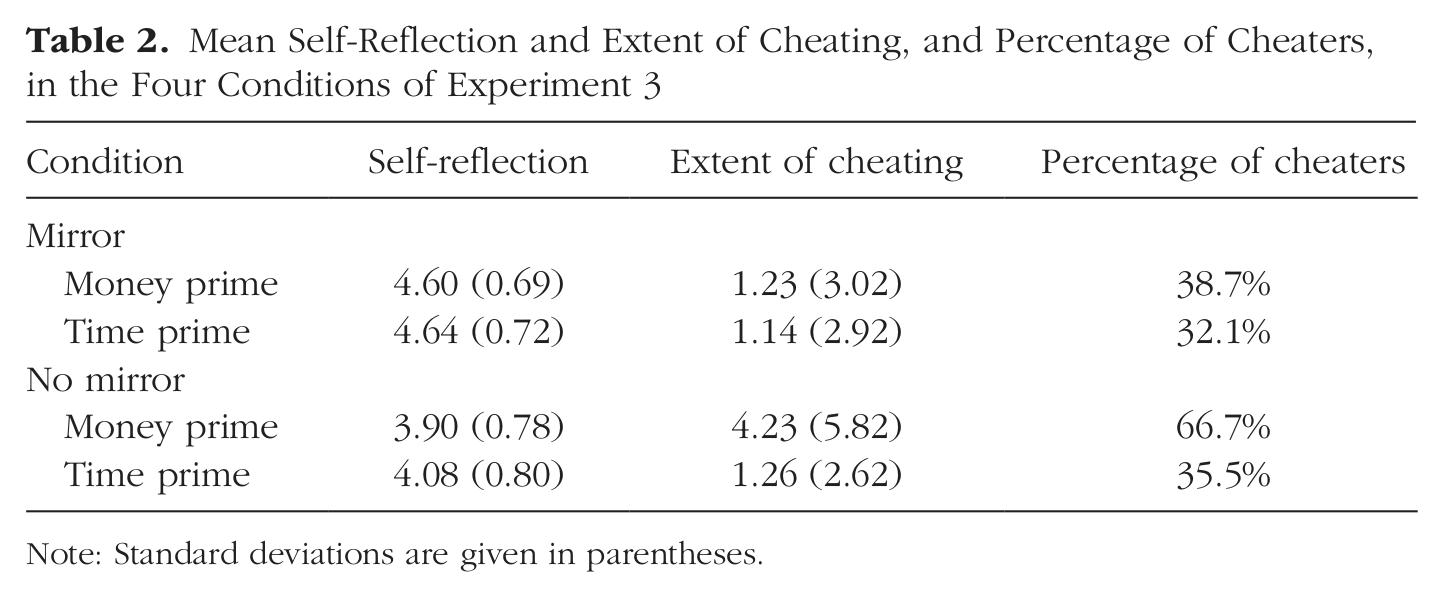
Note: Standard deviations are given in parentheses.
A 2 (prime) × 2 (mirror) analysis of variance on the extent of cheating revealed a significant main effect for both prime condition, F(1, 116) = 4.81, p = .03, η p 2 = .04, and mirror condition, F(1, 116) = 5.01, p = .03, η p 2 = .04. These effects were qualified by a significant interaction, F(1, 116) = 4.30, p = .04, η p 2 = .04 (see Table 2 for information about the percentage of cheaters and the extent of cheating in each condition). Only when participants did not complete their tasks in front of a mirror did thinking about money lead to greater cheating than thinking about time, F(1, 116) = 9.11, p = .003. When a mirror was present, there was no difference in cheating between the money and time conditions, F < 1.
These results provide further evidence that priming time decreases cheating by making people reflect on who they are. When self-reflection was triggered through the use of a mirror, participants primed with money behaved the same way as those primed with time.
Experiment 4: Measuring Self-Reflection Directly
Our first three experiments consistently showed that thinking about money encourages cheating, whereas thinking about time discourages it. Experiments 2 and 3 also offered evidence that these effects occur through self-reflection. In Experiment 4, we tested for this mechanism more directly by including a self-reported measure of self-reflection.
Method
Participants and design
Two hundred fourteen adults recruited through Amazon’s Mechanical Turk (135 males, 79 females; mean age = 27.78 years, SD = 6.00) completed this online study for pay. Participants were randomly assigned to one of three conditions: time prime, money prime, or control. The study included two supposedly unrelated tasks: a scrambled-sentences task (the prime) and a word-jumble task (the cheating measure).
Prime
Participants completed the same scrambled-sentences task as in Experiment 1. Depending on condition, this task surreptitiously exposed participants to time-related words, money-related words, or neutral words.
Questionnaire
After the prime, participants completed a short questionnaire that included a measure of self-reflection (the proposed mediator) and some filler items. Self-reflection was assessed with four items (α = .81) rated on a 7-point scale, from 1 (strongly disagree) to 7 (strongly agree): “Right now, I feel like reflecting on my own life”; “Right now, I am thinking about who I am as a person”; “ Right now, I am aware of myself”; and “Right now, I feel attentive to my inner feelings.”
Cheating opportunity
Next, participants completed an ostensibly unrelated task that involved unscrambling jumbled words (from Wiltermuth, 2011). They were told that they would receive a $0.50 bonus for every jumble they reported solving correctly. Participants were to indicate which jumbled words they successfully unscrambled but were not asked to write out the unscrambled words.
The instructions indicated that the jumbles had to be solved in the order in which they appeared: “If you successfully unscramble the first three word jumbles but not the fourth, you will be paid only for the first three—even if you also successfully unscramble the fifth, sixth, and seventh word jumbles.” Participants saw nine jumbled words, eight of which could be unscrambled to spell such common words as house, carol, and jumping. The third jumbled word, however, could be unscrambled to spell the obscure word taguan. 1 In a pretest, not one of 42 participants successfully unscrambled this jumble, so it is unlikely that participants acting honestly would report having solved this item. Notably, solving the third jumble allowed participants to be paid for solving the very solvable fourth through ninth jumbles. Thus, participants had an incentive to cheat on the third jumble so that they could receive a greater payment. The frequency with which participants reported having solved this jumble served as the measure of cheating.
Final questionnaire
After being paid for the task, participants answered a questionnaire with demographic questions and an open-ended question regarding their awareness of the purpose of the study. No participant correctly guessed the study’s objective or hypothesis.
Results and discussion
Self-reflection
Participants’ reported self-reflection varied by condition, F(2, 210) = 12.42, p < .001, η p 2 = .11 (see Table 3). In particular, reported levels of self-reflection were lower in the money condition compared with both the control condition (p = .001) and the time condition (p < .001). Participants reported greater self-reflection in the time condition than in the control condition (p = .024).
Mean Self-Reflection and Percentage of Cheaters in the Three Conditions of Experiment 4
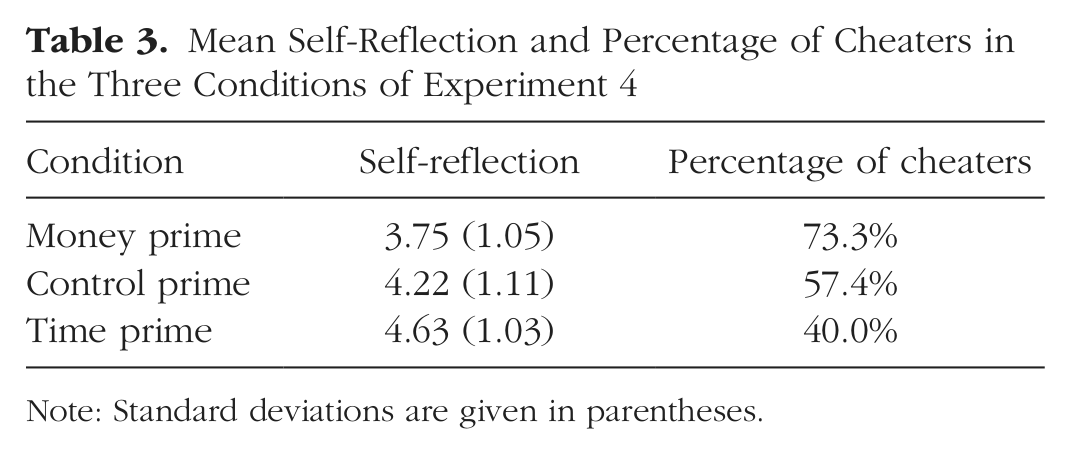
Note: Standard deviations are given in parentheses.
Cheating
We observed the same pattern of results for cheating, χ 2 (2, N = 213) = 16.44, p < .001: Participants were more likely to cheat in the money condition (73.3%, 55/75) than in either the control condition (57.4%, 39/68), χ2(1, N = 143) = 4.04, p = .044, or the time condition (40.0%, 28/70), χ2(1, N = 145) = 16.44, p < .001. Participants were less likely to cheat in the time condition than in the control condition, χ2(1, N = 138) = 4.16, p = .041.
Mediation analyses
Next, we conducted mediation analyses (Baron & Kenny, 1986) to test whether self-reflection explained the relationship between the time prime and reduced cheating, and the relationship between the money prime and increased cheating. The effect of priming time was reduced to nonsignificance (from b = −0.70, SE = 0.35, p < .05, to b = −0.45, SE = 0.38, p = .24) when self-reflection was included in the model; greater self-reflection was associated with lower cheating (b = −0.96, SE = 0.21, p < .001). A bootstrap analysis showed that the 95% bias-corrected confidence interval (CI) for the size of the indirect effect, [−0.90, –0.07], excluded zero, which suggested a significant indirect effect (MacKinnon, Fairchild, & Fritz, 2007). Similarly, the effect of priming money became nonsignificant (from b = 0.71, SE = 0.36, p < .05, to b = 0.41, SE = 0.39, p = .30) when self-reflection was included in the model; self-reflection again predicted cheating (b = −0.86, SE = 0.21, p < .001; 95% bias-corrected CI = [0.07, 1.00]).
These results suggest that priming time reduces cheating by increasing self-reflection, and priming money increases cheating by lowering self-reflection. By measuring self-reflection directly through self-reports, this experiment provided further evidence for the hypothesized role of self-reflection as the psychological mechanism linking time, money, and morality.
General Discussion
Does money corrupt? Given society’s obsession with money, our findings offer a sobering answer to this question by showing that simply thinking about money can make people behave more dishonestly. Fortunately, an equally ubiquitous resource in daily life, time, has the opposite effect. Across four experiments, using different primes and a variety of measures and tasks, we consistently found that shifting people’s attention to time decreases dishonesty. Priming time makes people reflect on who they are, and this self-reflection reduces their likelihood of behaving dishonestly.
Focusing on time therefore seems to lead people to notice that how they spend their time sums up to their life as a whole, encouraging them to act in ways they can be proud of when holding up this mirror to who they are. Consequently, priming time (rather than money) makes people behave more ethically. Future research could examine potentially important boundary conditions based on how people think of time. For instance, if people feel time constrained (i.e., if they assume a short-term, instead of a long-term, view of time), they may act less ethically, rather than more ethically.
This research contributes to previous work on the effects of money and time primes on individual behavior. Our findings suggest that the effects demonstrated in prior work may not be due to money or time primes per se, but rather to the amount of self-reflection they elicit. In fact, our results show that money and time primes trigger low and high levels of self-reflection, respectively. Thus, our research provides a conceptual contribution to accounting for the previously documented effects of money and time primes.
Our work also contributes to existing work in moral psychology and behavioral ethics. Recent research in this domain has demonstrated that although people care about being moral and being seen as ethical by others, they often fail to follow their moral compass and cheat (e.g., Mazar et al., 2008). Our results suggest that finding ways to nudge people to reflect on the self at the time of temptation, rather than on the potential rewards they can accrue by cheating, may be an effective way to curb dishonesty. Given the pervasiveness of dishonesty in today’s society, we hope our research will inspire other investigations or interventions that can successfully reduce unethical behavior.
Footnotes
Acknowledgements
The authors greatly appreciate the support and facilities of the labs where the studies were conducted: the Center for Decision Research at the University of North Carolina at Chapel Hill, the CLER Lab at Harvard Business School, and the Wharton Behavioral Lab.
Declaration of Conflicting Interests
The authors declared that they had no conflicts of interest with respect to their authorship or the publication of this article.
Funding
We thank Harvard Business School and Wharton’s Dean’s Research Fund for financial support.