



Abstract
In three studies, we examined how racial progress affects Whites’ perceptions of anti-White bias. When racial progress was chronically (Study 1) and experimentally (Study 2) salient, Whites who believed the current U.S. status hierarchy was legitimate were more likely to report that Whites were victims of racial discrimination. In contrast, Whites who perceived the current status system as illegitimate were unaffected by the salience of racial progress. The results of Study 3 point to the role of threat in explaining these divergent reactions to racial progress. When self-affirmed, Whites who perceived the status hierarchy as legitimate no longer showed increased perceptions of anti-White bias when confronted with evidence of racial progress. Implications for policies designed to remedy social inequality are discussed.
Keywords
For decades, the phrase victim of racial discrimination evoked images of racial minorities. Whites were seen as perpetrators, rather than as targets, of racial bias. More recently, an increasing number of Whites in the United States are identifying themselves as victims of racial discrimination. We argue that racial progress, or racial minorities more frequently occupying high-status positions traditionally held by Whites, is one cause of this shift. For Whites who support the status hierarchy, racial progress is an assault on their social standing that causes them to perceive greater amounts of racial bias against Whites.
Perhaps the most salient example of racial progress was the election of President Barack Obama. Many heralded Obama’s presidency as a symbol of a postracial era in which racism no longer disadvantages racial minorities (Williams & Negrin, 2008). Indeed, Whites’ perceptions of racial progress increased after Obama’s victory (Sears & Tesler, 2011), and after the election, individuals reported that they perceived racism against racial minorities as less of a problem than in the past (Kaiser, Drury, Spalding, Cheryan, & O’Brien, 2009). Taken together, these findings suggest that the status of racial minorities in the United States is perceived as improving.
Interestingly, this increase in perceptions of racial progress seems to have been accompanied by an increase in perceptions of discrimination against Whites. A recent national survey revealed that Whites believe that anti-White bias has been increasing over time, whereas anti-Black bias has been decreasing (Norton & Sommers, 2011). Furthermore, 58% of Whites aged 18 to 24 years agreed that “discrimination against Whites has become as big a problem as discrimination against Blacks and other minorities” (Public Religion Research Institute, 2011, para. 5). Despite the increasing perceptions of racial victimization among Whites, researchers have yet to establish why this shift has occurred.
We argue that for Whites who endorse beliefs that legitimize the status hierarchy (but not for Whites who reject these beliefs), racial progress is threatening and leads to greater perceptions of anti-White bias.
Status-Legitimizing Beliefs Justify Inequality
The United States, like most societies, is structured hierarchically, such that groups at the top of the hierarchy have more access to resources than do groups at the bottom (Sidanius & Pratto, 1999). Given high-status-group members’ desire to justify the existing social structure, societies propagate status-legitimizing beliefs (SLBs) that rationalize the status hierarchy and support the status quo (Jost & Banaji, 1994). For example, endorsement of SLBs (e.g., Protestant work ethic, individual-mobility beliefs, belief in a just world) justifies the position of low-status groups, such as Blacks, by implying that they do not work hard enough (Kinder & Sears, 1981). SLBs further allow Whites to rationalize their high-status position because they frame Whites as hardworking and deserving of status (Major et al., 2002; Major, McFarlin, & Gagnon, 1989). Rejection of SLBs, in contrast, is associated with the belief that the current status hierarchy is illegitimate and stems from injustice (Crocker & Major, 1994).
We argue that for Whites who endorse the status hierarchy (SLBs), racial progress threatens their standing. It also implies that racial minorities are receiving preferential treatment, thereby facilitating their illegitimate ascent in the status hierarchy. This hypothesis is grounded in research that has demonstrated that instability in status systems causes high-status groups to experience threat and engage in efforts to maintain and justify their group’s high-status position (Bettencourt, Dorr, Charlton, & Hume, 2001; Scheepers, 2009; Turner & Brown, 1978). Indeed, when Whites who endorse SLBs perceive themselves as having less successful outcomes than racial minorities, they are particularly likely to see their loss as illegitimate and due to racial bias (Major et al., 2002).
In contrast, for Whites who reject SLBs, racial progress validates their belief that the traditional social structure is illegitimate. For these individuals, social inequality is perceived as unfair and society as in need of change. In essence, racial progress is threatening for SLB endorsers but not for SLB rejecters. Thus, SLB-endorsing Whites should experience threat when they consider racial progress, whereas SLB-rejecting Whites should not be threatened.
Perceiving Discrimination in Response to Threat
Perceiving greater racial discrimination against Whites may be one way that Whites respond to the threat of racial progress. Attributions to discrimination can protect the self because they imply that rejections are caused by factors outside the individual and not from personal shortcomings (Crocker & Major, 1989; Major, Kaiser, & McCoy, 2003). Thus, if racial progress threatens SLB-endorsing Whites, those individuals may be more inclined to perceive anti-White discrimination to mitigate threat to the group’s social standing. In contrast, if SLB-endorsing Whites are buffered from the experience of threat (e.g., via self-affirmation; Steele, 1988), this should eliminate the link between SLBs and perceptions of anti-White bias.
Hypotheses
For Whites who endorse SLBs, racial progress challenges the status hierarchy. Thus, we hypothesized that Whites who endorse SLBs should perceive more anti-White bias when racial progress is chronically (Study 1) or experimentally (Study 2) salient. For Whites who reject SLBs, racial progress is not threatening, and their perceptions of anti-White bias should not be influenced by the salience of racial progress. When SLB-endorsing Whites are buffered from threat (via self-affirmation), the link between racial progress and perceptions of anti-White bias should be eliminated (Study 3).
Study 1
In Study 1, we tested whether SLBs moderated the relationship between racial progress and perceptions of anti-White bias. We hypothesized that perceiving greater amounts of racial progress would be associated with greater perceptions of anti-White bias among individuals who strongly endorse SLBs but not among individuals who reject SLBs.
Method
Participants
Participants were 79 Whites (54.9% female, 43.7% male, 1.4% did not report gender) who were recruited online through Amazon’s Mechanical Turk and participated in exchange for $0.25. After we removed individuals who had engaged in random clicking (e.g., selecting a response when asked not to), 71 participants remained.
Procedure and measures
Participants completed the measures in the order described in the following sections. All items were rated using scales from 1 (strongly disagree) to 7 (strongly agree).
SLBs
Participants completed Levin, Sidanius, Rabinowitz, and Federico’s (1998) 12-item SLB measure, which assesses individuals’ beliefs regarding system legitimacy, or the perception that the system is fair (example item: “America is a just society where differences in status between ethnic groups reflect actual group differences”); system permeability, or the perception that all individuals, regardless of ethnicity, can achieve social advancement (example item: “America is an open society where individuals of any ethnicity can achieve higher status”); and Protestant work ethic, or the idea that hard work is rewarded (example item: “If people work hard they almost always get what they want”). We averaged these items (α = .90; M = 3.54, SD = 1.02) and used the composite score in our analyses because the separate subscales functioned similarly across analyses (also see O’Brien & Major, 2005). Together, our SLB items assess the extent to which individuals believe that the system is fair and legitimate.
For high-status groups, system justification and status justification are compatible processes that serve the same function (Jost & Hunyady, 2002): maintaining Whites’ position at the top of the racial hierarchy. We measured system justification rather than status justification because it is unlikely that Whites would explicitly report the belief that Whites should maintain their position at the top of the status hierarchy, given social conventions that discourage expressions of bias (e.g., Dovidio & Gaertner, 1986).
Racial progress
The measure of racial progress comprised the following five items: (a) “Blacks in the U.S. are better off now (financially, politically, etc.) than they ever have been,” (b) “In the last 50–70 years, great progress has been made toward racial equality in the United States,” (c) “There has been little improvement in conditions for Blacks in the U.S. since the Civil Rights Movement” (reverse-scored), (d) “The election of the first Black president shows that the U.S. has made strides toward racial equality,” and (e) “Racial minorities now occupy high-status positions traditionally held by Whites” (α = .76; M = 5.41, SD = 0.87). 1
Perceptions of anti-White bias
We used eight items to assess perceptions of anti-White bias: (a) “Prejudice and discrimination against Whites are on the rise,” (b) “Whites are victims of racial bias,” (c) “Whites do not experience racism” (reverse-scored), (d) “Whites experience discrimination from Blacks,” (e) “Whites experience discrimination from other Whites,” (f) “Blacks and other racial groups benefit from preferential treatment that disadvantages Whites,” (g) “Reverse racism (where racial minorities are favored over Whites) is pervasive,” and (h) “Only racial minorities experience negative outcomes based on their race” (reverse-scored; α = .87; M = 4.46, SD = 1.14).
Results and discussion
To test whether SLBs moderated the relationship between racial progress and perceived anti-White bias, we entered mean-centered SLB scores and mean-centered racial-progress scores in Step 1 of a hierarchical linear regression with anti-White-bias perceptions as the dependent variable. The two-way interaction between SLBs and racial progress was entered in Step 2.
The first step of the analysis was significant, F(2, 68) = 9.63, p < .001, and revealed that stronger endorsement of SLBs was associated with greater perceptions of anti-White bias, b = 0.48, SE = 0.13, t(68) = 3.85, p < .001. 2 Racial progress was unrelated to anti-White bias in Step 1, b = 0.14, SE = 0.15, t(68) = 0.92, p = .36. Consistent with our hypotheses, results revealed a significant interaction between SLBs and racial progress in Step 2, F(3, 67) = 7.99, p < .001; R2 change = .04; b = 0.24, SE = 0.12, t(67) = 1.97, p = .05.
To probe the interaction, we computed high and low SLB scores: We subtracted and added 1 standard deviation to mean-centered SLB scores and then computed interaction terms with mean-centered racial-progress scores. These interactions were entered in the second step of a hierarchical linear regression (Cohen, Cohen, Aiken, & West, 2003). For Whites who endorsed SLBs (those whose scores were 1 SD above the mean), perceptions of racial progress were associated with greater perceptions of anti-White bias, b = 0.43, SE = 0.21, t(67) = 2.07, p = .04. For Whites who rejected SLBs (those whose scores were 1 SD below the mean), perceptions of racial progress were unrelated to perceptions of anti-White bias, b = −0.10, SE = 0.19, t(67) = −0.55, p = .58 (see Fig. 1). In sum, Study 1 supports the hypothesis that perceptions of racial progress are associated with greater perceptions of anti-White discrimination for Whites who believe the status hierarchy is legitimate but not for Whites who think the status hierarchy is illegitimate.
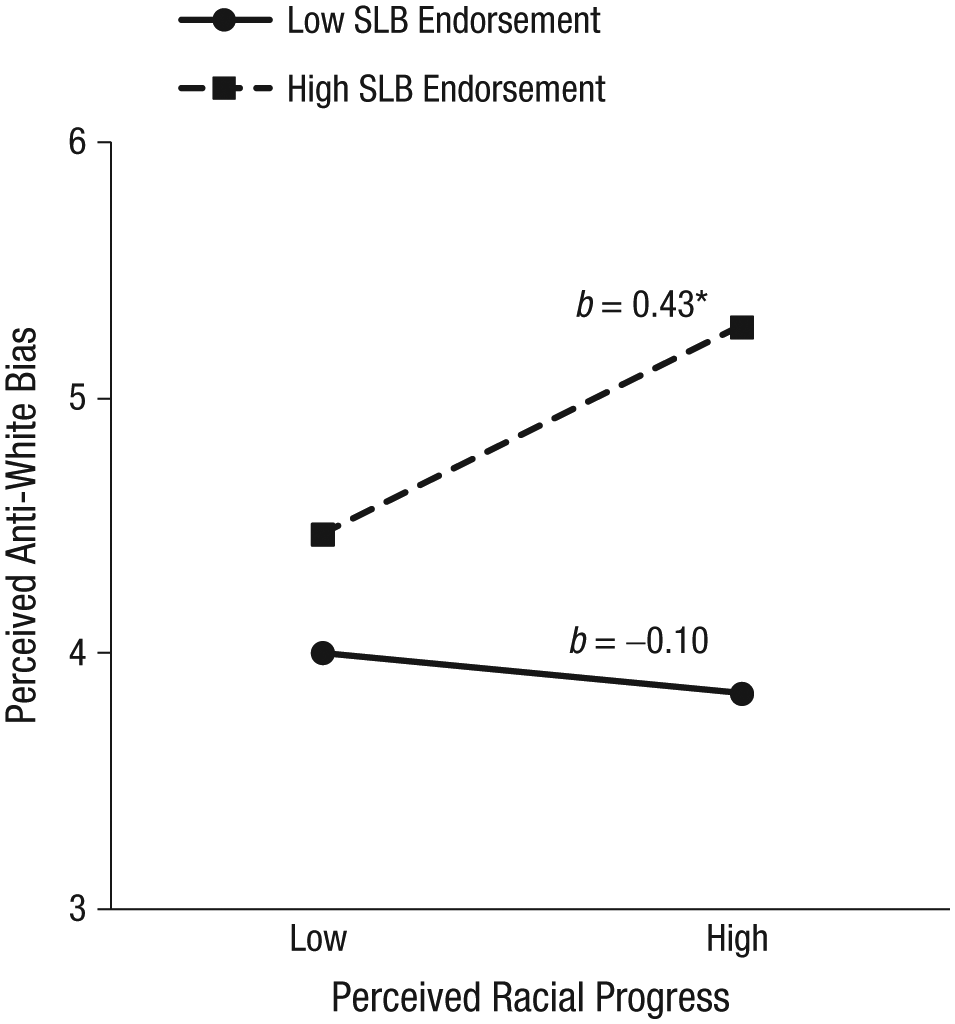
Results of Study 1: mean perceived anti-White bias as a function of perceived racial progress and SLB endorsement. The range of possible anti-White-bias scores was 1 to 7. For low and high levels of perceived racial progress and SLB endorsement, scores were 1 SD below and above the mean, respectively. The asterisk indicates a significant slope (p < .05, two-tailed).
Study 2
In Study 2, we tested whether SLBs moderated the relationship between racial progress and anti-White bias when racial progress was manipulated rather than measured. We predicted that participants who strongly endorsed SLBs, but not participants who rejected SLBs, would report greater perceptions of anti-White bias in the racial-progress condition than in the control condition. Similarly, we predicted that SLBs would be positively associated with perceptions of anti-White discrimination in the racial-progress condition but not in the control condition.
Method
Participants
Participants were 168 Whites (39% female, 61% male; mean age = 27.85 years, SD = 9.54) who were recruited through Mechanical Turk and participated in exchange for $0.25. We removed 8 participants from the analysis for random clicking.
Procedure
Participants were told that they would be participating in two separate studies. The “first study” was described as an examination of reactions to news articles. Participants were randomly assigned to read one of two articles. In the racial-progress condition, participants read about high-status racial minorities in traditionally White positions (e.g., Barack Obama, Condoleezza Rice) and further read that social mobility is generalized to racial minorities in the United States (e.g., progress in college enrollment and income). In the control condition, participants read about an underdog swim team winning the national championship. This control article mirrored the racial-progress article in that it was about a low-status group becoming a higher-status group. Participants completed questions that tested their memory of the articles.
The “second study” was described as an examination of perceptions of society. This portion of the procedure contained the measure of anti-White bias and a manipulation check—an item measuring participants’ agreement with the statement “Blacks in the U.S. are better off now (financially, politically, etc.) than they ever have been.” Participants then reported their endorsement of SLBs and demographic information.
Measures
Perceptions of anti-White discrimination (α = .85; M = 4.21, SD = 1.12) and SLB endorsement (α = .86; M = 3.46, SD = 0.90) were measured as described in Study 1.
Results and discussion
Manipulation check
Participants in the racial-progress condition (M = 5.64, SD = 1.12) reported stronger perceptions of racial progress than did participants in the control condition (M = 4.96, SD = 1.24), t(158) = 3.50, p = .001. SLB endorsement was not affected by the racial-progress manipulation, t(158) = −0.86, p = .39.
Analytic plan
Mean-centered SLB scores and condition (0 = control, 1 = racial progress) were entered in Step 1 of a hierarchical linear regression. The two-way interaction between SLB and condition was entered in Step 2. In order to examine whether there were differences between conditions for individuals high and low in SLB endorsement, we tested the effects of condition for participants whose levels of SLB endorsement were high (1 SD above the centered mean) and low (1 SD below the centered mean; Cohen et al., 2003). Additionally, we examined simple slopes to determine whether SLB endorsement was related to anti-White bias within each condition.
Does SLB endorsement moderate perceptions of anti-White bias?
The first step of the regression examining perceptions of discrimination against Whites was significant, F(2, 157) = 12.05, p < .001. Stronger SLB endorsement was associated with increased perceptions of anti-White bias, b = 0.45, SE = 0.09, t(157) = 4.9, p < .001. There was no main effect of condition, b = 0.10, SE = 0.17, t(157) = 0.59, p = .56. Step 2 revealed a significant interaction between condition and SLB endorsement, F(3, 156) = 10.70, p < .001; R2 change = .04; b = 0.49, SE = 0.18, t(156) = 2.66, p = .01. The slopes from this interaction are displayed in Figure 2.

Results of Study 2: mean perceived anti-White bias as a function of SLB endorsement and condition. The range of possible anti-White-bias scores was 1 to 7. For low and high levels of SLB endorsement, scores were 1 SD below and above the mean, respectively. Asterisks indicate a significant slope (p < .001, two-tailed).
Consistent with our hypotheses, results showed that among participants who strongly endorsed SLBs (scores 1 SD above the mean), participants in the racial-progress condition perceived more anti-White bias than did those in the control condition, b = 0.53, SE = 0.23, t(156) = 2.3, p = .02. In contrast, among participants who rejected SLBs (scores 1 SD below the mean), there were no significant differences between the racial-progress and the control condition in perceptions of racial bias, b = −0.34, SE = 0.23, t(156) = −1.47, p = .14.
As expected, in the racial-progress condition, the more participants endorsed SLBs, the more they reported perceiving anti-White bias, b = 0.67, SE = 0.12, t(156) = 5.51, p < .001. SLB endorsement was unrelated to participants’ perceptions of anti-White bias in the control condition, b = 0.18, SE = 0.14, t(156) = 1.31, p = .19.
In Study 2, manipulating racial progress revealed that SLB endorsement moderated perceptions of anti-White bias. Whites who endorsed SLBs reported more anti-White bias in the racial-progress condition than in the control condition. Thus, for individuals who believed that Whites’ rightful place is at the top of the hierarchy, changes to that hierarchy increased their perceptions that Whites are victims of racial bias.
Studies 1 and 2 provided converging support for the hypothesis that SLBs moderate the relationship between racial progress and perceptions of anti-White bias. They did not, however directly examine whether racial progress is threatening for SLB endorsers. Thus, in Study 3, we examined whether racial progress threatened SLB-endorsing Whites by using self-affirmation to manipulate the experience of threat.
Study 3
Method
Participants
Participants were 100 Whites (40% female, 60% male; mean age = 33.51 years, SD = 12.91) who were recruited online through Mechanical Turk and participated in exchange for $1. We eliminated 5 participants from the analysis for random clicking.
Procedure
Participants completed measures that assessed their SLB endorsement and then read a shortened version of the racial-progress article used in Study 2. All participants read about racial progress because in Study 2, the racial-progress condition was the only condition in which SLB endorsement predicted perceptions of anti-White bias. Next, participants were randomly assigned to one of two conditions. In the self-affirmation condition, we asked participants to view a list of values (e.g., “social life/relationships,” “religion/spirituality”) and to write about a time when their behavior exemplified their most important value. In the nonaffirmation condition, participants were asked to recall and write about what they had eaten during the previous day (see Monin, Sawyer, & Marquez, 2008, for more details about the use of this control). Participants then reported their perceptions of anti-White bias as well as demographic information. Responses to all items were made using scales from 1 (strongly disagree) to 7 (strongly agree).
Measures
We used 12 items to assess participants’ SLB endorsement. These items were similar to those used in Studies 1 and 2 but did not include ethnic-group labels. For example, the item “America is an open society where individuals of any ethnicity can achieve higher status” was changed to “America is an open society where individuals of any group can achieve higher status” (α = .83; M = 3.52, SD = 0.88; see O’Brien & Major, 2005, for this scale). The use of a SLB measure that did not prime racial status provided a stronger test of status-justification motives. Anti-White bias was measured with the same items used in Studies 1 and 2 (α = .78; M = 3.52, SD = 1.04).
Results
Mean-centered SLB scores and affirmation condition (0 = nonaffirmation, 1 = self-affirmation) were entered in Step 1 of a hierarchical linear regression, and the interaction between mean-centered SLBs and affirmation condition was entered in Step 2. The first step of the regression was marginally significant, F(2, 92) = 2.55, p = .08. Participants with stronger SLB endorsement, compared with those with weaker SLB endorsement, reported that Whites experience more bias, b = 0.27, SE = 0.12, t(92) = 2.26, p = .03. There was no effect of affirmation condition, b = −0.06, SE = 0.21, t(92) = −0.29, p = .78. Step 2 revealed the hypothesized interaction between condition and SLB endorsement in predicting perceptions of anti-White bias, F(3, 91) = 3.29, p = .02; R2 change = .05; b = −0.51, SE = 0.24, t(91) = −2.14, p = .04.
We found that SLB endorsement predicted greater perceptions of anti-White bias in the nonaffirmation condition, b = 0.52, SE = 0.17, t(91) = 3.14, p = .002, a result that replicated our findings from Studies 1 and 2. Importantly, after the self-affirmation manipulation, participants’ SLB endorsement no longer significantly predicted their perceptions of anti-White bias, b = 0.02, SE = 0.17, t(91) = 0.09, p = .93, which suggests that racial progress was no longer threatening to self-affirmed participants. The slopes for this interaction are displayed in Figure 3.

Results of Study 3: mean perceived anti-White bias as a function of SLB endorsement and condition. The range of possible anti-White-bias scores was 1 to 7. For low and high levels of SLB endorsement, scores were 1 SD below and above the mean, respectively. Asterisks indicate a significant slope (p < .01).
Also consistent with our expectations, results revealed that among participants with strong SLB endorsement (scores 1 SD above the mean), participants in the self-affirmation condition perceived marginally lower amounts of anti-White bias than did participants in the nonaffirmation condition, b = −0.51, SE = 0.30, t(91) = −1.73, p = .08. In contrast, among participants who rejected SLBs (scores 1 SD below the mean), there were no significant differences between conditions in perceptions of anti-White bias, b = 0.38, SE = 0.29, t(91) = 1.30, p = .20.
Discussion
In Study 3, we examined whether the relationship between SLB endorsement and perception of anti-White bias among Whites exposed to racial progress would be mitigated by a self-affirmation procedure. Among individuals in the nonaffirmation condition, SLB endorsement was positively associated with perceptions of anti-White bias. In contrast, SLBs were unrelated to bias perceptions among individuals in the self-affirmation condition. Thus, self-affirmation allowed SLB-endorsing Whites to perceive racial progress without feeling like victims of racial bias. According to the self-affirmation framework, when individuals’ self-integrity is affirmed and their normal response to threat is mitigated, one can infer that “the response was motivated by a desire to protect self-integrity” (Sherman & Cohen, 2006, p. 187). Thus, our results are consistent with the perspective that racial progress is threatening to individuals with stronger SLB endorsement and that this threat corresponds to greater perceptions of anti-White bias.
General Discussion
Whites are increasingly identifying themselves as victims of racial discrimination (Norton & Sommers, 2011), and many Whites believe that discrimination against Whites is as serious a problem as discrimination against racial minorities (Public Religion Research Institute, 2011). Our work is the first to demonstrate why this trend is emerging and for whom it is most descriptive. Our studies reveal that racial progress causes Whites who view the status hierarchy as fair to react by perceiving more anti-White bias.
Study 3 provided evidence that racial progress is threatening to the extent to which participants endorse SLBs. The positive relationship between SLB endorsement and perceptions of discrimination among Whites exposed to racial progress was eliminated when participants were self-affirmed. Thus, regardless of participants’ beliefs about status legitimacy, when they were buffered from threats to the self, racial progress had no implications for their perceptions of anti-White bias.
Caveats
Given that SLBs were measured rather than manipulated, SLBs might covary with other individual differences among Whites. For example, one could argue that SLBs correspond to zero-sum beliefs (ZSBs) about discrimination, such that our SLB-endorsing participants perceived gains for racial minorities as losses for Whites (Norton & Sommers, 2011) or as indicative of greater anti-White bias. We examined this possibility in a study similar to Study 2, in which we manipulated racial progress and measured ZSBs. Although SLBs and ZSBs were correlated, r(45) = .45, p = .02, ZSBs did not moderate condition effects on perceptions of anti-White bias (whereas SLBs did). Furthermore, our racial-progress manipulation did not affect participants’ ZSBs, t(41) = 0.86, p = .39. Thus, our results provide a unique explanation not accounted for by ZSBs.
Furthermore, one might question whether SLBs predict increased perceptions of anti-White bias when simply race, as opposed to racial progress, is made salient. In a separate study in which we manipulated race salience by having participants read either a story about Blacks and Whites in the United States—without a reference to the changing status relations between them—or the story about the swim team used in Study 2, there was no main effect of SLBs and there was no interaction between SLBs and racial-salience condition, t(107) = 0.34, p = .73.
Finally, some may wonder whether SLBs are a proxy for prejudice, such that Whites who endorse SLBs are more biased against racial minorities and more likely to see themselves as victims of bias. Although there is some overlap between SLBs and measures of bias, the relationship is small (Chambers, Schlenker, & Collisson, 2013), which suggests that SLBs and prejudice are distinct constructs. Thus, it is unlikely that these alternatives account for our results.
Implications
If some Whites respond to racial progress by seeing themselves as victims of discrimination, this response may influence their perceptions of the future needs of both Whites and other racial groups. Whites who believe that their racial group is victimized may be less inclined to believe that racial minorities need programs designed to mitigate inequality (Eibach & Purdie-Vaughns, 2010; Kaiser et al., 2009; Plaut, 2011). Furthermore, Whites who view their racial group as victimized may believe that funding and resources traditionally directed toward racial minorities should be redirected toward Whites, whom they perceive to be the new face of racial discrimination. This shift would correspond to the perspective that affirmative-action policies systematically advantage racial minorities and disadvantage Whites, as evidenced by recent court cases (e.g., Fisher v. University of Texas at Austin, 2013; also see Apfelbaum, Norton, & Sommers, 2012; Plaut, 2011).
It is important to note that the current state of racial progress is far from complete (Pettit, 2012). Many disparities remain between Blacks and Whites. For example, the median wealth of White households is 20 times higher than that of Black households and 18 times higher than that of Latino households (Kochhar, Fry, & Taylor, 2011). Furthermore, in 2009, the White-to-Black wealth ratio was higher than it had been in the previous two decades. If exaggerated notions of racial progress continue, racial injustice is likely to persist.
Conclusion
Three studies provide converging evidence that racial progress is a threat to the status hierarchy, which causes Whites who support that hierarchy to perceive more anti-White discrimination. Future work should examine whether social progress is threatening to members of other high-status groups and whether it leads them to perceive greater bias toward their group. For example, would perceptions of gender progress threaten men (Scheepers, Ellemers, & Sintemaartensdijk, 2009) and thereby cause them to perceive more anti-male sexism? If societies are to become more equal, it is critical to identify strategies that allow high-status groups to perceive social progress in a nonthreatening way.
Footnotes
Acknowledgements
We thank our research assistants and Michael Inkles for data collection and Sapna Cheryan, Adam Galinsky, and Tony Greenwald for feedback on previous drafts of the manuscript.
Declaration of Conflicting Interests
The authors declared that they had no conflicts of interest with respect to their authorship or the publication of this article.
Funding
This research was supported by National Science Foundation (NSF) and Ford Foundation predoctoral fellowships, by Grants in Support of Scholarship from Wesleyan University to C. L. Wilkins, and by NSF Grant BCS-0749159 to C. R. Kaiser.

Notes
References
Supplementary Material
Please find the following supplemental material available below.
For Open Access articles published under a Creative Commons License, all supplemental material carries the same license as the article it is associated with.
For non-Open Access articles published, all supplemental material carries a non-exclusive license, and permission requests for re-use of supplemental material or any part of supplemental material shall be sent directly to the copyright owner as specified in the copyright notice associated with the article.
