




Abstract
The widespread existence of cooperation is difficult to explain because individuals face strong incentives to exploit the cooperative tendencies of others. In the research reported here, we examined how the spread of reputational information through gossip promotes cooperation in mixed-motive settings. Results showed that individuals readily communicated reputational information about others, and recipients used this information to selectively interact with cooperative individuals and ostracize those who had behaved selfishly, which enabled group members to contribute to the public good with reduced threat of exploitation. Additionally, ostracized individuals responded to exclusion by subsequently cooperating at levels comparable to those who were not ostracized. These results suggest that the spread of reputational information through gossip can mitigate egoistic behavior by facilitating partner selection, thereby helping to solve the problem of cooperation even in noniterated interactions.
Keywords
The existence of cooperation poses a puzzle to the biological and social sciences because each person faces strong incentives to exploit the cooperative tendencies of others (Dawes, 1980; Komorita & Parks, 1996). What, then, can explain the existence of widespread cooperation observed in human societies? Recent research on reputation systems has provided one potential explanation: The knowledge that one’s behavior will be known by many others reduces an individual’s incentive to behave selfishly, thereby promoting cooperation (Hardy & van Vugt, 2006; Simpson & Willer, 2008; Willer, 2009). In addition, knowing which of one’s potential partners has a reputation for cooperation or defection helps sustain cooperation in at least two ways. First, such information assists individuals in determining whom to selectively interact with by allowing them to choose to pair with more cooperative partners (Barclay & Willer, 2007). Further, within relationships, such information can be used to guide how much trust individuals should invest in a given partner (Barclay, 2004). But although scholars have identified reputation systems as valuable in fostering cooperation (Milinski, Semmann, & Krambeck, 2002; Wedekind & Milinski, 2000), little research has explored how these systems emerge. When do individuals share information on the past behavior of others, and what effects does it have? Here, we examine how the spread of reputational information through gossip facilitates cooperation and limits defection in groups.
Although gossip is often considered trivial or antisocial, many positive social functions of gossip have been proposed (Foster, 2004). One prominent theory views gossip as a policing mechanism that helps individuals track those who have exploited other group members, even when such exploitation was not directly observed (Dunbar, 2004). Consistent with this argument, ethnographic evidence suggests that group members readily spread reputational information about and stigmatize those who do not conform to normative levels of cooperation (Wilson, Wilczynski, Wells, & Weiser, 2000). In addition, experimental studies have investigated the link between gossip and cooperation, finding that gossip can facilitate indirect reciprocity (Sommerfeld, Krambeck, Semmann, & Milinski, 2007) and deter exploitative behavior in groups (Beersma & van Kleef, 2011; Feinberg, Willer, Stellar, & Keltner, 2012; Piazza & Bering, 2008).
In the research reported here, we explored the possibility that gossip promotes cooperation by facilitating partner selection. We hypothesize that gossip fosters and sustains high levels of cooperation when paired with a means for social exclusion. Specifically, if individuals are made aware of others’ past behavior through gossip, they will use this information as a guide for selectively interacting with only those people known to be cooperative, ostracizing those known to be defectors. As a result, we expect such reputational-information sharing to promote cooperation in groups by allowing more cooperative individuals to exclude free riders and thus reap the benefits of group efforts while avoiding exploitation.
Additionally, ostracism should serve as a powerful tool for mitigating free riding. Social exclusion is an effective means of social and economic punishment. Ostracized individuals cannot reap the benefits of group efforts (Ouwerkerk, Kerr, Gallucci, & van Lange, 2005; Spoor & Williams, 2007; Williams, 2007), which makes the threat of expulsion a strong disincentive to defection. Beyond its economic effects, research has shown that social exclusion activates neurological responses analogous to pain responses associated with physical injury (Eisenberger, Lieberman, & Williams, 2003; MacDonald & Leary, 2005). Thus, it is likely that people will find that the costs of ostracism outweigh the potential benefits for selfish behavior, which will lead ostracized individuals to cooperate at higher levels in subsequent group settings. We therefore expect that gossip and ostracism will work especially well in tandem, because gossip facilitates diffusion of information about formerly exploitative group members and ostracism provides a means for partner selection.
To test these claims, we conducted a large-scale group-interaction study. In each round of the study, participants decided whether or not to make a costly contribution that would benefit their group before moving onto the next round, in which they interacted with an entirely different group. The study featured two treatment conditions and one control condition. In both treatment conditions, prior to the beginning of a subsequent round, group members could relay reputational information about one of their current group members to that person’s future interaction partners. Additionally, in one treatment condition, recipients of this reputational information could use it as a means for partner selection by excluding one of the prospective group members. We hypothesized that when participants could relate reputational information and recipients could act on the information they received by ostracizing a suspect group member, groups would achieve significantly higher levels of cooperation.
Method
Participants
Two hundred sixteen participants (82 male, 134 female; mean age = 20.4 years) took part in this study in return for a flat payment of $5 and the opportunity to earn an additional payment ranging from approximately $2 to $12.
Procedure
The study involved nine separate groups of 24 participants each and was run in a behavioral-economics laboratory at a large public university. The experimenter seated all participants at separate computer stations and requested that they not verbally communicate with anyone else at any time during the study. The experimenter then informed participants that the study would be conducted using the computer and directed them to follow the directions presented on the computer in front of them.
After completing a basic demographic questionnaire, participants learned how to play a public-goods exercise (Fehr & Gachter, 2002). The exercise involved groups of 4 participants each. Each participant received an allotment of 10 points at the beginning of each round of the exercise. Each point was worth 2.5¢. All 4 participants then determined how many of their 10 points they wished to contribute to a group fund and how many they wished to keep for themselves. Whatever number of points all 4 participants contributed to the group fund as a whole was then doubled and redistributed equally to each group member. Researchers commonly use this public-goods exercise to examine social dilemmas because individual participants will benefit the most by selfishly free riding off of everyone else’s contributions while contributing nothing themselves (Fehr & Gachter, 2002; Weber, Kopelman, & Messick, 2004).
After learning how to play in the public-goods exercise, all participants completed a five-question comprehension check. The computer displayed a message informing participants which questions they had missed (if any) and re-presented each of these questions until they selected the correct answer. Once participants had successfully completed the comprehension check, they were provided with a practice round of the public-goods exercise to familiarize them with the computer interface.
The experiment employed a repeated measures design in which all participants played three distinct games: a basic game, a gossip game, and a gossip-with-ostracism game. Instructions informed participants that all 24 participants would take part in one of the three games at the same time, with all three games being played simultaneously by different groups of participants. The order of the games was randomized across the nine unique experimental sessions, and analyses showed that none of our findings resulted from game order (for more information, see Order Effects in the Supplemental Material available online). All participants played six successive rounds of each of the public-goods games in groups of 4 (see Fig. 1).

Schematic showing the timeline of the experimental procedure. In the basic game, all participants received an allotment of 10 points at the beginning of each round and determined how many of the points they wished to contribute to a group fund and how many they wished to keep for themselves. At the end of each round, the 4 participants in each group learned how much each member had contributed and earned. Participants were then assigned to a new group and the process was repeated. In the gossip game and the gossip-with-ostracism game, after learning the results of each round, participants were given the opportunity to send a note to the upcoming game partners of 1 of the participants they just played the game with. At the beginning of each round in the gossip-with-ostracism game, after receiving the gossip notes (if any were sent), participants could anonymously vote to exclude 1 participant from playing in the upcoming round; if a participant was excluded by receiving two or more exclusion votes, the remaining 3 participants played without him or her.
During each game, participants were identifiable to one another only on the basis of an assigned code letter (e.g., Participant A, Participant B). Different codes were assigned at the beginning of each of the three games so that participants’ reputations could not carry over from one game to the next.
Following past research (Fehr & Gachter, 2002), we employed a round-robin format that was designed to ensure that no 2 participants were paired in the same group more than once across the six rounds of each game. At the end of each round, participants learned how much each member had contributed and earned. Participants were then assigned to a new group and played the next round of the public-goods exercise with these new partners.
Before participants started each of the three games, the computer informed them what that game entailed. In the basic game, participants played the public-goods exercise with no additions or changes. Thus, in each round, participants played in groups of 4 and all participants contributed as much as they wished of their 10 points to the group fund. After all 24 participants had made their contribution decisions for that round, participants learned how much their 3 current interaction partners had contributed and earned for that round. Participants were then assigned to a new group and played the next round of the public-goods exercise with these new partners. The game continued in this way for six total rounds.
The procedures of both the gossip and gossip-with-ostracism games paralleled the basic game’s procedure with slight changes. In the gossip game and the gossip-with-ostracism game, after learning the results of each round, participants were given the opportunity to send a gossip note to the upcoming game partners of 1 of the participants they had just played the game with. Also, at the beginning of each round in the gossip-with-ostracism game, after receiving the gossip notes (if any were sent), participants could anonymously vote to exclude 1 participant from playing in the upcoming round (see Gossip and Gossip-With-Ostracism Instructions and Language of Coordinated Action in the Supplemental Material). If group members ostracized someone from the group, the remaining 3 participants engaged in the public-goods exercise with a new multiplier for contributions: Instead of the group’s contributions to the group fund being multiplied by 2, they were multiplied by 1.5 (see Changing Group Multiplier in the Supplemental Material for further details).
Overall, participants played 18 total rounds of the public-goods exercise—six rounds for each game (see Fig. 1). Once participants completed the final round of the last game, the experimenter informed them that the study was over. The experimenter then debriefed the participants, paid them the amount of money they had earned, and dismissed them from the study.
Results
The prosocial function of gossip
Our central hypothesis was that groups in contexts that featured both gossip and a means for exclusion would achieve higher levels of cooperation. First, we compared the total amount participants contributed to their group fund, aggregated across all six rounds (possible range = 0 to 60 points) for each of the three experimental games. In the gossip-with-ostracism game, whenever participants were ostracized, we coded their contribution for that round as zero. A within-subjects analysis of variance (ANOVA) yielded a significant omnibus difference across games, F(2, 430) = 249.89, p < .001, η2 = .54. 1 Comparisons between games revealed that participants contributed significantly more when playing in the gossip game (M = 29.79, SD = 16.54) than they did when playing in the basic game (M = 17.54, SD = 16.28), F(1, 215) = 195.04, p < .001, η2 = .48. This finding captures the unique effect of having one’s behavior potentially communicated to future interaction partners (Barclay, 2004).
More relevant to our hypothesis, further comparisons revealed that when participants played in the gossip-with-ostracism game (M = 42.89, SD = 14.79), they contributed significantly more than they did when playing in either the basic game, F(1, 215) = 417.06, p < .001, η2 = .66, or the gossip game, F(1, 215) = 110.80, p < .001, η2 = .34. Even in the first round, participants contributed significantly more when in the gossip-with-ostracism game (M = 6.80, SD = 3.17) than they did when in either the basic game (M = 4.91, SD = 3.56), F(1, 215) = 49.66, p < .001, η2 = .19, or the gossip game (M = 6.01, SD = 3.31), F(1, 215) = 8.83, p < .01, η2 = .04, which suggests that simply knowing about the potential to be gossiped about and ostracized by future group members was enough to engender an increase in cooperation. Importantly, we found differences in total contributions across the six rounds between the gossip-with-ostracism game and the two other games, even though in 15% of the rounds of the gossip-with-ostracism game, participants were excluded and could not contribute anything. This result points to the significant role gossip plays in fostering cooperation, especially when it can be used for partner-selection purposes.
To analyze whether contributions tended to increase or decrease as rounds progressed, we conducted a two-way within-subjects Game × Round Number ANOVA. This analysis yielded a significant omnibus interaction, F(10, 2150) = 22.92, p < .001, η p 2 = .10. Analyses examining potential linear-trend differences across the six rounds for each game revealed significant differences between the gossip-with-ostracism game and both the basic game, F(1, 215) = 132.91, p < .001, η p 2 = .38, and the gossip game, F(1, 215) = 62.34, p < .001, η p 2 = .23. Additionally, there was a significant linear-trend difference between the basic game and the gossip game, F(1, 215) = 10.23, p < .01. η p 2 = .05. Separate within-game linear-trend analyses revealed that there was a decrease in contributions as rounds progressed in both the basic game, F(1, 215) = 162.43, p < .001, η p 2 = .43, and the gossip game, F(1, 215) = 54.44, p < .001, η p 2 = .20, a common finding in public-goods studies (Ledyard, 1995). In the gossip-with-ostracism game, however, contributions increased as rounds progressed, F(1, 215) = 15.29, p < .001, η p 2 = .07 (Fig. 2).

Average individual contribution in each round as a function of type of game. The possible range of contributions was 0 to 10 points. Error bars represent ±1 SE.
How gossip promotes cooperation
The preceding analyses demonstrated that participants in the gossip-with-ostracism game were able to achieve high levels of cooperation. How did participants in this game achieve such cooperation? We next examined two factors we hypothesized would drive cooperation within the game.
Gossip facilitates partner selection
For gossip to foster cooperation through partner selection, participants must readily spread reputational information about one another. We found that, in the two games in which gossip was possible, participants gossiped often. When playing in the gossip game, across the 6 opportunities participants had to gossip, they did so an average of 5.1 times, or on 85% of the total opportunities. Similarly, when playing in the gossip-with-ostracism game, participants who were able to gossip (those who were not ostracized in a given round) capitalized on 82% of the opportunities they had to engage in gossip—an average of 4.32 times across the six rounds. Further, to examine which people participants wrote notes about, we created a variable measuring how much participants’ contributions negatively deviated from their group’s mean for a given round. Regression analyses revealed that in each round, the more participants negatively deviated from their group mean, the more they were the subject of the notes in that round (gossip game: βs < −0.49, ps < .001, R2s > .23; gossip-with-ostracism game: βs < −0.24, ps < .001, R2s > .06), which suggests that participants readily gossiped about one another, particularly those who played selfishly in the games.
To examine whether participants playing in the gossip-with-ostracism game used the reputational information received through gossip as a guide for partner selection, we created a variable we called reputation strength. Three coders blind to our hypotheses rated each note on whether it portrayed the target of the note in a positive, negative, or neutral manner. Coders were in unanimous agreement across 86% of the notes. All discrepancies between coders were resolved through discussion. On the basis of these ratings, we assigned a single reputation-strength score to each note: positive (+1), negative (−1), or neutral (0). The maximum number of notes that could be written about a single target in any round was three (one note from each of his or her interaction partners for that round). We aggregated the reputation-strength scores for each note for participants who had more than one note sent about them in a given round. Thus, participants could earn a reputation-strength score ranging from −3 to +3, with a −3 score indicating that three negative notes were written about them and a +3 score indicating that three positive notes were written about them. Logistic regression analyses revealed that reputation strength significantly predicted whether or not an individual would be ostracized in the upcoming round, bs < −1.22, ps < .001, exp(b)s < 0.30, which suggests that the more negatively an individual was portrayed by previous interaction partners, the more likely that individual would subsequently be ostracized by his or her new interaction partners.
Next, we tested whether reputation strength mediated the relationship between giving at low levels and subsequently being ostracized. First, logistic regression analyses revealed that the more participants’ contributions deviated negatively from their group’s mean, the more likely those participants were to be ostracized in the next round of the game, bs < −0.39, ps < .01, exp(b)s < 0.68. Then, we tested whether the relationship between participants’ negative-deviation scores and likelihood of being ostracized was explained by reputation strength. We found that negative-deviation scores significantly predicted reputation strength in all six rounds, βs > 0.35, ps < .001, R2s > .12. As reported earlier, reputation strength scores predicted whether or not an individual would be ostracized. When both the negative-deviation and reputation-strength variables were entered as simultaneous predictors in a logistic regression analysis, the results revealed that the relationship across rounds between relative selfishness and ostracism was mediated by the reputation-strength variable, Sobel zs > 3.32, ps < .001, which means the more selfishly individuals had behaved in a previous round, the more negative their reputation would be, resulting in a greater chance that their upcoming-round partners would ostracize them.
Ostracized individuals behave more cooperatively
In the gossip-with-ostracism game, contribution levels among participants who had contributed fewer than half of their points in the first round (M = 2.67, SD = 1.52) increased substantially thereafter. By Round 6, the average number of points these participants contributed had risen to 7.84 (SD = 2.77). Ostracism played a significant role in compelling these more egoistic participants to increase their contributions. An examination of ostracized individuals’ contributions in the round before and the round after being ostracized revealed that these participants increased their contribution by an average of 2.86 points, Fs > 5.00, ps < .05, η2s > .27, whereas those who were not ostracized increased their contribution by an average of 0.26 points over the same period (see Ostracized Individuals Versus Nonostracized Individuals Round-to-Round Changes in the Supplemental Material for additional details, including degrees of freedom for F-test results).
Further, when participants returned to playing after being ostracized, their contribution amounts were often not significantly different from those of participants who had not been excluded in the previous round—Round 3 after exclusion in Round 2: t(183) = 2.63, p < .01, d = 0.39; Round 4 after exclusion in Round 3: t(178) = .56, p = .58, d = 0.08; Round 5 after exclusion in Round 4: t(180) = 1.71, p = .09, d = 0.25; Round 6 after exclusion in Round 5: t(192) = 1.94, p = .053, d = 0.28. Such a result suggests that ostracism compelled these uncooperative participants to behave less selfishly and thereby conform to the more cooperative behavior of the rest of the group. Of further note, those who contributed the most in a group were never ostracized, which suggests that participants did not engage in antisocial punishment (Herrmann, Thöni, & Gächter, 2008; Parks & Stone, 2010; for further examination, see Antisocial Punishment in the Supplemental Material).
Additional Analyses
Earnings
Although cooperation rates increased in the gossip-with-ostracism game, this does not necessarily mean that the game produced the greatest overall public good. When someone is ostracized, fewer individuals can contribute to the public good. Thus, ostracism may have been suboptimal from an earnings perspective. To examine this possibility, we calculated earnings both at the group level and the individual level (see Calculating Earnings Data in the Supplemental Material for further details) and explored differences in earnings for each game. As shown in Figure 3, earnings suffered early in the gossip-with-ostracism game because ostracism resulted in a smaller resource pool and smaller multiplier.
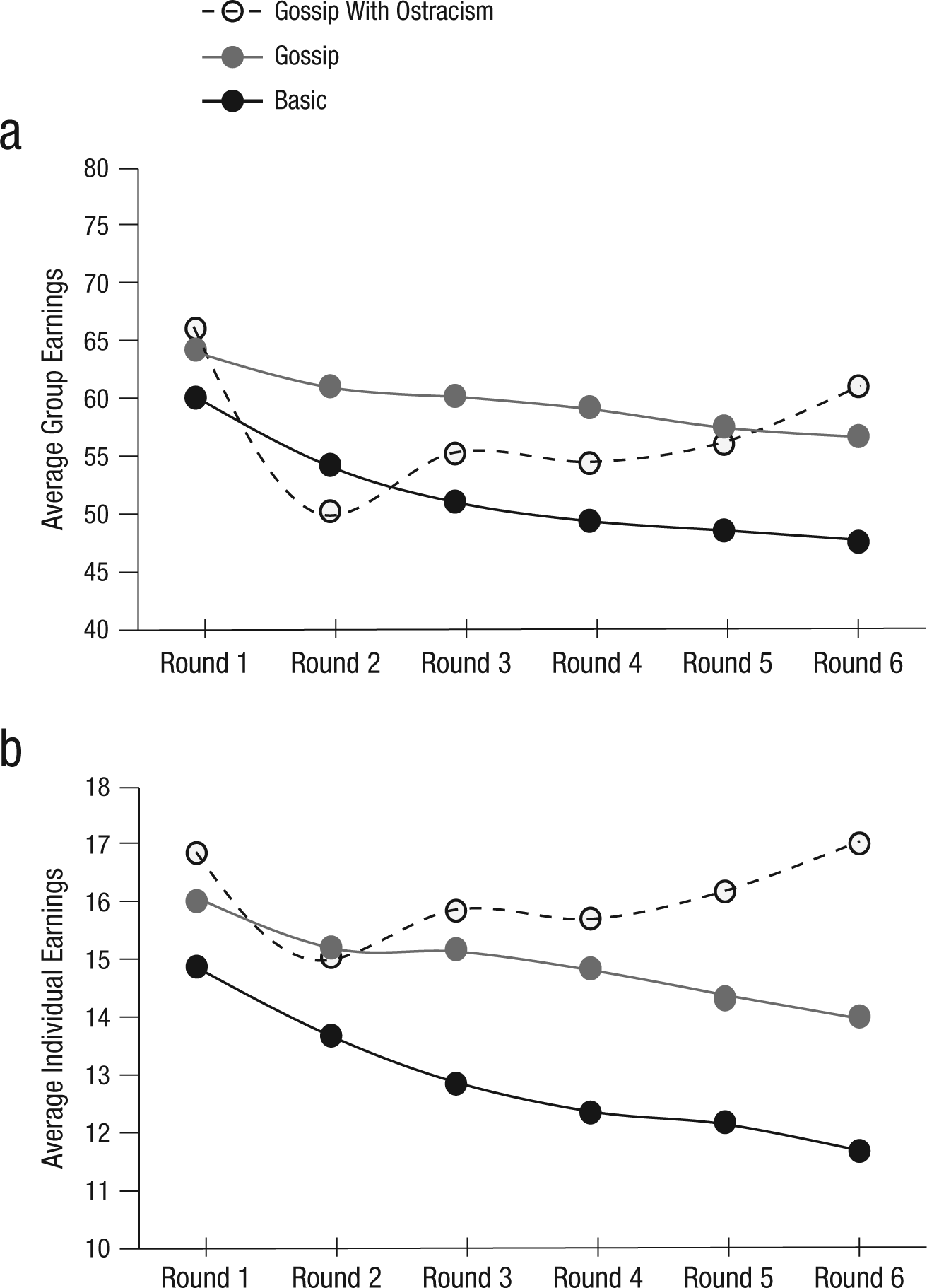
Average (a) group earnings and (b) individual earnings in each round as a function of type of game.
However, the gossip-with-ostracism game produced the highest individual-level earnings by Round 5, omnibus F(2, 159) = 45.47, p < .001, η2 = .36, pairwise t(159)s > 4.36, ps < .001, ds > 0.69, and the highest group-level earnings by Round 6, omnibus F(2, 159) > 22.71, p < .001, η2 = .22, pairwise t(159)s > 2.41, ps < .05, ds > 0.38. Further, an examination of earnings in the gossip-with-ostracism game from the second round onward revealed a significant upward linear trend, Fs(1, 53) > 42.32, ps < .001, η2s > .44, which shows that earnings levels were increasing when the game concluded.
Prosocial gossip
Recent research has argued that gossiping about selfish individuals is a prosocial act that more prosocial individuals engage in (Feinberg et al., 2012). In line with this research, logistic regression analyses showed that in five of the six rounds of the gossip-with-ostracism game, the more individuals positively deviated from their group mean, the more likely they were to engage in gossip, bs > 0.26, ps < .05, exp(b)s > 1.29. Given that it was through gossip that reputational information was transferred, leading to the exclusion of those who behaved more selfishly, this result suggests that those who were more prosocial instigated and maintained much of the cooperation that occurred during the gossip-with-ostracism game.
General Discussion
Overall, these results advance the understanding of how gossip promotes prosocial behavior. Although past research has shown that gossip can deter selfishness (Beersma & van Kleef, 2011; Feinberg et al., 2012; Piazza & Bering, 2008) and facilitate indirect reciprocity (Sommerfeld et al., 2007), the present research goes beyond these findings in showing that gossip can also foster cooperation by facilitating partner selection. When given the opportunity, participants readily spread reputational information about other participants; recipients of this gossip, in turn, used the information to form reputation judgments and select partners. Specifically, participants chose to interact with others known to be cooperative while excluding known defectors. By removing defectors from their groups, more cooperative individuals could more freely invest in the public good without fear of exploitation. Additionally, the threat of ostracism facilitated by gossip effectively deterred defection, as evidenced by our finding that even in Round 1, the gossip-with-ostracism game featured the highest levels of contribution. Finally, ostracism influenced the behavior of defectors. When ostracized individuals returned from exclusion, they increased their contributions substantially, because exclusion compelled them to conform to the more cooperative behavior of the rest of the group. Thus, our results show how gossip, when paired with a mechanism for partner selection, can foster and sustain high levels of cooperation even in noniterated interactions.
Our results may seem at odds with research showing that gossip alone produces cooperation, because contributions in the gossip game gradually decreased. This past research, however, showed that the threat of gossip, relative to a control, deters selfish behavior, a finding our results replicated: Participants cooperated more in the gossip game than in the basic game. Gossip alone likely promotes cooperation because gossiping and knowing that others could gossip about you makes reputation salient, which tends to foster prosociality (Willer, Feinberg, Irwin, Schultz, & Simpson, 2010), and because defecting when future partners will know what you did will lead these partners to not cooperate with you, which reduces the incentive to defect in the first place. However, these forces, over the long run, were insufficient to maintain high levels of cooperation. This may have been the case because exposure to gossip about a low contributor from a prior round also stimulates fears of exploitation, which could result in reduced contribution to avoid exploitation (Kuwabara, 2005).
Our findings fit well with models of biological markets, which argue that individuals will choose partners based on others’ reputation or “market value” when partner selection is possible (Barclay, 2013; Noë & Hammerstein, 1995). As exemplified in the present research, reputational information obtained through gossip greatly expands the breadth of individuals’ knowledge of others’ past behavior. Further, models of biological markets contend that individuals often compete to demonstrate their value as a partner. In the present research, because having the lowest market value of the group led to the highest likelihood of being ostracized, participants likely engaged in such “competitive altruism” (Roberts, 1998), vying to be more prosocial than the other group members to avoid exclusion. In such a dynamic, the standard for avoiding ostracism escalates, which further explains why contributions continually increased across the rounds of the gossip-with-ostracism game. Moreover, these competitive pressures to cooperate would likely have been even greater had we allowed group members not only to exclude individuals, but also to select partners for inclusion—an important topic for future research.
Finally, our results add to the literature on how individuals respond to ostracism. Whereas some research has shown that ostracized individuals respond to exclusion with decreased prosociality (e.g., Mulder, van Dijk, De Cremer, & Wilke, 2006; Twenge, Baumeister, DeWall, Ciarocco, & Bartels, 2007), our finding that ostracized individuals behaved as cooperatively as everyone else upon returning to their groups fits well with a social-dilemmas perspective of responses to ostracism (Balliet & Ferris, 2013; Joireman, Daniels, George-Falvy, & Kamdar, 2006). This perspective holds that after exclusion, individuals face competing incentives: They are tempted in the short run to respond negatively, possibly by behaving more selfishly out of spite. But, in the long run, they benefit most by conforming to group expectations, especially when punishment has significant repercussions (Tenbrunsel & Messick, 1999; van Lange, Joireman, Parks, & van Dijk, 2013). In the present study, because ostracized participants faced heavy punishment—earning nothing at all—the dominant incentive was to withhold retaliation and, instead, cooperate.
Footnotes
Acknowledgements
We would like to thank James Doty and Emma Seppala for their support.
Declaration of Conflicting Interests
The authors declared that they had no conflicts of interest with respect to their authorship or the publication of this article.
Funding
This research was funded by a National Science Foundation Graduate Student Research Fellowship awarded to M. Feinberg, an Xlab Grant from the Haas School of Business at the University of California, Berkeley, and postdoctoral funding from the Center for Compassion and Altruism Research and Education at Stanford University.

Notes
References
Supplementary Material
Please find the following supplemental material available below.
For Open Access articles published under a Creative Commons License, all supplemental material carries the same license as the article it is associated with.
For non-Open Access articles published, all supplemental material carries a non-exclusive license, and permission requests for re-use of supplemental material or any part of supplemental material shall be sent directly to the copyright owner as specified in the copyright notice associated with the article.
