




Abstract
The positive effect of losses on performance has been explained as stemming from the increased weighting of losses relative to gains. We examine an alternative possibility whereby this effect is mediated by attentional processes. Using the dual-task paradigm, we expected that positive effects of losses on performance would emerge under attentional scarcity and diffuse to a concurrently presented task. In Study 1, decision performance was compared for a task that involved either gains or losses and was performed either alone or as a secondary task. The results showed a significant 40% improvement in performance in the loss condition, but only under conditions of resource scarcity, when the task was a secondary one. In Study 2, the same task was presented as a primary task. Again, losses were associated with improved performance in the secondary task. Given that this secondary task did not include losses, these findings demonstrate an attentional spillover effect.
In “The Babylon Lottery,” a story by Jorge Luis Borges (1941/1961), he describes a society in which merchants have invented a lottery whose winners receive silver coins and other rewards. Initially, the public remains indifferent to this lottery system. Then “someone attempted to introduce a slight reform: the interpolation of a certain small number of adverse outcomes among the favored numbers” (p. 66). This leads to immense popularity, and eventually, the loss-based lottery becomes mandatory for all citizens. Borges’s tale appears to capture the exhilaration triggered by the prospect of losing and its potential for elevating attention as well as excitement. Modern studies have indeed shown that embedding losses within a cognitive task increases physiological arousal (e.g., Bechara, Damasio, Tranel, & Damasio, 1997; Hochman & Yechiam, 2011; Löw, Lang, Smith, & Bradley, 2008; Satterthwaite et al., 2007) and enhances performance (e.g., Bereby-Meyer & Erev, 1998; Costantini & Hoving, 1973; Dawson, Gilovich, & Regan, 2002; Denes-Raj & Epstein, 1994; Hossain & List, 2012; Maddox, Baldwin, & Markman, 2006; Pope & Schweitzer, 2011; Saguy & Kteily, 2011). We recently proposed that these two effects are interlinked: The increased arousal following losses marks an increase in attentional investment, which in turn results in enhanced performance in some settings (Yechiam & Hochman, 2013a). Our goal in the research reported here was to examine, in a direct fashion, whether the increased allocation of attention to tasks that involve losses mediates their effect on performance.
A dominant view attributes the effect of losses on performance to loss aversion (e.g., Bereby-Meyer & Erev, 1998; Erev & Barron, 2005; Hossain & List, 2012; Pope & Schweitzer, 2011), whereby losses have greater subjective weight than equivalent gains (Kahneman & Tversky, 1979). For example, in a recent field experiment, Hossain and List (2012) used monetary incentives framed as gains (“gain y by doing x”) or losses (“avoid losing y by doing x”) to increase workers’ productivity in a real factory. Although both of these types of incentives increased productivity, the magnitude of the effect of loss framing was about 15% larger. Hossain and List (2012) explained this difference as stemming from loss aversion, which should result in an increased tendency to perform above criterion level so as to avoid losses. By contrast, under the alternative loss-attention model (Yechiam & Hochman, 2013a, 2013b) losses should draw more attention to the task and, consequentially, increase workers’ sensitivity to the task’s incentive structure.
Although in studies such as Hossain and List’s (2012), the two accounts for the effect of losses could not be disentangled, several previous findings indirectly supported the role of attention as a mediator for the effect of losses on performance: First, whereas the positive effect of losses on performance was found in conditions in which tasks involving losses versus gains were administered in a between-subjects design (as in Hossain & List, 2012), such an effect was not observed in a within-subjects design in which tasks involving losses and gains were administered intermittently (e.g., Magoon & Critchfield, 2008; Ruddle, Bradshaw, & Szabadi, 1981). 1 Second, losses were found to have a positive effect on performance even in situations in which high levels of performance resulted in greater losses (Yechiam & Hochman, 2013b). Both sets of findings suggest that losses affect performance through increased general arousal and attention rather than increased weighting of losses relative to gains. Still, these previous studies provided only indirect evidence for the mediating role of attention.
To examine whether the effect of losses on performance stems from their impact on attentional processes, we employed the dual-task paradigm, which is often used in attention research (see Kahneman, 1973; Navon & Gopher, 1979; Wickens, 2002). Following Kahneman’s (1973) seminal work, our basic premise was that changes in attention occur on two different levels: the overall attentional-resource pool (see also Young & Stanton, 2002) and the relative allocation of resources from that pool between concurrent tasks. In line with the loss-attention model (Yechiam & Hochman, 2013a), we further assumed that losses in a given task mainly increase the overall attentional-resource pool available for the task, leading to an inverse-U-shaped effect on performance (following the so-called Yerkes-Dodson law; see Kahneman, 1973).
The implication of this model for the effect of losses on performance can be demonstrated using the following numerical example. Consider a resource-limited dual task setting (Navon & Gopher, 1979; Norman & Bobrow, 1975) in which additional resources can improve performance. Our model might posit 10 units of resources available when gains are involved, with a distribution of 7 units for the primary task and 3 for the secondary task. If the tasks are changed to include losses, the available supply of resources increases (e.g., by a factor of 1.5) without any changes to the relative allocation of the pool between concurrent tasks. Hence, the allocation in this loss condition would be 10.5:4.5, with the primary task gaining more resources than the secondary task (3.5 units vs. 1.5 units). However, as demonstrated in Figure 1, our model suggests that losses would nevertheless have a larger effect on performance in the secondary task than in the primary task because of the diminishing marginal benefit of investment implied by the Yerkes-Dodson law.

A hypothetical graph showing changes in performance as a function of attentional resources. Line A denotes the performance improvement from 3 to 4.5 resource units, and Line B denotes the performance improvement from 7 to 10.5 units. Despite the similar rate of increased resources (1.5), performance improvement is larger for the resource-lean position.
This model leads to three specific predictions. First, losses are expected to have a greater effect on performance in a dual-task setting in which attentional resources are depleted (e.g., because of strict time limitations) than in a single- or dual-task setting in which resources abound. Second, given the shape of the function (see Fig. 1), this effect should be stronger for a secondary than for a primary task. Third, losses are predicted to affect performance in a global manner, such that losses in one task could improve performance in a different task. Specifically, if losses are part of a primary task, they are expected to increase overall task attention. As noted earlier, this should have little effect on primary-task performance, but it could substantially affect performance in the secondary task even if it does not include losses. More generally, this would be an instance of a spillover effect, whereby stimuli in one task affect performance in a conjoined task (see Lavie & Torralbo, 2010; Navon & Gopher, 1979; Swallow & Jiang, 2013).
Study 1: Losses in a Secondary Task
In this study, we examined whether the effect of losses on decision performance was amplified when they were part of a secondary task. The basic task we used involved repeated selections between two choice alternatives, one of which was advantageous in terms of expected value. Hence, a high level of performance implies the selection of the advantageous option and increased earning.
The payoffs contingent on selecting alternatives were drawn from the distributions shown in Table 1. In each condition, one alternative had a higher expected value than the other. To make the incentive structure less transparent, we added a noise factor, which was randomly drawn from the following set of outcomes: −4, −3,−2, −1, 0, 1, 2, and 3. The task involved 100 trials, with the final payment for the experiment being based on the accumulated reward. Participants were not told in advance that one alternative in each trial had a higher expected value than the other. Rather, they were expected to learn this through feedback (as in Erev & Barron, 2005). In the loss condition, the fixed outcome for each choice alternative was multiplied by −1 and the noise factor remained the same.
Outcomes of Each Alternative in Each Condition for Problem 1
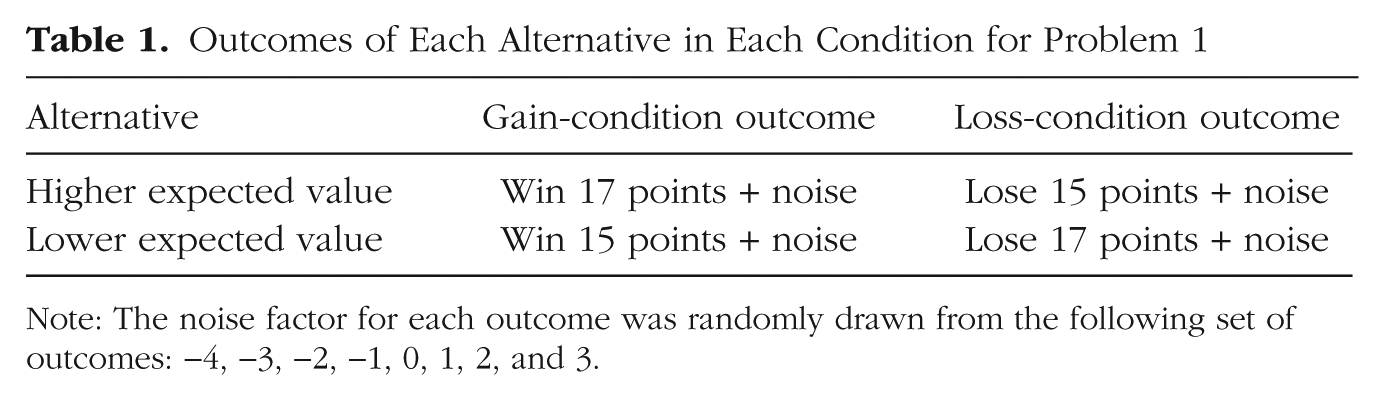
Note: The noise factor for each outcome was randomly drawn from the following set of outcomes: −4, −3, −2, −1, 0, 1, 2, and 3.
In the single-task condition, participants performed only Problem 1 as a two-alternative forced-choice task. Participants were required to make each selection in 3 s (one selection per trial). Previous findings have suggested that response time in this type of tasks is quite short (typically less than 2 s; Yechiam & Telpaz, 2013). We therefore assumed that a time limit of 3 s would result in no scarcity of attentional resources. Hence, we predicted only a limited effect of losses on performance in the single-task setting.
By contrast, in the dual-task condition, participants performed two tasks, each requiring a separate decision, under the same 3-s time constraint. In attention research, participants are sometimes told which task is primary and which is secondary. In other studies, this hierarchy is implicitly implemented by having a primary task with higher payoffs than the secondary task (see, e.g., Gopher, Weil, & Siegel, 1989). We used the latter design, as shown in Table 2.
Outcomes of Each Alternative for Problem 2

As can be seen, in this choice problem as well, one alternative has higher expected value than the other. However, the difference between alternatives in this problem lies not in the magnitude but in the probability of payoffs (this was implemented so as to minimize transfer of learning from the concurrently performed Problem 1). Also, the incentives in this task are substantially higher (by a factor of 10) than in Problem 1, resulting in a larger expected difference between alternatives. Hence, we expected that participants would prioritize Problem 2 (the primary task) over Problem 1 (the secondary task). Therefore, under our model, within the dual-task setting, performance in Problem 1 (the secondary task) was expected to improve in the loss condition relative to the gain condition.
Method
Participants
Eighty-eight Technion undergraduates (44 males, 44 females) were recruited through e-mail notices for an experiment yielding 15 shekels to 35 shekels (at the time of this study, 1 shekel was equivalent to $4.20). The participants’ average age was 25.0 years (age range = 20–33). Participants were randomly assigned to the single- and dual-task conditions and, within these conditions, to the gain and loss conditions (single-task/gain condition: n = 23; single-task/loss condition: n = 21; dual-task/gain condition: n = 22; dual-task/loss condition: n = 22). Their payment consisted of a fixed fee of 20 shekels and a variable fee contingent on task performance.
Task
In the single-task condition, the participants’ instructions were as follows:
In this experiment, you will perform a decision-making task. Your basic fee is NIS 20 [20 Israel new shekels]. This payment will be updated based on your accumulated winnings at a rate of NIS 1 per 1,000 game points. In the screen in front of you there will be two buttons, A and B. Your task is to select between these buttons by pressing one of the buttons. You can press a button multiple times (as many times as you want) or switch between buttons (as much as you want). In each trial, you will see the outcome from the selected button and from the unselected button, as well as the accumulating sum. In each trial you will have 3 seconds to respond once you see the outcomes. Please notice that your outcome in a given trial is only affected by the current trial and not by past trials.
An illustration of the task appears in Figure 2.
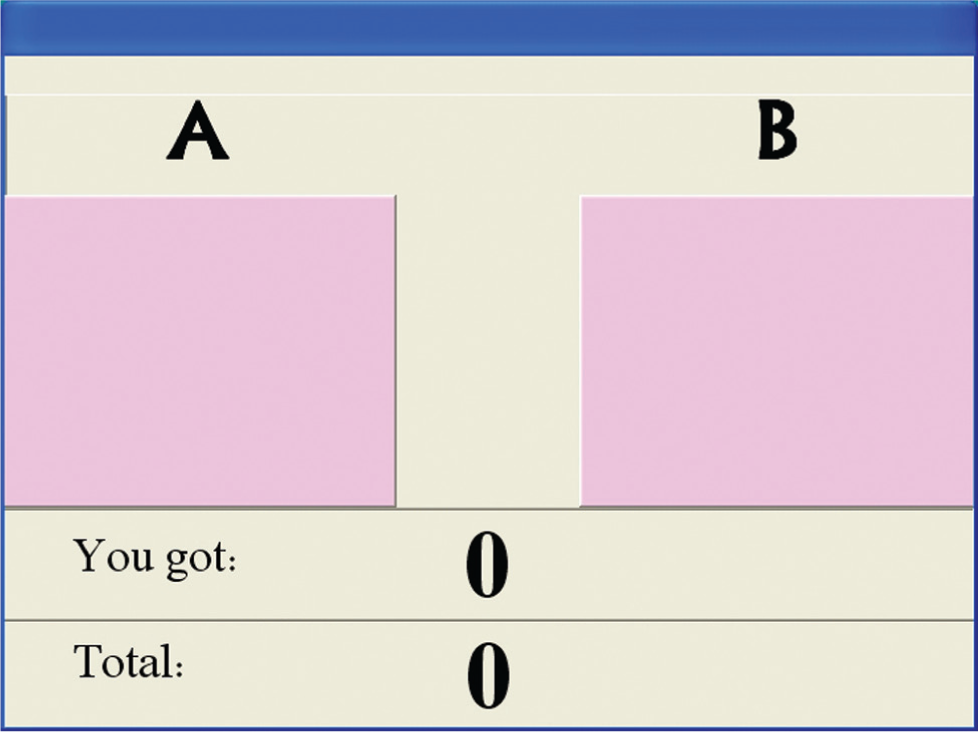
Sample screenshot from a trial in the single-task condition of Study 1.
After making each choice, payoffs for the selected and unselected buttons were presented for 1 s. During this 1-s window, the participants could not press the buttons (buttons were colored red and disabled). Then participants had 3 s to make their next selection. The total amount of accumulated payoffs was presented constantly. The payoffs in each trial were contingent on the button chosen and were randomly drawn from the relevant distributions of Problem 1 (depending on the experimental condition). The allocation of the lower-expected-value and higher-expected-value alternatives to Buttons A and B was randomized for each participant and was kept constant throughout the task. The dependent measure was the rate of higher-expected-value selections in the first and second blocks of trials.
In the dual-task condition, after being informed about the basic fee as in the single-task condition, participants were told the following:
In the screen in front of you there will be four buttons, A, B, C, and D. You have two tasks: to select between buttons A and B (the top buttons) and to select between buttons C and D (the bottom buttons). In each trial you will have to perform both tasks by selecting one button in each pair.
The remaining instructions were the same as in the single-task condition. An illustration of the task appears in Figure 3. Payoffs for the top task were drawn from Problem 2 (the primary task), and payoffs for the bottom task were drawn from Problem 1 (the secondary task).
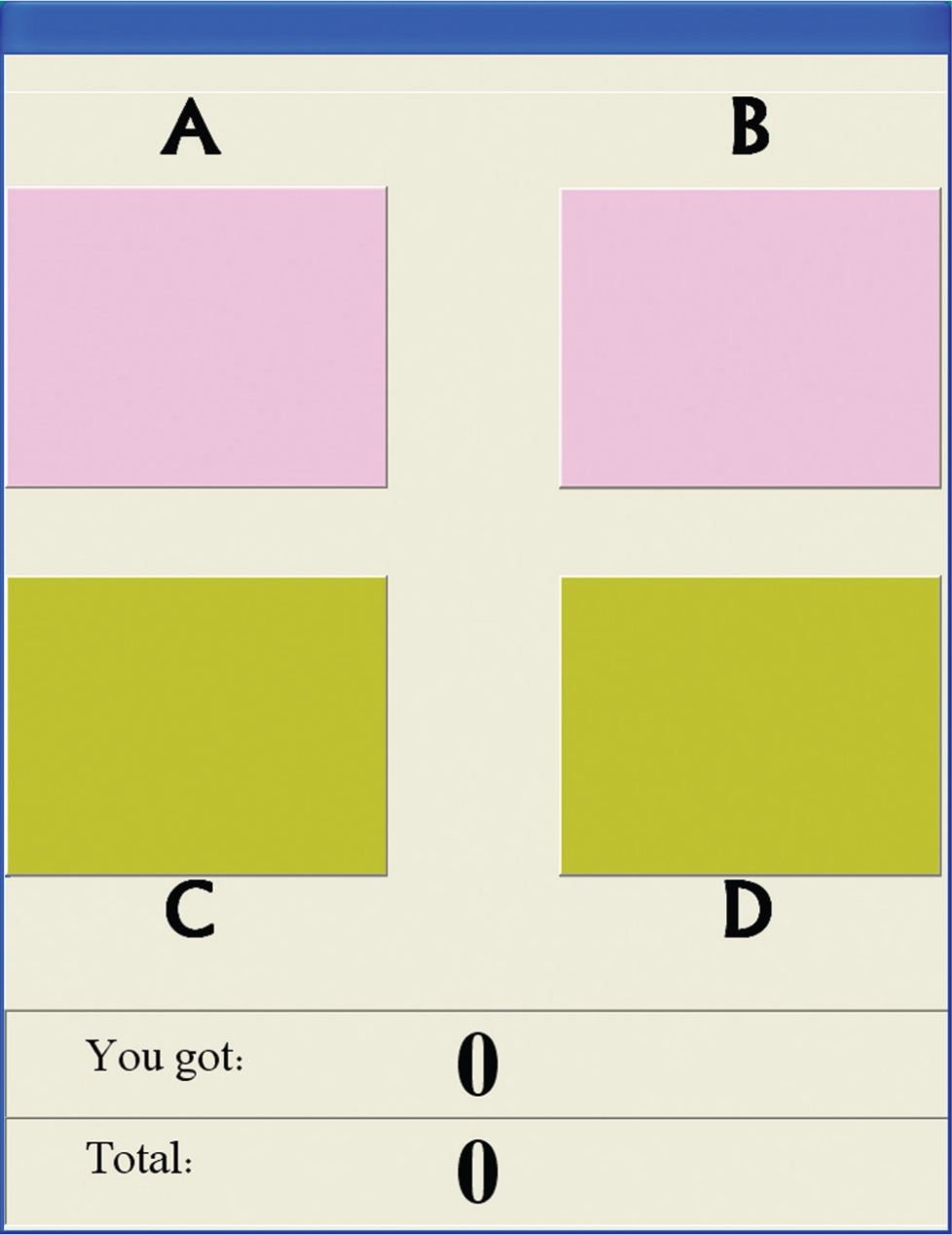
Sample screenshot from a trial in the dual-task condition of Studies 1 and 2.
Participants had a 3-s response-time limit (as in the single-task condition) to make selections in both decision tasks. Again, the main dependent variable was the rate of high-expected-value selections in Problem 1.
Participants in all conditions were given an initial practice session with the goal of learning to respond in a timely manner. Not responding within the time limit resulted in a loss of 200 points. The practice session used a simple two-alternative forced-choice task, with one alternative producing a constant payoff of 100 points and the other producing a payoff of 0 points. After participants completed this practice task, their rate of no-response trials in the actual task was very low (4.0%).
Results
Figure 4 presents the selection rates for the advantageous higher-expected-value alternative in the first and second blocks of the task. As can be seen, within the single-task condition, the overall rate of higher-expected-value selections in Problem 1 was similar in the gain and loss conditions—gain condition: .81, loss condition: .73. As predicted, a much larger positive effect of losses on performance appeared in the dual-task condition, such that losses increased higher-expected-value selection rates by 40%—gain condition: .56; loss condition: .79.

Results from Study 1: mean proportions of selections of the higher-expected-value alternative in Problems 1 and 2 as a function of trial block and condition. Results are shown separately for (a) the single task in Problem 1, (b) the secondary task in Problem 1, and (c) the primary task in Problem 2. Error bars denote standard errors. The horizontal line at .5 marks the point of indifference between the two alternatives.
To examine the statistical significance of the results, we conducted a mixed analysis of variance (ANOVA) with valence (gain vs. loss) and task (single task vs. dual task) as between-subjects factors and trial block as a within-subjects factor. The results showed a significant positive effect of trial block, F(1, 84) = 8.24, p = .005, and task, F(1, 82) = 4.24, p = .04, on performance, but no main effect of valence, F(1, 84) = 2.19, p = .14. Most important, however, there was a significant interaction of valence and task, F(1, 84) = 8.90, p = .004. Planned contrasts with Bonferroni corrections showed that within the single-task setting, the difference between the gain and loss conditions was not significant, F(1, 42) = 2.18, p = .29. The difference was significant only in the dual-task condition, F(1, 42) = 6.73, p = .02. Hence, losses led to higher performance than equivalent gains only when Problem 1 was performed as a secondary task.
We also examined the effect of losses on performance in Problem 2, the primary task in the dual-task condition. Because the primary task was not assumed to benefit much from additional resources (see Fig. 1), losses were not expected to considerably affect performance on it. The results showed that in this task, the rate of higher-expected-value selections was .63 (SE = .13) in the gain condition and .71 (SE = .05) in the loss condition (a 12% improvement). The ANOVA results indeed showed no main effect of valence, F(1, 42) = 1.53, p = .22. However, the interaction between valence and trial block was significant, F(1, 42) = 11.16, p = .002, as in the second block of trials, losses in the secondary task improved performance in the primary task as well, t(42) = 2.04, p = .047.
We next examined whether improved performance in the secondary task was associated with improved performance in the primary task at the individual level as well. In the loss condition, there was a high positive correlation between performance in the primary and secondary tasks, r = .75, p < .001. By contrast, in the gain condition, the correlation between performance in these two tasks was weak and nonsignificant, r = .15, p = .52. Hence, rather than creating a tradeoff between the primary and secondary tasks, losses in the secondary task appeared to increase the consistency with which effort was allocated to the two tasks.
To verify that the scarcity of resources contributed to the effect of losses on secondary-task performance, we ran a replication study in which we employed the dual-task condition but with no penalty for going beyond the 3-s time constraint (participants who did not respond within 3 s simply received no points for that trial). This study involved 48 participants (24 males, 24 females). In this setting, the rate of trials in which the time limit was exceeded was rather high—23%, compared with 4% in the original experiment. In accordance, mean response times were longer—replication-study gain condition: 2.97 s (SE = 0.10 s); replication-study loss condition: 3.05 s (SE = 0.07 s); Study 1 gain condition: 2.27 s (SE = 0.11 s); Study 1 loss condition: 2.40 s (SE = 0.15 s). Also, the distribution of response times was more skewed, with a mean maximal response time of 12.7 s (SE = 2.11 s) per trial compared with 3.30 s (SE = 0.34 s) in the original dual-task condition. Hence, participants had considerably more time to perform the secondary task (Problem 1). As expected, in this case, performance levels in the secondary task were similar in the gain and loss conditions—gain condition: .74 (SE = .07); loss condition: .66 (SE = .07; see Fig. S1 in the Supplemental Material). Thus, the performance advantage induced by losses appeared only in the original study, in which time limitations were enforced.
Study 2: Losses in a Primary Task
In this study, we examined the effect of losses in a primary task on performance in a secondary task. It was expected that the increase in overall attention due to losses in the primary task would mostly affect performance in the resource-depleted secondary task. The primary task was Problem 1, with the same gain and loss conditions as in Study 1. The secondary task was a variant of Problem 2 in which we divided each possible payout amount by 1,000, creating very small monetary amounts, as shown in Table 3. We expected that losses in the primary task would lead to increased performance in this secondary task.
Outcomes of Each Alternative for Problem 3

Method
Participants
Forty-eight Technion undergraduates (24 males, 24 females) participated in this study. Their average age was 24.0 years (age range = 17–32). Participants were randomly assigned to the gain and loss conditions (n = 24 in each condition). As in Study 1, participants’ payoff consisted of a fixed fee of 20 shekels and a variable fee based on task performance.
Task
The recruitment protocol, experimental task, and instructions were identical to those in Study 1 (see Fig. 3). The only difference was that payoffs for the topmost buttons were now sampled from Problem 1, whereas payoffs for the bottom buttons were sampled from Problem 3.
Results
The selection rates from the advantageous higher-expected-value alternative in the primary and secondary tasks appear in Figure 5. Within Problem 1, the primary task in terms of payoff magnitude, there was no significant difference between the gain and loss conditions, F(1, 46) = 1.09, p = .30, and no interaction between trial block and condition, F(1, 46) = 2.88, p = .10. Hence, losses did not significantly affect performance in this task. However, losses in the primary task had a substantial positive effect on performance in the secondary task (Problem 3), F(1, 46) = 12.10, p = .001. Performance in this task increased in the loss condition by about 53%—gain condition: .43; loss condition: .66. In addition, there was a significant condition-by-trial-block interaction, F(1, 46) = 7.16, p = .01, which shows that the effect of losses on performance increased over time. Thus, losses in the primary task improved performance in the secondary task.

Results from Study 2: mean proportions of selections of the high-expected-value alternative in (a) Problem 3 (the secondary task in this study) and (b) Problem 1 (the primary task) as a function of trial block and condition. Error bars denote standard errors. The horizontal line at .5 marks the point of indifference between the two alternatives.
We also examined whether performance in these two tasks at the individual level was related. In the loss condition, the correlation between performance in the primary and secondary tasks was significant and extremely high, r = .91, p < .001. By contrast, in the gain condition, the correlation was near zero, r = −.16, p = .45.
Discussion
In two studies, we found evidence that attentional processes modulate the effect of losses on cognitive performance. In Study 1, losses did not significantly affect performance in a decision task performed with no additional concurrent requirements. When the very same task was presented as a secondary task in a setting in which participants performed two tasks within a limited time, the same losses led to a substantial (40%) improvement in task performance. Hence, losses appear to improve performance in the classic setting of depleted attention (Navon & Gopher, 1979). 2 Losses in the secondary task also led to a small (12%) improvement in the concurrently performed primary task, which was significant in the second half of the task. Although we did not expect this interaction, it is consistent with our proposition that the effect of losses is to expand the overall attentional-resource pool and that losses in a secondary task can therefore affect performance in the primary task as well.
In Study 2, the secondary task in the previous study (Problem 1) was used as a primary task in a dual-task setting. The results showed that losses did not affect performance in this task. Instead, there was a positive effect of losses on the concurrently performed secondary task (which involved only gains). Thus, losses led to an attentional spillover from the primary to the secondary task, resulting in improved performance in the secondary task. This further suggests that within a dual-task setting, losses enhance performance in a resource-lean secondary task.
The individual-differences findings in Studies 1 and 2 provide converging evidence for the attentional effect of losses. In both studies, the administration of losses resulted in much higher correlations between performance levels in the primary and secondary tasks. Specifically, increased performance in the task that included losses was associated with increased performance in the concurrently performed task that did not include losses. It therefore appears that at the individual level, as well, the allocation of attention and increased performance due to losses is not a local phenomenon but one that affects global task performance. It is interesting to speculate on the mechanism responsible for this pattern of individual differences. One possible contributor is individual differences in peoples’ sensitivity to negative stimuli (e.g., Higgins, 1997; Maddox et al., 2006). The increased sensitivity to losses of some participants may have contributed to their elevated global performance level in the face of losses. Another possibility, however, is that in the loss condition, successful performers better generalized their performance strategy from one task to the other. Consequentially, those with superior performance in the task that included losses also performed better in the concurrent task that did not include losses.
The complete absence of an effect of losses on performance in the one-task setting of Study 1 appears to be inconsistent with the results of studies showing a positive effect of losses in a single-task setting (e.g., Bereby-Meyer & Erev, 1998; Costantini & Hoving, 1973; Denes-Raj & Epstein, 1994; Hossain & List, 2012; Maddox et al., 2006; Pope & Schweitzer, 2011). Yet note that unlike the conditions in these studies, in the loss condition of Study 1, participants could not avoid sustaining losses. This might have led some participants to experience learned helplessness (Maier & Seligman, 1976), thereby reducing the positive effect of losses on performance (see Yechiam & Hochman, 2013a). Additionally, some of the aforementioned studies involved tasks with considerable attentional requirements (e.g., Costantini & Hoving, 1973; Hossain & List, 2012; Pope & Schweitzer, 2011). For instance, Pope and Schweitzer (2011) and Hossain and List (2012) focused on real-world tasks (golfing, production, and inspection) in which participants have off-task distractions that may carry attention away from the main task and thus increase the positive effect of losses on performance. Our results therefore do not necessarily contradict these previous findings. Rather, they serve to highlight an inherent condition (attentional scarcity) that makes cognitive tasks susceptible to the positive effect of losses.
Conclusions
The most common explanation for the effect of losses on performance invokes the construct of loss aversion. Some argue that loss aversion entails only a utility asymmetry between gains and losses (Kahneman & Tversky, 1979), whereas others argue that it is a multifaceted process involving utilitarian as well as attentional asymmetries (Baumeister, Bratslavsky, Finkenauer, & Vohs, 2001; Taylor, 1991). We have demonstrated that in a dual-task setting, an attentional effect is a necessary and sufficient condition to understand the effect of losses. With no attentional constraints, when a task was performed singly, losses had no effect on performance. By contrast, in both of our studies, the most substantial effect of losses on performance occurred in a setting that involved limited resources and in which the (loss or gain) choice task was secondary.
Footnotes
Declaration of Conflicting Interests
The authors declared that they had no conflicts of interest with respect to their authorship or the publication of this article.
Funding
This work was supported in part by the Max Wertheimer Minerva Center for Cognitive Studies.

Notes
References
Supplementary Material
Please find the following supplemental material available below.
For Open Access articles published under a Creative Commons License, all supplemental material carries the same license as the article it is associated with.
For non-Open Access articles published, all supplemental material carries a non-exclusive license, and permission requests for re-use of supplemental material or any part of supplemental material shall be sent directly to the copyright owner as specified in the copyright notice associated with the article.
