



Abstract
In the research presented here, we tested the idea that a lack of material resources (e.g., low income) causes people to make harsher moral judgments because a lack of material resources is associated with a lower ability to cope with the effects of others’ harmful behavior. Consistent with this idea, results from a large cross-cultural survey (Study 1) showed that both a chronic (due to low income) and a situational (due to inflation) lack of material resources were associated with harsher moral judgments. The effect of inflation was stronger for low-income individuals, whom inflation renders relatively more vulnerable. In a follow-up experiment (Study 2), we manipulated whether participants perceived themselves as lacking material resources by employing different anchors on the scale they used to report their income. The manipulation led participants in the material-resources-lacking condition to make harsher judgments of harmful, but not of nonharmful, transgressions, and this effect was explained by a sense of vulnerability. Alternative explanations were excluded. These results demonstrate a functional and contextually situated nature of moral psychology.
Keywords
How wrong is it to lie? How wrong is it to cheat on a tax report? Answers to such questions constitute moral judgments, defined as “evaluations (good vs. bad) of the actions or character of a person that are made with respect to a set of virtues held to be obligatory by a culture or subculture” (Haidt, 2001, p. 817). Moral judgments are important because they determine how individuals, communities, and legislators respond to and regulate social behavior. Yet people frequently disagree in their moral judgments, and this disagreement can be a source of conflict (Harman, 1996; Rai & Fiske, 2011) that leads to disputes about legal frameworks (Sunstein, 1996), divisions along political party lines (Gutmann & Thompson, 1996), and even conflict between countries (Walzer, 2000). Understanding why people differ in their moral judgments may help to explain and perhaps even mitigate conflict.
The research presented here provides an answer to the question of why people differ in their moral judgments by considering the amount of material resources people have at their disposal. We argue that individuals who lack material resources feel more vulnerable to others’ potentially harmful behaviors because they are less able to cope with the effects of such behaviors. By potentially harmful behaviors, we mean antisocial acts directed at another person, which can be distinguished from nonharmful transgressions of convention, such as offenses against social standards of purity, sanctity, or authority (Graham, Haidt, & Nosek, 2009). We propose that the greater vulnerability to others’ harmful behavior among individuals who lack material resources leads to a self-protective response of harsher moral judgments of harmful transgressions. We tested this idea using a large cross-cultural survey in which we examined the effects of material-resource availability on moral judgments. In a follow-up experiment, we tested the proposed psychological mechanism and ruled out alternative explanations by comparing the effects of resource availability on judgments of harmful versus nonharmful transgressions.
Our research complements past work that has investigated how moral judgments are affected by people’s life situation, such as their occupational and educational status (e.g., Kohn & Schooler, 1969; Lamont, Schmalzbauer, Waller, & Weber, 1996), but did not regard material resources as an important explanation for this phenomenon. We contribute to this literature by demonstrating that the availability of material resources shapes people’s moral judgments and by testing a theory for why this effect occurs. Considering the ubiquity of differences in the availability of material resources (Furnham, 1998; Johnson & Krueger, 2006), we have identified a very broad and potentially powerful explanation for variation in moral judgments.
Theory and Overview
We assume that the amount of material resources people have at their disposal influences their ability to cope with the effects of others’ harmful behavior. For example, in the case of theft, a high-income individual will more easily replace the stolen objects than will a low-income individual. If an individual becomes the victim of aggression, a victim with a high income, relative to a victim with a low income, will be able to afford a more effective recovery program and will encounter relatively fewer difficulties if he or she needs to stop working during convalescence. Consistent with this reasoning, research on the effect of money on life satisfaction (Furnham, 1998; Johnson & Krueger, 2006) has suggested that “money protects people from unfortunate and unforeseen perturbations in life” (Vohs, Mead, & Goode, 2008, p. 208).
People who lack material resources are thus, on average, more vulnerable to the effects of others’ harmful behaviors. If this is so, then it is possible that a lack of material resources leads to harsher moral judgments of such behaviors. Harsher moral judgments in response to a lack of material resources could be adaptive, given that this response could potentially be one way of reducing the (relatively greater) threat of others’ harmful behavior. Specifically, harsher moral judgments might deter others’ harmful actions by increasing the costs associated with such behavior. If a given behavior is judged more harshly by a group of people, the behavior is more likely to be regulated (Ullmann-Margalit, 1977) and punished (Cushman, 2008). Consequently, an increased vulnerability to others’ harmful behavior due to a lack of material resources may be offset by the social consequences of harsher moral judgments.
Regardless of the functional benefits that harsher moral judgments in response to a lack of material resources may confer, prior research also directly supports the notion that a greater threat of others’ harmful behavior should translate into more negative evaluations of such acts. Research on fear appeals has shown that people exhibit negative responses to potential threats and readily modify their behavior as a result (for a review, see Eagly & Chaiken, 1993). Similarly, research on self-protection has demonstrated that people are strongly averse to potential threats and mobilize psychological and behavioral responses aimed at minimizing threats (Neuberg, Kenrick, & Schaller, 2011). This may be particularly true for threats that presented a recurrent adaptive challenge over the course of human evolutionary history (Öhman & Mineka, 2001), and others’ harmful actions likely posed such a threat (Duntley, 2005). Finally, in their research on “intuitive prosecutors,” Tetlock et al. (2007) examined directly how moral judgments are influenced by contextual factors that affect the degree to which individuals perceive others’ harmful behavior as threatening. Tetlock et al. found that a manipulation that involved informing participants that crime was widespread caused harsher moral judgments of such behavior. Thus, prior research supports our assumption that if a certain event is considered to be relatively more threatening, it will elicit more negative evaluations, including harsher moral judgments in the case of others’ harmful behavior.
In sum, we argue that a lack of material resources makes people more vulnerable to the effects of others’ harmful behavior. This vulnerability, in turn, should lead to harsher moral judgments of such behavior. We tested this theory in two studies. In Study 1, we used a survey to test whether both a chronic and a situational lack of material resources are associated with harsher moral judgments. Furthermore, we examined whether the effect of inflation is stronger for people with low incomes, who, we argued, are rendered relatively more vulnerable by inflation than are people with high incomes (this point is developed later in the Study 1: Survey section). In Study 2, we manipulated participants’ perception of the income they had at their disposal and examined how this manipulation affected their moral judgments. We also tested the hypothesized psychological mechanism (sense of vulnerability) as well as potential alternative explanations.
Study 1: Survey
To conduct an initial test of our theory, we used a large cross-cultural survey to examine whether a chronic (due to low income) as well as a situational (due to inflation 1 ) lack of material resources is associated with harsher moral judgments of harmful actions. Both of these factors imply a lower ability to cope with the effects of others’ harmful behavior. Thus, if our theory is correct, these factors should be associated with harsher judgments of such behavior.
We also predicted that the effect of inflation would be stronger for people with low incomes than for people with high incomes because inflation renders low-income people relatively more vulnerable to the effects of harmful actions. For people with high incomes, some loss in the value of their resources generally does not have a substantial effect on their ability to cope with negative events in life, such as the effects of others’ harmful behavior. However, for people with low incomes, who are already relatively vulnerable, an additional loss in the value of their resources can present a significant hindrance to their ability to cope with others’ harmful behavior. Our prediction is also consistent with the economic analysis of the effects of inflation. Low-income people hold a larger portion of their resources in assets that are adversely affected by inflation (e.g., cash) than do high-income people, who possess more assets that are generally not adversely affected by inflation, such as real estate (Easterly & Fischer, 2001). Thus, not only does a loss in the value of material resources impair the ability of low-income people to cope with others’ harmful actions to a greater extent than it impairs high-income people’s ability to cope, but inflation reduces the value of material resources of low-income people disproportionally more. Our theory thus predicts that the effect of inflation (whereby inflation makes moral judgments harsher) should be stronger for people with low incomes than for people with high incomes.
Method
Individual-level data (moral judgments, income, and control variables) were obtained from the World Values Survey (2009). The World Values Survey is a global research project that has surveyed representative samples of the populations of almost 100 countries since 1981. For the combination of variables that were of interest to us in this research, 85,475 responses were available. The responses came from 56 countries and spanned a 13-year period.
Moral judgments
The World Values Survey (2009) solicited respondents’ moral judgments of eight harmful behaviors (e.g., “lying,” “cheating on taxes”); responses were made using scales from 1 (never justifiable) to 10 (always justifiable). We averaged and reversed the scores for these items so that higher values represented harsher moral judgments (α = .84). For more details on scale items and validity, see Moral Judgments in the Study 1 Supplement section of the Supplemental Material available online.
Income
World Values Survey respondents reported their household income, comprising all wages, salaries, pensions, and other income. Respondents’ household income was ranked on a scale from 1 to 10. Because our theoretical focus was on the effect of a lack of resources, we reversed the scores for this variable so that higher values represented fewer material resources.
Inflation
Inflation data were obtained from the World Development Indicators database published by the World Bank (2012b).
Controls
To examine the unique effects of income, we also controlled for factors likely to be correlated with income that might affect moral judgments: respondents’ education, occupational status, subjective social class, religiosity, and race. These data were also obtained from the World Values Survey (2009) data set. Details regarding the control variables’ coding and robustness checks are provided in Control Variables and Control Variables: Analysis Robustness Check in the Study 1 Supplement section of the Supplemental Material.
Results and discussion
We fitted a multilevel regression model, with individuals nested within countries and years. Table 1 summarizes the effect of income, inflation, and their interaction on moral judgments and shows that both lower income and higher inflation were associated with harsher moral judgments. The interaction between the two was also significant. Consistent with our theory, results showed that for respondents whose income was 1 standard deviation below the mean, the effect of inflation was significant, such that inflation was associated with harsher moral judgments, b = 0.00084, SE = 0.00029, z = 2.870, p = .004. However, for respondents whose income was 1 standard deviation above the mean, inflation had no effect on moral judgments, b = 0.00024, SE = 0.00028, z = 0.855, p = .392. These results provide support for our theory.
Study 1: The Effect of Income, Inflation, and Their Interaction on Moral Judgments
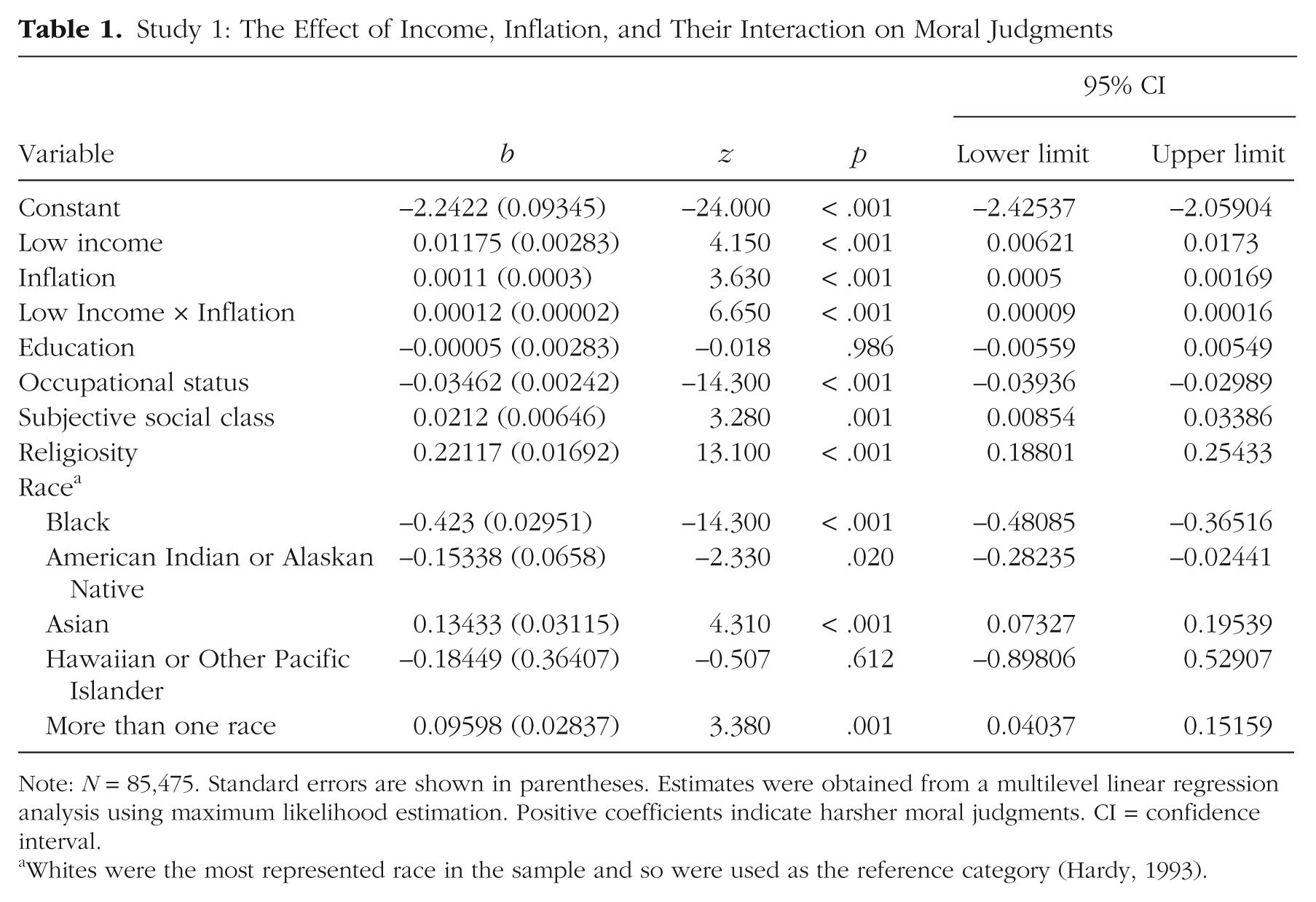
Note: N = 85,475. Standard errors are shown in parentheses. Estimates were obtained from a multilevel linear regression analysis using maximum likelihood estimation. Positive coefficients indicate harsher moral judgments. CI = confidence interval.
Whites were the most represented race in the sample and so were used as the reference category (Hardy, 1993).
Study 2: Experiment
We supplemented Study 1 with an experiment in which we manipulated whether or not participants perceived that they lacked material resources. Our main goal in the experiment was to test the proposed causal effect of a lack of material resources on moral judgments. In addition, we examined the hypothesized psychological mechanism by measuring how vulnerable participants felt after the manipulation. Finally, we also sought to exclude potential alternative explanations for our findings.
One alternative explanation for our hypothesized effect is that a lack of material resources makes judgments of all behaviors more negative rather than affecting judgments of harmful actions specifically. This explanation would be consistent with the conservation-of-resources model, which suggests that a lack of all resources, including material resources, can lead to higher levels of anxiety and stress (Hobfoll, 1989). Such adverse states can, in turn, render evaluations of others’ behavior more negative (Van den Bos, 2003).
It is also possible that the threatening situation engendered by a lack of material resources leads to harsher judgments of all transgressions of social norms, rather than of harmful transgressions specifically. This possibility is consistent with research that has suggested that conservatism serves a self-protective role of managing uncertainty and threat (Jost, Glaser, Kruglanski, & Sulloway, 2003). It is also consistent with research that has shown that people with low incomes adopt a more interdependent self-construal (Stephens, Markus, & Townsend, 2007), which may cause them to respond negatively to others who deviate from socially accepted standards for behavior. Finally, terror-management theory would also predict a stronger insistence on social norms in response to personal threats as a means of boosting self-esteem, which serves to buffer existential concerns (Rosenblatt, Greenberg, Solomon, Pyszczynski, & Lyon, 1989).
We designed Study 2 to provide a comparative test of our hypothesized explanation and the alternative explanations for the effect of a lack of material resources on moral judgments. The design included an income manipulation, after which participants were asked to judge either harmful or nonharmful transgressions. Our examination of the effect of a lack of material resources on both transgression types allowed for a comparative test of the hypothesized and alternative explanations because the alternative accounts lead to a different prediction than does our theory with respect to the effect of a lack of material resources on judgments of nonharmful transgressions.
Specifically, our theory suggests that a lack of material resources makes people more vulnerable to the effects of others’ harmful behavior, which, in turn, leads to a self-protective response of harsher moral judgments of such behavior. But material resources offer little protection against others’ nonharmful transgressions, such as offences against purity or sanctity. For instance, regardless of the amount of resources a person has, he or she will be similarly vulnerable to witnessing someone’s indecent behavior in public. Thus, according to our theory, there is no reason why people who lack resources should make harsher judgments of nonharmful transgressions. If our explanation is correct, lack of material resources should affect judgments of harmful transgressions only.
In contrast, if the alternative explanation that a lack of material resources makes judgments of all behaviors more negative is correct, then this should also be reflected in harsher judgments of nonharmful transgressions. Similarly, if the alternative explanation that a lack of material resources leads to harsher judgments of all transgressions (rather than of only harmful transgressions) is correct, a lack of material resources should also lead to harsher judgments of nonharmful transgressions. In sum, our theory predicts an interaction between resource availability and transgression type, such that a lack of resources leads to harsher judgments of harmful but not of nonharmful transgressions, whereas alternative theoretical accounts would predict harsher judgments of both transgression types in response to a lack of resources.
Our final goal in Study 2 was to test whether a sense of vulnerability, but not potential alternative mediators, explains the effect of a lack of material resources on moral judgments. To this end, we measured participants’ mood and self-esteem to examine whether sense of vulnerability exerts an effect independent of these more general psychological states. In addition, we measured participants’ sense of their status and power. As in Study 1, our intent was to demonstrate that the effect of a lack of material resources could not be explained by differences in participants’ perceptions of their social standing. We conducted a simultaneous mediation analysis to demonstrate that sense of vulnerability, but not the alternative mediators (mood, self-esteem, sense of status, and sense of power), accounts for the effect of a lack of material resources on moral judgments.
Method
Participants and design
We recruited 203 participants (mean age = 29.61 years, SD = 8.99; 64% male, 36% female) from Amazon’s Mechanical Turk, an online subject pool representative of the U.S. population (Buhrmester, Kwang, & Gosling, 2011), to participate in a short experiment in exchange for $0.50. Participants were randomly assigned to conditions of a 2 (material resources: lacking vs. not lacking) × 2 (transgression type: harmful vs. nonharmful) between-subjects design.
Procedure and materials
After participants had read and signed the consent form, they were told that they would be asked to provide their judgments of different social behaviors. Participants were told that before providing their judgments, they would first report their demographic information and current mood. Because of ethical considerations, we told participants they were not obligated to report demographic information if they did not feel comfortable doing so. Four participants skipped one or more of the questions, so the final sample consisted of 199 participants.
The demographic questions asked participants about their race, religiosity, occupation, and educational attainment (for measure details, see the Study 1 Supplement: Control Variables and Study 2 Supplement: Controls sections in the Supplemental Material). As in Study 1, these variables were used as controls. The demographic questions were followed by two items concerning participants’ income, which were ostensibly included to allow us to examine whether “the data differ among different income groups.” In reality, the two items constituted our manipulation and a manipulation check.
Material-resources manipulation
Following prior research (Nelson & Morrison, 2005), we manipulated participants’ perception of the amount of material resources they had by varying anchors on the scale that participants used to indicate the approximate amount they earned in a month. In the material-resources-lacking condition, scale anchors were from 1 ($0–$1,000) to 11 (over $500,000). Thus, in this condition, most participants reported their monthly income on the lower end of the scale. In the material-resources-not-lacking condition, scale anchors ranged from 1 ($0–$50) to 11 (over $500). In this condition, most participants selected values at the higher end of the scale. This difference creates the impression that a person has either few or sufficient material resources (Nelson & Morrison, 2005).
Manipulation check
To check the effectiveness of the manipulation, we asked participants to respond to the following item: “Would you say your income is low or high?” Responses were made using a scale from 1 (very low) to 7 (very high).
Mediators
Next, participants were told that we wanted to assess their temporary mood so that we could control for any effects of mood on judgments of others’ behavior. We asked participants to respond to four items that measured the degree to which they felt “vulnerable,” “threatened,” “unable to meet the challenges in life,” and “incapable of coping with external shocks in life” (α = .77); responses were made using scales from 1 (definitely not) to 5 (extremely). In addition, participants responded to measures of alternative mediators—mood, self-esteem, and subjective sense of status and power—as described in more detail in Alternative Mediators in the Study 2 Supplement section in the Supplemental Material.
Dependent variables
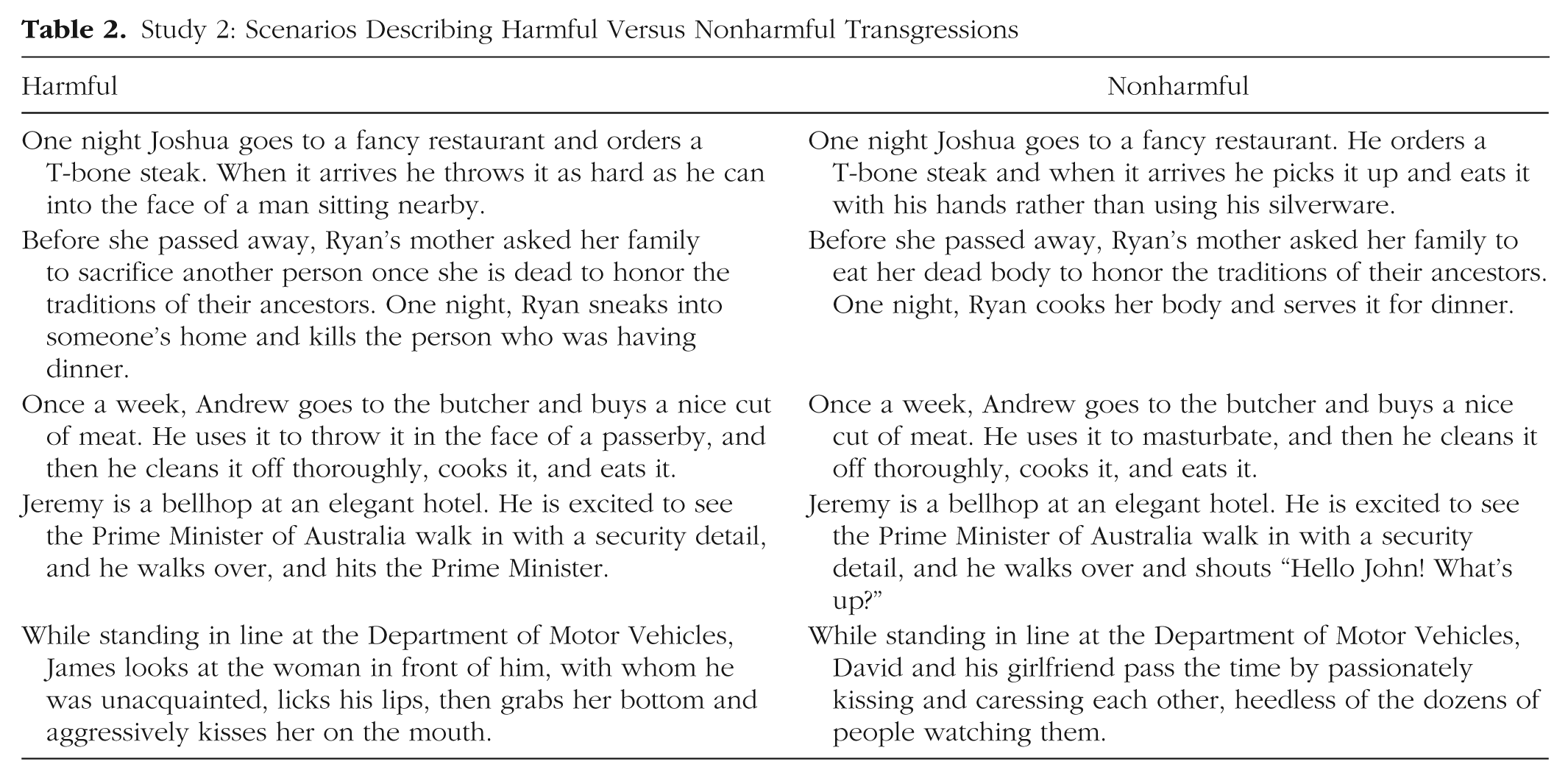
Finally, each participant read five scenarios (in random order) that described people engaging in either harmful or nonharmful transgressions. The scenarios (adapted from Huebner, Lee, & Hauser, 2010) are shown in Table 2. 2 For each behavior, participants responded to four items, indicating whether the behavior was “wrong,” “blameworthy,” “inappropriate,” or “unacceptable” (α = .92); responses were made using scales from 1 (strongly disagree) to 7 (strongly agree).
Study 2: Scenarios Describing Harmful Versus Nonharmful Transgressions
Results and discussion
Manipulation check
Participants in the material-resources-lacking condition reported that their income was lower (M = 2.63, SD = 1.34) than did participants in the material-resources-not-lacking condition (M = 3.25, SD = 1.66), t(197) = 2.91, p = .004.
Moral judgments
Although the following analyses were conducted with the control variables included, it is important to note that all the results held without controls.
A 2 (material resources: lacking vs. not lacking) × 2 (transgression type: harmful vs. nonharmful) analysis of covariance yielded the predicted interaction between the two factors, F(1, 185) = 8.80, p = .003. An analysis of simple effects showed that a lack of material resources led to harsher judgments of harmful transgressions (resources lacking: M = 6.36, SD = 0.37; resources not lacking: M = 5.91, SD = 0.53), F(1, 185) = 9.97, p = .002, but not to harsher judgments of nonharmful transgressions (resources lacking: M = 4.51, SD = 1.14; resources not lacking: M = 4.64, SD = 0.99), F(1, 185) = 1.37, p = .244. In fact, judgments of nonharmful transgressions were slightly (but not significantly) less harsh in the material-resources-lacking condition. The results thus support our theory and rule out alternative explanations for the effect of lack of material resources on moral judgments.
Mediation analysis
We conducted a simultaneous test of the hypothesized as well as all of the potential alternative mediators of the effect of lack of resources on judgments of harmful versus nonharmful transgressions. None of the direct or indirect effects on judgments of nonharmful transgressions were significant.
The results of the mediation analysis for judgments of harmful transgressions are displayed in Figure 1. Supporting our theory, results showed that a lack of material resources led to a significantly stronger sense of vulnerability. Sense of vulnerability, in turn, led to harsher judgments of harmful transgressions. The indirect effect of a lack of material resources on judgments of harmful transgressions through sense of vulnerability did not include 0, indicating a significant indirect effect (Shrout & Bolger, 2002). All other indirect effects were nonsignificant, such that a lack of material resources had no effect on any of the alternative mediators and none of the alternative mediators had an effect on judgments of harmful transgressions.

Path models depicting the effect of a lack of material resources on judgments of harmful transgressions as mediated by sense of vulnerability and alternative mediators (indicated by dashed borders) in Study 2. The variable for lack of resources was dummy-coded (0 = not lacking, 1 = lacking). A positive coefficient indicates a stronger sense of vulnerability and harsher moral judgments. Bias-corrected and accelerated 95% confidence intervals (CIs) from 10,000 bootstrap samples are reported for specific indirect effects.
General Discussion
The results of a large cross-cultural survey and an experiment support the idea that a lack of material resources causes harsher moral judgments because lacking material resources makes people feel more vulnerable to the effects of others’ harmful behavior. Considering the ubiquity of differences in the availability of material resources (Furnham, 1998; Johnson & Krueger, 2006), we have identified a widespread factor that explains moral judgments. Our work also has indirect implications for the psychological and sociological study of broader phenomena such as judicial outcomes, political disagreement, and social conflict, which are affected by differences in moral judgment (Gutmann & Thompson, 1996; Sunstein, 1996; Walzer, 2000). Finally, our research complements past work that considered how people’s life situation shapes them psychologically and affects their moral judgment (e.g., Kohn & Schooler, 1969; Lamont et al., 1996), which assumed that resources do not have a causal effect on moral judgment in themselves and, instead, emphasized the role of other social-class differences, such as differences in occupation and education.
The present research has limitations that warrant discussion. As demonstrated in Study 2, variation in availability of material resources explains judgments of harmful, but not of nonharmful, behaviors. Thus, our theory cannot be used to explain reactions to more symbolic transgressions, such as those against standards of purity, sanctity, or authority. In addition, although our theory explains variation in moral judgments made with respect to specific isolated harmful behaviors, it may be limited in its ability to explain moral judgments in more complex situations, such as moral dilemmas. When people have to choose between two harmful options, aversion to harmful behaviors engendered by a lack of resources might not prompt preference for either alternative.
Future research may extend our theory to explain other phenomena. It is possible that the higher moral standards resulting from a lack of material resources documented in our studies also translate into more moral actions (Ajzen, 1991). Vulnerability brought about by a lack of material resources might also be relevant for an explanation of other social behaviors, such as making oneself additionally vulnerable in social interactions by trusting others. Considering the pervasive importance of material resources in everyday life, we believe that a systematic theoretical approach to understanding the social psychological effects of material-resource availability presents a promising and potentially powerful explanation for important social phenomena.
Footnotes
Acknowledgements
We thank Madan M. Pillutla, Chen-Bo Zhong, and Selin Kesebir for their helpful advice and comments on earlier versions of this manuscript.
Declaration of Conflicting Interests
The authors declared that they had no conflicts of interest with respect to their authorship or the publication of this article.

Notes
References
Supplementary Material
Please find the following supplemental material available below.
For Open Access articles published under a Creative Commons License, all supplemental material carries the same license as the article it is associated with.
For non-Open Access articles published, all supplemental material carries a non-exclusive license, and permission requests for re-use of supplemental material or any part of supplemental material shall be sent directly to the copyright owner as specified in the copyright notice associated with the article.
