



Abstract
In adults, selective memory retrieval can both impair and improve recall of other memories. The study reported here examined whether children also show these two faces of memory retrieval. Employing a variant of the directed-forgetting task, we asked second, fourth, and seventh graders to study a list of target and nontarget words. After study, the participants received a cue to either forget or continue remembering the list. We subsequently asked some participants to recall the nontarget words before we tested their memory for the target words; for the remaining participants, we tested memory only for the target words. Prior retrieval of nontarget words impaired retrieval of to-be-remembered target words, regardless of children’s age. In contrast, prior retrieval of nontarget words improved recall of to-be-forgotten target words in seventh graders, though not in fourth and second graders. These results suggest a developmental dissociation between the two faces of memory retrieval and indicate later maturation of the beneficial effect than of the detrimental effect of selective memory retrieval.
When a child is interrogated about a crime event that he or she has witnessed, the interrogation typically comprises a large number of questions. Whether the child provides useful information depends on the child’s ability to successfully retrieve specific details about the event from memory. If, during the course of interrogation, the child fails to answer a supposedly critical question, the question may be put aside for a while, and the interrogator may proceed with other questions before finally coming back to the original question. This practice may rest on the interrogator’s assumption (or hope) that retrieval is a self-propagating process and that retrieval of some (nontarget) information can aid and guide the retrieval of other (target) information. Although such an assumption is indeed part of applied interviewing techniques for adults and children (Geiselman, Fisher, MacKinnon, & Holland, 1985; McCauley & Fisher, 1995), prior research has often failed to find support for the notion that retrieval is self-propagating.
Indeed, previous studies have generally found that the very act of retrieving information from memory impairs the retrieval of other information. Evidence of this effect has arisen in studies with young adults (for reviews, see Anderson, 2003; Bäuml, Pastötter, & Hanslmayr, 2010; Roediger & Neely, 1982) but has also been reported for young children. Examining retrieval dynamics in first, second, and fourth graders, for instance, Zellner and Bäuml (2005) showed that prior retrieval of some items of a previously studied list impaired children’s recall of the list’s remaining items. This detrimental effect of retrieval was comparable in size across the three age groups and was equivalent to that observed in an adult group (see also Ford, Keating, & Patel, 2004; Lechuga, Moreno, Pelegrina, Gómez-Ariza, & Bajo, 2006), which suggests that in both adults and children, retrieval can be self-limiting.
However, recent evidence from research with adults suggests that retrieval is not always self-limiting but can also be self-propagating. Using the list-wise directed-forgetting task (e.g., see Bjork, 1970), Bäuml and Samenieh (2010) let adult participants study a list of items. After participants had studied the items, they received a cue instructing them either to forget (forget condition) or to continue to remember (remember condition) the list. After presentation of a second list, memory for predefined target items of the original list was assessed, but this memory test was preceded by retrieval of the list’s remaining (nontarget) items. Although prior nontarget recall impaired target recall in the remember condition, it improved target recall in the forget condition, which suggests the existence of two faces of memory retrieval. This finding has been confirmed and attributed to inhibition and context-reactivation processes (e.g., Bäuml & Samenieh, 2012). The proposition is that the target items’ encoding context is deactivated when participants are told to forget the list, and retrieval of the list’s nontarget items reactivates this context (e.g., Howard & Kahana, 2002); in contrast, in the remember condition, the encoding context remains active, and the (easily accessible) target information is inhibited to reduce interference and make selection of the nontarget material easier (e.g., Anderson & Spellman, 1995).
Previous developmental research on selective memory retrieval has used situations in which access to the original encoding context was largely maintained at test (e.g., Ford et al., 2004; Zellner & Bäuml, 2005) and has thus focused on the self-limiting property of children’s memory retrieval. Indeed, very little is known about the effects of selective memory retrieval when children’s encoding context is deactivated. Such knowledge would be highly relevant, because in real-life settings, such as criminal investigations, access to the original encoding context is often impaired. Interrogators of child eyewitnesses would like to know whether, in such situations, children’s memory for some critical detail of a witnessed event can be triggered by the prior retrieval of other information.
In principle, children can reactivate the context of previously encoded events. Wilkinson (1988) found enhanced event memory in 3- to 5-year-old preschoolers when they were interviewed in the same physical context as that present during event encoding (see also Pipe & Wilson, 1994). In particular, Dietze and Thomson (1993) found improved event memory in 6- and 11-year-olds who were asked to imagine the context in which the events took place (see also Saywitz, Geiselman, & Bornstein, 1992). Thus, even young children may use and profit from contextual information. However, it is unclear whether children are also able to reactivate context information when selectively retrieving part of a previous episode and whether such selective retrieval enhances retrieval of other memories of that episode.
Indeed, recent results on the contiguity effect in free recall suggest that the self-propagating property of memory retrieval may emerge relatively late in development. The contiguity effect refers to the observation that people tend to recall in succession items that were studied in nearby serial positions, an observation that has been associated with context-reactivation processes (e.g., Howard & Kahana, 1999). Lehmann and Hasselhorn (2010) examined age-related changes in the contiguity effect and found the effect to be largely reduced, if not absent, in 8-year-olds compared with adults, which suggests that young children may not be able to capitalize on retrieval-induced context-reactivation processes.
The current study examined directly whether children show not only the self-limiting but also the self-propagating property of selective memory retrieval. Following the method of Bäuml and Samenieh (2010), we asked second, fourth, and seventh graders to study a list of predefined target and nontarget words. After the children studied the list, we asked them either to forget or to continue to remember the words on that list. We then presented another list of words, and after the children studied the second list, we asked them to recall the original list’s target words, either with or without prior recall of the list’s nontarget words. We expected to confirm previous developmental research (e.g., Zellner & Bäuml, 2005) by finding equivalent detrimental effects of retrieval on to-be-remembered target words in the three age groups. We expected to find differences between age groups in the beneficial effects of retrieval on to-be-forgotten target words. Given the reduced contiguity effect in elementary-school children (Lehmann & Hasselhorn, 2010), it seems that young children may not yet be able to capitalize on retrieval-induced context reactivation. Thus, the beneficial effect of memory retrieval may arise in older children (seventh graders), but it may be reduced or even absent in younger children (second graders). Until now, no study has demonstrated a beneficial effect of selective memory retrieval in children.
Method
Participants
Forty-eight second graders (mean age = 7.3 years, SD = 0.5 years), 48 fourth graders (mean age = 9.2 years, SD = 0.4 years), and 48 seventh graders (mean age = 12.9 years, SD = 0.9 years) took part in the experiment. Participants were recruited from several elementary and secondary schools in and near Regensburg, Germany. They were tested individually.
Materials
We constructed four study lists, each consisting of 12 unrelated concrete German nouns drawn from word norms for children (Hasselhorn, Jaspers, & Hernando, 1990; Posnansky, 1978). Two of the lists were used as List 1, and the other two were used as List 2. Each child saw one List 1 and List 2 in one condition and then a different List 1 and List 2 in the other condition. Within each List 1, 4 items were randomly chosen as targets, and 8 items as nontargets. Among all words, each target word began with a unique letter, and nontarget words began with unique sequences of two or more letters (word stems), depending on word length. List composition was the same for all participants (see the Supplemental Material available online for further discussion of the choice of material in research on selective memory retrieval).
Design and procedure
The experiment had a 2 × 2 × 3 design, with a within-participants factor of cue condition (remember, forget) and between-participants factors of prior nontarget retrieval (present, absent) and age group (second graders, fourth graders, seventh graders). In both cue conditions, the 12 items on List 1 were presented successively on index cards, one every 4 s, in random order. Two study cycles were conducted to avoid potential floor effects in the youngest age group. Thereafter, the interlist cue (i.e., the instruction to remember or to forget) was provided. In the remember condition, participants were told that List 1 should be remembered for an upcoming memory test. In the forget condition, participants were told that List 1 had been presented erroneously and thus should be forgotten (see Aslan, Staudigl, Samenieh, & Bäuml, 2010). Then, List 2 was presented in exactly the same way as List 1.
In both cue conditions, after a 90-s distractor task, the children were asked to recall and write down the items from List 1. Target and nontarget words were presented on separate sheets of paper. For each target word, the initial letter was given, followed by a blank line (e.g., “A____”; see Fig. 1). For each nontarget word, the word stem was listed, followed by a blank line (e.g., “Unc___”). 1 On each test sheet, the order of the initial letters (for targets) or word stems (for nontargets) was random. Only children who were asked to recall the nontarget words were given the sheet listing the word stems. The children had 1 min to complete each sheet but were given extra time if they needed it. List 2 items were tested subsequently, but the results are not reported here. After a short break, the second cue condition started. The order of the remember and forget conditions was counterbalanced across participants, as was the assignment of lists to the two conditions (see Bäuml & Samenieh, 2010, 2012).
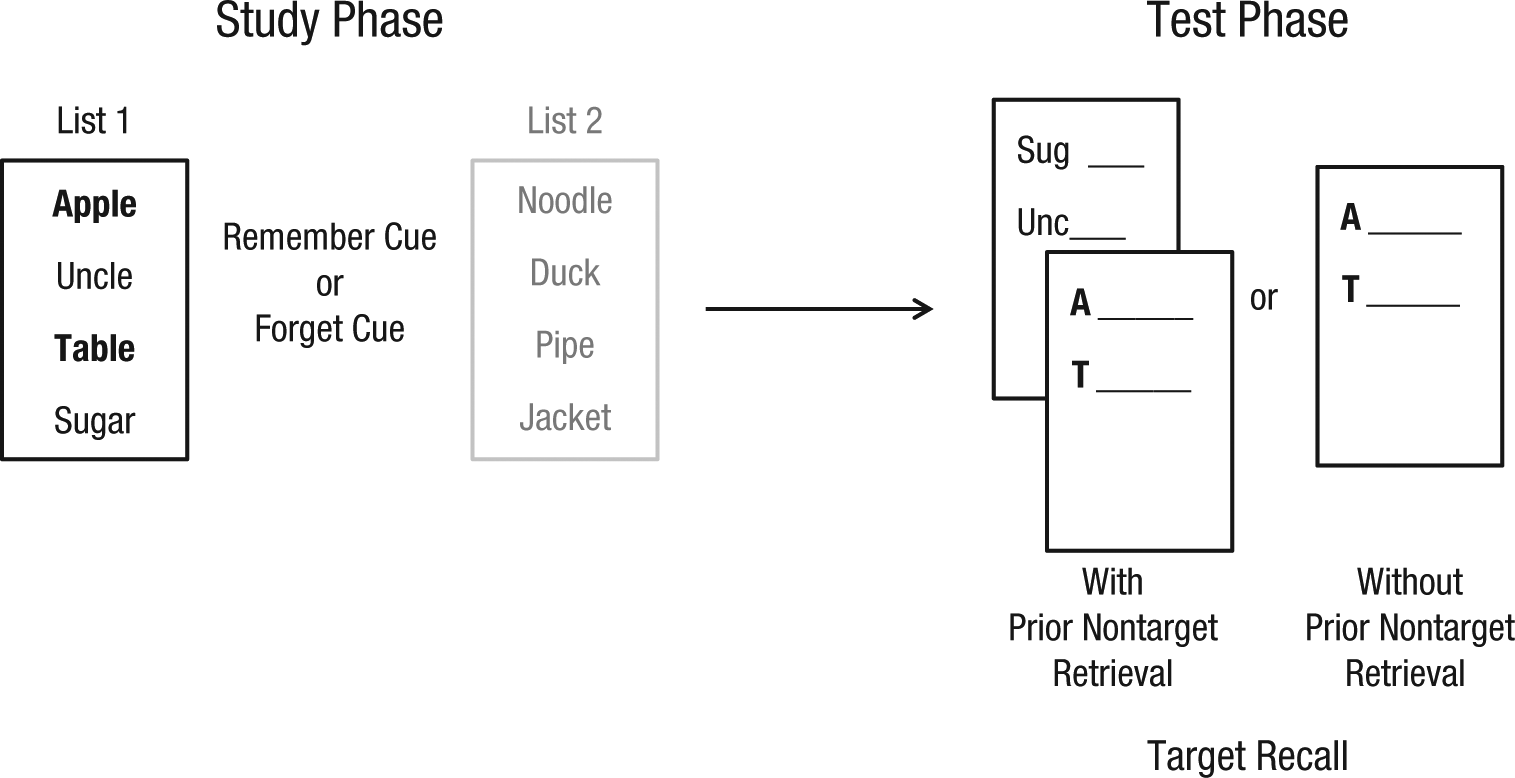
Overview of the experimental procedure. In the study phase, children studied two word lists, each containing 12 words. After study of List 1, the children received a cue to either forget or continue to remember that list. In the test phase, the children were asked to recall predefined target words (boldface type) from List 1 (e.g., “Apple,” “Table”). For each target word, the initial letter was given, followed by a blank line. The target words were tested with or without prior retrieval of the list’s remaining (nontarget) words (e.g., “Uncle,” “Sugar”). When the children were cued to retrieve nontargets, each nontarget’s word stem was listed, followed by a blank line. For this illustration, German words were translated to English.
Results
Recall rates for target words are shown in Figure 2. A 2 × 2 × 3 analysis of variance with the factors of cue condition (remember, forget), prior nontarget retrieval (present, absent), and age group (second graders, fourth graders, seventh graders) revealed significant main effects of cue condition, F(1, 138) = 10.4, MSE = 0.037, p = .002, η p 2 = .07, and age group, F(1, 138) = 20.6, MSE = 0.063, p < .001, η p 2 = .23. These main effects reflect both reduced overall recall in the forget condition compared with the remember condition and higher overall recall in older compared with younger children. There was also a significant two-way interaction between prior nontarget retrieval and cue condition, F(1, 138) = 24.1, MSE = 0.037, p < .001, η p 2 = .15, reflecting the fact that, with the data collapsed across age groups, prior retrieval of nontarget words reduced recall of to-be-remembered target words and enhanced recall of to-be-forgotten target words.
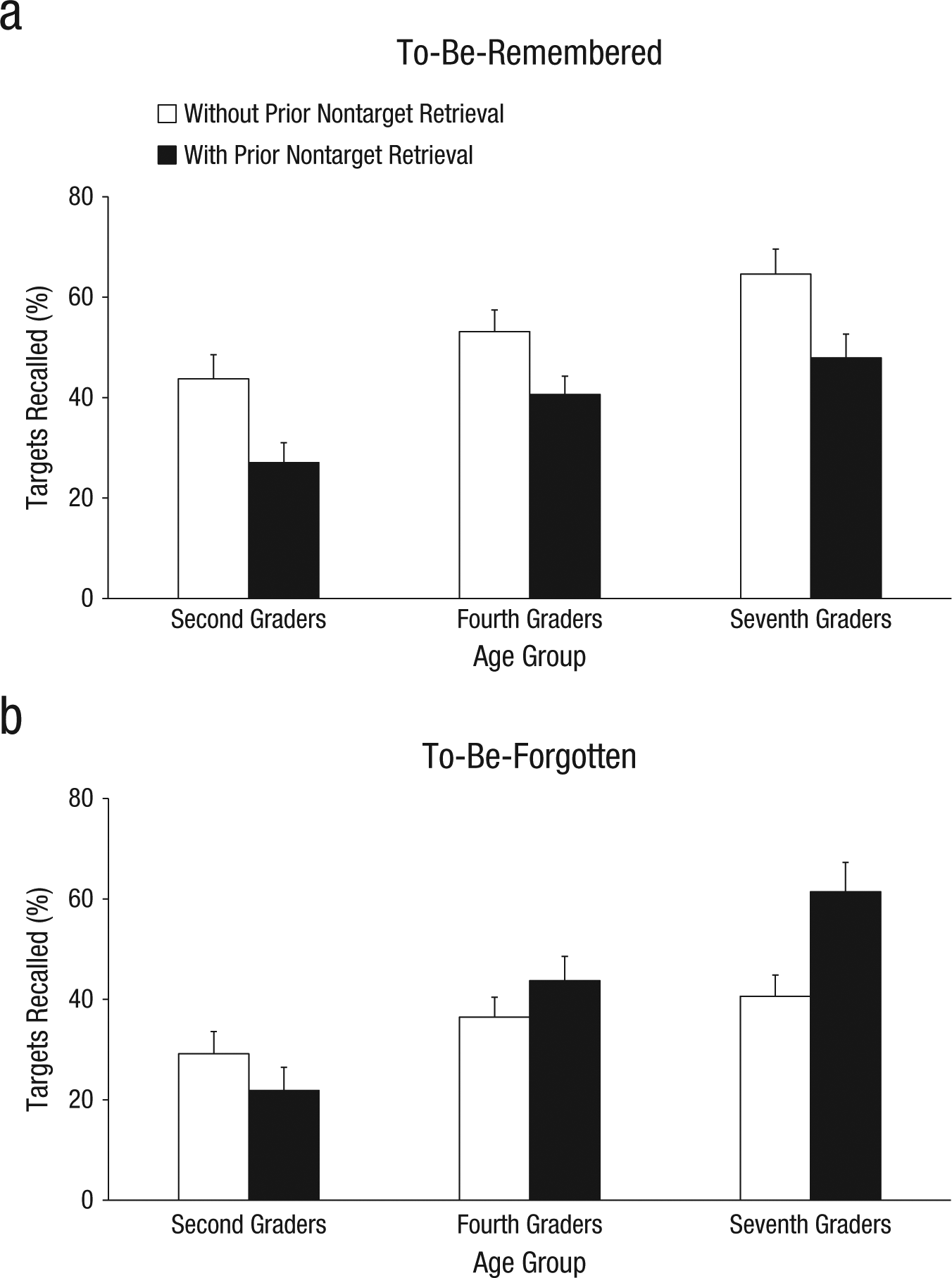
Percentage of recalled (a) to-be-remembered and (b) to-be-forgotten target words as a function of age group and the presence or absence of prior nontarget retrieval. The error bars represent +1 SE.
Note, however, that there was also a significant three-way interaction, F(1, 138) = 3.3, MSE = 0.037, p = .040, η p 2 = .05, suggesting that the beneficial effect of retrieval develops later than its detrimental effect. Indeed, whereas the detrimental effect on recall of to-be-remembered target words was present in all three age groups (second graders: 16.7%, p = .010; fourth graders: 12.5%, p = .032; seventh graders: 16.7%, p = .019), the beneficial effect on recall of to-be-forgotten words was present in seventh graders (20.8%, p = .006) but absent in the two younger age groups (second graders: −7.3%; fourth graders: 7.3%; both ps > .240). (For additional analyses of the data, see the Supplemental Material available online.)
Discussion
We found in all three age groups a detrimental effect of prior nontarget retrieval on retrieval of to-be-remembered target material, which is consistent with results from prior work (e.g., Ford et al., 2004; Zellner & Bäuml, 2005). More important, we found a beneficial effect of selective memory retrieval, with children’s prior nontarget retrieval improving their retrieval of to-be-forgotten target words. Unlike the detrimental effect, this beneficial effect was present only in the oldest age group tested. These results reveal a developmental dissociation between the two effects of selective memory retrieval, indicating later maturation of the beneficial than of the detrimental effect.
The two faces of memory retrieval have been attributed to different mechanisms: Inhibition underlies the detrimental effect, and context-reactivation processes underlie the beneficial effect (Bäuml & Samenieh, 2012). Consistent with this view and with recent evidence for deficient inhibitory processes in kindergartners compared with second graders (Aslan & Bäuml, 2010), the results suggest that the detrimental effect of memory retrieval develops shortly after the time of school entry, and that children from this age on can rely on retrieval-induced inhibitory processes to reduce interference from related memories. The beneficial effect of memory retrieval develops after elementary school; only then can children capitalize on retrieval-induced context-reactivation processes to make forgotten memories accessible again.
Context reinstatement can involve associations of items with the context itself (e.g., Howard & Kahana, 2002); thus, older (though not younger) children’s retrieval of nontarget items may reactivate contextual information, which then guides retrieval of target items. Alternatively, or in addition, context reinstatement may involve the use of direct interitem associations, such that retrieved nontarget items themselves serve as a type of (episodic) contextual cue for target items (e.g., Raaijmakers & Shiffrin, 1981). Because younger children generally encode items in a less associative manner than older children or adults do (Schneider & Pressley, 1997), part of the beneficial effect of retrieval that we observed may have been due to age-related improvements in encoding processes. Future research may address the issue of the exact role of encoding and retrieval processes in the development of the beneficial effect of selective memory retrieval.
Our results indicating that young children do not yet show retrieval-induced context reactivation is consistent with Lehmann and Hasselhorn’s (2010) findings regarding the contiguity effect, which is typically attributed to context-reactivation processes and is reduced, if not absent, in 8-year-olds. Moreover, our results do not conflict with research in which young children were found to use and profit from contextual information (e.g., Dietze & Thomson, 1993; Wilkinson, 1988). In these previous studies, either the contextual information was present throughout the recall phase (as in the case of physical context reinstatement), or specific mental-reinstatement instructions or questions were introduced before the recall phase to reactivate the contextual information. Neither was the case in the current study, in which reactivation processes could be triggered only by the selective retrieval of some of the previously encoded items. Thus, whereas dedicating exceptional effort to reactivate contextual information may be critical for the reinstatement of context in younger children, it does not seem to be necessary in older children.
A forget cue can trigger similar processes in children and adults (Aslan et al., 2010; Harnishfeger & Pope, 1996), which indicates that in both groups, the presentation of a forget cue deactivates the study context (Geiselman, Bjork, & Fishman, 1983; Sahakyan & Kelley, 2002). Therefore, the fact that we did not find beneficial effects of young children’s nontarget recall in the forget condition suggests that these children did not engage in context-reactivation processes. Alternatively, young children may have intact context-reactivation processes, but their directed forgetting may be mediated by processes other than context deactivation. However, no support for such a claim has arisen to date.
In sum, this is the first study to examine the detrimental and beneficial effects of selective memory retrieval in children. Whereas second, fourth, and seventh graders showed the detrimental effect of memory retrieval, only seventh graders showed the beneficial effect. From a more theoretical perspective, the results indicate later maturation of the beneficial than the detrimental effect of selective memory retrieval. From a more applied perspective, the results suggest that in eyewitness situations, in which access to the original encoding context is often impaired, interrogators may indeed trigger children’s memory for critical information through guided retrieval of related information. Yet our results also suggest that mainly older children would benefit from such guided retrieval, and that other techniques, such as mental-reinstatement techniques (Dietze & Thomson, 1993), might be necessary to improve eyewitness testimony in younger children. The present findings thus provide important clues and restrictions for the further development and refinement of age-appropriate interrogation techniques for children.
Footnotes

References
Supplementary Material
Please find the following supplemental material available below.
For Open Access articles published under a Creative Commons License, all supplemental material carries the same license as the article it is associated with.
For non-Open Access articles published, all supplemental material carries a non-exclusive license, and permission requests for re-use of supplemental material or any part of supplemental material shall be sent directly to the copyright owner as specified in the copyright notice associated with the article.
