




Abstract
Forgiveness is considered to play a key role in the maintenance of social relationships, the avoidance of unnecessary conflict, and the ability to move forward with one’s life. But why is it that some people find it easier to forgive and forget than others? In the current study, we explored the supposed relationship between forgiveness and forgetting. In an initial session, 30 participants imagined that they were the victim in a series of hypothetical incidents and indicated whether or not they would forgive the transgressor. Following a standard think/no-think procedure, in which participants were trained to think or not to think about some of these incidents, more forgetting was observed for incidents that had been forgiven following no-think instructions compared with either think or baseline instructions. In contrast, no such forgetting effects emerged for incidents that had not previously been forgiven. These findings have implications for goal-directed forgetting and the relationship between forgiveness and memory.
To be wronged is nothing, unless you continue to remember it.
One of the most striking examples in the modern era of the power to forgive is that of the late South African President Nelson Mandela who, in 1963, was sentenced to life imprisonment on charges of attempting to undermine the State of South Africa. On release from prison 27 years later, Mandela did not call for revenge, but for forgiveness. In doing so, he not only forgave those people who had imprisoned him, but also encouraged others who had been the victims of injustice to do the same. Amid escalating civil discord, his actions proved critical in helping to unify a nation that had been torn asunder through the policies of apartheid.
While Mandela’s story is one of extraordinary forgiveness in the face of grave injustice, it nonetheless illustrates the potential importance of forgiveness for social change and reconciliation in society more generally. Yet despite the assumed role of forgiveness in promoting peace and social order, it is only within the last decade that psychologists have begun to focus on forgiveness as a testable psychological construct (Exline & Baumeister, 2000; Fincham, 2000; McCullough, Fincham, & Tsang, 2003). As a consequence, a host of associated benefits have begun to emerge, including enhancements to psychological well-being (Karremans, Van Lange, Ouwerkerk, & Kluwer, 2003; Orcutt, 2006; Toussaint & Webb, 2005), physiological health (Harris & Thoresen, 2005; Witvliet, Ludwig, & Vander Laan, 2001), and spiritual well-being (Strelan, Acton, & Patrick, 2009).
The act of forgiveness typically includes the ability to overcome strong negative emotions toward a transgressor with more positive feelings (Enright, Gassin, & Wu, 1992; Yovetich & Rusbult, 1994). On some occasions, forgiveness may even necessitate having to set aside vengeful impulses (DeWall, Pond, & Bushman, 2010; Finkel & Campbell, 2001). From a cognitive perspective, this kind of effortful activity—the need to regulate and inhibit inappropriate thoughts and impulses in a goal-directed manner—can be seen to be a function of executive control (Borkowski & Burke, 1996; Chan, Shum, Toulopoulou, & Chen, 2008; Denckla, 1996; Payne, 2005; Pronk, Karremans, Overbeek, Vermulst, & Wigboldus, 2010).
Beyond this, however, relatively little is understood about the actual cognitive mechanism that allows people to set aside upsetting thoughts and vengeful behavior. As a first step toward addressing this, we explored the supposed relationship between forgiveness and forgetting. Like the ability to forgive, the ability to forget—at least, intentionally—also appears to depend on the efficacy of executive control (see Anderson & Green, 2001; Anderson & Huddleston, 2011; Bjork, 1972). More specifically, motivated forgetting is thought to be a function of an inhibitory control mechanism that can prevent unwanted memories from entering conscious awareness (see Anderson, 2003; Anderson, Green, & McCulloch, 2000; Anderson & Spellman, 1995; Levy & Anderson, 2002; M. D. MacLeod & Saunders, 2005; Storm & Levy, 2012; but see Bulevich, Roediger, Balota, & Butler, 2006; C. M. MacLeod, 2007; C. M. MacLeod, Dodd, Sheard, Wilson, & Bibi, 2003, for alternative accounts).
Given that executive control appears to be implicated in the acts of forgiveness and motivated forgetting, we explored whether there was any empirical basis for the assumed relationship between forgiveness and forgetting. To do so, we employed a variant of the think/no-think paradigm (Anderson & Green, 2001), in which participants are typically presented with unrelated word pairs (e.g., “ordeal”-“roach”) that are learned to criterion. Participants are then trained to forget the target words associated with some of the previously learned cues (no-think condition) and to think about others (think condition). Thus, participants might be presented with the cue “ordeal” and then asked to keep the associated word (“roach”) from coming to mind. Results from this procedure have shown more forgetting at final test for target words in the no-think condition than both in the think condition and when no instructions are given (e.g., Anderson & Green, 2001; Anderson, Reinholz, Kuhl, & Mayr, 2011; Bergstrom, de Fockert, & Richardson-Klavehn, 2009; Hanslmayr, Leipold, & Bäuml, 2010). Most recently, this motivated-forgetting effect has also been demonstrated to apply to relatively rich autobiographical memories (Noreen & MacLeod, 2013, 2014; Stephens, Braid, & Hertel, 2013).
Despite enjoying a long history, as evidenced by the well-known idiom “to forgive and forget” (cf. Colossians 3:12–14), the assumed relationship between forgiveness and forgetting, as well as the nature of its causal direction, remains unresolved and has not been empirically verified. One possibility is that forgiveness may facilitate forgetting by creating the impetus to forget; that is, forgiveness may provide the basis for goal-directed forgetting. On the other hand, forgetting may facilitate forgiveness insofar as it may empower individuals to dismiss transgressions, thereby enabling the forgiver to preserve valued relationships and to move on with his or her life.
While we acknowledge the potential for complex bidirectional relationships to emerge, especially over long periods of time, the current research offers a modest first step toward untangling this complex nexus of relationships. We asked participants to imagine that they were the victim of a number of hypothetical scenarios and then to decide whether or not they would forgive the transgressor. In a follow-up session, the same participants were presented with a subset of the scenarios originally presented (half had been forgiven and half had not) and were asked to complete a standard think/no-think procedure, in which participants were required to recall some of the scenarios (think condition), to avoid saying or thinking about others (no-think condition), or given no instructions (baseline condition). Our rationale was that if forgiveness affects what people ultimately remember, we would expect intentional forgetting to be facilitated for scenarios that had previously been forgiven, whereas motivated forgetting might be more difficult to achieve for incidents that were unforgiven.
Method
Participants
Following previous think/no-think studies, we recruited 30 participants (age = 18–39 years; 25 females, 5 males). All participants were from the University of St Andrews and were paid £12.50 (~$19.23) for their participation. Current levels of depression were measured using the second edition of the Beck Depression Inventory (BDI-II; Beck, Steer, & Brown, 1996); all participants had BDI-II scores of 9 or below (M = 4.5), which indicates they were not currently experiencing depressed mood.
Materials and procedure
To assess dispositional forgiveness, we employed the Tendency to Forgive Scale (TTF; Brown, 2004). The TTF consists of four statements (e.g., “I tend to get over it quickly when someone hurts my feelings”) that are designed to explore individual differences in people’s responses to incidents in which they had been hurt by the actions of others. Participants responded by indicating the extent to which they agreed with each statement on a 7-point scale (higher scores indicating a greater dispositional tendency to forgive).
We also constructed 40 scenarios, some of which were adapted from the Forgiveness Attitudes Questionnaire (Kanz, 2000), and the Forgiveness Likelihood Scale (Rye, 1998; Rye et al., 2001). These scenarios were designed to assess a variety of hypothetical wrongdoings, such as infidelity, slander, and theft. These scenarios were matched for word length and contained information relating to (a) the offense, (b) the consequence of the offense, and (c) what the transgressor did to make amends. For each scenario, the transgressor was depicted as a friend, parent, partner, supervisor, work colleague, or boss. For example, “The offence is that your professor does not believe you when you tell [him or her] you have not plagiarized your work. The consequence is that you are expelled from the university. Later your professor realizes you were telling the truth and tries to make amends by attempting to get you reinstated.”
Participants were instructed to read the scenario and then indicate whether they would forgive the transgressor by circling one of two responses (“yes” or “no”). Using a series of 7-point Likert-type scales, participants rated how confident they were in their decision to forgive or not to forgive the transgressor, how serious they considered the offense to be, how motivated they were to forgive the transgressor, how hurtful they found the offense to be, how sympathetic they were toward the victim, and how sympathetic they were toward the transgressor.
In the initial session, participants completed the screening questionnaire, BDI-II, and the TTF. Each participant also completed the forgiveness questionnaire, which contained the 40 scenarios. From these responses, we obtained 12 forgiven scenarios and 12 unforgiven scenarios for each participant. No participants indicated having experienced similar incidents to any of the hypothetical scenarios depicted (either as a victim or an offender). The screening and scenario-rating session took place 7 to 14 days before the second session (think/no-think task) of the study.
In the second session, participants saw each of the scenarios again, but this time each was paired with an unrelated neutral cue word. Pairings were subsequently divided into six sets, with three sets containing four cue/forgiven-scenario pairs and three sets containing four cue/unforgiven-scenario pairs. Subsequently, one forgiven and one unforgiven set were assigned at random to each of the think, no-think, and baseline conditions. These pairings were fully counterbalanced. Furthermore, two forgiven and two unforgiven scenarios were paired with an additional four neutral words that acted as fillers. The second session consisted of four phases.
Learning phase
In the learning phase, participants saw each cue-scenario pair on a computer screen for 60 s and were told to remember the pairings. Participants were told that each scenario contained information concerning (a) the offense, (b) the consequence of the offense, and (c) how the transgressor tried to make amends. Their task was to try to remember all three details about each scenario. A 500-ms intertrial interval preceded the presentation of the next pair. All pairs were presented in a prespecified order.
Initial recall phase
In the initial recall phase, participants saw only the cue words that previously accompanied each scenario. Each cue word was presented for a maximum of 30 s, and participants were asked to press the space bar as soon as the associated scenario came to mind. Participants were given 1 min in which to recount the scenario in as much detail as possible. To help participants, we prompted them to recall each of the three details for the scenarios. Following a 500-ms delay, feedback was provided on the accuracy of recall for each scenario. Responses were scored as correct if participants retrieved all three descriptions. Regardless of how they performed, participants again saw the scenario for each cue word to study, followed by an intertrial interval of 300 ms. All participants were required to achieve a minimum of 50% accuracy on this assessment before continuing with the procedure.
Think/no-think phase
In the think/no-think phase, participants were told they would see some cue words in either green or red font. Green cues were accompanied by a prompt word related to the scenario. Participants were asked to briefly summarize the associated offense, the consequence of the offense, and what the transgressor did to make amends (the think condition). Incorrect responses resulted in the correct aspect of the scenario being displayed for 4 s. For red cues, participants were simply presented with the cue word and instructed to avoid thinking or saying anything about the associated scenario (the no-think condition). Each trial began with a small cross appearing on the screen for 200 ms. Subsequently, a cue word (and a prompt word for green cues) appeared on the screen for 4 s, which was followed by an intertrial interval of 400 ms. Participants saw 16 of the 24 cue words. Each of the cue words was presented 16 times, resulting in 256 trials in total. There was a break of 3 min after each set of 64 trials. Cue words were presented in a prespecified order.
It is important to note that we used prompt words for the think condition because the majority of previous think/no-think studies have consistently used 4-s trials for the no-think and think conditions. Given that, in our study, participants initially had 1 min to retrieve the scenarios (as we required participants to retrieve three separate details), it would not have been possible to retrieve all the details for each scenario in the space of 4 s. Most think/no-think studies require only one-word responses. By providing participants with a prompt to retrieve only one aspect of the scenario, we equalized the amount of time given in think and no-think trials to ensure comparability with other think/no-think studies. Also, it is worth noting that the use of prompt words in the think/no-think paradigm has been found to have no influence on whether a forgetting effect emerges or not (see Noreen & MacLeod, 2013).
Final recall phase
In the final recall phase, participants saw all the cue words originally presented and were asked to recall the scenarios associated with each cue. Participants initially saw a cue word for 30 s and were asked to press the space bar as soon as the associated scenario came to mind. Participants were then given 1 min to recount the scenario in as much detail as possible. Again, participants were prompted to recall all three details concerned with each scenario (Noreen & MacLeod, 2013, 2014). All responses were recorded. This was followed by an intertrial interval of 400 ms. Finally, participants responded a second time to the forgiveness questionnaire they had filled out in the first phase of the study. For each scenario, they indicated whether they would forgive the transgressor, how confident they were of their decision, how serious the offense was, how motivated they were to forgive the transgressor, how hurtful the offense was, how sympathetic they were toward the victim, and how sympathetic they were toward the transgressor.
All the retrieved scenario details were subsequently transcribed and coded in relation to the offense, the consequence of the offense, and what the transgressor did to make amends. The scenarios were scored as correct if all three descriptions were judged to have corresponded to the original scenarios. A second independent rater scored all the scenarios for half of the sample (i.e., 360 scenarios in total). Using Holsti’s (1969) method, we found that the level of agreement between the two scorers was very high: 97.83% agreement overall (agreement: offense = 98%, consequence = 98%, and what the transgressor did to make amends = 97.5%).
Results
Characteristics of forgiven and unforgiven offenses
Mean ratings regarding the seriousness of the offense and the motivation to forgive the transgressor were compared using a 2 (scenario: forgiven vs. unforgiven) × 3 (instruction: baseline vs. think vs. no-think) mixed design analysis of variance (ANOVA). This analysis revealed that unforgiven scenarios were perceived as more serious (M = 6.57, SD = 0.32) than forgiven scenarios (M = 4.03, SD = 0.85), F(1, 118) = 491.23, p < .01, d = 3.96. Furthermore, participants were more motivated to forgive the transgressor for scenarios that had been forgiven (M = 2.92, SD = 0.76) than unforgiven (M = 5.84, SD = 0.76), F(1, 118) = 417.62, p < .01, d = 3.84. For analyses of other items on the forgiveness questionnaire, see the Supplemental Material available online.
Accuracy in the initial recall phase
To establish whether there were any intrinsic differences in the memorability of forgiven versus unforgiven scenarios after learning, we also conducted a 2 (scenario: forgiven vs. unforgiven) × 3 (instruction: baseline vs. think vs. no-think) mixed design ANOVA on participants’ recall performance prior to the introduction of think/no-think instructions. This analysis revealed neither a significant effect of instruction, F(2, 57) = 0.19, p > .05, or scenario, F(1, 58) = 0.08, p > .05, nor an instruction-by-scenario interaction, F(2, 57) = 0.09, p > .05 (see Table 1 for means). Thus, we can be reasonably confident that any differences in recall performance following the think/no-think procedure cannot be attributed to inherent differences in the memorability of the scenarios themselves.
Mean Percentage of Scenarios Correctly Recalled Prior to the Think/No-Think Procedure
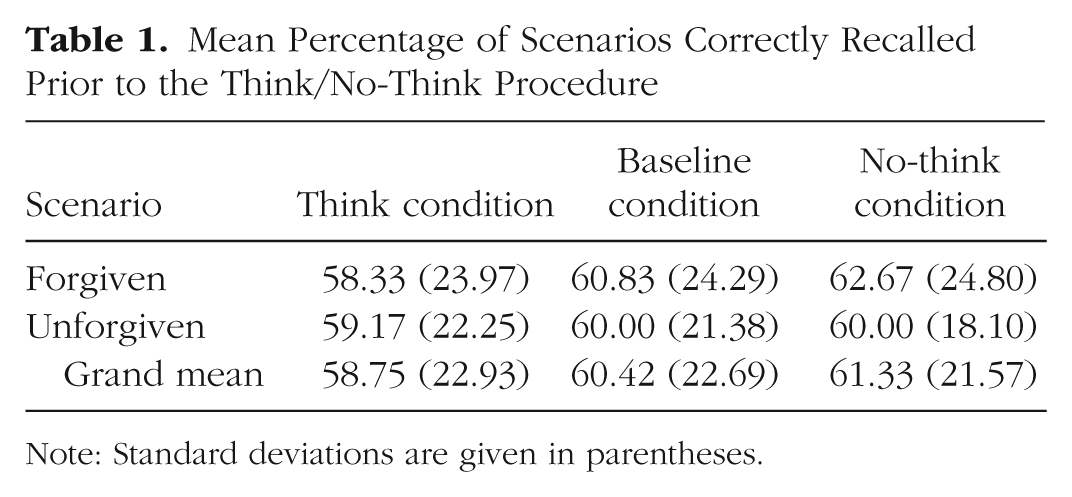
Note: Standard deviations are given in parentheses.
Recall accuracy at final test
A 2 (scenario: forgiven vs. unforgiven) × 3 (instruction: baseline vs. think vs. no-think) mixed design ANOVA on recall accuracy at final test revealed a main effect of instruction, F(2, 57) = 17.48, p < .01, and a significant instruction-by-scenario interaction, F(2, 57) = 8.31, p < .01. Subsequent pairwise analyses revealed that participants recalled significantly more details for forgiven scenarios in the think condition (M = 77.50%, SD = 16.54) compared with the baseline condition, in which no instructions to forget or remember had been given (M = 60.83%, SD = 21.46), t(29) = 4.33, p < .001, d = 0.87. Participants also recalled more details accurately for forgiven scenarios in the think condition than in the no-think condition (M = 38.33%, SD = 29.16), t(29) = 7.56, p < .001, d = 1.65. Notably, our analysis also revealed that participants showed significantly more forgetting for forgiven scenarios in the no-think condition than in the baseline condition, t(29) = 4.51, p < .001, d = 0.88 (see Fig. 1). Post hoc power analysis (using G*Power Version 3.1.7; Faul, Erdfelder, Lang, & Buchner, 2007) revealed high statistical power for detecting group differences (1 − β = 0.97, p = .008, N = 30, d = 0.88).

Mean percentage of forgiven and unforgiven scenarios correctly recalled in the think, baseline, and no-think conditions. Error bars represent ±1 SEM.
In contrast, for unforgiven scenarios, no significant difference in recall performance was apparent at final test between the think condition (M = 69.17%, SD = 19.35) and the baseline condition (M = 63.33%, SD = 25.20), t(29) = 1.16, p > .05, d = 0.26, or between the think condition and the no-think condition (M = 61.67%, SD = 28.42), t(29) = 1.20, p > .05, d = 0.31. Furthermore, there was no significant difference in recall performance between the no-think condition and the baseline condition, t(29) = 1.41, p > .05, d = 0.06 (see Fig. 1). Given that these null findings are pivotal to the interpretation of these data, we conducted a post hoc power analysis (again using G*Power Version 3.1.7) to eliminate the possibility that the null effects reported here were not a function of inadequate statistical power. A two-tailed test revealed that a sample size in excess of 15,000 would have been required in order for group differences to have reached statistical significance at the .05 level (1 − β = 0.80, p = .008).
We also explored whether there were any differences in overall recall performance for forgiven and unforgiven scenarios across the think, no-think, and baseline conditions. Subsequent pairwise analyses revealed no significant differences in recall performance between forgiven and unforgiven scenarios in the think, t(29) = 1.79, p > .05, or baseline conditions, t(29) = 0.41, p > .05. Participants, however, recalled significantly fewer details when prompted to recall forgiven than unforgiven scenarios in the no-think condition, t(29) = 3.14, p < .03.
Dispositional forgiveness and forgetting
We also explored whether there was a relationship between dispositional forgiveness (as indexed by the TTF) and the extent of forgetting observed for both forgiven and unforgiven scenarios. The forgetting effect size was calculated by subtracting no-think scores from baseline scores, with higher positive scores reflecting larger forgetting effects (cf. Noreen & MacLeod, 2013, 2014). No relationship was found between the extent of forgetting and dispositional forgiveness either for forgiven scenarios, r(30) = .22, p > .05, or for unforgiven scenarios, r(30) = .22, p > .05. This suggests that one’s inherent tendencies to forgive—at least, as measured in the current study—are unrelated to one’s ability to forget.
Discussion
Despite the fact that the virtues of being able to “forgive and forget” have been extolled for centuries (see McCullough et al., 1998), the current study represents the first empirical demonstration of a link between forgiveness and intentional forgetting. Our findings suggest that when individuals have already forgiven a transgressor, memories related to the forgiven offense become more susceptible to subsequent motivated forgetting. When individuals have not forgiven the transgressor, however, participants are less successful in suppressing details related to unforgiven incidents. These differences in final recall performance cannot be ascribed to inherent differences in the memorability of forgiven and unforgiven scenarios in our study.
The fact that no differences emerged between the forgiven and unforgiven scenarios in the initial recall test (i.e., prior to the instructions to forget) is worth further consideration. On first inspection, this might suggest that details of forgiven incidents are not forgotten spontaneously; that is, the forgiver may also have to be motivated to forget in order for forgetting to occur. Another possibility, however, is that the absence of forgetting between forgiven and unforgiven incidents in the initial recall test may have more to do with the fact that participants were tested immediately after learning the scenarios. It is possible that more forgetting may spontaneously emerge when greater time has elapsed between the act of forgiveness and the cue to recall. One possibility is that forgiveness may result in less rumination (McCullough, Bono, & Root, 2007) and thereby create greater temporal distance from the offense than when an incident has not been forgiven.
Our study also raises the intriguing possibility that the relationship between forgiving and forgetting may depend less on one’s inherent disposition to forgive and more on whether one has actually forgiven the transgressor. This, in turn, may be a function of the characteristics of the transgression (e.g., its seriousness) or the effectiveness of inhibitory control. The fact that there is considerable variation in the ability to inhibit unwanted memories (Levy & Anderson, 2008) raises the possibility that variability may also exist in the extent to which vengeful thoughts and deeds can be inhibited. It is important to acknowledge, however, that as independent cues were not employed at final test (Anderson & Spellman, 1995), we cannot be certain that the observed forgetting effects were a function of inhibition per se—only that the forgetting effects were consistent with an inhibitory account. While we recognize the need to address this important question, it is equally important to have taken that first step to establish that there is a link between forgiveness and forgetting.
Finally, it is possible that motivational factors contributed to the absence of forgetting for unforgiven scenarios following instructions to suppress them. One could surmise that if one is not prepared to forgive, one may be less willing to forget the details of the incident, as such details may serve as justification for future retaliatory actions. It is worth noting, however, that there was no evidence of enhanced recall performance for unforgiven scenarios in comparison with baseline scenarios. Thus, while the motivation to remember wrongs perpetrated by other people remains a possibility, there is little evidence to suggest that such factors contributed to the forgetting effect between forgiven and unforgiven scenarios in the present study.
In conclusion, our findings indicate that forgiveness facilitates forgetting, insofar as once an individual has forgiven a transgressor, the forgiver becomes more successful at suppressing the details concerned with the offense. The ability to forget such upsetting memories may, in turn, provide an effective coping strategy that ultimately enables people to move on with their lives. In time, research in this new field of enquiry may combine forgetting- and forgiveness-based interventions that might, in turn, give rise to powerful therapeutic tools that will enable people to “forgive and forget” more effectively. In the meantime, it would seem that while forgiving remains an effortful process, forgetting may actually become easier as a result.
Footnotes

References
Supplementary Material
Please find the following supplemental material available below.
For Open Access articles published under a Creative Commons License, all supplemental material carries the same license as the article it is associated with.
For non-Open Access articles published, all supplemental material carries a non-exclusive license, and permission requests for re-use of supplemental material or any part of supplemental material shall be sent directly to the copyright owner as specified in the copyright notice associated with the article.
