



Abstract
In Arabic, as in many languages, the future is “ahead” and the past is “behind.” Yet in the research reported here, we showed that Arabic speakers tend to conceptualize the future as behind and the past as ahead of them, despite using spoken metaphors that suggest the opposite. We propose a new account of how space-time mappings become activated in individuals’ minds and entrenched in their cultures, the temporal-focus hypothesis: People should conceptualize either the future or the past as in front of them to the extent that their culture (or subculture) is future oriented or past oriented. Results support the temporal-focus hypothesis, demonstrating that the space-time mappings in people’s minds are conditioned by their cultural attitudes toward time, that they depend on attentional focus, and that they can vary independently of the space-time mappings enshrined in language.
Across many of the world’s languages, the future is “ahead” of the speaker, and the past is “behind.” In English, people can look “forward” to their retirement or look “back” on their childhood (Clark, 1973; Evans, 2004; Haspelmath, 1997; Lakoff & Johnson, 1980). Beyond talking about time using a front-back axis, it appears that people also think about time this way (Boroditsky, 2000; Miles, Nind, & Macrae, 2010; Torralbo, Santiago, & Lupiáñez, 2006; Ulrich et al., 2012). This link between time and space is believed to arise from a universal aspect of perceptuo-motor interactions with the physical world (Clark, 1973). Human bodies have an intrinsic front, which determines how they move forward through space (literally) and through time (metaphorically). When people walk along a path, the points they have already passed lie behind them, and the points they will travel to in the future lie ahead of them. If this universal pattern of body-world interaction is, indeed, responsible for an association between space and time in language and mind, it would be natural to assume that the future should be ahead and the past behind universally, across languages and cultures.
Yet some languages exhibit the opposite space-time mapping. In the Andean language Aymara, for example, metaphors place the past in front (e.g., nayra mara, tr. “front year,” means last year) and the future behind (e.g., qhipa marana, tr. “back year,” means next year; Núñez & Sweetser, 2006). Aymara speakers’ spontaneous hand gestures provide further evidence for this reversed space-time mapping (for past-in-front mappings in other languages, see Buetow, 2004; Dahl, 1995; Hau’ofa, 2008; Moore, 2006, 2011; Rymer, 2012; Thornton, 1987; Yu, 2012).
What causes some communities to adopt a future-in-front mapping and others a past-in-front mapping for time? In the research reported here, we investigated this question by exploring a surprising discovery about temporal language and thought in speakers of Darija, a Moroccan dialect of modern Arabic. Front-back time metaphors in Arabic are similar to metaphors in English and other future-in-front languages (Table 1).
Examples of Standard Arabic Sentences Showing a Future-in-Front and a Past-in-Back Mapping
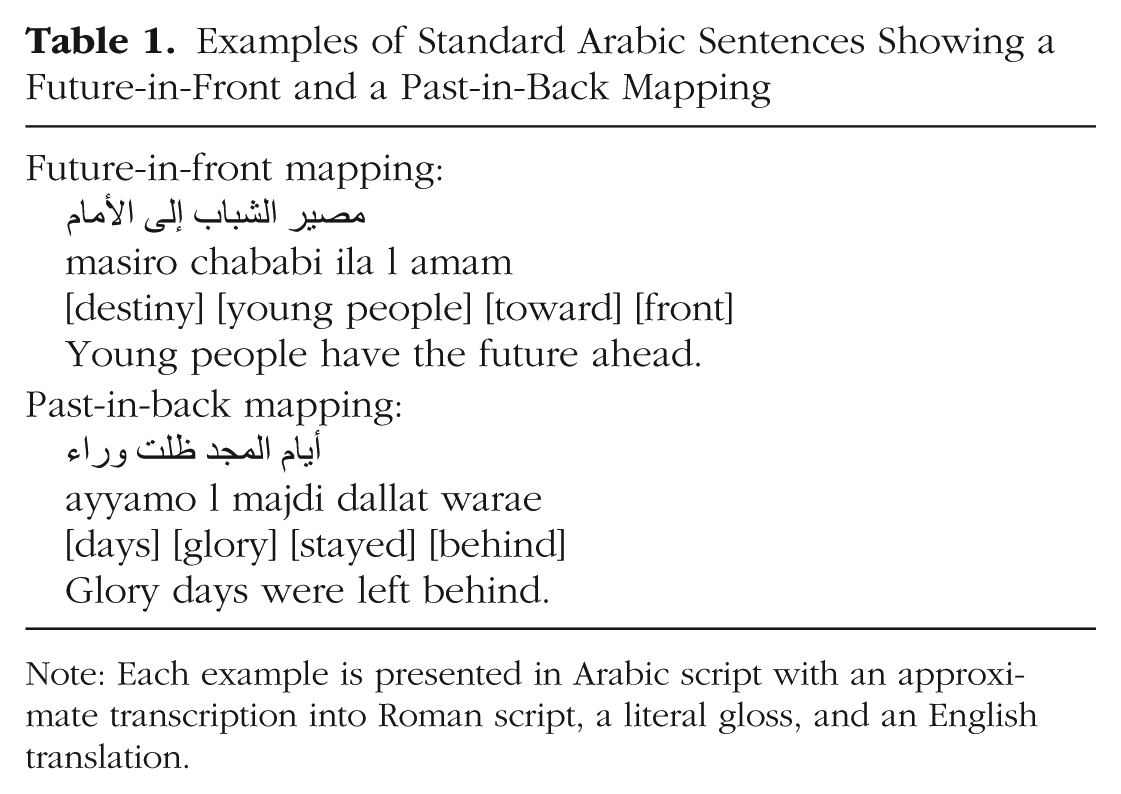
Note: Each example is presented in Arabic script with an approximate transcription into Roman script, a literal gloss, and an English translation.
Yet Darija speakers’ spontaneous hand gestures suggest a dissociation between the way they talk about time and the way they think about it. We compared how native Spanish and Darija speakers gesture when talking about past and future events (Román, Santiago, Jasmin, & Casasanto, 2014). Whereas Spaniards showed a weak tendency to gesture according to the future-in-front mapping, Moroccans showed a strong tendency to gesture according to the past-in-front mapping—despite using future-in-front metaphors in speech. On the basis of their cospeech gestures, it appears that Darija speakers think about time like the Aymara do, even though they talk about it like speakers of English, Spanish, and other familiar future-in-front languages.
In the present study, we first corroborated the serendipitous finding of a past-in-front mapping in Moroccans, confirming a dissociation between their temporal language and thought (Experiment 1). We then proposed and tested a new account of how particular temporal mappings become activated in individuals’ minds, and entrenched in their cultures, on the basis of their temporal focus of attention: the temporal-focus hypothesis (Experiments 2–5).
Experiment 1: Do Moroccan Arabs Place the Past in Front?
The past-in-front pattern of gestures that we previously observed in Moroccan Arabic speakers was strong, but it was also unpredicted, unexplained, and contradictory to patterns in Arabic language (Hamdi, 2007) and to the universal experience of moving forward through both space and time during ordinary locomotion (Clark, 1973). The goal of Experiment 1 was to replicate this surprising result using a temporal diagram task and to contrast the space-time diagrams produced by Moroccans with those produced by Spaniards.
Method
Participants
Sample sizes varied according to the availability of participants. Overall, there were 125 participants. Spaniards (n = 50) were University of Granada psychology students (average age = 24.8 years, range = 18–43). Of the Moroccans (n = 75), 11 were University of Granada undergraduates who had lived in Spain for at least 5 years (average age = 27.2 years, range = 21–37). Both groups were tested in Granada, and all materials were in Spanish. The remaining Moroccans (n = 64) were students at Abdelmalek Essaadi University in Tetouan, Morocco (average age = 24.4 years, range = 19–52). They were tested in Tetouan in two cohorts, several months apart, with written instructions in Arabic and oral instructions presented in Darija by a native Darija speaker.
Materials and procedure
Participants performed a temporal diagram task adapted from Casasanto (2009, Experiment 1). They saw a cartoon character (named Juan in the Spanish version and Mohammed in the Arabic version), viewed from above, with one box in front of him and one box behind him (Fig. 1a). They read that yesterday Juan/Mohammed went to visit a friend who liked plants, and tomorrow he would be going to visit a friend who likes animals (or vice versa, depending on the version of the task the participant received). Participants were told to write the initial letter of the word for “plant” in the box that corresponded to past events and the initial letter of “animal” in the box that corresponded to future events (or vice versa). The order of mention of the plants and animals was counterbalanced, as were their pairings with “yesterday” and “tomorrow.”

Stimulus and results from Experiment 1. Participants viewed a cartoon character from above (a) who had one box in front of him and one box behind him. They indicated which box should correspond to a past event and which should correspond to a future event. The percentage of past-in-front and future-in-front responses (b) is shown separately for Spaniards and Moroccans. Error bars show standard errors of the mean.
Results
The front-back mapping of time completely reversed between the Spanish and Moroccan groups, as revealed by a binary logistic regression, Wald χ2(1, N = 126) = 48.26, p = .001, odds ratio = 42.67, 95% confidence interval (CI) = [14.69, 123.91] (Fig. 1b). The majority of Spaniards (88%) responded according to the future-in-front mapping, placing the future event in the box in front of the character and the past event in the box behind him (p = .0001). By contrast, the majority of Moroccans (85%) responded according to the past-in-front mapping, placing the future event in the box behind the character and the past event in the box in front of him (p = .0001). The percentage of past-in-front responses was significantly lower in the bicultural Moroccans living and tested in Spain (64%) than in the monocultural Moroccans living and tested in Morocco (89%), Wald χ2(1, N = 75) = 4.27, p = .04, odds ratio = 4.65, 95% CI = [1.08, 19.99].
The Moroccan results reported here include data from two independent cohorts of participants in Tetouan. The tendency to place the past in front of the character was significant in each cohort analyzed separately, which provided an internal replication of the previously undocumented past-in-front mapping in Moroccan Arabic speakers—Cohort 1 (n = 24): 79% past-in-front responses, p = .007; Cohort 2 (n = 40): 95% past-in-front responses, p = .0001.
The space-time mappings shown by this diagram task confirmed the mappings we previously observed (Román et al., 2014) in native Spanish and Moroccan participants’ spontaneous hand gestures: Whereas Spaniards conceptualize time according to a future-in-front mapping, Moroccans appear to conceptualize time according to a past-in-front mapping.
Experiment 2: Does Temporal Focus Differ Between Arabic and Spanish Cultures?
Why do Moroccans conceptualize the past as in front of them and the future as behind them? In the absence of any language- or body-based motivation for the Moroccan group’s observed space-time mapping, we turned to aspects of their culture. Compared with many Europeans and Americans, Moroccans tend to focus more on past times and older generations, they are more observant of ancient rituals, and they place more value on tradition (Mateo, 2010). Spaniards, by contrast, appear to have greater focus on the future, valuing economic development, globalization, and technological progress.
Could this cross-cultural difference in attitudes toward the past and future be responsible for the observed difference in the spatial mapping of time? We hypothesized that people who focus on the past metaphorically (i.e., who devote attention to it) should tend to place the past in front of them, in the location where they could focus on the past literally with their eyes if past events were physical objects that could be seen. If the end of the temporal continuum one tends to conceptualize as “in front” is determined by one’s focus on either the past or the future, then people should tend to conceptualize the future as in front of them to the extent that their culture (or subculture) encourages them to be future focused, and they should conceptualize the past as in front of them to the extent that their culture encourages them to be past focused. We call this the temporal-focus hypothesis. As a first step in testing this hypothesis, we developed a temporal-focus questionnaire to validate and quantify the proposed difference in temporal focus between Spaniards and Moroccans.
Method
Participants
The questionnaire was completed by a subset of the participants from Experiment 1 (N = 80), consisting of 40 Spaniards (mean age = 19.9 years, range = 18–25) and 40 Moroccans (mean age = 24.1 years, range = 20–43). All Spaniards were tested in Granada, in Spanish, and all Moroccans were tested in Tetouan, in Arabic.
Materials and procedure
After completing Experiment 1, participants responded to the temporal-focus questionnaire, which consisted of 21 assertions denoting opinions about past- and future-focused topics (the questionnaire was modeled after one devised by Kluckhohn & Strodtbeck, 1961; see Table S1 in the Supplemental Material available online). Example statements included “The young people must preserve the traditions” (past focus) and “Technological and economic advances are good for society” (future focus). Participants indicated their level of agreement with each statement on a 5-point Likert-type scale (higher numbers indicated stronger agreement). Items were presented in print in a fixed order, in Spanish for the Spaniards and Arabic for the Moroccans. Back-translation confirmed translation equivalence between the Spanish and Arabic versions.
Results
According to a mixed analysis of variance (ANOVA) with group (Spanish vs. Moroccan) as a between-subjects factor and temporal focus (past vs. future) as a within-subjects factor, temporal focus differed significantly between Spaniards and Moroccans, as indicated by a significant interaction of temporal focus and group, F(1, 78) = 19.12, p = .001, η p 2 = .20 (Fig. 2). Moroccans showed greater agreement with past-focused statements than Spaniards did, t(78) = 4.04, p = .001, and Spaniards showed greater agreement with future-focused statements than Moroccans did, t(78) = −3.32, p = .001.
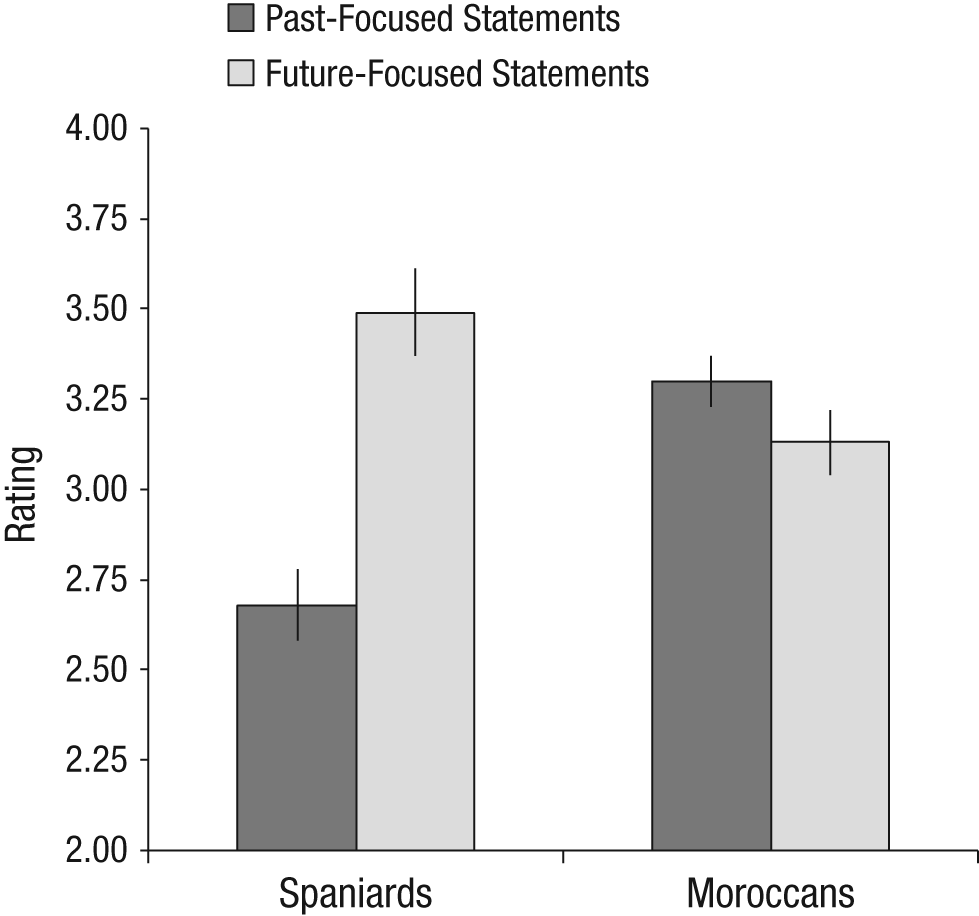
Results of Experiment 2: mean agreement with past- and future-focused statements on the temporal-focus questionnaire, separately for Spaniards and Moroccans. Error bars show standard errors of the mean.
Experiment 3: Age-Related Differences in Space-Time Mappings
If differences in temporal focus are responsible for the cross-cultural difference between Spaniards’ and Moroccans’ spatial mappings of time, it should be possible to observe a similar difference in space-time mappings within a single culture, in a comparison between groups who differ in their temporal focus. We reasoned that, compared with senior citizens, university students tend to be future focused (studying for the next exam, anticipating graduation, finding a job, getting married, etc.). Seniors, by contrast, may focus more on the past because they are on the far side of the reminiscence bump (i.e., the period of years from approximately age 10 to 30 during which the most frequently recalled autobiographical events occur; Rubin, Rahhal, & Poon, 1998). We hypothesized that if older Spaniards are more past focused than younger Spaniards, they should show a greater tendency to conceptualize the past as in front of them. We predicted, therefore, that older Spaniards should produce a greater percentage of past-in-front responses than younger Spaniards on the temporal diagram task from Experiment 1.
Method
Participants
A total of 156 Spaniards participated. The younger group were psychology students at the University of Granada (n = 50; mean age = 25.64 years, range = 17–60). The older group consisted of permanent residents of assisted-living facilities in the province of Granada (n = 106; mean age = 75.98 years, range = 64–100).
Materials and procedure
Cognitively normal older Spaniards were selected on the basis of Lobo’s Mini Mental State Examination (MMSE; Lobo, Ezquerra, Gómez, Sala, & Seva, 1979), which is the Spanish-validated version of Folstein’s MMSE (Folstein, Folstein, & McHugh, 1975). After completing the MMSE, participants completed the temporal diagram task from Experiment 1. We intended to follow these measures with the temporal-focus questionnaire from Experiment 2, but it was soon evident that the testing session became too tiring for many of our participants, and use of this questionnaire was discontinued.
Results
The front-back mapping of time differed significantly between older and younger Spaniards, as evidenced by a binary logistic regression, Wald χ2(1, N = 156) = 19.73, p = .001, odds ratio = 8.53, 95% CI = [3.35, 21.72]; this finding confirmed the prediction of the temporal-focus hypothesis. The majority of younger Spaniards (88%) responded according to the future-in-front mapping (p = .001; Fig. 3). By contrast, about half of the older Spaniards (54%) responded according to the past-in-front mapping, placing the future event in the box behind the character and the past event in the box ahead of him (p = .49). Thus, older Spaniards showed no trace of the future-in-front mapping found in young Spaniards’ responses and in spoken Spanish metaphors. Older Spaniards’ responses were intermediate between young Spaniards’ and Moroccans’ responses.

Results of Experiment 3: percentage of past-in-front and future-in-front responses, separately for younger and older Spaniards. Error bars show standard errors of the mean.
Experiment 4: Within-Subjects Correlation Between Temporal Focus and Space-Time Mappings
The goal of Experiment 4 was to corroborate the results of Experiments 1 through 3 with new samples of young Spaniards, elderly Spaniards, and young Moroccans using a within-subjects design. This design allowed us to test whether individuals’ responses on the temporal-focus questionnaire predicted their spatialization of the past and future.
Method
Participants
Participants (N = 220) consisted of 55 new Spanish students from the University of Granada (mean age = 20.2 years, range = 18–31), 93 new Moroccan students from the Abdelmalek Essaadi University (mean age = 28.6 years, range 18–42), and 72 new Spanish elders (mean age = 73.6 years, range = 65–89). This group of older Spaniards, who were contacted through two elder associations in Granada, was significantly younger than the group tested in Experiment 3, t(176) = 2.19, p = .03, and also more independent (e.g., whereas the former group was in assisted living, the present group lived independently).
Materials and procedure
All participants first completed the temporal diagram task and then the temporal-focus questionnaire. The elders also completed Lobo’s MMSE (Lobo et al., 1979) at the beginning of the session.
Results
Responses on the temporal-focus questionnaire replicated and extended our findings from Experiment 2. An ANOVA with group (young Spaniards, young Moroccans, older Spaniards) and temporal focus (past, future) revealed the predicted interaction, F(2, 217) = 49.65, p = .001, η p 2 = .31, as well as a main effect of group, F(2, 217) = 47.13, p = .001, η p 2 = .30 (Fig. 4a). Post hoc Tukey’s comparisons revealed that young Spaniards agreed more with future-focused than past-focused statements (p = .001), whereas young Moroccans agreed more with past-focused than future-focused statements (p = .001). Spanish elders were intermediate, showing equally high agreement with future-focused and past-focused items (p = .99).
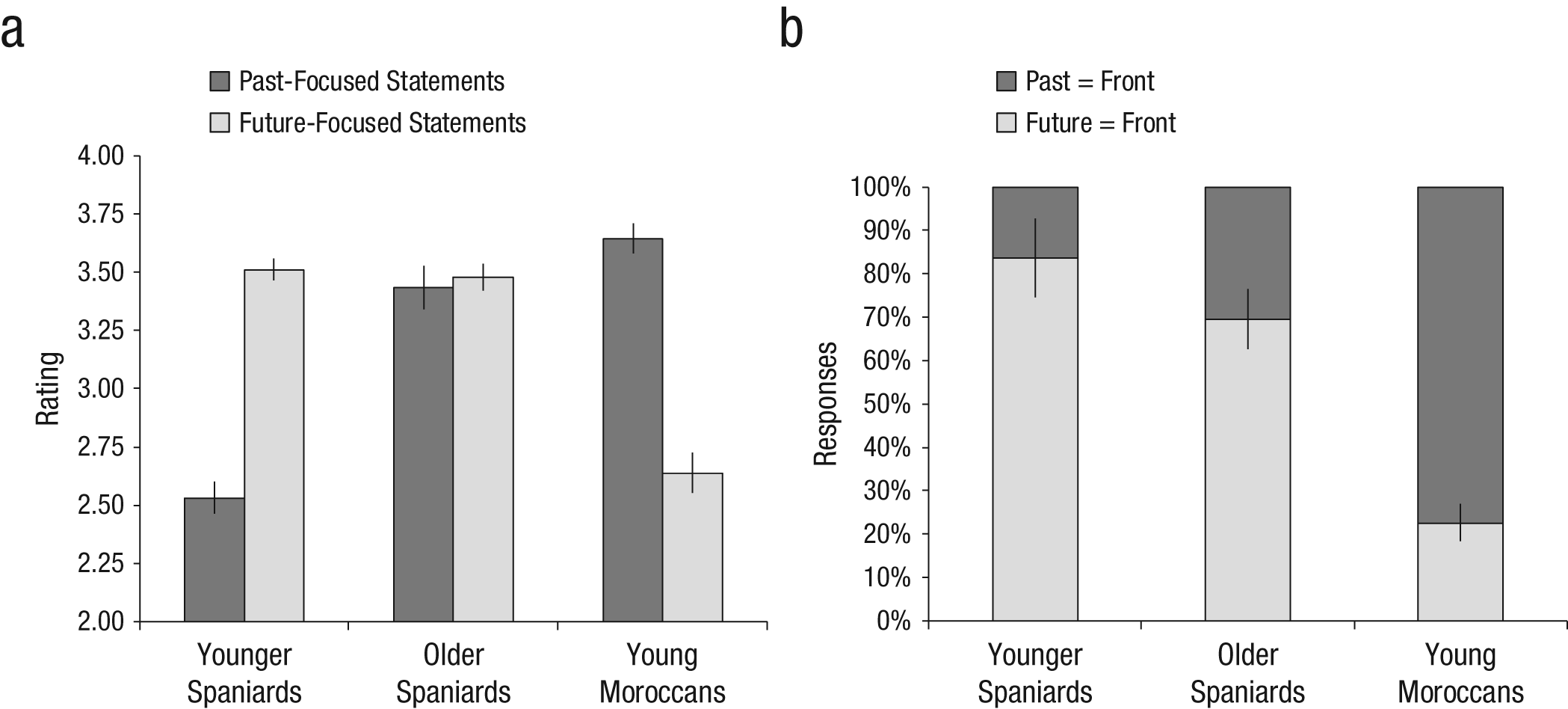
Results of Experiment 4: mean agreement with the past- and future-focused statements on the temporal-focus questionnaire (a) and percentage of past-in-front and future-in-front responses (b), separately for younger Spaniards, older Spaniards, and young Moroccans. Error bars show standard errors of the mean.
Results of the temporal diagram task corroborated our findings from Experiments 1 and 3: The spatialization of time differed as predicted across the three groups, Wald χ2(2, N = 220) = 53.43, p = .0001 (Fig. 4b). The majority of young Spaniards (84%) placed the future in front (p = .0001), whereas the majority of young Moroccans (77%) placed the past in front (p = .0001). The Spanish elders’ judgments were intermediate between the young Spaniards and the Moroccans. Older Spanish participants showed a significant tendency to place the future in front (69%; p = .0001), but this tendency was (marginally) less strong than that shown by the young Spaniards, Wald χ2(1, N = 127) = 3.31, p = .07, odds ratio = 2.04, 95% CI = [0.86, 4.87], and stronger than the tendency shown by the elders in Experiment 3, Wald χ2(1, N = 178) = 9.14, p = .003, odds ratio = 2.91, 95% CI = [1.56, 5.43]. These findings are consistent with the fact that the new group of elders was significantly younger, more independent, and therefore more future focused than the elders we tested previously.
Finally, we tested for a relationship between individuals’ responses on the temporal-focus questionnaire and their responses on the temporal diagram task. For each participant, a temporal-focus index (TFI) was created using all of their responses from the temporal-focus questionnaire: TFI = (mean of future-focused items − mean of past-focused items)/(mean of future-focused items + mean of past-focused items). The TFI expressed each participant’s overall agreement with past- and future-focused items on a scale from −1 (strong past focus) to +1 (strong future focus). Participants’ TFIs were a highly significant predictor of their responses on the temporal diagram task, Wald χ2(1, N = 220) = 72.59, p = .001, odds ratio = 21,934.84, 95% CI = [2,200.13, 218,685.70]. Lower TFIs were associated with more past-in-front responses, and higher TFIs with more future-in-front responses, consistent with the temporal-focus hypothesis.
Experiment 5: A Causal Role for Temporal Focus in Determining Space-Time Mappings
Experiments 1 to 4 provided correlational evidence supporting the temporal-focus hypothesis. Experiment 5 tested whether temporal focus can play a causal role in determining the direction of the front-back time mapping in people’s minds. Prior to completing the temporal diagram task used in our previous experiments, new groups of Spaniards performed a writing exercise that focused their attention on either the past or the future. If temporal focus was responsible for the between-group differences in space-time mappings we observed in Experiments 1, 3, and 4, then in the present experiment, participants assigned to focus on past events should be more likely to produce a past-in-front mapping on the diagram task than participants assigned to focus on future events.
Method
Participants
Spanish psychology students from the University of Granada (N = 209) participated. About half were randomly assigned to the past-focused group (n = 109, average age = 24.2 years, range = 17–51), and the others were assigned to the future-focused group (n = 100, average age = 23.6 years, range = 18–51).
Materials and procedure
Each of the writing exercises consisted of 10 questions: The past-focus exercise prompted participants to write about their past (e.g., “Were you happy as a child?”), and the future-focus exercise prompted them to write about their future (e.g., “Do you think you will be happy as an old person?”; see Table S2 in the Supplemental Material). Participants handwrote their responses at their own pace, after which they completed the temporal diagram task. These tasks were presented amid a series of tasks that lasted an hour. Debriefing responses indicated that no participant guessed there was any connection between the writing exercise and the diagram task.
Results
The front-back mapping of time differed significantly between participants assigned to the future-focus- and past-focus-training conditions, Wald χ2(1, N = 209) = 31.2, p = .001, odds ratio = 22.42, 95% CI = [8.46, 59.44] (Fig. 5), which supports the temporal-focus hypothesis. Of the participants assigned to write about their future, 95% placed the future in the front box (p = .0001). Of the participants assigned to write about their past, nearly half (46%) placed the past in the front box (p = .44). The percentage of past-in-front responses made by Spaniards trained to focus on the past (46%) was not as high as those made by the Moroccans tested in Experiments 1 and 4 combined (81%), Wald χ2(1, N = 277) = 34.41, p = .001, odds ratio = 3.60, 95% CI = [2.10, 6.17], presumably because a few minutes of writing about one’s past is not comparable with long-term enculturation. Yet after this brief training exercise, the Spaniards trained to focus on the past not only produced a far greater percentage of past-in-front responses than the Spaniards trained to focus on the future (46% vs. 5%), they also produced a far greater percentage of past-in-front responses than the untrained young Spaniards from Experiments 1, 3, and 4 combined (46% vs. 14%), Wald χ2(1, N = 264) = 30.95, p = .001, odds ratio = 7.53, 95% CI = [4.15, 13.64]. Furthermore, future-focus training increased participants’ tendency to conceptualize the future as in front of them compared with the young Spaniards from Experiments 1, 3, and 4 combined, even though this tendency was already very strong (95% vs. 86%), Wald χ2(1, N = 255) = 4.48, p = .03, odds ratio = 2.98, 95% CI = [1.08, 8.18]. These effects contribute to a growing body of evidence that space-time mappings can be rapidly modulated by context (Boroditsky, 2001; Casasanto, 2008; Casasanto & Bottini, 2014; Santiago, Román, & Ouellet, 2011; Torralbo et al., 2006).
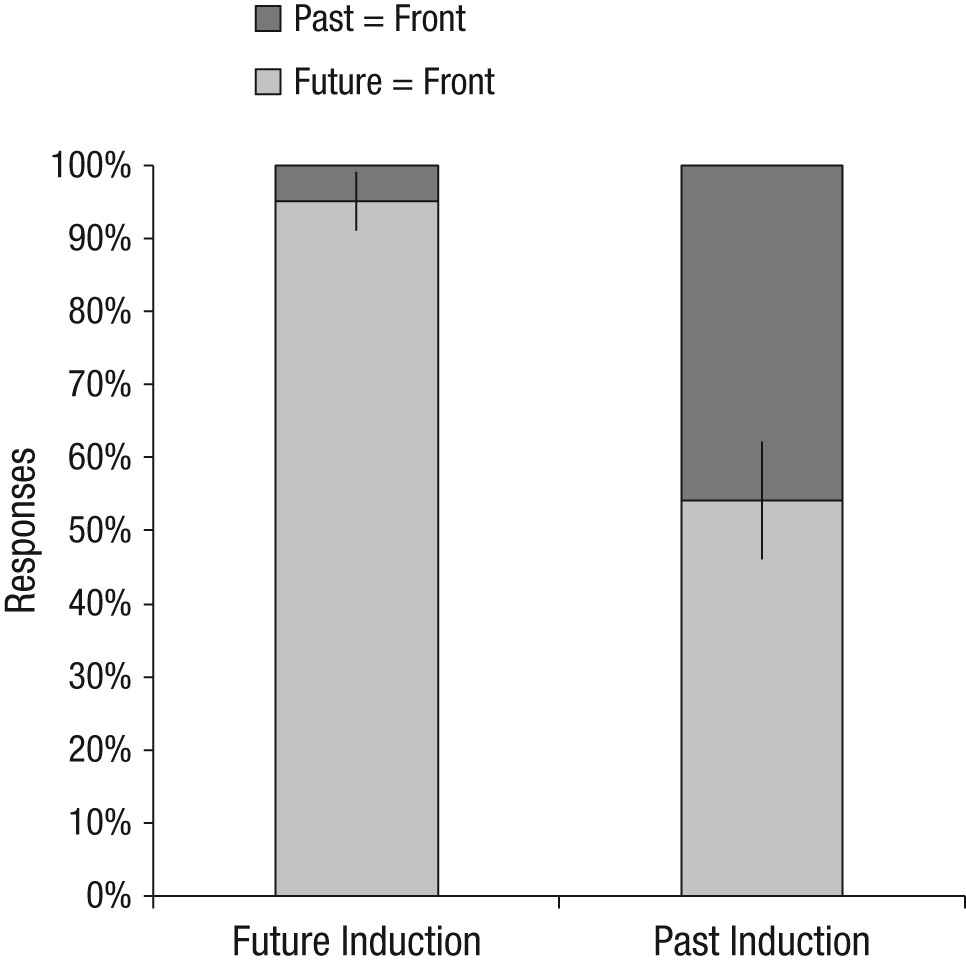
Results of Experiment 5: percentage of past-in-front and future-in-front responses, separately for Spaniards who received future-focus training and who received past-focus training. Error bars show standard errors of the mean.
In summary, inducing Spaniards to focus their attention on past events during a pretest writing exercise caused a dramatic increase in the rate of past-in-front responses, whereas inducing them to focus on future events caused an increase in the (already high) rate of future-in-front responses, compared with untrained Spaniards in the same age range. These results provide evidence that temporal focus can play a causal role in determining how people spatialize the past and future in their minds, supporting the temporal-focus hypothesis.
General Discussion
In spoken Arabic, the future is “ahead” and the past is “behind” the speaker, as in Spanish, English, and many other languages. According to the results of a temporal diagram task, young adult Spanish speakers conceptualize time as predicted by these linguistic metaphors. By contrast, Moroccan Arabic speakers conceptualize the past as ahead of them and the future as behind them, which reveals a striking dissociation between space-time mappings in the language and thought of these two groups. The difference between Moroccans’ and Spaniards’ conceptions of time cannot be traced to language, since both languages use similar future-in-front and past-in-back mappings (Hamdi, 2007). Nor can the difference in temporal thinking be traced to bodily differences, since the front-back asymmetry of the body, long believed to give rise to the front-back mapping of time, is universal (Clark, 1973).
Since existing theories cannot explain the pattern of space-time mappings observed across cultures, we proposed an alternative explanation, the temporal-focus hypothesis: People’s implicit associations of “past” and “future” with “front” and “back” should depend on their temporal focus. That is, in people’s mental models, they should place in front of them whichever pole of the space-time continuum they tend to “focus on” metaphorically—locating it where they could focus on it literally with their eyes if events in time were visible objects. Consistent with the temporal-focus hypothesis, our results showed that, compared with Moroccans, Spaniards tend to be future focused, attributing more importance to social change, economic and technological progress, and modernization. By contrast, compared with Spaniards, Moroccans tend to be past focused, attributing more importance to older generations and respect for traditional practices (see also Mateo, 2010). Attributing more importance to one pole of the past-future continuum or the other is likely to result in more time spent focusing one’s attention on past- or future-oriented thoughts and activities.
In a further test of the temporal-focus hypothesis, we showed that beyond explaining cross-cultural differences, temporal focus can predict variation in space-time mappings within a culture. Older Spaniards, who are likely to be more past focused compared with younger Spaniards, were also more likely to produce a past-in-front mapping. Moreover, across a broad sample of young Spaniards, older Spaniards, and young Moroccans, individuals’ temporal focus predicted their tendency to locate the past or future in front. Finally, to test for a causal role for temporal focus, we induced young Spaniards to focus either on past or future events during a pretest writing exercise. After future-focus training, nearly all of the participants placed the future in front; after past-focus training, a far greater percentage of participants produced a past-in-front mapping.
The motivation for the Moroccans’ past-in-front mapping that we propose here is different from the motivation Núñez and Sweetser (2006) proposed for the Aymara, who are believed to place the past in front because the past is known (i.e., seen) and the future unknown (i.e., unseen). Placing what is known in front of us is not the same as placing what we focus on in front of us: The future can be placed in front because we focus our attention on it, even though it cannot be known. The past- and future-induction task in Experiment 5, which changed the Spanish participants’ likelihood of placing the future in front, presumably did not change the extent to which they could know the future. Rather, temporal induction changed participants’ temporal focus, making them more likely to place either the knowable past or the unknowable future in front of them.
Together, these experiments demonstrate a previously unexplored cross-cultural difference in spatial conceptions of time and validate a new principle by which culture-specific habits of temporal thinking can arise: the temporal-focus hypothesis. Cultural attitudes and practices can influence habits of attending to past or future events in members of a culture (or subculture), thereby influencing their implicit spatializations of time. Since implicit space-time mappings can change more flexibly than explicit spatial metaphors for time in language, the way people are thinking about time at any moment may be exactly reversed from the way they are talking about it. Ultimately, understanding how people use space to mentally represent time will require understanding how the separable influences of linguistic, cultural, and bodily experiences combine to shape people’s minds.
Footnotes
Acknowledgements
We thank Saad Zemmouri, Abdellatif Chahboun, Abderrahman El Fathi, Abdessamad Dialmy, Allison Meins, Mouad El Mejdki, Bouthaina Ben El Amin, and Laureano Hernández for assistance with testing and data collection.
Declaration of Conflicting Interests
The authors declared that they had no conflicts of interest with respect to their authorship or the publication of this article.
Funding
This research was supported by grants from Junta de Andalucía, the European Regional Development Fund (P09-SEJ-4772), and the Spanish Ministry of Economy and Competitiveness (PSI2012-32464) to J. Santiago and D. Casasanto; a Leverhulme fellowship (VP1-2012-032) to J. Santiago; and a James S. McDonnell Foundation Scholar Award (220020236) to D. Casasanto.
Open Practices
All data have been made publicly available via Open Science Framework and can be accessed at osf.io/uh3in. The complete Open Practices Disclosure for this article can be found at http://pss.sagepub.com/content/by/supplemental-data. This article has received the badge for Open Data. More information about the Open Practices badges can be found at https://osf.io/tvyxz/wiki/view/ and  .
.
References
Supplementary Material
Please find the following supplemental material available below.
For Open Access articles published under a Creative Commons License, all supplemental material carries the same license as the article it is associated with.
For non-Open Access articles published, all supplemental material carries a non-exclusive license, and permission requests for re-use of supplemental material or any part of supplemental material shall be sent directly to the copyright owner as specified in the copyright notice associated with the article.
