



Abstract

“Sense of self” implies a basic spatial unity of the self and the physical body. To generate a unified self, the brain must bind together different sensory inputs linked to different body parts. For example, to identify one’s own foot, one’s brain links the motor act of looking down with the visual representation of a foot (Slater, Spanlang, Sanchez-Vives, & Blanke, 2010). People’s experiences are tagged with a first-person perspective. Out-of-body experiences reflect failure of this spatial binding, so that the self no longer perceives the physical body from the usual internal perspective (Brugger, Regard, & Landis, 1997).
The vestibular system provides an absolute gravitational reference for control of body posture in space (Day, Cauquil, Bartolomei, Pastor, & Lyon, 1997). We therefore hypothesized that one function of this fundamental input might be to bind together multiple sensory signals to provide the normal embodied perspective on the world. Out-of-body experiences are often associated with altered vestibular function, including sensations of elevation, floating, and lightness. Stimulation of the temporoparietal junction (Blanke, Ortigue, Landis, & Seeck, 2002)—a key cortical vestibular projection—can provoke out-of-body experiences.
A useful laboratory measure of embodiment is the perspective used to interpret tactile patterns drawn on the skin during a graphesthesia task (Natsoulas & Dubanoski, 1964). For example, when an experimenter draws the letter b on the forehead of a blindfolded participant, the participant may perceive the stimulus either from an external third-person perspective (reading it as b) or from an internal first-person perspective (reading it as d). Prevalence of one judgment over the other provides an implicit measure of whether the perceiver’s perspective on the stimuli originates from within his or her body or from outside it.
Method
We combined galvanic vestibular stimulation (GVS), an established method for controlled artificial vestibular stimulation, with the graphesthesia task. Eighteen healthy participants volunteered for the study (see Participants in the Supplemental Material available online). Participants kept their eyes closed during the trials. Carbon rubber electrodes were placed binaurally over each participant’s mastoid processes and fixed in place with adhesive tape. Electrodes for sham stimulation were placed on each participant’s neck in a left-anodal/right-cathodal configuration 5 cm below the location of the GVS electrodes. All electrodes were placed at the beginning of the session and remained in place throughout.
Each trial began with a 1-s pause, after which the participant received either 6 s of GVS (1-mA right-anodal/left-cathodal GVS or 1-mA left-anodal/right-cathodal GVS) or 6 s of a sham stimulation that was applied to the cervical area and did not affect the vestibular organs (see Methods in the Supplemental Material). One second after the stimulation began, a letter form (b, d, p, or q, chosen at random) was traced on the participant’s forehead with a cotton swab in a single motion beginning with the end of the letter stem (see Fig. 1a). After 4 s of stimulation, a tone signaled that the participant should name the letter. Three stimulation conditions (right-anodal/left-cathodal GVS, left-anodal/right-cathodal GVS, and sham stimulation; Fig. 1b) were administered in separate blocks in randomized order. Each block consisted of 32 trials, with eight repetitions of each letter, presented in random order. There was a 5-s break between trials. The experimenter was blind to the experimental hypothesis.
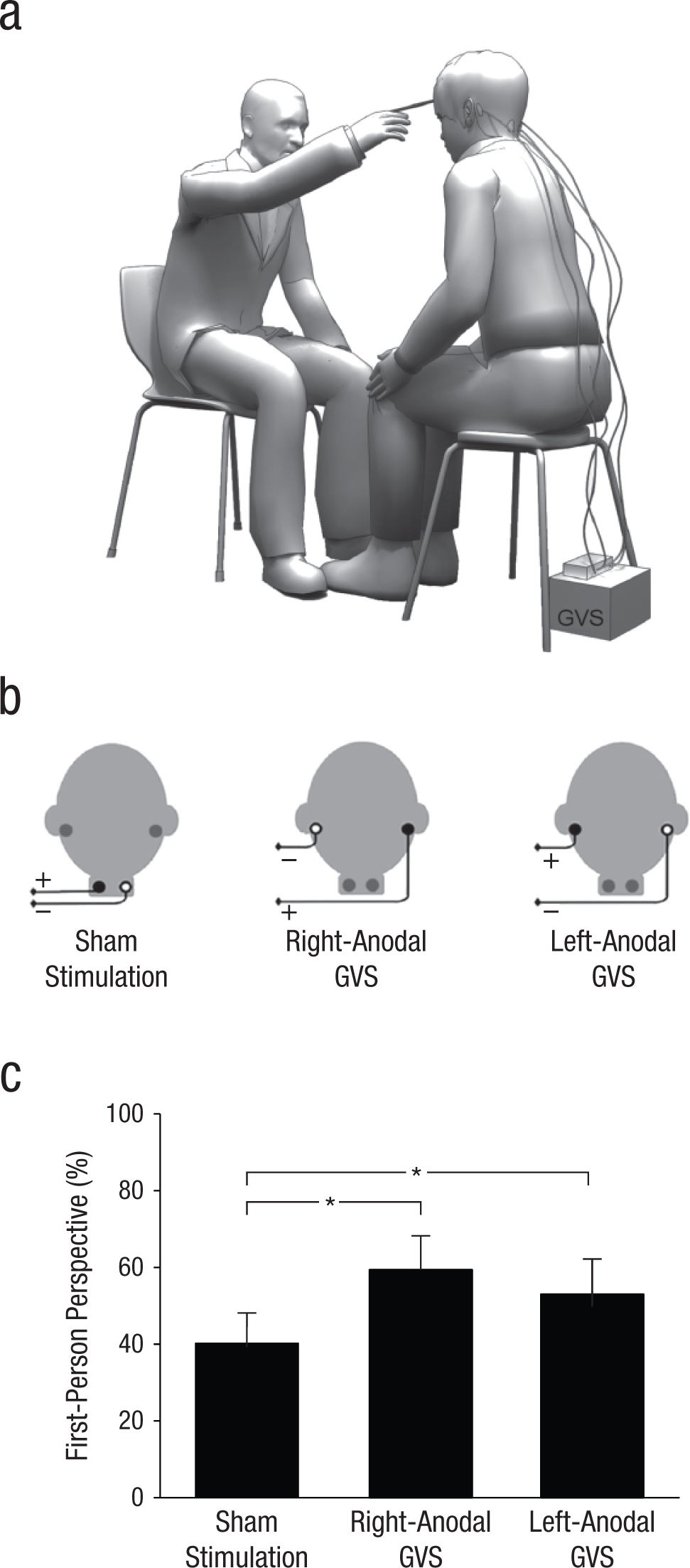
Experimental setup and results. On each trial, galvanic vestibular stimulation (GVS) or sham stimulation was delivered while the experimenter traced an ambiguous letter (b, d, p, or q) in the center of the participant’s forehead. The task was to name the letter. Sham stimulation, right-anodal/left-cathodal GVS, and left-anodal/right-cathodal GVS were delivered in separate blocks via electrodes placed over the mastoid processes (for GVS) or the sides of the neck (for sham stimulation; b). + = anode; – = cathode. The graph (c) shows the percentage of first-person-perspective responses as a function of condition. Error bars indicate standard errors of the mean. Asterisks indicate significant differences between sham stimulation and both GVS polarities (p < .05).
Results
Each response was classified as indicating a third-person perspective (e.g., b read as b), a first-person perspective (e.g., b read as d), or an error (any other response; e.g., b read as p). The percentage of first-person-perspective responses was then calculated for each stimulation condition. Most participants showed a mixture of first- and third-person perspectives (see Quality of Perspective Responses in the Supplemental Material). No order effects emerged (see Order-Effect Analysis in the Supplemental Material). An analysis of variance showed a significant main effect of stimulation condition, F(2, 34) = 4.625, p = .017. Follow-up testing revealed that, compared with sham stimulation, both right-anodal/left-cathodal GVS, t(17) = −2.652, p = .017, Cohen’s d = 0.52, and left-anodal/right-cathodal GVS, t(17) = −2.442, p = .026, Cohen’s d = 0.34, caused significantly more first-person-perspective judgments. No difference was found between right-anodal/left-cathodal GVS and left-anodal/right-cathodal GVS, t(17) = 0.961, p = .350 (Fig. 1c). These results cannot be explained by nonspecific factors, such as changes in arousal or distraction, because the percentage of error responses was similar across conditions (right-anodal/left-cathodal GVS: M = 4.86%, SEM = 1.91%; left-anodal/right-cathodal GVS: M = 7.06%, SEM = 2.37%; sham stimulation: M = 6.66 %, SEM = 2.34%; ps > .05 for all comparisons; see Nonspecific Effects of GVS: Analyses of Nonperspectival Errors in the Supplemental Material).
Discussion
Distortions of the relation between self and body in patients with vestibular disorders were first reported by Bonnier (1905). Vestibular stimulation has been shown previously to influence judgments about the orientation of visually presented images of bodies (Lenggenhager, Lopez, & Blanke, 2008). However, no previous studies have linked vestibular signals to the perspective taking in relating stimuli to one’s own body.
Graphesthetic perspective varies across skin regions (Corcoran, 1977; Parsons & Shimojo, 1987). Stimuli on the forehead, as used in this experiment, are normally, but not always, read from a first-person perspective, as if viewed from inside the head. Stimuli on the back of the head are normally read from a third-person perspective. The brief GVS we used promoted an “embodied eye” (Sekiyama, 1991): GVS, compared with sham stimulation, promoted more frequent first-person perspective relative to third-person perspective. Out-of-body experience (Blanke, 2012) would imply a bias in the opposite direction. If the self were located outside the body, stimuli on the skin would be seen with third-person perspective. Instead, we found bias toward first-person perspective in the GVS conditions. Our low-intensity GVS may have augmented a natural vestibular contribution to embodiment, rather than disrupting processes that normally anchor the self within the body. Indeed, GVS at the intensities we used produces functional postural responses similar to those produced by natural vestibular signals (Day et al., 1997). Disembodied experiences may require different stimulation patterns, stronger intensities, or direct stimulation of vestibular cortical areas rather than the vestibular periphery (Blanke et al., 2002).
The present study provides the first experimental evidence that vestibular inputs promote a first-person perspective. The temporoparietal junction might be involved in this process. This region receives multisensory body-related signals from somatosensory, proprioceptive, and vestibular pathways. Moreover, epileptic patients spontaneously reporting out-of-body experiences were found to have bilateral functional changes in temporoparietal regions (Blanke & Arzy, 2005). Our finding suggests that vestibular inputs contribute to the unity of multisensory experience that underlies self-awareness.
Footnotes
Acknowledgements
We are grateful to Eva Berlot for assistance in conducting the experiments.
Declaration of Conflicting Interests
The authors declared that they had no conflicts of interest with respect to their authorship or the publication of this article.
Funding
E. R. Ferrè and P. Haggard were supported by European Union Seventh Framework Programme (EU FP7) project Virtual Embodiment and Robotic Re-Embodiment WP1. P. Haggard was also supported by a Professorial Fellowship from the Economic and Social Research Council and by European Research Council Advanced Grant for the study “Human Volition, Agency and Responsibility.” C. Lopez has received funding from the People Programme (Marie Curie Actions) of the EU FP7 (2007–2013) under Research Executive Agency Grant 333607.

References
Supplementary Material
Please find the following supplemental material available below.
For Open Access articles published under a Creative Commons License, all supplemental material carries the same license as the article it is associated with.
For non-Open Access articles published, all supplemental material carries a non-exclusive license, and permission requests for re-use of supplemental material or any part of supplemental material shall be sent directly to the copyright owner as specified in the copyright notice associated with the article.
