



Abstract
Despite the fact that no invariant acoustic property corresponds to a single stop consonant coupled with different vowels (e.g., [da], [de], and [du]), adults effortlessly identify the same consonant embedded in different syllables. In so doing, they solve the invariance problem. Can 3- and 6-month-olds solve it as well? To answer this question, we developed a novel methodology based on pupillometry. In Experiment 1, we demonstrated for the first time that infants are sensitive to the distinction between frequent and infrequent acoustic stimuli, showing greater pupil dilation in response to infrequent stimuli. Building on this effect, in Experiment 2, we showed that 6-month-olds, but not 3-month-olds, solve the invariance problem. Moreover, this ability develops before, and therefore independently of, the ability to produce well-formed syllables.
Human language relies on a unique speech code that allows mature speakers to create a virtually infinite number of words by combining consonants and vowels in a lawful manner. This faculty is at the core of language productivity (Pinker & Jackendoff, 2005). Mature speech representations, however, are not available to infants before the age of 1 year (Hochmann, Benavides-Varela, Nespor, & Mehler, 2011; Peña, Werker, & Dehaene-Lambertz, 2012; Werker & Tees, 1984), and how infants represent speech in the first months of life remains unknown (Benavides-Varela, Hochmann, Macagno, Nespor, & Mehler, 2012). In the present study, we introduced the use of pupillometry as a new methodology for studying speech representations in the earliest stages of language acquisition. We used this methodology to examine whether infants exhibit one of the signatures of adult speech perception, which is the ability to perceive the same consonant in different syllables despite important variations in the physical realizations of the consonant in the acoustic signal. This ability is known as the resolution of the lack of invariance problem for consonants (often referred to as the invariance problem; Liberman, Cooper, Shankweiler, & Studdert-Kennedy, 1967).
At least three other signatures of mature speech perception are recognized: categorical perception of consonants (Liberman, Harris, Hoffman, & Griffith, 1957), great difficulty in perceiving nonnative speech sounds (native perception; Werker & Tees, 1984), and greater reliance on consonants than on vowels for identifying words (consonantal bias; Cutler, Sebastián-Gallés, Soler-Vilageliu, & Van Ooijen, 2000; Nazzi, 2005; Nespor, Peña, & Mehler, 2003). Categorical perception is known to be present shortly after birth (Eimas, Siqueland, Jusczyk, & Vigorito, 1971), whereas consonantal bias and difficulty in perceiving nonnative speech sounds emerge between the ages of 6 and 12 months (Hochmann et al., 2011; Peña et al., 2012; Pons & Toro, 2010; Werker & Tees, 1984). There have been few studies of the fourth signature (i.e., resolution of the invariance problem) in infants. Previous studies have suggested that neonates focus mainly on vowels (Bertoncini, Bijeljac-Babic, Jusczyk, Kennedy, & Mehler, 1988). In contrast, 2- to 4-month-olds encode the details of the whole syllable (consonant + vowel) and recognize the same vowel in different syllables, but they are not capable of solving the invariance problem for consonants (Bertoncini et al., 1988; Eimas, 1999; Jusczyk & Derrah, 1987). 1
Studies of adults have shown that pupil diameter is modulated by attention and cognitive load (Beatty & Kahneman, 1966; Hess & Polt, 1960; Laeng, Sirois, & Gredebäck, 2012). In particular, pupils dilate more often in reaction to infrequent than frequent auditory stimuli (Qiyuan, Richer, Wagoner, & Beatty, 1985). We were encouraged by recent studies in the domain of social cognition and visual-object perception to use pupillometry to study infants’ cognition. Pupil dilation was observed in infants within 2 s after an object-identity violation (Jackson & Sirois, 2009). Later effects were observed in an object-permanence task (Sirois & Jackson, 2012), in response to irrational feeding actions (Gredebäck & Melinder, 2010), in response to another infant’s distress (Geangu, Hauf, Bhardwaj, & Bentz, 2011), and when fixating an image moving in contingence with the infant’s own movements (Téglás, Kovács, Csibra, & Gergely, submitted).
In Experiment 1, we wanted to determine whether pupillometry could be used to study the perception and representation of acoustic stimuli in early infancy. A positive answer to this question was the prerequisite for using pupillometry to investigate young infants’ speech representation in Experiment 2. We sought to determine whether 3- and 6-month-olds could solve the invariance problem, recognizing the same consonant coupled with different vowels (e.g., [ba], [bo], [bi], [bu]). We used this novel methodology to explore this unanswered question.
Experiment 1
In Experiment 1, we investigated two questions. First, can pupillometry be used to study the perception of acoustic stimuli in infants? Second, what is the time window in which such effects are likely to occur? We presented sequences of four syllables to infants while their attention was captured by a cartoon on a computer screen. In 75% of trials, infants heard the same syllable four times (standard condition), and in 25% of trials, they heard the same syllable three times and then a different fourth syllable (deviant condition). We used an eye tracker to measure infants’ pupil diameters. The acoustic sequence began at the same frame of the same cartoon in every trial. Thus, any effect on pupil diameter could be related only to the acoustic stimuli.
Given the novelty of this paradigm, we were confronted with two major problems in data analysis. First, we had no a priori hypothesis regarding when an effect of stimulus frequency should be expected. Second, we wanted to make sure that any potential difference between conditions was not an artifact of an arbitrarily selected baseline. We thus adopted a fully data-driven approach for identifying (a) the time window during which effects were most likely to occur (the window of interest) and (b) a control time window during which effects were likely to be independent from our experimental manipulation. We wanted to identify significant effects in the comparison of infants’ pupil-size change in the standard and deviant conditions.
Method
Participants
Sixteen North American 3-month-old infants (age range = 3 months 6 days to 3 months 28 days; mean age = 3 months 20 days) and 14 North-American 6-month-old infants (age range = 5 months 25 days to 7 months 0 days; mean age = 6 months 13 days) were included in the final analysis. Ten additional infants were excluded because they completed an insufficient number of good trials (see Analyses). The number of participants to include was set a priori; thus, new participants were tested until that number was reached.
Stimuli
Two syllables, [ba] and [di], were created by using the artificial speech synthesizer MBROLA (The MBROLA Project, http://tcts.fpms.ac.be/synthesis/mbrola.html) with French voice database FR4. The syllables had a phoneme duration of 120 ms and pitch of 200 Hz. Each syllable was normalized to an intensity of 70 dB. Four soundtracks were created. In the two standard-condition soundtracks, the same syllable was presented four times (“ba-ba-ba-ba” or “di-di-di-di”). In the two deviant-condition soundtracks, one syllable was presented three times and then the other syllable was presented once (“ba-ba-ba-di” or “di-di-di-ba”). The onsets of two consecutive syllables were separated by 750 ms. These soundtracks were combined with a 5-s video clip (created with GoAnimate, http://www.goanimate.com) in which a smiling cartoon character jumped repeatedly.
Procedure
Each infant sat on his or her parent’s lap in front of a Tobii T60 eye tracker (Tobii Technology, Stockholm, Sweden). Eye-tracking data were recorded with TobiiStudio software run on a Dell Latitude 980sff Workhorse PC. The presentation of stimuli was controlled by Psyscope XB57 software (http://psy.ck.sissa.it/) run on an Apple iMac. The room was dark except for the light coming from the two computers’ screens. The experimenter began each trial by pressing a key on a keyboard to start the cartoon video clip. Trials were separated by a black screen displaying only a central blinking cross, which was intended to attract the infants’ gaze. The experiment ended after 100 trials or when infants started fussing.
Half of the participants heard “ba-ba-ba-ba” in the standard condition and “ba-ba-ba-di” in the deviant condition. The other half of participants heard “di-di-di-di” in the standard condition and “di-di-di-ba” in the deviant condition. The trial types (75% standard, 25% deviant) were presented in random order.
Analyses
We defined an area of interest (512 × 280 pixels) that corresponded to the surface of the video played on the screen to attract infants’ gaze. Trials for which pupil-diameter information was available for at least 75% of the total trial duration were defined as good trials. Infants with fewer than 24 good trials were excluded from further analysis. The mean number of good trials for 3-month-olds was 47 (SD = 14); 35 were standard trials (SD = 11) and 12 were deviant trials (SD = 3). The mean number of good trials for 6-month-olds was 35 (SD = 13); 26 were standard trials (SD = 10) and 9 were deviant trials (SD = 3). Before further analysis, we computed the pupil-size change in each trial relative to a 500-ms baseline period, before the onset of the fourth syllable.
Few studies have used pupillometry with infants, and none has investigated the response of infants’ pupils to acoustic stimuli in an oddball paradigm. Lacking information in the literature, we used a data-driven approach to define the relevant time windows for our analysis.
To identify the time window of the pupil-dilation effect, we first ran a permutation analysis including both 3- and 6-month-old participants. For each time point from the onset of the last syllable of each trial (Time 0) to the end of the trial (Time 2,183 ms), we computed a Student’s t test comparing the pupil-size change in the deviant and standard conditions. We then ran a preliminary cluster mass test (Maris & Oostenveld, 2007) with a relatively low threshold (t ≥ 1.6) to identify a broad time window for the effect (the window thus identified is referred to as the window of interest) and a control window (see the Supplemental Material available online).
Next, for each age group (3- and 6-month-olds), we ran a separate cluster mass test to identify the time window in which the effect was significant for each age group independently. For each time point in the window of interest, we considered the F value for the interaction of time (control window or current time point) and condition (standard or deviant), obtained with a repeated measures analysis of variance (ANOVA). We used an F value of 3.5 as a threshold. The time windows thus identified are referred to as effect windows.
Finally, to investigate the role of the age factor, we ran a repeated measures ANOVA with time window (control window or overlap of the 3-month-olds’ and 6-month-olds’ effect windows) and condition (standard or deviant) as within-subjects factors and age as a between-subjects factor.
Results
As shown in Figure 1, a strong constriction of the pupil was visible at the beginning of each trial in both conditions. This reduction of pupil diameter was the response to the sudden increase of luminance when the cartoon appeared (i.e., the pupillary light reflex) after a period in which the screen was dark (i.e., the intertrial interval).

Results from Experiment 1. The graphs in the top row show pupil-size change (relative to baseline) as a function of time in the standard and deviant conditions for 3- and 6-month-olds. The dark gray areas (effect windows) indicate the time windows during which the conditions differed in the extent to which the pupil-size change differed from that in the control time window, which is represented by the light gray areas. The square waveform along the x-axis indicates when the four syllables occurred in each trial. The graphs in the bottom row show average pupil-size change in the control window (0–883 ms) and in the overlap of the 3-month-olds’ and 6-month-olds’ effect windows (1,017–2,150 ms). Error bars represent within-subjects standard errors of the mean (Cousineau, 2005).
Our preliminary analysis, with the data collapsed across age groups, revealed a significant effect in the time window between 883 and 2,183 ms, p = .007. We considered this the window of interest in the subsequent analyses, and we used the preceding period (0–883 ms) as a control time window. Next, we analyzed the data from each age group separately, comparing the pupil-size change in the standard and deviant conditions during the window of interest (883–2,183 ms) with the pupil-size change during the control time window. A significant interaction effect was observed between 1,017 and 2,183 ms for 3-month-olds, p = .001, and between 983 and 2,150 ms for 6-month-olds, p = .03 (Fig. 1, top panel). Thus, between 1,017 and 2,150 ms, there was an effect for both 3- and 6-month-olds, and we used this time window for our final analysis.
The final 2 (time window: control or effect) × 2 (condition: standard or deviant) × 2 (age: 3 months or 6 months) repeated measures ANOVA yielded a main effect of condition, F(1, 28) = 9.15, p = .005, ηp2 = .25; a main effect of time window, F(1, 28) = 45.53, p < .001, η p 2 = .62; and an interaction between condition and time window, F(1, 28) = 15.07, p = .001, η p 2 = .35. The three-way interaction of condition, time window, and age was not significant, F < 1. The increase of pupil diameter over time was larger in the deviant condition than in the standard condition (Fig. 1, bottom panel), but there was no difference between the two age groups. In other words, pupil diameter in both 3- and 6-month-old infants was sensitive to stimulus frequency. Additional analyses for which time windows were selected from studies of adults yielded similar results (see the Supplemental Material).
Experiment 2
In our second experiment, we used pupillometry to probe infants’ categorization of speech sounds. We wanted to determine whether infants grouped together syllables that started with the same consonant, which would show that they perceived consonants presented in different vowel contexts as identical. Infants were tested with a procedure similar to that in Experiment 1. Four syllables were presented on each trial. In standard trials (75% of all trials), the infants heard three syllables that began with the same initial consonant (either [b] or [d]). Then they heard one of three possible fourth syllables that began with the same initial consonant as the first three words (e.g., “bead-bad-boat-boo”). In deviant trials (25% of all trials), the infants also heard three syllables that began with the same initial consonant (either [b] or [d]), but the fourth syllable began with the other consonant (e.g., “bead-bad-boat-due”). The acoustic sequence began at the same frame of the same cartoon in every trial. Thus, any effect on pupil diameter could be related only to the acoustic stimuli.
We reasoned that if participants recognized the same consonant embedded in different syllables, an increase in pupil dilation should be observed for deviant trials (because the last syllable began with a different, and hence less frequent, consonant) relative to standard trials (because the syllables all began with the same, and hence more frequent, consonant). On the contrary, lack of variation in pupil dilation would indicate that participants did not recognize the consonant embedded in the four syllables of standard trials as the same. Ultimately, in this experiment, the pupil-dilation effect obtained in Experiment 1 could be found only if infants formed a category including the three types of standard trials to which they were exposed.
Method
Participants
Sixteen North American 3-month-old infants (age range = 3 months 4 days to 4 months 21 days; mean age = 3 months 20 days) and 14 North American 6-month-old infants (age range = 5 months 21 days to 7 months 5 days; mean age = 6 months 12 days) were included in the final analysis. Twenty-one additional infants were excluded for not providing a sufficient number of good trials (see Analysis). The number of participants to include was set a priori. New participants were tested until that number was reached.
Stimuli
Twelve spoken words (“bead,” “bad,” “boat,” “bay,” “boo,” “Burt,” “deed,” “dad,” “dote,” “day,” “due,” and “dirt”) were synthesized with the Mac text-to-speech tool (Alex voice) on an Apple MacBook Pro running OS X 10.7.5. Each word was normalized to an intensity of 70 dB. Eight soundtracks were created. Four soundtracks started with the words “bead,” “bad,” and “boat” and ended with “bay,” “boo,” “Burt,” or “due.” Four soundtracks started with the words “deed,” “dad,” and “dote” and ended with “day,” “due,” “dirt,” or “boo.” Each fourth syllable was heard on 25% of the trials of a given type. Rhyming soundtracks were considered to correspond to the same condition across participants: “bead-bad-boat-Burt” and “deed-dad-dote-dirt” (Standard Condition 1); “bead-bad-boat-bay” and “deed-dad-dote-day” (Standard Condition 2); “bead-bad-boat-boo” and “deed-dad-dote-due” (Standard Condition 3); “bead-bad-boat-due” and “deed-dad-dote-boo” (deviant condition). The onsets of consecutive words were separated by 750 ms. The presentation of the soundtracks was combined with the display of the same video clip used in Experiment 1, although the clip was extended to 5.3 s in Experiment 2.
Questionnaire
Immediately after participating in the experiment, parents were interviewed about their infants’ vocalization to determine the infants’ babbling stage. Our questionnaire was modeled after a questionnaire reported in Eilers et al. (1993). We first asked an open-ended question: “Tell me what kind of sounds your baby makes.” Parents were then asked to describe their infants’ vocalizations and to estimate how often their infants produced such sounds. Finally, we asked yes/no questions, such as “Does your baby produce sounds such as [ba], [aba], [baba], or [dada]?” and “Would you say your baby produces clear syllables?” We considered that infants had entered the canonical babbling phase if parents reported production of repeated syllables in response to any of the questions (Eilers et al., 1993). Results of this questionnaire are summarized in the General Discussion.
Procedure
The procedure was the same as in Experiment 1 except for the soundtracks used as stimuli. Half of the participants were tested with the soundtracks in which [b] was the initial consonant of the first three words; the other half of the participants were tested with the soundtracks in which [d] was the initial consonant of the first three words.
Analyses
We defined the same area of interest (512 × 280 pixels) as in Experiment 1. Trials for which pupil-diameter information was available for at least 75% of the total trial duration were defined as good trials. Infants with fewer than 24 good trials were excluded from further analysis. The mean number of good trials for 3-month-olds was 43 (SD = 17); 32 were standard trials (SD = 13), and 11 were deviant trials (SD = 4). The mean number of good trials for 6-month-olds was 52 (SD = 13); 39 were standard trials (SD = 10), and 13 were deviant trials (SD = 3). Before further analysis, we computed the pupil-size change in each trial relative to a 500-ms baseline period before the onset of the fourth syllable.
Experiment 2 involved categorization, which was not the case for Experiment 1. Given this substantial difference, effects in pupil dilation could have been weaker, delayed, or both in Experiment 2. Therefore, a new data-driven analysis was carried out to investigate the size and latency of effects evoked in Experiment 2. The results of Experiment 1 were taken into account in selecting a control time window and a time window of interest. This procedure prevented biasing the analysis with an arbitrary baseline selection. For each age group (3- and 6-month-olds), we ran a separate cluster mass test considering the F value for the interaction of time (control window or current time point) and condition (Standard Condition 1, Standard Condition 2, Standard Condition 3, or deviant condition), obtained with a repeated measures ANOVA. We used an F value of 2.5 as a threshold. Next, we ran a repeated measures ANOVA with time window (control window or effect window) and condition as within-subjects factors and age as a between-subjects factor.
Results
The results of Experiment 2 are presented in Figure 2. As in Experiment 1, a strong constriction of the pupil was found at the beginning of the trials in both conditions, in response to the sudden increase in luminance.
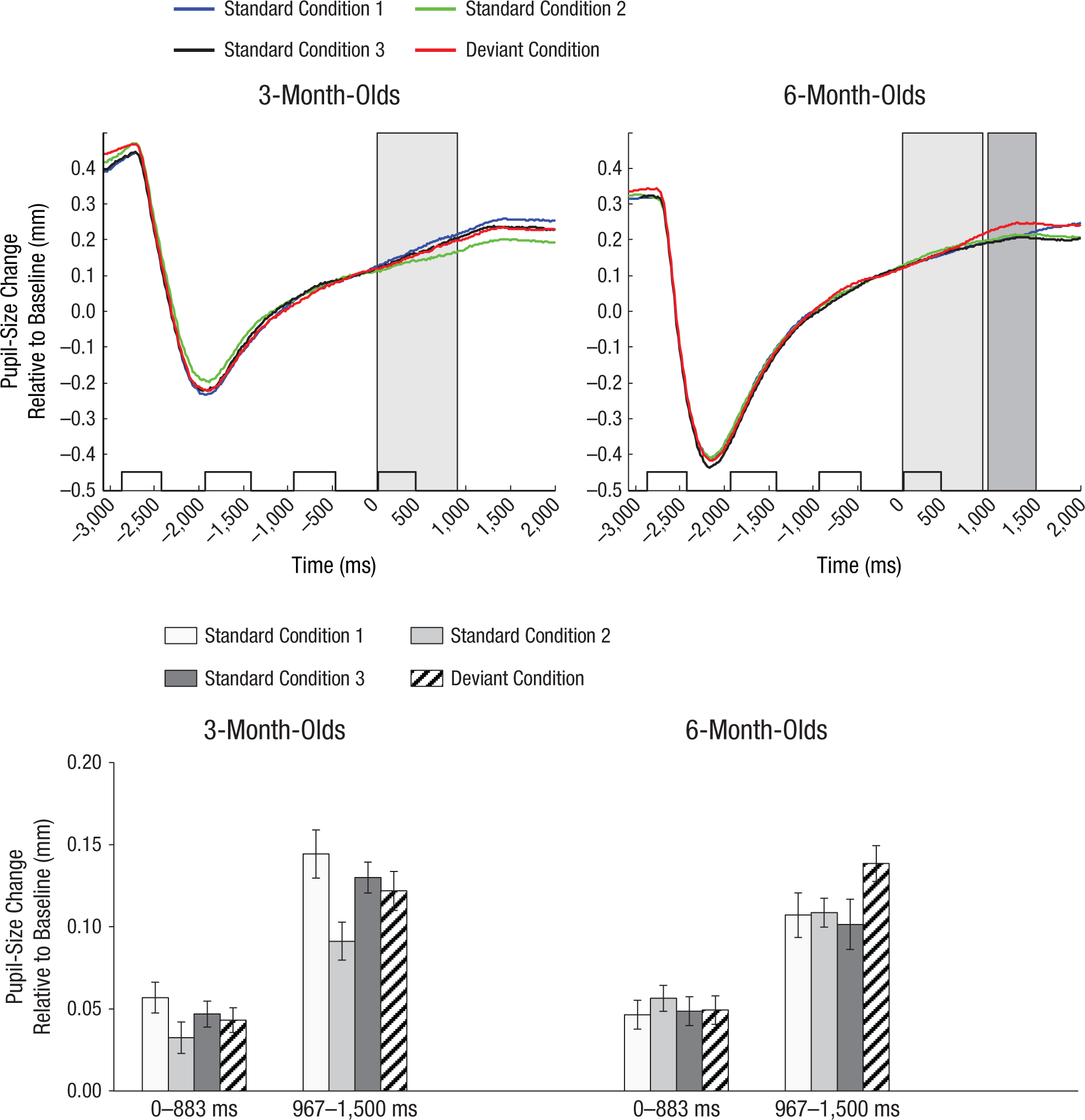
Results from Experiment 2. The graphs in the top row show pupil-size change (relative to baseline) as a function of time in the standard and deviant conditions for the 3- and 6-month-olds. The dark gray areas indicate the time window (effect window) during which the conditions differed in the extent to which the pupil-size change differed from that in the control time window, which is represented by the light gray areas. The square waveform along the x-axis indicates when the four syllables occurred in each trial. The graphs in the bottom row show average pupil-size change in the control window (0–883 ms) and in the effect window (967–1,500 ms) for the 3- and 6-month-olds. Error bars represent within-subjects standard errors of the mean (Cousineau, 2005).
We analyzed the data for each age group in a separate cluster mass test, comparing the pupil-size change in the four conditions during the window of interest identified in Experiment 1 (883–2,183 ms) with the pupil-size change during the control time window (0–883 ms). A significant interaction effect was observed between 967 and 1,500 ms for 6-month-olds, p = .038. No effect was observed for 3-month-olds (maximum F = 1.505; Fig. 2, top panel). We used the effect window found for 6-month-olds in our next analysis. A 2 (time window) × 4 (condition) × 2 (age) repeated measures ANOVA yielded a significant main effect of time window, F(1, 28) = 63.91, p < .001, η p 2 = .69; pupil diameter increased over time (Fig. 2, bottom panel). We found trends for the Condition × Age interaction, F(3, 26) = 2.61, p = .073, η p 2 = .23, and for the three-way Time Window × Condition × Age interaction, F(3, 26) = 2.66, p = .069, η p 2 = .23. All other effects were not significant, ps > .15. We then analyzed the two age groups separately to investigate the interactions further.
In 3-month-old participants, a 4 (condition) × 2 (time window) repeated measures ANOVA revealed a significant effect of time window, F(1, 15) = 39.36, p < .001, η p 2 = .72. No other effect was significant, all ps > .13. Planned comparisons of the increase in pupil diameter over time in the four different conditions revealed a marginal difference between Standard Condition 3 and Standard Condition 2, p = .055. There was no difference between the deviant condition and any of the three standard conditions, all ps > .3 (Fig. 2, bottom panel). Thus, we found no evidence that 3-month-olds could solve the invariance problem.
In 6-month-old participants, a corresponding repeated measures ANOVA revealed a significant effect of time window, F(1, 13) = 25.81, p < .001, η p 2 = .66, and a significant Time Window × Condition interaction, F(3, 11) = 4.29, p = .031, η p 2 = .54. Planned comparisons showed that the increase in pupil diameter over time was larger for the deviant condition than for the three standard conditions (deviant condition vs. Standard Condition 1, p = .009; deviant condition vs. Standard Condition 2, p = .033; deviant condition vs. Standard Condition 3, p = .022). The standard conditions did not differ from each other (all ps > .5; Fig. 2, bottom panel). The measurement of pupil dilation thus showed that 6-month-olds had formed a category of syllables sharing the initial consonant. This implies that they identified a consonant across different vowel contexts, thus solving the invariance problem. Additional analyses for which time windows were selected from studies of adults yielded similar results (see the Supplemental Material).
General Discussion
Our study demonstrates for the first time that the pupil diameter of young infants is modulated by the frequency of acoustic stimuli. This finding establishes a new methodological opportunity for research on young infants’ perception and representation of acoustic stimuli. Moreover, Experiment 1 showed that this effect is extremely stable in terms of latency and intensity across ages. Thus, this method provides an effective tool to study developmental changes. In Experiment 2, this tool was implemented to study speech representation in young infants and answer a question that traditional methodologies have not yet answered. We showed that 6-month-olds, but not 3-month-olds, recognize the same consonant embedded in different syllables.
The identification of phonetic segments inside a syllable is a long-standing problem for students of speech perception. There is no acoustic boundary between the onset consonant and the rhyme of a syllable (the segmentation problem), and no obvious acoustic marker for the identity of an onset stop consonant (the invariance problem; Liberman et al., 1967). Motor theories elegantly account for the effortless solution of the invariance problem in adults processing their native languages (Liberman et al., 1957; Liberman & Mattingly, 1985). According to this account, which emphasizes the similarity between the categorical nature of articulatory gestures for speech production and categorical speech perception, speech representations consist of representations of articulatory gestures. Ultimately, speakers perceive the categorical articulatory gestures that give rise to speech sounds.
Early versions of these theories posited that infants initially produce sounds randomly and progressively learn the associations between their articulatory gestures and the resulting speech sounds (Liberman et al., 1957). In this process, infants realize that the same gesture is performed to produce the syllables [ba], [bo], [bi], and so forth, and eventually abstract and form the representation of the segment [b]. Our findings that 6-month-olds but not 3-month-olds recognize the same consonant in different syllables is arguably compatible with motor theories, because the production of well-formed syllables may emerge as early as 6 months but rarely emerges earlier (Oller, 2000).
Parents’ answers to our questionnaire in Experiment 2 revealed that only three of the fourteen 6-month-old participants (and none of the 3-month-olds) had acquired this ability at the time of the experiment. The other infants were still in the prebabbling phase, producing mainly vowel-like sounds. Though canonical babblers showed a strong effect in Experiment 2, as measured by the pupil-size change in response to deviant trials (Fig. 3), several prebabblers showed an even stronger effect. Our results therefore are evidence against motor theories of speech perception based on associations between motor articulation and perception. Infants perceive the common onset consonant in syllables that they have never produced; therefore, the resolution of the invariance problem through individuation of phonetic segments comes before the control of articulatory effectors and independently of infants’ experience with production.
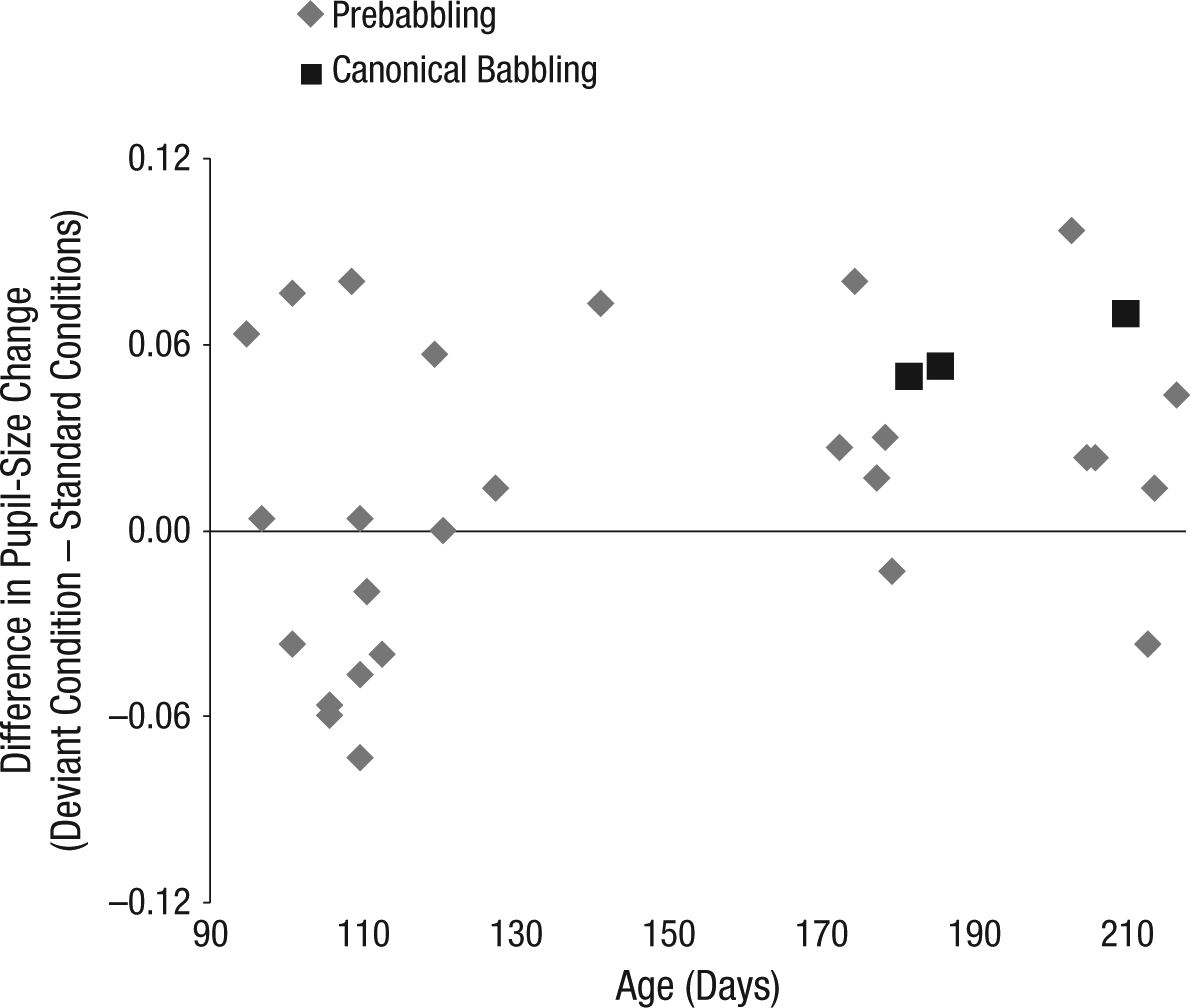
Results from Experiment 2. Scatter plot showing the association between age and pupil-size change in response to deviant trials. To compute this effect, we averaged the difference in pupil-size change between the effect window (967–1,500 ms) and the control window (0–883 ms) across the three standard conditions. We then subtracted this average from the difference in pupil-size change between the two windows in the deviant condition. Larger positive scores correspond to larger effects.
Our observations may nevertheless be compatible with the revised version of the motor theory of speech perception (Liberman & Mattingly, 1985), which proposes that correspondences between acoustic and motor representations are innately defined. A growing corpus of evidence suggests that speech perception in very young infants is multimodal (Desjardins & Werker, 2004; Meltzoff & Borton, 1979; Meltzoff & Moore, 1977; Ozturk, Krehm, & Vouloumanos, 2012; Peña, Mehler, & Nespor, 2011; Yeung & Werker, 2013). The specific role that each modality may play in the developmental change we observed between 3- and 6-month-olds needs to be further explored. Our results constrain further investigations by showing that although experience with speech production might possibly help to refine phonemic representations later on, it is not necessary to isolate phonetic segments and track them in different syllables.
Footnotes
Acknowledgements
We thank Judit Gervain for comments on a previous version of the manuscript, Manizeh Khan for discussion of the data analyses, and Susan Carey and the Harvard Laboratory for Developmental Studies for support and fruitful discussions.
Declaration of Conflicting Interests
The authors declared that they had no conflicts of interest with respect to their authorship or the publication of this article.
Funding
This research was supported by two Marie Curie International Outgoing Fellowships for Career Development: PIOF-GA-2010-272732-COIN (awarded to J.-R. Hochmann) and PIOF-GA-2010-273597-ACTICO (awarded to L. Papeo).

Notes
References
Supplementary Material
Please find the following supplemental material available below.
For Open Access articles published under a Creative Commons License, all supplemental material carries the same license as the article it is associated with.
For non-Open Access articles published, all supplemental material carries a non-exclusive license, and permission requests for re-use of supplemental material or any part of supplemental material shall be sent directly to the copyright owner as specified in the copyright notice associated with the article.
