



Abstract

An emerging literature has begun to examine the importance of sensitive periods of development for molding personality traits, as well as cognition and socioemotional traits. One specific question of interest is whether entering adulthood in difficult economic times may shape longer-term adult development. For example, the potential scarring effects of living during the Great Depression has been examined (Clausen, 1995), and there is some evidence that exposure to major economic events can affect trajectories of personality development (e.g., Mroczek & Spiro, 2003). More recently, Kahn (2010) showed that entering the labor force during a recession has lasting effects on earnings. In a new addition to the literature, Bianchi (2014) attempted to link macroeconomic conditions (measured by the national unemployment rate) as individuals enter adulthood (ages 18–25) and later ratings of narcissistic characteristics. Using two U.S. adult samples, one from an online survey panel (N = 1,500+) and a second from the nationally representative National Epidemiologic Survey on Alcohol and Related Conditions (NESARC; N = 30,000+), Bianchi found inverse associations between the national unemployment rate and narcissism scores. For her second study, she reported a difference of 0.40 (approximately 15% of a standard deviation) in narcissism scores between respondents who faced the best (4.1%) versus the worst (7.7%) unemployment rates during young adulthood.
However, the use of cross-sectional data combined with information on the annual unemployment rate imposed important limitations on the analysis. As is the case for researchers using age-period-cohort models in epidemiology (see Luo, 2013, and discussion outlined in Tolnay, 2013), Bianchi faced a severe collinearity problem in that each set of unemployment rates in young adulthood uniquely identifies a particular cohort. This general issue was first outlined in the developmental psychology literature by Schaie (1965).
In Bianchi’s particular analysis, because age and exposure (i.e., macroeconomic conditions for each birth cohort) are dependent in cross-sectional outcome data (age at time of survey = year of survey – birth year), it is extremely difficult (if not impossible) to make inferences about one potential determinant of narcissism (cohort exposure to unemployment rates) while holding constant a second determinant (age). 1 The well-known age profile of narcissism scores (see Fig. S1 in the Supplemental Material available online) suggests the need to include age controls in the model, but such a control makes it difficult to disentangle age effects from cohort exposure effects. To further examine the implications of this issue for the empirical results, I implemented extensions of Bianchi’s model for the NESARC data to determine the extent to which making slight adjustments in how age is statistically controlled affects the estimated association between cohort exposure and the outcome.
Extended Results: Assessing Associations Between Unemployment Rates and Narcissism Scores
The first column in Table 1 presents the results obtained when I replicated Bianchi’s modeling approach by regressing the individual-level narcissism scores (M = 2.3, SD = 2.7) on the national unemployment rate (measured when each individual was between 18 and 25 years old; M = 5.9%, SD = 1.01) with a control for age in years. The unstandardized coefficients were −0.11 for unemployment rate and −0.03 for age; these results are identical to those Bianchi reported (Model 1 in Table 2).
Results of Multiple Regression Analyses Using National Unemployment Rates and Age to Predict Narcissism Scores
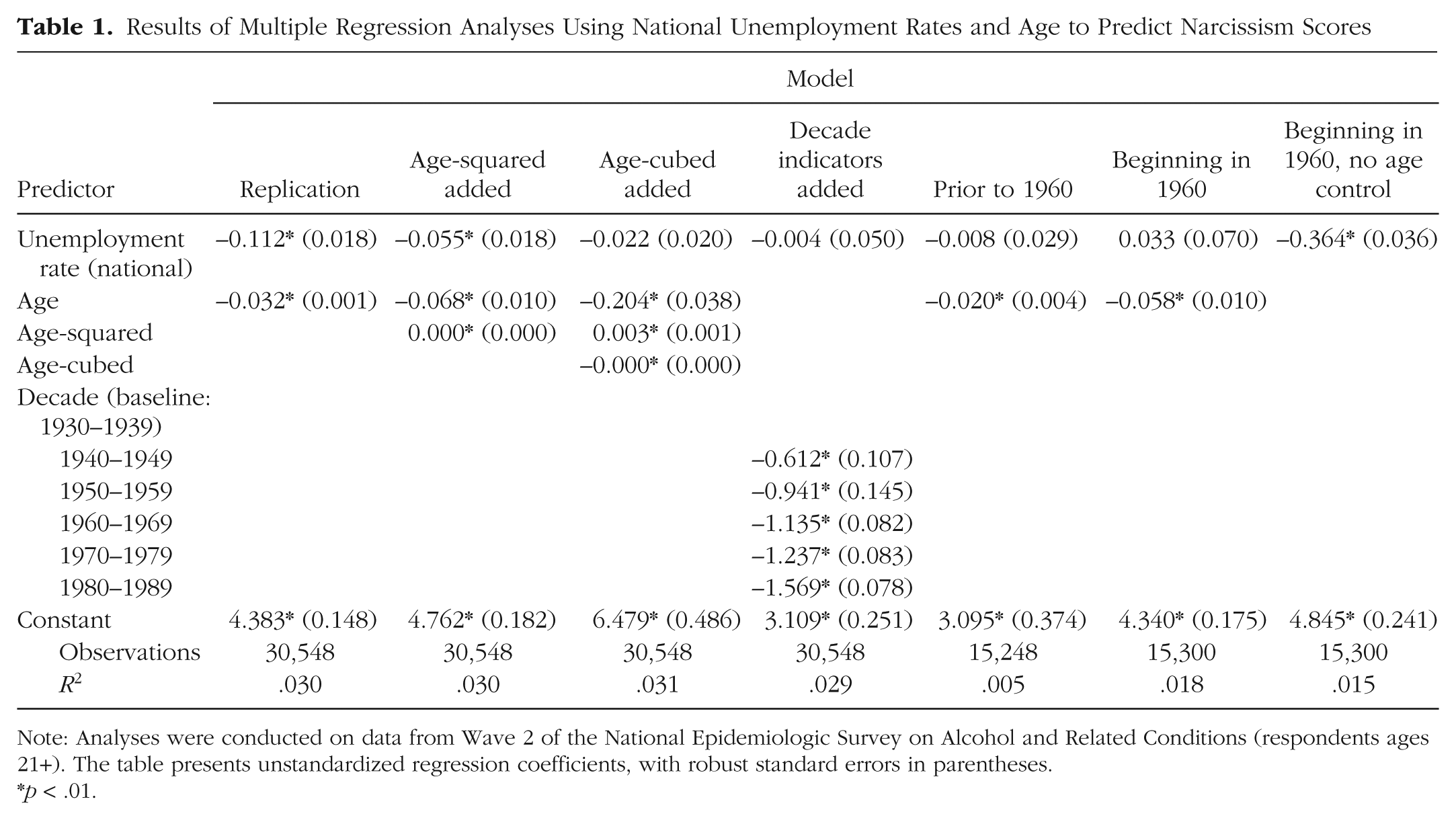
Note: Analyses were conducted on data from Wave 2 of the National Epidemiologic Survey on Alcohol and Related Conditions (respondents ages 21+). The table presents unstandardized regression coefficients, with robust standard errors in parentheses.
p < .01.
Because age and the unemployment rate are highly correlated in this sample (see Fig. S1), particularly after 1960 (r = .94), I extended Bianchi’s analysis by examining the sensitivity of the effects to slight changes in how age is controlled in the analysis, in order to assess the potential importance of the high level of collinearity between cohort exposure and age. As Table 1 shows, adding age-squared reduced the coefficient for unemployment rate by 50%; adding age-cubed further reduced the coefficient to −0.02 (approximately 20% of the baseline coefficient), so that it was no longer statistically different from zero. Including birth-decade indicators (which allowed less parameterization on age) reduced the coefficient to −0.004—about 4% of the original estimate. Although these results cannot necessarily suggest the appropriate modeling of the age covariate, they do show the important fragility of the baseline associations due to the strong dependence of the cohort exposure of interest on age.
Figure S1 suggests that stratifying the analysis at the year 1960 may allow a parsimonious examination of the effects of including age controls and the issue of the conflation of age and cohort effects. Table 1 shows that before 1960, there was no relationship between unemployment rates and narcissism scores; after 1960 (recall that the correlation between age and the unemployment rate was > .94 during this period; see Fig. S1), because of multicollinearity in the two independent variables, there was also not a statistically significant association, and the estimate for this period was positive. The sensitivity of the results to age controls is further demonstrated by the fact that the bivariate association after 1960 in a model without age controls was implausibly 3 times the baseline association (see Table 1).
Finally, following more recent work examining unemployment rates and adult outcomes (Kahn, 2010), I performed analyses using state unemployment rates instead of national unemployment rates (see Table S1 in the Supplemental Material; note that state-specific unemployment measures are not available for as many years as the national measures used in the main analyses reported in Table 1). This analysis broke the dependence between age and cohort exposure, as individuals who were the same age but who lived in different states could have experienced different cohort (state unemployment) exposures. The relationship between state unemployment rate and narcissism score was strong (again, the correlation between age and state unemployment rates was high, r = .58), but the results were not robust when state-level heterogeneity was controlled by adding state-level fixed effects. This latter result suggests that the dependence of cohort exposure on age was what actually produced the statistical association Bianchi found; an empirical specification that did not have the dependence issue did not produce evidence of an association between (state-specific) cohort exposure to unemployment and later narcissism.
Conclusion
In summary, the estimated association between macroeconomic conditions at ages 18 through 25 and narcissism scores in adulthood is highly dependent on the inclusion of control variables—and more adequate research designs suggest that there is no robust relationship. Future work in this area will need to separate cohort and age effects and address issues of severe multicollinearity in cross-sectional data by using pooled cross-sectional data and local (e.g., state) measures of economic conditions.
Footnotes

References
Supplementary Material
Please find the following supplemental material available below.
For Open Access articles published under a Creative Commons License, all supplemental material carries the same license as the article it is associated with.
For non-Open Access articles published, all supplemental material carries a non-exclusive license, and permission requests for re-use of supplemental material or any part of supplemental material shall be sent directly to the copyright owner as specified in the copyright notice associated with the article.
