



Abstract
Extremely positive experiences, and positive appraisals thereof, produce intense positive emotions that often generate both positive expressions (e.g., smiles) and expressions normatively reserved for negative emotions (e.g., tears). We developed a definition of these dimorphous expressions and tested the proposal that their function is to regulate emotions. We showed that individuals who express emotions in this dimorphous manner do so as a general response across a variety of emotionally provoking situations, which suggests that these expressions are responses to intense positive emotion rather than unique to one particular situation. We used cute stimuli (an elicitor of positive emotion) to demonstrate both the existence of these dimorphous expressions and to provide preliminary evidence of their function as regulators of emotion.
Some people cry at graduations, at the birth of their children, when a hero returns from war, when they reach their goals, and when someone gives to another person unselfishly. Some concertgoers scream as if in horror in the presence of their teen idol, and some people playfully growl and express their desire to pinch a baby’s cheeks. What these diverse situations have in common is that these positive experiences have elicited dimorphous expressions—not only positive expressions, but also expressions normatively associated with negative emotions (e.g., anger, sadness, and fear; Ekman & Friesen, 1971, 1986). During these dimorphous displays, both positive and negative expressions occur simultaneously in a disorganized manner, which leaves witnesses to rely on the context of the situation to interpret them (Carroll & Russell, 1996; Zaki, Hennigan, Weber, & Ochsner, 2010).
The Structure of the Dimorphous Expression of Emotion
Highlighting points of consensus among emotion researchers, Gross, John, and Richards (2000) proposed a process model of emotion that begins with a stimulus event, followed by an appraisal of the event, an emotional experience, and then an expressive behavior. Dimorphous expressions of emotion resemble this process model but feature a distinct pattern 1 of one stimulus event, one appraisal, one emotional experience, and two expressive behaviors.
To give an example, a person who has won $100 million in a lottery and appraised this event as an incredibly good thing might feel overwhelmed with happiness and express this feeling by both smiling and crying. Crying, which normatively expresses sadness, would seem to contradict the situation, the appraisal, and the positive emotions. The negative expression might be merely a facial display, or it might reflect the onset of an actual negative emotion. 2 At this point, we are not making a distinction on this matter, but we would note that one’s expression does not necessarily correspond with one’s emotional experience (Gross et al., 2000; Kappas, 2003).
The Function of Dimorphous Expressions
We presume that dimorphous expressions of emotion occur during situations in which people feel overwhelmed with emotion, when they perceive that a point has been reached at which their emotions have become unmanageable. These perceptions of feeling overwhelmed (Folkman & Moskowitz, 2000) may be dictated by physiological limits and may deter people from sustaining high levels of emotion that can be deleterious for the body (e.g., Colom et al., 2000).
Dimorphous expressions of emotion may help regulate emotions (see Gross, 2013, for a review), possibly through balancing one emotion with the expression of another. If the expression of one emotion regulates another emotion (Fredrickson, Mancuso, Branigan, & Tugade, 2000; Kappas, 2011; Samson & Gross, 2012; Schimmack, 2001), one might expect to see negative emotion expression when positive emotions run too high and see positive emotion expression when negative emotions run high. In fact, Fredrickson and Levenson (1998) reported such a dimorphic response to negative emotion, when over half of their participants spontaneously smiled while watching the most intense moments of a sad movie scene. Those who displayed their sadness in this dimorphic manner reported feeling sad but had faster cardiovascular recovery from the sad event than those who did not smile.
Preliminary Studies
We initially tested the proposed dimorphous expression of emotion with stimuli that are considered “cute” because the mere presentations of photographs of infants produce strong positive emotional responses and activate the reward system in the brain (Glocker, Langleben, Ruparel, Loughead, Valdez, et al., 2009). When people see characteristics such as large, wide-set eyes; round cheeks; and small chins (known as baby schema; Lorenz, 1943), they get the impulse to approach and provide protection and care (Glocker, Langleben, Ruparel, Loughead, Gur, & Sachser, 2009; Lorenz, 1971; Sherman, Haidt, & Coan, 2009; Sherman, Haidt, Iyer, & Coan, 2013).
Yet our observations yielded distinctly different responses to cute stimuli, including playful growling, squeezing, biting, and pinching. Considering the context in which these aggressive expressions occur, we assume that these responses are not generated from negative appraisals of cute beings, the intent to harm, or true aggression (Anderson & Bushman, 2002). Here, we explored such expressions as apt and testable illustrations of dimorphous expressions of emotion and the function of dimorphous expressions as emotion regulators.
We first wanted to establish that cute stimuli are elicitors of dimorphous expressions. To do this, we conducted a preliminary study in which participants (N = 105; 57 female, 48 male; mean age = 36.10 years) reported whether, within the explicit boundary of not wanting to harm cute beings, they had ever pinched (30%) and squeezed (52%) a cute baby or child. Although there is no word in English to describe these behaviors, we conducted a survey that identified such words in other languages (e.g., in Filipino, the word gigil refers to the gritting of teeth and the urge to pinch or squeeze something that is unbearably cute; Rubino & Llenado, 2002). (See Sections S2 and S3 in the Supplemental Material available online.) To test the generality of these responses as dimorphous expressions of emotions, not specific expressions in response to “cuteness,” and to test the model of one stimulus event, one appraisal, one emotional experience, and two expressive behaviors, we conducted Study 1.
Study 1: Displays of Both Care and Aggression in Response to Cute Stimuli
We reasoned that dimorphous expressions could be a form of emotion regulation, because they appear to occur when people feel overwhelmed with intense feelings. We further hypothesized that there could be stable individual differences in people’s tendencies toward dimorphous displays across a variety of situations that produce intense emotions, because other emotion-regulation mechanisms generalize in this way. For instance, an individual might evoke cognitive reappraisal (Gross & John, 2003) both to cope with anger from being mistreated and to cope with sadness from a loss.
We further predicted that our data would fit the model of the proposed emotional cascade (Gross et al., 2000), in which babies with higher infantile characteristics would induce higher positive appraisals; arouse higher reports of being overwhelmed with positive emotions; provoke higher expressions of care, as other researchers have demonstrated (e.g., Sherman et al., 2013); and also provoke higher expressions of aggression, as we hypothesized.
Method
Test of generality of dimorphous expressions
Participants
Participants were recruited online through Amazon’s Mechanical Turk (N = 143; 69 female, 74 male; mean age = 34.22 years, range = 19–73, SD = 12.31) and were compensated 25¢ to complete a survey that was advertised as follows: “Short Survey (5–10 minutes to complete). In this survey we ask you to answer a short questionnaire.” Of the 158 participants who logged in to the survey, 15 (9%) abandoned the survey before completing it, which left data from 143 participants in our final analyses.
Materials, procedure, and analysis
We created 30 items that described dimorphous expressions across a variety of situations. Thirteen items asked about the dimorphous expression of various positive emotions across situations that did not include responses to cute stimuli (e.g., crying at the happiest moment of a movie). The intercorrelation among these items was high (Cronbach’s α = .92). Another 13 items (α = .90) asked about the dimorphous expression of negative emotions within various situations, 3 and 4 items asked about situations involving cute stimuli and specific dimorphous expressions of aggression (α = .89). We provided a forced-choice response scale with no neutral point, as a neutral point would not be interpretable when asking whether someone does or does not behave in a certain manner (1 = strongly disagree, 2 = disagree, 3 = somewhat disagree, 4 = somewhat agree, 5 = agree, 6 = strongly agree).
After participants provided informed consent, an introduction to the survey explained that we were interested in how people express emotion. Participants then answered the questionnaire, provided basic demographics, and were thanked for their time. Participants were allowed to only move forward through the survey; no back button was provided.
Even though we were not creating a scale per se, we thought it would be helpful to use a factor analysis to determine how items related to one another. A simple correlations array of all the items would not account for all intercorrelations simultaneously. Therefore, all items were subjected to an exploratory factor analysis. Our one a priori prediction was that items involving cute stimuli would load on the same factor as various situations that elicit other dimorphous expressions of positive emotions. We had no a priori prediction for the items focused on the dimorphous expression of negative emotions. Two factors emerged, explaining 50% of the variance of the scale. As predicted, items concerning responses to cuteness clearly loaded on the same factor as other dimorphous expressions of positive emotions (see Table 1).
Factor Loadings for Each Item on the Test of Generality of Dimorphous Expressions
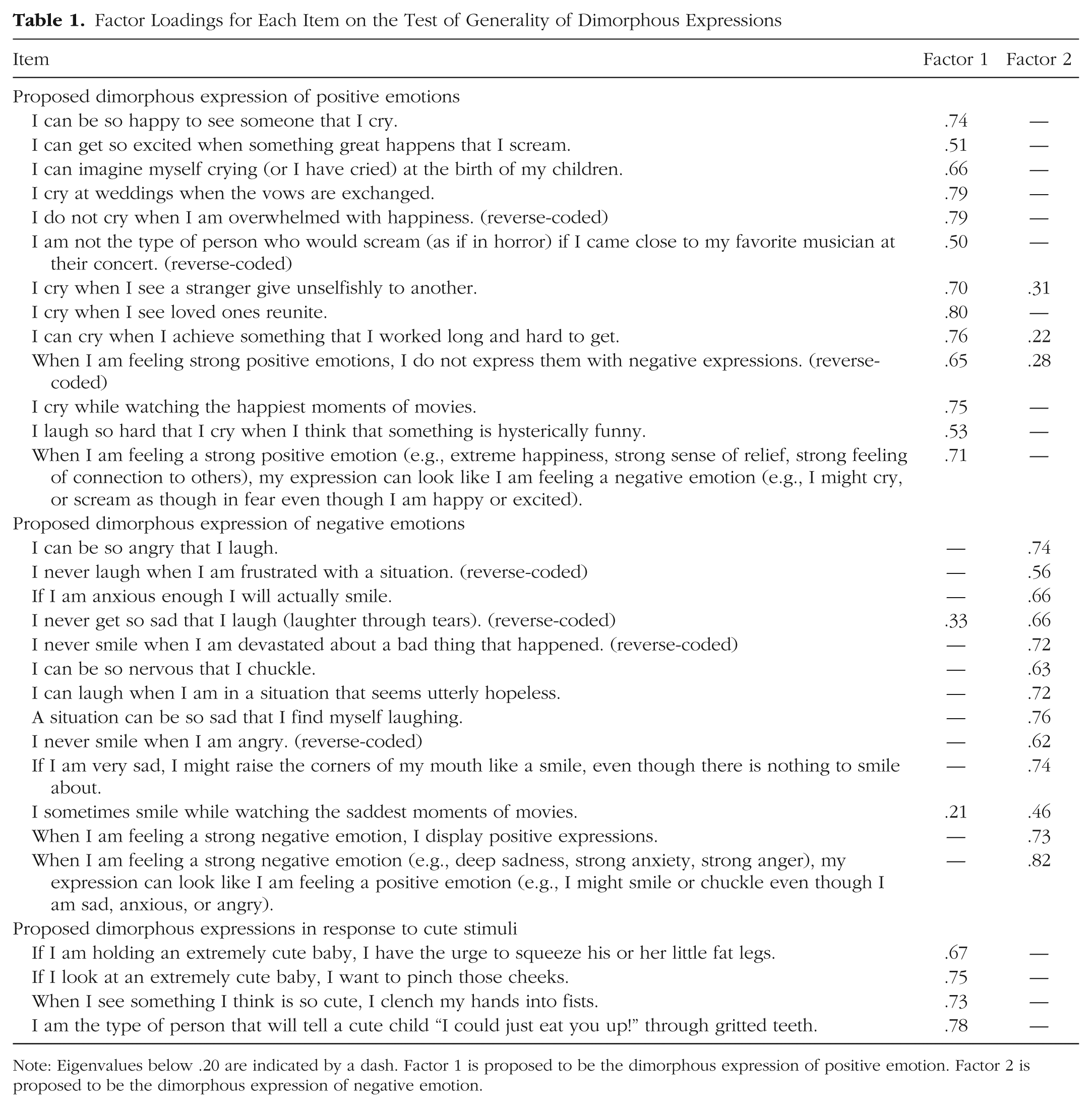
Note: Eigenvalues below .20 are indicated by a dash. Factor 1 is proposed to be the dimorphous expression of positive emotion. Factor 2 is proposed to be the dimorphous expression of negative emotion.
Our results indicated that the dimorphous expression of positive and negative emotions does cross situations and different emotions. This factor analysis differentiated the latent constructs of intense positive and negative emotions. As predicted, the dimorphous expression of positive emotion in response to cute stimuli loaded on the same factor as other situations that evoked dimorphous responses of positive emotions, but not dimorphous responses of negative emotions. This underscores the idea that it is not a negative emotional response to cute stimuli that is being expressed along with positive expressions, but rather a positive emotional response to cute stimuli that is being expressed with negative expressions.
The dimorphous expression of emotions in response to cute stimuli was strongly correlated with the dimorphous expression of positive emotion in response to other types of stimuli (r = .79, p < .001), but the dimorphous expressions of negative emotions in response to other types of stimuli showed a lower correlation (r = .21, p = .01; z-scored difference between correlations = 7.18, p < .001). The dimorphous expression of positive emotion was correlated with the dimorphous expression of negative emotion as well (r = .38, p < .001).
Test of the dimorphous-expression model
Participants
Participants were recruited online through Amazon’s Mechanical Turk (N = 299; 127 female, 172 male; mean age = 29.79 years, range = 18–63, SD = 9.70) and were compensated 35¢ for answering a survey that took approximately 5 min. The study was advertised as follows: “Short Survey (5–15 minutes to complete). In this survey we ask you to answer some questions about photos, and answer a short questionnaire.”
Using G*Power software (Faul, Erdfelder, Lang, & Buchner, 2007) and the effect size from the pretest (see the Stimuli section below) for feelings of being overwhelmed (as we thought these feelings were essential to expressions of aggression), we estimated (.80 power, alpha error probability = .05, two-tailed) that we would need approximately 300 participants. Therefore, we set a stopping point for data collection when 300 surveys were logged in as complete. Of the 314 participants who logged in to the survey, 14 (5%) abandoned the survey before completing the dependent variables, and 1 simply clicked through the survey without responding. Of the participants who did not complete the survey, 9 were originally assigned to the more-infantile condition and 6 were assigned to the less-infantile condition, which left data from 299 participants in the final analysis.
Materials
For stimuli, we used photographs of babies that had been prepared and validated by Sherman and colleagues (2013). Eight photographs of infants and toddlers (two female, six male) were morphed so that babies had more-infantile characteristics (larger eyes, cheeks, and forehead; smaller noses, lips, and chins) and less-infantile characteristics (the reverse); these morphs were based on extensive prior research documenting characteristics of cuteness (e.g., Alley, 1981; Glocker, Langleben, Ruparel, Loughead, Gur, & Sachser, 2009; Hildebrandt & Fitzgerald, 1979). We pretested these photographs utilizing an independent online sample from Amazon’s Mechanical Turk (N = 212; 103 female, 109 male; mean age = 33.08 years, age range 18–70, SD = 10.95). Participants were assigned randomly to view the more-infantile or the less-infantile photographs and to endorse statements designed to capture an overall positive appraisal of the stimuli and how those stimuli made the participant feel. We captured a positive appraisal of each baby with the items “I think that baby is cute” and “That baby is good” (α = .87). The statement, “When I look at this baby I feel overwhelmed with very strong positive feelings” captured the overwhelming positive emotional response toward the baby. Sliding scales were provided for response (1–20 = not at all true, 21–40 = a little bit true, 41–60 = true, 61–80 = very true, 81–100 = completely true).
As expected, the photographs presented in the more-infantile condition (M = 66.77, SD = 20.60) were appraised more positively than the photographs presented in the less-infantile condition (M = 59.84, SD = 24.60), t(210) = 2.23, p = .03, d = 0.31. Also as expected, the photographs presented in the more-infantile condition (M = 50.04, SD = 27.03) provoked higher reports of being overwhelmed with positive feelings than the photographs presented in the less-infantile condition (M = 41.42, SD = 28.76), t(210) = 2.25, p = .03, d = 0.31.
We captured in-the-moment responses with prompts situated below each photograph, which allowed participants to respond with the stimulus remaining in view. Slider bars for all responses had values between 1 and 100 (1–20 = not at all true, 21–40 = a little bit true, 41–60 = true, 61–80 = very true, 81–100 = completely true).
For the trials that measured appraisal of the babies, we used the same items as in the validation of the stimuli. On each trial, a statement appeared below each photograph that read either “When I look at this baby, I feel like this baby is cute” or “When I look at this baby, I feel like this baby is good.” These two items (α = .87) were each averaged across the eight trials.
For the trials that measured emotional experience, we also used the same items as in the validation of the stimuli. Situated below each photograph was the statement, “When I look at this baby, I feel like I am overwhelmed by very strong positive feelings.” For trials that measured care expressions, one of three statements appeared below each photograph. The statements always began with the phrase “When I look at this baby, I feel like,” but they ended with “I want to take care of it!” “I want to hold it!” or “I want to protect it!” These three items (α = .95) were each averaged across the eight trials.
For each trial that measured aggressive expressions, the phrase “When I look at this baby, I feel like” was completed by one of three phrases: “pinching those cheeks!” “saying ‘I want to eat you up!’ through gritted teeth,” or “being playfully aggressive!” Participants were asked to respond to all three items (α = .93), which were averaged across the eight trials. The term “playful aggression” was described to participants in the following way:
We also ask about “playful aggression.” Playful aggression is in reference to the expressions that people show sometimes when interacting with babies. Sometimes we say things and appear to be more angry than happy, even though we are happy. For example some people grit their teeth, clench their hands, pinch cheeks, or say things like “I want to eat you up!” It would be difficult to ask about every possible behavior of playful aggression, so we ask generally about things of this kind—calling them playful aggressions.
Our demographics questionnaire asked for age, ethnicity, the participants’ number of children, desire for children (or for more children if participants had any already), and whether participants who did not have children regularly spent time with children.
Procedure
After providing informed consent, participants read a short introduction to the survey that informed them that they would be asked to respond to some photographs. Participants were allowed to move only forward through the survey; no back button was provided. We told participants that we wished to measure positive experiences with photographs of babies, not negative experiences such as doing actual harm to or disliking babies. We further instructed them that if they did not experience such feelings as desiring to pinch a baby’s cheeks within these boundaries that they could indicate that by choosing “not at all true” ratings. Trials measuring expressions of aggression, expressions of care, and appraisals of the stimuli were presented separately and counterbalanced randomly. Directly following this, we collected demographic information.
Results
We found that more-infantile babies (M = 66.88, SD = 18.10) were appraised more positively than less-infantile babies (M = 56.68, SD = 21.28); an independent-samples t test revealed that this difference was significant, t(297) = 4.47, p < .001, d = 0.52. As expected, the photographs presented in the more-infantile condition (M = 52.48, SD = 23.85) provoked higher reports of being overwhelmed with very strong positive feelings than the photographs presented in the less-infantile condition (M = 42.74, SD = 23.81), t(297) = 3.54, p < .001, d = 0.41. Participants reported higher expressions of care for more-infantile babies (M = 55.81, SD = 27.07) than for less-infantile babies, (M = 47.47, SD = 27.30), t(297) = 2.65, p < .01, d = 0.31. Participants also reported higher expressions of aggression for more-infantile babies (M = 39.63, SD = 23.69) than for less-infantile babies (M = 33.35, SD = 21.68), t(297) = 2.39, p = .02, d = 0.28.
Next, we tested whether expressions of care in response to more- (vs. less-) infantile characteristics were mediated in serial fashion (progressing through one stage to the next). Serial mediation allows tests of mediation pathways with more than one mediator working sequentially rather than working in parallel. This analysis allowed us to test the entire hypothesized emotion-process framework (stimuli → appraisal → emotional experience → emotional expression; see Gross et al., 2000) in a single model.
In a bootstrapped serial mediation model with 5,000 samples using Process Model 6 (Hayes, 2013), we predicted the influence of infant-characteristic conditions on expressions of care, as mediated by positive appraisals and being overwhelmed with very strong positive feelings, while controlling for expressions of aggression. There was a significant indirect path (95% confidence interval, or CI = [0.03, 0.13]) from viewing more-infantile babies (vs. less-infantile babies) through the participants’ positive appraisals of such babies (b = 0.36, 4 SE = 0.10), t = 3.74, p < .001, next through the evoked overwhelming positive emotion (b = 0.55, SE = 0.04), t = 13.49, p < .01, to the care expressions made toward those babies (b = 0.35, SE = 0.06), t = 4.64, p < .001. Also, as expected, the manipulation of infancy no longer predicted care responses with positive appraisals and feelings of being overwhelmed with positive emotions in the model (c′ path; b = −0.05, SE = 0.07), t = −0.65, p = .52. This analysis tested all possible pathway combinations with the proposed mediators. There was another significant indirect pathway from infantile characteristics through positive appraisals predicting care responses (without overwhelming positive emotions; 95% CI = [0.07, 0.28]). This suggests that care responses can be mediated by both positive appraisals and feelings of being overwhelmed with very strong positive feelings toward the baby, but also that the feeling of being overwhelmed is not essential to an outcome of care responses, whereas having a positive appraisal of the baby is.
We ran an analogous serial mediation model with the same structure and factors as the previous one, except that it predicted aggressive expressions by infant-characteristic condition while controlling for expressions of care. There was a significant indirect path (95% CI = [0.02, 0.10]) from viewing more-infantile babies (vs. less-infantile babies) through the participants’ positive appraisals of such babies (b = 0.30, SE = 0.08), t = 3.56, p < .001, next through being overwhelmed with very strong positive feelings (b = 0.44, SE = 0.05), t = 9.55, p < .001, to the aggressive expressions made in reaction to those babies (b = 0.39, SE = 0.07), t = 5.49, p < .001. Further, the manipulation of infancy no longer predicted aggressive expressions with positive appraisals and feelings of being overwhelmed with positive emotions in the model (c′ path; b = 0.03, SE = 0.02), t = −0.31, p = .75. Again this analysis tested all possible pathway combinations with the proposed mediators. True to our hypothesis that the function of these expressions is to regulate emotions, there were no other significant pathways, which indicated that it was solely through the experience of being overwhelmed by very strong positive feelings that aggression was expressed. One might wonder if we were actually able to capture feelings of being overwhelmed. We remind the reader that we directly asked if participants were overwhelmed with strong positive feelings, and they responded that they were.
Expressions of care did not require being overwhelmed by very strong positive feelings for the indirect pathway to be significant, and expressions of care most likely have a function of caring for the baby, which leads to the baby’s well-being. Unlike expressions of care, expressions of aggression were specifically linked to overwhelming emotional experience, which suggests that they may serve the function of coping with those high emotions and lead to the expresser’s well-being. It should be noted that, ultimately, the baby’s well-being is served by cuteness eliciting both expressions of care and of aggression, because if the expresser is no longer incapacitated with overwhelming positive affect, that person may be better able to care for the baby (see Fig. 1).

Serial mediation models from Study 1 showing the influence of more-infantile (vs. less-infantile) stimuli on both expressions of care and expressions of aggression, as mediated by positive appraisals of the stimuli and reports of being overwhelmed with very strong positive feelings while viewing the stimuli. The model for each outcome variable controlled for the other. Black lines show results for models in which both mediators were included. Gray lines show results for models in which only positive appraisals were included. The one full path that is not significant is represented by a dashed line. Asterisks indicate significant paths (*p < .05, **p < .01, ***p < .001). The c path in the model reflects the total effect; the c′ path reflects the direct effect.
Discussion
We found support for the idea that individuals’ self-reports of dimorphous expressions correlate across situations and across the precise emotion expressed (e.g., happiness and excitement). Furthermore, responses to cute stimuli appear to be of the same kind as other dimorphous expressions of positive emotions, such as crying when reuniting with a loved one. We next illustrated our model of the dimorphous expression of emotion. As we hypothesized, people reported that they would make more caring and aggressive expressions after making higher positive appraisals and higher reports of feeling overwhelmed with positive feelings toward the stimuli that featured more characteristics of infancy.
One limitation to the studies presented in this article is that all measures were self-reports. In Section S7 of the Supplemental Material, we provide the results of a behavioral investigation into the dimorphous expression of emotion that corroborate what we report here. Another limitation is the use of online samples, for which there is little experimental control. In the Supplemental Material, we report replications of Study 1 (see Sections S4, S5, and S6) and experiments with university students in controlled laboratory settings (Sections S7 and S8), in which we found results similar to those reported here.
Study 2: Test of a Mechanism Underlying Dimorphous Expressions of Emotion
Next, we tested whether dimorphous expressions in reactions to infantile stimuli functioned to regulate emotion. If the dimorphous expression of emotion aids in emotion regulation, we expected participants who spontaneously express emotions in a dimorphous manner to return closer to prearousal levels after viewing cute stimuli, relative to those who do not show dimorphous responding. In other words, we expected that in a manner analogous to that reported by Fredrickson and Levenson (1998), negative expressions would help to regulate positive emotions.
We collected evidence of positive affect being regulated by such dimorphic displays by measuring participants’ affective states before, directly after (peak of experience), and 5 min after (end of recovery period) exposure to more- and less-infantile stimuli. We predicted that, overall, participants would report increased positive affect directly after viewing the stimuli and decreased positive affect following the recovery period. We further predicted that participants who had reported wanting to make aggressive expressions, relative to those who had not, would show greater recovery from the high positive affect by the end of the recovery period.
Here, we again tested the hypothesis that responses to infantile stimuli are an example of the general dimorphous expression of positive emotions. We predicted that participants’ questionnaire responses about dimorphous displays in other domains (e.g., “I cry while watching the happiest moments of movies”), but not the tendency to express emotion in congruent ways (e.g., “I smile while watching the happiest moments of movies”), would predict aggressive expressions captured while viewing cute stimuli. We also collected additional measures of the expression, the strength, and the dysregulation of emotions to test the prediction that the dimorphic expression of positive emotion would specifically explain aggressive displays during viewing of cute stimuli.
Method
Participants
Participants were recruited online through Amazon’s Mechanical Turk (N = 679; 390 female, 289 male; mean age = 37.88 years, range = 18–79, SD = 12.87) and compensated 75¢ for the approximately 20-min survey. The survey was advertised as follows: “Short Survey (20–30 minutes to complete). In this survey we ask you to answer a questionnaire, answer some questions about photos, work on a puzzle, and answer another questionnaire.”
To determine the number of participants needed for this study, we used G*Power software and the effect size (d = 0.24) from Sherman and colleague’s (2013) study asking about participants’ current mood after viewing these stimuli (1 = extremely negative, 9 = extremely positive). We felt that these mood ratings were the closest equivalent to the scale we used. We estimated (.80 power, alpha error probability = .05, two-tailed) that we would need approximately 550 participants. However, because we were collecting positive and negative affect with a different measure, we set a conservative stopping point for data collection, ceasing when 700 surveys were logged in as complete. Of the 735 participants who logged in to the survey, 21 clicked through but did not answer the survey, and 35 abandoned the survey before completing the dependent variables (total attrition: N = 56 (8%); cute condition = 31, less-cute condition = 25), which left data from 679 participants in the final analysis.
Materials and stimuli
We administered measures of emotional expression, dimorphous expression, strength of emotion, and dysregulation of emotion, as well as the Positive and Negative Affect Schedule (PANAS; Watson, Clark, & Tellegen, 1988) and a prosocial measure. A demographic questionnaire was also given. We used the same stimuli as in Study 1.
To capture respondents’ experience and how they express their emotions, we used the 16-item Berkeley Expressivity Questionnaire (α = .87; Gross & John, 1997). We added 32 adapted items (total = 48 items) that were changed in two ways. First, some original items asked about emotions but did not specify the emotion’s valence (e.g., “My body reacts very strongly to emotional situations”). We rephrased such questions to ask both about positive emotions (i.e., “My body reacts very strongly to emotional, positive situations”) and about negative emotions (i.e., “My body reacts very strongly to emotional, negative situations”). Second, we added items to capture the dimorphous expression of both positive and negative emotions.
Expression of positive emotions was captured with seven items (α = .90). Expression of negative emotions was captured with seven analogous items (α = .80). Dysregulation of positive emotions (α = .81) and dysregulation of negative emotions (α = .79) were captured with six items each. Strength of positive emotions (α = .82) and strength of negative emotions (α = .82) were each captured with three items. Finally, dimorphous expressions of positive emotions (α = .70) and dimorphous expressions of negative emotions (α = .66) were each captured with three items. See Table 2 for all items.
Survey Items Used in Study 2

Original items from which the current items were adapted are from the Berkeley Expressivity Questionnaire (Gross & John, 1997).
These eight subscales were subjected to factor analysis, which showed that 51% to 74% of the variance was explained in each subscale by the first factor 5 and that loadings on the first factor were consistently high (all items on all scales had Eigen values above .52 on the first factor). (See Section S9 in the Supplemental Material for intercorrelations of the eight subscales.)
The PANAS was administered before and after presentation of the infantile stimuli, as well as after recovery. The PANAS measures positive and negative affect by presenting participants with 20 feelings and emotions (e.g., “interested,” “irritable”) and asking them to rate “to what extent you feel this way right now.” The 10 positive items were averaged into a positive-affect score, and the 10 negative items were averaged into a negative-affect score.
The prompts during each trial and the instructions were the same as in Study 1. They measured appraisals of the babies (α = .82, two items), emotional experience when looking at the baby, care expressions (α = .92, three items), and aggressive expressions (α = .86, three items).
To create a filler task, we designed a word-search puzzle on the Web site Discovery.com using words we judged to be unrelated to the main task (e.g., “bay,” “brook,” “coastline”). Participants were told that the “puzzle may be difficult. Please do not worry about finding all of the words. This page will automatically advance after 5 minutes.” The puzzle had 30 words, which is more than would typically be found in a matrix this large (20 letters × 20 letters) in the 5-min interval. We did this to keep the experience similar for all participants. Because this was an online study, it cannot be said whether all individuals attended to the puzzle equally. However, the number of words found in the less-infantile (M = 5.12 words found, SD = 2.84) and more-infantile (M = 5.26 words found, SD = 3.10) conditions did not differ significantly, p = .55. Therefore, differences in recovery from the arousing event are not likely to have been accounted for by performance on this filler task, as equal performance should be an indication of equal attention given to the task. This supports the idea that attention to things other than the survey did not differ by condition.
The subscales of Universalism (rating values of equality, world peace, social justice, broadmindedness, and wisdom; α = .75) and Benevolence (rating feelings of helpfulness, honesty, forgiveness, loyalty, and responsibility; α = .68) from the Schwartz Value Survey (Schwartz, 1992) were combined into one scale of prosocial care (α = .79), following the protocol used by Sherman and colleagues (2013). We used the standard Schwartz instructions and presentation of values. (See Section S10 in the Supplemental Material for details on the use of this scale in replicating Sherman et al.’s, 2013, study on care responses to cute stimuli and prosocial values.)
Finally, our demographics questionnaire included items regarding age, ethnicity, the participants’ number of children, desire for children (or for more children if participants had any already), and whether participants who did not have children regularly spent time with children.
Procedure
Participants provided informed consent and were given a short introduction to the survey that explained that there would be questionnaires, pictures with questions, a puzzle, and another questionnaire. We first asked participants to fill out the emotional-expressivity measure. We then administered the preexperiment PANAS. Next, we told participants that they would be asked to respond to some photographs with the same instructions as in Study 1 (i.e., “not in reference to doing actual harm or disliking the baby”). Participants were allowed to move only forward through the survey; no back button was provided.
We presented trials in which we measured aggressive expressions and care expressions in random order. Directly after these in-the-moment trials, we administered the postexperimental PANAS. Participants were then asked to work on the puzzle for 5 min. The online page was designed not to advance during this period. Directly following this filler task, we administered the recovery PANAS. We then collected appraisals of the babies after a second exposure to the photographs, followed by a prosocial measure (the Schwartz Value Survey). Finally, we collected demographic information. See Figure 2 for an illustration of the experimental paradigm.
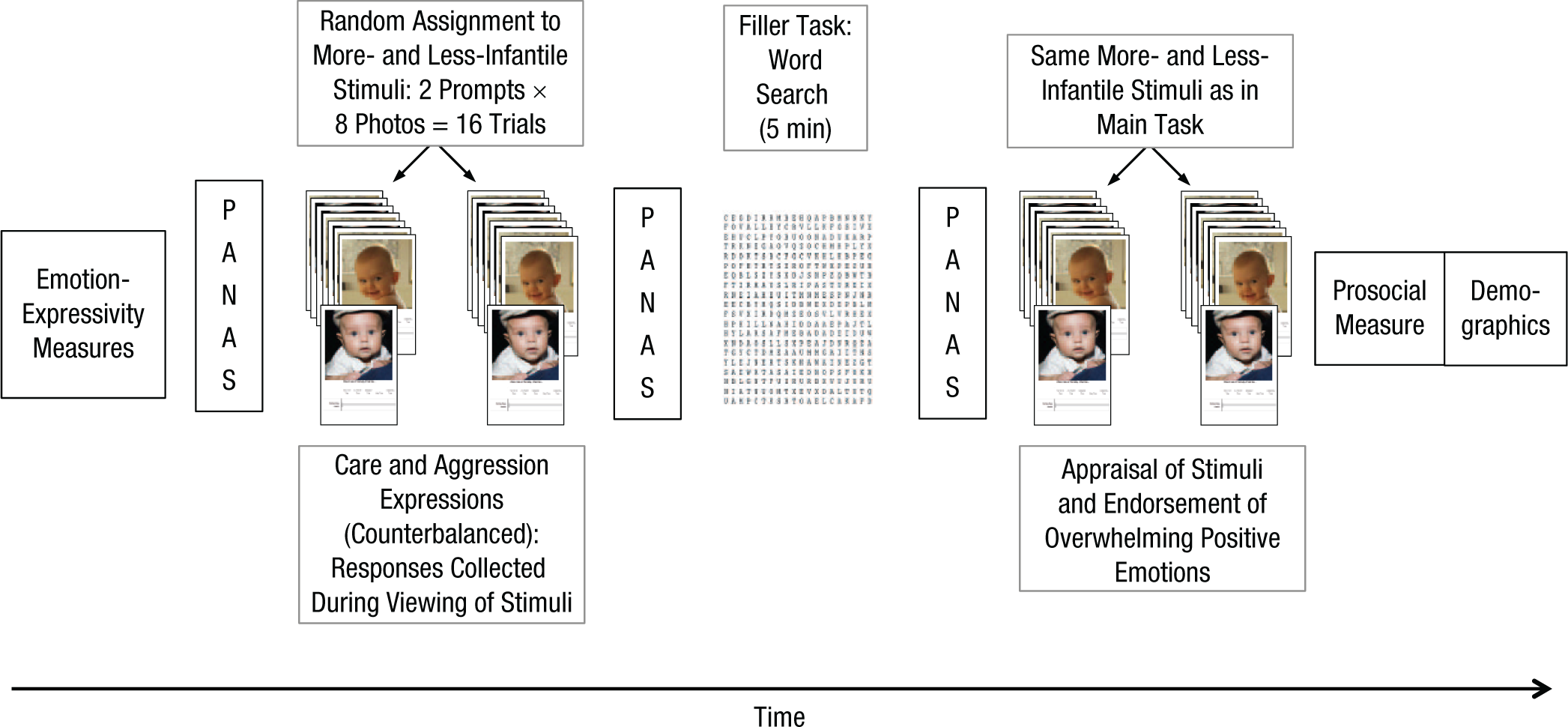
Design of Study 2. In the main task, participants viewed photos of infants that were manipulated to look more and less infantile, and then participants rated their own expressions of care and aggression. Participants completed the Positive and Negative Affect Schedule (PANAS; Watson, Clark, & Tellegen, 1988) before viewing stimuli, after viewing stimuli, and after a filler task. After the final PANAS, participants viewed the stimuli again and endorsed statements designed to capture how positive they felt about the stimuli and whether they had a positive overwhelming emotional response to each one. Additional measures were completed before and after the experiment.
Results
Replication of Study 1
A comparison of means showed that more-infantile babies (M = 71.14, SD = 19.58) were appraised more positively than less-infantile babies (M = 67.08, SD = 20.79); independent-samples t tests confirmed that this difference was significant, t(677) = 2.62, p < .01, d = 0.20. As expected, participants reported being more overwhelmed with positive feelings when viewing photographs in the more-infantile condition (M = 53.10, SD = 28.46) than when viewing photographs in the less-infantile condition (M = 47.75, SD = 28.16), t(677) = 2.46, p = .01, d = 0.19. Participants reported marginally higher care expressions for more-infantile babies (M = 58.64, SD = 26.70) than for less-infantile babies (M = 51.15, SD = 25.90), t(677) = 1.73, p = .08, d = 0.29. Participants also reported higher aggressive expressions for more-infantile babies (M = 37.62, SD = 22.82) than for less-infantile babies (M = 33.29, SD = 23.12), t(677) = 2.46, p = .01, d = 0.19.
Next, we ran a bootstrapped serial mediation model with 5,000 samples using PROCESS Model 6 (Hayes, 2013). As in Study 1, this model predicted the influence of viewing more-infantile (vs. less-infantile) babies on care expressions, through positive appraisals and being overwhelmed with very strong positive feelings, while controlling for expressions of aggression. There was a significant indirect path (95% CI = [0.01, 0.10]) from viewing more-infantile babies through the participants’ positive appraisals of such babies (b = 0.20, 6 SE = 0.07), t = 2.62, p < .01, and then through being overwhelmed with very strong positive feelings (b = 0.65, SE = 0.03), t = 21.93, p < .001, to the expressions of care made toward those babies (b = 0.43, SE = 0.03), t = 14.05, p < .001. The manipulation of infant characteristics no longer marginally predicted care responses when positive appraisals and being overwhelmed with very strong positive feelings were included in the model (c′ path; b = −0.04, SE = 0.05), t = −0.85, p = .40. Again there was a second significant indirect pathway from infant characteristics through positive appraisals predicting care responses (95% CI = [0.02, 0.16]). This suggests that being overwhelmed with very strong positive feelings is not essential to experiencing care responses but having a positive appraisal of the baby is.
We ran another serial mediation model to predict aggressive expressions from infant characteristics, through the pathways of positive appraisals and being overwhelmed with very strong positive feelings, while controlling for expressions of care. There was a significant indirect path (95% CI = [0.02, 0.12]) from viewing more-infantile babies (vs. less-infantile babies) through positive appraisals of such babies (b = 0.20, SE = 0.07), t = 2.62, p < .01, and then through being overwhelmed with very strong positive feelings (b = 0.65, SE = 0.03), t = 21.93, p < .001, to the aggressive expressions made toward those babies (b = 0.54, SE = .04), t = 13.36, p < .001. In confirmation of mediation, the manipulation of infant characteristics no longer predicted aggressive expressions when positive appraisals and being overwhelmed with very strong positive feelings were included in the model (c′ path; b = 0.07, SE = 0.06), t = 1.136, p = .25. There were no other significant pathways, which indicated that it was solely through the experience of being overwhelmed with very strong positive feelings that the expression of aggression occurred.
Testing emotion regulation through the dimorphous expression of emotion
We collected participants’ affective states before, directly after (our assumed peak of experience), and 5 min after exposure to more- and less-cute stimuli. We predicted that participants would report increased positive affect immediately after viewing the stimuli and decreased affect after the recovery period, but we also predicted that those who had reported aggressive displays at the moment of viewing the stimuli would show greater recovery from the peak of the postexperimental measurement to the 5-min postrecovery measurement than those who reported fewer aggressive displays of emotion.
We created a linear mixed model to account for the repeated measurements of positive affect. We tested our predictions that positive affect would increase from before to after exposure to our stimuli (postexperiment score = postexperiment positive affect – preexperiment positive affect) and that positive affect would decrease from after the exposure to after the recovery period (postrecovery score = postrecovery positive affect – postexperiment positive affect) with measurement (postexperiment score, postrecovery score), stimulus condition (more infantile, less infantile), and the interaction between measurement and stimulus condition as fixed factors. Participants’ preexperiment positive-affect scores were entered as a covariate. As expected, positive affect increased in the postexperiment score (b = 0.07, SE = 0.02) and decreased in the postrecovery score (b = −0.24, SE = 0.02), t(666.01) = 6.91, p < .001. No other factors or interactions were significant.
Next, we tested whether people who expressed aggression had systematically different postrecovery scores than those who did not. We ran a linear regression model with postrecovery scores predicted by expressions of aggression, and peak-of-experience positive-affect scores as a covariate. As one might expect, participants who had the higher peaks of positive affect after viewing babies showed greater declines in positive affect (b = −0.10, SE = 0.03, β = −0.14), t = −3.38, p < .001. Even after controlling for this main effect, there was an improvement to the model (p for ΔR2 = .01). When aggressive-expression scores were entered into the model, the results showed that as predicted, participants who expressed more aggression while viewing the babies showed a greater decline in positive affect during the recovery period (b = −0.06, SE = 0.03, β = −0.10), t = −2.53, p = .01, R2 = .04.
Test of general mechanism: predicting aggressive expressions to cute stimuli with individual-difference measures of dimorphous expression in other domains
We constructed a linear regression model in which we entered condition (more infantile = 1, less infantile = 0), the dimorphous expression of positive emotion, the congruent expression of positive emotion, the dysregulation of positive emotion, and the strength of positive emotion as predictors of expressions of aggression, as well as all interactions between condition and the four positive-emotion variables. As would be expected from the prior analyses of this sample, condition predicted expressions of aggression in response to the babies, with more-infantile babies eliciting higher aggressive expressions than less-infantile babies (b = 3.85, SE = 1.70, β = 0.08), t = 2.62, p = .02. We also found, as predicted, a main effect of individual-difference reports of dimorphous expressions of positive emotions, which predicted increased aggressive expressions in response to the infant stimuli regardless of condition (b = 5.42, SE = 1.32, β = 0.24), t = 4.10, p < .001. The congruent expression of emotion, the dysregulation of positive emotion, and the strength of positive emotion did not predict expressions of aggression in this experiment, all ps > .18, which emphasizes the specificity of the dimorphous predictor. That is, it is not just any expression of emotion that is related to these responses, but specifically the dimorphous expression of emotion. No interactions were significant.
Given that average ratings of being overwhelmed with very positive feelings in Study 1 (M = 48.18, SD = 25.27) and Study 2 (M = 50.44, SD = 28.42) were only moderate, some readers may wonder why moderate positivity would create these dimorphous expressions that we claim take place when an individual is overwhelmed. However, we remind the reader that we did not ask participants how positive they were feeling, but rather we asked them how true the statement that they were “overwhelmed with very strong positive feelings” was for them, and the average of participants’ overall responses in both conditions was equivalent to “true.”
More important, in our studies, we randomly assigned participants to infantile-characteristics conditions, with the understanding that people have varying emotional responses to babies. Indeed, the variation that we saw among participants in such feelings of being overwhelmed should have been randomly distributed between conditions. We randomly assigned participants to condition to experimentally manipulate such feelings of being overwhelmed with carefully controlled stimuli, and there were indeed meaningful differences between conditions.
We assert—and our statistics indicate—that feelings of being overwhelmed are an essential component in the dimorphous expression of emotions. Even so, this assertion may seem less than intuitive, particularly if the individual is not likely one to be overwhelmed by our stimuli or one who expresses emotion in a dimorphous manner. Therefore, in Figure 3, we provide a distribution of participants’ scores of being overwhelmed with very strong positive feelings (the average of each participant’s ratings across the eight stimuli) cross-tabulated with distributions of aggressive displays (depicted here by a split at the score of 50 on the scale from 0 to 100) for all participants in both Studies 1 and 2 combined (N = 978).
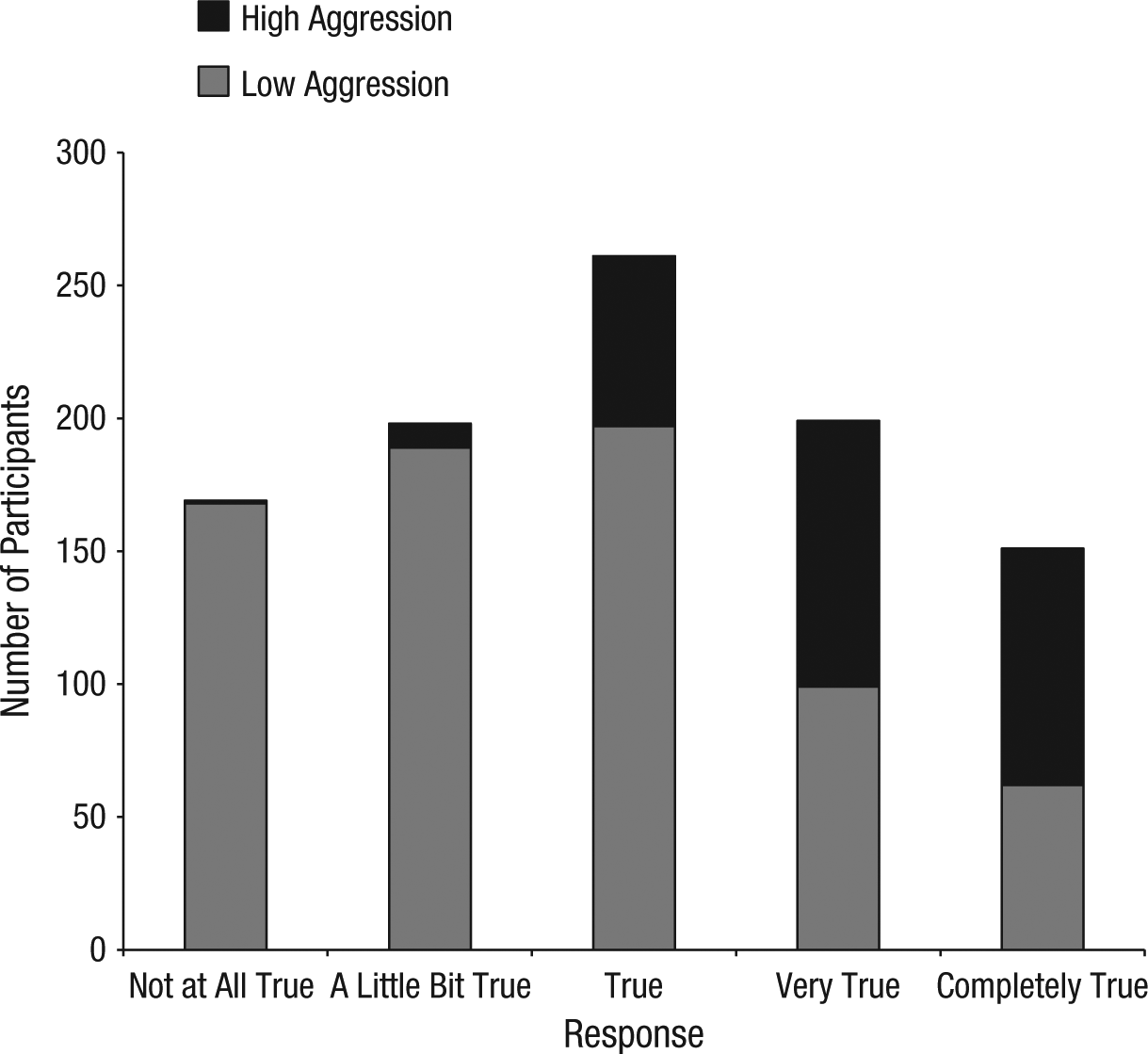
Distribution of responses to the question, “When I look at this baby, I feel like I am overwhelmed by very strong positive feelings,” among participants in Studies 1 and 2 who reported high and low levels of aggression in response to infant stimuli. Scores above 50.000 were classified as high; scores at or below 50.000 were classified as low.
Discussion
Our hypothesis that there are two distinct expressions arising from a single stimulus, a singular positive appraisal and a singular emotional response, was supported. It has long been established that infantile characteristics spur caretaking behaviors in adults (Lorenz, 1943). We found such care expressions in our investigation, and it follows that caretakers’ expressions of caring serve the well-being of infants (e.g., Lorenz, 1971). We also found expressions of aggression, and we presume that these expressions may help regulate emotion and support the immediate well-being of the caretaker.
General Discussion
In the present research, we illustrated the pathways through which dimorphous expressions arise and the possible function of such expressions (Levenson, 1994) as regulators of emotion. Dimorphous expressions may arise to regulate positive emotions because (a) people have less experience suppressing positive than negative emotions (Oishi, Diener, & Lucas, 2007; Wegener & Petty, 1994), (b) people might not be motivated to cognitively reappraise positive events (i.e., rethink them in negative ways), and (c) even though removing themselves from a positive situation is an effective strategy to regulate strong positive emotions (Nezlek & Kuppens, 2008), people may not be able to do so at all times, such as when taking care of a child. Exactly how these emotions are regulated through the expression of a second expression will need to be explored in future research. Perhaps dimorphous displays of emotion reflect the onset of a second emotion that arises to tamp down the original overwhelming emotion, or perhaps dimorphous expressions elicit physiological shifts away from intense positive emotions through afferent facial or postural feedback (e.g., Strack, Martin, & Stepper, 1988).
Additionally, perhaps people who feel positive express negativity to give important events the appropriate gravitas (Baumeister, Bratslavsky, Finkenauer, & Vohs, 2001), or maybe a dimorphous expression serves as a social signal to other people that the expresser is overwhelmed or incapacitated (Clark, Pataki, & Carver, 1996; Kappas, 2013; Smith, Mahler, Peciña, & Berridgem, 2010).
We defined and tested a model of dimorphous emotional expression—that is, the expression of negativity when one feels overwhelming positivity. We found that individuals who express positive emotions in this dimorphous manner do so across a variety of emotionally provoking situations. We used cute stimuli (an elicitor of positive emotion) to illustrate the existence of these dimorphous expressions, as well as to provide preliminary evidence of their possible function as regulators of emotion.
Footnotes
Acknowledgements
We thank Paul Bloom for feedback on the early theoretical framework of dimorphous expressions. We also thank Lindsay Davis and Chelcie Piasio for their assistance in the studies reported in Sections S2, S7, and S8 in the Supplemental Material available online.
Declaration of Conflicting Interests
The authors declared that they had no conflicts of interest with respect to their authorship or the publication of this article.

Notes
References
Supplementary Material
Please find the following supplemental material available below.
For Open Access articles published under a Creative Commons License, all supplemental material carries the same license as the article it is associated with.
For non-Open Access articles published, all supplemental material carries a non-exclusive license, and permission requests for re-use of supplemental material or any part of supplemental material shall be sent directly to the copyright owner as specified in the copyright notice associated with the article.
