




Abstract
Religiosity and participation in religious activities have been linked with decreased risky behavior. In the current research, we hypothesized that exposure to the concept of God can actually increase people’s willingness to engage in certain types of risks. Across seven studies, reminders of God increased risk taking in nonmoral domains. This effect was mediated by the perceived danger of a risky option and emerged more strongly among individuals who perceive God as a reliable source of safety and protection than among those who do not. Moreover, in an eighth study, when participants were first reminded of God and then took a risk that produced negative consequences (i.e., when divine protection failed to materialize), participants reported feeling more negatively toward God than did participants in the same situation who were not first reminded of God. This research contributes to an understanding of the divergent effects that distinct components of religion can exert on behavior.
Behavior-modification programs—such as 12-step addiction rehabilitation programs—routinely invoke God and religion to help people reduce or eliminate risky behaviors (Cain, 1991; Ferdinand, 1997; Holt et al., 2009; Kurtz, 1980; Wingood, Simpson-Robinson, Braxton, & Raiford, 2011). The wisdom of this strategy has empirical support: Religiosity and participation in religious activities are indeed associated with decreased risk taking (e.g., Arnett, 1998; Noussair, Trautmann, van de Kuilen, & Vellekoop, 2013; Steinman & Zimmerman, 2004), and exposure to religious references can decrease risky behaviors, such as substance abuse (Marsiglia, Kulis, Nieri, & Parsai, 2005; Wallace & Bachman, 1991), speeding (Arnett, 1998), and gambling (Hoffmann, 2000). Here, we propose that references to God can have the opposite effect and instead increase the tendency to take certain types of risks.
God is commonly viewed as a source of security; for instance, religious texts represent God as an entity that can protect individuals from harm and danger (e.g., Isaiah 43:1; Psalm 27:1–3; The Qur’an 4:45). Furthermore, people treat God as an attachment figure (Kirkpatrick & Shaver, 1992) and turn to God when they experience trauma (Park, 2005), illness (Feher & Maly, 1999; Ironson, Stuetzle, & Fletcher, 2006), and romantic rejection (Laurin, Schumann, & Holmes, 2014). These effects occur among both believers and nonbelievers, perhaps because broad cultural notions of God primarily represent God as a source of security. Although some conceptions of God portray both a punitive side and a protective side, people endorse the latter more strongly than the former (e.g., Lawrence, 1997; Shariff & Norenzayan, 2011; Shariff & Rhemtulla, 2012).
Feelings of security can reduce people’s perceptions of the likelihood and severity of a risky behavior’s potential negative outcomes, which increases their willingness to engage in that behavior (Fishbein & Ajzen, 1975; cf. Loewenstein, Weber, Hsee, & Welch, 2001). Indeed, children with secure attachment styles are more likely to explore unfamiliar environments, presumably because their secure attachment fosters the perception that they will be protected in the event of negative consequences, which makes the environment seem less dangerous (Ainsworth, Blehar, Waters, & Wall, 1978; Harlow, 1958). Even minimal physical contact with a stranger can induce feelings of security that increase risk taking (Levav & Argo, 2010).
We predicted that the association between the concept of God and feelings of security would lead people who are reminded of God to view risky behavior as less dangerous than they otherwise would, which in turn would increase their willingness to take risks. Although our hypothesis appears incompatible with evidence that religious references decrease risk taking, previous work has focused on risky behaviors typically considered immoral (e.g., gambling, drug use), and God primes have been shown to decrease immoral behavior in general (Mazar, Amir, & Ariely, 2008; Shariff & Norenzayan, 2011; Shariff & Rhemtulla, 2012). Here, we explored how reminders of God influence risky behaviors that carry no moral implications (e.g., skydiving). For these types of behaviors, we predicted that the perception of God as a source of security would reduce perceptions of risk and, consequently, increase risk taking.
A recent article provides preliminary evidence consistent with our hypotheses. Chan, Tong, and Tan (2014) found that reminders of God increased risk taking on the Balloon Analogue Risk Task (BART), a measure of risk-taking behavior. However, Chan and colleagues found that participants’ risk-taking tendency reversed when the BART was framed as an immoral task. We provide conceptual replications of these findings using more varied manipulations and a broader set of ecologically valid risky behaviors, but, more important, we offer a fundamentally different theoretical explanation for why reminders of God increase amoral risk taking. In particular, Chan and colleagues’ account locates perceived agency within the individual: They propose that reminders of God increase risk taking by heightening feelings of personal control. In contrast, our account locates perceived agency within God: We propose that reminders of God make participants feel safe and protected in the hands of an external agent. In providing evidence for our account, we also reveal novel mediators, moderators, and downstream consequences of the effect of reminders of God on risk taking.
Overview
Studies 1a through 1d tested whether subtle reminders of God increase individuals’ willingness to take risks that have no moral connotations. Study 2 tested whether reminders of God increase nonmoral risk taking but inhibit immoral risk taking. Studies 3 and 4 examined the mechanism underlying the effect of God on risk taking. Study 5 provided further evidence for this mechanism and demonstrated its downstream consequences.
Studies 1a Through 1d
In Studies 1a through 1d, we tested our hypothesis that reminders of God increase risk taking.
Method
Participants
We recruited all participants from Amazon’s Mechanical Turk (MTurk). 1 Sixty-one adults (mean age = 23.3 years; 50% male, 50% female) participated in Study 1a, 202 (mean age = 28.3 years; 68.8% male, 31.2% female) participated in Study 1b, 104 (mean age = 31.4 years; 64.4% male, 35.6% female) participated in Study 1c, and 136 (mean age = 34.2 years; 55.8% male, 44.2% female) participated in Study 1d. We obtained these participants by posting 60 (Study 1a), 200 (Study 1b), 100 (Study 1c), and 150 (Study 1d) surveys (known as human intelligence tasks, or HITs), each of which could be completed by 1 participant. 2
Manipulations
Participants in Studies 1a through 1c completed a scrambled-sentence priming task in which they constructed 10 four-word sentences using 10 sets of five words each. We randomly assigned participants to two conditions: In the God condition, half of the word sets included a word conceptually related to God (e.g., “spirit,” “divine”); in the control condition, all of the words were neutral (Shariff & Norenzayan, 2007; see the Supplemental Material available online for full materials).
In Study 1d, we used a manipulation designed to remind participants of the concept of God more directly, rather than the scrambled-sentence task that may have reminded them of other religious elements as well. Participants in the God condition read a short paragraph about God; participants in the control condition read a short paragraph about a non-God-related topic (both paragraphs taken from Wikipedia; for a similar approach, see Laurin, Kay, & Fitzsimons, 2012; see the Supplemental Material for materials).
Dependent measures and results
Study 1a
Our dependent measure in Study 1a was the Domain-Specific Risk-Taking scale (Weber, Blais, & Betz, 2002), a self-report measure assessing the likelihood that participants would engage in each of 40 risky behaviors across multiple domains (α = .90). The questionnaire was framed as an unrelated study. 3 Participants indicated how likely they would be to take each risk (1 = very unlikely, 5 = very likely). As predicted, participants in the God condition reported a higher propensity to take risks (M = 2.61, SD = 0.53) compared with participants in the control condition (M = 2.32, SD = 0.48), t(59) = 2.21, p = .031, Cohen’s d = 0.574 (see the Supplemental Material for further analysis and the results of a related follow-up test).
Study 1b
In Study 1b, we examined whether priming God would increase individuals’ willingness to take a risk that they had considered taking in the past. Specifically, participants first described a recreational risk that they had been considering taking (all participants successfully generated a risk). Following the scrambled-sentence manipulation, which we described as an unrelated survey, participants returned to their own description of the recreational risk and answered the question, “What is the likelihood that you will take this risk in the next month?” (1 = extremely unlikely, 7 = extremely likely). Participants in the God condition reported a greater likelihood that they would take the recreational risk (M = 3.38, SD = 1.90) than did participants in the control condition (M = 2.77, SD = 1.88), t(200) = 2.27, p = .024, Cohen’s d = 0.323. These results converge with the results of Study 1a, which suggests that priming the concept of God can increase individuals’ willingness to take risks.
Study 1c
In Study 1c, we used a behavioral measure to capture participants’ interest in risk taking. We gave participants the opportunity to read about skydiving, a high-stakes risk. Participants saw a list of six topics about going skydiving and could choose to read about as many topics as they wanted. (See the Supplemental Material for the full list of topics, as well as for the results of a pilot test confirming that the number of topics selected reflects greater interest in skydiving, not greater anxiety about the prospect of skydiving.) Thus, Study 1c enabled us to test whether reminders of God would change participants’ risk-related behavior. At the end of the survey, participants reported whether they had skydived before.
Participants in the God condition chose a greater number of topics (M = 1.56, SD = 1.97) than participants in the control condition (M = 0.84, SD = 1.17), t(98) = 2.22, p = .029, Cohen’s d = 0.444. 4 In conjunction with the results of the pilot test, these findings suggest that reminders of God increase participants’ interest in engaging in a risky behavior.
Study 1d
Study 1d aimed to replicate the findings of Studies 1a through 1c using a risky decision with real consequences in a different, nonrecreational context. Following the God manipulation, participants chose between two options for their final task. Option 1—the risky option—involved looking at extremely bright colors; we warned participants that this carried the risk of damage to their eyes, and in extreme cases could cause macular degeneration. Selecting this option required participants to sign a virtual waiver indicating that they were over 18 years old and aware of its risks. Option 2 involved looking at darker colors that posed no risk; however, participants were told that this task was 2 min longer. Finally, they were told that if they selected Option 1, they would receive a 25¢ bonus (see Fig. 1). In reality, both options were safe. Participants selected and completed the task of their choice.
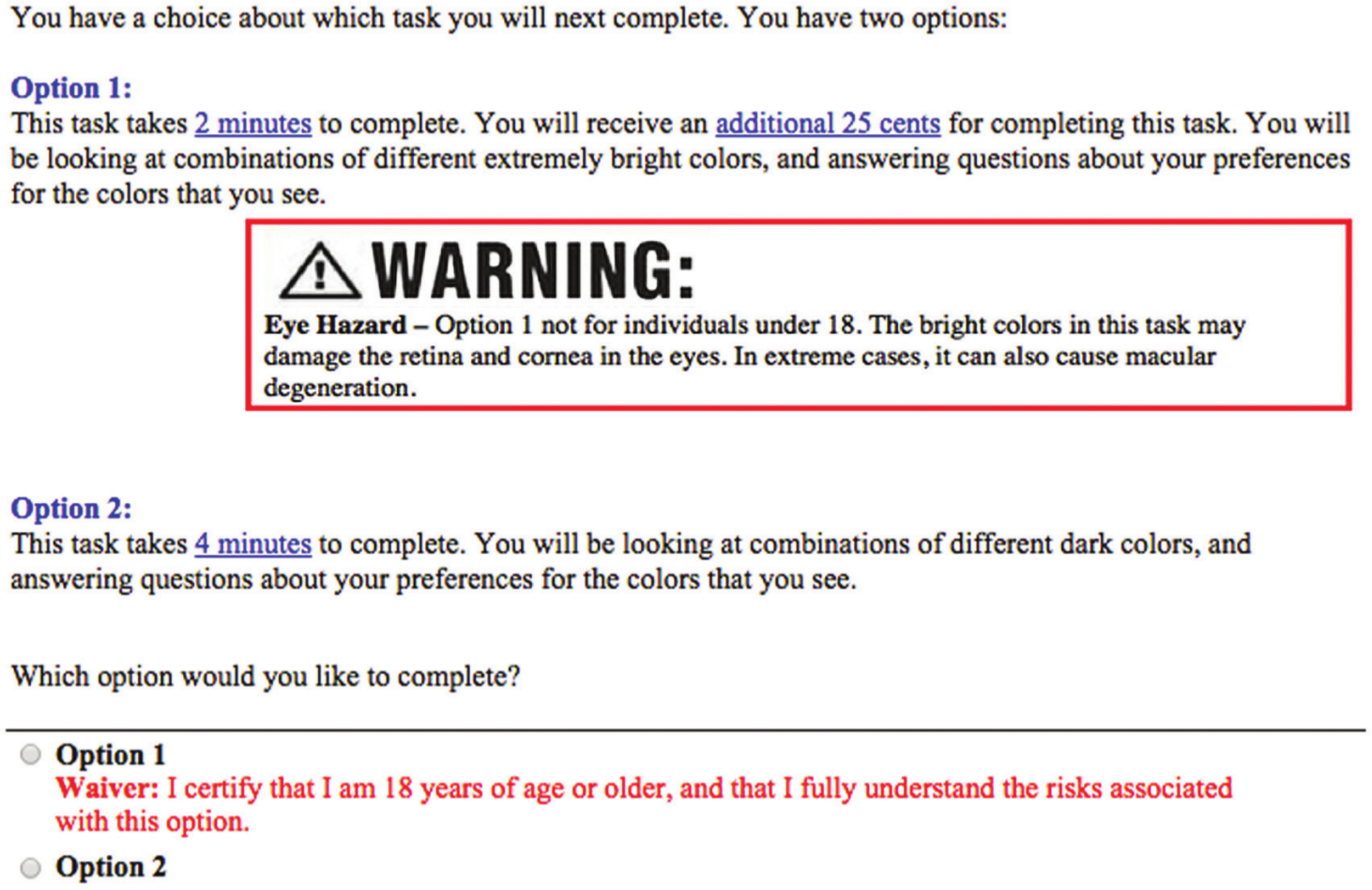
Screenshot of the options given to participants in Study 1d. Option 1 took less time than Option 2 but was risky. Option 2 took more time but was not risky. Participants were required to certify their age and acknowledge the risk in order to proceed only if they chose Option 1.
Participants in the God condition chose the risky task more often (95.5%) than did participants in the control condition (84.3%), χ2(1, N = 136) = 4.59, p = .032. Overall, most participants chose to engage in this risk, likely because the payoffs for doing so were relatively large in the context of an MTurk study and because they read that, as with many risks, the most severe consequences occurred only in extreme cases. It is noteworthy that we found our effect even though the baseline willingness to accept the risk was high in the control condition.
Discussion
Studies 1a through 1d provided consistent evidence that reminders of God increase individuals’ intended and actual risk taking. We designed Study 2 to reconcile our findings with the existing literature on religion and immoral risk taking.
Study 2
Study 2 was a field experiment in which we posted ads to a social-networking Web site and recorded click-through rates. In this naturalistic setting, individuals were unaware that their behavior was being studied and thus had no reason to click unless they wanted to learn more about engaging in the advertised activity. We predicted that making God salient would increase interest (i.e., clicks) in nonmoral risks, decrease interest in immoral risks, and have no effect on interest in neutral behavior.
Method
We launched six advertisements for 1 day each on a social-networking Web site in a 2 (God vs. no God) × 3 (immoral risk vs. nonmoral risk vs. no risk) design. The ads ran 452,051 times on accounts registered to users over 18 years of age residing in the United States. The immoral-risk ad encouraged users to “learn how to bribe,” the nonmoral-risk ad encouraged users to “find skydiving near you,” and the no-risk ad encouraged users to “find amazing video games.” We expected that the relevance of risk to skydiving would be self-evident, but we emphasized the risky nature of engaging in bribery to ensure we were capturing risk-relevant behavior (see Fig. 2). We subtly manipulated the salience of God by stating either “God knows what you’re missing!” or “You don’t know what you’re missing!” at the beginning of each ad.
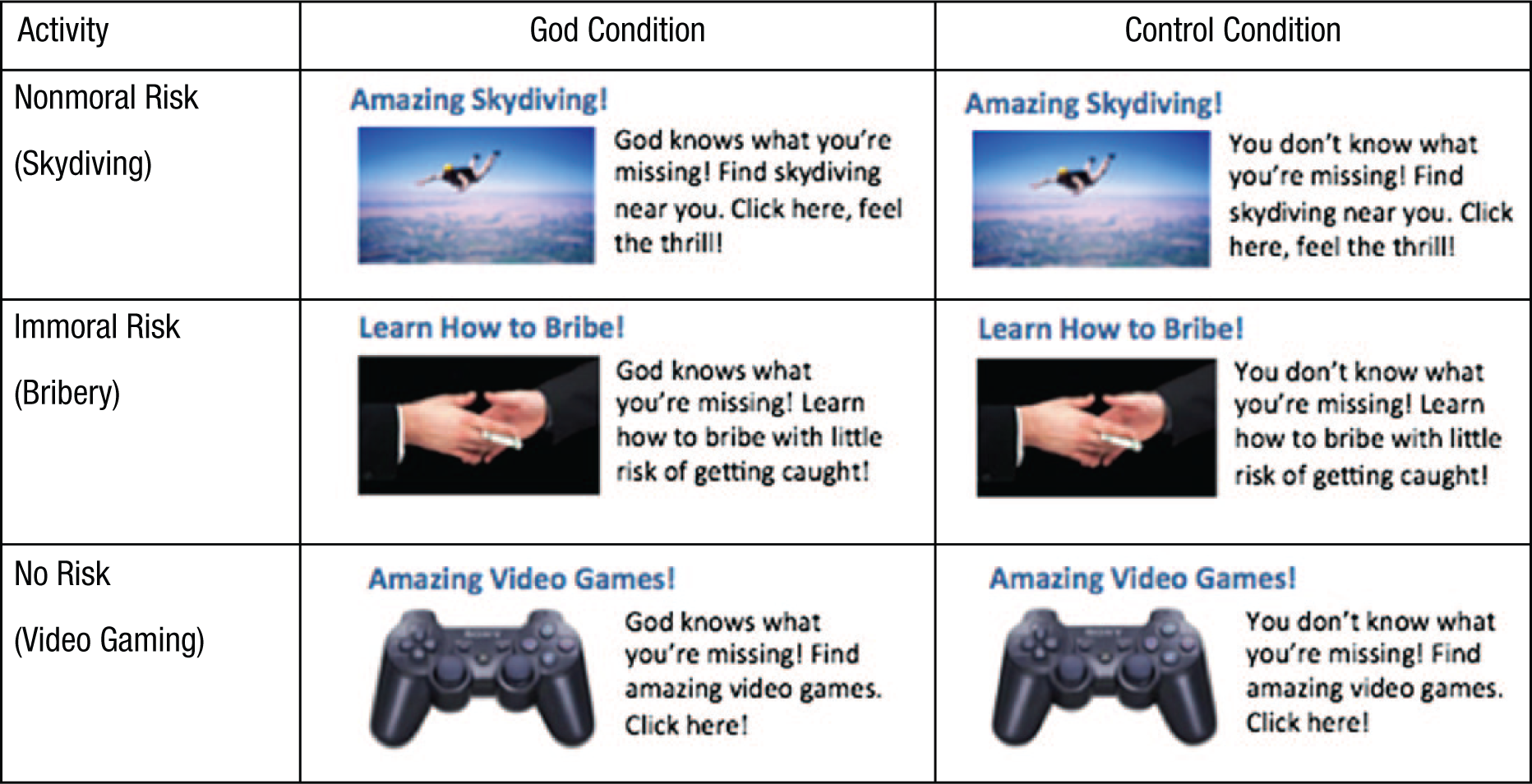
Ads shown in Study 2. Each ad encouraged readers to click to find out more about one of three types of activities, and ads were run with and without primes reminding participants about God.
Results
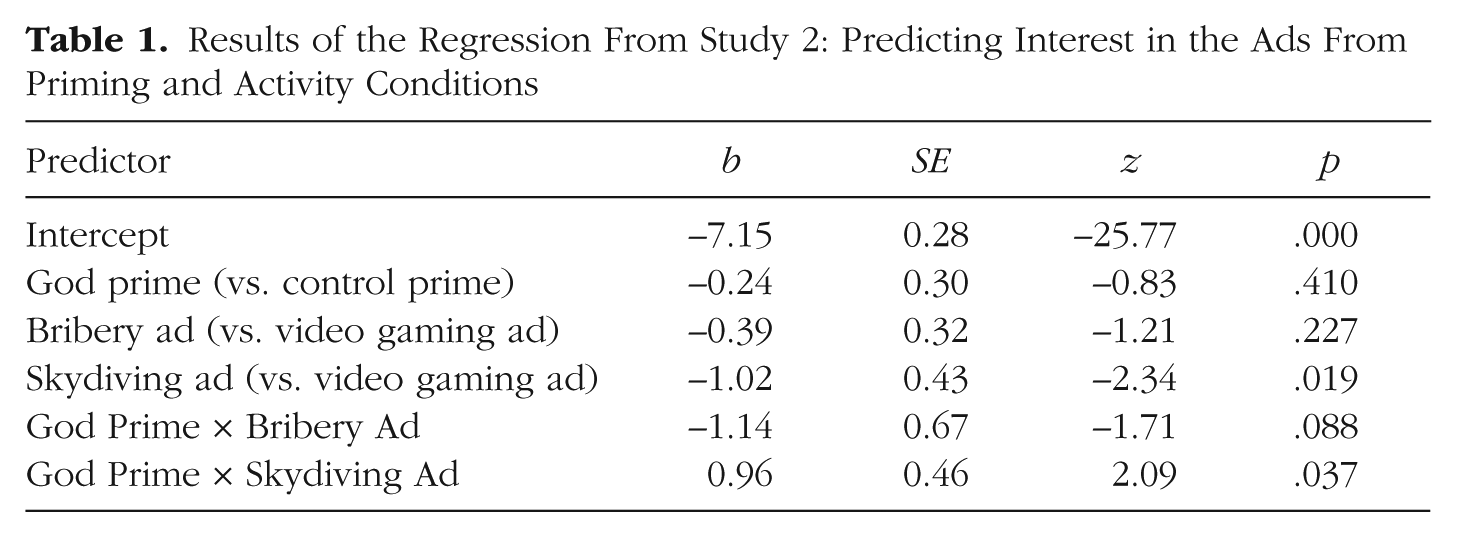
We computed a binary logistic regression model to predict clicking behavior using priming condition (God = 1, control = 0), activity condition (dummy coded with video games as the comparison condition), and Priming Condition × Activity interaction terms for each of the dummy-coded activity variables. This model explained significantly more variance than a model excluding the interaction terms, χ2(2, N = 452,051) = 13.61, p < .001 (Table 1 and Fig. 3). When God was salient, compared with when God was not salient, individuals clicked more often on the ad for the nonmoral risk (skydiving; b = 0.71, z = 2.04, p = .041) but less often on the ad for the immoral risk (bribery; b = -1.39, z = -2.31, p = .021). They clicked equally often on the no-risk (video game) ad regardless of God’s salience (b = -0.24, z = -0.83, p = .410). Figure 3 reports click-through rates as a function of ad type and priming condition; although the overall rates appear low, they approximate rates observed in previous research (e.g., Tormala, Jia, & Norton, 2012).
Results of the Regression From Study 2: Predicting Interest in the Ads From Priming and Activity Conditions
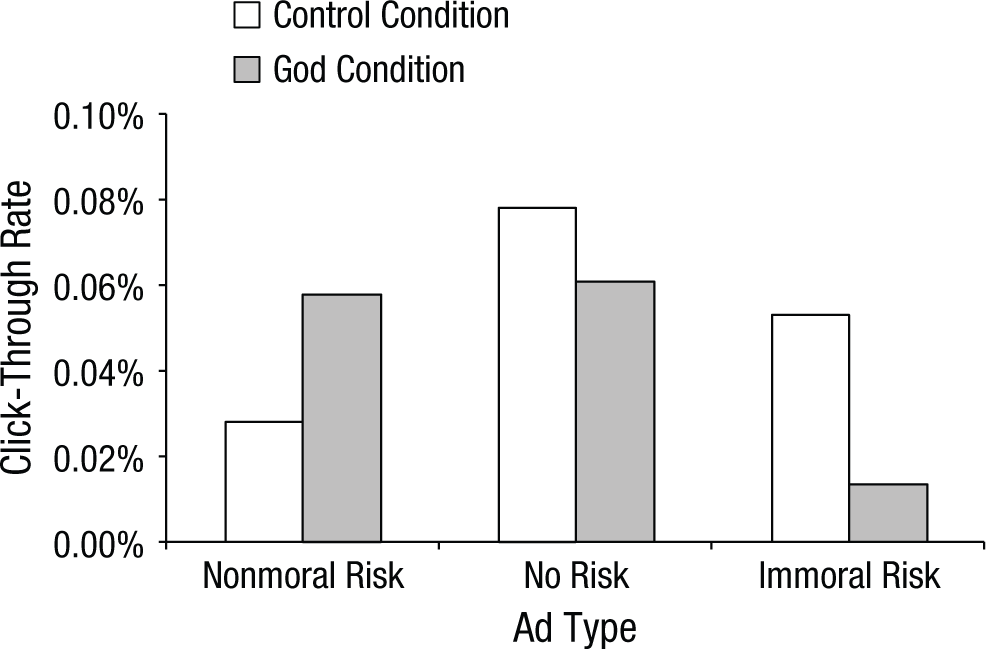
Results from Study 2: mean click-through rate as a function of ad type and priming condition.
Discussion
This study provided additional behavioral evidence that reminders of God—even when evoked by a simple colloquial expression—increase individuals’ interest in taking nonmoral risks. Moreover, these results help reconcile our findings with existing literature linking religion to risk taking: Reminders of God may decrease immoral risk taking but increase nonmoral risk taking.
Study 3
Across five studies, priming God increased people’s willingness to take nonmoral risks. In Study 3, we tested our hypothesis that this effect occurs because reminders of God lead individuals to perceive themselves as protected—that is, that the risks present less danger.
Method
One hundred one participants (mean age = 31.4 years; 64.4% male, 35.6% female) completed this study. We obtained these participants by posting 100 HITs on MTurk. We randomly assigned participants to either the God condition or the control condition from Study 1d. In an ostensibly unrelated survey, participants read three scenarios that each described a risky decision (motorcycling without a helmet, wilderness camping, and backcountry skiing; see the Supplemental Material). After reading each scenario, participants completed three items assessing their perceptions of danger: “If you did [e.g., go wilderness camping], what is the likelihood that you will get injured?” (1 = extremely unlikely, 7 = extremely likely), “If you did get injured while [e.g., wilderness camping], how serious do you think the injury would be?” (1 = not serious at all, 7 = extremely serious), and “If you did get injured while [e.g., wilderness camping], how well would you be able to cope with the injury?” (1 = not well at all, 7 = extremely well; reverse coded). We created an index of the nine subjective-danger-perception items (with higher scores representing more perceived danger; α = .71). Finally, participants reported how willing they would be to take each risk (1 = not likely at all, 7 = extremely likely), which yielded an index of risk taking (α = .60).
Results
The results of a linear mixed model that included scenario (three levels, dummy coded), condition, and the terms representing their interaction did not differ from the results of the model without the interaction, χ2(2, N = 101) = 1.24, p = .539, which indicates that scenario did not moderate the effect of condition. We therefore collapsed our analyses across the three risky scenarios.
Our primary analysis tested the indirect effect (Hayes, 2013) using willingness to take risks as the dependent variable, priming condition (God = 1, control = 0) as the independent variable, and perceived risk as the mediating variable—this test confirmed our predictions. Specifically, participants in the God condition reported a higher willingness to take risks, b = 0.61, t(99) = 2.29, p = .024, and also perceived less danger associated with these risks, b = −0.44, t(99) = −2.97, p = .004, than did participants in the control condition. When the effects of God condition and perceived danger were both included in the model, the indirect effect (i.e., through the mediator) was significant (95% confidence interval, or CI = [0.12, 0.64]), whereas the direct effect (i.e., the effect of condition independent of the mediator) was not significant, b = 0.28, t(98) = 1.12, p = .267 (see Fig. 4; see the Supplemental Material for similar results treating each item in the perceived-danger composite individually).
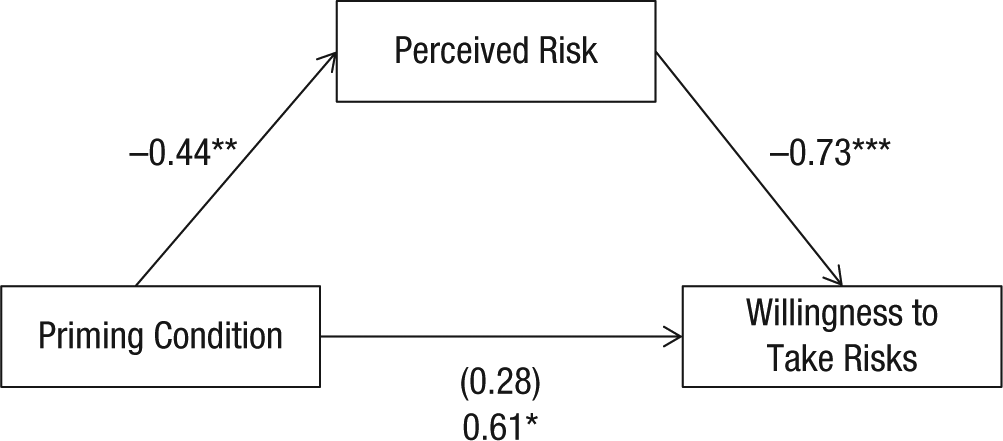
Results from Study 3: mediation model showing the influence of priming condition (God vs. control) on willingness to take risks, as mediated by perceived risk. On the bottom path, the value outside parentheses reflects the direct effect, and the value inside parentheses reflects the effect of condition on willingness to take risks, controlling for the mediator. Unstandardized coefficients are shown. Asterisks indicate significant paths (*p < .05, **p < .01, ***p < .001).
Discussion
In Study 3, reminders of God increased willingness to take risks because they evoked a feeling of safety from potential harm. Although this study did not directly measure whether reminders of God increase the salience of protective conceptions of God, the observed effects on perceived risk are consistent with that account. We tested this possibility more directly in Study 4.
Study 4
We have argued that our effect arises because reminders of God make people feel protected and safe. If this is the case, people who view God as a source of security should be most likely to take risks in response to reminders of God. Additional analyses (see the Supplemental Material) found no evidence that our findings thus far were moderated by whether or not individuals reported believing in God. Researchers have long speculated that such binary measures not only fail to meaningfully capture individuals’ multidimensional and nuanced beliefs regarding God, but also fail to distinguish true nonbelievers from believers (for a discussion, see Laurin et al., 2012). Therefore, in Study 4, we used a more targeted measure assessing the dimension of belief that we predicted to be relevant to the current effect—attachment security. Individuals who are more securely attached to God perceive God as a better source of security and protection (Kirkpatrick & Shaver, 1992). We predicted that participants who are reminded of their attachment to God, rather than simply of the concept of God, should be more willing to take risks only if they are securely attached to God.
Method
Ninety-eight participants (mean age = 32.9 years; 40.0% male, 60.0% female) completed this study. We obtained these participants by posting HITs on MTurk for 100 participants. As in Study 1b, participants first described a recreational risk they were considering taking. Participants then completed three tasks: a six-item attachment measure assessing the security of their attachment to God (e.g., “God knows when I need support”; α = .97; Rowatt & Kirkpatrick, 2002), six demographic questions, and a measure assessing the likelihood that they would take their previously described risk in the next month (1 = extremely unlikely, 7 = extremely likely).
We randomly varied the order of these tasks such that some participants reported their attachment security before they answered the risk-likelihood question, whereas others reported their attachment security after answering this question. Specifically, participants in the salient condition first completed the six-item God-security scale, followed by the likelihood measure, and finally the six demographics questions. This order ensured that these participants’ explicit beliefs about God as a source of security were made salient before they indicated their likelihood of taking the risk. Participants in the nonsalient condition answered the demographics questions first, followed by the likelihood measure, and finally the God-security scale. In other words, these participants indicated their likelihood of taking the risk before thinking about their explicit beliefs about God as a source of security. Thus, rather than simply reminding participants of the concept of God (as we did in the previous studies), in this study, participants in the salient condition were reminded of their explicit beliefs about God as a source of security. We predicted that only participants in the salient (vs. nonsalient) condition who had a secure attachment to God would show an increased willingness to take a self-identified risk; participants who did not indicate a secure attachment to God would show no effect of condition.
Results and discussion
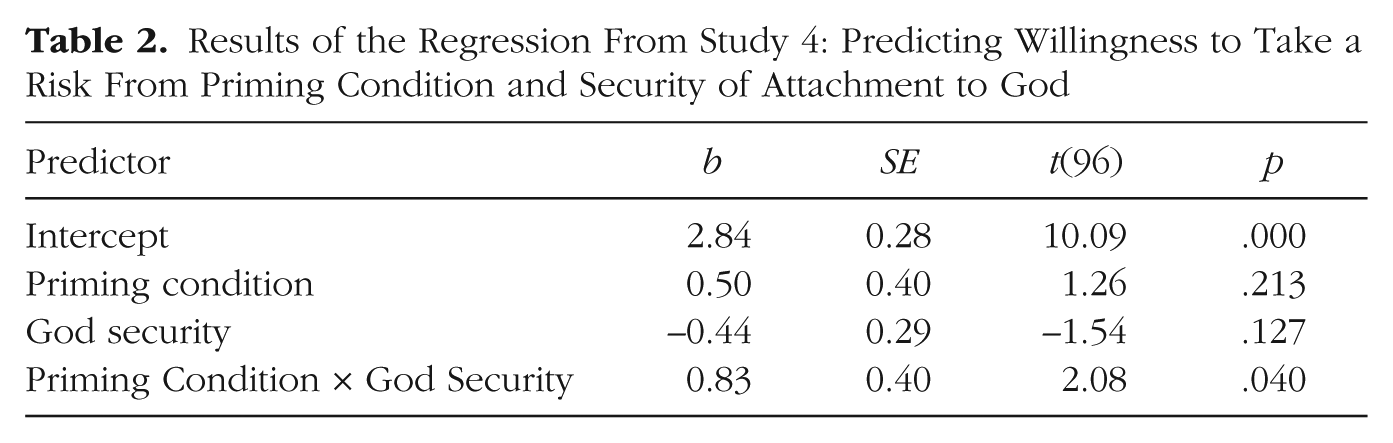
We regressed participants’ willingness to take their self-identified risk on priming condition (nonsalient = 0, salient = 1), scores on the God-security measure (mean-centered), and their interaction. This analysis revealed only a significant interaction, b = 0.83, t(96) = 2.08, p = .040 (see Table 2), which we decomposed using a spotlight analysis (Aiken & West, 1991). At 1 standard deviation above the mean of the God-security measure, participants in the salient condition were more likely to take the recreational risk than were participants in the nonsalient condition, b = 2.17, t(96) = 2.42, p = .017. At 1 standard deviation below the mean of the God-security measure, there was no effect of condition, b = −1.17, t(96) = −1.30, p = .196 (Fig. 5).
Results of the Regression From Study 4: Predicting Willingness to Take a Risk From Priming Condition and Security of Attachment to God
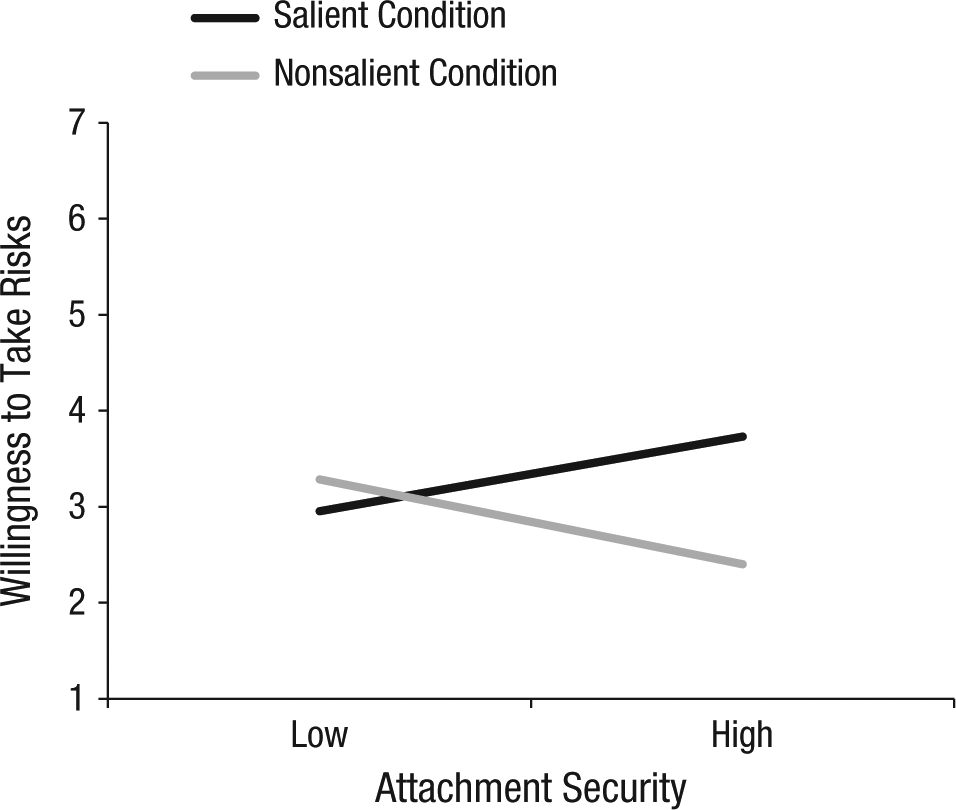
Results from Study 4: mean willingness to take a risk as a function of security of attachment to God and priming condition. For God security, high and low refer to levels 1 standard deviation above and below the mean, respectively.
Scores on the God-security measure were positively, but not significantly, associated with risk taking in the salient condition, b = 0.39, t(96) = 1.40, p = .166; unexpectedly, this trend was reversed in the nonsalient condition, b = −0.44, t(96) = −1.54, p = .127. The first of these effects fits with our theorizing: Among participants reminded of God, those who felt more securely attached reported greater willingness to take a risk. The second is more difficult to interpret, but we speculate that a secure attachment to God may be linked to other chronic religious traits that decrease risk taking (e.g., Arnett, 1998; Noussair et al., 2013). In sum, Study 4 showed that, consistent with our hypothesis that reminders of God increase risk taking by increasing the expectation of safety and security, reminders of God increased risk taking only when individuals perceived God to be a reliable source of protection.
Study 5
Across seven studies, reminders of God increased nonmoral risk taking. If this increased risk taking occurred because reminders of God give people a sense of divine protection, then people reminded of God (vs. not reminded of God) might feel more negatively toward God after taking a risk that leads to a negative outcome. In Study 5, all participants experienced a negative outcome from taking a risk. We predicted that those who had been reminded of God prior to taking the risk would express more negative feelings toward God compared with control participants. Such results would provide further evidence consistent with the idea that reminders of God give people a sense that they will be protected.
Method
One hundred eighty-seven participants (mean age = 33.9 years; 55.2% male, 44.8% female) completed this study. We obtained these participants by posting 200 HITs on MTurk. We randomly assigned participants to either the God condition or the control condition from Study 1d (see the Supplemental Material for materials). Next, in an ostensibly unrelated study, participants engaged in a risky-decision task. Specifically, in an adapted version of the BART (Lejuez et al., 2002), participants read that they would inflate a virtual balloon and that each pump would earn them more money. They further learned that they could choose to stop the task and collect the money they accumulated at any time, but that every pump ran the risk of causing the balloon to explode, in which case they would lose all of the money they had accumulated.
Unbeknownst to participants, the balloon was programmed to pop after the second pump. We designed the parameters of the task, though, in such a way as to encourage participants to pump: Participants were told that they would accumulate 75¢ (i.e., nearly twice the study’s 40¢ baseline pay) for every pump, and the instructions (printed in boldface) informed them that, on average, the balloon popped around the fourth or fifth pump. As a result, we expected that all participants, whether primed with the concept of God or not, would pump at least twice. We would therefore be left with a sample of participants, some primed with God and some not, who had all made a risky decision and suffered a negative consequence as a result. 5
After participants’ balloon exploded and they lost the money that they had accumulated, they reported their feelings toward God. Specifically, participants indicated the extent to which they trusted God, felt neglected by God (reverse scored), felt close to God, felt angry at God (reverse scored), felt that God was with them, felt resentment toward God (reverse scored), and felt cared for by God (1 = not at all, 7 = very much; α = .84).
We predicted that participants who had first been reminded of God would report more negative feelings toward God, compared with participants who had not first been reminded of God. Such a result would suggest that participants primed with God anticipated some degree of divine protection when inflating the balloon, and thus felt upset with God when that protection did not materialize. However, an alternative interpretation might be that when participants felt upset following the loss of their money, they transferred that negative emotion onto whatever other constructs they had activated at that time (i.e., God). To rule out this alternative interpretation, we included a second pair of conditions, in which we manipulated reminders of dentists (see the Supplemental Material for materials), and measured participants’ attitudes toward their dentist, following the same risk task.
To summarize, participants were randomly assigned to one cell in a 2 (target: God vs. non-God) × 2 (prime: target vs. control) design. We predicted a significant interaction, whereby participants primed with God would experience more negative attitudes toward God after the failed risk than participants not primed with God, but that participants both primed and not primed with the concept of dentists would experience equivalent attitudes toward dentists after the failed risk task.
Results
A 2 (target: God vs. non-God) × 2 (prime: target vs. control) analysis of variance on feelings toward the target revealed a significant interaction, F(1, 164) = 6.99, p = .009. Following a negative outcome sustained because of a risky behavior, participants who had previously been primed with the concept of God experienced more negative feelings toward God (M = 4.16, SD = 1.28) than participants who had not been primed with God (M = 5.09, SD = 1.48), F(1, 164) = 12.48, p = .001, Cohen’s d = 0.671. However, participants reported the same feelings toward dentists regardless of whether or not they had been primed with the concept of dentists (dentist prime: M = 4.34, SD = 1.00; no dentist prime: M = 4.29, SD = 0.91), F(1, 164) = 0.03, p = .859, Cohen’s d = 0.052.
Discussion
The results of Study 5 support our contention that reminders of God lead people to feel protected by God from negative outcomes. These findings carry significant practical implications: Negative affect toward God is associated with a wide range of negative outcomes, including increased anxiety, depressive affect, poor coping, and in the long run, even increased mortality (Exline & Rose, 2005; Exline, Yali, & Lobel, 1999; Pargament, Koenig, Tarakeshwar, & Hahn, 2001; Pargament et al., 1998). Crucially, these results also support our account that reminders of God evoke the idea of God as a protective agent (such that perceived agency is located within God) and cannot readily be explained by the idea that reminders of God increase feelings of personal control (such that perceived agency is located within the individual, as suggested by Chan et al., 2014).
General Discussion
The results of seven studies indicate that reminders of God increase risk taking in nonmoral domains. This effect emerged across a range of risks and using several different types of reminders of God. In all these studies, as well as in our final and eighth study, we found evidence that the salience of God increases risk taking by making people feel safe and protected from harm.
Our findings may seem surprising given the substantial evidence that both religiosity and religious participation are associated with decreased risk taking (e.g., Arnett, 1998; Steinman & Zimmerman, 2004). However, because many of the previously studied risky behaviors have ethical implications, prior findings may have emerged because reminders of God decrease unethical behavior (Shariff & Norenzayan, 2011). Indeed, in Study 2, reminders of God increased interest in nonmoral risks while decreasing interest in immoral risks. Our data—most notably in Studies 3 through 5—suggest that reminders of God increase nonmoral risk taking because of people’s spontaneous associations of God as a protector (see also Lawrence, 1997).
Although our findings contrast with established wisdom on the relationship between religion and risk taking, they are consistent with those reported in a recent article providing preliminary evidence regarding risk taking following reminders of God (Chan et al., 2014). We provided multiple independent conceptual replications consistent with Chan and colleagues’ findings using more varied manipulations and a broader set of ecologically valid risky behaviors. Our results also extend these findings in numerous ways. Most important, we illuminated the underlying role of feelings of protection and safety in driving the effect of reminders of God on risk taking. Our account, whereby people reminded of God feel protected, stands in direct contrast to the account of Chan and colleagues, who propose that reminders of God make people feel greater personal control over their own fates. Indeed, our theoretical position locates perceived agency in God, whereas Chan et al.’s locates perceived agency in the individual. Moreover, we present the first evidence that reminders of God systematically shape individuals’ perceptions of the dangers inherent in risks. We also provide novel insight into the shift in feelings toward God that can occur when individuals who are reminded of God’s protective powers experience negative outcomes from a risky behavior. Furthermore, we found that the effects of these reminders depend heavily on the security of participants’ attachment to God.
One unexplored additional implication of our account is that the effect we have documented may not emerge in cultures in which God is not perceived as a protector. For example, in Christian subcultures that portray God primarily as a punishing force (e.g., with sermons emphasizing “fire and brimstone” messages), individuals may associate God with punishment more than security, which might eliminate the effect we observed. Similarly, our effect may not occur in societies in which gods are represented as less able to provide protection (Slingerland, Henrich, & Norenzayan, 2013).
References to God pervade daily life; indeed, the word “God” is one of the most common nouns in the English language (Wiktionary, 2013). The research reported here suggests that these frequent reminders can shape people’s risk perceptions and influence their likelihood of engaging in potentially dangerous behaviors.
Footnotes

References
Supplementary Material
Please find the following supplemental material available below.
For Open Access articles published under a Creative Commons License, all supplemental material carries the same license as the article it is associated with.
For non-Open Access articles published, all supplemental material carries a non-exclusive license, and permission requests for re-use of supplemental material or any part of supplemental material shall be sent directly to the copyright owner as specified in the copyright notice associated with the article.
