



Abstract
People engage in self-promotional behavior because they want others to hold favorable images of them. Self-promotion, however, entails a trade-off between conveying one’s positive attributes and being seen as bragging. We propose that people get this trade-off wrong because they erroneously project their own feelings onto their interaction partners. As a consequence, people overestimate the extent to which recipients of their self-promotion will feel proud of and happy for them, and underestimate the extent to which recipients will feel annoyed (Experiments 1 and 2). Because people tend to promote themselves excessively when trying to make a favorable impression on others, such efforts often backfire, causing targets of self-promotion to view self-promoters as less likeable and as braggarts (Experiment 3).
Keywords
People want others to hold favorable images of them (Baumeister, 1982; Frey, 1978; Goffman, 1967; Jones & Wortman, 1973; Leary & Kowalski, 1990; Schlenker, Weigold, & Hallam, 1990; Sedikides, 1993) and often engage in self-promotion to achieve this end, for example, by enumerating their strengths and positive traits, highlighting their accomplishments, and making internal attributions for success and achievements (Jones & Pittman, 1982; Rudman, 1998). Self-promotion can, however, backfire (Godfrey, Jones, & Lord, 1986). Favorable impressions may be more successfully instilled by modest self-presentation, or even self-denigration, than by outright bragging about one’s positive qualities (Ben-Ze’ev, 1993; Feather, 1993; Powers & Zuroff, 1988; Schlenker, 1980; Schlenker & Leary, 1982; Stires & Jones, 1969; Tice, 1991; Tice & Baumeister, 1990; Tice, Butler, Muraven, & Stillwell, 1995; Wosinska, Dabul, Whetstone-Dion, & Cialdini, 1996).
People are not oblivious to the negative consequences of excessive self-promotion, especially when anticipating public evaluation (Baumeister, 1982; Schlenker, 1975) or interacting with friends (Tice et al., 1995). Yet self-promotion is a commonly used impression-management strategy (cf. Leary et al., 1994), and most people have at times been on the receiving end of others’ out-of-control self-praise. Why do so many people so often seem to get the trade-off between self-promotion and modesty wrong, ultimately (metaphorically) shooting themselves in the foot? We propose that excessive self-promotion results from limitations in people’s emotional perspective taking when they are trying to instill a positive image in others.
Emotional perspective taking requires predicting how somebody else would emotionally respond to a situation that is different from the situation that the perspective taker is currently experiencing (Van Boven & Loewenstein, 2005). Emotional perspective taking entails two judgments along two dimensions of psychological distance (Van Boven & Loewenstein, 2005; Van Boven, Loewenstein, Dunning, & Nordgren, 2013). The first judgment is an estimate of how one would react to an emotional situation different from one’s own current situation. The second consists of adjusting one’s own emotional reaction for differences between oneself and others.
Failures of emotional perspective taking can result from systematic errors in either judgment. First, people have difficulties predicting how they themselves would emotionally react to situations that are different from the ones they are currently in—a phenomenon referred to as the empathy gap (Loewenstein, 2000). For example, people underestimate how much they (and others) are influenced by social anxiety in public performances and expect to be more willing to perform at the “moment of truth” than they end up being (Van Boven, Loewenstein, & Dunning, 2005; Van Boven, Loewenstein, Welch, & Dunning, 2012). Second, people tend to underestimate differences between their own and others’ emotional reactions, and use the former as anchors to estimate the latter. Because people believe their worldview to be objective and unbiased, they project their perceptions, feelings, and judgments onto others (cf. Griffin & Ross, 1991; Krueger, 2003; Krueger & Clement, 1997; Ross & Ward, 1995, 1996). Such social projection, and the fact that people insufficiently adjust for differences between themselves and others (Epley & Gilovich, 2004; Epley, Keysar, Van Boven, & Gilovich, 2004), leads to social projection bias. Social projection bias (difficulty in imagining how others would feel) and empathy gaps (difficulties in imagining how one would feel in a different situation) make emotional perspective taking a challenging task.
We argue that self-promoters err not only in mispredicting the extent to which their behavior elicits specific emotional responses, but even—and often—in mispredicting the valence of the elicited responses. People may talk openly about their successes and achievements to others because they are guided by a genuine belief that others will be happy for them, or proud of them, or because they want to appear enviable, but they insufficiently adjust for any awareness that recipients of their self-promotion may be annoyed by their claims. We predict, therefore, that self-promoters will overestimate the extent to which their behavior elicits positive emotional reactions in others, and underestimate the extent to which their behavior elicits negative emotional reactions. As a consequence, self-promotion may have unanticipated and unintended negative social repercussions.
We tested these predictions in three experiments. In Experiments 1 and 2, we looked for evidence of the predicted miscalibration, examining whether people overestimate positive, and underestimate negative, emotions that their self-promotion elicits in others. In Experiment 3, we examined the consequences of such miscalibration, testing the prediction that individuals who seek to elicit as favorable an image as possible in others will engage in excessive self-promotion, causing them to be perceived as less likeable and as braggarts.
Experiment 1
Method
Experiment 1 was designed to test whether self-promoters overestimate the extent to which their behavior elicits positive emotional reactions in others and underestimate the extent to which it elicits negative emotional reactions in others. One hundred thirty-one Amazon Mechanical Turk workers (mean age = 34.1 years, SD = 13.52; 60.3% female, 35.9% male, 3.8% not reported) accessed and completed a short study on personality and received $0.50 as compensation. Sample size was set to a minimum of 50 participants per between-subjects experimental condition, and the data were analyzed only after data collection had been completed. We restricted participation to respondents located in the United States.
Participants were randomly assigned to one of two conditions. Participants in the self-promotion condition were asked, “Can you describe a situation in which you have bragged to someone else about something? Please be as detailed as possible.” They were then asked to describe which emotions they had experienced and which emotions they believed their counterpart (the recipient of their self-promotion) had experienced. Participants in the recipient-of-self-promotion condition were asked, “Can you describe a situation in which someone has bragged to you about something? Please be as detailed as possible.” They were then asked to describe which emotions they had experienced and which emotions they believed their counterpart (the self-promoter) had experienced. The experiment thus employed a 2 (reporter: self-promoter vs. recipient of self-promotion; between subjects) × 2 (emotions reported: own emotions experienced vs. predicted emotions experienced by counterpart; within subjects) mixed design.
We predicted that self-promoters would be more likely to report experiencing positive emotions than recipients would be. Because of projection bias, however, we expected that self-promoters would believe that recipients were more likely to experience positive emotions than they actually were. Finally, we predicted that recipients would be more likely to report experiencing negative emotions than self-promoters would anticipate.
Results
Two research assistants independently analyzed the content of participants’ descriptions. Responses from 2 participants (both in the self-promotion condition) were excluded: One participant claimed that he had never bragged in his life, and the other described a self-promotion instance that the coders did not identify as such—a shopping episode in which a shop owner got angry at him. The coders were instructed to indicate whether each participant’s response denoted the experience of positive and negative emotions, by using two separate dummy variables (one for each valence), and to also indicate whether these emotions were reported to be experienced by the self-promoter or by the recipient of self-promotion. The coders also categorized the topics of self-promotion and the discrete emotions mentioned by participants. Overall interrater agreement was 91%, and Cohen’s kappa, an interrater reliability measure that corrects for chance agreement, was .77, a value indicating excellent reliability (Fleiss, 1981). Disagreements were resolved through discussion. The following topic categories were used: (a) achievements; (b) individual traits and skills; (c) money, possessions, power, and status; (d) family and relationships; and (e) luck. For examples of participants’ responses, see Table 1.
Examples Illustrating the Categorization of Responses According to Topic in Experiment 1

Self-promoters and recipients differed in the topics of the self-promotions they recalled (see Table 2). Bragging about achievements was more likely to be recalled by self-promoters than by recipients, whereas bragging about money, possessions, power, and status was more frequently recollected by recipients than by self-promoters.
Results From Experiment 1: Frequency of the Self-Promotion Topics in the Two Conditions

Note: For all chi-square tests, df = 1 and N = 129.
Our hypotheses pertain to three of the four experimental conditions. We predicted that the likelihood of positive emotions being mentioned would be greatest for self-promoters’ experienced emotion, intermediate for self-promoters’ predictions of recipients’ emotions, and lowest for recipients’ experienced emotions. The opposite rank ordering was predicted for the likelihood of negative emotions being mentioned: lowest for self-promoters’ experienced emotions, intermediate for self-promoters’ predictions of recipients’ emotions, and greatest for recipients’ experienced emotions. We estimated two logit models with robust errors clustered by participant; one model predicted the likelihood of reporting (1) versus not reporting (0) positive emotions, and the other predicted the likelihood of reporting (1) versus not reporting (0) negative emotions. The predictors were represented by means of two dummy-coded variables: emotion experienced by the self-promoter (1 = yes, 0 = no) and recipient’s emotion predicted by the self-promoter (1 = yes, 0 = no); emotion experienced by the recipient was the baseline. The effect of the two dummy variables was thus estimated relative to the likelihood of recipients experiencing either emotion. Furthermore, we included the topics of self-promotion as control variables (luck was chosen as the baseline topic). The results of the models are summarized in Table 3.
Results From the Logit Models in Experiment 1: Predicting Reports of Positive and Negative Emotions
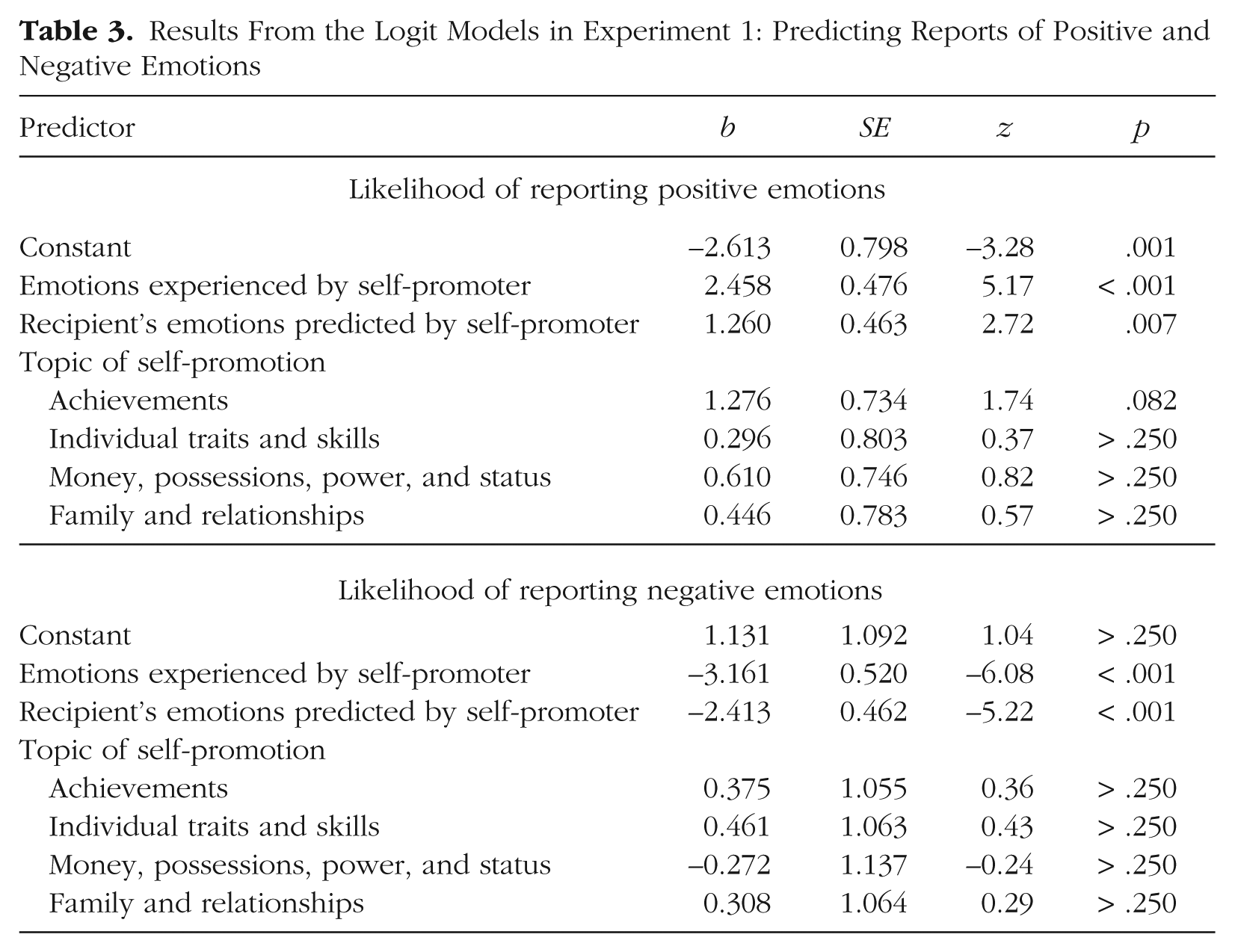
The results of the model predicting the likelihood of mentioning positive emotions showed that, as predicted, self-promoters were more likely to report having experienced positive emotions than recipients were (65.6% vs. 13.8%), b = 2.458, SE = 0.476, p < .001. Self-promoters also believed that recipients had experienced positive emotions significantly more often than recipients actually reported (37.5% vs. 13.8%), b = 1.260, SE = 0.463, p = .007 (see Fig. 1, left panel). The analogous but opposite pattern was observed in the model predicting the likelihood of mentioning negative emotions. Self-promoters were less likely to report having experienced negative emotions than recipients were (15.6% vs. 71.9%), b = −3.161, SE = 0.520, p < .001, and self-promoters believed that recipients had experienced negative emotions significantly less often than recipients actually reported (28.1% vs. 71.9%), b = −2.413, SE = 0.462, p < .001 (see Fig. 1, right panel). The sign, size, and significance of the effects did not change when the topic control variables were not included.
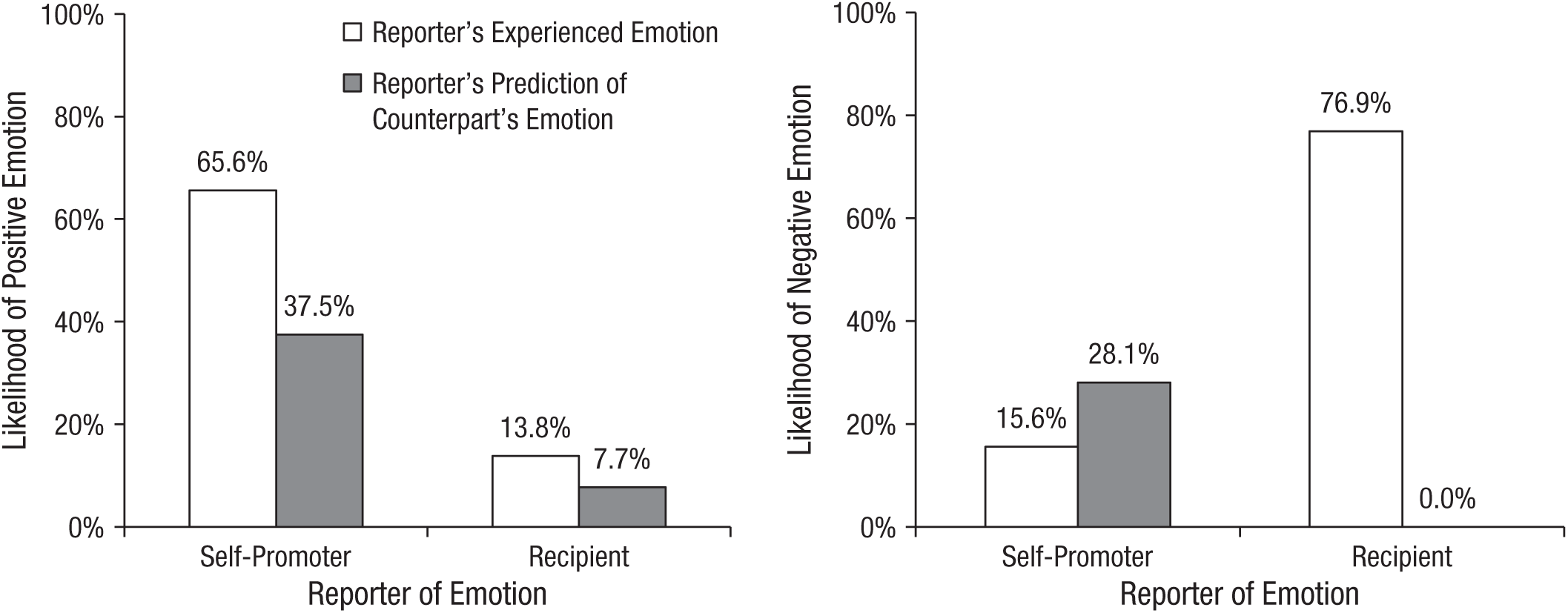
Results from Experiment 1: reports of positive (left panel) and negative (right panel) emotions. The graphs show the likelihood of self-promoters and recipients reporting that they had experienced positive and negative emotions and their predictions of their counterparts’ positive and negative emotions.
We did not include recipients’ reports of self-promoters’ emotions in our models because we made no specific prediction about these reports. However, we note that recipients underestimated the extent to which self-promoters experienced both positive and negative emotions.
Discussion
The results of Experiment 1 support our prediction that self-promoters overestimate the extent to which their actions elicit positive emotions and underestimate the extent to which they elicit negative emotions. Self-promoters reported that recipients experienced fewer positive and more negative emotions than they themselves did, but their adjustments fell well short of reaching the actual levels of recipients’ experienced emotions.
Experiment 1, however, was limited in two ways. First, the open-ended questions, which left participants free to report whatever came to mind, may have biased the results, as participants may have focused on emotions that were salient, particularly easy to remember, or relatively strong but not necessarily relatively frequent. We addressed this issue in Experiment 2 by asking participants to rate the extent to which they themselves (self-promotion condition) or their counterparts (recipient-of-self-promotion condition) had experienced a predefined set of emotions. Second, self-promoters and recipients of self-promotion recalled different self-promotion instances in Experiment 1 (we tried to control for this by including topic of the self-promotion as a control variable); we addressed this issue more directly in Experiment 3 by asking all participants to rate the same set of self-presentation instances.
Experiment 2
Method
In Experiment 2, participants in the self-promoter condition were asked to rate the extent to which their counterparts had experienced a series of discrete emotions, and participants in the recipient condition were asked to rate the extent to which they themselves had experienced the same series of discrete emotions (i.e., a two-cell between-subjects design). Sample size was set to a minimum of 75 participants per condition, and the data were analyzed only after data collection had been completed. One hundred fifty-four Amazon Mechanical Turk workers (mean age = 30.86 years, SD = 11.19; 62.3% male, 37.0% female, 0.6% not reported) accessed and completed a short study on personality and received $0.50 as compensation. We restricted participation to respondents who were located in the United States and had not participated in Experiment 1.
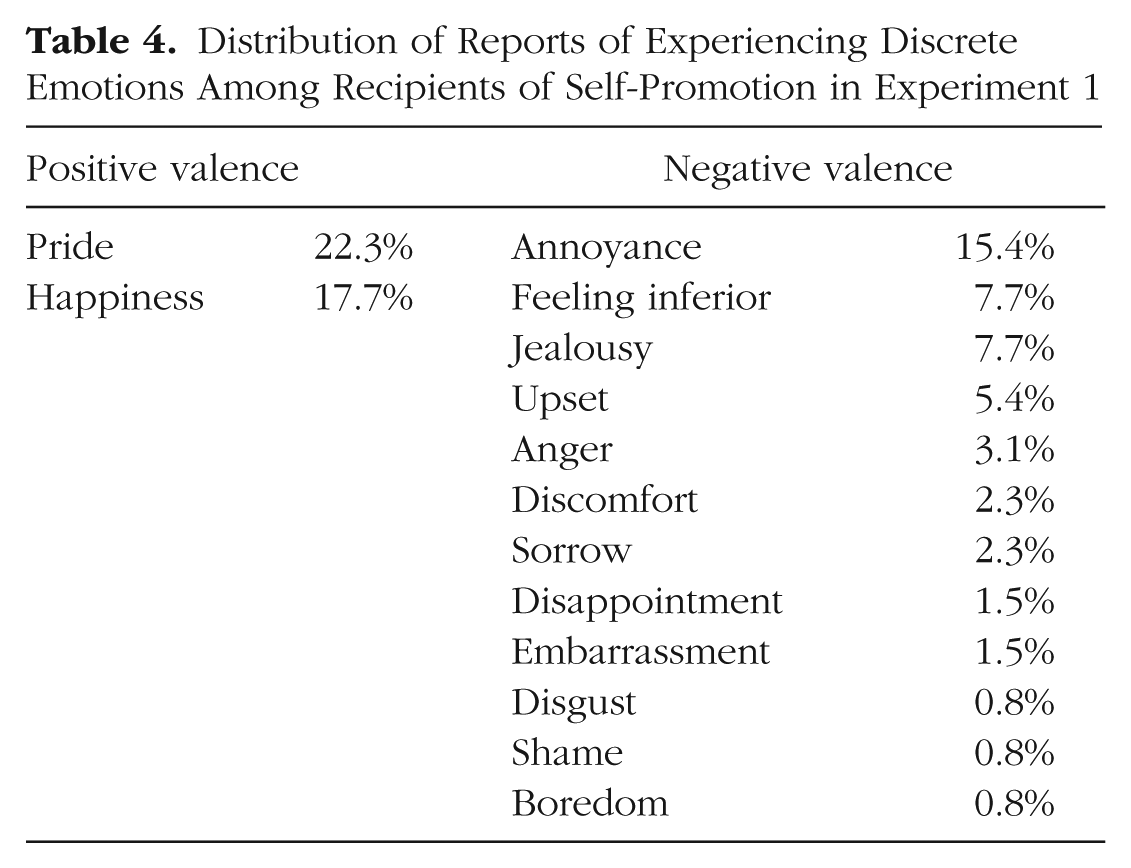
As in Experiment 1, participants described an instance of having engaged in self-promotion or having been the recipient of someone else’s self-promotion. Next, participants in the self-promotion condition were asked to indicate the extent to which their counterpart had felt happy for, proud of, annoyed by, jealous of, angry at, upset by, and inferior to them, whereas participants in the recipient-of-self-promotion condition were asked to rate their own level of these experienced feelings. These emotions were the seven most frequently mentioned emotions in Experiment 1 (see Table 4 for a complete list of the emotions mentioned in that experiment). All emotions were rated on 7-point scales from not at all (1) to very much (7). The topics of self-promotion were categorized as in Experiment 1.
Distribution of Reports of Experiencing Discrete Emotions Among Recipients of Self-Promotion in Experiment 1
Results
Responses from 3 participants (2 in the self-promotion condition and 1 in the recipient condition) were excluded; 2 participants claimed that they had never bragged in their life, and the other participant did not describe a self-promotion instance but only indicated that he used to have a friend who was a braggart.
We conducted a two-way mixed analysis of variance on ratings of the seven emotional reactions, with condition (self-promotion vs. recipient) as a between-subjects factor, emotion as a within-subjects factor, and topic dummy variables as covariates (luck served as the baseline topic). The interaction of condition and emotion was significant, F(6, 912) = 10.90, p < .001, η2 = .07 (see Table 5); self-promoters and recipients differed on the emotions they reported. As predicted, self-promoters overestimated the extent to which recipients felt happy for them (M = 4.88, SD = 1.78, vs. M = 3.70, SD = 1.91), F(1, 145) = 10.85, p = .001, η2 = .07, and proud of them (M = 4.33, SD = 1.81, vs. M = 3.08, SD = 1.77), F(1, 145) = 12.12, p < .001, η2 = .08. However, contrary to our predictions, self-promoters also overestimated the extent to which recipients felt jealous of them (M = 3.60, SD = 2.01, vs. M = 2.82, SD = 2.07), F(1, 145) = 3.76, p = .054, η2 = .03, and marginally overestimated the extent to which recipients felt inferior to them (M = 2.93, SD = 1.82, vs. M = 2.43, SD = 1.69), F(1, 145) = 2.75, p = .10, η2 = .02. Also as predicted, self-promoters underestimated the extent to which recipients were annoyed (M = 3.54, SD = 1.94, vs. M = 4.82, SD = 2.15), F(1, 145) = 11.56, p = .001, η2 = .07. No significant differences were observed in ratings of upset (M = 2.58, SD = 1.71, vs. M = 3.04, SD = 1.86), F(1, 145) = 1.15, p > .250, η2 = .01, or anger (M = 2.74, SD = 1.61, vs. M = 2.97, SD = 1.80), F(1, 145) = 0.25, p > .250, η2 = .002. None of the control variables (topics) had significant effects (see Table 5), and the estimated effects of the experimental variables did not change when the control variables were not included in the model. Means of the dependent variables are displayed in Figure 2.
Results From Experiment 2: Tests of Within- and Between-Subjects Effects
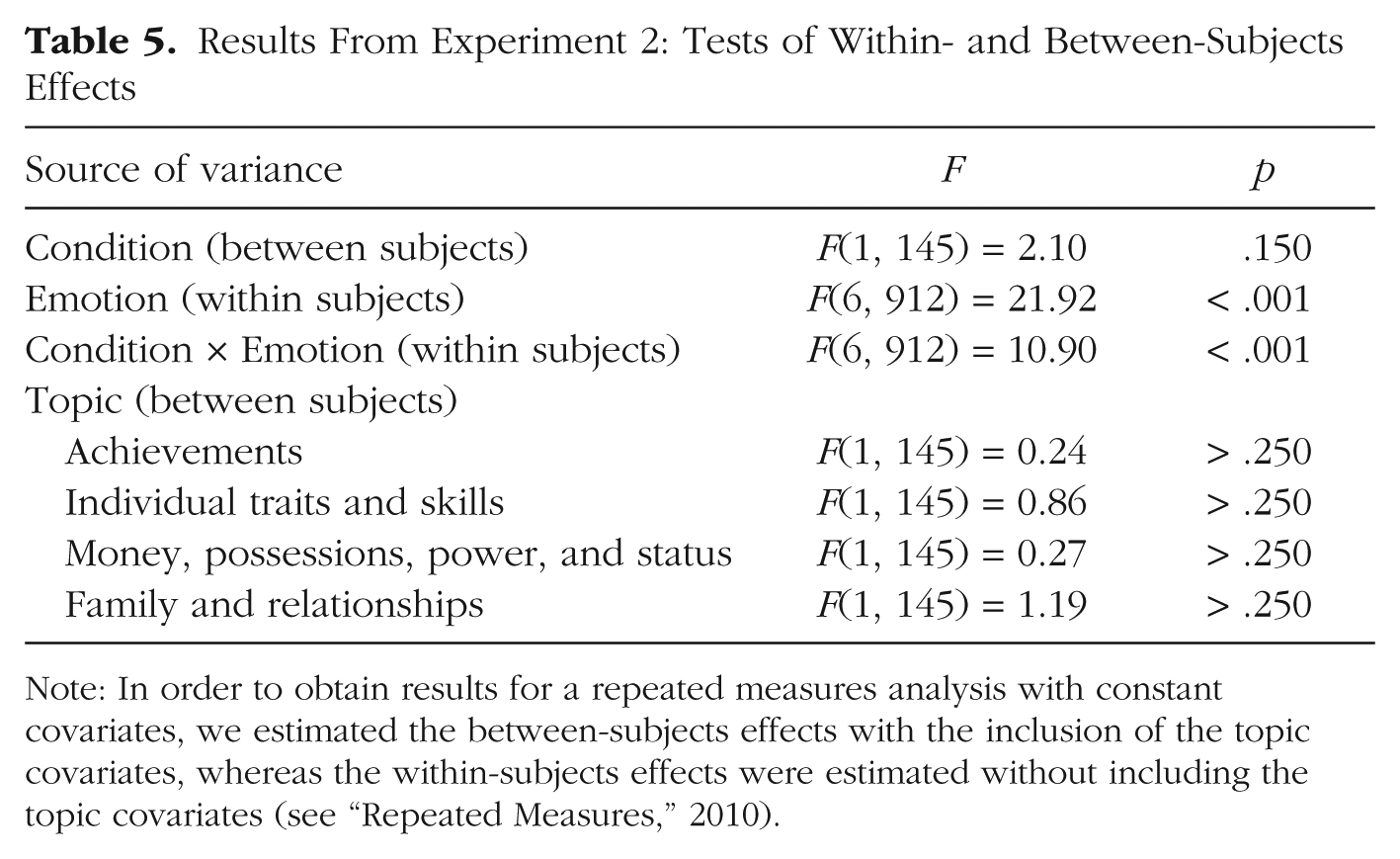
Note: In order to obtain results for a repeated measures analysis with constant covariates, we estimated the between-subjects effects with the inclusion of the topic covariates, whereas the within-subjects effects were estimated without including the topic covariates (see “Repeated Measures,” 2010).
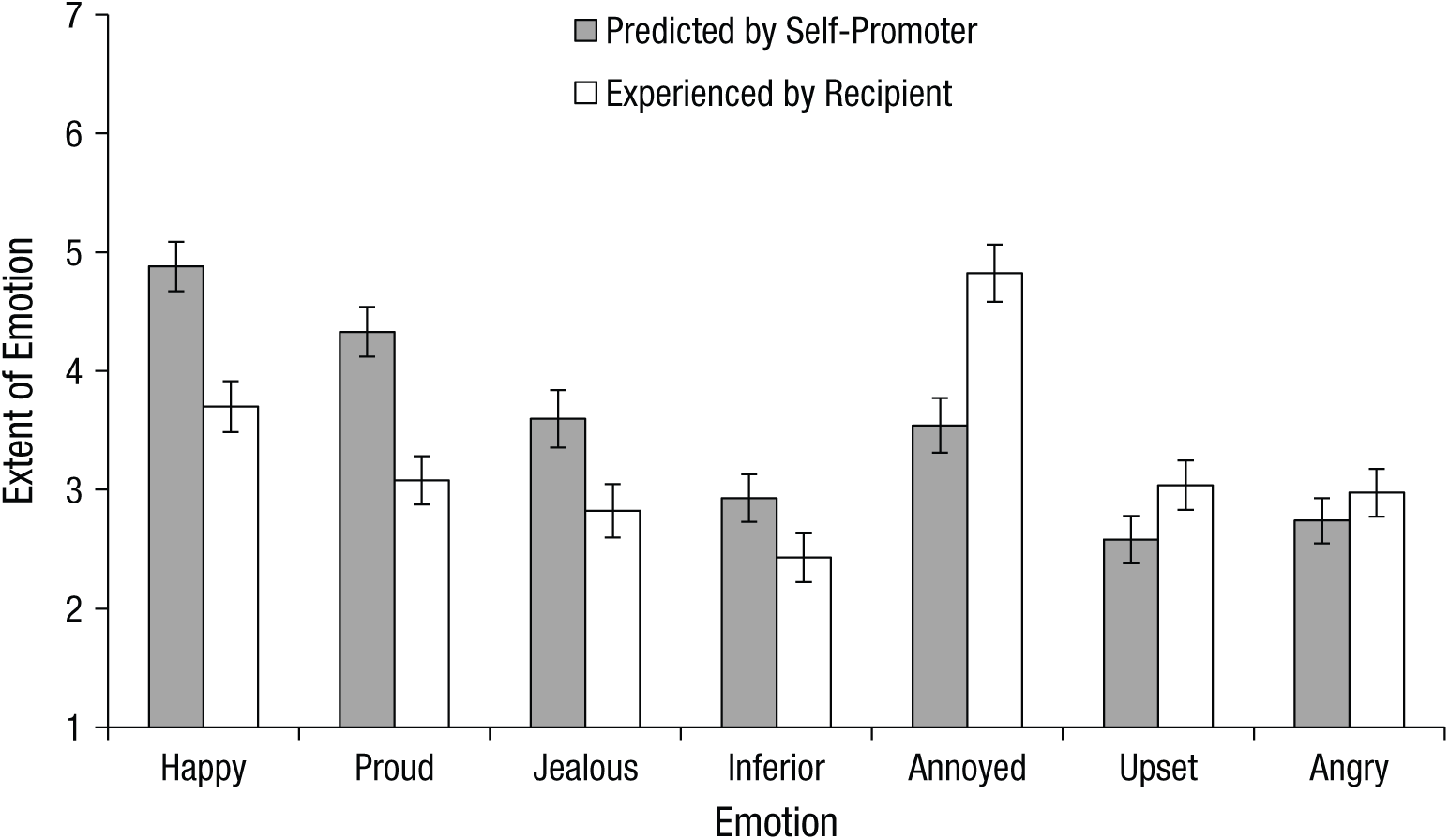
Results from Experiment 2: self-promoters’ predictions of recipients’ experienced emotions and recipients’ ratings of their actual experienced emotions. Error bars represent ±1 SEM.
Discussion
The results of Experiment 2 further support our prediction that self-promoters overestimate the extent to which their counterparts experience positive emotions (feel happy for and proud of them) and underestimate the extent to which their counterparts experience negative emotions (feel annoyed by them). Unexpectedly, self-promoters also overestimated the extent to which their self-promotion would make other people feel jealous of and inferior to them. A post hoc explanation of this finding may be that self-promoters not only are motivated to instill favorable images in other people, but also are to some extent narcissistically motivated to appear enviable and superior (Buss & Chiodo, 1991).
As over- and underestimation were observed for the same set of emotions, it is unlikely that the differences between self-promoters and recipients were due to the two groups focusing on different emotions or interpreting the rating scales differently. However, self-promoters and recipients may have focused on different types of self-promotion. Although the effect of condition was significant when we controlled for the topic of self-promotion, self-promoters may have been more likely to recall instances in which they promoted themselves only moderately, whereas recipients may have been more likely to recall instances of excessive bragging. To address this concern, in Experiment 3 we asked one set of participants to engage in self-promotion by writing a personal profile and to forecast how readers would evaluate their profile. A different set of participants evaluated the same profiles. Because the forecasted and actual evaluations referred to the same profiles (self-promotion instances), any differences in the ratings of self-promoters and recipients could be exclusively attributed to differences between their perspectives.
Experiment 3
Method
Experiment 3 tested whether the misprediction of the impact of self-promotion documented in the first two experiments has behavioral consequences. Specifically, we examined whether people who have the goal of making a positive impression on others tend to promote themselves excessively, guided by the belief that such self-promotion will have a more positive effect on others’ evaluations than it actually has.
Experiment 3 was conducted in two stages. Participants in the first stage wrote personal profiles, following one of two sets of instructions, and rated how they expected other people would evaluate their profiles. Participants in the second stage (judges) evaluated the profiles. Thus, the experiment had a 2 (instruction: control vs. maximize interest of other people) × 2 (evaluation: predicted vs. actual) between-subjects design.
Ninety-nine Amazon Mechanical Turk workers (mean age = 33.58 years, SD = 12.65; 55.6% female, 44.4% male) participated in the first stage in return for compensation of $2.00. Sample size was set to 50 participants per condition, and the data were analyzed only after data collection had been completed (we estimated that about 100 profiles would be sufficient to obtain reliable estimates of predicted evaluations). We restricted participation to respondents who were located in the United States and had not participated in either Experiment 1 or Experiment 2.
These participants were asked to create a personal profile by writing down five facts about themselves. Profile writers in the control condition read the following instructions: In this study, we would like you to present yourself by creating a personal profile that describes five things about you. For example, you can write about your work or education, sports or hobbies, your look or personality, your family, your social life. Please write in the boxes below five facts about you to create your personal profile.
Profile writers in the maximize-interest condition read the same instructions with the following addition: Your profile will be evaluated by other people, and your goal is to write five things about you that will make other people most interested in meeting you.
We ensured that participants had understood the instructions by asking them to rewrite the instructions in their own words on the subsequent screen.
After creating their profile, participants in both conditions predicted how other people would evaluate it. Specifically, they were asked to indicate the extent to which they thought that people reading their profile would like them, be interested in meeting them, think that they were successful, and think that they were braggarts. Finally, participants completed the Modest Responding Scale (MRS; Cialdini, Wosinska, Dabul, Whetstone-Dion, & Heszen, 1998), which measures the tendency to present oneself modestly. All scales ranged from not at all (1) to very much (7).
In the second stage of Experiment 3, 456 different Amazon Mechanical Turk workers located in the United States (mean age = 32.94 years, SD = 12.58; 51.8% female, 48.2% male) served as judges and evaluated the profiles created by participants in the first stage (compensation was $1.00). Each judge was randomly assigned to evaluate 10 of the 99 profiles (randomly selected) on one of the four rating scales. Thus, a subset of respondents rated how much they liked the authors of the profiles, another subset rated their interest in meeting the authors, a third subset rated the likely success of the authors, and a fourth subset rated how much the authors seemed to be bragging. This procedure ensured that evaluations would not be contaminated by halo effects. Each profile was rated on average 11.51 times on each of the four scales. The sample size of about 400 was chosen to ensure that at least 10 judges would evaluate each profile; the final data set included an average of 1,139.5 evaluations for each of the four dimensions (99 profiles × 11.51 evaluations per profile per dimension).
Results
Correlations of predicted and actual evaluations
We first examined the correlations among predicted (profile writers’) and actual (judges’) evaluations and profile writers’ MRS scores (α = .96; see Table 6). For each profile, we averaged the actual ratings across judges, obtaining average judges’ ratings for liking, interest, success, and bragging; the 99 profiles were thus the unit of analysis for the correlation analysis. Predicted evaluations of bragging and actual evaluations of bragging correlated moderately (r = .37, p < .01), as did predicted and actual evaluations of success (r = .32, p < .01). In contrast, predicted and actual liking and interest were uncorrelated (r = .10, p = .35, and r = .01, p = .90, respectively). Finally, MRS scores of profile writers were weakly correlated with their predictions of judges’ perceptions of their bragging (r = −.23, p = .02) and even less correlated with the judges’ actual evaluations of their bragging (r = −.19, p = .07). The small to nonsignificant correlations show that, overall, profile writers were not well calibrated in predicting responses to their self-presentation.
Results From Experiment 3: Correlation Matrix for Evaluations and MRS Scores

Note: In this experiment, self-promoters predicted how external judges would evaluate their profiles. MRS = Modest Responding Scale (Cialdini, Wosinska, Dabul, Whetstone-Dion, & Heszen, 1998).
p < .05 (two-tailed). **p < .01 (two-tailed).
Effect of instruction condition on the differences between predicted and actual evaluations
We combined profile writers’ and judges’ evaluations of profiles in one data set. The resulting data set contained 99 predicted (profile writers’) evaluations for each of the four rating dimensions (liking, interest, success, and extent of bragging), in addition to, on average, 1,139.5 actual evaluations on each of the four dimensions. We regressed each rating on the two manipulated variables, instruction (1 = maximize interest of others, −1 = control) and evaluation (1 = predicted, −1 = actual), and on their interaction. To account for the fact that each profile was evaluated by several judges (but only one profile writer), we clustered robust errors by judges. Clustering standard errors by judges means that the standard errors are no longer homogeneous across observations. Because effect-size estimation assumes homogeneous errors, the effect sizes we report (Cohen’s ds) are only approximations (degrees of freedom were set to the number of clusters).
The regression of liking ratings was significant, F(3, 257) = 11.37, p < .001. There was a significant main effect of evaluation, b = 0.324, robust SE = 0.071, t(257) = 4.56, p < .001, d = 0.57; profile writers thought judges would like them more (M = 5.05, SD = 1.30) than judges actually did (M = 4.42, SD = 1.54). The main effect of instruction was not significant, b = 0.055, robust SE = 0.067, t(257) = 0.82, p = .414, d = 0.10, but there was a significant interaction, b = 0.162, robust SE = 0.067, t(257) = 2.42, p = .016, d = 0.30. Whereas profile writers who tried to maximize interest in themselves believed that they would be liked more (M = 5.28, SD = 1.20) than did profile writers in the control condition (M = 4.85, SD = 1.36), b = 0.434, robust SE = 0.257, t(257) = 1.69, p = .093, d = 0.21, judges actually liked profile writers in the maximize-interest condition (M = 4.31, SD = 1.57) less than profile writers in the control condition (M = 4.52, SD = 1.51), b = −0.215, robust SE = 0.073, t(257) = −2.94, p = .004, d = 0.37 (see Fig. 3).

Results from Experiment 3: predicted and actual liking of the profile writers in the two instruction conditions. Error bars represent ±1 SEM.
The regression of interest ratings was also significant overall, F(3, 199) = 16.43, p < .001. A main effect of evaluation was found, b = 0.487, robust SE = 0.077, t(199) = 6.32, p < .001, d = 0.89; profile writers thought judges would be more interested in meeting them (M = 4.71, SD = 1.29) than judges actually were (M = 3.75, SD = 1.80). The main effect of instruction was marginally significant, b = 0.135, robust SE = 0.069, t(199) = 1.94, p = .054, d = 0.27, and was qualified by a significant interaction, b = 0.139, robust SE = 0.069, t(199) = 2.00, p = .047, d = 0.28. Whereas profile writers who tried to maximize interest in themselves believed judges would be more interested in meeting them (M = 5.00, SD = 1.10) than did profile writers in the control condition (M = 4.45, SD = 1.39), b = 0.547, robust SE = 0.253, t(199) = 2.16, p = .032, d = 0.31, judges were equally interested in meeting profile writers in the two conditions (maximize interest: M = 3.75, SD = 1.85; control: M = 3.76, SD = 1.76), b = −0.009, robust SE = 0.114, t(199) = −0.08, p > .250, d = 0.01 (see Fig. 4).
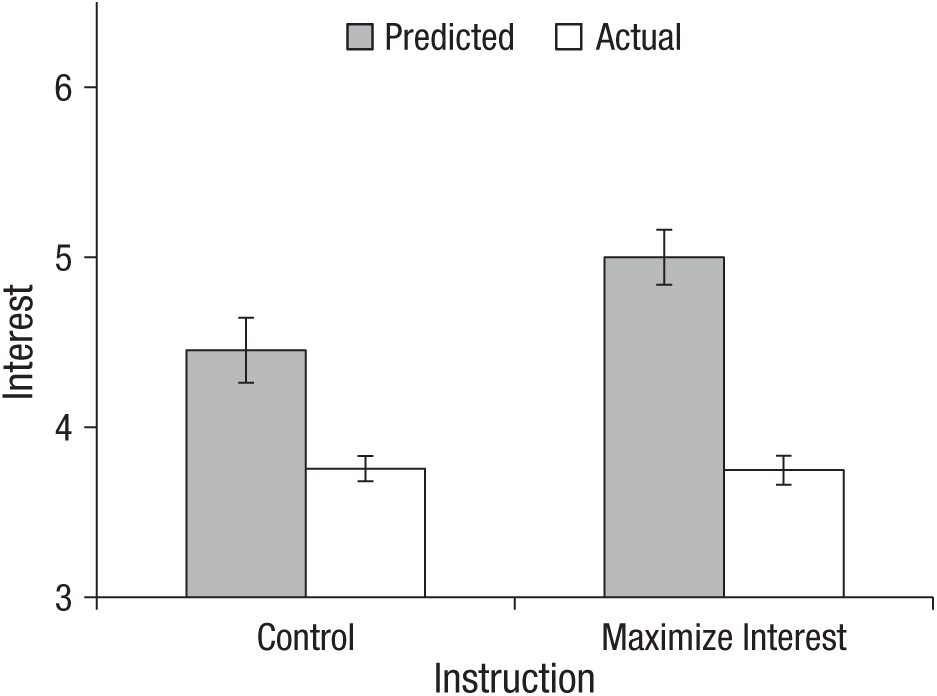
Results from Experiment 3: predicted and actual interest in meeting the profile writers in the two instruction conditions. Error bars represent ±1 SEM.
The regression of success ratings was significant, F(3, 165) = 3.82, p = .011. No main effect of evaluation was found, b = 0.047, robust SE = 0.089, t(165) = 0.52, p > .250, d = 0.08, but there was a main effect of instruction, b = 0.249, robust SE = 0.078, t(165) = 3.20, p = .002, d = 0.50, which was qualified by a significant interaction, b = 0.221, robust SE = 0.078, t(165) = 2.85, p = .005, d = 0.44. Profile writers who tried to maximize interest in themselves believed they would be perceived as more successful (M = 4.98, SD = 1.36) than did profile writers in the control condition (M = 4.04, SD = 1.56), b = 0.941, robust SE = 0.287, t(165) = 3.28, p < .001, d = 0.51, but judges rated profile writers in the two conditions as equally successful (maximize interest: M = 4.44, SD = 1.49; control: M = 4.39, SD = 1.44), b = 0.055, robust SE = 0.119, t(165) = 0.46, p > .250, d = 0.07 (see Fig. 5).

Results from Experiment 3: predicted and actual ratings of the success of the profile writers in the two instruction conditions. Error bars represent ±1 SEM.
Finally, the regression of bragging ratings was significant, F(3, 223) = 25.60, p < .001. Unlike in the case of the ratings of liking, interest, and success, profile writers correctly predicted that they would get higher bragging ratings by judges in the maximize-interest condition than by judges in the control condition. However, profile writers underestimated the extent to which judges would perceive them as braggarts. A main effect of evaluation was observed, b = −0.187, robust SE = 0.087, t(223) = −2.14, p = .033, d = 0.29; profile writers believed that they would be perceived less as braggarts (M = 2.72, SD = 1.53) than judges actually perceived them to be (M = 3.08, SD = 1.88). The main effect of instruction was also significant, b = 0.366, robust SE = 0.081, t(223) = 4.53, p < .001, d = 0.61; bragging ratings were higher for profiles in the maximize-interest condition (M = 3.52, SD = 1.96) than for profiles in the control condition (M = 2.65, SD = 1.67). The interaction was not significant, b = −0.325, robust SE = 0.323, t(223) = −1.01, p > .250, d = 0.13 (see Fig. 6).
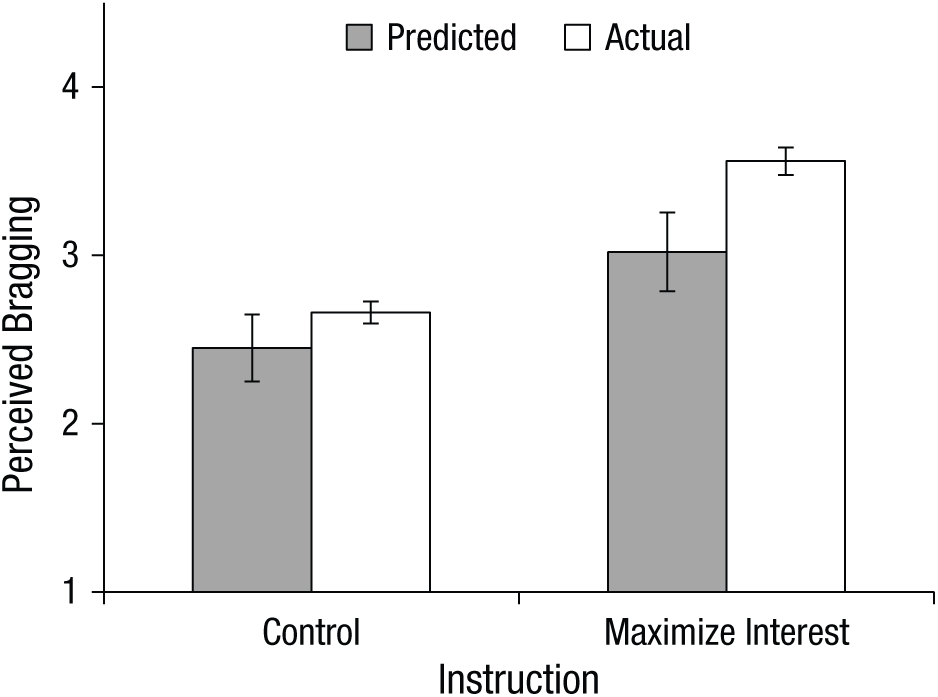
Results from Experiment 3: predicted and actual level of the perceived bragging of the profile writers in the two instruction conditions. Error bars represent ±1 SEM.
Discussion
When instructed to maximize the favorability of their impression on other people, profile writers engaged in more self-promotion. Although the goal they were given was to increase the likelihood that other people would be interested in meeting them, their efforts backfired. More self-promotion did not change judges’ perceptions of their success or judges’ interest in meeting them, but decreased judges’ liking of them and increased judges’ perceptions of them as braggarts. Egocentrism and social projection lead individuals to promote themselves in ways that have consequences that are the opposite of those intended.
General Discussion
These three experiments show that self-promoters overestimate the extent to which their self-promotion elicits positive emotions and underestimate the extent to which it elicits negative emotions. As a consequence, when seeking to maximize the favorability of the opinion others have of them, people engage in excessive self-promotion that has the opposite of its intended effects, decreasing liking with no positive offsetting effect on perceived competence. In a related study, Godfrey et al. (1986) asked pairs of participants to engage in a casual conversation. One member of each pair was asked to be an ingratiator or a self-promoter; ingratiators tried to maximize their partners’ liking for them, and self-promoters tried to maximize both their partners’ perceptions of their competence and their partners’ liking for them. Self-promoters were liked less than ingratiators, but were not perceived as more competent. Our study extends these findings by showing that (a) even the goal of only maximizing others’ interest can backfire, (b) self-promoters do not anticipate these effects, and (c) the reason why they do not anticipate these effects is the difficulty in engaging in emotional perspective taking.
The notion of bragging is closely related to the concept of signaling in economics. Bénabou and Tirole (2006) have shown the dilemma of potential donors to charity who worry that their donations will be interpreted as an indication not only of their generosity, but also of their desire to appear generous (cf. Berman, Levine, Barasch, & Small, 2015). This article complements theirs in its empirical focus and concern with not only the underlying activity that one can potentially brag about but also how much information to reveal to others. Many activities and experiences, whether in the physical or professional or even sexual realm, can be motivated, in whole or in part, by the goal of bragging about them later. A recent study (Cooney, Gilbert, & Wilson, 2014) has shown that such extraordinary experiences spoil subsequent social interactions and increase social exclusion.
The choice of how much to self-promote confronts individuals with a trade-off between the goal of projecting a favorable image and the goal of avoiding being perceived as an arrogant braggart. The optimal point on this trade-off may vary depending on the audience, the history between the interacting parties, and the situation (Stires & Jones, 1969). The results we obtained may not generalize to all conditions (e.g., if the recipient identifies with the self-promoter closely enough that a good thing happening to the self-promoter is a good thing also for the recipient, or if the recipient has a stake in or has contributed to whatever positive act or outcome the self-promoter touts; cf. Mills, 2003). Finally, there are surely cross-cultural differences in the acceptance of bragging on both sides, the self-promoter’s and the recipient’s. For example, the Law of Jante, familiar to Scandinavians, stipulates 10 rules, including “You’re not to think you are good at anything” and “You’re not to think you are anything special” (“Law of Jante,” 2015). Needless to say, the ethos in the United States is quite different. Nevertheless, our results highlight that even in this cultural context, recipients respond to self-promotion less positively than self-promoters expect, and that the decision to brag may often be made without an accurate consideration of recipients’ reactions.
People are generally aware that being the recipient of self-promotion may induce bad feelings, and our research supports this belief. Undoubtedly, some of these feelings may be due to the fact that others’ self-promotion makes people feel annoyed, so they may end up being resentful. In addition, recipients may assume that self-promoters have no compunction about bragging, which means they have probably disclosed all the possible positive information about themselves. In contrast, if someone has good qualities but does not mention them, and some positive information eventually dribbles out, one may be more likely to assume that the person probably has several other positive qualities, skills, and traits that he or she is similarly reticent to share. Truly savvy self-promoters, therefore, will not brag, but may employ the services of a so-called wingman or other advocate who can brag on their behalf.
Another source of bad feelings that future research may shed light on could be the guilt of recipients of self-promotion: They feel that they should be happy for the other person but are not. People tend to have hydraulic views of feelings and personality, so they assume that if they have a twinge of envy or disappointment when others promote themselves, it must mean that they do not like it when others do well, which perhaps means that they take pleasure in others’ failures (Smith et al., 1996). So, ultimately, being bragged at makes people feel that they are bad people. They might feel less bad if they recognized that mixed feelings are possible. It is possible, for example, to both take pleasure in a friend’s accomplishments and experience some envy about those same accomplishments.
Footnotes
Declaration of Conflicting Interests
The authors declared that they had no conflicts of interest with respect to their authorship or the publication of this article.
Funding
This research was supported in part by a seed grant from the Center for Behavioral and Decision Research at Carnegie Mellon University provided to I. Scopelliti.
Open Practices
All data and materials have been made publicly available through Open Science Framework and can be accessed at https://osf.io/chm94/ and https://osf.io/evikb/, respectively. The complete Open Practices Disclosure for this article can be found at http://pss.sagepub.com/content/by/supplemental-data. This article has received badges for Open Data and Open Materials. More information about the Open Practices badges can be found at https://osf.io/tvyxz/wiki/view/ and  .
.
References
Supplementary Material
Please find the following supplemental material available below.
For Open Access articles published under a Creative Commons License, all supplemental material carries the same license as the article it is associated with.
For non-Open Access articles published, all supplemental material carries a non-exclusive license, and permission requests for re-use of supplemental material or any part of supplemental material shall be sent directly to the copyright owner as specified in the copyright notice associated with the article.
