



Abstract
Clear empirical demonstrations of the theoretical principles underlying assortative mating remain elusive. This article examines a moderator of assortative mating—how well couple members knew each other before dating—suggested by recent findings related to market-based (i.e., competition) theories. Specifically, competition is pervasive to the extent that people achieve consensus about who possesses desirable qualities (e.g., attractiveness) and who does not. Because consensus is stronger earlier in the acquaintance process, assortative mating based on attractiveness should be stronger among couples who formed a relationship after a short period rather than a long period of acquaintance. A study of 167 couples included measures of how long partners had known each other before dating and whether they had been friends before dating, as well as coders’ ratings of physical attractiveness. As predicted, couples revealed stronger evidence of assortative mating to the extent that they knew each other for a short time and were not friends before initiating a romantic relationship.
Human mating is studied in nearly every discipline of social science. Economists, anthropologists, sociologists, and psychologists all examine overlapping portions of the mating process, researchers from each field contributing their own theoretical perspectives and methodologies. In this milieu, one mating-relevant phenomenon has received robust attention from all social-science perspectives for over a century: assortative mating.
Assortative mating refers to the tendency for individuals to be paired with mates who have similar physical, behavioral, and psychological characteristics (Lutz, 1905; Lykken & Tellegen, 1993). In other words, the scores provided for such characteristics by the two individuals in a romantic pair tend to be positively correlated, typically to a greater extent than are scores from random pairs created from the same samples. Researchers from disciplines as diverse as economics (Becker, 1991), sociology (Kalmijn, 1998), evolutionary psychology (Buss, 1985), behavior genetics (Reynolds, Baker, & Pederson, 2000), family studies (Houts, Robins, & Huston, 1996), and social psychology (Feingold, 1988) have used this observation to buttress claims about how people sort demographically, initiate relationships, and maintain relationships.
A variety of frameworks have been proposed to explain why assortative mating emerges. One particularly influential framework draws from competition or “market-based” perspectives: Individuals compete to obtain desirable mates, and an individual’s success in this mating market is constrained by his or her own desirability (Kalick & Hamilton, 1986). This framework is typically used to explain sorting on physical attractiveness (r = .30–.40 in meta-analyses; Feingold, 1988), which is for both men and women one of the most highly desirable characteristics in a romantic partner (Eastwick, Luchies, Finkel, & Hunt, 2014). Other plausible frameworks include similarity-attraction (i.e., matching) perspectives, in which individuals prefer mates who are similar rather than dissimilar (Berscheid, Dion, Walster, & Walster, 1971; Sprecher & Hatfield, 2009), and propinquity perspectives, in which individuals are likely to encounter potential mates who already resemble them (“mating requires meeting”; Kalmijn & Flap, 2001, p. 1289).
Despite considerable research on this topic, empirical work that links one or more of these frameworks to the mechanism underlying assortative mating is lacking. Scholars frequently compare assortative-mating correlations across different traits (e.g., Figueredo, Sefcek, & Jones, 2006; Hur, 2003; Watson et al., 2004). Yet cross-variable comparisons typically do not allow for precise tests of one of the underlying theories, and complicating matters is the fact that the assortative-mating effect size (e.g., r = .30) is often similar across variables linked to different frameworks, such as competition frameworks (e.g., attractiveness, r = .31; Hitsch, Hortaçsu, & Ariely, 2010), similarity-attraction frameworks (e.g., openness, r = .29; Escorial & Martín-Buro, 2012), and propinquity frameworks (e.g., education, r = .30; Godoy et al., 2008). A precise demonstration of the underlying mechanism would reveal that assortative-mating correlations for a single trait shift according to factors that derive from one of the theoretical perspectives. In this article, we examine how assortative mating based on an unambiguously desirable characteristic (i.e., physical attractiveness) shifts depending on a variable that is theoretically linked to the presence of competitive market forces: the length of time that couple members knew each other before they began dating.
Consensus and Uniqueness Shift With Length of Acquaintance
Investigations into interpersonal perceptual processes (Kenny, 1994; Kenny & La Voie, 1984) have shown that all judgments, including ratings of attractiveness and romantic desirability, include some degree of consensus (i.e., agreement about a given target across raters) and uniqueness (i.e., idiosyncratically high or low ratings of a given target by a given rater). The relative balance of consensus and uniqueness may affect assortative-mating correlations (i.e., the correlation between the attractiveness ratings of the two members of a particular couple). Consider assortative mating based on desirability in the Pairing Game, a class exercise used to illustrate the matching phenomenon (Ellis & Kelley, 1999). Students playing this game hold random numbers (i.e., playing cards) to indicate their hypothetical desirability, and they attempt to pair up with the most desirable target possible. Because each person’s value is entirely determined by his or her number, this game contains perfect consensus and no uniqueness—all participants’ ratings are identical for each target. This setup amplifies competitive market forces and results in highly matched pairs. Eastwick and Buck (2014) modified the game to include equal amounts of consensus and uniqueness in students’ assigned numbers; now, students could succeed by acquiring a target for which there was consensus about desirability (i.e., a high card value), a uniquely desirable target (i.e., a match to his/her randomly assigned preference for a particular playing-card suit), or some combination thereof. Assortative mating was much lower in the modified game than in the original version of the game. In other words, to the extent that contexts feature less consensus and more uniqueness, competitive market forces diminish, and pairs that are mismatched on desirability are more likely to emerge.
In what environments would one find low levels of consensus and high levels of uniqueness in real life? In an investigation of romantic evaluations of acquaintances, classmates, and close opposite-sex others, Eastwick and Hunt (2014) found that as length of acquaintance increased, individuals exhibited less consensus and more uniqueness in their judgments of the extent to which people they knew possessed various romantically desirable qualities. For example, consensus on ratings of physical attractiveness was larger than uniqueness (both of which are expressed as a percentage of total construct variance) by 2 percentage points when raters had known one another for only 2 weeks, but uniqueness was larger than consensus by 10 percentage points after 14 weeks and 37 percentage points among well-acquainted others. Essentially, longer acquaintance affords more opportunities for opposite-sex raters to encounter one another in different contexts (e.g., Daria interacts with Trent at home and at school, whereas Brittany interacts with Trent only at school) and more opportunities to disagree about whether a target’s behaviors reflect romantically desirable or undesirable qualities (e.g., Daria is impressed by Trent’s musical performance onstage, but Brittany finds his playing pretentious and strange; Eastwick & Hunt, 2014). Thus, as individuals become acquainted over time, romantic impressions become increasingly unique and less consensual.
Taken together, these studies suggest that length of acquaintance should be tied to patterns of assortative mating based on physical attractiveness. As length of acquaintance increases, consensus about other people’s desirable qualities declines (Eastwick & Hunt, 2014). In contexts featuring reduced consensus, the influence of competitive forces on the mating market diminishes, resulting in more mismatched pairs (i.e., reduced assortative mating; Eastwick & Buck, 2014). Therefore, the length of time that couple members knew each other before the actual formation of their relationship—even if this event lay many years in the distant past—should predict lower assortative mating.
Method
As part of a broader study, dating and married couples reported how long they had known each other and how long they had been romantically involved. Independent judges rated the attractiveness of each member of the couple. Our central hypothesis was that the length of time for which couple members had known each other before becoming romantically involved would moderate the association between the man’s attractiveness and the woman’s attractiveness. Specifically, this association should be stronger among couples who formed a relationship after a shorter rather than a longer acquaintance. In addition, the data set included a conceptually related measure: whether the couple members were platonic friends before dating. Given that an initial period of platonic friendship should give couple members a chance to form impressions of each other outside of the romantic-competition process, we also hypothesized that assortative mating would be stronger for couples who had not been friends before dating than for couples who had been friends before dating.
Participants
Participants in this study consisted of 167 couples (334 individual participants) who were drawn from a larger sample of 195 couples taking part in a longitudinal study of romantic relationships (DeWall et al., 2011; Finkel, Slotter, Luchies, Walton, & Gross, 2013; Slotter, Emery, & Luchies, 2014). (Video data from 7 couples were unusable because of technical or clerical problems, and the rationale for the exclusion of the additional 21 couples is presented later in Moderator: Length of Acquaintance Before Dating.) These 167 couples were a mix of dating couples (n = 67) and married couples (n = 100); the average relationship length for all couples was 104 months (SD = 132 months, range = 3–645 months), and the average marriage length for the married couples was 125 months (SD = 147 months, range = 1–613 months). The mean age of the 334 participants was 31.7 years (SD = 13.9 years); 2.7% of the participants were African American/Black, 13.6% were Asian American/Asian, 78.9% were Caucasian/White, 3.6% were Hispanic or Latino, 0.6% were multiracial, and 0.6% had missing data or did not specify race or ethnicity. Details on recruitment and the stopping rule (i.e., how many participants to run) are included in the Supplemental Material available online.
Procedure
Participants first completed an online intake questionnaire of about 1 hr followed by a laboratory session of about 2.5 hr. Part of the laboratory session consisted of a discussion in which each couple sat at a table and discussed how they had changed since the beginning of their relationship. These discussions were videotaped such that the head and torso of both couple members were clearly visible. Participants also completed other tasks that are not relevant to the present hypotheses.
Materials
Physical-attractiveness coding
Physical attractiveness was coded in two ways. First, seven trained undergraduate coders watched each of the self-change videos in its entirety. These coders completed several items about the couples in the videos, including a measure in which they rated the physical attractiveness of each partner on a scale from −3 (very unattractive) to 3 (very attractive). We refer to this measure as the joint assessment of physical attractiveness. The coders were reliable, α = .88 for ratings of the men and α = .92 for ratings of the women. The assortative-mating correlation using this measure was high, r = .55, p < .001.
We suspected that the assortative-mating correlation could have been particularly strong for this measure because the coders’ attractiveness scores for one partner may have inadvertently but positively influenced their scores for the other partner. Therefore, we recoded physical attractiveness by having a new team of coders rate the attractiveness of the couple members one at a time. These raters watched clips consisting of only the first 5 s of each self-change video (with no sound), and half of the screen was covered so that they could see only one member of the couple. On the first pass through the videos, they coded the man or woman sitting on the right side of the screen, and on the second pass through the videos, they coded the man or woman sitting on the left side of the screen. Depending on the size of the coding team during the semester that we assigned the coding task, between four and nine trained undergraduate coders rated each video. The coders rated the extent to which each participant was physically attractive and sexy on a scale from 1 (not at all) to 7 (extremely); these two items were highly correlated (r = .93 for men; r = .92 for women), and so we averaged them to form the separate assessment measure of physical attractiveness. Again, the coders were reliable, α = .90 for ratings of the men and α = .90 for ratings of the women. As anticipated, the assortative-mating correlation using this physical attractiveness measure, although still robust, was lower, r = .38, p < .001, and closer to the meta-analytic average of .39 (Feingold, 1988). Although hypothesis tests using an average of the two measures yielded identical conclusions, we present the findings for both measures of physical attractiveness in the Results section. (The two measures correlated at r = .81.)
Moderator: length of acquaintance before dating
Researchers who study close relationships frequently assess relationship length, but they rarely assess the additional information required to calculate the amount of time that couple members knew each other before they began dating. Fortunately, on the intake questionnaire for the broader study from which the present data set was drawn, participants completed two items that we used to compute this variable. One item was “How many months have you known your romantic partner (spouse)?” and the other item was “How many months have you been romantically involved with your partner (spouse)?” We took the difference between the responses to these two items (time acquainted minus time involved) and used it as our measure of length of acquaintance before dating. These items were reported by both the man and the woman in each couple; their answers correlated highly (r = .98 for both items), and we used an average of the man’s and woman’s values for length of acquaintance before dating in all analyses. One of the 195 couples did not report values for these items and was excluded from analyses.
Because these items asked participants to report numbers of months, the possible upper limit of values for length of acquaintance before dating was quite high. As a consequence, some couples exhibited extreme scores on this variable (e.g., 7 SD above the mean) and would therefore have possessed considerable leverage in any regression analysis. To address this variability in an a priori, empirically sound manner, we calculated Tukey’s outer fences for length of acquaintance before dating and considered values outside of this range (n = 20 couples) to be missing (Eastwick et al., 2006; Myers & Well, 1995; Tukey, 1977). According to this procedure, scores of 19 months or greater were considered extreme values. For the 167 remaining couples used in the analyses, the mean length of acquaintance before dating was 3.8 months, the median was 2 months, the standard deviation was 4.3 months, and the range was 0 to 17.5 months.
Participants also completed an item on the intake questionnaire that could be conceptualized as an estimate, albeit less precise, of how well two individuals were acquainted before dating: “Were you and your partner platonic friends before becoming romantically involved?” (coded as 0 = no, 1 = yes). We also examined this friends-first variable as an alternative moderator of the assortative-mating association in the analyses reported. As with length of acquaintance before dating, we took each couple’s average: 41% of couples indicated that they had not been friends first, 40% indicated that they had been friends first, 19% disagreed on whether they had been friends first (and hence received a score of .5 on this variable), and 1% did not complete this item. The length-of-acquaintance-before-dating and friends-first measures correlated at .40, p < .001; hypothesis tests using a composite measure of these two variables (i.e., an average of the standardized version of length of acquaintance before dating and friends first for each couple) revealed identical conclusions.
Results
To examine whether the length of acquaintance before couples began dating would moderate the size of the assortative-mating correlation, we first examined whether length of acquaintance before dating interacted with the man’s attractiveness to predict the woman’s attractiveness. This interaction was significant for both the joint assessment of physical attractiveness, β = −0.21, t(163) = −3.15, p = .002, and the separate assessment of physical attractiveness, β = −0.16, t(163) = −2.53, p = .012. 1 The negative sign of the interaction indicates that the longer couple members had known each other before they started dating, the less likely they were to be matched for attractiveness. Predicted values derived from these two regressions are plotted in Figure 1. For both measures of attractiveness, predicted values for the assortative-mating correlation were quite strong for couple members who began dating within a month of meeting each other (r = .72 and r = .53 for the joint assessment and the separate assessment, respectively, at length of acquaintance before dating = 0). However, as length of acquaintance before dating increased, the size of the assortative-mating correlation for physical attractiveness decreased. The Johnson-Neyman significance region (provided by the PROCESS macro for SPSS; Hayes, 2013) ended at 9.9 months and 8.8 months for the joint assessment and separate assessment, respectively. In other words, if couple members knew each other for about 9 months or more before they started dating (while still remaining in the typical range of predating acquaintanceship duration), assortative mating based on physical attractiveness was modest in magnitude and not significantly different from zero.
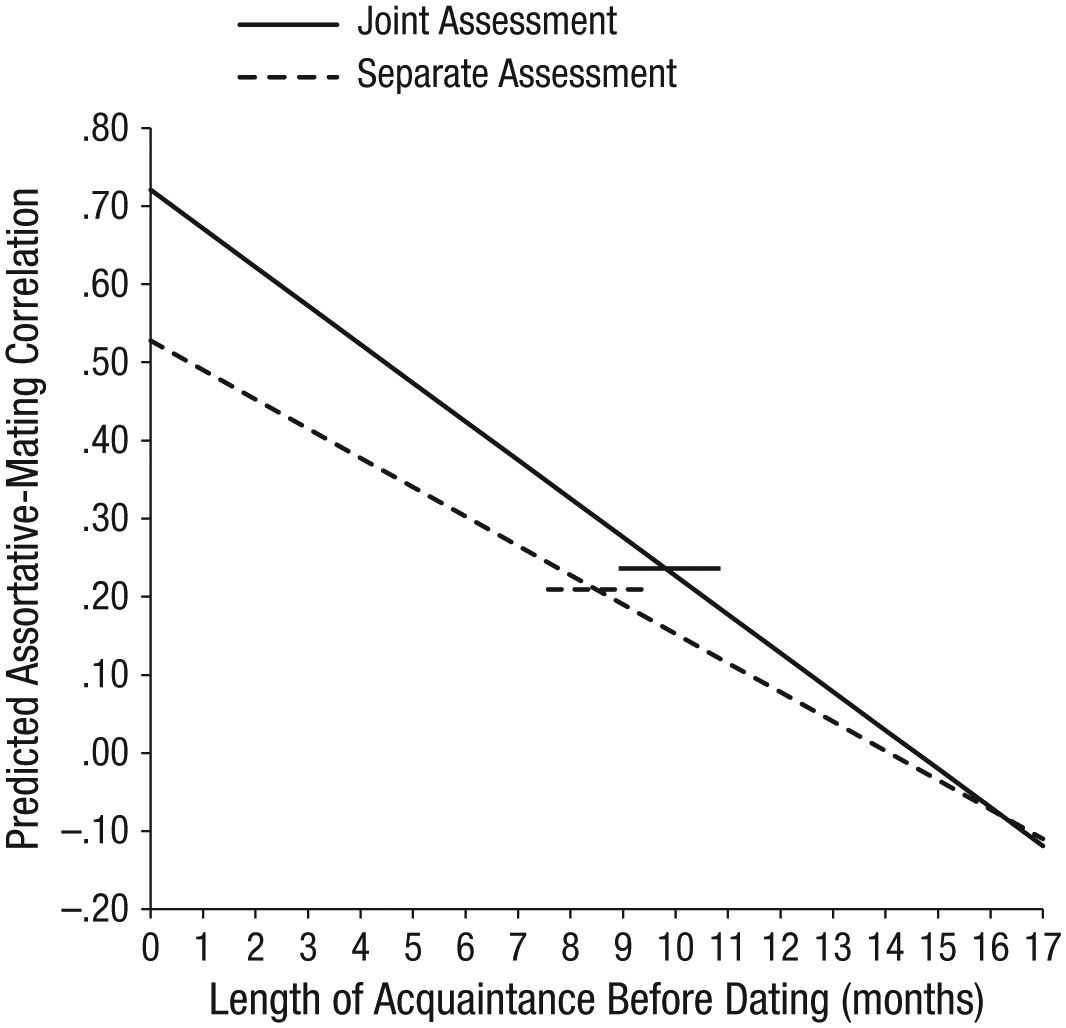
Predicted values of the assortative-mating correlations for joint and separate assessments of physical attractiveness, as a function of length of acquaintance before dating. Predicted values are depicted across the entire range of the length-of-acquaintance-before-dating variable. The horizontal lines indicate the boundaries for the Johnson-Neyman regions of significance; y-axis values beneath these dashes are not significantly different from zero.
We also examined whether the friends-first variable moderated the size of the assortative-mating correlation using a similar regression analysis. Once again, the interaction was significant for both the joint assessment of physical attractiveness, β = −0.13, t(162) = −2.04, p = .043, and the separate assessment of physical attractiveness, β = −0.15, t(162) = −2.03, p = .044. In other words, couple members were less likely to be matched for attractiveness if they had been friends before they started dating. Predicted values derived from these two regressions are presented in Figure 2. For couples who had not been friends before they started dating, assortative-mating correlations were predicted to be .70 and .52 for the joint assessment and separate assessment, respectively. However, for participants who had been friends first, these correlations were predicted to be .40 and .20, respectively. (All four correlations were at least marginally significantly different from zero according to the Johnson-Neyman significance region.)
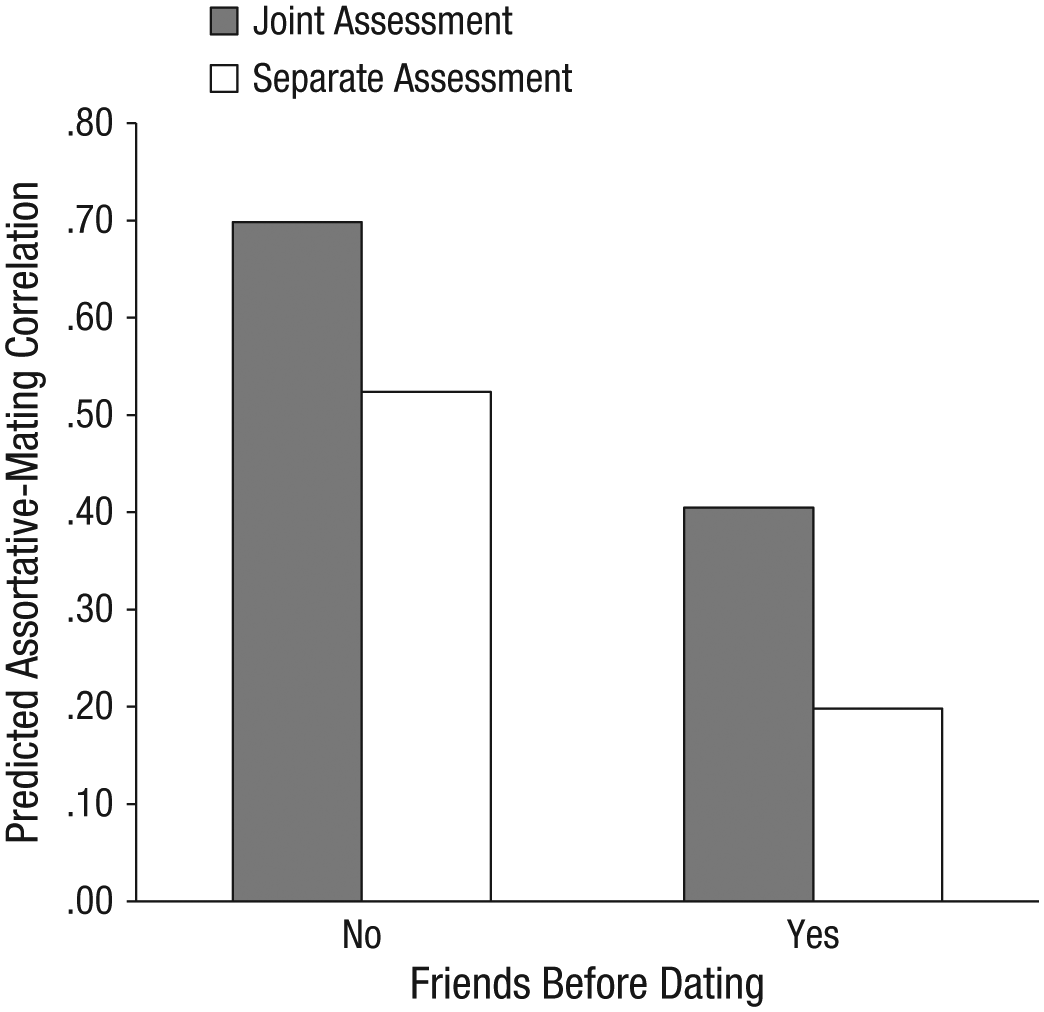
Predicted values of the assortative-mating correlations for joint and separate assessments of physical attractiveness. Results are shown separately for couples who had and had not been friends before they started dating.
For the friends-first variable, it was straightforward to calculate the actual (rather than predicted) assortative-mating correlations by correlating the men’s and women’s attractiveness scores for the three different values of the friends-first variable (i.e., no, disagreed, and yes). For the joint assessment of attractiveness, couples who had not been friends first (n = 68) exhibited an assortative-mating correlation of .67, p < .001; couples who disagreed about whether they had been friends first (n = 31) exhibited a correlation of .57, p = .001; and couples who had been friends first (n = 67) exhibited a correlation of .43, p < .001. For the separate assessment of attractiveness, couples who had not been friends first (n = 68) exhibited assortative-mating correlations of .46, p < .001; couples who disagreed about whether they had been friends first (n = 31) exhibited a correlation of .52, p = .002; and couples who had been friends first (n = 67) exhibited a correlation of .18, p = .138. This pattern of correlations was similar to the pattern of predicted values generated earlier using the regression equations.
In addition, we examined whether relationship status (i.e., dating vs. married) or relationship length moderated the four significant interactions reported (i.e., eight total analyses). Only one of the eight moderation analyses was significant or marginal: For the joint assessment of attractiveness, relationship status significantly moderated the friends-first association, β = −0.16, t(158) = −2.45, p = .015. The friends-first variable was a significant moderator of the assortative-mating correlation for married couples, β = −0.027, t(95) = −3.00, p = .003, but not for dating couples, β = 0.03, t(63) = 0.34, p = .737. This moderating effect was not predicted a priori and should be interpreted with caution.
Finally, the association between similarity in attractiveness and relationship quality has been a subject of some debate in the assortative-mating literature; some studies have found evidence for a positive association between similarity in attractiveness and relationship outcomes (e.g., White, 1980), and others have failed to find such an association (e.g., Murstein & Christy, 1976). The current sample revealed no association between couple matching based on attractiveness (i.e., the absolute value of the difference between the partners’ attractiveness scores) and relationship satisfaction (assessed using the five-item measure from Rusbult, Martz, & Agnew, 1998) for either men or women, rs = −.03 to −.07. That is, matched couples were no more likely to be satisfied with their relationships than mismatched couples. None of these associations were moderated by relationship status or relationship length.
Discussion
The current investigation sheds light on how length of acquaintance before initiation of a romantic relationship predicts the tendency for individuals to form relationships with partners similar in attractiveness. Couples who formed their relationships soon after meeting were more likely to match based on physical attractiveness than those who formed their relationships well after meeting each other. Moreover, assortative mating based on attractiveness was stronger among couples who had not been friends before dating than those who had been friends before dating. These findings are consistent with previous research demonstrating that relatively short acquaintance lengths tend to be associated with romantic impressions that rely heavily on consensual desirability, whereas longer acquaintance lengths tend to feature romantic impressions that rely heavily on unique, idiosyncratic desirability (Eastwick & Hunt, 2014). The assortative-mating patterns we observed may be due to the fact that impression-formation contexts featuring less consensus and more uniqueness reduce competition and allow individuals to acquire uniquely desirable partners (Eastwick & Buck, 2014).
Although the notion that relationship timing affects relationship dynamics is not new, previous investigations have failed to pinpoint precisely how time influences mating (Eastwick, 2013). For example, the length of time that a couple has been dating (rather than length of acquaintance before dating) has been examined as a moderator of assortative mating based on attractiveness (e.g., White, 1980), yet subsequent meta-analyses (e.g., Feingold, 1988) failed to support this hypothesis. Drawing from recent findings in the attraction and interpersonal-perception domains, this study is the first to show that the length of time that two people know each other before starting a relationship reliably moderates assortative-mating trends observed many years later. Thus, the current study highlights the importance of integrating studies on relationship maintenance with studies on relationship initiation, because the process of romantic initiation can have profound effects on future relationship dynamics.
Market-forces theories (e.g., Kalick & Hamilton, 1986) combined with contemporary research on consensus in person perception (Eastwick & Hunt, 2014) generated the current predictions. Yet the findings do not contradict other theoretical frameworks relevant to assortative mating. In fact, a meta-analysis by Montoya, Horton, and Kirchner (2008) demonstrated that, across both field and laboratory studies, the similarity-attraction effect was stronger in contexts involving little or no interaction than in contexts involving many interactions or existing relationships. Thus, the current pattern of results could in principle reflect a stronger preference for similar partners among new acquaintances. However, the market-forces framework is likely to remain a more compelling explanation for the current set of findings than the similarity-attraction framework given that the similarity-attraction effect generally tends to be weak to nonexistent for physical attractiveness (Shaw Taylor, Fiore, Mendelsohn, & Cheshire, 2011; Tidwell, Eastwick, & Finkel, 2013).
The current study reveals several exciting directions for future research. The theoretical rationale for examining a single, highly desirable trait (i.e., physical attractiveness) in this investigation stemmed from recent findings showing that contextual features linked to the presence versus the absence of strong competitive forces (e.g., degree of consensus) should predict assortative-mating patterns. Future research is required to determine whether these assortative-mating shifts would apply to other characteristics, especially those that are less consensually desirable at initial acquaintance (e.g., religiosity). Furthermore, such shifts should be examined across samples with greater diversity than that in the current study (e.g., gay and lesbian couples) and across different relationship contexts to pinpoint precisely when shifts in assortative-mating trends reliably occur. For example, closed fields (e.g., workplaces or classrooms) may permit longer acquaintanceships and generate friends-first relationships, whereas open fields (e.g., bars or large social gatherings) may lend themselves to romantic pairings after shorter acquaintanceships (Murstein, 1970). That is, independently of acquaintance length, closed fields (as opposed to open fields) might also encourage individuals to form idiosyncratic impressions of people’s desirable qualities, thus reducing assortative mating. A meta-analytical and longitudinal exploration of assortment patterns—from attraction to established relationships and across different kinds of settings—would undoubtedly enhance understanding of relationship initiation and maintenance.
The current study is one of the first to link an explanatory framework (i.e., competitive market forces) to a mechanism underlying assortative mating based on physical attractiveness (i.e., time known before dating). This moderator reinforces the point that relationship initiation and maintenance must be understood as parts of the same continuous process in humans; to consider these two relationship stages separately may preclude a complete understanding of human mating. The present findings suggest that in contexts in which people generally agree about who is desirable and who is not, competition in the mating market will be strong, and sorting according to this agreed-upon desirability will be prominent. Yet in contexts that allow people to develop divergent perceptions about each other’s positive and negative idiosyncrasies, the traditional trappings of market forces fall away, permitting individuals to seek mates on a more level playing field.
Footnotes
Acknowledgements
We thank Erica Slotter and Laura Luchies for their major contributions to the execution of this study.
Declaration of Conflicting Interests
The authors declared that they had no conflicts of interest with respect to their authorship or the publication of this article.
Funding
This research was supported in part by National Science Foundation Grants BCS-1243323 (to P. W. Eastwick) and BCS-719780 (to E. J. Finkel). Any opinions, findings, and conclusions or recommendations expressed in this material are those of the authors and do not necessarily reflect the views of the National Science Foundation.
Open Practices
All materials have been made publicly available via Open Science Framework and can be accessed at https://osf.io/zmh8j. However, our data cannot be made publicly available, because it is possible that they could be used to identify our participants. Such identification would breach our guarantee of confidentiality. Furthermore, the study was not preregistered because our data were collected in 2008 as part of a larger study of married couples. The complete Open Practices Disclosure for this article can be found at http://pss.sagepub.com/content/by/supplemental-data. This article has received the badge for Open Materials. More information about the Open Practices badges can be found at https://osf.io/tvyxz/wiki/view/ and  .
.
Notes
References
Supplementary Material
Please find the following supplemental material available below.
For Open Access articles published under a Creative Commons License, all supplemental material carries the same license as the article it is associated with.
For non-Open Access articles published, all supplemental material carries a non-exclusive license, and permission requests for re-use of supplemental material or any part of supplemental material shall be sent directly to the copyright owner as specified in the copyright notice associated with the article.
