



Abstract
Two theories offer competing explanations of sex differences in aggressive behavior: sexual-selection theory and social-role theory. While each theory has specific strengths and limitations depending on the victim’s sex, research hardly differentiates between intrasex and intersex aggression. In the present study, 11,307 students (mean age = 14.96 years; 50% girls, 50% boys) from 597 school classes provided social-network data (aggression and friendship networks) as well as physical (body mass index) and psychosocial (gender and masculinity norms) information. Aggression networks were used to disentangle intra- and intersex aggression, whereas their class-aggregated sex differences were analyzed using contextual predictors derived from sexual-selection and social-role theories. As expected, results revealed that sexual-selection theory predicted male-biased sex differences in intrasex aggression, whereas social-role theory predicted male-biased sex differences in intersex aggression. Findings suggest the value of explaining sex differences separately for intra- and intersex aggression with a dual-theory framework covering both evolutionary and normative components.
A robust finding in the field of human aggression is that males tend to be more aggressive than females. Especially for physical forms of aggressive behavior, several meta-analyses support this finding across different age groups, methods, and cultures (e.g., Archer, 2004; Bettencourt & Miller, 1996; Card, Stucky, Sawalani, & Little, 2008; Eagly & Steffen, 1986). Two competing theories offer different explanations of this consistent sex difference in aggressive behavior, namely sexual-selection theory (Darwin, 1871) and social-role theory (Eagly, 1987), which are contrasted in Figure 1.

Similarities and differences between the two competing theories of sex differences in aggressive behavior.
Investigating the validity of these theories is a continuing focus of scientific effort (cf. Archer, 2009a), and cumulative evidence has been produced for both of them (e.g., Lindenfors & Tullberg, 2011; Nivette, Eisner, Malti, & Ribeaud, 2014). However, to date, researchers in this field have tended to study the sex of aggressors without considering the sex of their victims. We believe that differentiating between intrasex aggression and intersex aggression will help to further improve the precision of theories that intend to explain sex differences in aggression.
Dual-Theory Explanation of Intra- and Intersex Aggression
The rationale for examining sex differences in intra- and intersex aggression separately is that existing theories differ in their ability to explain these two phenomena. On the one hand, the main tenet of sexual-selection theory—intermale competition leads to sex differences in aggression—offers a convincing explanation for sex differences in intrasex aggression. There have been attempts to widen the classic scope of sexual-selection theory and propose evolutionary arguments for intersex aggression (Muller, Kahlenberg, Thompson, & Wrangham, 2007). However, male aggression toward females is not a common reproductive strategy in humans, who typically engage in stable long-term relationships characterized by intensive biparental care (Fernandez-Duque, Valeggia, & Mendoza, 2009). Moreover, evolutionary arguments for intersex aggression account only for greater male aggression toward females, but not for greater female aggression toward males, for which there is evidence in some human societies (cf. Alpern, 1998).
On the other hand, social-role theory seems to be of particular value for explaining sex differences in intersex aggression, which have been found to equalize in societies with less traditional and more liberal gender roles (Archer, 2006). While traditional gender roles in patriarchal societies encourage males’ use of aggression, including the approval of male aggression toward females, liberal gender roles in postfeminist Western societies do not inhibit females’ use of aggression, including the approval of female aggression toward males. The adequacy of social-role theory has been challenged, however, because of the noncumulative growth of sex differences in aggression over the life course despite cumulative socialization experiences (cf. Archer, 2009a) or the constant sex ratio of crime rates in liberalized Western societies over the last 50 years (Kenrick & Griskevicius, 2009).
Overall, the literature indicates that neither of the two theories provides a universal framework that explains sex differences in human aggression. Instead, a dual-theory approach, with sexual-selection theory explaining sex differences in intrasex aggression and social-role theory explaining sex differences in intersex aggression, would acknowledge the different mechanisms that underlie these two forms of sex differences.
Disentangling Intra- and Intersex Differences Using Aggression Networks
There are only a few studies that differentiate intra- and intersex aggression (e.g., Hilton, Harris, & Rice, 2000; Pellegrini & Long, 2002), which is in part due to the methodological difficulties involved in assessing aggression within and between the sexes. We propose that a social-network approach, which models the ties between network members (Borgatti, Mehra, Brass, & Labianca, 2009), helps to advance this line of research. Depending on the nature of assessed ties, network information can capture different types of interdependencies. Although most social-network research focuses on positive ties, such as friendship patterns, it is also possible to study negative ties, such as aggressive behavior (cf. Huitsing et al., 2012). By considering the sex of all networkmembers, researchers can use aggression networks to precisely disentangle intrasex aggression and intersex aggression. Moreover, relying on network data also helps to overcome some limitations of traditional methods, such as the unidirectional perspective of self-reports or the complex and time-consuming data assessment associated with observational studies.
Objective and Hypotheses
In the present study, we used detailed social-network data to disentangle intra- and intersex aggression within a given environment. Using a large-scale data set that included nearly 600 social networks, we determined the magnitude of intra- and intersex aggression scores in boys and girls across different environments. We then explained this environment-dependent variability of sex differences in aggression with the help of contextual predictors (outlined in Fig. 1) that derived from sexual-selection theory and social-role theory (for more details, see Archer, 2009a; Wood & Eagly, 2002).
To investigate this research objective, we focused on adolescents to ensure the necessary comparability between both theories, which suggest a similar development of sex differences in aggression until adolescence (see Fig. 1) but differ in their predictions thereafter (cf. Archer, 2009a). Moreover, we used an ethnically diverse data set with a high number of immigrants from traditional societies to provide sufficient variability of traditional and Western gender roles. Considering a diverse sample is important for studying sex differences in intersex aggression, because they differ as a function of cultural norms (cf. Archer, 2004, 2006) and may therefore be moderated by ethnicity, a proxy for cultural norms.
On the basis of the outlined literature, we tested the following hypotheses:
Males are more aggressive than females to same-sex individuals and, in our ethnically diverse sample with more traditional norms, other-sex individuals.
Predictors derived from sexual-selection theory explain sex differences in intrasex aggression, whereas predictors derived from social-role theory explain sex differences in intersex aggression.
Method
Sample
Participants were drawn from the Children of Immigrants Longitudinal Survey in Four European Countries (CILS4EU; Kalter et al., 2013). All data used in this study were from the completed first wave of this ongoing international collaboration between England, Germany, The Netherlands, and Sweden. The target population of 14-year-old children was recruited from a school-based stratified sample standardized across countries. Given the main research goal of CILS4EU—comparing children of immigrant and nonimmigrant parents—the present study systematically oversampled students from ethnic-minority groups. Participation rate was high, with an average school participation rate of 84%, average class participation within participating schools of 99%, and average student participation rate within participating classes of 85%.
England could not be considered in the present study because of a technical problem with the social-network data. In the remaining three countries, school classes with fewer than 15 students (11%) were excluded so we could analyze reasonably large networks. Moreover, given our main research question, we had to exclude single-sex classes (2%) as well as classes with a sex ratio 3 standard deviations above and below the mean (1%) in order to meaningfully compare aggressive behavior between girls and boys.
These inclusion criteria left a total of 597 classes containing 12,640 students. Completed data on all study variables were available from 11,307 of these students (90%). The sample had an average age of 14.96 years (SD = 0.62), an equally distributed sex ratio (50% girls, 50% boys), and the intended disproportionally high number of immigrants (38%; mainly from Turkey, Morocco, and Iraq). Missing-data analyses revealed that students with missing data hardly differed in terms of sex (52% girls, 48% boys), z(12631) = −1.19, p > .05, d = −0.04; age (M = 14.97 years), t(12351) = −0.50, p > .05, d = −0.02; and ethnic-minority status (44%), z(12599) = −3.56, p < .001, d = 0.12; hence, the attrition can be considered unsystematic.
Measures
Data were collected in students’ regular school setting by the middle of the 2010 to 2011 school year. In a 2-hr session, participants were asked to answer a standardized questionnaire with the help of trained test administrators. The complete questionnaire assessed core dimensions of integration, sociometric data, and school achievement, from which we analyzed the following measures.
Criterion variables
The criterion variables were intrasex aggression and intersex aggression, as well as the respective class-aggregated difference score between males and females. All of these outcomes relied on aggression-network data. In a peer-nomination procedure, participants nominated aggressors in their class (i.e., “Who is sometimes mean to you?”). Subsequent network analysis elicited aggression networks in all classes by assessing participants’ first five nominations. Figure 2 illustrates a sample aggression network that has a representative density (i.e., the ratio of existing to theoretically possible ties) that is, on average, substantially smaller than the density of friendship networks (cf. Huitsing et al., 2012).

Sample aggression network of a school class. Black circles represent boys, and white triangles represent girls. Arrows indicate aggression nominations, with the direction of the arrow indicating the person nominated as an aggressor and the start of the arrow indicating the nominator.
This information allowed us to determine the extent to which boys were nominated as aggressors by boys and girls were nominated as aggressors by girls (intrasex aggression), as well as the extent to which boys were nominated as aggressors by girls and girls were nominated as aggressors by boys (intersex aggression). This provided the basis to determine each individual’s intra- and intersex aggression score by counting the number of received aggression nominations from network members of the same and the opposite sex, respectively.
To examine the main research question, we then averaged both aggression scores separately for boys and girls within each class and calculated the difference. The resulting two parameters represented class-specific sex differences in intra- and intersex aggression, with positive values indicating higher male aggression and negative values indicating higher female aggression. For example, if boys received an average of 1.5 aggression nominations by their male classmates (male intrasex score = 1.5) and girls received an average of 0.5 aggression nominations by their female classmates (female intrasex score = 0.5), then the resulting intrasex difference score within this particular class would be 1.0 (1.5 − 0.5).
Sexual-selection predictors
Variation of reproductive chances (social hierarchy in males)
Reproductive chances are reflected in males’ status (Hopcroft, 2006), and the extent to which this status varies across individuals can be expressed in the form of a social hierarchy. Social hierarchy was determined with the help of friendship networks. In a procedure similar to that used to assess aggression-network data, participants were asked to nominate up to five friends in their class (i.e., “Who are your best friends in class?”). The number of peer nominations a network member received expressed his or her social status, and the variation of this social status was calculated by using the contextual network parameter centralization (Freeman, 1979). Scores ranged from 0 to 1, with a low centralization score representing a network in which individuals tend to have equal power and a high centralization score representing a hierarchical network with only a few powerful individuals or even just one. Given that sexual-selection theory emphasizes the relevance of social hierarchy in males, we calculated the class-specific variance of social status among boys only.
Reproductive competition (operational sex ratio)
Reproductive competition is best measured using the operational sex ratio (Kvarnemo & Ahnesjö, 1996), which is quantified as the proportion of males to females within a given environment. The operational sex ratio was calculated by dividing the number of boys by the number of girls in a class, so that higher scores represent a larger proportion of boys.
Body dimorphism (sex differences in body mass index)
Body dimorphism describes the phenotypic difference between the sexes and was quantified as the aggregated difference in body mass index between males and females within a given environment (cf. Larsen, 2003). Body mass index is determined by dividing an individual’s weight in kilograms by his or her squared height in meters. The respective aggregated sex difference was calculated by subtracting the mean body mass index of boys from the mean body mass index of girls in a class; the higher the resulting scores, the greater the phenotypic difference of males relative to females.
Social-role predictors
Gender-typical roles (gender norms)
The method of choice for assessing gender-typical roles is to measure the respective self-reported norms using psychometric scales (McHugh & Frieze, 1997). In the present study, four items assessed attitudes toward gender-specific activities. The items started with the common stem “In a family, who should . . . ” and were completed by “take care of the children,” “cook,” “earn money,” or “clean the house.” Participants chose one of three response options (mostly the man, mostly the woman, both about the same). Individual gender norms were calculated by averaging participants’ responses across a recoded 3-point scale (−1 = nontraditional gender norms, 0 = balanced gender norms, 1 = traditional gender norms), so that higher scores represent the internalization of more traditional gender roles. The resulting scale had a reliability of Cronbach’s α = .69. Respective class-specific scores represented the internalization of gender norms within a given environment and were calculated as the mean gender-norm score of all students in a class.
Masculinity beliefs (masculinity norms)
Masculinity beliefs are assessed adequately by means of self-reported norms (McHugh & Frieze, 1997). In the present study, three items were averaged to assess the approval of male violence. The items began with the common stem “A man should be ready to use violence . . . ” and were completed by “to defend his wife and children,” “against insults,” or “if someone talks badly about his family.” Individual masculinity norms were calculated by averaging participants’ responses across a 5-point Likert scale (1 = strongly disagree to 5 = strongly agree), so that higher scores represented more traditional masculinity norms. The resulting scale had a reliability of Cronbach’s α = .76. Respective class-specific scores represented the degree of masculinity beliefs within a given environment and were calculated as the mean masculinity-norm score of all students in a class.
Sociodemographic and contextual control variables
In addition to sex, we assessed ethnic-minority (immigrant) status according to the second-generation-immigrant concept, which assigns participants to the minority group if they report that their own, their mother’s, or their father’s country of birth differs from the respective survey country. On the contextual level, we controlled for the size of a class (i.e., number of students) and the diversity of a school (i.e., immigrant proportion).
Statistical analyses
Data were analyzed using a two-step procedure. First, we tested whether sex differences existed in intra- and intersex aggression. For this purpose, we ran a multivariate analysis of variance (MANOVA) that compared the two aggression scores between males and females as well as between the minority and majority groups. Second, we predicted the class-aggregated sex differences in aggressive behavior with the help of contextual predictors. A multivariate multilevel model with the outcome variables intrasex and intersex aggression on Level 1, school classes on Level 2, and schools on Level 3 was used to simultaneously examine the effect of sexual-selection predictors and social-role predictors on both aggression outcome variables while adequately considering the nested data structure. Given the contextual focus of this study, with classes being the unit of analysis, we analyzed multilevel models across all countries in order to maximize statistical power. All continuous predictors were standardized as z scores to facilitate the comparison of regression coefficients among variables with different scaling formats.
Results
Descriptive statistics
Aggression networks were based on a total number of 7,210 nominations, which corresponded to an average of 12.08 (SD = 7.98) nominations per class and 0.64 (SD = 1.22) nominations per student, although the vast majority of students (66%) received no aggression nomination at all. In contrast, friendship networks were based on 41,033 nominations, which corresponded to an average of 68.73 (SD = 21.58) nominations per class and 3.62 (SD = 1.97) nominations per student, with only a small minority of students (4%) receiving no friendship nominations at all. This expected pattern of students being more often nominated as friends than as aggressors, t(11306) = −138.71, p < .001, d = 1.83, reflects the comparatively low density of aggression networks in contrast to the density of friendship networks—the mean proportion of existing to theoretically possible ties was .12 (SD = .07) for aggression networks and .70 (SD = .11) for friendship networks.
On average, there was no significant difference between students’ degree of intrasex aggression (M = 0.32, SD = 0.73) and intersex aggression (M = 0.31, SD = 0.78), t(11306) = 1.63, p > .05, d = 0.01. The comparable frequency of intra- and intersex aggression underscores the importance of studying both phenomena.
Table 1 presents the means and standard deviations for all contextual predictors, as well as their intercorrelations. Descriptive statistics followed the expected pattern: On average, school classes had flat social hierarchies among males, equal sex ratios, and male-biased body dimorphism, as well as balanced gender and masculinity norms, with a slight tendency for more traditional over less traditional beliefs. All intercorrelations were small to moderate, with an absolute value of .49 at most.
Descriptive Statistics of Contextual Predictors

Note: N = 597 school classes.
Values for these factors are class-aggregated scores.
p < .01. ***p < .001.
Sex differences in intra- and intersex aggression
The present study supports the well-documented sex difference in aggressive behavior. In Table 2, males’ and females’ levels of intra- and intersex aggression are reported for the minority and majority groups. Aggressive behavior was examined using a 2 (sex: male = 1, female = 2) × 2 (ethnic status: majority = 0, minority = 1) MANOVA.
Sex Differences in Aggressive Behavior
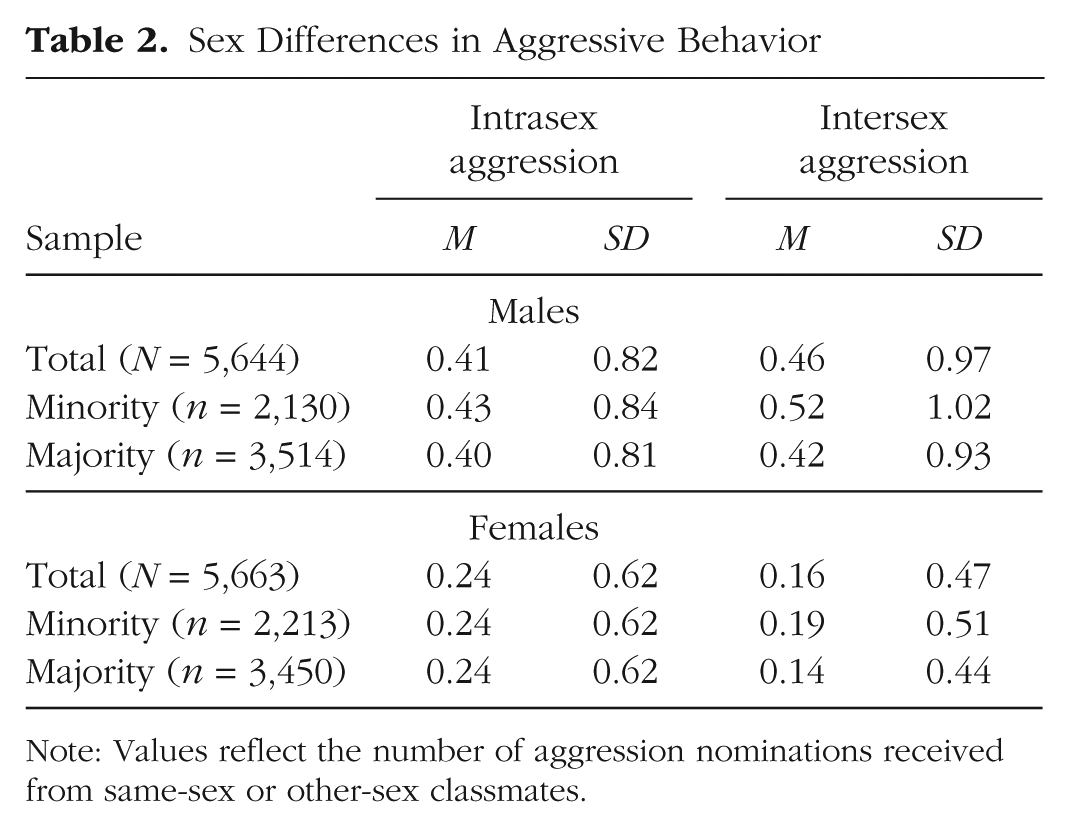
Note: Values reflect the number of aggression nominations received from same-sex or other-sex classmates.
In accordance with the first hypothesis, males were more aggressive than females to same-sex individuals (intrasex aggression), F(1, 11303) = 155.37, p < .001, as well as to other-sex individuals (intersex aggression), F(1, 11303) = 421.29, p < .001, a finding supported by the obtained effect sizes (Cohen’s d = 0.23 and 0.39, respectively). As expected, the sex difference in intersex aggression was, in part, based on the proportionally high number of ethnic-minority students. Our analyses revealed no main effect of ethnic status for intrasex aggression, F(1, 11303) = 1.35, but a main effect of ethnic status for intersex aggression, F(1, 11303) = 27.24, p < .001, as well as a significant Sex × Ethnic Status interaction, F(1, 11303) = 2.96, p < .05. Specifically, while the sex difference in intersex aggression was greater in the minority group than in the majority group, there was a similar sex difference in intrasex aggression across the majority and minority group. Further analyses confirmed the expectation that this interactive effect might be traced back to the more traditional norms of the ethnic minority, who, compared with the ethnic majority, scored higher on both gender norms (minority: M = 0.39, SD = 0.36; majority: M = 0.31, SD = 0.35), F(1, 11305) = 131.46, p < .001, d = 0.23, and masculinity beliefs (minority: M = 2.83, SD = 1.04; majority: M = 2.67, SD = 0.91), F(1, 11305) = 71.80, p < .001, d = 0.17. It should be noted, however, that the sex difference in intersex aggression was still statistically significant in the subsample of ethnic-majority students, t(6962) = 15.83, p < .001, d = 0.38.
Explaining sex differences across different class environments
Class-aggregated sex differences in intra- and intersex aggression differed considerably across different class environments, as shown in Figure 3. The histograms illustrate that the overall sex difference in aggressive behavior tended toward the male direction, in line with the findings reported above. However, at the same time, scores for both outcome variables indicate a substantial amount of variance across the different class environments, including a noticeable number of classes in which girls were more aggressive than boys to same-sex or opposite-sex classmates (i.e., classes with a negative score on the x-axis in Fig. 3).

Class-aggregated sex differences in intra- and intersex aggression. Values on the x-axis represent the difference between the average aggression score for boys and for girls. Positive values indicate higher male aggression, and negative values indicate higher female aggression.
We examined this environment-dependent variability of sex differences in intra- and intersex aggression by simultaneously modeling predictors derived from sexual-selection theory as well as social-role theory while controlling for the class size and ethnic composition of schools. The intraclass coefficients were .07 for intrasex aggression and .10 for intersex aggression, which indicates that 7% and 10% of the variance in each respective outcome variable was attributable to the school level, whereas 93% and 90% were attributable to the class level. Table 3 summarizes the results of the respective multivariate multilevel models.
Results of Multivariate Multilevel Models Predicting Sex Differences in Aggressive Behavior

Note: N = 597 school classes nested in N = 323 schools. CI = confidence interval. Models controlled for class size at Level 2.
All predictors were standardized using z scores to allow for the comparison of regression coefficients. bValues for these factors are class-aggregated scores.
p < .05. **p < .01. ***p < .001.
Findings suggest that the utility of sexual-selection theory and social-role theory for explaining the sex differences in aggressive behavior differed as a function of the victim’s sex. As hypothesized, while sexual-selection predictors explained sex differences in intrasex aggression, social-role predictors tended to explain sex differences in intersex aggression. That is, the male-biased difference in intrasex aggression increased in classes with a stronger hierarchy among males, proportionally more males, and larger male-bias in body dimorphism, while the male-biased difference in intersex aggression increased in classes with more traditional gender norms. The operational sex ratio needs to be interpreted with caution: For both outcome variables, this significant effect might be, in part, structural in nature, given that classes with proportionally more males lacked potential female targets and offered more potential male targets.
Besides the level of statistical significance, the revealed effects can be considered meaningful. For example, the predictor social hierarchy of males indicates that sex differences in intrasex aggression changed by 0.037 if this predictor increased by 1 standard deviation, which corresponds to a change of 12% in the outcome variable. It is, however, important to note that the relative importance of some predictors (i.e., body dimorphism, gender norms, masculinity norms) did not differ as a function of the form of sex difference, as indicated by the overlapping confidence intervals. That is, predictors largely failed to reach the level of statistical significance needed to explain the nontheorized outcome variable, but this predictiveness was not significantly worse than the predictiveness of the theorized outcome variable.
Additional regression models indicated that it is of value to differentiate and separately explain intra- and intersex aggression. Using the same predictors, we found that the model that explained general sex differences in aggression (adjusted R2 = .014, 95% confidence interval, or CI = [−.005, .033], Akaike information criterion, or AIC = −208.18) had a worse fit than models that separately explained intra- and intersex sex differences in aggression (adjusted R2 = .116, 95% CI = [.068, .164], AIC = −485.36; adjusted R2 = .076, 95% CI = [.036, .116], AIC = −359.07). Moreover, all results were replicated in school classes with a low proportion of immigrants (n = 293 school classes).
Discussion
In the present study, we precisely differentiated intrasex and intersex aggression with the help of aggression networks, determined the aggregated sex differences in each type of aggression across ethnically diverse environments, and explained the environment-dependent variability of these sex differences by simultaneously considering biological and social factors. The main findings demonstrate the male-biased sex difference in intrasex aggression as well as intersex aggression and its dual-theory explanation using sexual-selection theory and social-role theory.
Sex differences in intra- and intersex aggression
Sex differences in aggressive behavior differ according to the environment, and it is possible that the usual male-biased difference reverses in some contexts (Clutton-Brock, 2007). However, in general, males were found to be more aggressive than females in terms of both intrasex and intersex aggression. While the sex difference in intrasex aggression seems to be a general effect that is consistent with findings across many meta-analyses (e.g., Card et al., 2008), the sex difference in intersex aggression replicates those of all studies that look beyond conventional Western societies (e.g., Archer, 2006). In this way, the latter finding highlights the successful samplingprocedure in this study, in which we systematically oversampled students from ethnic-minority groups with more traditional gender roles than those reported in ethnic-majority groups.
Having said that, the high proportion of ethnic-minority students contributed only in part to the male-biased difference in intersex aggression, because this difference was also found, albeit to a slightly lesser extent, for the ethnic-majority group. This finding challenges previous research, which suggests that this sex difference tendsto equalize in samples from Western societies (Archer, 2004). However, the few existing studies on intersex aggression mainly focused on aggression within romantic relationships and largely relied on self- or partner reports. Utilizing objective network data of broader social settings, we found an ethnically robust sex difference in both intrasex and intersex aggression.
Dual-theory explanation of sex differences in aggression
In accordance with the existing literature, our results showed that sexual-selection theory primarily predicts sex differences in intrasex aggression, whereas social-role theory primarily predicts sex differences in intersex aggression. This specific pattern of associations is robust across settings with low to high ethnic diversity.
Along these lines, a more helpful framework for explaining sex differences in human aggression seems to be a dual-theory approach with evolutionary as well as normative components. This theoretical refinement corresponds with recent integrative reformulations (Archer, 2009b; Wood & Eagly, 2002) as well as interactive approaches (Eagly & Wood, 2013; Geary, 1999; van den Berghe, 2009), which take into account both sides of the nature-nurture debate that underlies this theoretical discussion. In fact, the complex interaction of biological predispositions as well as sociocultural influences will usually present a better explanation of human behavior than either perspective alone. Despite the revealed theory-specific predictive power, the finding that the relative importance of some predictors did not differ across the outcome variables suggests that social and biological factors are important in both forms of aggression. It is, for example, plausible to assume that phenotypic sex differences are likely to create a predisposition for greater male aggression toward females than vice versa, whereas gender roles are likely to amplify male-biased differences in intrasex aggression. However, given the evidential strengths of sexual-selection theory and social-role theory as well as the finding that the model fit was better when differentiating intra- and intersex aggression than when predicting general sex differences in aggression, it seems to be valuable for an integrative model of sex differences in aggression to disentangle intrasex and intersex aggression and emphasize a particular theory depending on the victim’s sex.
Limitations and future research directions
The aggression-network data used in this research did not specifically allow us to assess physical aggression but merely general aggression, including physical and nonphysical forms of aggression. However, this makes the test of hypotheses more conservative, given females’ higher or at least similar use of nonphysical forms of aggression in comparison with males (Card et al., 2008; Crick & Grotpeter, 1995). Although we still found the expected sex differences, aggression networks in future studies should utilize more precise peer-nomination items (e.g., “Who hits or pushes you sometimes?”).
Another limitation is that we cannot draw causal conclusions from this study. Even though the present cross-sectional design is sufficient for testing the proposed dual-theory approach, experimental research allows a more powerful examination of its validity. More specifically, experimental designs enable researchers to test whether the manipulation of specific biological or social factors affects the sex difference in aggression (e.g., gender rearrangement in school classes). Moreover, even though the predictors used in this study cover a broad range of sociometric, psychosocial, and physical measures, we have to emphasize that any attempt to compare competing theories is limited by the operationalization of their key constructs, and the debate should proceed with new studies using alternative operationalizations (e.g., testosterone dimorphism, parenting attitudes, perceived sex differences). Finally, although there has been much progress in understanding male-biased sex differences in aggression, female-biased aggression is still poorly understood. In accordance with the literature, our study indicates that sex differences in aggression favor females in some contexts. This phenomenon deserves further research, because a better understanding of females’ aggression will advance this field in general.
To conclude, the present study indicates that differentiating between intrasex and intersex aggression has the potential to improve both the precision and predictive power of theories that attempt to explain sex differences in aggression. A dual-theory approach with sexual-selection theory explaining sex differences in intrasex aggression and social-role theory explaining sex differences in intersex aggression seems to acknowledge the different mechanisms that underlie these two forms of sex differences in aggression.
Footnotes
Declaration of Conflicting Interests
The authors declared that they had no conflicts of interest with respect to their authorship or the publication of this article.
Funding
This research was funded by the New Opportunities for Research Funding Agency Co-operation in Europe (NORFACE) research program Migration in Europe: Social, Economic, Cultural and Policy Dynamics.