




Abstract
Bilinguals have two languages that are activated in parallel. During speech production, one of these languages must be selected on the basis of some cue. The present study investigated whether the face of an interlocutor can serve as such a cue. Spanish-Catalan and Dutch-French bilinguals were first familiarized with certain faces, each of which was associated with only one language, during simulated Skype conversations. Afterward, these participants performed a language production task in which they generated words associated with the words produced by familiar and unfamiliar faces displayed on-screen. When responding to familiar faces, participants produced words faster if the faces were speaking the same language as in the previous Skype simulation than if the same faces were speaking a different language. Furthermore, this language priming effect disappeared when it became clear that the interlocutors were actually bilingual. These findings suggest that faces can prime a language, but their cuing effect disappears when it turns out that they are unreliable as language cues.
A bilingual walks into a bar in Barcelona and starts up a conversation with a gentleman sitting at a table. Their conversation is interrupted by a phone call from the bilingual’s Spanish-speaking mother. As he puts down the phone, the bilingual wants to resume the conversation, but he starts wondering which language he was speaking with the gentleman prior to the interruption. Was it Spanish, or was it Catalan?
Bilinguals have two available languages and continuously need to select the appropriate one for the given context. They seem to do this quite effortlessly, even though their two languages are constantly activated in parallel during speech production (Costa, Caramazza, & Sebastián-Gallés, 2000; Van Hell & Dijkstra, 2002) and comprehension (Colomé, 2001; Dijkstra, Grainger, & van Heuven, 1999; Van Assche, Duyck, Hartsuiker, & Diependaele, 2009). For instance, Costa et al. (2000) asked Catalan-Spanish bilinguals to name pictures whose names were either cognates (i.e., words with the same meaning and similar orthography and phonology) or noncognates in the two languages. Analyses revealed that the bilinguals had shorter naming latencies for cognates than for noncognates, because of cross-lingual activation transfer. This cognate facilitation effect supports the notion that lexical access is language nonselective.
Because language selection is required at some point during the production process, language-nonselective access implies a control mechanism that activates the proper language. Several theories have been proposed to explain this mechanism (e.g., Costa, Miozzo, & Caramazza, 1999; Dijkstra & van Heuven, 2002; Green, 1998; Poulisse & Bongaerts, 1994). For instance, Poulisse and Bongaerts’s model assumes that first-language (L1) and second-language (L2) words are stored in a single network, lemmas are tagged with a language label (cf. Green, 1986), and language selection is driven by language cues in the conceptual input. Strikingly, none of these models are clear about the sort of cue that initiates language selection. It is assumed that, in everyday life, language selection is determined by bottom-up information provided by context, such as the language in which the bilingual is being addressed. In experimental conditions, language selection can be driven through other contextual cues, such as the language of prime words or sentences. Nevertheless, it seems that these linguistic cues are often not sufficient to regulate language activation.
Hermans, Bongaerts, de Bot, and Schreuder (1998) showed that Dutch-English bilinguals were unable to restrict language activation to the target language in a picture-word interference paradigm. Participants had to name pictures in English, ignoring simultaneously spoken English words. When the English word distractors were phonologically similar to the Dutch names of the pictures, naming latencies were significantly slowed, which suggests that the Dutch language was activated during English production. Colomé and Miozzo (2010) presented Spanish-Catalan bilinguals with pairs of partially overlapping colored pictures and instructed them to name the green picture in Spanish and ignore the red picture, which had a Catalan name that was either a cognate or a noncognate of the Spanish name. Distractor pictures with cognate names interfered more with picture naming than did distractor pictures with noncognate names.
So, it seems that even when only a single language is relevant for production, lexical activation in bilinguals is not restricted to a single language. Therefore, a number of other researchers have proposed that visual cues, which are extrinsic to the stimuli that are processed, might be able to drive language selection. One such possible cue is the sociocultural identity of a face. When Chinese-English bilinguals were instructed to name pictures of objects, their responses were facilitated when the pictures were preceded by an image of a face consistent with the target language (e.g., an Asian face for a Chinese response; Li, Yang, Scherf, & Li, 2013). Such language priming by faces may also impede speech production: Chinese immigrants’ fluency in English was reduced when they spoke to a Chinese instead of a Caucasian face (Zhang, Morris, Cheng, & Yap, 2013).
In the domain of language comprehension, Molnar, Ibáñez-Molina, and Carreiras (2015) recently showed that face-language associations facilitate word recognition. Proficient Basque-Spanish bilinguals were faster to comprehend words when they were delivered in the language previously associated with the interlocutor’s face. Furthermore, Hartsuiker and Declerck (2009) found that famous faces also influence language production. They asked Dutch-English bilinguals to describe what was happening in a scene showing three pictures, each a head shot of a famous native English-speaking or native Dutch-speaking person. The pictures started moving on the screen, and participants had to describe what happened either in English or in Dutch. For instance, pictures of Jennifer Aniston and Elvis Presley moved upward, and participants were asked to describe this in Dutch or English. Results showed that they experienced more nontarget-language intrusions when the language associated with the famous people and their names was inconsistent with the language to be used in the description. Language intrusions included uttering the English instead of the Dutch conjunction: “Jennifer Aniston and [not “en”] Elvis Presley gaan naar boven.”
In the present study, we investigated whether a familiar face can serve as a language cue that affects language selection and production. Previous studies demonstrated a relation between the cultural identity of a face and language production, but does this relation persist when there is no cultural cue? In other words, can the face of the gentleman in the bar help the bilingual in selecting the appropriate language if the face is a priori neutral regarding the target language? If so, language selection should be facilitated when the target language is congruent with the language linked to the familiar face, and overriding this link (i.e., having to speak in a language not associated with the face) may result in costly top-down interference.
To test this hypothesis, we asked Spanish-Catalan (Experiment 1) and Dutch-French (Experiment 2) bilinguals to perform a language production task. 1 First, participants were familiarized with 12 previously unknown faces through simulated Skype interactions (6 faces spoke one of the participants’ languages, and 6 spoke the other language). In the subsequent test phase, participants were required to generate words semantically related to word stimuli produced by both familiar and unfamiliar faces. Familiar faces uttered words either in the same language they had spoken during the Skype interactions (congruent trials) or in the language that had been used by the other half of the familiar faces (incongruent trials). Trials with the unfamiliar faces served as a baseline. Congruent, incongruent, and baseline trials were mixed and could present stimuli in either language. To avoid effects of language switching (Costa & Santesteban, 2004; Meuter & Allport, 1999), we also included filler trials with other unfamiliar faces to introduce language switches. Thus, both congruent and incongruent trials were always nonswitch trials.
If familiar faces can indeed serve as language cues, participants should be faster in responding to congruent trials than in responding to baseline and incongruent trials. All faces started speaking 2 s after they appeared on-screen, so that that there was enough time for participants to generate language expectations.
Experiment 1
Method
Participants
Twenty-four Spanish-Catalan participants, all bilinguals from birth, were recruited from the University of Pompeu Fabra in Barcelona. All participants were naive to the purpose of the experiment. They were told that the study was about interactions between people via social media, such as Skype. Participants completed a questionnaire about their language proficiency and usage. A 5-point Likert scale, ranging from 1 (rather bad) to 5 (native-speaker level), was employed to tap into each of four language skills (comprehension, speaking, reading, and writing) in both Spanish and Catalan. Composite scores were created to measure L1 and L2 proficiency. Table 1 reports demographic data for this sample.
Demographic Data for Experiments 1 and 2

Note: Standard deviations are given in parentheses.
Materials and procedure
All participants were tested individually, and the entire experiment lasted about 1.5 hr per participant. Tasks were presented via E-Prime 2 (Psychology Software Tools, Pittsburgh, PA) on an IBM-compatible laptop computer that had a 15-in. screen and was running Windows XP. A voice key recorded all response latencies.
Exposure phase
This phase consisted of simulated Skype conversations with 12 different interlocutors and four interactions per interlocutor (an initial interaction, second interaction, etc.). All videos of the interlocutors were recorded beforehand and superimposed on a Skype chat frame. The frame contained the face and shoulders of the interlocutor centered in front of a white background. There were no ethnic differences among the interlocutors’ faces. Each interaction was divided into two segments. The first always contained the interlocutor’s Skype name followed by a question; the second built upon the previous question and then led to another question.
Two interaction sets were created; in each, half of the interlocutors spoke Spanish, and the other half spoke Catalan. Although all interlocutors were recorded in both languages, a given participant heard each interlocutor speaking only one of the two languages. The interlocutors’ languages were counterbalanced across the sets.
Participants were seated in front of the computer and presented with one of the interaction sets (first all initial interactions, then all second interactions, etc.). Skype windows appeared on-screen, and participants were asked to engage in conversation by answering the interlocutors’ questions. Participants were not aware that their responses did not matter. They were allowed to use any language during each interaction, but in most cases used the interlocutor’s language.
Test phase
The test phase involved a noun-verb association task. On each of the 72 experimental trials, a different Catalan noun or its Spanish translation equivalent (see Table A1 in the appendix) was uttered either by an interlocutor from the exposure phase (familiar face) or by an unfamiliar face. Only nouns that could easily be related to a verb were chosen; cognates and false friends (i.e., words that appear the same across languages but actually have different meanings) were excluded. Mean log frequency per million words was matched for the Catalan and Spanish words (Catalan: M = 1.15; Spanish: M = 1.14; p = .89) using NIM, an online stimulus search engine for Spanish, Catalan, and English (Guasch, Boada, Ferré, & Sánchez-Casas, 2013).
Twelve randomization lists were created. A given noun was used in one of the three conditions (congruent, incongruent, or baseline). Each list included 24 nouns produced by familiar faces in the same language they had used during the exposure phase (congruent trials), 24 nouns produced by familiar faces in the language they had not used (incongruent trials), and 24 nouns produced by unfamiliar faces (baseline trials). Sixteen trials with filler nouns, uttered by unfamiliar faces, were added to introduce language switches. Each familiar face appeared four times: twice in a congruent trial and twice in an incongruent trial. The unfamiliar faces also appeared four times: twice speaking Catalan and twice speaking Spanish.
Faces appeared one by one, centered on-screen in front of a white background. Each face was presented for 2,000 ms and then uttered a stimulus word in Catalan or Spanish. Participants were asked to respond to each stimulus as quickly as possible, producing the first verb they associated with it, in the same language as the stimulus. They were given up to 5,000 ms to respond before the program automatically moved on to the next trial.
Posttest phase
A face-language association task served as a manipulation check. Participants were presented with the 12 familiar faces and had to indicate whether each had spoken Catalan or Spanish during the Skype simulation. This task allowed us to determine whether the exposure phase had been sufficient for the participants to memorize both the faces and their languages.
Results
Noun-verb association task
Analyses were performed on reaction times (RTs) for correct responses. A response was considered correct if it was a verb that could plausibly be associated with the stimulus, even if it was unexpected. All RTs deviating more than 2.5 SD from an individual’s mean were excluded from further analyses. This procedure eliminated 0.02% of the trials. Trials without responses (0.04% of all trials) and with incorrect responses (e.g., a verb in the wrong language; 0.01% of all trials) were not included in the analyses.
We analyzed mean RTs using within-subjects (F1) and between-items (F2) 2 (language: Spanish, Catalan) × 3 (condition: baseline, congruent, incongruent) analyses of variance (ANOVAs). These analyses yielded a main effect of language, F1(1, 23) = 16.71, p < .001, η p 2 = .421, and F2(1, 69) = 12.70, p = .001, η p 2 = .155, and a main effect of condition, F1(2, 23) = 75.76, p < .001, η p 2 = .767, and F2(2, 69) = 3.62, p = .032, η p 2 = .095. Participants responded faster in Spanish than in Catalan. There was no Language × Condition interaction, F1 < 1.00, n.s., and F2 = 1.36, n.s. Planned comparisons revealed that responses were slower on baseline trials (M = 1,885 ms, SD = 283) than on congruent trials (M = 1,578 ms, SD = 271), t1(23) = 10.42, p < .001, and t2(46) = 2.93, p = .005. RTs were also slower on baseline trials than on incongruent trials (M = 1,575 ms, SD = 258), t1(23) = 9.93, p < .001, and t2(47) = 1.75, p = .087. RTs did not differ between congruent and incongruent trials.
A follow-up analysis tested the hypothesis that an effect of congruency dissipated over the course of the experiment, as familiar faces spoke in an unexpected language on the incongruent trials, so that the face-language associations grew weaker over time. In this analysis, the position of the 42 congruent and incongruent trials was taken into account. These trials were divided according to whether they were among the first 6 (Position 1) or the remainder (Position 2) of each type of trial. We placed the cutoff between Positions 1 and 2 at the first 6 trials in order to have sufficient data points in both languages and to make sure that participants had seen every speaker at least once (in either the congruent or the incongruent condition). We analyzed mean RT in 2 (language: Spanish, Catalan) × 2 (condition: congruent, incongruent) × 2 (position: 1, 2) F1 and F2 ANOVAs; in the latter, condition and position were between-items factors. These analyses produced main effects of language, F1(1, 19) = 18.53, p < .001, η p 2 = .446, and F2(1, 44) = 12.74, p = .001, η p 2 = .225. There were no main effects of condition, F1(1, 19) = 3.05, p = .094, η p 2 = .117, and F2(1, 44) < 1.0, n.s., or of position, F1(1, 19) = 1.05, p = .316, η p 2 = .044, and F2(1, 44) < 1.0, n.s. Crucially, the Condition × Position interaction was significant in the F1 analysis, F1(1, 19) = 6.71, p = .016, η p 2 = .226, though not in the F2 analysis, F2(1, 44) < 1.0, n.s., probably because of the limited number of observations and the fact that both variables were between items. Other interactions were not significant (all Fs < 1.0). Paired-samples t tests revealed a difference between congruent and incongruent trials at Position 1 in the F1 analysis, t1(23) = −2.38, p = .026, and t2(22) = −0.85, p = .403; responses were faster on congruent trials. There was no congruency effect at Position 2, t1(23) = 1.65, p = .113, and t2(23) = −0.43, p = .670 (Fig. 1).

Reaction times (RTs) on congruent and incongruent trials as a function of position. For Experiment 1 (left panel), Position 1 refers to the first six trials of each type, and Position 2 refers to the remaining trials. For Experiment 2 (right panel), Position 1 refers to the first half of congruent and incongruent trials in Block 2, and Position 2 refers to the second half of these trials in Block 2. Vertical bars represent ±1 SE.
Face-language association
On average, participants reported the correct face-language association on 85.5% of the trials (Catalan: M = 83.3%, SD = 15.1%; Spanish: M = 87.7%, SD = 12.5%). Language did not have a significant effect on memory for these associations.
Discussion
Across the entire experiment, the noun-verb association task yielded no effect of congruency: Responses on congruent trials were faster than responses on baseline trials, but RTs on congruent and incongruent trials were comparable. However, when we looked only at the first six trials of the task, we found that participants clearly responded much faster on congruent trials than on incongruent trials. These results suggest that a face can serve as a cue for a specific language. Moreover, the face-language association task confirmed that participants actually related an interlocutor’s face to a certain language. We also observed that the introduction of incongruent trials, which made the faces less predictive for language in subsequent trials, strongly affected the congruency effect, so that there was no RT difference between congruent and incongruent trials later in the experiment. This demonstrates that although a face can prime a language, this effect vanishes rapidly when it turns out that the face is unreliable as a language cue (i.e., when it becomes clear that the face speaks more than one language).
All in all, the results of Experiment 1 demonstrate a priming effect of faces, albeit only on early trials. Because early in the test phase participants experienced that the familiar faces actually spoke two languages, we modified our design in Experiment 2 in order to have a larger number of congruent and baseline trials before incongruent trials were introduced. This experiment was conducted among Dutch-French bilinguals, and the association task comprised two blocks. Block 1 contained only baseline and congruent trials, whereas Block 2 consisted of both congruent and incongruent trials. Additionally, we used a noun-noun association task instead of a noun-verb association task, because of the availability of a normed database that allowed us to control for association frequency in both French and Dutch.
We again tested the hypothesis that familiar faces have the ability to prime language. We assumed that RTs on congruent trials in Block 1 would be faster than RTs on incongruent trials in Block 2. Furthermore, we expected that the congruency effect would persist only in the beginning of Block 2 and then disappear quickly, as the incongruent trials would soon weaken the participants’ expectations (as in Experiment 1).
Experiment 2
Method
Participants
We tested 30 highly proficient Dutch-French bilinguals recruited in Ghent and Brussels. All participants were naive to the purpose of the experiment. Seven were bilinguals from birth, 8 were early bilinguals (i.e., L2 acquired before age 6), and 15 were late bilinguals (i.e., L2 acquired at age 6 or later). Five participants indicated that French was their L1; the others reported that Dutch was their L1. Participants completed a questionnaire about their language proficiency and usage. Again, a 5-point Likert scale was used to tap into four language skills, this time in Dutch and French, and a composite score was created for each language. Table 1 reports demographic data for this sample.
Materials and procedure
The procedure was the same as in Experiment 1. Oral responses were recorded via Edirol R-1 (Roland Corp., Los Angeles, CA), and RTs were determined manually in Praat (Boersma & Weenink, 2013).
Exposure phase
The materials for this phase were the same as in Experiment 1, except that all videos showed 12 Belgian interlocutors speaking Dutch and French.
Test phase
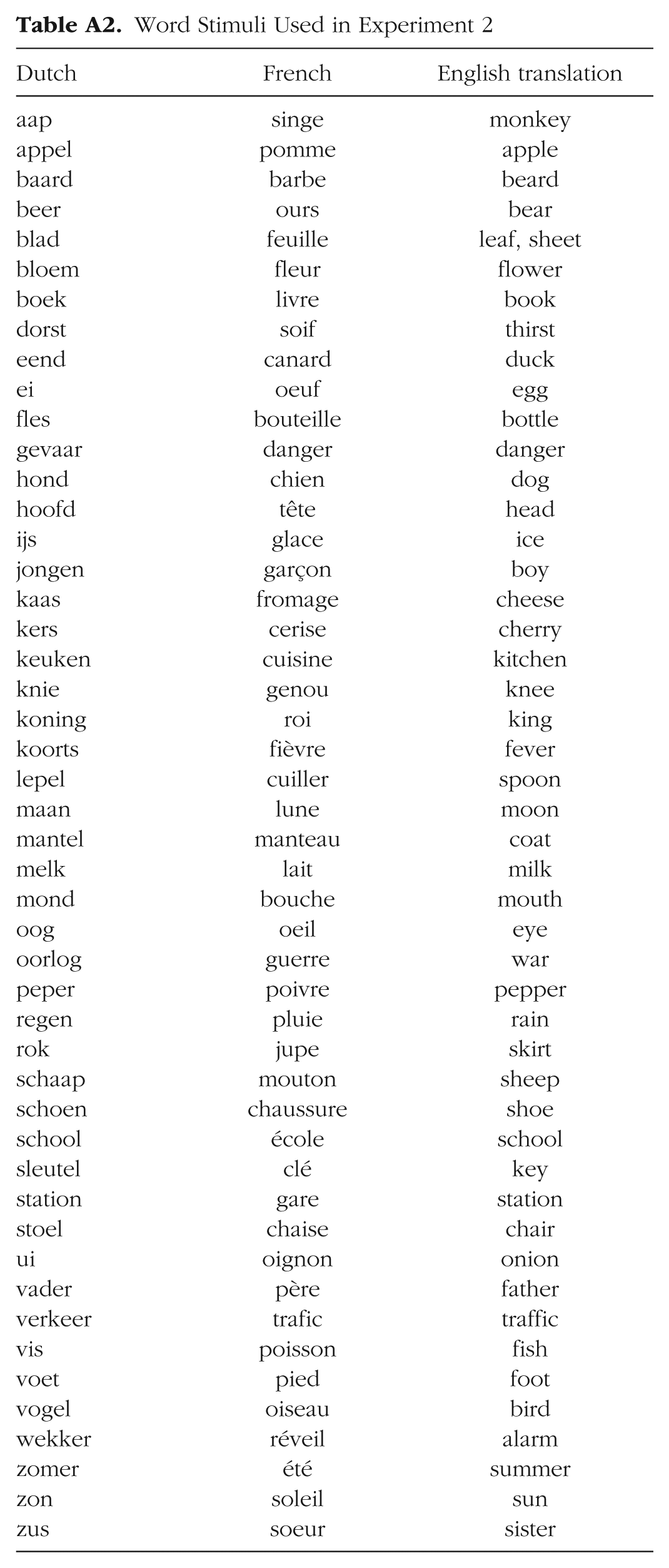
The test phase involved a noun-noun association task that was modeled after the noun-verb association task in Experiment 1. On each of the 48 experimental trials, a different Dutch noun or its French translation equivalent (see Table A2 in the appendix) was uttered by a familiar or unfamiliar face. Each noun appeared in all conditions (baseline, congruent, and incongruent). Only nouns that could easily be related to another noun and that had the highest association frequency (> .15; calculated using the database of De Deyne & Storms, 2008) were chosen. Association frequency (Dutch: M = .18, French: M = .18) and number of phonological syllables (Dutch: M = 1.35; French: M = 1.45) were matched between the Dutch words and their French translation equivalents. Mean log frequency per million was also matched for the Dutch and French words (Dutch: M = 1.78; French: M = 1.80), using the WordGen stimulus-generation program (Duyck, Desmet, Verbeke, & Brysbaert, 2004) and selecting words from the Dutch CELEX corpus (Baayen, Piepenbrock, & Van Rijn, 1993) and the French Lexique corpus (New, Pallier, Brysbaert, & Ferrand, 2004). Paired-samples t tests showed that the Dutch words and their French translation equivalents were similar with respect to all these variables (all ps > .13).
Eight randomization lists of 66 trials were created, and each contained two blocks. Block 1 consisted of 12 baseline trials, 9 filler trials, and 12 congruent trials; Block 2 consisted of another 9 filler trials, 12 congruent trials, and 12 incongruent trials. Participants were asked to respond to each stimulus as quickly as possible, producing the first noun they associated with it, in the same language as the stimulus.
Posttest phase
The face-language association task was the same as in Experiment 1, but included the 12 Belgian speakers, and participants indicated whether each face had spoken Dutch or French during the Skype simulation.
Results
Noun-noun association task
Analyses were performed on RTs for correct responses only. RTs deviating more than 2.5 SD from an individual’s mean were excluded from further analyses. This procedure eliminated 2.9% of all trials. Error rates were high: Participants did not respond on 2.4% of the trials, responded in the incorrect language on 2.1% of the trials, and responded with words that were not from the correct grammatical category (i.e., that were not nouns) on 7.4% of the trials. Trials with stimuli that led to misinterpretations due to homophony (e.g., the French word bouche was often interpreted as the English name Bush) were also excluded (2.9% of the trials).
Block 1 contained congruent trials (mean RT = 2,163 ms, SD = 423) and baseline trials (mean RT = 2,188 ms, SD = 375); Block 2 included congruent trials (mean RT = 2,234 ms, SD = 512) and incongruent trials (mean RT = 2,349 ms, SD = 498). We performed both F1 analyses, in which language and condition varied within participants, and F2 analyses, in which both factors varied between items. Analyses of the data from Block 1 did not yield any effects of condition (both Fs < 1.0, n.s.). In order to assess the congruency effect across blocks, we ran 2 (language: Dutch, French) × 2 (condition: congruent trials from Block 1, incongruent trials from Block 2) ANOVAs. The F1 analysis yielded an effect of language, F1(1, 29) = 6.83, p = .014, η p 2 = .191; responses were slower in French than in Dutch. This analysis also revealed an effect of condition, F1(1, 29) = 6.94, p = .013, η p 2 = .193; participants responded more slowly on incongruent trials (Block 2) than on congruent trials (Block 1). The F2 analyses did not yield effects of either language, F2(1, 42) = 2.26, p = .140, η p 2 = .051, or condition, F2(1, 42) = 2.14, p = .151, η p 2 = .048. There were no interactions (both Fs < 1.0, n.s.).
A follow-up analysis tested our hypothesis that the congruency effect would vanish over the course of Block 2. In this analysis, we took into account the position of the congruent and incongruent trials. The 12 congruent trials were divided into the first 6 (Position 1) and the second 6 (Position 2). The same was done for the 12 incongruent trials. We then performed 2 (language: Dutch, French) × 2 (condition: congruent, incongruent) × 2 (position: 1, 2) F1 and F2 analyses. The F1 analysis yielded main effects of condition, F1(1, 25) = 4.68, p = .040, η p 2 = .158, and language, F1(1, 25) = 5.82, p = .024, η p 2 = .189, but no effect of position, F < 1.0, n.s. The F2 analysis revealed no main effects—condition: F2(1, 18) = 3.15, p = .093, η p 2 = .149; language: F2(1, 18) = 3.48, p = .079, η p 2 = .162; position: F < 1.0, n.s. Critically, the Condition × Position interaction was significant in both analyses, F1(1, 25) = 8.03, p = .009, η p 2 = .243, and F2(1, 18) = 5.45, p = .031, η p 2 = .232. No other interactions were significant (all Fs < 1.0). Paired-samples t tests revealed that responses were significantly faster on congruent trials than on incongruent trials at Position 1, t1(29) = −3.16, p = .004, and t2(23) = −4.54, p < .001, but not at Position 2, t1(29) = 0.44, p = .666, and t2(23) = 0.33, p = .743 (Fig. 1).
Face-language association
Because of a technical malfunction, 3 participants’ responses in the posttest were not recorded. We performed analyses on the responses of the remaining 27 participants. On average, participants reported the correct association on 92.9% of the trials (Dutch: 94.4%, SD = 8.0%; French: 91.4%, SD = 14.2%), which again validated the face-language manipulation. There were no significant effects of language on accuracy.
Discussion
We obtained a significant interaction between condition and position in Experiment 2, and therefore replicated the early congruency effect found in Experiment 1. Participants responded much faster on congruent trials than on incongruent trials, but this effect disappeared toward the end of Block 2, after a few incongruent trials. These outcomes confirm the hypothesis that faces can prime a language as long as they are associated with only one language.
General Discussion
Given that a bilingual’s two languages are constantly activated in parallel during speech production (e.g., Colomé & Miozzo, 2010; Costa et al., 2000; Van Hell & Dijkstra, 2002), something must trigger selection of one of those languages. We investigated whether familiar faces that are specifically associated with one language could constitute such a cue and consequently affect language selection. We recruited Spanish-Catalan and Dutch-French bilinguals to perform a language production task in which they had to generate words associated with the words produced by familiar and unfamiliar faces displayed on-screen. Prior to this task, participants were acquainted with the familiar faces by interacting with them in simulated Skype conversations. Each familiar face was associated with only one specific language. The language production task consisted of congruent trials (familiar faces uttering words in the same language they had used during the Skype conversations), incongruent trials (familiar faces speaking in the other language), baseline trials (unfamiliar faces), and filler trials (unfamiliar faces that introduced language switches). We reasoned that if faces can serve as language cues, bilinguals would be faster to respond on congruent trials than on baseline and incongruent trials.
The first experiment was conducted with Spanish-Catalan bilinguals and provided evidence that a face could prime a language: Production was faster when participants responded to a face speaking the expected language rather than the unexpected language; that is, there was a congruency effect. Nevertheless, after the first incongruent trials, participants seem to have realized that a previously reliably Spanish-speaking interlocutor could also speak Catalan, or vice versa. This removed the strong predictive value of the faces and immediately altered the congruency effect. We therefore modified our design in the second experiment, carried out with Dutch-French bilinguals.
In this second experiment, we created two blocks. The first contained baseline and congruent trials, and the second contained congruent and incongruent trials. We found an overall congruency effect, with faster RTs on congruent trials, when we compared congruent trials from the first block with incongruent trials from the second block. We also compared congruent and incongruent trials within the second block, in which they were mixed. A congruency effect was initially present, but then disappeared. This confirms the hypothesis that language selection can be triggered by a face prime. Nevertheless, it also suggests that faces can serve as primes only for as long as they are associated with only one language. As soon as faces lose their predictive consistency, they are no longer used as language cues.
In general, Spanish-Catalan bilinguals were faster and made fewer errors than Dutch-French bilinguals, perhaps because of different requirements of the association tasks they performed. Participants may have found it easier to generate a noun-verb than a noun-noun association. This possibility is supported by the fact that many Dutch-French bilinguals made the grammatical error of producing a verb even though a noun was requested. We also found that participants reacted faster in Spanish and Dutch than in Catalan and French, but language never interacted with condition or with the Condition × Position interaction. Additionally, Dutch-French bilinguals reported lower L2 proficiency than Spanish-Catalan bilinguals. To ascertain whether L2 proficiency and age of acquisition affected the results, we correlated the self-reported L2 data with the congruency effects in both experiments and found no relation (rs ranged between −.20 and .15, all ps > .19).
Li et al. (2013) established that the sociocultural identity of a face primes language activation in bilinguals. The current study now adds that the association between a culturally neutral face and a language may have a similar effect. Our study also demonstrates that even a little experience with an interlocutor is enough to form such an association. However, it also shows that a little experience with counterexamples (i.e., when a face starts speaking another language) is enough to override such an expectancy. The face then loses its strong predictive value for language. An interesting remaining question is whether faces with strong cultural identity (such as those used by Li et al. and Zhang et al., 2013) would also lose their cuing effect quickly after incongruent trials, or instead continue to prime the language associated with the culture.
Our results also mirror the effects demonstrated by Molnar et al. (2015) in the perception domain. They found that bilinguals were faster to comprehend words if the words were spoken in the language previously associated with the interlocutors rather than another language, but this was not the case when it was clear that the interlocutors spoke two languages. In that study, faces were also ethnically neutral; it is therefore an interesting question whether the observed elimination of the priming effect would still be found if the faces’ physical appearance was clearly associated with language.
Finally, we believe our findings have substantial theoretical implications for models of bilingual language production, because they suggest some top-down mechanism that may tune production on the basis of reliable nonlinguistic cues. We propose that our findings can be integrated with the theory set forth by Poulisse and Bongaerts (1994), which states that language selection is determined during conceptualization. Specifically, a face that is linked to a particular language can activate word representations tagged with that language label. On incongruent trials, the familiar faces activated the language previously associated with them, and it took time to activate representations in the other language (which at that moment was the correct response language); this led to longer RTs on these incongruent trials. At the same time, our findings indicate that as soon as a cue loses its language-specific predictive value, such top-down language priming disappears.
Footnotes
Appendix
Word Stimuli Used in Experiment 2
| Dutch | French | English translation |
|---|---|---|
| aap | singe | monkey |
| appel | pomme | apple |
| baard | barbe | beard |
| beer | ours | bear |
| blad | feuille | leaf, sheet |
| bloem | fleur | flower |
| boek | livre | book |
| dorst | soif | thirst |
| eend | canard | duck |
| ei | oeuf | egg |
| fles | bouteille | bottle |
| gevaar | danger | danger |
| hond | chien | dog |
| hoofd | tête | head |
| ijs | glace | ice |
| jongen | garçon | boy |
| kaas | fromage | cheese |
| kers | cerise | cherry |
| keuken | cuisine | kitchen |
| knie | genou | knee |
| koning | roi | king |
| koorts | fièvre | fever |
| lepel | cuiller | spoon |
| maan | lune | moon |
| mantel | manteau | coat |
| melk | lait | milk |
| mond | bouche | mouth |
| oog | oeil | eye |
| oorlog | guerre | war |
| peper | poivre | pepper |
| regen | pluie | rain |
| rok | jupe | skirt |
| schaap | mouton | sheep |
| schoen | chaussure | shoe |
| school | école | school |
| sleutel | clé | key |
| station | gare | station |
| stoel | chaise | chair |
| ui | oignon | onion |
| vader | père | father |
| verkeer | trafic | traffic |
| vis | poisson | fish |
| voet | pied | foot |
| vogel | oiseau | bird |
| wekker | réveil | alarm |
| zomer | été | summer |
| zon | soleil | sun |
| zus | soeur | sister |
Declaration of Conflicting Interests
The authors declared that they had no conflicts of interest with respect to their authorship or the publication of this article.
Funding
This study was supported by the Special Research Fund (BOF) of Ghent University, the Spanish Government (PSI2011-23033), the Catalan Government (GRNC-2014SGR1210), and the European Research Council under the European Community’s Seventh Framework (FP7/2007-2013 Cooperation Grant Agreement 613465-AThEME).