



Abstract
A growing social psychological literature reveals that brief interventions can benefit disadvantaged students. We tested a key component of the theoretical assumption that interventions exert long-term effects because they initiate recursive processes. Focusing on how interventions alter students’ responses to specific situations over time, we conducted a follow-up lab study with students who had participated in a difference-education intervention 2 years earlier. In the intervention, students learned how their social-class backgrounds mattered in college. The follow-up study assessed participants’ behavioral and hormonal responses to stressful college situations. We found that difference-education participants discussed their backgrounds in a speech more frequently than control participants did, an indication that they retained the understanding of how their backgrounds mattered. Moreover, among first-generation students (i.e., students whose parents did not have 4-year degrees), those in the difference-education condition showed greater physiological thriving (i.e., anabolic-balance reactivity) than those in the control condition, which suggests that they experienced their working-class backgrounds as a strength.
A growing literature in social psychology demonstrates the power of brief interventions to improve the academic and social outcomes of students who are disadvantaged by mainstream educational settings (Wilson, 2011). A short self-affirmation exercise—for example, writing about their values—can dramatically improve the academic outcomes of racial-minority students (Cohen, Garcia, Apfel, & Master, 2006). Moreover, framing university assessment practices as a tool for learning, rather than selection, can improve the academic performance of students from lower social-class backgrounds (Smeding, Darnon, Souchal, Toczek-Capelle, & Butera, 2013). Although some of the long-term benefits of these interventions (e.g., better grades) are well documented, additional research is needed to clarify how these types of interventions can affect students’ subjective psychological experiences across time and situations. Scholars theorize that these interventions exert long-term effects because they initiate recursive, or self-reinforcing, processes that shift how students make sense of and respond to situations over time (Cohen & Sherman, 2014; Sherman et al., 2013; Yeager & Walton, 2011).
In this article, we report a study focused on a key prediction of this critical yet largely untested theoretical assumption: that long after an intervention, the effects of recursive processes should be observable in response to specific situations relevant to the intervention. We recruited participants nearly 2 years after they participated in an hour-long intervention designed to improve the college adjustment of students from lower social-class backgrounds (or a control intervention). In the difference-education intervention, incoming college students—both first-generation (i.e., students whose parents did not have 4-year college degrees) and continuing-generation (i.e., students who had at least one parent with a 4-year degree)—listened to senior students’ stories of transitioning to college and learning how to be successful (Stephens, Hamedani, & Destin, 2014). The stories highlighted how students’ diverse social-class backgrounds can shape their experiences and challenges in college, as well as the strengths and strategies that students need to be successful. In other words, participants in the difference-education condition learned that although their social-class backgrounds might confer certain obstacles or challenges, their backgrounds could also serve as a source of strength as they learned to navigate college. In the control intervention, incoming first-generation and continuing-generation students learned similar content about challenges, obstacles, and strategies for success in college, but this content was not linked to their backgrounds.
We found that at the end of the first year in college, participants in the difference-education condition adjusted more effectively to college than those in the control condition. For example, they reported higher levels of social fit, academic identification, and psychological well-being. Moreover, we also found that first-generation students in the difference-education condition in particular showed improved academic outcomes and sought campus resources more often than first-generation students in the control condition. We theorized that one way in which the difference-education intervention produced these benefits was by providing students with a framework to understand how their social-class backgrounds shaped what they experienced in college, in both good and bad ways. If this difference-education framework functions as theorized, then it should equip students with an understanding of their backgrounds that persists over time, guiding how they make sense of and respond to the specific experiences they encounter in college. Accordingly, we predicted that long after the intervention, participants in the difference-education condition would retain and be able to use the framework to make sense of how their backgrounds influenced their college experiences. Moreover, given that first-generation students frequently experience cultural conflicts between their working-class backgrounds and the middle-class culture of higher education (Covarrubias & Fryberg, 2014; Covarrubias, Romero, & Trivelli, 2015), we expected that the framework would benefit them in particular. Specifically, we predicted that among participants in the difference-education condition, first-generation students would be especially likely to experience their working-class backgrounds as a resource or source of strength and therefore show physiologically adaptive coping responses (physiological thriving) in the face of stressful college situations.
To test these predictions, we conducted a controlled laboratory study 2 years after participants’ initial exposure to the difference-education intervention. Specifically, we asked students to complete a series of ostensibly unrelated stressful tasks: to discuss the influence of their backgrounds in a speech and to complete two additional activities (i.e., a GRE and word-search task). As participants completed the tasks, we assessed their stress responses by measuring changes in their levels of a catabolic hormone (i.e., cortisol) and an anabolic hormone (i.e., dehydroepiandrosterone in its bound form: DHEA sulfate, or DHEA(S)).
We hypothesized that
Participants in the difference-education condition would use the difference-education framework more than participants in the control condition, as indicated by mentioning their backgrounds while delivering the speech.
First-generation students in the difference-education condition would show a greater degree of physiological thriving in their coping responses than first-generation students in the control condition, as indicated by their neuroendocrine measures (i.e., a greater ratio of anabolic to catabolic hormones).
Method
First-generation and continuing-generation college students participated in a two-part study. Part 1, the initial intervention, occurred during the first few weeks of students’ first year in college (see Stephens et al., 2014, for more information). Part 2 occurred in the last few months of participants’ second year in college. This lab portion of the study examined whether they retained and could use the difference-education framework and assessed physiological thriving in their coping responses (i.e., changes in neuroendocrine levels).
Participants
In the first few weeks of their first year in college, participants were randomly assigned to one of two conditions of the initial intervention: the difference-education condition (n = 84) or the control condition (n = 84; see the Supplemental Material for Stephens et al., 2014, for additional details about the criteria for initial recruitment). During the spring quarter of their second year in college, these students were sent an e-mail invitation to participate in a lab study for which they would be paid $50. Participants were told that the purpose of the study was to “develop and test new materials and tasks that [university name] may use to help incoming students” in the future. They were also informed that the researchers were “interested in students’ physiological responses to these academic tasks.” The description of the study did not connect it to the initial intervention, so that we could assess whether the theorized effects would emerge spontaneously without explicitly reminding participants of the original intervention.
We recruited as many of the 168 intervention participants (78 first-generation and 90 continuing-generation) as possible. Specifically, our sample for Part 2 consisted of 133 students (mean age = 20.04 years, SD = 0.38; 69 females, 64 males; retention rate = 79.2%; difference-education condition: n = 70; control condition: n = 63). 1 Among first-generation students (n = 56), 42.86% self-identified as White, 17.86% as Asian or Asian American, 14.29% as African American, and 25.00% as Latino. Among continuing-generation students (n = 77), 49.35% self-identified as White, 24.68% as Asian or Asian American, 10.39% as African American, 14.29% as Latino, and 1.30% as Hawaiian or Pacific Islander.
Procedure
Part 1: intervention
During the hour-long intervention (see Stephens et al., 2014, for a complete description of the intervention methods), all participants, regardless of condition, heard the same demographically diverse panel of college seniors (three first-generation, five continuing-generation) respond to a series of planned questions asked by a moderator. Panelists’ responses highlighted how they adjusted to and found success in college; the content was based on panelists’ real-life experiences. Responses in the two conditions were comparable in valence, length, and appeal.
The key difference between the two conditions was whether the content of the responses was background-specific. In the difference-education condition, the content of panelists’ stories was linked to their social-class backgrounds. In other words, through subtle yet systematic variation in the content of panelists’ stories, participants gained a framework to understand how their social-class backgrounds could matter in college. Specifically, panelists’ stories made their family social-class backgrounds salient and linked those backgrounds to particular obstacles that students are likely to confront in college. The stories also highlighted how different backgrounds can confer strengths and require particular strategies to be successful. For example, panelists in the difference-education condition were asked, “Can you provide an example of an obstacle that you faced when you came to [university name] and how you resolved it?” One panelist, who had previously identified herself as a first-generation student, responded: Because my parents didn’t go to college, they weren’t always able to provide me the advice I needed. So it was sometimes hard to figure out which classes to take and what I wanted to do in the future. But there are other people who can provide that advice, and I learned that I needed to rely on my adviser more than other students.
In contrast, a continuing-generation panelist who had previously mentioned her parents’ graduate degrees responded: I went to a small private school, and it was great college prep. We got lots of one-on-one attention, so it was a big adjustment going into classes with 300 people. I felt less overwhelmed when I took the time to get to know other students in the class.
As these two examples reveal, panelists’ stories not only highlighted their different social-class backgrounds (e.g., parents’ educational attainment), but also linked those backgrounds to their particular college experiences and strategies needed to be successful (e.g., the first-generation student had difficulty choosing classes and found it helpful to get extra advice).
In the control condition, panelists’ stories provided general content that was not linked to their social-class backgrounds. In other words, participants did not gain a framework to understand how their social-class backgrounds could affect their college experience. For example, panelists were asked, “What do you do to be successful in your classes?” One panelist advised, “Go to class, and pay attention. If you don’t understand something or have a hard time with the material, meet with your teaching assistant or professor during office hours.” Participants in the control condition also learned about panelists’ different experiences in college and strategies needed to be successful (e.g., a student had difficulty with coursework and found it helpful to meet with a professor). This content, however, was not background-specific. (See the Supplemental Material for Stephens et al., 2014, for a full list of the questions and sample responses from both conditions.)
Part 2: lab session
As already noted, we recruited participants for a study ostensibly aimed at developing new welcome materials and activities for incoming students. A research assistant scheduled each participant individually for the study, which took place between 2:00 p.m. and 7:00 p.m., when cortisol levels reach their diurnal nadir. So that potential effects of sex-hormone fluctuations on cortisol would be minimized, female students were scheduled to participate when they were in the follicular phase of their menstrual cycles (as determined by their responses to a prestudy survey). Before their scheduled visit, participants received a list of activities to avoid prior to their session because of potential hormonal effects (e.g., exercising, consuming caffeine).
The experimenter greeted participants as they arrived in the lab and told them the following: Residential Education is responsible for developing the policies and programs that are used with incoming students. In an effort to evaluate some of the strategies that [university name] has used in the past, we are currently testing potential materials, tasks, and activities for next year’s incoming class. We would like your help developing and testing new materials and tasks that [university name] may use with incoming students in the future. In addition to having students test these materials and tasks, we are also interested in students’ physiological responses to these academic tasks.
Next, participants completed an initial questionnaire that included questions assessing female participants’ menstrual phase and whether participants had followed the instructions to avoid certain activities. Afterward, they provided a baseline saliva sample (20 min after arrival in the lab). Participants were told that in the next part of the study they would be asked to give a 5-min speech for which they would have 2 min to prepare. They were told that the speech should focus on how their backgrounds influenced their college experience. The research assistant introduced the task as follows: We would like for you to give a brief testimonial or speech to next year’s incoming students explaining the ways in which your background influenced your transition to and experience at [university name]. We would like you to focus on the parts of your background that might have affected your experience at [university name] and how you think those factors made a difference.
The research assistant explained that the speech would be recorded, that participants should speak for the full 5 min, and that the researchers conducting the study would later listen to the speeches to develop content for the university’s future orientation materials. Participants were then given a document that reiterated the verbal instructions and provided some blank space for writing notes in preparation for the speech.
After preparing for and delivering the speech, participants completed a series of additional tasks. The research assistant told them, “We also want to assess the validity of measures of verbal and math skills—some that [university name] has used in the past to determine whether people need additional tutoring before entering certain classes.” The research assistant then asked participants to roll a die to determine their random assignment to a set of tests. In reality, however, all students were asked to complete the same set of stressful tasks: a GRE test including both math and verbal items (7 min) and a word-search puzzle (3 min). The purpose of these tasks was to create an evaluative and stressful set of situations mirroring the evaluative stress students often encounter in college so that we could assess participants’ physiological thriving (i.e., their neuroendocrine responses). We included these tasks because pairing cognitive tasks with a speech effectively activates the hypothalamic-pituitary-adrenocortical (HPA) axis, one of the primary stress systems (Dickerson & Kemeny, 2004). After completing the stressful tasks, participants filled out a questionnaire that assessed their perceptions of their experience with the speech and GRE tasks. 2 During the course of these activities, poststressor saliva samples were collected 20, 35, and 50 min after participants received the speech instructions. In the time that remained prior to the final saliva sample, participants completed an unrelated survey (for a different study) about their college transition.
Measures
Discussing one’s background
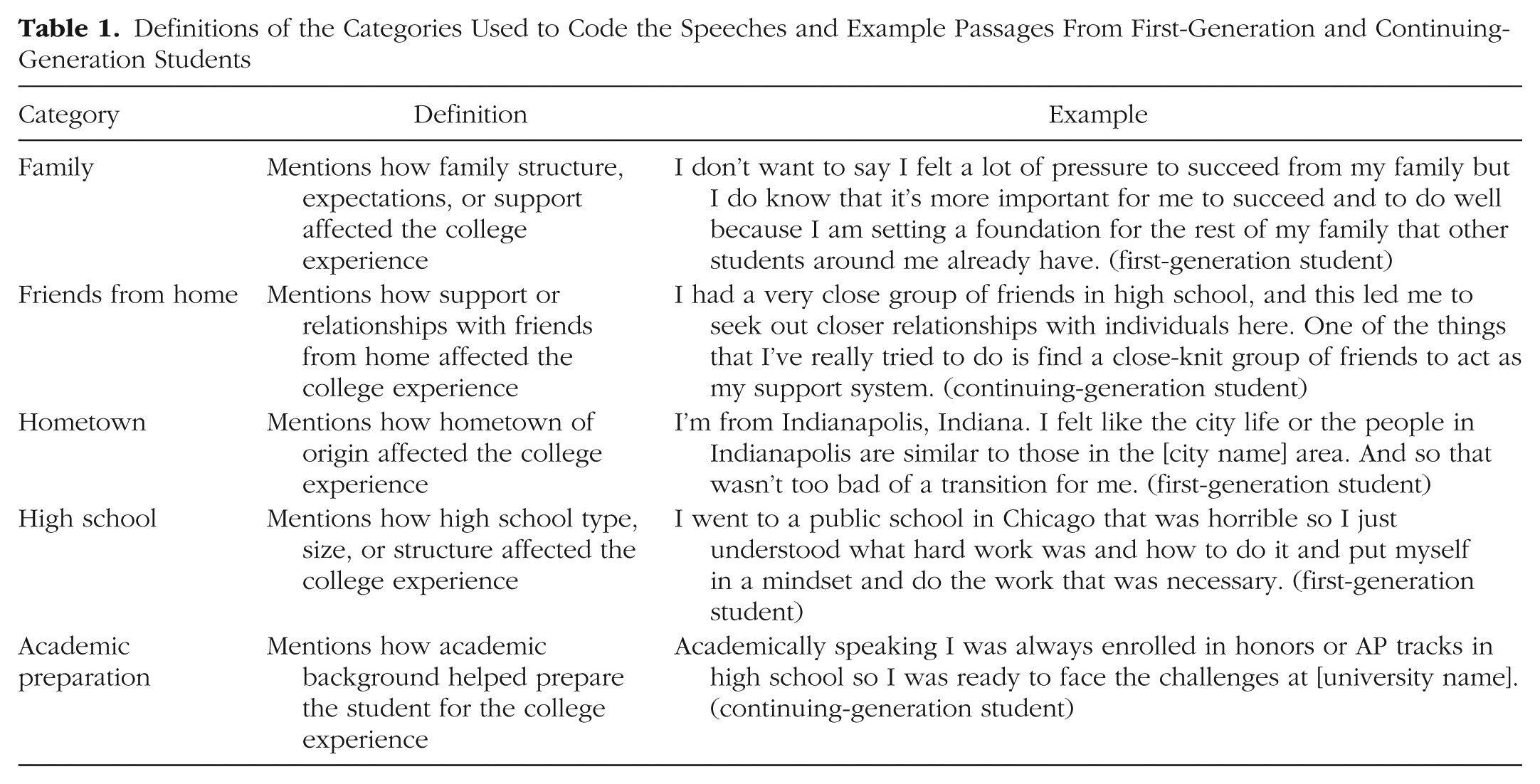
To assess participants’ willingness to discuss their backgrounds publicly, we first transcribed their speeches and then coded the content. We developed a coding scheme that included five important background contexts that are likely to shape students’ experiences in college: family, friends from home, hometown, high school, and academic preparation. Each speech was coded for whether it included each of these background contexts (1 = yes; 0 = no).
Two research assistants who were unaware of the study conditions and hypotheses used the coding scheme to code 25% of the speeches. After they attained excellent reliability (mean κ = .93, range = .75–1.0; Landis & Koch, 1977), one of the research assistants independently coded the remaining speeches. Table 1 provides definitions of the five coding categories and examples of passages that were coded as referring to these contexts.
Definitions of the Categories Used to Code the Speeches and Example Passages From First-Generation and Continuing-Generation Students
Neuroendocrine reactivity
To assess participants’ physiological thriving, we measured changes in levels of catabolic and anabolic hormones (i.e., cortisol and DHEA(S), respectively) while participants engaged in the stressful tasks. We used these measures to examine anabolic balance, that is, the ratio of anabolic to catabolic hormones. Some hormonal increases indicate maladaptive reactions, whereas others indicate benign or healthy reactions (Epel, McEwen, & Ickovics, 1998; McEwen, 1998). By assessing relative changes in anabolic and catabolic hormones, one can distinguish between these reactions. Both cortisol and DHEA(S) are end products of the HPA axis. DHEA(S) may protect the body from the catabolic aspects of the stress response by counterregulating catabolic hormones (Epel et al., 1998; Wolf et al., 1997), and low levels of DHEA(S) have been linked to affective vulnerability (Akinola & Mendes, 2008). By indicating the net anabolic relative to catabolic effects of stress, anabolic balance may provide a more nuanced picture of the magnitude of adaptive relative to maladaptive coping than cortisol alone does (Mendes, Gray, Mendoza-Denton, Major, & Epel, 2007; Townsend, Eliezer, Major, & Mendes, 2014; Wolkowitz, Epel, & Reus, 2001).
For each of four samples, participants expectorated 1 ml of saliva into an IBL SaliCap (IBL International, Toronto, Ontario, Canada) sampling device. The SaliCaps were stored in a freezer at −4 °C until shipped on dry ice to a laboratory in Dresden, Germany, where they were assayed for salivary-free cortisol and DHEA(S). For cortisol, the intra- and interassay coefficients of variance were both less than 5%. For DHEA(S), the intra-assay coefficients of variance were less than 7%, and the interassay coefficients of variance were less than 10%.
The measure of DHEA(S) was converted to nanomoles per liter so that cortisol and DHEA(S) would be measured in a common unit before we calculated anabolic balance at each time point (i.e., DHEA(S)/cortisol). To examine the participants’ neuroendocrine changes, we created reactivity scores for cortisol, DHEA(S), and anabolic balance by subtracting baseline values from poststressor-sample values (see Mendes et al., 2007; Townsend et al., 2014). Higher reactivity values indicate greater increase in cortisol, DHEA(S), or anabolic balance.
Subjective experience
As noted, after participants completed the series of stressful tasks, they reported their perceptions of their experience with the speech and GRE tasks. To measure the degree to which they felt stressed, we computed the mean of their responses to eight items: “How nervous did you feel while giving the speech [completing this test]?”; “How stressed out did you feel while giving the speech [completing this test]?”; “How comfortable did you feel giving a speech [with the questions on this test]?” (reverse-coded); and “How much did you enjoy this speech task [do you like this task as a measure of verbal/math skills]?” (reverse-coded; α = .62). To measure participants’ perceptions of the tasks’ difficulty, we computed the mean of their responses to four items: “How challenging was the speech task [test]?” and “How difficult was the speech task [test]?” (α = .58). 3 To measure participants’ motivation to perform well, we computed the mean of their responses to four items: “How hard did you try on the speech [this test]?” and “How motivated were you to do well on the speech [this test]?” (α = .75).
Results
Of the 133 participants, 24 did not provide usable data: Eight provided insufficient saliva for the assays, 9 females were not in the required phase of their menstrual cycle (i.e., the follicular phase), 4 participants stopped working on the task before the allotted time had passed, 4 2 did not complete the surveys because of a computer malfunction, and 1 engaged in more than one of the prohibited activities prior to the study. For the sake of consistency, these participants were excluded from all analyses reported in this article. The final data set included 109 participants (47 first-generation and 62 continuing-generation students; mean age = 20.04 years, SD = 0.36; 53 females, 56 males; difference-education condition: n = 58, control condition: n = 51).
Data-analysis strategy
For all of the analyses reported in this article, we used three covariates: race-ethnicity, gender, and family income. Data for these variables were collected during the intervention phase of the study. We included these demographic variables because they predict adjustment to college (Eimers & Pike, 1997; Titus, 2006) and are also associated with neuroendocrine reactivity (e.g., Clancy, Granger, & Razza, 2005; Fujita, Diener, & Sandvik, 1991; Wilcox, Bopp, Wilson, Fulk, & Hand, 2004). In addition to this standard set of three covariates, we included baseline neuroendocrine levels and time since awakening as covariates in analyses involving neuroendocrine measures (see Mendes et al., 2007; Townsend et al., 2014).
To control for race-ethnicity, we created a dummy variable that represented the distinction between advantaged and disadvantaged racial status in university settings (African American, Latino, or Native American = 0; White, Asian, or Asian American = 1). White, Asian, and Asian American participants were grouped together because membership in one of these groups positively predicts academic performance (e.g., Kao, 1995; Ying et al., 2001). African American, Latino, and Native American participants were grouped together because membership in one of these groups negatively predicts academic performance (e.g., Fryberg et al., 2013; Steele, 1997). To control for gender and income, we also created dummy variables (male = 0, female = 1; not low income = 0, low income = 1). Participants were designated as low income if university records indicated that they had received Pell grants.
Discussing one’s background
Using the background contexts coded in the speeches, we tested our first hypothesis—that participants in the difference-education condition would more often publicly discuss their backgrounds compared with those in the control condition. In an initial set of analyses, we summed the five background codes to create a composite measure of the degree to which participants mentioned their backgrounds in their speeches. We conducted a 2 (generation status: first generation vs. continuing generation) × 2 (condition: difference-education vs. control) analysis of covariance (ANCOVA) with the standard set of covariates. We found no significant interaction, F(1, 101) = 0.38, p = .54, η p 2 = .004, but we found the predicted main effect of condition; participants in the difference-education condition (M = 3.05, SD = 1.25) more often mentioned their backgrounds than did control participants (M = 2.20, SD = 1.03), F(1, 101) = 15.41, p < .001, η p 2 = .13, mean difference = −0.84, 95% confidence interval (CI) for the difference = [−1.27, −0.42]. 5 We also found a significant main effect of generation status; first-generation students (M = 2.93, SD = 1.35) mentioned their backgrounds more often than did continuing-generation students (M = 2.32, SD = 1.07), F(1, 101) = 6.48, p = .01, ηp2 = .06, mean difference = −0.60, 95% CI for the difference = [−1.08, −0.13].
Next, we used chi-square tests to examine potential effects of intervention condition for each of the five background contexts. The two conditions differed significantly for three of the five contexts (see Table 2). Specifically, compared with participants in the control condition, participants in the difference-education condition more often mentioned how their backgrounds with family and friends from home influenced their college experience, as well as how their academic backgrounds prepared them for college. These findings supported our hypothesis that overall, participants in the difference-education condition would show an increased willingness to discuss how their backgrounds mattered in college.
Comparison of the Percentage of Speeches Mentioning Each Coded Background Context in the Two Conditions

p ≤ .05. **p ≤ .01.
Neuroendocrine reactivity
Using participants’ neuroendocrine responses to index physiological thriving, we tested our second hypothesis—that first-generation students in the difference-education condition would show more physiological thriving (i.e., greater anabolic balance) while engaging in the stressful tasks than would first-generation students in the control condition. As reported in the Supplemental Material available online, we found no condition or generation-status differences in participants’ basal neuroendocrine levels. We then conducted 2 (generation status: first generation vs. continuing generation) × 2 (condition: difference-education vs. control) × 3 (time: 20 vs. 35 vs. 50 min poststressor) mixed ANCOVAs with cortisol reactivity, DHEA(S) reactivity, and anabolic-balance reactivity as the outcomes. Table 3 summarizes the results from these analyses.
Results of Analyses of Covariance Predicting Cortisol Reactivity, DHEA(S) Reactivity, and Anabolic-Balance Reactivity

Note: The table presents F values from multivariate tests. Gender was coded 0 for male and 1 for female, low income was coded 0 for not low income and 1 for low income, and race-ethnicity was coded 0 for disadvantaged (African American, Latino, or Native American) and 1 for advantaged (White, Asian, or Asian American). DHEA(S) = dehydroepiandrosterone sulfate.
p ≤ .05. **p ≤ .01. ***p ≤ .001.
The repeated measures ANCOVAs with cortisol and DHEA(S) reactivity as the outcomes revealed no significant main effects for generation status or condition and no significant interactions. The repeated measures ANCOVA with anabolic-balance reactivity as the outcome revealed a main effect of generation status, F(1, 100) = 4.36, p = .04, η p 2 = .04; first-generation students (M = 0.22, SE = 0.21) showed higher levels of anabolic-balance reactivity than continuing-generation students (M = −0.40, SE = 0.18). This main effect was qualified by the predicted Generation Status × Condition interaction, F(1, 100) = 4.09, p = .046, η p 2 = . 04 (see Fig. 1). Specifically, first-generation students in the difference-education condition (M = 0.68, SE = 0.29) showed higher levels of anabolic-balance reactivity, indicating more physiological thriving, compared with first-generation students in the control condition (M = −0.23, SE = 0.30), F(1, 100) = 5.05, p = .03, η p 2 = .05, mean difference = 0.90, 95% CI for the difference = [0.11, 1.70].
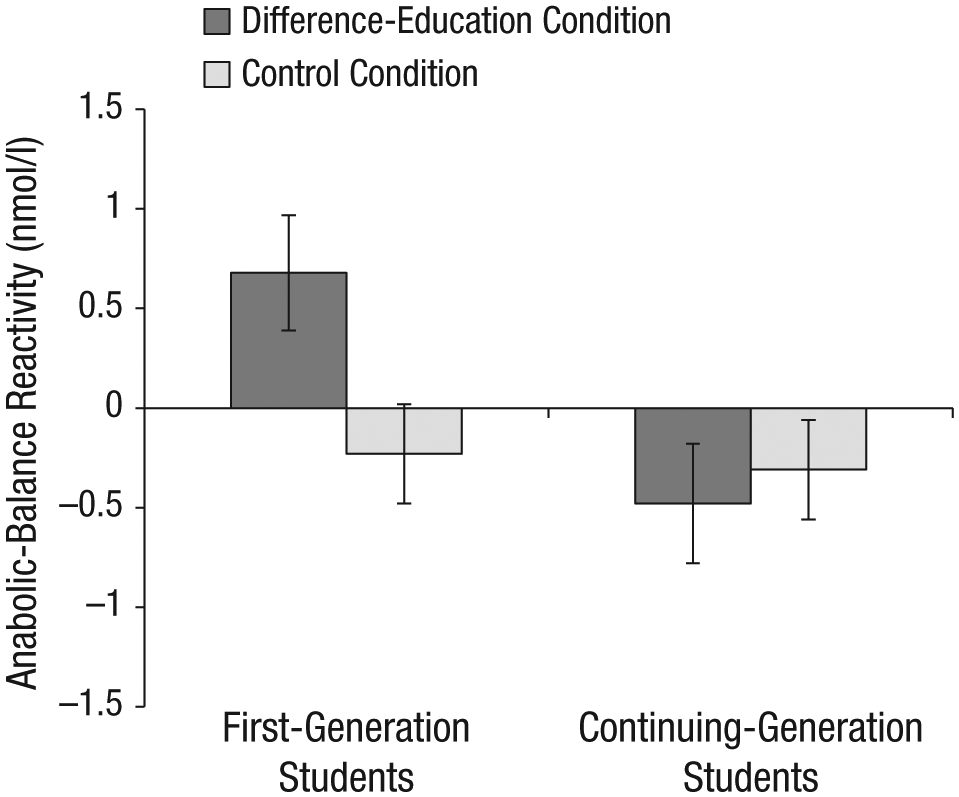
Anabolic-balance reactivity by generation status and intervention condition. Error bars represent ±1 SEM.
Continuing-generation students, in contrast, showed no differences in anabolic-balance reactivity across conditions (difference-education: M = −0.48, SE = 0.25; control: M = −0.31, SE = 0.25), F(1, 100) = 0.23, p = .63, η p 2 = .002, mean difference = −0.17, 95% CI for the difference = [−0.85, 0.52]. Additionally, in the difference-education condition, first-generation students showed higher anabolic-balance reactivity than continuing-generation students, F(1, 100) = 8.34, p = .005, η p 2 = .08, mean difference = 1.15, 95% CI for the difference = [0.36, 1.95]. However, in the control condition, first-generation and continuing-generation students did not differ, F(1, 100) = 0.05, p = .83, η p 2 = .000, mean difference = 0.08, 95% CI for the difference = [−0.70, 0.87] (see Fig. 1). 6
Subjective experience
We conducted a series of 2 (generation status: first generation vs. continuing generation) × 2 (condition: difference-education vs. control) ANCOVAs with the standard set of covariates to examine participants’ perceptions of the tasks as stressful, difficult, and motivating. For the three measures of subjective experience, we found neither a significant main effect of condition, all ps > .30, nor a significant Generation Status × Condition interaction, all ps > .47. Although the nonconscious measure of physiological thriving (i.e., anabolic-balance reactivity) showed the predicted pattern, participants’ perceptions of their stress did not. This lack of correspondence between nonconscious (e.g., physiological) and perceived (e.g., self-reported) responses is consistent with previous findings (Kirschbaum, Klauer, Filipp, & Hellhammer, 1995; Stephens, Townsend, Markus, & Phillips, 2012; Townsend, Major, Gangi, & Mendes, 2011) and with theories that these two classes of responses may serve different functions or index different aspects of experience (e.g., Mendes, Blascovich, Lickel, & Hunter, 2002). 7
Discussion
Nearly 2 years after a brief intervention that educated students about how social class can matter in college, we asked whether participants—in particular, those who were first-generation college students—were able to use and benefit from this difference-education framework to cope with stressful college situations. Our results for both behavioral and neuroendocrine measures suggest that the answer to this question is yes. First, we found that, overall, participants in the difference-education condition discussed their backgrounds in a speech more often than participants in the control condition. This outcome suggests that participants retained the difference-education framework and were able to use it to understand how their backgrounds influenced their college experiences. Second, we found that first-generation students in the difference-education condition showed more physiological thriving (i.e., higher anabolic-balance reactivity) than first-generation students in the control condition. This finding suggests that the difference-education framework equipped first-generation students to experience their working-class backgrounds as a strength and enabled them to thrive while they completed a series of stressful tasks.
Theoretical contributions
Although the results do not fully illuminate the cyclical nature of the recursive processes through which interventions are theorized to confer long-term benefits, they do suggest that such processes are quite likely and highly influential. Other studies have shown initial evidence of recursive processes by examining participants’ psychological responses soon after the intervention (Shnabel, Purdie-Vaughns, Cook, Garcia, & Cohen, 2013), measuring long-term psychological outcomes via self-report (e.g., self-doubt or belonging; Cook, Purdie-Vaughns, Garcia, & Cohen, 2012; Walton & Cohen, 2011), or assessing ongoing narrative accounts of experience (e.g., daily diaries; Sherman et al., 2013). However, evidence of the theorized recursive processes should also be observable over time and in specific situations that are relevant to the initial intervention. Thus, building on this previous research, we used a novel laboratory paradigm to capture how an intervention may shape students’ behavioral and psychological responses to specific situations that they may confront in college. Participants in the difference-education condition responded more effectively than control participants in response to the same stressful tasks. Specifically, those who had received the difference-education intervention more frequently acknowledged and discussed the significance of their backgrounds. Moreover, first-generation students in the difference-education condition showed more physiological thriving than first-generation students in the control condition. These results provide initial evidence that social psychological interventions initiate recursive processes that take hold and shape students’ psychological experiences over time.
The current study also contributes to the literature on the particular kinds of challenges that first-generation students commonly confront as they transition to college life (Covarrubias et al., 2015; Croizet & Claire, 1998; Housel & Harvey, 2009; Johnson, Richeson, & Finkel, 2011). Our results highlight the importance of improving first-generation students’ comfort with their working-class backgrounds as they participate in the middle-class context of higher education. Specifically, our results suggest that increasing first-generation students’ understanding of how their particular social-class backgrounds can influence their college experience enables them to draw on their backgrounds as a source of strength. Our findings also underscore the critical importance of helping first-generation students navigate the common experiences of home-school conflicts or “family guilt” (see Covarrubias & Fryberg, 2014). Finally, our study is also consistent with previous work showing that the pressure to assimilate to the mainstream middle-class culture by “covering,” or hiding meaningful identities, may exact a serious toll on students’ ability to cope with stress and their subsequent health outcomes (cf. Yoshino, 2007).
Limitations and future directions
Although our results generally supported our hypotheses, two findings warrant further discussion. First, we found that participants in the difference-education condition—both first-generation and continuing-generation—discussed their backgrounds in a speech more often than those in the control condition. We theorized that the difference-education framework equipped students with the understanding that they needed to respond to the speech prompt and acknowledge the significance of their backgrounds. Although we did not connect the follow-up lab study to the initial intervention, it is possible that participants linked the two research studies in their minds (e.g., both studies referenced incoming students). Moreover, the lab study prompted participants to use the difference-education framework by asking them to deliver a speech about how their backgrounds mattered. As a result, they could have been especially likely to use the difference-education framework. Future research should therefore investigate whether participants who have received the difference-education intervention spontaneously use the framework provided by the intervention in other situations that they normally encounter throughout their lives in college.
Second, although we predicted that first-generation students in the difference-education condition would show higher anabolic-balance reactivity than their counterparts in the control condition, we did not anticipate that first-generation students in the difference-education condition would have higher anabolic-balance reactivity than continuing-generation students in the difference-education condition. There are various reasons why this could have occurred. Prior research suggests that interdependence is central to first-generation students’ comfort, motivation, and academic performance in higher education (e.g., Stephens, Fryberg, Markus, Johnson, & Covarrubias, 2012; Stephens, Townsend, et al., 2012). Thus, given that the difference-education framework recognizes the interdependence of students’ current college experiences with their prior social contexts, it may be particularly meaningful to first-generation students and therefore likely to benefit them more than continuing-generation students. Another related possibility is that first-generation students may have been more comfortable than continuing-generation students with the interdependent nature of the speech task, which required them to connect the social contexts of their backgrounds to their college experience. Future research should consider how the congruence of students’ cultural norms, the difference-education framework, and types of academic tasks might affect students’ stress responses.
Conclusion
Social psychologists and intervention scientists have long theorized about how and why brief interventions can change individuals’ long-term trajectories and life outcomes. These effects are possible when interventions unleash recursive processes that unfold over time and systematically redirect how people would otherwise makes sense of their experiences and respond to specific situations that they encounter in their lives (cf. Wilson, 2011). For the first time, in a well-controlled laboratory study, we have provided behavioral and physiological evidence of the long-term influence of the recursive processes initiated by an intervention. Our results suggest that, as theorized, brief interventions do systematically alter how students respond over time to specific situations in the college context. For students disadvantaged by mainstream educational settings, these small changes to their default responses—for example, seeing their backgrounds as a strength—have great potential to improve their overall comfort in higher education and equip them with the tools that they need to thrive.
Footnotes

References
Supplementary Material
Please find the following supplemental material available below.
For Open Access articles published under a Creative Commons License, all supplemental material carries the same license as the article it is associated with.
For non-Open Access articles published, all supplemental material carries a non-exclusive license, and permission requests for re-use of supplemental material or any part of supplemental material shall be sent directly to the copyright owner as specified in the copyright notice associated with the article.
